


 |
市場調查報告書
商品編碼
2154516
泡菜液用化學品:市場佔有率分析、行業趨勢和統計數據、成長預測(2026-2031 年)Pickling Chemicals - Market Share Analysis, Industry Trends & Statistics, Growth Forecasts (2026 - 2031) |
||||||

※ 本網頁內容可能與最新版本有所差異。詳細情況請與我們聯繫。
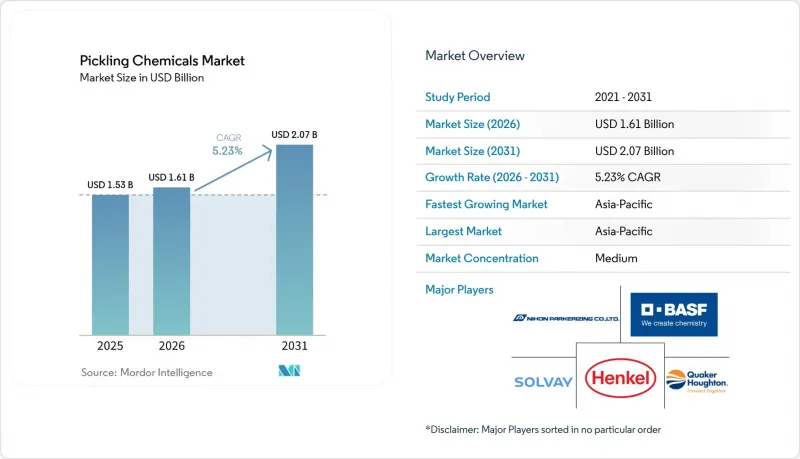
據 Mordor Intelligence 稱,酸洗化學品市場預計在 2025 年價值 15.3 億美元,預計在預測期(2026-2031 年)內將以 5.23% 的複合年成長率成長,從 2026 年的 16.1 億美元成長到 2031 億美元的 20.77 億美元。
全球酸洗化學品市場趨勢及洞察
擴大鋼材酸洗和表面處理能力。
對鋼鐵加工生產線的資本投資正在創造對酸洗化學品的短期需求。 2025年12月,John Cockerell報告稱,一項針對矽鋼酸洗廢酸的酸再生計畫已成功運作。酸再生技術能夠妥善管理廢水,同時維持表面處理所需的條件,即使在高產量生產線上也能實現。與通用鋼材相比,電工鋼板和高性能鋼材對酸洗停留時間、酸濃度和槽溫的容差要求更為嚴格。在這些生產線中,必須在軋製、塗層和其他下游製程之前可靠地去除氧化物。隨著加工商提高產能以滿足更高規格的要求,酸洗化學品市場對特種配方的需求也不斷成長。
對優質塗層鋼和高強度鋼的需求
汽車結構件中先進高抗張強度鋼的應用正在改變酸洗槽的要求。 2025年11月,世界汽車鋼鐵協會(WorldAutoSteel)修訂了其《先進高抗張強度鋼應用指南》,重點介紹了塗層高抗張強度鋼應用中行之有效的方法。矽合金鋼在熱軋過程中會形成富含二氧化矽的氧化皮,這種氧化皮比傳統的氧化鐵更難去除。加工商可能需要使用酸性促進劑或延長處理時間才能滿足表面品質要求。 2025年,塔塔鋼鐵荷蘭公司和大眾汽車集團報告稱,在用於汽車碰撞結構的第三代鍍鋅先進高強度鋼的研發方面取得了進展。隨著高等級鋼材的普及,高品質、合格表面處理的價值日益凸顯,酸洗化學品市場也將從中受益。
處理危險酸、廢水、遵守排放法規的相關成本。
管理危險酸會產生營運成本和資本投資,尤其是在嚴格監管的地區。歐盟《化學品註冊、評估、授權和限制法規》(REACH)已於2025年9月生效,該法規要求每年處理量超過10噸的註冊企業進行化學品安全評估。此閾值適用於許多工業酸洗製程。一份2026年北愛爾蘭金屬生產和加工化學品合規性報告記錄了33項輕微不合規情況,並發現有9家工廠的英國REACH文件已過期。用於不銹鋼加工的氫氟酸和硝酸系統需要嚴格的中和、金屬回收和廢水處理。這些要求可能會降低小規模化學酸洗的經濟效益。因此,酸洗化學品市場可能會越來越依賴能夠維護專用加工系統的大規模加工商。
細分市場分析
2025年,鹽酸在酸性酸洗劑市場中佔35.23%的佔有率。這一地位反映了其在碳鋼、鍍鋅鋼和矽鋼連續生產線上的廣泛應用。快速沖洗、酸洗速度快以及完善的再生設施為其大規模應用提供了支援。硫酸在不銹鋼條酸洗和鋁陽極氧化中仍然發揮著重要作用,尤其是在已配備廢酸處理系統的場所。硝酸和磷酸鹽配方用於航太領域和不銹鋼鈍化,在這些領域,OEM(目的地設備製造商)認證要求可能比投入成本更為重要。鹽和螯合劑能夠提高無機酸和有機酸系統的槽液穩定性、抑制腐蝕並促進鈍化。酸洗劑產業正朝著提高單位附加價值並同時維持較高鹽酸用量的配方方向發展。
預計2026年至2031年間,有機酸的複合年成長率將達到6.14%,在所有化學品類型中增速最高。這一成長主要受監管機構要求減少有害無機酸的使用以及有機酸技術性能的驗證所驅動。 2025年發表於《電化學學會雜誌》(Journal of the Electrochemical Society)的一項研究比較了七種用於航太合金AA2024-T3陽極氧化的有機酸電解,發現蘋果酸在所有測試的電解液中表現出最佳的阻隔膜性能。這一結果與航太領域的表面處理密切相關,因為無鉻化學處理正日益受到關注。此外,與強礦物酸相比,有機酸作為廢水更容易處理。封閉回路型處理所需的投資較低,使得小規模精密加工企業和特種塗料公司更容易採用有機酸。因此,儘管鹽酸基產品仍被廣泛使用,但酸洗化學品市場正逐漸轉向更專業的化學品。
區域分析
預計到2025年,亞太地區將佔據全球酸洗化學品市場46.47%的佔有率,並在2031年之前以5.87%的複合年成長率成長。該地區受益於鋼鐵加工、電子製造和汽車生產的擴張。中國、印度、日本、韓國和東協等國家都對市場需求做出了貢獻。基礎建設、鐵路網路擴張以及對汽車行業的投資,都支撐著該地區高於全球平均水平的需求。日本和韓國仍然是汽車和電子出口產業所用高規格化學品的重要來源國。此外,下游新增產能的擴張和相關資本投資也為亞太酸洗化學品市場的發展帶來了正面影響。
北美和歐洲分別構成第二和第三大需求支柱,但與亞太地區相比,這兩個地區的監管更為嚴格,生產驅動力也較弱。在北美,混合金屬汽車平台的需求催生了對鈦、鋯和有機官能基矽烷預處理的需求,此外,傳統的酸洗工藝也必不可少。電動車產量的擴張也增加了電池用銅箔加工和馬達零件預處理的需求。在歐洲,重點在於投資再生系統和環境改進,而非增加新的加工產能。塔爾伯特港的再生系統訂單表明,歐洲營運商可以在升級現有生產線的同時提高加工能力。歐盟的排放氣體和化學品法規有利於那些能夠提供低風險配方證明和合規支持的供應商。
南美洲、中東和非洲是酸洗化學品需求規模雖小但至關重要的地區。巴西和阿根廷已建立起使用鹽酸和硫酸系統的鋼板生產企業和汽車供應鏈。據世界鋼鐵協會稱,霍爾木茲海峽的緊張局勢導致航運中斷,使得中東鋼鐵需求在2026年萎縮。沙烏地阿拉伯的產業多元化以及海灣國家的基礎設施發展計畫預計在物流穩定後支撐需求復甦。金達爾不銹鋼公司已於2027會計年度運作了年產能110萬噸的熱軋、退火和酸洗生產線以及17萬噸的冷軋、退火和酸洗生產線。非洲的建設活動支撐著鋼鐵加工的需求,但該地區依賴進口特殊化合物產品。這種高度依賴性使得當地買家極易受到全球酸價和物流波動的影響。
其他好處:
- Excel格式的市場預測(ME)表
- 3個月的分析師支持
目錄
第1章:引言
- 研究假設和市場定義
- 調查範圍
第2章:調查方法
第3章執行摘要
第4章 市場狀況
- 市場概覽
- 市場促進因素
- 擴大鋼材酸洗和表面處理能力。
- 對優質塗層鋼和高強度鋼的需求
- 汽車、建築、航太和電子製造業的成長
- 酸再生和封閉回路型酸洗系統的引入
- 即時監控浴缸狀況並自動配藥。
- 針對特定用途的低煙、無硝酸鹽組合藥物
- 市場限制因素
- 與危險酸的處理、廢水處理和排放相關的合規成本
- 礦物酸和特殊添加劑的成本波動
- 其他方法包括機械清洗、拋光、雷射清洗和乾洗。
- 高性能合金和再生氧化領域的認知瓶頸。
- 價值鏈分析
- 波特五力分析
第5章 市場規模與成長預測
- 按類型
- 鹽酸
- 硫酸
- 硝酸和磷酸
- 有機酸
- 鹽和螯合劑
- 其他
- 透過使用
- 鋼鐵冶金
- 電鍍和金屬表面處理
- 金屬回收利用
- 電子和精密製造
- 食品/飲料加工
- 工業化學處理
- 其他
- 按地區
- 亞太地區
- 中國
- 印度
- 日本
- 韓國
- 東南亞國協
- 其他亞太國家
- 北美洲
- 美國
- 加拿大
- 墨西哥
- 歐洲
- 德國
- 英國
- 法國
- 義大利
- 北歐國家
- 其他歐洲國家
- 南美洲
- 巴西
- 阿根廷
- 其他南美國家
- 中東和非洲
- 沙烏地阿拉伯
- 南非
- 其他中東和非洲國家
- 亞太地區
第6章 競爭情勢
- 市場集中度
- 策略趨勢
- 市佔率和排名分析
- 公司簡介
- BASF
- Callington Group
- Chemtex Speciality Limited
- Columbia Chemical
- Crown Technology, Inc.
- Henkel AG & Co. KGaA
- Hubbard-Hall Inc.
- Nihon Parkerizing Co., Ltd.
- Novel Surface Treatments
- Quaker Houghton
- Solvay
- Surface Innovator LLP
- Surtec Suisse GmbH
- TIB Chemicals AG
- voestalpine Bohler Welding Group GmbH
第7章 市場機會與未來展望
According to Mordor Intelligence, the pickling chemicals market size was estimated at USD 1.53 billion in 2025 and is estimated to grow from USD 1.61 billion in 2026 to USD 2.07 billion by 2031, at a CAGR of 5.23% during the forecast period (2026-2031).
Global Pickling Chemicals Market Trends and Insights
Expansion of Steel Pickling and Surface-Treatment Capacity
Capital investment in steel processing lines is creating near-term demand for pickling chemicals. In December 2025, John Cockerill reported the successful operation of an acid regeneration project for silicon steel pickling waste acid. Acid regeneration allows high-throughput lines to manage waste streams while maintaining the conditions required for consistent surface treatment. Electrical steel and advanced grades require narrower operating ranges for dwell time, acid strength, and bath temperature than commodity grades. Such lines require reliable oxide removal before rolling, coating, and other downstream processes. This gives the pickling chemicals market greater exposure to specialty formulations as processors add higher-specification capacity.
Demand for Higher-Quality Coated and Advanced-Strength Steels
The use of advanced high-strength steel in automotive structures changes the requirements placed on pickling baths. In November 2025, WorldAutoSteel updated its Advanced High-Strength Steel Application Guidelines, emphasizing validated approaches for coated high-strength steel applications. Silicon-alloyed grades can form silica-rich scale during hot rolling, which is more difficult to remove than conventional iron oxide. Processors may need acid accelerators or longer treatment periods to meet surface-quality requirements. In 2025, Tata Steel Nederland and Volkswagen Group reported progress on third-generation advanced high-strength steel with zinc coating for automotive crash structures. The pickling chemicals market benefits when higher-grade steel increases the value of consistent, qualified surface treatment.
Hazardous-Acid Handling, Wastewater, and Emission Compliance Costs
Managing hazardous acids incurs operating and capital costs, particularly in more regulated regions. The consolidated September 2025 edition of the EU Registration, Evaluation, Authorization and Restriction of Chemicals (REACH) Regulation requires chemical safety assessments for registrants handling 10 or more tons of covered substances per year. This threshold applies to many industrial pickling operations. Northern Ireland's 2026 chemical compliance report for metal production and processing recorded 33 minor non-conformances and identified outdated UK REACH documentation at 9 sites. Hydrofluoric and nitric acid systems used in stainless steel processing require careful neutralization, metal recovery, and wastewater permitting. These obligations can reduce the economic viability of small-scale chemical pickling. The pickling chemicals market may, therefore, become more dependent on larger processors capable of supporting dedicated treatment systems.
Other drivers and restraints analyzed in the detailed report include:
- Growth of Automotive, Construction, Aerospace, and Electronics Manufacturing
- Adoption of Acid Regeneration and Closed-Loop Pickling Systems
- Volatility in Mineral-Acid and Specialty-Additive Costs
For complete list of drivers and restraints, kindly check the Table Of Contents.
Segment Analysis
Hydrochloric acid held 35.23% of the pickling chemicals market share in the type segment in 2025. Its position reflects widespread use in continuous lines for carbon steel, galvanized steel, and silicon steel. Fast rinsing, pickling speed, and established regeneration equipment support its use at scale. Sulfuric acid remains important for stainless steel strip pickling and aluminum anodizing, particularly where spent-acid handling systems are already in place. Nitric and phosphoric acid formulations are used in aerospace and stainless steel passivation, where original equipment manufacturer qualification requirements can matter more than input cost. Salts and chelating agents support bath stability, inhibition, and passivation across mineral-acid and organic systems. The pickling chemicals industry is shifting toward formulations that deliver higher value per unit while retaining substantial quantities of hydrochloric acid.
Organic acids are forecast to expand at a 6.14% CAGR from 2026 to 2031, the fastest rate among chemical types. Regulatory pressure to reduce hazardous mineral-acid use and evidence of technical performance support this growth. A 2025 study in the Journal of The Electrochemical Society compared seven organic acid electrolytes for AA2024-T3 aerospace alloy anodization and found that malic acid produced the highest barrier-film properties among the candidates tested. This result is relevant to aerospace surface treatment, where chromium-free chemistry is receiving greater attention. Organic acids can also offer simpler spent-liquor disposal than strong mineral acids. Their lower closed-loop investment requirement can make them more accessible to smaller precision finishers and specialty coating operations. This supports a gradual shift in the pickling chemicals market toward more specialized chemistry, even as high-quantity hydrochloric acid lines remain established.
Complete Report Scope:
- By Type
- Hydrochloric Acid
- Sulfuric Acid
- Nitric and Phosphoric Acids
- Organic Acids
- Salts and Chelating Agents
- Others
- By Application
- Steel and Metallurgy
- Electroplating and Metal Finishing
- Metal Recycling and Recovery
- Electronics and Precision Manufacturing
- Food and Beverage Processing
- Industrial Chemical Processing
- Others
- By Geography
- Asia-Pacific
- China
- India
- Japan
- South Korea
- ASEAN Countries
- Rest of Asia-Pacific
- North America
- United States
- Canada
- Mexico
- Europe
- Germany
- United Kingdom
- France
- Italy
- NORDIC Countries
- Rest of Europe
- South America
- Brazil
- Argentina
- Rest of South America
- Middle East and Africa
- Saudi Arabia
- South Africa
- Rest of Middle East and Africa
- Asia-Pacific
Geography Analysis
Asia-Pacific held 46.47% of the pickling chemicals market share in 2025 and is forecast to grow at a 5.87% CAGR through 2031. The region benefits from the expansion of steel processing, electronics manufacturing, and automotive production. China, India, Japan, South Korea, and the Association of Southeast Asian Nations all contribute to demand. Infrastructure construction, rail expansion, and automotive investment support demand above the global average. Japan and South Korea remain important sources of high-specification chemistries used in the automotive and electronics export industries. The pickling chemicals market in Asia-Pacific also benefits from new downstream capacity and related investments in equipment.
North America and Europe form the second and third demand pillars, although both are more regulated and less output-driven than the Asia-Pacific. In North America, mixed-metal vehicle platforms create demand for titanium, zirconium, and organo-functional silane pretreatments alongside conventional acid pickling. Electric vehicle production is also increasing the requirements for battery copper foil treatment and electric motor component preparation. In Europe, investment is focused more on regeneration systems and environmental improvement than on greenfield processing capacity. The Port Talbot regeneration order demonstrates how European operators can upgrade existing lines while increasing throughput. EU emissions and chemical regulations favor suppliers that can provide documented low-hazard formulations and compliance support.
South America, the Middle East, and Africa are smaller but relevant demand areas for the pickling chemicals market. Brazil and Argentina have established flat-steel producers and automotive supply chains that use hydrochloric and sulfuric acid systems. Middle East steel demand contracted in 2026 amid shipping disruption linked to Strait of Hormuz tensions, according to the World Steel Association. Saudi Arabian industrial diversification and Gulf infrastructure programs can support recovery when logistics stabilize. Jindal Stainless commissioned 1.1 million tons per annum (MTPA) of hot-rolled annealed and pickled capacity and 0.17 MTPA of cold-rolled annealed and pickled capacity for FY27. African construction activity supports demand for steel processing, but the region depends on imported specialty formulations. This reliance exposes local buyers to global acid prices and logistics conditions.
- BASF
- Callington Group
- Chemtex Speciality Limited
- Columbia Chemical
- Crown Technology, Inc.
- Henkel AG & Co. KGaA
- Hubbard-Hall Inc.
- Nihon Parkerizing Co., Ltd.
- Novel Surface Treatments
- Quaker Houghton
- Solvay
- Surface Innovators LLP
- Surtec Suisse GmbH
- TIB Chemicals AG
- voestalpine Bohler Welding Group GmbH
Additional Benefits:
- The market estimate (ME) sheet in Excel format
- 3 months of analyst support
TABLE OF CONTENTS
1 Introduction
- 1.1 Study Assumptions and Market Definition
- 1.2 Scope of the Study
2 Research Methodology
3 Executive Summary
4 Market Landscape
- 4.1 Market Overview
- 4.2 Market Drivers
- 4.2.1 Expansion of Steel Pickling and Surface-Treatment Capacity
- 4.2.2 Demand for Higher-Quality Coated and Advanced-Strength Steels
- 4.2.3 Growth of Automotive, Construction, Aerospace, and Electronics Manufacturing
- 4.2.4 Adoption of Acid Regeneration and Closed-Loop Pickling Systems
- 4.2.5 Real-Time Bath Monitoring and Automated Chemical Dosing
- 4.2.6 Application-Specific Low-Fume and Nitric-Acid-Free Formulations
- 4.3 Market Restraints
- 4.3.1 Hazardous-Acid Handling, Wastewater, and Emission Compliance Costs
- 4.3.2 Volatility in Mineral-Acid and Specialty-Additive Costs
- 4.3.3 Substitution by Mechanical, Abrasive, Laser, and Dry-Cleaning Technologies
- 4.3.4 Qualification Bottlenecks for Advanced Alloys and Regenerated-Acid Chemistries
- 4.4 Value Chain Analysis
- 4.5 Porter's Five Forces Analysis
- 4.5.1 Threat of New Entrants
- 4.5.2 Bargaining Power of Suppliers
- 4.5.3 Bargaining Power of Buyers
- 4.5.4 Threat of Substitutes
- 4.5.5 Competitive Rivalry
5 Market Size and Growth Forecasts (Value)
- 5.1 By Type
- 5.1.1 Hydrochloric Acid
- 5.1.2 Sulfuric Acid
- 5.1.3 Nitric and Phosphoric Acids
- 5.1.4 Organic Acids
- 5.1.5 Salts and Chelating Agents
- 5.1.6 Others
- 5.2 By Application
- 5.2.1 Steel and Metallurgy
- 5.2.2 Electroplating and Metal Finishing
- 5.2.3 Metal Recycling and Recovery
- 5.2.4 Electronics and Precision Manufacturing
- 5.2.5 Food and Beverage Processing
- 5.2.6 Industrial Chemical Processing
- 5.2.7 Others
- 5.3 By Geography
- 5.3.1 Asia-Pacific
- 5.3.1.1 China
- 5.3.1.2 India
- 5.3.1.3 Japan
- 5.3.1.4 South Korea
- 5.3.1.5 ASEAN Countries
- 5.3.1.6 Rest of Asia-Pacific
- 5.3.2 North America
- 5.3.2.1 United States
- 5.3.2.2 Canada
- 5.3.2.3 Mexico
- 5.3.3 Europe
- 5.3.3.1 Germany
- 5.3.3.2 United Kingdom
- 5.3.3.3 France
- 5.3.3.4 Italy
- 5.3.3.5 NORDIC Countries
- 5.3.3.6 Rest of Europe
- 5.3.4 South America
- 5.3.4.1 Brazil
- 5.3.4.2 Argentina
- 5.3.4.3 Rest of South America
- 5.3.5 Middle East and Africa
- 5.3.5.1 Saudi Arabia
- 5.3.5.2 South Africa
- 5.3.5.3 Rest of Middle East and Africa
- 5.3.1 Asia-Pacific
6 Competitive Landscape
- 6.1 Market Concentration
- 6.2 Strategic Moves
- 6.3 Market Share (%)/Ranking Analysis
- 6.4 Company Profiles (includes Global Overview, Market Overview, Core Segments, Financials as available, Strategic Information, Products and Services, and Recent Developments)
- 6.4.1 BASF
- 6.4.2 Callington Group
- 6.4.3 Chemtex Speciality Limited
- 6.4.4 Columbia Chemical
- 6.4.5 Crown Technology, Inc.
- 6.4.6 Henkel AG & Co. KGaA
- 6.4.7 Hubbard-Hall Inc.
- 6.4.8 Nihon Parkerizing Co., Ltd.
- 6.4.9 Novel Surface Treatments
- 6.4.10 Quaker Houghton
- 6.4.11 Solvay
- 6.4.12 Surface Innovators LLP
- 6.4.13 Surtec Suisse GmbH
- 6.4.14 TIB Chemicals AG
- 6.4.15 voestalpine Bohler Welding Group GmbH
7 Market Opportunities and Future Outlook
- 7.1 White-Space and Unmet-Need Assessment

 酸洗化學品市場:依產品類型、應用、形態、國家及地區分類-全球產業分析、市場規模、市場佔有率及2026年至2033年預測
 奈米塗層和防腐蝕表面處理解決方案市場預測至2034年—按塗層類型、基材、應用、最終用戶和地區分類的全球分析功能性表面處理化學品市場報告:趨勢、預測和競爭分析(至2035年)
 表面改質化學品:市場佔有率分析、產業趨勢與統計、成長預測(2026-2031)鈍化化學品:市場佔有率分析、行業趨勢和統計數據、成長預測(2026-2031 年)
 表面處理市場機會、成長要素、產業趨勢分析及2026-2035年預測。表面處理化學品:市場佔有率分析、產業趨勢及統計、成長預測(2026-2031)表面處理和電鍍市場預測至2034年-按製程類型、材料、基材、應用、最終用戶和地區分類的全球分析表面處理化學品市場:依產品類型、基材、應用、最終用途產業、國家及地區分類-全球產業分析、市場規模、市場佔有率及2026年至2033年預測
 混凝土表面處理化學品市場:全球市場按產品類型、化學成分、形態、技術和應用進行預測,2026-2032年