


 |
市場調查報告書
商品編碼
2125593
表面處理化學品:市場佔有率分析、產業趨勢及統計、成長預測(2026-2031)Surface Treatment Chemicals - Market Share Analysis, Industry Trends & Statistics, Growth Forecasts (2026 - 2031) |
||||||

※ 本網頁內容可能與最新版本有所差異。詳細情況請與我們聯繫。
據 Mordor Intelligence 稱,2025 年表面處理化學品市場規模為 47.8 億美元,預計到 2031 年將達到 70.6 億美元,而 2026 年為 51 億美元,預測期(2026-2031 年)複合年成長率為 6.72%。
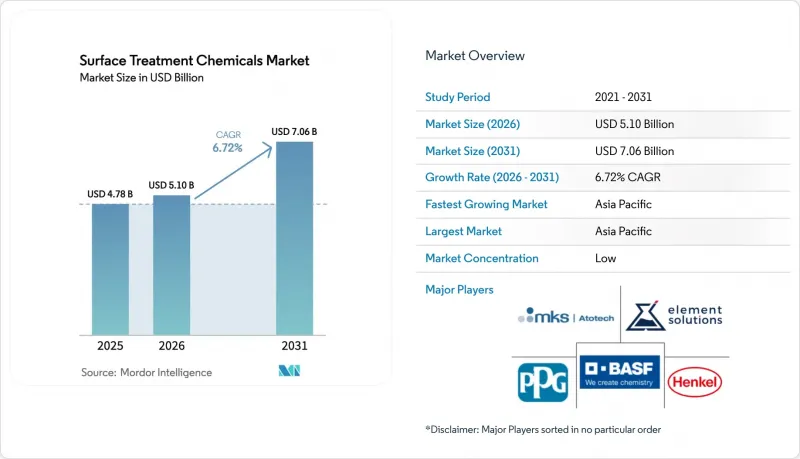
本報告按化學品類型(清潔劑、化學塗料、陽極氧化化學品及其他)、基材(金屬、塑膠及其他基材)、終端用戶產業(汽車及運輸設備、建築、電子、工業機械及其他)及地區(亞太地區、北美地區及其他)進行細分。市場預測以美元計價。
全球表面處理化學品市場趨勢及洞察
亞洲汽車製造業快速擴張
2024年,中國向市場推出了大量汽車,其中包括許多新能源汽車。產量激增導致預處理生產線上車身材料迅速從鋼製轉向鋁製。同時,印度的FAME舉措旨在2030年實現顯著的電動車年銷量。實現這一目標需要提高電池托盤和馬達外殼化學塗料的產能。 2024年,東南亞國協吸引了對汽車和電子工廠的新投資,增加了對在地採購化學品的需求。隨著產業朝向多材料車身結構發展,鋯塗層的使用量顯著增加,它不僅提供與磷酸鹽塗層相當的防腐蝕性能,也避免了磷酸鹽污泥的缺點。與區域OEM實驗室合作開發化學品的供應商正在鞏固其作為首選供應商的地位。
電子設備的微型化正在推動對高精度電鍍的需求。
2024年,台積電的先進封裝業務實現成長,這主要得益於對銅TSV和微凸塊電鍍的需求,這兩項技術均要求均勻性優於10奈米。同時,三星的3D整合策略以鎳金合金和銅錫合金的應用為核心,旨在防止高電流線路中出現空洞。每片晶圓電鍍面積的顯著增加,導致對抑制劑、整平機和增亮劑的需求激增。然而,隨著歐盟針對常用界面活性劑的PFAS法規即將生效,各代工廠必須在2027年截止日期前完成添加劑的重組。因此,晶圓代工廠正在尋找擁有成熟的無PFAS系統和線上槽液分析能力的供應商,以監測有機物的分解情況。
加強對六價鉻的監管
歐盟的REACH法規將於2026年到期,其中已指定了12種六價鉻鹽。此舉迫使航太、國防和重型機械行業的公司重新認證符合ASTM B117標準的替代品,這一過程需要18至24個月。同時,美國環保署(EPA)計劃將某些六價鉻化合物列為有害空氣污染物。這項分類將要求持續監測,並可能在各地消耗大量資源。在加州,根據65號提案,消費者警告標籤現已成為強制性要求,這導致一些家用電器製造商將電鍍流程轉移到海外。雖然三價鉻的耐磨性較差,但採用矽烷偶合劑的高銅鋁鋯基體系表明,在特殊應用領域,對六價鉻工藝的需求仍然強勁。
細分市場分析
化學塗層仍然是汽車和消費性電子產品領域的主要黏合促進劑,預計到2025年將佔表面處理化學品市場42.45%的佔有率。清潔劑市場預計到2031年將以7.12%的複合年成長率成長,這主要得益於塗覆有傳統潤滑劑的再生鋁原料的供應。在電子業,由於高鹼性腐蝕銅線的風險,酸性清潔劑的使用正在增加。表面處理化學品市場規模雖小規模但發展強勁,這主要得益於建築覆層和智慧型機殼對II型可著色氧化物的需求。
在電動車組裝線上,鋯基化學品正被取代磷酸鐵浴,以降低沖洗溫度並減少污泥產生。BASF的「Gardobond」和Chemetall的「Oxsilan」系列產品可在室溫下進行處理,有助於減少廢水排放量。清潔劑的需求正受益於循環經濟的趨勢。特斯拉的4680個回收鋁罐在陽極氧化前要經過三道清洗工序,因此預計需求將會增加。硬質陽極氧化建築面板,例如阿布達比盧浮宮的染色青銅外牆面板,顯示高階設計使陽極氧化化學品保持在高利潤的細分市場中。
區域分析
到2025年,亞太地區將佔據表面處理化學品市場42.95%的佔有率,預計到2031年將以7.05%的年均成長率成長。中國對反相塗層的需求激增,主要受新能源汽車的推動;而印度雄心勃勃的半導體產業舉措也帶動了對新增電鍍生產線的需求。 2024年,東協對汽車和電子工廠的吸引力日益增強,鞏固了其作為在地採購叢集中心的地位。同時,日本和韓國雖然為半導體材料提供了高純度特殊產品,但由於汽車製造業已趨於成熟,其絕對成長受到限制。 2025年初,區域內鋯前置作業時間供應短缺,交貨週期延長,促使原始設備製造商(OEM)採取雙重採購策略。
北美地區佔據了相當大的銷售佔有率。該地區對電動車 (EV) 的重視得益於《通貨膨脹抑制法案》,該法案刺激了對電動車和電池工廠的大規模投資。這股熱潮促使密西根州、俄亥俄州、田納西州和喬治亞等州新建了預處理生產線。 2024 年,受特斯拉在蒙特雷和寶馬在聖路易斯波托西的佈局推動,墨西哥推出了新的汽車市場,展現了其汽車產業的實力。汽車產業的繁榮隨後帶動了更環保的電鍍解決方案的銷售。然而,加州第 1469 號規則(草案)帶來了挑戰,可能迫使一些代工製造商改用三價鉻,甚至完全停產。這可能會在短期內降低產量,但可能會使遵守新規定的供應商受益。此外,人手不足也進一步加劇了運轉率的壓力。
歐洲在2025年的支出中佔了相當大的佔有率。英國離岸風力發電計畫已取得關鍵里程碑進展,並且正在規劃雄心勃勃的計畫。隨著這些項目的擴張,C5-M塗層系統在亨伯賽德造船廠的應用變得至關重要。儘管面臨能源價格飆升的挑戰,德國的汽車組裝仍在穩步推進,其中電池式電動車(BEV)佔據了相當大的佔有率。法國空中巴士公司正在擴大A320neo的生產,但供應鏈中斷阻礙了相關化學品的需求。南歐正利用太陽能板玻璃的加工技術,開拓出屬於自己的利基市場。同時,在巴西汽車生產和沙烏地阿拉伯下游計畫的推動下,南美洲以及中東和非洲地區也正在為市場做出貢獻。
其他好處:
- Excel格式的市場預測(ME)表
- 3個月的分析師支持
目錄
第1章:引言
- 市場分析與定義的前提條件
- 分析範圍
第2章 分析方法
第3章執行摘要
第4章 市場狀況
- 市場概覽
- 市場促進因素
- 亞洲汽車製造業快速擴張
- 電子設備的微型化推動了對高精度電鍍的需求。
- 風力渦輪機塔架的嚴格耐腐蝕標準
- 現場3D列印的金屬零件,列印後需進行表面處理。
- 電動車平台中鋁材用量的激增,使得多金屬清潔劑的需求日益成長。
- 市場限制因素
- 加強對六價鉻的監管
- 生物基塗料的普及性降低了對傳統化學產品的需求。
- 我們內部金屬表面處理生產線的總擁有成本 (TCO) 不斷上升。
- 價值鏈分析
- 波特五力模型
第5章:預測市場規模與成長率
- 依化學物質類型
- 清潔劑
- 化學塗層
- 陽極處理化學品
- 其他類型的化學品
- 按基礎材料
- 金屬
- 塑膠
- 其他基材(玻璃、合金、木材)
- 按最終用戶行業分類
- 汽車和運輸機械
- 建造
- 電子設備
- 工業機械
- 其他(石油和天然氣管道、發電、軍事、包裝等)
- 地區
- 亞太地區
- 中國
- 印度
- 日本
- 韓國
- ASEAN
- 其他亞太國家
- 北美洲
- 美國
- 加拿大
- 墨西哥
- 歐洲
- 德國
- 英國
- 法國
- 義大利
- 西班牙
- 俄羅斯
- 其他歐洲國家
- 南美洲
- 巴西
- 阿根廷
- 其他南美國家
- 中東和非洲
- 沙烏地阿拉伯
- 南非
- 其他中東和非洲國家
- 亞太地區
第6章 競爭情勢
- 市場集中度
- 策略趨勢
- 市佔率和排名分析
- 公司簡介
- Aalberts Surface Technologies GmbH
- ALANOD GmbH and Co. KG
- Asterion LLC
- BASF
- Bulk Chemicals Inc.
- ChemTech Surface Finishing Pvt. Ltd.
- Dow
- Element Solutions Inc
- Henkel AG and Co. KGaA
- MKS|Atotech
- Nihon Parkerizing Co., Ltd.
- Nippon Paint Holdings Co. Ltd.
- OC Oerlikon Management AG
- PPG Industries, Inc.
- Quaker Chemical Corporation
- The Sherwin-Williams Company
- YUKEN INDUSTRY CO.,LTD.
第7章 市場機會與未來展望
According to Mordor Intelligence, the surface treatment chemicals market size was valued at USD 4.78 billion in 2025 and is estimated to grow from USD 5.10 billion in 2026 to reach USD 7.06 billion by 2031, at a CAGR of 6.72% during the forecast period (2026-2031).
This report is Segmented by Chemical Type (Cleaner, Chemical Conversion Coating, Anodizing Chemicals, and Other Types), Base Material (Metal, Plastic, and Other Base Materials), End-User Industry (Automotive and Transportation, Construction, Electronics, Industrial Machinery, and Others), and Geography (Asia-Pacific, North America, and More). Market Forecasts are Provided in Terms of Value (USD).
Global Surface Treatment Chemicals Market Trends and Insights
Rapid Expansion of Automotive Production in Asia
In 2024, China rolled out vehicles, with many being new-energy units. This surge in production has led pretreatment lines to swiftly alternate between steel and aluminum bodies. Meanwhile, India's FAME initiative aims for significant annual EV sales by 2030. This ambition necessitates an increase in conversion-coating capacity for battery trays and motor housings. In 2024, ASEAN attracted fresh investments for automotive and electronics plants, heightening the demand for localized chemical supplies. As the industry pivots towards multi-material body structures, there's a notable shift to zirconium coatings, which offer comparable corrosion protection without the downsides of phosphate sludge. Suppliers collaborating with regional OEM labs to co-develop chemistries are securing a coveted preferred-vendor status.
Electronics Miniaturization Demanding High-Precision Plating
In 2024, TSMC's advanced packaging revenue grew, fueled by the demand for copper TSV and micro-bump plating, both requiring sub-10 nm uniformity. Meanwhile, Samsung's 3D integration strategy is anchored on using nickel-gold and copper-tin alloys, a move aimed at preventing voids in high-current lines. With the plated surface area per wafer having significantly increased, there's a corresponding surge in demand for suppressors, levelers, and brighteners. However, looming EU PFAS restrictions on common surfactants are pushing for additive reformulations ahead of the 2027 deadline. As a result, foundries are on the lookout for suppliers boasting proven PFAS-free systems and inline bath analytics to monitor organic breakdown.
Regulatory Clamp-Down on Hexavalent Chromium
With sunset windows closing in 2026, the EU REACH has flagged 12 hexavalent chromium salts. This move compels players in aerospace, defense, and heavy equipment to requalify alternatives that align with ASTM B117 cycles, a task stretching over 18-24 months. Meanwhile, the U.S. EPA is set to designate specific Cr(VI) compounds as hazardous air pollutants. This classification mandates continuous monitoring, a process that could drain significant resources for each site. In California, under Proposition 65, consumer-warning labels are now a requirement, leading appliance manufacturers to shift their plating processes overseas. While trivalent chromium falls short on abrasion resistance, zirconium systems, reliant on silane coupling agents for high-copper aluminum, underscore the enduring demand for hexavalent processes in specialized applications.
Other drivers and restraints analyzed in the detailed report include:
- Stringent Anti-Corrosion Standards in Wind-Turbine Towers
- On-Site 3D-Printed Metal Parts Requiring Post-Print Surface Prep
- Shift Toward Bio-Based Coatings Reduces Legacy Chemical Demand
For complete list of drivers and restraints, kindly check the Table Of Contents.
Segment Analysis
Conversion coatings captured 42.45% of the surface treatment chemicals market share in 2025 as they remain the principal adhesion promoter for automotive and appliance lines. Cleaners are projected to deliver a 7.12% CAGR to 2031, reflecting recycled-aluminum feedstocks that arrive coated with legacy lubricants. Acidic cleaners gain traction in electronics because high alkalinity can undercut copper traces. The surface treatment chemicals market size for anodizing chemicals remains modest yet resilient, supported by architectural cladding and smartphone housings that demand Type II colorable oxides.
Zirconium formulations are replacing iron-phosphate baths on EV assembly lines, lowering rinse temperatures and sludge. BASF's Gardobond and Chemetall's Oxsilan series run at room temperature and cut wastewater. Cleaner demand rides the circular-economy trend; Tesla's 4680 recycled-aluminum cans pass through three cleaning stages before anodizing, underscoring volume upside. Hard-anodized architectural panels, such as the Louvre Abu Dhabi's dyed bronze cladding, illustrate how premium design keeps anodizing chemicals in high-margin niches.
Complete Report Scope:
- By Chemical Type
- Cleaner
- Chemical Conversion Coating
- Anodizing Chemicals
- Other Types of Chemicals
- By Base Material
- Metal
- Plastic
- Other Base Materials (Glass, Alloys, Wood)
- By End-User Industry
- Automotive and Transportation
- Construction
- Electronics
- Industrial Machinery
- Others (Oil and Gas Pipeline, Power, Military, Packaging, etc.)
- Geography
- Asia-Pacific
- China
- India
- Japan
- South Korea
- ASEAN
- Rest of Asia-Pacific
- North America
- United States
- Canada
- Mexico
- Europe
- Germany
- United Kingdom
- France
- Italy
- Spain
- Russia
- Rest of Europe
- South America
- Brazil
- Argentina
- Rest of South America
- Middle-East and Africa
- Saudi Arabia
- South Africa
- Rest of Middle-East and Africa
- Asia-Pacific
Geography Analysis
Asia-Pacific accounted for 42.95% of the 2025 surface treatment chemicals market share and is growing at 7.05% through 2031. China's burgeoning demand for conversion coatings is driven by its new-energy vehicles, while India's ambitious semiconductor initiative is fueling the need for additional electroplating lines. In 2024, ASEAN's allure for auto and electronics plants solidified its status as a hub for localized supply clusters. Meanwhile, Japan and South Korea, while contributing high-purity niche volumes for semiconductor materials, face limitations on absolute growth due to their already mature automotive outputs. Early 2025 witnessed regional shortages of zirconium precursors, leading to stretched lead times and prompting OEMs to adopt a dual-sourcing strategy.
North America commands a significant revenue share. The region's commitment to electric vehicles (EVs) is underscored by the Inflation Reduction Act, which catalyzed a substantial investment in EV and battery plants. This surge has led to the establishment of new pretreatment lines across states like Michigan, Ohio, Tennessee, and Georgia. In 2024, Mexico's automotive prowess was evident as it rolled out vehicles, bolstered by the presence of Tesla in Monterey and BMW in San Luis Potosi. This automotive boom has subsequently driven sales in cleaner and electro-coating solutions. However, California's draft Rule 1469 poses challenges, potentially compelling a portion of job shops to pivot to trivalent chromium or cease operations altogether. While this may dampen near-term volumes, it could benefit suppliers who align with the new regulations. Additionally, labor shortages are further constraining capacity utilization.
Europe accounted for a notable share of the spending in 2025. The UK's offshore wind initiatives have surpassed significant milestones, with ambitious projects in the pipeline. This expansion necessitates the use of C5-M coating systems at the Humberside yards. Despite facing energy-price challenges, Germany successfully assembled vehicles, with a commendable share being battery electric vehicles (BEVs). France's Airbus is ramping up its A320neo output, but supply chain snags are hindering the corresponding chemical demand. Southern Europe is carving out a niche, benefiting from treatments for solar-panel glass. Meanwhile, both South America and the Middle-East Africa regions contribute to the market, with Brazil's production of vehicles and downstream projects in Saudi Arabia leading the charge.
- Aalberts Surface Technologies GmbH
- ALANOD GmbH and Co. KG
- Asterion LLC
- BASF
- Bulk Chemicals Inc.
- ChemTech Surface Finishing Pvt. Ltd.
- Dow
- Element Solutions Inc
- Henkel AG and Co. KGaA
- MKS | Atotech
- Nihon Parkerizing Co., Ltd.
- Nippon Paint Holdings Co. Ltd.
- OC Oerlikon Management AG
- PPG Industries, Inc.
- Quaker Chemical Corporation
- The Sherwin-Williams Company
- YUKEN INDUSTRY CO.,LTD.
Additional Benefits:
- The market estimate (ME) sheet in Excel format
- 3 months of analyst support
TABLE OF CONTENTS
1 Introduction
- 1.1 Study Assumptions and Market Definition
- 1.2 Scope of the Study
2 Research Methodology
3 Executive Summary
4 Market Landscape
- 4.1 Market Overview
- 4.2 Market Drivers
- 4.2.1 Rapid Expansion of Automotive Production in Asia
- 4.2.2 Electronics Miniaturisation Demanding High-Precision Plating
- 4.2.3 Stringent Anti-Corrosion Standards in Wind-Turbine Towers
- 4.2.4 On-Site 3D-Printed Metal Parts Requiring Post-Print Surface Prep
- 4.2.5 Surge in Aluminium Use in EV Platforms Necessitating Multi-Metal Cleaners
- 4.3 Market Restraints
- 4.3.1 Regulatory Clamp-Down on Hexavalent Chromium
- 4.3.2 Shift Toward Bio-Based Coatings Reduces Legacy Chemical Demand
- 4.3.3 Rising Total-Cost-of-Ownership of Captive Metal Finishing Lines
- 4.4 Value Chain Analysis
- 4.5 Porter's Five Forces
- 4.5.1 Bargaining Power of Suppliers
- 4.5.2 Bargaining Power of Buyers
- 4.5.3 Threat of New Entrants
- 4.5.4 Threat of Substitutes
- 4.5.5 Degree of Competition
5 Market Size and Growth Forecasts (Value)
- 5.1 By Chemical Type
- 5.1.1 Cleaner
- 5.1.2 Chemical Conversion Coating
- 5.1.3 Anodizing Chemicals
- 5.1.4 Other Types of Chemicals
- 5.2 By Base Material
- 5.2.1 Metal
- 5.2.2 Plastic
- 5.2.3 Other Base Materials (Glass, Alloys, Wood)
- 5.3 By End-User Industry
- 5.3.1 Automotive and Transportation
- 5.3.2 Construction
- 5.3.3 Electronics
- 5.3.4 Industrial Machinery
- 5.3.5 Others (Oil and Gas Pipeline, Power, Military, Packaging, etc.)
- 5.4 Geography
- 5.4.1 Asia-Pacific
- 5.4.1.1 China
- 5.4.1.2 India
- 5.4.1.3 Japan
- 5.4.1.4 South Korea
- 5.4.1.5 ASEAN
- 5.4.1.6 Rest of Asia-Pacific
- 5.4.2 North America
- 5.4.2.1 United States
- 5.4.2.2 Canada
- 5.4.2.3 Mexico
- 5.4.3 Europe
- 5.4.3.1 Germany
- 5.4.3.2 United Kingdom
- 5.4.3.3 France
- 5.4.3.4 Italy
- 5.4.3.5 Spain
- 5.4.3.6 Russia
- 5.4.3.7 Rest of Europe
- 5.4.4 South America
- 5.4.4.1 Brazil
- 5.4.4.2 Argentina
- 5.4.4.3 Rest of South America
- 5.4.5 Middle-East and Africa
- 5.4.5.1 Saudi Arabia
- 5.4.5.2 South Africa
- 5.4.5.3 Rest of Middle-East and Africa
- 5.4.1 Asia-Pacific
6 Competitive Landscape
- 6.1 Market Concentration
- 6.2 Strategic Moves
- 6.3 Market Share(%)/Ranking Analysis
- 6.4 Company Profiles (includes Global Overview, Market Overview, Core Segments, Financials, Strategic Information, Products and Services, Recent Developments)
- 6.4.1 Aalberts Surface Technologies GmbH
- 6.4.2 ALANOD GmbH and Co. KG
- 6.4.3 Asterion LLC
- 6.4.4 BASF
- 6.4.5 Bulk Chemicals Inc.
- 6.4.6 ChemTech Surface Finishing Pvt. Ltd.
- 6.4.7 Dow
- 6.4.8 Element Solutions Inc
- 6.4.9 Henkel AG and Co. KGaA
- 6.4.10 MKS | Atotech
- 6.4.11 Nihon Parkerizing Co., Ltd.
- 6.4.12 Nippon Paint Holdings Co. Ltd.
- 6.4.13 OC Oerlikon Management AG
- 6.4.14 PPG Industries, Inc.
- 6.4.15 Quaker Chemical Corporation
- 6.4.16 The Sherwin-Williams Company
- 6.4.17 YUKEN INDUSTRY CO.,LTD.
7 Market Opportunities and Future Outlook
- 7.1 White-space and Unmet-Need Assessment

 表面處理和電鍍市場預測至2034年-按製程類型、材料、基材、應用、最終用戶和地區分類的全球分析
 表面處理化學品市場:依產品類型、基材、應用、最終用途產業、國家及地區分類-全球產業分析、市場規模、市場佔有率及2026年至2033年預測
 混凝土表面處理化學品市場:全球市場按產品類型、化學成分、形態、技術和應用進行預測,2026-2032年
 全球成品生產線市場規模、佔有率、趨勢及成長分析報告(2026-2034)全球表面處理化學品市場,2025-2032年表面處理化學品市場預測至2034年-全球產品類型、化學品類型、基礎化學、製程類型、基材、應用和區域分析
 酸洗輥市場:按類型、材料、應用和地區分類
 表面處理化學品市場規模、佔有率和趨勢分析報告:按材料、化學品、處理方法、最終用途、地區和細分市場預測(2026-2033 年)
 表面處理市場機會、成長要素、產業趨勢分析及2026-2035年預測。
 2026年全球混凝土表面加固劑市場報告