


 |
市場調查報告書
商品編碼
2154521
表面改質化學品:市場佔有率分析、產業趨勢與統計、成長預測(2026-2031)Surface Modification Chemicals - Market Share Analysis, Industry Trends & Statistics, Growth Forecasts (2026 - 2031) |
||||||

※ 本網頁內容可能與最新版本有所差異。詳細情況請與我們聯繫。
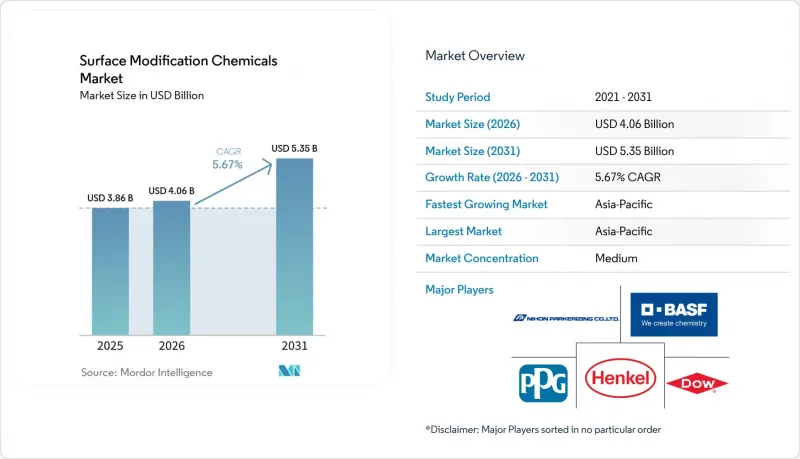
據 Mordor Intelligence 稱,2025 年表面改質化學品的市場規模估計為 38.6 億美元,預計從 2026 年的 40.6 億美元成長到 2031 年的 53.5 億美元,預測期(2026-2031 年)的複合年成長率為 5.67%。
全球表面改質化學品市場趨勢及洞察
電動車輕量化與多金屬預處理:變革車身白車身應用中的化學技術
在電動車白車身部件的製造過程中,高抗張強度鋼、鋁合金、鎂合金壓鑄件和玻璃纖維增強塑膠等多種材料在同一條組裝上進行加工。這種組合使得表面改質化學品市場對預處理系統的需求日益成長,這些系統能夠在一個處理槽中處理不同的基材,而無需更換化學品。鋯矽烷混合轉化塗層比磷酸鋅處理更能有效滿足這項需求。這些處理過程在較低溫度下進行,產生的磷酸鹽污泥較少,從而減少了汽車行業一級供應商的廢棄物處理工作。 2025年10月,BASF塗料的子公司Chemetall推出了Gardoline D,這是電動車電池銅箔的無鉻無氟鈍化技術。在已發表的測試條件下,該產品在25 度C下經過1000次充放電循環後,可將電池壽命延長高達6%。
歐盟電池法規將從2027年起強制要求使用數位電池護照和有害物質聲明。這些要求推動了電動車電池供應鏈對無鉻表面處理技術的需求成長。因此,原始設備製造商(OEM)正在加速改造多金屬相容生產線,並逐步淘汰磷酸鋅系統。這意味著短期資本投資將流向矽烷和鋯基轉化劑供應商,而非通用清潔劑製造商。能夠同時滿足混合金屬性能要求和正式化學品揭露要求的供應商將受益於表面改質化學品市場。隨著電池材料加工與整車組裝要求的連結日益緊密,那些已經為汽車生產線改造提供支援的供應商將能夠鞏固其市場地位。
電子元件小型化與精密電鍍:亞5奈米尺寸驅動化學特異性
在5奈米以下的半導體製程節點上,先進封裝的每個表面處理階段都需要更高的純度和更大的化學品用量。這推動了用於銅穿透矽通孔(TSV)金屬化和微凸塊形成的表面改質化學品市場的發展。晶圓級封裝需要抑制劑、整平機和增亮劑,以確保一致性,精度低於十億分之一。由於晶片堆疊中單一穿透矽通孔的缺陷都可能導致整個模組無法工作,因此化學品規格已成為性能要求,而不僅僅是常規的成本考慮。氨基矽烷和六甲基二矽酸鈉(HMDS)基黏附促進劑在先進邏輯和記憶體製造的極紫外線(EUV)光刻底層化學中繼續發揮至關重要的作用。
在美國晶片科學法律計劃 (CHIPS Scientific Law Program) 的支持下,亞利桑那州、俄亥俄州和德克薩斯州的晶圓廠擴建項目將提升晶圓產能至 2028 年,從而帶動新工廠對高純度製程化學品的需求。一項發表於 2025 年的研究展示瞭如何利用大規模語言模型 (LLM) 代理實現電鍍槽的自主最佳化。該代理商能夠選擇鎳薄膜沉積所需的電流密度、溫度和添加劑濃度,展現瞭如何在先進的工廠中實現精確的電鍍控制。此外,5G 的部署也推動了對用於印刷電路基板的烷氧基矽烷改質環氧樹脂的需求,這些樹脂必須在高功率密度運行下保持毫米波頻段的介電穩定性。這些需求將推動表面改質化學品市場在晶片封裝和通訊硬體領域發揮關鍵作用。
六價鉻重新認證和合規成本:REACH過渡相關的不確定性
2025年4月,歐洲化學品管理局 (ECHA) 發布了一項關於歐盟 REACH 法規 (EC No. 1907/2006) 下 13 種六價鉻化合物的限制提案。該提案估計,受影響的歐洲產業的合規成本將在 3.14 億歐元(約 3.638 億美元)至 32.3 億歐元(約 37.4 億美元)之間,其中包括替代方案、工人接觸管理以及潛在的設施關閉費用。現有的 REACH 附件 XIV 核准決定正逐漸成為化學品用戶不可靠的規劃工具,因為核准流程平均需要 14.5 個月,而法定核准期限為三個月。這降低了採購團隊在管理化學品變更和相關資本投資方面的確定性,並可能導致表面改質化學品市場的採購決策延誤。
隸屬於「航太與國防鉻酸鹽再認證聯盟」的航太和國防用戶已獲準將其持續使用授權延長至2034年12月,從而為其過渡管理爭取了時間。而未加入該聯盟的中小型汽車和一般工業用戶則面臨著更為緊迫的合規挑戰,表面處理研發團隊被迫將時間投入到法規文件和再認證工作中,而非新產品開發。這種情況有利於擁有完善法規合規資源的大規模跨國複合材料製造商,並可能加速表面改質化學品市場的產業重組。
細分市場分析
預計2026年至2031年間,黏合促進劑的複合年成長率將達到6.45%,成為成長最快的化學品類型。這些產品用於難以黏合的聚合物基材,例如汽車車身面板、家用電子電器機殼和結構組件。傳統的機械處理方法並不能始終保證在所需公差範圍內實現持久的界面黏合。隨著汽車製造商擴大使用低表面能聚丙烯和熱塑性聚烯(TPO),氯化聚烯和矽烷改質底漆系統的應用也日益普及。 2024年的研究發現,用於聚烯的共用價鍵結底漆可將等離子處理基材的搭接剪切強度提高10%至50%,即使儲存兩個月後仍能維持此效果。這種耐久性對於組裝應用具有重要意義。
2025年,矽烷偶合劑佔表面改質化學品市場34.56%的佔有率。這一市場地位反映了其廣泛的功能性,包括輪胎填料粘合、先進印刷基板層壓以及汽車和工業應用中的防腐蝕預處理。隨著塗料系統從溶劑型轉變為水性轉變,界面活性劑和潤濕劑的市場也不斷擴大。 2025年4月,贏創推出了TEGO Wet 288,用於水性和輻射固化配方,在這些配方中,傳統的潤濕劑在儲存過程中可能會失去效力。轉化劑、蝕刻劑和氧化劑正在從磷酸鋅基奈米轉化層轉向鋯基奈米轉化層。一項2025年的研究證實,在一家汽車塗裝廠,磷酸鹽基奈米轉化層在12天內完全轉化為鋯基奈米轉化層。
區域分析
亞太地區預計到2025年將佔表面改質化學品市場42.13%的佔有率,並預計到2031年將以6.85%的複合年成長率成長。該地區是半導體製造、汽車組裝和家用電子電器製造的主要中心。在中國,產業政策強調電子元件原料的策略性自給自足,這促使汽車塗料生產線從磷酸鹽基預處理轉向鋯轉化預處理,並擴大了國內矽烷和特種化學品的供應。日本和韓國正在推動半導體製程和顯示面板生產中對高純度材料的高階需求。在越南、泰國和馬來西亞,隨著企業供應鏈多元化,電子組裝產業的投資正在被吸引。
印度正透過其生產連結獎勵計畫計劃 (PLI) 對電子組裝和封裝行業的投資,發展成為新的需求中心。儘管目前印度對錶面處理化學品的需求主要依賴進口,但本地混合能力正在逐步提升。來自日本、美國和德國的高純度複合產品將在未來幾年繼續發揮重要作用。北美是第二大區域市場,對航太塗料、先進半導體特種化學品以及汽車OEM預處理等高附加價值產品的需求旺盛。亞利桑那州、俄亥俄州和德克薩斯州新建的晶圓廠正在推動對高純度粘合促進劑、電鍍助劑和轉化化學品的需求,從而擴大了表面改性化學品市場的區域基礎。
在歐洲,受法規驅動,汽車、航太和離岸風力發電產業對不含鉻和 PFAS 的產品需求旺盛。 REACH 法規相關的六價鉻合規性要求和替代方案也可能因生產線改造成本而限制支出成長。南美市場規模仍然小規模,但巴西和阿根廷對汽車車身本體預處理劑和工業維護塗料的需求正在增加。在中東和非洲,受沙烏地阿拉伯工業多元化計畫以及區域管道和上游石油基礎設施建設的推動,需求正在成長。在許多區域細分市場,分銷網路能力仍然是主要的阻礙因素,而非產品供應,因此,對於參與企業而言,發展本地服務網路至關重要。
其他好處:
- Excel格式的市場預測(ME)表
- 3個月的分析師支持
目錄
第1章:引言
- 研究假設和市場定義
- 調查範圍
第2章:調查方法
第3章執行摘要
第4章 市場狀況
- 市場概覽
- 市場促進因素
- 電動車輕量化和多金屬預處理
- 電子設備小型化和精密電鍍
- 防止基礎設施腐蝕並擴大離岸風力發電
- 積層製造中的表面處理
- 利用封閉回路型人工智慧控制進行浴缸管理
- 無鉻低揮發性有機化合物創新
- 市場限制因素
- 六價鉻再認證和合規成本
- 特殊原物料價格波動
- 專屬式線的總成本和廢棄物管理負擔。
- 生物基和奈米結構替代品的兼容性差距
- 價值和供應鏈分析
- 波特五力分析
第5章 市場規模與成長預測
- 依化學類型
- 矽烷偶合劑
- 黏附促進劑
- 界面活性劑和潤濕劑
- 用於轉化、蝕刻和氧化的化學品
- 其他表面改質化學品
- 按基板
- 金屬
- 塑膠和聚合物
- 玻璃和陶瓷
- 複合材料
- 其他基板
- 透過使用
- 油漆和塗料
- 黏合劑和密封劑
- 電子和半導體
- 汽車和運輸零件
- 其他用途
- 按地區
- 亞太地區
- 中國
- 印度
- 日本
- 韓國
- 東南亞國協
- 其他亞太國家
- 北美洲
- 美國
- 加拿大
- 墨西哥
- 歐洲
- 德國
- 英國
- 法國
- 義大利
- 北歐國家
- 其他歐洲國家
- 南美洲
- 巴西
- 阿根廷
- 其他南美國家
- 中東和非洲
- 沙烏地阿拉伯
- 南非
- 其他中東和非洲國家
- 亞太地區
第6章 競爭情勢
- 市場集中度
- 策略趨勢
- 市佔率和排名分析
- 公司簡介
- ALTANA
- BASF
- Dow
- Element Solutions Inc
- Evonik Industries AG
- Henkel AG and Co. KGaA
- JCU CORPORATION
- Lamberti SpA
- Momentive
- Nihon Parkerizing Co., Ltd.
- NOF CORPORATION
- PPG Industries, Inc.
- Quaker Chemical Corporation
- Shin-Etsu Chemical Co., Ltd.
- Wacker Chemie AG
第7章 市場機會與未來展望
According to Mordor Intelligence, the surface modification chemicals market size was estimated at USD 3.86 billion in 2025 and is estimated to grow from USD 4.06 billion in 2026 to USD 5.35 billion by 2031, at a CAGR of 5.67% during the forecast period (2026-2031).
Global Surface Modification Chemicals Market Trends and Insights
EV Lightweighting and Multi-Metal Pretreatment: The Body-in-White Chemistry Shift
Electric vehicle body-in-white construction combines high-strength steel, aluminum alloys, magnesium die-castings, and glass-fiber-reinforced polymers on a single assembly line. This mix supports demand in the surface modification chemicals market for pretreatment systems that can handle different substrates in a single bath without chemistry changeovers. Zirconium-silane hybrid conversion coatings manage this requirement more effectively than zinc phosphating. They operate at lower temperatures and produce less phosphate sludge, which reduces waste-treatment work for automotive Tier 1 facilities. Chemetall, part of BASF Coatings, launched Gardolene D in October 2025 as a chromium-free and fluoride-free passivation technology for EV battery copper foils. The product delivered up to 6% longer battery life after 1,000 charge cycles at 25°C under the reported testing conditions.
The EU Battery Regulation requires digital battery passports and hazardous-substance declarations from 2027. These requirements increase the need for chromium-free surface chemistry across EV battery supply chains. OEMs are therefore moving more quickly to retrofit multi-metal lines and retire zinc-phosphate systems. This directs near-term capital spending toward silane and zirconium conversion chemical suppliers rather than commodity cleaning formulators. The surface modification chemicals market benefits where suppliers can meet both mixed-metal performance requirements and formal chemical disclosure needs. Suppliers that already support automotive line conversion can strengthen their position as battery material processing becomes more closely tied to vehicle assembly requirements.
Electronics Miniaturization and Precision Plating: Sub-5 nm Drives Chemistry Specificity
Semiconductor process nodes below 5 nm require higher purity and greater chemical input at every surface-treatment stage in advanced packaging. This supports the surface modification chemicals market for copper through-silicon-via metallization and micro-bump formation. Wafer-level packaging requires suppressors, levelers, and brighteners with sub-parts-per-billion consistency. A defect in a single through-silicon via within a chiplet stack can disable the entire module, making chemical specification a performance requirement rather than a routine cost decision. Aminosilane- and HMDS-based adhesion promoters remain important in the underlayer chemistry of extreme ultraviolet (EUV) lithography for advanced logic and memory production.
U.S. CHIPS and Science Act-supported fab expansions in Arizona, Ohio, and Texas are adding wafer-start capacity through 2028, creating demand for high-purity processing chemistries at new facilities. Research published in 2025 demonstrated autonomous optimization of an electroplating bath using a large language model (LLM) agent that selected current density, temperature, and additive concentration for nickel thin-film deposition, illustrating how precision plating control can be developed in advanced facilities. The 5G rollout also supports demand for alkoxysilane-modified epoxy resins in printed circuit boards that must retain dielectric stability at millimeter-wave frequencies under power-dense operation. These requirements give the surface modification chemicals market a role in both chip packaging and communications hardware.
Hexavalent Chromium Requalification and Compliance Costs: REACH Transition Uncertainty
In April 2025, the European Chemicals Agency published a restriction proposal for 13 hexavalent chromium compounds under the EU REACH Regulation EC No. 1907/2006. The proposal estimated compliance costs of EUR 314 million (~USD 363.80 million) to EUR 3.23 billion (~USD 3.74 billion) for affected European industries, covering substitution programs, worker exposure controls, and potential facility closures. Existing REACH Annex XIV authorization decisions have become less reliable planning tools for chemical users, with authorization processing averaging 14.5 months, compared with a statutory three-month period. This has reduced certainty for procurement teams managing chemistry changeovers and associated capital spending, which, in turn, can slow purchasing decisions in the surface-modification chemicals market.
Aerospace and defense users within the Aerospace and Defense Chromates Re-Authorization Consortium secured authorizations extending continued-use titles until December 2034, providing more time to manage the transition. Smaller automotive and general-industrial users outside such consortium arrangements face more immediate compliance needs, with surface-treatment research teams required to devote time to regulatory records and requalification work rather than new product development. This situation favors larger multinational formulators with established regulatory resources and may drive consolidation in the surface modification chemicals market.
Other drivers and restraints analyzed in the detailed report include:
- Infrastructure Corrosion Protection and Offshore Wind Expansion: Scale Drives Demand
- Chromium-Free and Low-VOC Formulation Innovation: Compliance as a Product Catalyst
- Specialty Raw-Material Price Volatility: Silicon Metal and Feedstock Concentration Risk
For complete list of drivers and restraints, kindly check the Table Of Contents.
Segment Analysis
Adhesion promoters are forecast to expand at a 6.45% CAGR from 2026 to 2031, making them the fastest-growing chemical type. They are used on difficult-to-bond polymer substrates in automotive body panels, consumer electronics housings, and structural assemblies. Conventional mechanical preparation cannot always provide durable interfacial bonds at the required tolerances. Chlorinated polyolefin and silane-modified primer systems are gaining use as automakers increase the use of low-surface-energy polypropylene and thermoplastic polyolefin (TPO). A 2024 study found that a covalent-bonding adhesion primer for polyolefins increased lap shear strength by 10% to 50% against plasma-treated substrates and remained effective after two months of storage. This durability has clear implications for assembly-line use.
Silane coupling agents accounted for 34.56% of the surface modification chemicals market share in 2025. Their position reflects functional versatility across tire-filler bonding, advanced printed circuit board laminates, and corrosion-inhibiting pretreatment for automotive and industrial applications. Surface-active and wetting agents are also expanding as coating systems shift from solventborne to waterborne formats. Evonik launched TEGO Wet 288 in April 2025 for waterborne and radiation-curing formulations where conventional wetting agents can lose effectiveness during storage. Conversion, etching, and oxidation chemicals are moving from zinc phosphate to zirconium-based nano-conversion layers. A 2025 study documented a complete phosphate-to-zirconium conversion at an automotive paint facility in 12 days.
Complete Report Scope:
- By Chemical Type
- Silane Coupling Agents
- Adhesion Promoters
- Surface-Active and Wetting Agents
- Conversion, Etching and Oxidation Chemicals
- Other Surface Modification Chemicals
- By Substrate Material
- Metals
- Plastics and Polymers
- Glass and Ceramics
- Composites
- Other Substrate Materials
- By Application
- Paints and Coatings
- Adhesives and Sealants
- Electronics and Semiconductors
- Automotive and Transportation Components
- Other Applications
- By Geography
- Asia-Pacific
- China
- India
- Japan
- South Korea
- ASEAN Countries
- Rest of Asia-Pacific
- North America
- United States
- Canada
- Mexico
- Europe
- Germany
- United Kingdom
- France
- Italy
- NORDIC Countries
- Rest of Europe
- South America
- Brazil
- Argentina
- Rest of South America
- Middle East and Africa
- Saudi Arabia
- South Africa
- Rest of Middle East and Africa
- Asia-Pacific
Geography Analysis
Asia-Pacific held 42.13% of the surface modification chemicals market share in 2025 and is forecast to grow at a 6.85% CAGR through 2031. The region has large bases for semiconductor fabrication, automotive assembly, and consumer electronics manufacturing. China is transitioning automotive coating lines from phosphate-based to zirconium-conversion pretreatment and expanding domestic silane and specialty chemical supply, as industrial policy emphasizes self-sufficiency in strategic electronics inputs. Japan and South Korea contribute premium demand for high-purity materials in semiconductor processing and display panel production. Vietnam, Thailand, and Malaysia are attracting investment in electronics assembly as companies diversify their supply chains.
India is developing as another demand center through investments in electronics assembly and packaging under the Production Linked Incentive scheme. Its surface-treatment chemical requirements are currently met largely through imports, although localized blending capacity is beginning to develop. High-purity formulations from Japan, the United States, and Germany will remain important for several years. North America is the second-largest regional market, with high-value demand in aerospace coatings, advanced semiconductor specialty chemicals, and automotive OEM pretreatment. New fabs in Arizona, Ohio, and Texas are supporting demand for high-purity adhesion promoters, plating additives, and conversion chemicals, broadening the regional base for the surface modification chemicals market.
Europe has regulation-driven demand for chromium- and PFAS-free products in the automotive, aerospace, and offshore wind sectors. REACH-related Cr(VI) compliance and substitution programs also create costs for line conversions and can restrain spending growth. South America remains a smaller market, with Brazil and Argentina supporting demand for automotive body-in-white pretreatment and industrial maintenance coatings. The Middle East and Africa are seeing increased demand driven by Saudi Arabia's industrial diversification programs and regional pipeline and upstream oil infrastructure development. In many regional submarkets, distribution-network capability, rather than product availability, remains the primary limitation, making local service coverage important for participants in the surface modification chemicals market.
- ALTANA
- BASF
- Dow
- Element Solutions Inc
- Evonik Industries AG
- Henkel AG and Co. KGaA
- JCU CORPORATION
- Lamberti S.p.A.
- Momentive
- Nihon Parkerizing Co., Ltd.
- NOF CORPORATION
- PPG Industries, Inc.
- Quaker Chemical Corporation
- Shin-Etsu Chemical Co., Ltd.
- Wacker Chemie AG
Additional Benefits:
- The market estimate (ME) sheet in Excel format
- 3 months of analyst support
TABLE OF CONTENTS
1 Introduction
- 1.1 Study Assumptions and Market Definition
- 1.2 Scope of the Study
2 Research Methodology
3 Executive Summary
4 Market Landscape
- 4.1 Market Overview
- 4.2 Market Drivers
- 4.2.1 EV Lightweighting and Multi-Metal Pretreatment
- 4.2.2 Electronics Miniaturization and Precision Plating
- 4.2.3 Infrastructure Corrosion Protection and Offshore Wind Expansion
- 4.2.4 Additive Manufacturing Surface Finishing
- 4.2.5 Closed-Loop, AI-Controlled Bath Management
- 4.2.6 Chromium-Free and Low-VOC Formulation Innovation
- 4.3 Market Restraints
- 4.3.1 Hexavalent Chromium Requalification and Compliance Costs
- 4.3.2 Specialty Raw-Material Price Volatility
- 4.3.3 Captive-Line Total Cost and Waste-Management Burden
- 4.3.4 Qualification Gaps for Bio-Based and Nanostructured Alternatives
- 4.4 Value and Supply-Chain Analysis
- 4.5 Porter's Five Forces Analysis
- 4.5.1 Bargaining Power of Suppliers
- 4.5.2 Bargaining Power of Buyers
- 4.5.3 Threat of New Entrants
- 4.5.4 Threat of Substitutes
- 4.5.5 Competitive Rivalry
5 Market Size and Growth Forecasts (Value)
- 5.1 By Chemical Type
- 5.1.1 Silane Coupling Agents
- 5.1.2 Adhesion Promoters
- 5.1.3 Surface-Active and Wetting Agents
- 5.1.4 Conversion, Etching and Oxidation Chemicals
- 5.1.5 Other Surface Modification Chemicals
- 5.2 By Substrate Material
- 5.2.1 Metals
- 5.2.2 Plastics and Polymers
- 5.2.3 Glass and Ceramics
- 5.2.4 Composites
- 5.2.5 Other Substrate Materials
- 5.3 By Application
- 5.3.1 Paints and Coatings
- 5.3.2 Adhesives and Sealants
- 5.3.3 Electronics and Semiconductors
- 5.3.4 Automotive and Transportation Components
- 5.3.5 Other Applications
- 5.4 By Geography
- 5.4.1 Asia-Pacific
- 5.4.1.1 China
- 5.4.1.2 India
- 5.4.1.3 Japan
- 5.4.1.4 South Korea
- 5.4.1.5 ASEAN Countries
- 5.4.1.6 Rest of Asia-Pacific
- 5.4.2 North America
- 5.4.2.1 United States
- 5.4.2.2 Canada
- 5.4.2.3 Mexico
- 5.4.3 Europe
- 5.4.3.1 Germany
- 5.4.3.2 United Kingdom
- 5.4.3.3 France
- 5.4.3.4 Italy
- 5.4.3.5 NORDIC Countries
- 5.4.3.6 Rest of Europe
- 5.4.4 South America
- 5.4.4.1 Brazil
- 5.4.4.2 Argentina
- 5.4.4.3 Rest of South America
- 5.4.5 Middle East and Africa
- 5.4.5.1 Saudi Arabia
- 5.4.5.2 South Africa
- 5.4.5.3 Rest of Middle East and Africa
- 5.4.1 Asia-Pacific
6 Competitive Landscape
- 6.1 Market Concentration
- 6.2 Strategic Moves
- 6.3 Market Share (%)/Ranking Analysis
- 6.4 Company Profiles (includes Global Overview, Market Overview, Core Segments, Financials as available, Strategic Information, Products and Services, and Recent Developments)
- 6.4.1 ALTANA
- 6.4.2 BASF
- 6.4.3 Dow
- 6.4.4 Element Solutions Inc
- 6.4.5 Evonik Industries AG
- 6.4.6 Henkel AG and Co. KGaA
- 6.4.7 JCU CORPORATION
- 6.4.8 Lamberti S.p.A.
- 6.4.9 Momentive
- 6.4.10 Nihon Parkerizing Co., Ltd.
- 6.4.11 NOF CORPORATION
- 6.4.12 PPG Industries, Inc.
- 6.4.13 Quaker Chemical Corporation
- 6.4.14 Shin-Etsu Chemical Co., Ltd.
- 6.4.15 Wacker Chemie AG
7 Market Opportunities and Future Outlook
- 7.1 White-Space and Unmet-Need Assessment

 酸洗化學品市場:依產品類型、應用、形態、國家及地區分類-全球產業分析、市場規模、市場佔有率及2026年至2033年預測
 奈米塗層和防腐蝕表面處理解決方案市場預測至2034年—按塗層類型、基材、應用、最終用戶和地區分類的全球分析功能性表面處理化學品市場報告:趨勢、預測和競爭分析(至2035年)
 泡菜液用化學品:市場佔有率分析、行業趨勢和統計數據、成長預測(2026-2031 年)鈍化化學品:市場佔有率分析、行業趨勢和統計數據、成長預測(2026-2031 年)
 表面處理市場機會、成長要素、產業趨勢分析及2026-2035年預測。表面處理化學品:市場佔有率分析、產業趨勢及統計、成長預測(2026-2031)表面處理和電鍍市場預測至2034年-按製程類型、材料、基材、應用、最終用戶和地區分類的全球分析表面處理化學品市場:依產品類型、基材、應用、最終用途產業、國家及地區分類-全球產業分析、市場規模、市場佔有率及2026年至2033年預測
 混凝土表面處理化學品市場:全球市場按產品類型、化學成分、形態、技術和應用進行預測,2026-2032年