


 |
市場調查報告書
商品編碼
2154732
非人類身分(NHI)安全與管治:市場佔有率分析、產業趨勢與統計及成長預測(2026-2031)Non-Human Identity (NHI) Security and Governance - Market Share Analysis, Industry Trends & Statistics, Growth Forecasts (2026 - 2031) |
||||||

※ 本網頁內容可能與最新版本有所差異。詳細情況請與我們聯繫。
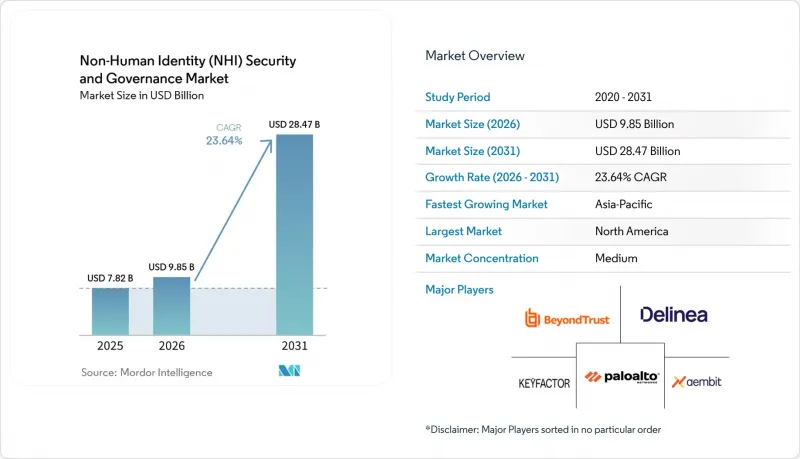
根據 Mordor Intelligence 預測,非人類身分 (NHI) 安全和管治市場將從 2025 年的 78.2 億美元和 2026 年的 98.5 億美元成長到 2031 年的 284.7 億美元,2026 年至 2031 年的年複合成長率(CAGR)率為 23.4%。
全球非人類身分(NHI)安全與管治市場趨勢及洞察
雲端原生工作負載和 API 擴充
在雲端原生環境中,API 已成為主要的攻擊目標,因此,妥善管理與每個端點關聯的憑證至關重要。 Akamai 報告稱,到 2025 年,企業每天將遭受 258 次 API 攻擊,年增 113%。此外,87% 的受訪企業報告了與 API 相關的安全事件。每個新增的 API 端點都會增加關聯的服務帳戶、令牌或金鑰,因此需要進行庫存管理和策略控制。隨著企業開始將經過驗證的 API 活動視為機器身分事件而非網路事件,非人類身分 (NHI) 安全和管治市場將從中受益。 Salt Security 的一項調查發現,47% 的受訪者表示其 API 數量同比成長 51% 至 100%,另有 47% 的受訪者由於擔心 API 暴露給自治系統而推遲了生產環境的發布。 API 閘道控制(透過根據身分策略評估每個請求)可以限制憑證外洩的影響。
引入人工智慧代理和自主工作流程
人工智慧代理帶來的身份風險與靜態服務帳戶的風險有所不同。這些代理程式可以在運行時使用憑證、建立子代理程式、呼叫外部 API 並跨多個系統執行操作。 OWASP 已將身分和權限濫用列為基於代理的應用程式中的重大風險。美國國家標準與技術研究院 (NIST) 國家網路安全卓越中心於 2026 年 2 月發布了一份關於軟體代理和基於代理的人工智慧應用程式的身份和授權實踐的概念文件。因此,非人類身分 (NHI) 安全性和管治市場正在轉向在工具使用點檢驗代理身份、請求權限和授權的控制措施。根據雲端安全聯盟 (CSA) 的一份報告,超過 16% 的組織沒有追蹤與人工智慧相關的身份的創建,這表明缺乏監控。
工程團隊與安全團隊之間的職責分配
由於工程團隊與安全團隊之間職責不明確,機器身分管治常常面臨延誤。工程團隊可能在 CI/CD 管線、Kubernetes叢集、SaaS 整合和 AI 工作流程中建立憑證,而沒有正式的安全管理流程。雲端安全聯盟的一項調查發現,只有 15% 的組織對自身防範利用 NHI 的攻擊能力“非常有信心”,只有 5.7% 的組織能夠完全了解服務帳戶的情況。人類身分管理流程並不明確適用於服務帳戶,因為服務帳戶是在部署時建立的,並在基礎架構執行個體回收時刪除。偵測工具可以識別風險,但如果沒有授權團隊進行必要的更改,糾正措施就會被延誤。對於擁有眾多工程團隊和多樣化交付方法的大型企業而言,這個問題尤其嚴重。
細分市場分析
到 2025 年,應用程式和服務身分將佔總收入的 26.58%。此類別佔據最大收入佔有率,是因為託管服務供應商正在更廣泛的企業環境中部署管治控制。這些部署包括本機服務帳戶、SaaS OAuth 授權和雲端工作負載令牌。預計到 2031 年,AI 代理身分將以 25.05% 的複合年成長率成長。 NHI 安全性和管治市場對 AI 代理身分的需求源自於管理執行階段使用憑證的代理的需要。 OWASP 將工具濫用和身分權限濫用列為基於代理的系統的主要風險。這種風險狀況推動了對存取控制的需求,這些控制可以在代理使用連接工具之前對其進行評估。這也促使人們的關注點從定期審查轉向持續批准。
工作負載和容器身分、應用程式間和 API 身分以及機器和裝置身分正在推動該類別的大量需求。微服務和互聯設備生態系統的採用正在增加這些身分的數量和多樣性。在證書用於建立應用程式和裝置之間可信任通訊的情況下,加密身分仍然至關重要。隨著傳統自動化程序與新的管治平台整合,機器人和 RPA 身分的重要性也日益凸顯。 CA/瀏覽器論壇計畫縮短憑證有效期,這增加了加密身分管理的維運負擔。隨著續期週期的縮短,自動化的價值將進一步提升。 ISO/IEC 27001 和 NIST SP 800-57 為支援加密身分生命週期管理實務提供了技術指導。
到 2025 年,解決方案將佔總收入的 61.24%。這反映了市場對發現引擎、存取管治、金鑰儲存和憑證生命週期管理功能的需求。早期購買者通常會優先考慮平台,因為他們擁有能夠內部處理配置工作的安全團隊。預計到 2031 年,服務業務將以 24.05% 的複合年成長率成長。非人類身分 (NHI) 安全和管治市場對服務的需求主要來自那些需要所有權模型、庫存管理和糾正措施程序方面幫助的客戶。隨著專案的成熟,董事會和安全官將尋求有據可查的管治成果,而不僅僅是工具部署的記錄。託管服務和部署支援在彌補內部能力不足方面發揮重要作用。
解決方案和服務在商業性更像是互補關係而非替代關係。即使在購買平台之後,客戶仍然需要協助建立負責任的所有權並建立可操作的營運流程。諮詢支援也有助於使控制措施與合規性要求保持一致。 2026 年 3 月,SailPoint 發布了“機器身份安全快速入門指南”,這是一個結構化的四週實施框架。此類框架可以縮短從初始檢測到採取有效糾正措施的時間。將諮詢方法融入實施流程的供應商可以降低採用門檻。這種方法也有助於客戶將平台應用於各種不同的憑證類型。
區域分析
到2025年,北美將佔全球整體收入的41.37%。該地區的非人類身分(NHI)安全和管治市場受益於雲端原生技術的早期應用、專業供應商的高度集中以及受監管行業的積極參與。金融服務、醫療保健和國防產業的合規要求支持了對身分控制的持續投資。美國政府透過讓國家安全局(NSA)和網路安全與基礎設施安全局(CISA)共同製定2026年軟體業務手冊(SBOM)的更新最低要求,加強了軟體供應鏈實務。這些實踐可能會增加對與身分相關的軟體供應鏈證明的需求。加拿大和墨西哥也透過雲端採用和製造自動化為市場做出了貢獻。
歐洲在國家健康資訊安全局 (NHI) 的安全和管治市場中佔據著重要的戰略佔有率。 DORA 於 2025 年 1 月為金融機構和關鍵資訊通訊技術 (ICT) 供應商建立了通用的營運彈性架構。德國的 NIS2 實施法預計將在 2025 年 12 月前將約 29,000 家機構納入德國聯邦資訊安全局 (BSI) 的監管之下。法國在本報告期間內繼續推進其 NIS2 國家化進程。歐盟人工智慧法在 2026 年和 2027 年期間對高風險人工智慧系統增加了新的義務。這些措施提高了在歐洲受監管部署中可審計的機器身分管治的重要性。
預計到2031年,亞太地區將以24.21%的複合年成長率成長。到2025年,中國將在該地區的收入佔有率方面領先,這得益於其不斷擴展的雲端基礎設施以及對國內網路安全措施的高度重視。印度是該地區成長最快的國家,這主要得益於金融科技的擴張、IT服務業務的活性化以及外包軟體開發帶來的大量API憑證。日本、韓國和澳洲正透過雲端採用和自動化項目來支援需求。南美洲尚處於早期階段,但巴西正透過金融服務的數位化和雲端原生開發引領該地區的雲端採用。中東的數位轉型專案正在為銀行、金融和保險(BFSI)以及電信業創造機遇,而南非和奈及利亞則出現了與行動金融服務和科技產業發展相關的早期需求。提供雲端管理服務和透過合作夥伴提供服務的供應商可以滿足那些本地安全工程能力有限的市場的需求。
其他好處:
- Excel格式的市場預測(ME)表
- 3個月的分析師支持
目錄
第1章:引言
- 研究假設和市場定義
- 調查範圍
第2章:調查方法
第3章執行摘要
第4章 市場狀況
- 市場概覽
- 宏觀經濟因素對市場的影響
- 市場促進因素
- 擴展雲端原生工作負載和 API
- 人工智慧代理和自主工作流程的部署
- 零信任與監理執法
- 無秘密存取和臨時憑證輪換
- 利用恆等圖量化NHI的攻擊面
- 身分關聯軟體供應鏈認證
- 市場限制因素
- 工程團隊和安全團隊之間的所有權分配
- 原生超大規模資料中心業者中心的獨特功能有助於降低額外費用。
- 臨時身分認同與歸屬感之間的差距。
- 對 Secret Zero 和傳統協定的依賴
- 產業價值鏈分析
- 監理情勢
- 技術展望
- 波特五力分析
第5章 市場規模與成長預測
- ID 類型
- 應用程式和服務標識符
- 應用程式到應用程式 (A2A) 和 API 身份
- 工作負載和容器標識符
- 機器和設備的識別符
- 加密ID
- AI代理ID
- 機器人和機器人流程自動化 (RPA) ID
- 報價
- 解決方案
- 服務
- 不同的發展
- 雲端原生
- 混合
- 現場
- 按組織規模
- 大公司
- 小型企業
- 透過使用
- 存取管理
- 身分管治與管理
- 秘密管理與輪換
- 證書生命週期管理
- 合規管理
- 其他用途
- 最終用戶
- BFSI
- 醫療保健和生命科學
- 資訊科技/通訊
- 政府/公共部門
- 零售與電子商務
- 工業製造
- 能源公用事業
- 其他最終用戶
- 按地區
- 北美洲
- 美國
- 加拿大
- 墨西哥
- 南美洲
- 巴西
- 阿根廷
- 其他南美國家
- 歐洲
- 德國
- 英國
- 法國
- 俄羅斯
- 其他歐洲國家
- 亞太地區
- 中國
- 日本
- 印度
- 韓國
- 澳洲
- 其他亞太國家
- 中東
- 沙烏地阿拉伯
- 阿拉伯聯合大公國
- 土耳其
- 其他中東國家
- 非洲
- 南非
- 奈及利亞
- 其他非洲國家
- 北美洲
第6章 競爭情勢
- 市場集中度
- 策略趨勢
- 市佔率分析
- 公司簡介
- Aembit, Inc.
- Akeyless Security Ltd.
- AppViewX, Inc.
- Astrix Security Ltd.
- BeyondTrust Corporation
- Britive, Inc.
- Clutch Security Ltd.
- Palo Alto Networks
- Delinea, Inc.
- Entro Security Ltd.
- GitGuardian SAS
- Keyfactor, Inc.
- Oasis Security Ltd.
- P0 Security, Inc.
- Permiso Security, Inc.
- Saviynt, Inc.
- Silverfort Ltd.
- Teleport, Inc.
- Token Security Ltd.
- Apono, Inc.
第7章 市場機會與未來展望
According to Mordor Intelligence, the Non-Human identity security and governance market size is projected to expand from USD 7.82 billion in 2025 and USD 9.85 billion in 2026 to USD 28.47 billion by 2031, registering a CAGR of 23.64% between 2026 and 2031.
Global Non-Human Identity (NHI) Security and Governance Market Trends and Insights
Cloud-Native Workload and API Expansion
APIs have become a major attack surface in cloud-native environments, increasing the need to govern the credentials associated with each endpoint. Akamai reported 258 daily API attacks per organization in 2025, a 113% increase from the prior year, while 87% of surveyed organizations reported an API-related security incident. Every additional API endpoint can introduce an associated service account, token, or key that requires inventory and policy control. The Non-Human Identity (NHI) security and governance market benefits when organizations treat authenticated API activity as a machine identity event rather than only a network event. Salt Security found that 47% of respondents reported API expansion of 51%-100% over the prior year, and 47% delayed a production release due to security concerns about APIs exposed to autonomous systems. Controls at the API gateway can limit the reach of a compromised credential by assessing each request against an identity policy.
AI Agent and Autonomous Workflow Adoption
AI agents create identity risks that differ from those associated with static service accounts. These agents can consume credentials at runtime, create sub-agents, call external APIs, and carry out actions across multiple systems. OWASP identifies identity and privilege abuse as a material risk for agentic applications. NIST's National Cybersecurity Center of Excellence published a February 2026 concept paper on identity and authorization practices for software agents and agentic AI applications. The Non-Human Identity (NHI) security and governance market is therefore moving toward controls that verify an agent's identity, requested scope, and authorization at the point of tool use. The Cloud Security Alliance reported that more than 16% of organizations did not track the creation of AI-related identities, leaving a gap in oversight.
Fragmented Ownership Across Engineering and Security Teams
Machine identity governance is often slowed by divided accountability between engineering and security teams. Engineering teams can create credentials in CI/CD pipelines, Kubernetes clusters, SaaS integrations, and AI workflows without a formal security ownership process. The Cloud Security Alliance found that 15% of organizations were highly confident in their ability to prevent NHI-based attacks, and 5.7% had full visibility into service accounts. Human identity processes do not map cleanly to a service account created at deployment and removed when an infrastructure instance is recycled. Discovery tools can identify risk, but remediation is delayed when no team has the authority to make the needed change. This issue is more severe in large enterprises with many engineering teams and varied delivery practices.
Other drivers and restraints analyzed in the detailed report include:
- Zero Trust and Regulatory Enforcement
- Secretless Access and Ephemeral Credential Rotation
- Native Hyperscaler Identity Features Reduce Incremental Spend
For complete list of drivers and restraints, kindly check the Table Of Contents.
Segment Analysis
Application and Service Identities represented 26.58% of revenue in 2025. This category had the largest revenue share because managed service providers deploy governance controls across broad enterprise environments. These deployments can cover on-premises service accounts, SaaS OAuth grants, and cloud workload tokens. AI Agent Identities are projected to expand at a 25.05% CAGR through 2031. NHI security and governance market demand for AI Agent Identities is supported by the need to govern agents that use credentials at runtime. OWASP lists tool misuse and identity privilege abuse among key risks for agentic systems. This risk profile raises demand for access controls that can assess an agent before it uses a connected tool. It also shifts attention from periodic review toward continuous authorization.
Workload and Container Identities, Application-to-Application and API Identities, and Machine and Device Identities provide material demand across the category. The adoption of microservices and connected device fleets increases the volume and diversity of these identities. Cryptographic Identities remain important where certificates establish trusted application and device communications. Bots and RPA Identities are also relevant as older automation programs connect with newer governance platforms. The CA/Browser Forum's planned reductions in certificate validity increase the operational burden of cryptographic identity management. Automation becomes more valuable as renewal intervals shorten. ISO/IEC 27001 and NIST SP 800-57 provide technical guidance that supports cryptographic identity lifecycle practices.
Solutions accounted for 61.24% of revenue in 2025. This position reflects demand for discovery engines, access governance, secrets vaulting, and certificate lifecycle capabilities. Early buyers often prioritize platforms because they have internal security teams able to configure them. Services are projected to expand at a 24.05% CAGR through 2031. Non-Human Identity (NHI) security and governance market demand for Services is driven by customers who need help with ownership models, inventory management, and remediation procedures. As programs mature, boards and security leaders seek documented governance outcomes rather than evidence of tool deployment alone. Managed services and implementation support address gaps in internal capability.
Solutions and Services are commercially complementary rather than substitutes. A customer may buy a platform but still needs assistance to establish accountable owners and workable operating processes. Advisory support can also help align controls with compliance requirements. SailPoint launched Machine Identity Security QuickStart in March 2026 with a structured 4-week deployment framework. Such frameworks can reduce the time between initial discovery and practical remediation. Vendors that build advisory methods into implementation can reduce adoption barriers. This approach also helps customers apply the platform across diverse credential types.
Complete Report Scope:
- By Identity Type
- Application and Service Identities
- Application-to-Application and API Identities
- Workload and Container Identities
- Machine and Device Identities
- Cryptographic Identities
- AI Agent Identities
- Bots and Robotic Process Automation Identities
- By Offering
- Solutions
- Services
- By Deployment
- Cloud-Native
- Hybrid
- On-Premises
- By Organization Size
- Large Enterprises
- Small and Medium-Sized Enterprises
- By Application
- Access Management
- Identity Governance and Administration
- Secrets Management and Rotation
- Certificate Lifecycle Management
- Compliance Management
- Other Applications
- By End User
- BFSI
- Healthcare and Life Sciences
- Information Technology and Telecommunications
- Government and Public Sector
- Retail and E-Commerce
- Industrial Manufacturing
- Energy and Utilities
- Other End Users
- By Geography
- North America
- United States
- Canada
- Mexico
- South America
- Brazil
- Argentina
- Rest of South America
- Europe
- Germany
- United Kingdom
- France
- Russia
- Rest of Europe
- Asia-Pacific
- China
- Japan
- India
- South Korea
- Australia
- Rest of Asia-Pacific
- Middle East
- Saudi Arabia
- United Arab Emirates
- Turkey
- Rest of Middle East
- Africa
- South Africa
- Nigeria
- Rest of Africa
- North America
Geography Analysis
North America held 41.37% of global revenue in 2025. The Non-Human Identity (NHI) security and governance market in the region benefits from early adoption of cloud-native technologies, a high concentration of dedicated vendors, and strong activity in regulated industries. Financial services, healthcare, and defense have compliance requirements that support recurring investment in identity controls. The US government has reinforced software supply chain practices by issuing updated minimum elements for SBOMs, jointly by the NSA and CISA in 2026. These practices can increase demand for identity-bound software supply chain attestation. Canada and Mexico also contribute through cloud adoption and manufacturing automation.
Europe represents a strategically important part of the NHI security and governance market. DORA established a common operational resilience framework for financial entities and critical ICT providers from January 2025. Germany's NIS2 Implementation Act brought an estimated 29,000 organizations under BSI supervision in December 2025. France continued its NIS2 transposition process during the period supplied. The EU AI Act adds obligations for high-risk AI systems through 2026 and 2027. These measures make auditable machine identity governance more relevant across regulated European deployments.
Asia-Pacific is projected to expand at a 24.21% CAGR through 2031. China held the largest regional revenue share in 2025, supported by cloud infrastructure expansion and domestic cybersecurity priorities. India is the fastest-growing country in the region because of fintech expansion, IT services activity, and high volumes of API credentials from outsourced software development. Japan, South Korea, and Australia support demand through cloud adoption and automation programs. South America is at an earlier stage, with Brazil leading regional uptake through financial services digitization and cloud-native development. Middle East digital transformation programs create opportunities in BFSI and telecommunications, while South Africa and Nigeria show early demand linked to mobile financial services and the development of the technology sector. Vendors that offer cloud-managed or partner-delivered services can address markets with limited local security engineering capacity.
- Aembit, Inc.
- Akeyless Security Ltd.
- AppViewX, Inc.
- Astrix Security Ltd.
- BeyondTrust Corporation
- Britive, Inc.
- Clutch Security Ltd.
- Palo Alto Networks
- Delinea, Inc.
- Entro Security Ltd.
- GitGuardian SAS
- Keyfactor, Inc.
- Oasis Security Ltd.
- P0 Security, Inc.
- Permiso Security, Inc.
- Saviynt, Inc.
- Silverfort Ltd.
- Teleport, Inc.
- Token Security Ltd.
- Apono, Inc.
Additional Benefits:
- The market estimate (ME) sheet in Excel format
- 3 months of analyst support
TABLE OF CONTENTS
1 INTRODUCTION
- 1.1 Study Assumptions and Market Definition
- 1.2 Scope of the Study
2 RESEARCH METHODOLOGY
3 EXECUTIVE SUMMARY
4 MARKET LANDSCAPE
- 4.1 Market Overview
- 4.2 Impact of Macroeconomic Factors on the Market
- 4.3 Market Drivers
- 4.3.1 Cloud-Native Workload and API Expansion
- 4.3.2 AI Agent and Autonomous Workflow Adoption
- 4.3.3 Zero Trust and Regulatory Enforcement
- 4.3.4 Secretless Access and Ephemeral Credential Rotation
- 4.3.5 NHI Attack Surface Quantification by Identity Graphs
- 4.3.6 Identity-Bound Software Supply Chain Attestation
- 4.4 Market Restraints
- 4.4.1 Fragmented Ownership Across Engineering and Security Teams
- 4.4.2 Native Hyperscaler Identity Features Reduce Incremental Spend
- 4.4.3 Ephemeral Identity Discovery and Attribution Gaps
- 4.4.4 Secret Zero and Legacy Protocol Dependence
- 4.5 Industry Value Chain Analysis
- 4.6 Regulatory Landscape
- 4.7 Technological Outlook
- 4.8 Porter's Five Forces Analysis
- 4.8.1 Intensity of Competitive Rivalry
- 4.8.2 Threat of New Entrants
- 4.8.3 Bargaining Power of Suppliers
- 4.8.4 Bargaining Power of Buyers
- 4.8.5 Threat of Substitutes
5 MARKET SIZE AND GROWTH FORECASTS (VALUE)
- 5.1 By Identity Type
- 5.1.1 Application and Service Identities
- 5.1.2 Application-to-Application and API Identities
- 5.1.3 Workload and Container Identities
- 5.1.4 Machine and Device Identities
- 5.1.5 Cryptographic Identities
- 5.1.6 AI Agent Identities
- 5.1.7 Bots and Robotic Process Automation Identities
- 5.2 By Offering
- 5.2.1 Solutions
- 5.2.2 Services
- 5.3 By Deployment
- 5.3.1 Cloud-Native
- 5.3.2 Hybrid
- 5.3.3 On-Premises
- 5.4 By Organization Size
- 5.4.1 Large Enterprises
- 5.4.2 Small and Medium-Sized Enterprises
- 5.5 By Application
- 5.5.1 Access Management
- 5.5.2 Identity Governance and Administration
- 5.5.3 Secrets Management and Rotation
- 5.5.4 Certificate Lifecycle Management
- 5.5.5 Compliance Management
- 5.5.6 Other Applications
- 5.6 By End User
- 5.6.1 BFSI
- 5.6.2 Healthcare and Life Sciences
- 5.6.3 Information Technology and Telecommunications
- 5.6.4 Government and Public Sector
- 5.6.5 Retail and E-Commerce
- 5.6.6 Industrial Manufacturing
- 5.6.7 Energy and Utilities
- 5.6.8 Other End Users
- 5.7 By Geography
- 5.7.1 North America
- 5.7.1.1 United States
- 5.7.1.2 Canada
- 5.7.1.3 Mexico
- 5.7.2 South America
- 5.7.2.1 Brazil
- 5.7.2.2 Argentina
- 5.7.2.3 Rest of South America
- 5.7.3 Europe
- 5.7.3.1 Germany
- 5.7.3.2 United Kingdom
- 5.7.3.3 France
- 5.7.3.4 Russia
- 5.7.3.5 Rest of Europe
- 5.7.4 Asia-Pacific
- 5.7.4.1 China
- 5.7.4.2 Japan
- 5.7.4.3 India
- 5.7.4.4 South Korea
- 5.7.4.5 Australia
- 5.7.4.6 Rest of Asia-Pacific
- 5.7.5 Middle East
- 5.7.5.1 Saudi Arabia
- 5.7.5.2 United Arab Emirates
- 5.7.5.3 Turkey
- 5.7.5.4 Rest of Middle East
- 5.7.6 Africa
- 5.7.6.1 South Africa
- 5.7.6.2 Nigeria
- 5.7.6.3 Rest of Africa
- 5.7.1 North America
6 COMPETITIVE LANDSCAPE
- 6.1 Market Concentration
- 6.2 Strategic Moves
- 6.3 Market Share Analysis
- 6.4 Company Profiles (includes Global Level Overview, Market Level Overview, Core Segments, Financials as available, Strategic Information, Market Rank/Share, Products and Services, Recent Developments)
- 6.4.1 Aembit, Inc.
- 6.4.2 Akeyless Security Ltd.
- 6.4.3 AppViewX, Inc.
- 6.4.4 Astrix Security Ltd.
- 6.4.5 BeyondTrust Corporation
- 6.4.6 Britive, Inc.
- 6.4.7 Clutch Security Ltd.
- 6.4.8 Palo Alto Networks
- 6.4.9 Delinea, Inc.
- 6.4.10 Entro Security Ltd.
- 6.4.11 GitGuardian SAS
- 6.4.12 Keyfactor, Inc.
- 6.4.13 Oasis Security Ltd.
- 6.4.14 P0 Security, Inc.
- 6.4.15 Permiso Security, Inc.
- 6.4.16 Saviynt, Inc.
- 6.4.17 Silverfort Ltd.
- 6.4.18 Teleport, Inc.
- 6.4.19 Token Security Ltd.
- 6.4.20 Apono, Inc.
7 MARKET OPPORTUNITIES AND FUTURE OUTLOOK
- 7.1 White-Space and Unmet-Need Assessment

 身分與存取管理 (IAM)保全服務:市場佔有率分析、產業趨勢與統計資料、成長預測(2026-2031 年)
 客戶識別和存取管理市場預測至 2034 年—按組件、部署模式、身份驗證方法、組織規模、最終用戶和地區分類的全球分析
 識別及存取管理專業服務市場:2026-2032年全球市場預測(按服務類型、交付方式、軟體包格式、身分類型、應用程式、產業、部署模式和組織規模分類)身分與存取管理市場:2026-2032年全球市場預測(按服務類型、存取類型、技術、部署模式、身分驗證類型、最終使用者和組織規模分類)
 2026-2030年全球身分與訪問管理市場企業識別及存取管理 (IAM):市場佔有率分析、行業趨勢和統計數據以及成長預測 (2026-2031)非人類身分(NHI)安全:市場佔有率分析、行業趨勢和統計數據以及成長預測(2026-2031 年)
 非人類身分(NHI)存取管理市場規模、佔有率和成長分析:按元件、身分類型、部署模式、應用程式、企業規模、最終用戶產業和地區分類-2026-2033年產業預測
 全球身分和存取管理市場規模、佔有率、成長,和依類型、應用的市場分析,區域趨勢,2026-2034年的預測
 2026年全球抗量子遠距認證市場報告