


 |
市場調查報告書
商品編碼
2099060
企業識別及存取管理 (IAM):市場佔有率分析、行業趨勢和統計數據以及成長預測 (2026-2031)Enterprise Identity and Access Management (IAM) - Market Share Analysis, Industry Trends & Statistics, Growth Forecasts (2026 - 2031) |
||||||

※ 本網頁內容可能與最新版本有所差異。詳細情況請與我們聯繫。
根據 Mordor Intelligence 預測,企業識別及存取管理 (IAM) 市場預計將從 2025 年的 234.1 億美元成長到 2026 年的 275.3 億美元,到 2031 年達到 619.9 億美元,2026 年至 2031 年的複合年成長率為 17.63%。
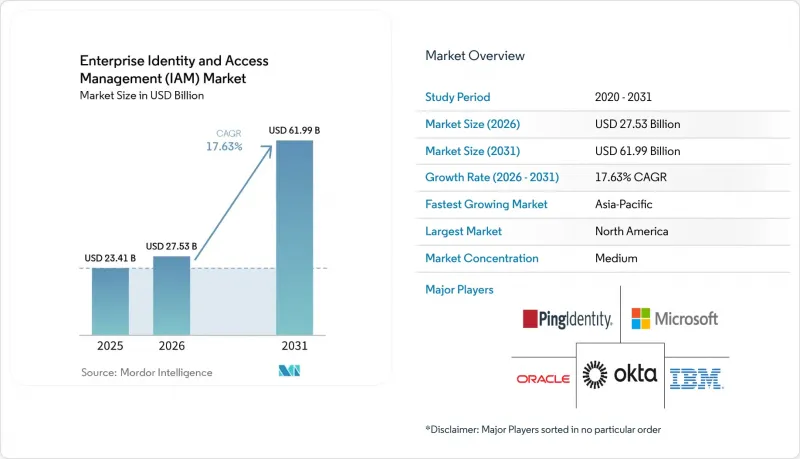
本報告按組件(解決方案和服務)、技術(員工識別等)、部署模式(雲端、本地部署、混合部署)、組織規模(大型企業和中小企業)、最終用戶行業(銀行、金融服務、保險等)和地區進行細分。市場預測以價值(美元)表示。
全球企業識別及存取管理 (IAM) 市場趨勢與洞察
身分詐騙和帳戶劫持案件日益增多
基於身分的攻擊是企業識別及存取管理 (IAM) 市場中最明顯的購買促進因素之一,因為它們會同時影響客戶管道、員工存取權限和復原工作流程。根據美國聯邦調查局 (FBI) 網路犯罪申訴中心 (IC3) 的數據,基於超過 4700 起申訴,2025 年帳戶盜用造成的損失高達 3.597 億美元,同年網路犯罪造成的總損失達到 209 億美元。 LexisNexis Risk Solutions 分析了 2025 年超過 1,160 億筆線上交易,結果顯示全球詐欺攻擊率成長了 8%。其中,歐洲、中東和非洲 (EMEA) 地區的增幅尤為顯著,年增率高達 27%。微軟也報告稱,2025 年全球每秒將發生超過 7,000 起密碼攻擊,這表明攻擊者竊取憑證的成本已大幅降低。隨著交易管理的日益完善,攻擊者正將攻擊點提前到使用者流程的早期階段,利用帳戶創建、憑證重置和恢復等環節,而許多公司目前仍採用不一致的流程來管理這些環節。這種轉變正推動企業身分與存取管理 (IAM) 市場朝著更強大的身分驗證、更廣泛的多因素身分驗證 (MFA)、自適應存取策略和更嚴格的生命週期管治,而不再僅依賴登入控制。
零信任存取架構的擴展
企業識別及存取管理 (IAM) 市場的發展也受到從邊界控制轉變為以身分為主要策略引擎的持續檢驗模型的推動。 2025 年 6 月,美國國家標準與技術研究院 (NIST) 發布了特別出版刊物1800-35,其中介紹了 19 個可操作的零信任架構實施模型,這些模型是與 24 家產業合作夥伴合作檢驗的。 2026 年 4 月,美國國家安全局 (NSA) 發布了更新的指南,定義了使用者支柱中特定階段的零信任成熟度要求。這為國防機構提供了一套系統化的身份升級路線圖。這些框架至關重要,因為它們將身分控制轉化為政府機構、承包商和在受監管供應鏈中運作的企業可衡量的專案要求。 NIS2 及相關產業法規正在歐洲強化類似的趨勢,在歐洲,存取管治和特權存取控制現在與法律課責和採購標準更直接地連結在一起。因此,許多組織正在將其現有的企業 IAM 環境重構為持續信任模型,而不是從頭開始,這對已經整合到企業身分環境中的供應商來說是有利的。
與傳統目錄環境整合的複雜性
企業識別及存取管理 (IAM) 市場仍面臨諸多挑戰,其中之一是許多公司在過去 15 到 20 年間建構的傳統目錄環境的複雜性。 Active Directory 環境通常包含自訂群組結構、自訂連接器、未記錄的依賴項以及“影子整合”,這些只有在遷移規劃開始時才會被發現。這使得專案範圍界定變得困難,部署週期也因此延長,因為每個連接的應用程式都可能帶來單獨的測試和授權難題。正在進行現代化改造的公司通常會在漫長的遷移期內並行運行多個身分系統,這不僅增加了支援成本,還造成了需要額外控制的臨時策略漏洞。在工業和中型企業市場,由於目錄歷史記錄悠久,而專用 IAM 架構的容量有限,這個問題尤其突出。因此,儘管企業 IAM 市場需求強勁,但部分需求轉化為實際收入的速度卻很慢,因為現代化改造專案所需的時間比採購計畫中最初預期的要長。
細分市場分析
預計到2025年,解決方案將佔企業識別及存取管理 (IAM) 市場規模的71.35%。這表明,企業在擴展其支援服務時,仍然高度重視核心平台。這個細分市場之所以能保持其主導地位,是因為身分驗證、存取控制、身分生命週期自動化、特權存取管理和風險分析構成了所有後續管治活動的基礎。買家通常需要先部署這些軟體層,才能實現策略標準化、身分驗證自動化或將控制擴展到新的數位管道。解決方案的基礎架構也十分廣泛,因為員工和客戶身分管理程序都依賴通用的策略引擎、憑證控制和管理工作流程。因此,儘管部署模式和採購趨勢不斷變化,軟體仍然是企業識別及存取管理市場的主要收入來源。
預計到2031年,服務業將以19.53%的複合年成長率成長,成為預測期內企業識別及存取管理 (IAM) 市場中成長最快的細分領域。由於許多公司缺乏高度專業化的IAM工程團隊,需要外部支援來進行遷移規劃、連接器部署、策略調整和持續的管治運營,因此市場需求旺盛。根據歐盟網路與安全局 (ENISA) 2025年的調查,34%的歐盟組織表示缺乏IAM能力,這解釋了為什麼即使在已經對該平台產生興趣的情況下,對託管服務的需求仍然強勁。託管服務的發展速度比傳統的基於專案的工作更快,因為混合環境需要持續監控、存取審查和生命週期管理,而不是週期性的部署里程碑。 IBM於2026年5月推出的「AskIAM」表明,服務供應商正在重新思考如何透過基於代理的編配來交付服務,該編排可在IBM Verify、Microsoft Entra、Saviynt、CyberArk和SailPoint等環境中運行。
到 2025 年,存取管理將佔技術收入的 36.79%,這反映出其在企業識別及存取管理 (IAM) 市場中,在員工和客戶環境中廣泛應用。單一登入、自適應多因素身份驗證 (MFA)、會話控制和條件存取已成為大多數企業的核心營運需求,而不僅僅是可選的升級功能。這種規模支撐了該細分市場佔據領先地位,因為幾乎所有 IAM 專案都從訪問編配開始,然後擴展到更細粒度的權限管治。如今,該細分市場的差異化更多地取決於策略的精確性、身份編配以及跨雲端和本地系統協調存取訊號的能力,而不是基本的登入功能。因此,即使買家需要更廣泛的管治能力,存取管理仍然是企業識別及存取管理 (IAM) 市場的核心。
非人類身分管理預計到 2031 年將以 22.28% 的複合年成長率成長,成為企業身分和存取管理 (IAM) 市場中成長最快的技術領域。這個類別之所以不斷擴張,是因為企業現在除了管理人類身分外,還要管理服務帳戶、API 金鑰、機器人、容器、憑證和 AI 代理,而每項都有其獨特的存取權和課責需求。特權身分管理和第三方身分管理程序也在同步擴展,因為對供應商和機器的存取與營運和供應鏈風險的關聯日益密切。 2026 年 4 月,Okta 正式發布了“Okta for AI Agents”,為通用目錄中的 AI 代理程式添加了生命週期管理、短期權杖認證和撤銷控制功能。隨後,SailPoint 於 2026 年 3 月發布了“Agentic Fabric”,進一步鞏固了 AI 代理身份管治正在成為企業識別及存取管理 (IAM) 市場中一個獨特的控制層這一觀點。
區域分析
到2025年,北美將佔據企業識別及存取管理(IAM)市場39.27%的佔有率,成為該地區最大的收入貢獻者。該地區受益於IAM供應商的高度集中、充足的企業軟體預算,以及身份現代化通常與聯邦網路安全計劃直接掛鉤的採購環境。美國國防部的「零信任戰略和成熟度藍圖」持續影響整個國防生態系統的預期,推動了對支持最小權限、持續檢驗和可審計訪問管治的身份控制的需求。加拿大也在推動其數位身分和網路安全計劃,而美國的金融服務和金融科技業仍然是該地區最活躍的買家之一。
預計亞太地區在2026年至2031年間將以23.61%的複合年成長率成長,成為企業識別及存取管理市場成長最快的地區。這一成長由多種因素共同驅動,包括政府數位身分計畫、行動優先服務模式、日益成長的詐欺風險以及主要經濟體加速採用雲端運算。在印度,數位支付和金融科技的擴張,以及對事件報告日益成長的期望,增加了對即時身份驗證和存取治理的需求,進一步強化了對身分和存取管治的需求。中國憑藉其龐大的數位經濟和產業基礎,仍然是一個重要的市場,這為員工、設備和應用程式的身份管理帶來了大規模的需求。在日本、韓國和東南亞,隨著企業擴大雲端運算的使用並要求更有效地控制客戶身分、員工存取權限和非人為帳戶,市場正在加速成長。
儘管歐洲目前在規模上僅次於北美,但企業識別及存取管理 (IAM) 市場的支出趨勢很大程度上受到 NIS2 和 DORA 相關義務的影響。根據歐盟網路安全與資訊安全局 (ENISA) 的 2025 年評估,34% 的歐盟組織將面臨 IAM 能力不足的問題,這表明對現代化改造的需求非常高,而且在許多情況下,這種需求仍未得到滿足。隨著開放銀行、數位支付以及銀行、金融和保險 (BFSI) 行業數位化進程的推進,南美洲正在崛起成為一個重要的成長區域,這使得增強客戶和員工身分管理日益重要。中東和非洲地區也正在蓬勃發展,沙烏地阿拉伯和阿拉伯聯合大公國正在擴大其數位轉型計畫和政府主導的數位身分服務。
其他好處:
- Excel格式的市場預測(ME)表
- 3個月的分析師支持
目錄
第1章:引言
- 研究假設和市場定義
- 調查範圍
第2章:調查方法
第3章執行摘要
第4章 市場狀況
- 市場概覽
- 市場促進因素
- 身分詐騙和帳戶劫持案件日益增多
- 零信任存取架構的擴展
- 混合型企業中雲端和SaaS的擴展
- 監管機構的壓力要求加強准入管治。
- 透過機器間訪問擴展非人類身份
- 身分安全與更廣泛的網路平台的整合。
- 市場限制因素
- 與傳統目錄環境整合的複雜性
- 企業級身分與存取管理現代化改造高成本
- 雲端平台上的身分資料碎片化
- 身分管治領域熟練人才短缺
- 產業價值鏈分析
- 監理情勢
- 技術展望
- 價格分析
- 專利趨勢
- 波特五力分析
- 宏觀經濟因素對市場的影響
第5章 市場規模與成長預測
- 按組件
- 解決方案
- ID生命週期自動化
- 身份驗證和存取控制
- 身分管治
- 特權存取管理
- 詐欺和風險分析
- 無密碼身份驗證和生物識別
- 服務
- 專業服務
- 託管服務
- 解決方案
- 透過技術
- 員工身分
- 客戶身分
- 特權身分
- 機器和非人類身份
- 第三方身分識別
- 部署模式
- 雲
- 現場
- 混合
- 按組織規模
- 大公司
- 小型企業
- 按最終用途行業分類
- 銀行、金融服務和保險(BFSI)
- 政府/公共行政
- 醫療保健和生命科學
- 資訊科技/通訊
- 零售與電子商務
- 能源公用事業
- 工業製造
- 教育和研究機構
- 運輸/物流
- 其他終端用戶產業
- 按地區
- 北美洲
- 美國
- 加拿大
- 墨西哥
- 南美洲
- 巴西
- 阿根廷
- 其他南美國家
- 歐洲
- 德國
- 英國
- 法國
- 義大利
- 西班牙
- 俄羅斯
- 其他歐洲國家
- 亞太地區
- 中國
- 印度
- 日本
- 韓國
- 澳洲
- 其他亞太國家
- 中東
- 沙烏地阿拉伯
- 阿拉伯聯合大公國
- 土耳其
- 其他中東國家
- 非洲
- 南非
- 奈及利亞
- 其他非洲國家
- 北美洲
第6章 競爭情勢
- 市場集中度
- 策略趨勢
- 市佔率分析
- 公司簡介
- Microsoft Corporation
- Okta, Inc.
- IBM Corporation
- Oracle Corporation
- Ping Identity Corporation
- CyberArk Software Ltd.
- SailPoint Technologies Holdings, Inc.
- Broadcom Inc.
- Thales Group
- SAP SE
- ForgeRock, Inc.
- One Identity LLC
- SecureAuth Corporation
- HID Global Corporation
- RSA Security LLC
- OpenText Corporation
- Akamai Technologies, Inc.
- BeyondTrust Corporation
- Avatier Corporation
- ManageEngine
第7章 市場機會與未來展望
According to Mordor Intelligence, the enterprise identity and access management (IAM) market size is expected to increase from USD 23.41 billion in 2025 to USD 27.53 billion in 2026 and reach USD 61.99 billion by 2031, growing at a CAGR of 17.63% over 2026-2031.
This report is Segmented by Component (Solutions, and Services), Technology (Workforce Identity, and More), Deployment Mode (Cloud, On-Premises, and Hybrid), Organization Size (Large Enterprises, and Small and Medium Enterprises), End-Use Industry (Banking, Financial Services, and Insurance, and More), and Geography. The Market Forecasts are Provided in Terms of Value (USD).
Global Enterprise Identity and Access Management (IAM) Market Trends and Insights
Rising Identity Fraud and Account Takeover Attempts
Identity-based attacks have become one of the clearest buying triggers in the enterprise identity and access management (IAM) market because they affect customer channels, workforce access, and recovery workflows at the same time. The FBI Internet Crime Complaint Center recorded USD 359.7 million in account takeover losses from more than 4,700 complaints in 2025, while total cybercrime losses reached USD 20.9 billion in the same year. LexisNexis Risk Solutions reviewed more than 116 billion online transactions in 2025 and found an 8% rise in global fraud attack rates, with EMEA recording a 27% year-over-year increase. Microsoft also reported that password attacks exceeded 7,000 per second globally in 2025, which shows how inexpensive credential abuse has become for attackers. As transaction controls improve, attackers are moving earlier in the user journey and exploiting account creation, credential reset, and recovery steps that many enterprises still manage through inconsistent processes. That shift is pushing the enterprise IAM market toward stronger identity proofing, broader MFA, adaptive access policies, and tighter lifecycle governance rather than relying only on sign-in controls.
Expansion of Zero Trust Access Architectures
The enterprise identity and access management (IAM) market is also being lifted by the shift from perimeter controls to continuous verification models that rely on identity as the main policy engine. NIST published Special Publication 1800-35 in June 2025 and presented 19 practical zero trust architecture implementation builds validated with 24 industry collaborators. The NSA released updated guidance in April 2026 that defined phase-based zero trust maturity expectations for the user pillar, which gives defense organizations a structured path for identity upgrades. These frameworks matter because they turn identity controls into measurable program requirements for agencies, contractors, and enterprises working in regulated supply chains. NIS2 and related sector rules are reinforcing the same direction in Europe, where access governance and privileged access control are now tied more directly to legal accountability and procurement standards. The result is that many organizations are not starting from scratch; they are rebuilding existing enterprise IAM estates into continuous trust models, which favors vendors already embedded in enterprise identity environments.
Integration Complexity With Legacy Directory Environments
The enterprise identity and access management (IAM) market still faces friction from the depth of legacy directory environments that many enterprises built over 15 to 20 years. Active Directory estates often include custom group structures, one-off connectors, undocumented dependencies, and shadow integrations that are only discovered after migration planning begins. This makes program scoping difficult and stretches deployment timelines because each connected application can create a separate testing and entitlement challenge. Enterprises that proceed with modernization often run parallel identity systems for long transition windows, which increase support costs and create temporary policy gaps that require additional controls. The problem is most visible in industrial and mid-market environments where directory history is deep but dedicated IAM architecture capacity is limited. As a result, strong demand exists in the enterprise IAM market, but a part of it converts slowly into recognized revenue because modernization programs take longer to execute than initial buying plans suggest.
Other drivers and restraints analyzed in the detailed report include:
- Cloud and SaaS Sprawl Across Hybrid Enterprises
- Regulatory Pressure for Stronger Access Governance
- High Cost of Enterprise-Scale IAM Modernization
For complete list of drivers and restraints, kindly check the Table Of Contents.
Segment Analysis
Solutions captured 71.35% of the enterprise identity and access management (IAM) market size in 2025, which shows how strongly enterprises still prioritize core platforms before expanding delivery support. This segment remained dominant because authentication, access control, identity lifecycle automation, privileged access management, and risk analytics form the foundation on which all later governance activity depends. Buyers usually need these software layers in place before they can standardize policy, automate certifications, or extend controls across new digital channels. The solutions base is also broad because both workforce identity and customer identity programs depend on common policy engines, credential controls, and administrative workflows. For that reason, the enterprise identity and access management market continues to anchor revenue in software even while deployment models and procurement preferences evolve.
Services are projected to grow at a 19.53% CAGR through 2031, which makes them the faster-moving part of the enterprise identity and access management (IAM) market over the forecast period. Demand is rising because many enterprises do not have deep IAM engineering teams and need outside support for migration planning, connector deployment, policy tuning, and ongoing governance operations. ENISA's 2025 finding that 34% of EU organizations reported IAM capability gaps helps explain why managed service demand remains strong even when platform interest is already established. Managed services are advancing faster than traditional project work because hybrid environments require continuous monitoring, access review, and lifecycle administration rather than periodic implementation milestones. IBM's AskIAM launch in May 2026 showed how service providers are repositioning delivery through agentic orchestration that works across IBM Verify, Microsoft Entra, Saviynt, CyberArk, and SailPoint environments.
Access management held 36.79% of technology revenue in 2025, which reflects its broad deployment base across workforce and customer-facing environments in the enterprise identity and access management (IAM) market. Single sign-on, adaptive MFA, session controls, and conditional access have become core operating requirements rather than optional upgrades for most enterprises. That scale supports the segment's leading share because nearly every IAM program starts with access orchestration before it expands into deeper entitlement governance. Competitive separation in this segment now depends less on basic sign-in features and more on policy precision, identity orchestration, and the ability to align access signals across cloud and on-premises systems. This keeps access management at the center of the enterprise identity and access management (IAM) market even as buyers ask for wider governance capability.
Non-human identity management is projected to grow at a 22.28% CAGR through 2031, which makes it the fastest-growing technology segment in the enterprise IAM market. The category is widening because enterprises now manage service accounts, API keys, bots, containers, certificates, and AI agents alongside human identities, and each of those assets carries separate access and accountability needs. Privileged identity and third-party identity programs are growing in parallel because supplier access and machine access are now linked more closely to operational and supply chain risk. Okta made Okta for AI Agents generally available in April 2026, adding lifecycle management, short-lived token authentication, and revocation controls for AI agents inside Universal Directory. SailPoint followed with Agentic Fabric in March 2026, which reinforced the idea that AI agent identity governance is becoming a distinct control layer inside the enterprise identity and access management (IAM) market.
Complete Report Scope:
- By Component
- Solutions
- Identity Lifecycle Automation
- Authentication and Access Control
- Identity Governance and Administration
- Privileged Access Management
- Fraud and Risk Analytics
- Passwordless and Biometric Authentication
- Services
- Professional Services
- Managed Services
- Solutions
- By Technology
- Workforce Identity
- Customer Identity
- Privileged Identity
- Machine and Non-Human Identity
- Third-Party Identity
- By Deployment Mode
- Cloud
- On-Premises
- Hybrid
- By Organization Size
- Large Enterprises
- Small and Medium Enterprises
- By End-Use Industry
- Banking, Financial Services, and Insurance (BFSI)
- Government and Public Administration
- Healthcare and Life Sciences
- IT and Telecommunication
- Retail and E-Commerce
- Energy and Utilities
- Industrial Manufacturing
- Education and Research Institutions
- Transportation and Logistics
- Other End-User Industries
- By Geography
- North America
- United States
- Canada
- Mexico
- South America
- Brazil
- Argentina
- Rest of South America
- Europe
- Germany
- United Kingdom
- France
- Italy
- Spain
- Russia
- Rest of Europe
- Asia-Pacific
- China
- India
- Japan
- South Korea
- Australia
- Rest of Asia-Pacific
- Middle East
- Saudi Arabia
- United Arab Emirates
- Turkey
- Rest of the Middle East
- Africa
- South Africa
- Nigeria
- Rest of Africa
- North America
Geography Analysis
North America held 39.27% of the enterprise identity and access management (IAM) market share in 2025, which made it the leading regional contributor by revenue. The region benefits from the highest concentration of IAM vendors, deep enterprise software budgets, and a procurement environment where identity modernization is often tied directly to federal cybersecurity programs. The U.S. Department of Defense's zero trust strategy and maturity roadmap continue to shape expectations across the defense ecosystem, which strengthens demand for identity controls that support least privilege, continuous verification, and auditable access governance. Canada is also advancing digital identity and cybersecurity programs, while U.S. financial services and fintech remain among the most active buyers in the region.
Asia-Pacific is projected to grow at a 23.61% CAGR from 2026 to 2031, which makes it the fastest-growing region in the enterprise identity and access management market. Growth is being driven by a mix of government digital identity programs, mobile-first service models, rising fraud exposure, and faster cloud adoption across major economies. India is seeing stronger IAM demand as digital payments, fintech expansion, and incident reporting expectations increase the need for real-time identity verification and access governance. China remains important because the size of its digital economy and industrial base creates large-scale workforce, machine, and application identity requirements. Japan, South Korea, and Southeast Asia are also adding momentum as enterprises broaden cloud usage and look for stronger controls over customer identity, workforce access, and non-human accounts.
Europe ranks behind North America in current scale, but its spending path in the enterprise identity and access management (IAM) market is being shaped strongly by NIS2 and DORA-related obligations. ENISA's 2025 assessment that 34% of EU organizations reported IAM capability gaps shows that modernization demand is substantial and still under-served in many environments. South America is emerging as a meaningful growth area as open banking, digital payments, and BFSI digitization increase the value of stronger customer and workforce identity controls. The Middle East and Africa are also gaining momentum as Saudi Arabia and the UAE expand digital transformation programs and government-backed digital identity services.
- Microsoft Corporation
- Okta, Inc.
- IBM Corporation
- Oracle Corporation
- Ping Identity Corporation
- CyberArk Software Ltd.
- SailPoint Technologies Holdings, Inc.
- Broadcom Inc.
- Thales Group
- SAP SE
- ForgeRock, Inc.
- One Identity LLC
- SecureAuth Corporation
- HID Global Corporation
- RSA Security LLC
- OpenText Corporation
- Akamai Technologies, Inc.
- BeyondTrust Corporation
- Avatier Corporation
- ManageEngine
Additional Benefits:
- The market estimate (ME) sheet in Excel format
- 3 months of analyst support
TABLE OF CONTENTS
1 INTRODUCTION
- 1.1 Study Assumptions and Market Definition
- 1.2 Scope of the Study
2 RESEARCH METHODOLOGY
3 EXECUTIVE SUMMARY
4 MARKET LANDSCAPE
- 4.1 Market Overview
- 4.2 Market Drivers
- 4.2.1 Rising Identity Fraud and Account Takeover Attempts
- 4.2.2 Expansion of Zero Trust Access Architectures
- 4.2.3 Cloud and SaaS Sprawl Across Hybrid Enterprises
- 4.2.4 Regulatory Pressure for Stronger Access Governance
- 4.2.5 Non-Human Identity Growth From Machine-to-Machine Access
- 4.2.6 Identity Security Convergence With Broader Cyber Platforms
- 4.3 Market Restraints
- 4.3.1 Integration Complexity With Legacy Directory Environments
- 4.3.2 High Cost of Enterprise-Scale IAM Modernization
- 4.3.3 Identity Data Fragmentation Across Cloud Platforms
- 4.3.4 Skilled Identity Governance Talent Shortage
- 4.4 Industry Value-Chain Analysis
- 4.5 Regulatory Landscape
- 4.6 Technological Outlook
- 4.7 Pricing Analysis
- 4.8 Patent Landscape
- 4.9 Porter's Five Forces Analysis
- 4.9.1 Threat of New Entrants
- 4.9.2 Bargaining Power of Suppliers
- 4.9.3 Bargaining Power of Buyers
- 4.9.4 Threat of Substitutes
- 4.9.5 Intensity of Competitive Rivalry
- 4.10 Impact of Macroeconomic Factors on the Market
5 MARKET SIZE AND GROWTH FORECASTS
- 5.1 By Component
- 5.1.1 Solutions
- 5.1.1.1 Identity Lifecycle Automation
- 5.1.1.2 Authentication and Access Control
- 5.1.1.3 Identity Governance and Administration
- 5.1.1.4 Privileged Access Management
- 5.1.1.5 Fraud and Risk Analytics
- 5.1.1.6 Passwordless and Biometric Authentication
- 5.1.2 Services
- 5.1.2.1 Professional Services
- 5.1.2.2 Managed Services
- 5.1.1 Solutions
- 5.2 By Technology
- 5.2.1 Workforce Identity
- 5.2.2 Customer Identity
- 5.2.3 Privileged Identity
- 5.2.4 Machine and Non-Human Identity
- 5.2.5 Third-Party Identity
- 5.3 By Deployment Mode
- 5.3.1 Cloud
- 5.3.2 On-Premises
- 5.3.3 Hybrid
- 5.4 By Organization Size
- 5.4.1 Large Enterprises
- 5.4.2 Small and Medium Enterprises
- 5.5 By End-Use Industry
- 5.5.1 Banking, Financial Services, and Insurance (BFSI)
- 5.5.2 Government and Public Administration
- 5.5.3 Healthcare and Life Sciences
- 5.5.4 IT and Telecommunication
- 5.5.5 Retail and E-Commerce
- 5.5.6 Energy and Utilities
- 5.5.7 Industrial Manufacturing
- 5.5.8 Education and Research Institutions
- 5.5.9 Transportation and Logistics
- 5.5.10 Other End-User Industries
- 5.6 By Geography
- 5.6.1 North America
- 5.6.1.1 United States
- 5.6.1.2 Canada
- 5.6.1.3 Mexico
- 5.6.2 South America
- 5.6.2.1 Brazil
- 5.6.2.2 Argentina
- 5.6.2.3 Rest of South America
- 5.6.3 Europe
- 5.6.3.1 Germany
- 5.6.3.2 United Kingdom
- 5.6.3.3 France
- 5.6.3.4 Italy
- 5.6.3.5 Spain
- 5.6.3.6 Russia
- 5.6.3.7 Rest of Europe
- 5.6.4 Asia-Pacific
- 5.6.4.1 China
- 5.6.4.2 India
- 5.6.4.3 Japan
- 5.6.4.4 South Korea
- 5.6.4.5 Australia
- 5.6.4.6 Rest of Asia-Pacific
- 5.6.5 Middle East
- 5.6.5.1 Saudi Arabia
- 5.6.5.2 United Arab Emirates
- 5.6.5.3 Turkey
- 5.6.5.4 Rest of the Middle East
- 5.6.6 Africa
- 5.6.6.1 South Africa
- 5.6.6.2 Nigeria
- 5.6.6.3 Rest of Africa
- 5.6.1 North America
6 COMPETITIVE LANDSCAPE
- 6.1 Market Concentration
- 6.2 Strategic Moves
- 6.3 Market Share Analysis
- 6.4 Company Profiles (includes Global Level Overview, Market Level Overview, Core Segments, Financials as available, Strategic Information, Market Rank/Share, Products and Services, Recent Developments)
- 6.4.1 Microsoft Corporation
- 6.4.2 Okta, Inc.
- 6.4.3 IBM Corporation
- 6.4.4 Oracle Corporation
- 6.4.5 Ping Identity Corporation
- 6.4.6 CyberArk Software Ltd.
- 6.4.7 SailPoint Technologies Holdings, Inc.
- 6.4.8 Broadcom Inc.
- 6.4.9 Thales Group
- 6.4.10 SAP SE
- 6.4.11 ForgeRock, Inc.
- 6.4.12 One Identity LLC
- 6.4.13 SecureAuth Corporation
- 6.4.14 HID Global Corporation
- 6.4.15 RSA Security LLC
- 6.4.16 OpenText Corporation
- 6.4.17 Akamai Technologies, Inc.
- 6.4.18 BeyondTrust Corporation
- 6.4.19 Avatier Corporation
- 6.4.20 ManageEngine
7 MARKET OPPORTUNITIES AND FUTURE OUTLOOK
- 7.1 White-Space and Unmet-Need Assessment

 身分與存取管理 (IAM)保全服務:市場佔有率分析、產業趨勢與統計資料、成長預測(2026-2031 年)
 客戶識別和存取管理市場預測至 2034 年—按組件、部署模式、身份驗證方法、組織規模、最終用戶和地區分類的全球分析
 識別及存取管理專業服務市場:2026-2032年全球市場預測(按服務類型、交付方式、軟體包格式、身分類型、應用程式、產業、部署模式和組織規模分類)身分與存取管理市場:2026-2032年全球市場預測(按服務類型、存取類型、技術、部署模式、身分驗證類型、最終使用者和組織規模分類)
 2026-2030年全球身分與訪問管理市場
 全球非人類身分(NHI)存取管理市場:市場規模、佔有率、趨勢和成長分析(2026-2034 年)非人類身分(NHI)安全:市場佔有率分析、行業趨勢和統計數據以及成長預測(2026-2031 年)全球物聯網身分與存取管理 (IAM) 市場規模、佔有率、趨勢和成長分析報告(2026-2034 年)
 非人類身分(NHI)存取管理市場規模、佔有率和成長分析:按元件、身分類型、部署模式、應用程式、企業規模、最終用戶產業和地區分類-2026-2033年產業預測
 非人類身分存取管理市場規模、佔有率和趨勢分析報告:按組件、部署模式、ID 類型、組織規模、最終用途、地區和細分市場預測(2026-2033 年)