


 |
市場調查報告書
商品編碼
2098547
非人類身分(NHI)安全:市場佔有率分析、行業趨勢和統計數據以及成長預測(2026-2031 年)Non-Human Identity (NHI) Security - Market Share Analysis, Industry Trends & Statistics, Growth Forecasts (2026 - 2031) |
||||||

※ 本網頁內容可能與最新版本有所差異。詳細情況請與我們聯繫。
根據 Mordor Intelligence 預測,非人類身分 (NHI) 安全市場規模將從 2025 年的 68.2 億美元和 2026 年的 82.2 億美元成長到 2031 年的 229.4 億美元,2026 年至 2031 年的年複合成長率(CAGR)為 22.78%。
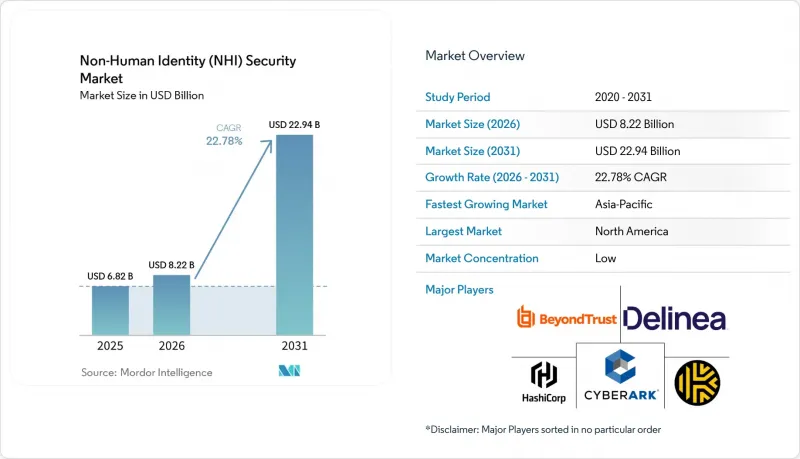
本報告按元件(解決方案和服務)、身分類型(應用程式 ID 和服務 ID 等)、部署模式(雲端、本地部署、混合部署)、企業規模(大型企業、中小企業)、最終用戶產業(銀行、金融服務和保險、醫療保健和生命科學等)以及地區進行細分。市場預測以價值(美元)表示。
全球非人類身分(NHI)安全市場趨勢與洞察
API、雲端工作負載和機器間存取的快速擴展
在非人類身分認同 (NHI) 安全市場中,API主導架構仍然是最強勁的需求推動要素。這是因為每個雲端服務、微服務、CI/CD 工作流程和整合端點都會產生至少一個機器身分。因此,即使在 AI 代理和自動化機器人添加到環境之前,現代企業也需要管理大量的服務帳戶、令牌和金鑰。 CyberArk 報告稱,到 2025 年,普通企業中的機器身份數量將是人類身份數量的 82 倍,這凸顯了機器憑證數量正迅速成為安全團隊的一項重大負擔。此外,身分數量的成長並非線性成長,而是隨著新部署在服務之間建立新的信任關係,在應用層、雲層和整合層之間同步擴散。這一趨勢確保了身分發現、輪調和策略執行仍然是整個非人類身分安全市場採購標準的核心要素。 IETF WIMSE 計畫中的標準化工作也表明,工作負載身分驗證正從一個細分領域轉變為機器間安全的核心基礎設施控制。
因服務帳戶權限過高而導致的安全漏洞成本增加
權限過高的服務帳戶持續推動非人類身分 (NHI) 安全市場的支出,因為它們與被盜用的人類帳戶構成不同的風險特徵。這些帳戶通常未啟用多因素身份驗證,很少觸發與員工帳戶相同的行為檢查,並且往往會在多年內累積權限。 IBM 在 2025 年的報告中指出,識別和遏制基於憑證的資料外洩平均需要 246 天,平均成本為 467 萬美元,這凸顯了經營團隊持續關注長期隱藏的身份洩露的必要性。 BeyondTrust 的一項研究發現,在 2025 年評估的企業環境中,超過 70% 存在處於休眠狀態的特權服務帳戶。同時,Entro Security 的一份報告顯示,五分之一的非人類身分 (NHI) 擁有完整的管理員權限,其中許多帳戶已閒置超過九個月。因此,攻擊面問題並非只是「清理」的問題。這是因為問題的根源在於為人類而非機器規模的身份所建構的管治流程。這種不一致持續推動著整個 NHI 安全市場對偵測、策略和最小權限控制的持續需求。
國民健康保險缺乏標準化的門禁控制框架
缺乏廣泛採用的機器身分保障框架持續阻礙非人類身分 (NHI) 安全市場的發展。這是因為買家缺乏統一的策略設計、成熟度評估或預算論證基準。儘管 OWASP 發布了「非人類身分十大風險」指南,產業組織也積極推動工作負載身分的標準化,但目前仍沒有與成熟的人類身分保障模型直接對應的框架。因此,許多組織選擇將來自多個來源的控制措施拼湊在一起,而不是在一個統一的、公認的框架內實施控制。雲端安全聯盟 (CSA) 在 2026 年報告中指出,超過 16% 的組織根本不追蹤 AI 相關身分的創建,這表明儘管身分數量不斷增加,但策略執行仍然不足。因此,安全、基礎設施和應用團隊之間的內部協調存在滯後。在標準更貼近通用業務實踐之前,這個問題將繼續成為 NHI 安全市場普及應用的主要障礙。
細分市場分析
到2025年,解決方案將佔據61.09%的市場佔有率,這表明買家優先考慮用於發現、姿態管理和即時策略控制的軟體平台。預算仍然主要分配給那些無需依賴人工清點即可跨雲端、應用和基礎架構環境識別機器身分的工具。這一趨勢反映了API金鑰、OAuth令牌、憑證、服務帳戶和AI相關憑證在日常工作流程中激增所帶來的營運負擔。因此,在非人類身分(NHI)安全市場,能夠整合發現和生命週期管理(而不僅僅是提供可見性)的供應商更受青睞。 IBM在2026年發布的「機器身分管理」也證實了企業需求正在從一次性評估轉向自動化發行、續約、撤銷和管治。
預計到2031年,服務業的複合年成長率將達到23.84%,顯示深化實施的重要性幾乎與平台選擇不相上下。許多實施方案需要在策略生效前與現有的特權存取管理 (PAM)、客戶資訊和事件管理 (CIEM)、安全資訊和事件管理 (SIEM) 以及雲端身分堆疊進行整合,才能在生產環境中看到策略效果。此外,採購公司還需要在憑證輪調、所有權映射、進入許可權審查以及跨團隊營運模式設計方面獲得支持,因為這些團隊未必共用相同的身分工作流程。隨著非人類身分 (NHI) 專案的成熟,諮詢、託管營運和糾正措施支援將繼續成為非人類身分安全市場產品採用的重要補充。平台投資和營運支援之間的平衡表明,該領域正從早期認知階段過渡到更結構化、企業級的實施階段。
到2025年,應用程式和服務身分將佔據27.14%的市場佔有率,成為非人類身分(NHI)安全市場中最大的身分類型。這一主導地位反映了OAuth令牌、API金鑰、SaaS整合憑證和服務帳戶在日常業務運作中的廣泛應用。此外,由於這些身分與應用程式效能、整合可靠性和發布計劃緊密相關,因此難以更改。 Entro Security在2025年報告中指出,47%的NHI已超過一年未進行更改。許多靜態憑證集中在應用整合層,輪換這些憑證會擾亂工作流程。這種規模和營運敏感度相結合,使得應用程式身分始終是買家關注的焦點。
預計到 2031 年,工作負載和容器身分將以 23.95% 的複合年成長率成長,成為身分類別中成長最快的細分市場。雲端原生運算基金會 (CNCF) 繼續將 SPIFFE 和 SPIRE 定位為 2026 年 Kubernetes 環境中工作負載身分的關鍵方法,這對於尋求無需使用持久金鑰即可進行加密證明的組織尤其重要。這表明,隨著雲端原生環境轉向短期憑證和更強大的運行時信任控制,非人類身分 (NHI) 安全產業正在經歷更廣泛的平台轉型。由於工業IoT的日益普及和 DevSecOps 證書的廣泛應用,機器和設備身分以及加密身分的市場也在不斷擴大,從而拓寬了整體目標市場。雲端安全聯盟 (CSA) 引用 Verizon 2026 年關於供應鏈和第三方資料外洩風險日益增加的研究結果,凸顯了在外部信任邊界之外管理 API 和工作負載身分的迫切性。
區域分析
到2025年,北美將佔據非人類身分(NHI)安全市場32.15%的佔有率,成為該地區收入貢獻最大的區域。該地區受益於雲端原生公司的高度集中、零信任架構的積極應用以及支援專業NHI供應商的風險投資環境。同時,北美也是平台整合最活躍的地區,Palo Alto Networks於2026年2月完成對CyberArk的收購,思科於2026年5月收購Astrix Security,以增強其身分和人工智慧代理管治能力。金融服務和科技業的買家仍然是主要的需求來源,因為他們經營大規模的機器身分環境,並且對管治有著很高的期望。
歐洲繼續保持其第二大區域市場的地位,這得益於其對數據主權的高度重視以及金融領域對營運韌性的關注。英國、德國和法國繼續引領市場,受監管行業傾向於採用能夠與現有身分和存取管理 (IAM) 環境整合的本地部署和混合解決方案。 《數位營運韌性法案》為可追溯的 ICT 存取控制增加了一個強大的合規層,從而推動了金融機構對機器身分管治進行多年採購。 GitGuardian 的 2026 年更新版本,保護了超過 115,000 名開發人員並監控了超過 61 萬個程式庫,也顯示了歐洲及其他地區以開發為中心的組織對機密安全有著強勁的需求。
預計到2031年,亞太地區將以24.39%的複合年成長率成長,成為非人類身分(NHI)安全市場成長最快的區域市場。預計到2025年,中國將在該地區佔據最大的市場佔有率,這得益於其大規模的雲端基礎設施的擴張以及能夠支援機器身份控制的本土技術提供商的存在。印度預計將繼續保持該地區成長最快的國家地位,這主要得益於數位專案、金融科技的擴張以及IT服務的成長,從而推動了服務帳戶和API憑證數量的增加。日本、韓國和澳洲也透過企業持續採用雲端技術以及對自動化和人工智慧相關工作負載的更嚴格管治日益成長的興趣,全部區域的需求提供了支持。中東和非洲仍處於起步階段,但海灣國家的數位轉型努力以及南非和奈及利亞金融、保險和證券(BFSI)以及通訊業的需求,將繼續為未來的應用奠定基礎。
其他好處:
- Excel格式的市場預測(ME)表
- 3個月的分析師支持
目錄
第1章:引言
- 研究假設和市場定義
- 調查範圍
第2章:調查方法
第3章執行摘要
第4章 市場狀況
- 市場概覽
- 市場促進因素
- API、雲端工作負載和M2M存取的快速擴展
- 因服務帳戶權限過高而導致的安全漏洞成本增加。
- 雲端原生和 Kubernetes 中的身分氾濫
- 在非人類工作負載中徹底實施零信任
- 監管不力的AI代理和自動化機器人
- 對無秘密且臨時的認證資訊輪調的需求
- 市場限制因素
- 國民健康保險缺乏標準化的門禁控制框架
- 傳統和混合 IT 環境中整合的複雜性
- 臨時身分的發現和所有權映射有限
- IAM、PAM、CIEM 和機密資訊管理工具之間的重疊導致了採購摩擦。
- 宏觀經濟因素對市場的影響
- 產業價值鏈分析
- 監理情勢
- 技術展望
- 波特五力分析
第5章 市場規模與成長預測
- 按組件
- 解決方案
- 服務
- ID 類型
- 應用程式和服務 ID
- 工作負載和容器標識符
- 機器和設備的識別符
- 加密ID
- 不同的發展
- 雲
- 現場
- 混合
- 按公司規模
- 大公司
- 小型企業
- 按最終用戶行業分類
- BFSI
- 醫療保健和生命科學
- 資訊科技/通訊
- 零售與電子商務
- 工業製造
- 政府/公共部門
- 其他終端用戶產業
- 按地區
- 北美洲
- 美國
- 加拿大
- 墨西哥
- 南美洲
- 巴西
- 阿根廷
- 其他南美國家
- 歐洲
- 德國
- 英國
- 法國
- 義大利
- 西班牙
- 俄羅斯
- 其他歐洲國家
- 亞太地區
- 中國
- 印度
- 日本
- 韓國
- 澳洲
- 其他亞太國家
- 中東和非洲
- 中東
- 沙烏地阿拉伯
- 阿拉伯聯合大公國
- 其他中東國家
- 非洲
- 南非
- 奈及利亞
- 其他非洲國家
- 中東
- 北美洲
第6章 競爭情勢
- 市場集中度
- 策略趨勢
- 市佔率分析
- 公司簡介
- CyberArk Software Ltd.
- Delinea, Inc.
- BeyondTrust Corporation
- HashiCorp, Inc.
- Keeper Security, Inc.
- One Identity, LLC
- AppViewX, Inc.
- Aembit, Inc.
- Akeyless Security Ltd.
- Astrix Security Ltd.
- Clutch Security Ltd.
- Entro Security Ltd.
- GitGuardian SAS
- P0 Security, Inc.
- Permiso Security, Inc.
- Silverfort Ltd.
- Teleport Security, Inc.
- Token Security Ltd.
- Britive, Inc.
- Saviynt, Inc.
第7章 市場機會與未來展望
According to Mordor Intelligence, the non-Human identity (NHI) security market size is projected to expand from USD 6.82 billion in 2025 and USD 8.22 billion in 2026 to USD 22.94 billion by 2031, registering a CAGR of 22.78% between 2026 and 2031.
This report is Segmented by Component (Solutions and Services), Identity Type (Application and Service Identities, and More), Deployment (Cloud, On-Premises, and Hybrid), Enterprise Size (Large Enterprises, and Small and Medium Enterprises), End-User Industry (BFSI, Healthcare and Life Sciences, and More), and Geography. The Market Forecasts are Provided in Terms of Value (USD).
Global Non-Human Identity (NHI) Security Market Trends and Insights
Rapid Expansion of APIs, Cloud Workloads, and Machine-To-Machine Access
API-led architectures remain the strongest demand driver for the Non-Human Identity (NHI) Security Market because every cloud service, microservice, CI/CD workflow, and integration endpoint creates at least 1 machine identity. Modern enterprises therefore manage very large populations of service accounts, tokens, and keys, even before AI agents and automation bots are added to the environment. CyberArk reported in 2025 that machine identities outnumbered human identities by 82:1 in the average enterprise, underscoring how quickly machine credential populations have become the primary burden on security teams. New deployments also create new trust relationships between services, so identity growth is not linear and tends to spread across the application, cloud, and integration layers simultaneously. This pattern keeps discovery, rotation, and policy enforcement near the center of buying criteria across the Non-Human Identity Security Market. The standardization work under the IETF WIMSE effort also shows that workload identity attestation is moving from a niche topic toward a core infrastructure control for machine-to-machine security.
Rising Breach Costs from Over-Privileged Service Accounts
Over-privileged service accounts continue to drive spending in the Non-Human Identity (NHI) Security Market because they create a different risk profile from human account compromise. These accounts often operate without multi-factor authentication; they rarely trigger the same behavioral checks as employee accounts, and they tend to accumulate permissions over many years. IBM reported in 2025 that credential-based breaches took an average of 246 days to identify and contain, at an average cost of USD 4.67 million, highlighting the need to keep executive focus on identity exposure that remains hidden for long periods. BeyondTrust found dormant privileged service accounts in more than 70% of enterprise environments assessed in 2025, while Entro Security reported that 1 in 20 NHIs had full administrative privileges and many had remained inactive for more than 9 months. The result is that the attack surface is not just a cleanup issue, because it stems from governance processes built for people rather than for machine-scale identities. That mismatch continues to support durable demand for discovery, policy, and least-privilege controls across the NHI Security Market.
Absence of Standardized Access Control Frameworks For NHIs
The lack of a widely adopted machine identity assurance framework continues to slow the Non-Human Identity (NHI) Security Market because buyers lack a single benchmark for policy design, maturity scoring, or budget justification. OWASP has published its Non-Human Identities Top 10, and industry groups have pushed workload identity standards, yet there is still no direct equivalent to long-established human identity assurance models. This leaves many organizations combining controls from several sources rather than implementing them in a single recognized structure. Cloud Security Alliance reported in 2026 that more than 16% of organizations did not track the creation of AI-related identities at all, indicating that policy coverage remains weak even as identity populations expand. The result is slower internal alignment between security, infrastructure, and application teams. Until standards move closer to common enterprise practice, this issue should remain a real drag on deployment speed in the NHI Security Market.
Other drivers and restraints analyzed in the detailed report include:
- Cloud-Native and Kubernetes Identity Sprawl
- Zero Trust Enforcement Across Non-Human Workloads
- Integration Complexity Across Legacy and Hybrid IT Environments
For complete list of drivers and restraints, kindly check the Table Of Contents.
Segment Analysis
Solutions held 61.09% of the market in 2025, which showed that buyers first prioritized software platforms for discovery, posture management, and real-time policy control. The largest budgets still flowed to tooling that could identify machine identities across cloud, application, and infrastructure environments without relying on manual inventory work. This preference reflected the operational burden created by API keys, OAuth tokens, certificates, service accounts, and AI-related credentials that had spread across daily workflows. The Non-Human Identity (NHI) Security Market, therefore, favored solution vendors that could unify discovery with lifecycle actions instead of offering visibility alone. IBM's 2026 launch of Machine Identity Management also reinforced that enterprise demand had moved toward automated issuance, renewal, revocation, and governance rather than one-time assessment.
The Services segment is projected to grow at a 23.84% CAGR through 2031, indicating that implementation depth is becoming almost as important as platform selection. Many deployments require integration with existing PAM, CIEM, SIEM, and cloud identity stacks before policy outcomes become visible in production. Buyers also need support for credential rotation, ownership mapping, access reviews, and operating model design across teams that do not always share the same identity workflows. As NHI programs mature, consulting, managed operations, and remediation support should remain essential complements to product adoption in the Non-Human Identity (NHI) Security Market. The balance between platform spending and operational support suggests that the category is moving from early awareness into more structured enterprise execution.
Application and Service Identities accounted for 27.14% of the market in 2025, making them the largest identity type inside the Non-Human Identity (NHI) Security Market. Their lead reflected the heavy use of OAuth tokens, API keys, SaaS integration credentials, and service accounts across ordinary business operations. These identities are also difficult to change because many are tightly linked to application performance, integration reliability, and release timelines. Entro Security reported in 2025 that 47% of NHIs had remained unchanged for more than 1 year, with many static credentials concentrated in application integration layers where rotation can break workflows. That mix of scale and operational sensitivity kept application identities at the center of buyer concern.
Workload and Container Identities are projected to expand at a 23.95% CAGR through 2031, which makes it the fastest-growing identity category. The Cloud Native Computing Foundation continued in 2026 to frame SPIFFE and SPIRE as important approaches to workload identity in Kubernetes environments, especially for organizations seeking cryptographic attestation without persistent secrets. This points to a broader platform shift within the Non-Human Identity (NHI) Security industry, as cloud-native environments move toward shorter-lived credentials and stronger runtime trust controls. Machine and Device Identities and Cryptographic Identities are also expanding as industrial IoT adoption, and the use of DevSecOps certificates expands the overall addressable base. Cloud Security Alliance's reference to Verizon's 2026 findings on higher supply chain and third-party breach exposure adds urgency to governing API and workload identities across external trust boundaries.
Complete Report Scope:
- By Component
- Solutions
- Services
- By Identity Type
- Application and Service Identities
- Workload and Container Identities
- Machine and Device Identities
- Cryptographic Identities
- By Deployment
- Cloud
- On-Premises
- Hybrid
- By Enterprise Size
- Large Enterprises
- Small and Medium Enterprises
- By End-user Industry
- BFSI
- Healthcare and Life Sciences
- Information Technology and Telecom
- Retail and E-commerce
- Industrial Manufacturing
- Government and Public Sector
- Other End-user Industries
- By Geography
- North America
- United States
- Canada
- Mexico
- South America
- Brazil
- Argentina
- Rest of South America
- Europe
- Germany
- United Kingdom
- France
- Italy
- Spain
- Russia
- Rest of Europe
- Asia-Pacific
- China
- India
- Japan
- South Korea
- Australia
- Rest of Asia-Pacific
- Middle East and Africa
- Middle East
- Saudi Arabia
- United Arab Emirates
- Rest of Middle East
- Africa
- South Africa
- Nigeria
- Rest of Africa
- Middle East
- North America
Geography Analysis
North America accounted for 32.15% of the Non-Human Identity (NHI) Security Market in 2025, making it the largest regional contributor by revenue. The region benefits from a high concentration of cloud-native enterprises, strong zero-trust adoption, and a venture environment that has supported specialist NHI vendors. It also remains the most active region for platform consolidation, with Palo Alto Networks completing its acquisition of CyberArk in February 2026 and Cisco acquiring Astrix Security in May 2026 to strengthen identity and AI agent governance capabilities. Financial services and technology buyers remain the main demand centers because they run large machine identity estates and face higher governance expectations.
Europe remained the second-largest regional market, supported by strong data sovereignty priorities and the financial sector's focus on operational resilience. The United Kingdom, Germany, and France continued to lead adoption as regulated sectors favored on-premises and hybrid options that could integrate with established IAM estates. The Digital Operational Resilience Act has added a durable compliance layer for traceable ICT access control, which supports multi-year procurement for machine identity governance in financial institutions. GitGuardian's 2026 update on protecting more than 115,000 developers and monitoring more than 610,000 repositories also points to strong demand for secrets security across development-heavy organizations operating in Europe and other regions.
Asia-Pacific is projected to expand at a 24.39% CAGR through 2031, which makes it the fastest-growing regional segment in the Non-Human Identity (NHI) Security Market. China held the largest regional revenue share in 2025, supported by large-scale cloud infrastructure expansion and the presence of domestic technology providers that can support machine identity controls. India is expected to remain the fastest-growing country in the region as digital programs, fintech expansion, and IT services growth create larger volumes of service accounts and API credentials. Japan, South Korea, and Australia also support regional demand through continued enterprise cloud adoption and growing interest in stronger governance for automation and AI-linked workloads. The Middle East and Africa remained earlier-stage markets, but digital transformation programs in the Gulf and demand from BFSI and telecom in South Africa and Nigeria continued to create an entry point for future adoption.
- CyberArk Software Ltd.
- Delinea, Inc.
- BeyondTrust Corporation
- HashiCorp, Inc.
- Keeper Security, Inc.
- One Identity, LLC
- AppViewX, Inc.
- Aembit, Inc.
- Akeyless Security Ltd.
- Astrix Security Ltd.
- Clutch Security Ltd.
- Entro Security Ltd.
- GitGuardian SAS
- P0 Security, Inc.
- Permiso Security, Inc.
- Silverfort Ltd.
- Teleport Security, Inc.
- Token Security Ltd.
- Britive, Inc.
- Saviynt, Inc.
Additional Benefits:
- The market estimate (ME) sheet in Excel format
- 3 months of analyst support
TABLE OF CONTENTS
1 INTRODUCTION
- 1.1 Study Assumptions and Market Definition
- 1.2 Scope of the Study
2 RESEARCH METHODOLOGY
3 EXECUTIVE SUMMARY
4 MARKET LANDSCAPE
- 4.1 Market Overview
- 4.2 Market Drivers
- 4.2.1 Rapid Expansion of APIs, Cloud Workloads, and Machine-to-Machine Access
- 4.2.2 Rising Breach Costs From Over-Privileged Service Accounts
- 4.2.3 Cloud-Native and Kubernetes Identity Sprawl
- 4.2.4 Zero Trust Enforcement Across Non-Human Workloads
- 4.2.5 Under-Governed AI Agents and Automation Bots
- 4.2.6 Secretless and Ephemeral Credential Rotation Demand
- 4.3 Market Restraints
- 4.3.1 Absence of Standardized Access Control Frameworks for NHIs
- 4.3.2 Integration Complexity Across Legacy and Hybrid IT Environments
- 4.3.3 Limited Discovery and Ownership Mapping for Ephemeral Identities
- 4.3.4 Procurement Friction From IAM, PAM, CIEM, and Secrets Tool Overlap
- 4.4 Impact of Macroeconomic Factors on the Market
- 4.5 Industry Value-Chain Analysis
- 4.6 Regulatory Landscape
- 4.7 Technological Outlook
- 4.8 Porter's Five Forces Analysis
- 4.8.1 Bargaining Power of Buyers
- 4.8.2 Bargaining Power of Suppliers
- 4.8.3 Threat of New Entrants
- 4.8.4 Threat of Substitutes
- 4.8.5 Intensity of Competitive Rivalry
5 MARKET SIZE AND GROWTH FORECASTS (VALUE)
- 5.1 By Component
- 5.1.1 Solutions
- 5.1.2 Services
- 5.2 By Identity Type
- 5.2.1 Application and Service Identities
- 5.2.2 Workload and Container Identities
- 5.2.3 Machine and Device Identities
- 5.2.4 Cryptographic Identities
- 5.3 By Deployment
- 5.3.1 Cloud
- 5.3.2 On-Premises
- 5.3.3 Hybrid
- 5.4 By Enterprise Size
- 5.4.1 Large Enterprises
- 5.4.2 Small and Medium Enterprises
- 5.5 By End-user Industry
- 5.5.1 BFSI
- 5.5.2 Healthcare and Life Sciences
- 5.5.3 Information Technology and Telecom
- 5.5.4 Retail and E-commerce
- 5.5.5 Industrial Manufacturing
- 5.5.6 Government and Public Sector
- 5.5.7 Other End-user Industries
- 5.6 By Geography
- 5.6.1 North America
- 5.6.1.1 United States
- 5.6.1.2 Canada
- 5.6.1.3 Mexico
- 5.6.2 South America
- 5.6.2.1 Brazil
- 5.6.2.2 Argentina
- 5.6.2.3 Rest of South America
- 5.6.3 Europe
- 5.6.3.1 Germany
- 5.6.3.2 United Kingdom
- 5.6.3.3 France
- 5.6.3.4 Italy
- 5.6.3.5 Spain
- 5.6.3.6 Russia
- 5.6.3.7 Rest of Europe
- 5.6.4 Asia-Pacific
- 5.6.4.1 China
- 5.6.4.2 India
- 5.6.4.3 Japan
- 5.6.4.4 South Korea
- 5.6.4.5 Australia
- 5.6.4.6 Rest of Asia-Pacific
- 5.6.5 Middle East and Africa
- 5.6.5.1 Middle East
- 5.6.5.1.1 Saudi Arabia
- 5.6.5.1.2 United Arab Emirates
- 5.6.5.1.3 Rest of Middle East
- 5.6.5.2 Africa
- 5.6.5.2.1 South Africa
- 5.6.5.2.2 Nigeria
- 5.6.5.2.3 Rest of Africa
- 5.6.5.1 Middle East
- 5.6.1 North America
6 COMPETITIVE LANDSCAPE
- 6.1 Market Concentration
- 6.2 Strategic Moves
- 6.3 Market Share Analysis
- 6.4 Company Profiles (includes Global Level Overview, Market Level Overview, Core Segments, Financials as available, Strategic Information, Market Rank/Share, Products and Services, Recent Developments)
- 6.4.1 CyberArk Software Ltd.
- 6.4.2 Delinea, Inc.
- 6.4.3 BeyondTrust Corporation
- 6.4.4 HashiCorp, Inc.
- 6.4.5 Keeper Security, Inc.
- 6.4.6 One Identity, LLC
- 6.4.7 AppViewX, Inc.
- 6.4.8 Aembit, Inc.
- 6.4.9 Akeyless Security Ltd.
- 6.4.10 Astrix Security Ltd.
- 6.4.11 Clutch Security Ltd.
- 6.4.12 Entro Security Ltd.
- 6.4.13 GitGuardian SAS
- 6.4.14 P0 Security, Inc.
- 6.4.15 Permiso Security, Inc.
- 6.4.16 Silverfort Ltd.
- 6.4.17 Teleport Security, Inc.
- 6.4.18 Token Security Ltd.
- 6.4.19 Britive, Inc.
- 6.4.20 Saviynt, Inc.
7 MARKET OPPORTUNITIES AND FUTURE OUTLOOK
- 7.1 White-Space and Unmet-Need Assessment

 身分與存取管理 (IAM)保全服務:市場佔有率分析、產業趨勢與統計資料、成長預測(2026-2031 年)
 客戶識別和存取管理市場預測至 2034 年—按組件、部署模式、身份驗證方法、組織規模、最終用戶和地區分類的全球分析
 識別及存取管理專業服務市場:2026-2032年全球市場預測(按服務類型、交付方式、軟體包格式、身分類型、應用程式、產業、部署模式和組織規模分類)身分與存取管理市場:2026-2032年全球市場預測(按服務類型、存取類型、技術、部署模式、身分驗證類型、最終使用者和組織規模分類)
 2026-2030年全球身分與訪問管理市場企業識別及存取管理 (IAM):市場佔有率分析、行業趨勢和統計數據以及成長預測 (2026-2031)
 全球非人類身分(NHI)存取管理市場:市場規模、佔有率、趨勢和成長分析(2026-2034 年)全球物聯網身分與存取管理 (IAM) 市場規模、佔有率、趨勢和成長分析報告(2026-2034 年)
 非人類身分(NHI)存取管理市場規模、佔有率和成長分析:按元件、身分類型、部署模式、應用程式、企業規模、最終用戶產業和地區分類-2026-2033年產業預測
 非人類身分存取管理市場規模、佔有率和趨勢分析報告:按組件、部署模式、ID 類型、組織規模、最終用途、地區和細分市場預測(2026-2033 年)