


 |
市場調查報告書
商品編碼
2154451
透過觸覺回饋和感覺模擬實現延展實境:市場佔有率分析、行業趨勢和統計數據以及成長預測(2026-2031 年)Haptic Feedback and Sensorial Simulation For XR - Market Share Analysis, Industry Trends & Statistics, Growth Forecasts (2026 - 2031) |
||||||

※ 本網頁內容可能與最新版本有所差異。詳細情況請與我們聯繫。
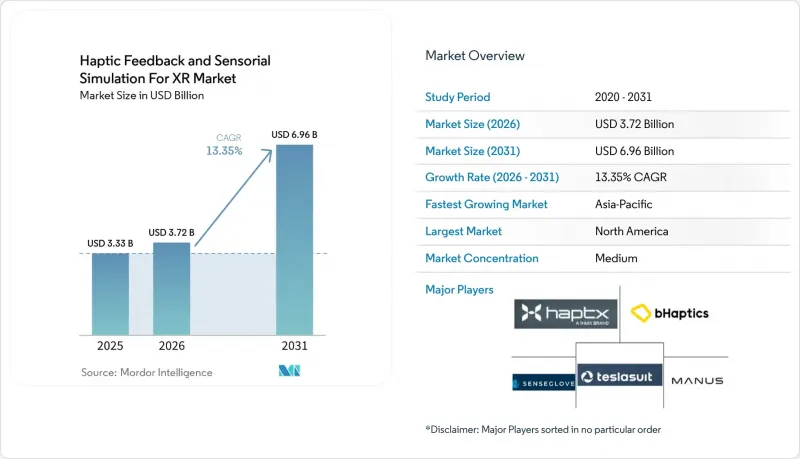
根據 Mordor Intelligence 預測,XR 市場中觸覺回饋和感覺模擬的市場規模預計將從 2025 年的 33.3 億美元和 2026 年的 37.2 億美元成長到 2031 年的 69.6 億美元,2026 年至 2031 年的年複合成長率(CAGR)為 3.35%。
全球觸覺回饋與XR感官模擬市場趨勢與洞察
XR硬體的普及與空間運算技術的應用
高通驍龍XR2+第二代處理器支援高解析度混合實境(MR)設備,並為新型頭戴式設備設計提供強大的處理能力。低成本、量產的頭戴式設備將擴大相容控制器、手套和背心等產品的潛在基本客群。三星、谷歌和高通在混合實境(MR)領域的聯合項目,著眼於2026年的消費市場,也正在推動頭戴式設備的銷售。頭戴式設備使用者無需特殊設定即可添加觸覺配件,這將提升XR市場對觸覺回饋和感官模擬的需求。不斷擴大的用戶群也將激勵軟體開發者將專用觸覺功能整合到新的XR遊戲中。 2026年6月,高通發布了驍龍Reality Elite和可擴展的交鑰匙AI就緒工具包,為觸覺解決方案供應商在建構AR硬體時提供了更多開發工具。
企業對高保真模擬與訓練的需求
當僅靠視覺模擬無法複製物理阻力、紋理或觸覺感受時,企業負責人會採用觸覺系統。外科手術訓練、飛機維護、未爆彈處理以及複雜的製造流程都需要工作人員練習詳細的操作步驟。 HEART 計畫於 2025 年 3 月在歐盟資助的 MasterXR 框架下推出,該計畫將 SenseGlove 的「Rembrandt」力回饋手套與 Aeon Robotics 的「HandEffector」機器人系統結合。該計畫旨在透過虛擬實境和力回饋介面,使未經培訓的操作人員能夠在 1 小時內學習複雜的機器人操作。這種模式將買家的關注點從設備規格轉移到部署時間、事故減少和培訓效果。能夠提供軟體開發工具包 (SDK)、內容庫和系統支援以及硬體的供應商也越來越受到青睞。
系統成本高且整合要求複雜
對於小規模訓練機構和教育機構而言,具備生物識別功能的全身觸覺系統仍然很昂貴。 Teslasuit 在 2026 年國際消費電子展 (CES) 上推出了專業和研究應用的 XR5 系統,建議零售價為 9,900 美元。這些系統可能需要與學習管理平台、遊戲引擎和企業軟體整合。由此產生的整合工作可能會使總擁有成本超過設備標價。高昂的價格也限制了可用於改善人工智慧驅動的觸覺渲染的互動資料量。雖然售價低於 400 美元的無線消費手套的出現降低了人們對入門級設備的期望,但在監管嚴格的模擬環境中,高階多感測器系統仍然必不可少。
細分市場分析
觸覺控制器仍是主流XR頭戴裝置的主要觸覺介面,預計到2025年將佔全球銷售額的28.32%。 XR市場的觸覺回饋和感官模擬得到了許多遊戲引擎和豐富的遊戲庫的支持。觸覺手套應用於企業訓練、手術模擬和遠端控制等領域,其中HaptX、SenseGlove和Manus VR分別採用了不同的力回饋設計。觸覺背心和腰帶主要用於遊戲和線下娛樂,而觸覺套裝則價格更高,主要用於企業和國防領域。觸覺鞋類、觸覺頭顯和頭戴式裝置雖然市佔率較小,但它們正在拓展觸覺感知在全身的覆蓋範圍。
空中觸覺系統是成長最快的產品類型,預計到2031年將以13.56%的複合年成長率成長,因為它們無需手持配件即可實現互動。 SIM IP於2025年收購了Ultraleap的觸覺和XR相關專利組合。該組合包含500多項資產,為其商業許可策略提供支援。如果這些資產能夠支持更廣泛的無控制器互動商業開發,觸覺回饋XR市場將從中受益。在2026年CVPR大會上發表的研究引入了“觸覺神經場”,它將3D場景中的形狀、用戶動作和觸覺響應聯繫起來。這種方法減少了創建特定材質效果所需的手動工作量,並提高了空中系統的實用性,使其不再局限於小眾安裝環境。此外,非接觸式互動還減輕了與穿戴式控制器相關的清潔和維護負擔。
預計到2025年,振動觸覺回饋將成為收入最高的觸覺回饋方式,佔38.42%的市佔率。這主要歸功於其採用成熟且低成本的致動器,以及與各種遊戲硬體的兼容性。 Haptics公司報告稱,其擁有超過39,000種動態模式,相容於100多款遊戲。如此豐富的內容確保了振動觸覺回饋在觸覺回饋XR市場中仍然是最容易使用的方式。其次是力覺和動覺回饋,其中阻力和方向提示至關重要。皮膚拉伸回饋、電觸覺觸覺回饋和熱回饋則用於小規模、更專業的應用,例如復健治療,在這些應用中,溫度變化有助於治療和評估。
多模態和感覺模擬是XR市場規模的基礎,它們透過結合振動、力和熱訊號的系統來實現。 HAPhy利用語言模型和視覺輸入,從物體說明和3D影像中產生多模態模態觸覺參數。在盲測中,使用者認為產生的體驗與手動創建的刺激效果相當。電觸覺和熱感設備的安全評估和CE認證要求可能會延遲消費產品的上市,並增加不具備合規能力的供應商的准入門檻,尤其是在產品用於長時間物理接觸或在監護環境中使用時。
區域分析
到2025年,北美將佔全球銷售額的36.40%,主要得益於XR開發者、企業培訓採購商以及對觸覺公司的投資。醫療、國防、航空航太和先進製造業等領域的區域需求推動了XR市場的觸覺回饋和感覺模擬技術的發展。儘管美國仍然是高保真企業系統的重要市場,但HaptX在2026年歐洲機器人論壇上展示了使用手套遠端控制靈巧機械手的技術。歐洲也正透過跨境專案、工業機器人和專業模擬活動建構起重要的收入基礎。歐盟資助的MasterXR框架支持觸覺技術的研究和開發,其中德國和英國在工業機器人、醫療模擬和國防領域的需求尤其突出。
預計到2031年,亞太地區將以14.19%的複合年成長率成長。該地區在觸覺回饋和XR感官模擬領域的市場佔有率得益於其硬體製造能力、國家級XR項目以及不斷成長的遊戲用戶群。日本NTT Docomo和慶應義塾大學的一項示範實驗表明,商用5G可以支援高保真觸覺遠端控制。韓國的2026扶持計畫為旨在拓展海外市場的XR和AI內容公司提供了途徑,而中國的執行器生態系統則有助於降低硬體成本。印度和澳洲的消費級和工業級觸覺設備市場滲透率仍然較低。
隨著公共XR計畫支持經濟多元化,中東正崛起為高成長次區域。卡達通訊與資訊科技部於2025年2月在卡達網路高峰會上推出了一個人工智慧和XR沙盒計畫。沙烏地阿拉伯的「2030願景」框架正在支援醫療和國防領域的VR模擬器。非洲仍處於早期市場階段,一些大學研究中心和高階遊戲設施,尤其是在南非、埃及和奈及利亞,預計將推動早期商業應用。
其他好處:
- Excel格式的市場預測(ME)表
- 3個月的分析師支持
目錄
第1章:引言
- 研究假設和市場定義
- 調查範圍
第2章:調查方法
第3章執行摘要
第4章 市場狀況
- 市場概覽
- 宏觀經濟因素對市場的影響
- 市場促進因素
- XR硬體的普及和空間運算的引入
- 企業對高保真模擬與訓練的需求
- 觸覺穿戴裝置在遊戲和健身領域的應用日益廣泛
- 遠端機器人和遠端操作中力回饋的擴展
- AI驅動的自適應多感官觸覺渲染
- 亞太地區和中東地區的XR區域投資項目
- 市場限制因素
- 系統成本高且整合要求複雜
- 跨平台觸覺互通性的局限性
- 功率、重量、發熱和佩戴舒適度方面的限制
- 在行動裝置上再現現實世界的紋理和力場的難度。
- 產業價值鏈分析
- 監理情勢
- 技術展望
- 波特五力分析
第5章 市場規模與成長預測
- 依產品類型
- 觸覺控制器
- 觸覺手套
- 觸覺背心和腰帶
- 觸覺套裝
- 觸覺鞋和鞋類
- 觸覺耳機和頭戴式設備
- 空中觸覺系統
- 其他產品類型
- 透過回饋方法
- 振動觸覺回饋
- 力回饋和動覺回饋
- 皮膚拉伸回饋
- 電觸覺觸覺回饋
- 熱回饋
- 多模態回饋
- 按外形規格
- 有線設備
- 無線裝置
- 軟體控制設備
- 剛性外骨骼裝置
- 模組化設備
- 全身系統
- 部分系統
- 透過使用
- 遊戲與娛樂
- 工業訓練和模擬
- 醫療保健和康復
- 國防和公共安全訓練
- 遠端機器人和遠端操作
- 教育/研究
- 健身和運動訓練
- 設計、工程、原型製作
- 最終用戶
- 消費者
- 企業和商業組織
- 醫療服務提供方
- 國防和政府機構
- 學術和研究機構
- XR內容和平台開發商
- 透過分銷管道
- 直銷
- 系統整合商和經銷商
- 線上管道
- 專業零售
- 訂閱和觸覺軟體套裝
- 按地區
- 北美洲
- 美國
- 加拿大
- 墨西哥
- 南美洲
- 巴西
- 阿根廷
- 哥倫比亞
- 其他南美國家
- 歐洲
- 德國
- 英國
- 法國
- 義大利
- 俄羅斯
- 其他歐洲國家
- 亞太地區
- 中國
- 日本
- 韓國
- 印度
- 台灣
- 澳洲
- 其他亞太國家
- 中東
- 沙烏地阿拉伯
- 阿拉伯聯合大公國
- 以色列
- 卡達
- 土耳其
- 其他中東國家
- 非洲
- 南非
- 埃及
- 奈及利亞
- 其他非洲國家
- 北美洲
第6章 競爭情勢
- 市場集中度
- 策略趨勢
- 市佔率分析
- 公司簡介
- HaptX Inc.
- Manus VR BV
- SenseGlove BV
- CyberGlove Systems LLC
- VRgluv Inc.
- Dexta Robotics Inc.
- BeBop Sensors Inc.
- Contact CI
- NeuroDigital Technologies SL
- Noitom Ltd.
- Teslasuit Inc.
- bHaptics Inc.
- Virtuix Inc.
- Straythink
- ExoGeniX
- GestureTek Inc.
- Tactai Inc.
- AxonVR Inc.
- Actronika SAS
- Woojer Ltd.
- SUBPAC Inc.
- FundamentalVR
第7章 市場機會與未來展望
According to Mordor Intelligence, the haptic feedback and sensorial simulation for XR market size is projected to expand from USD 3.33 billion in 2025 and USD 3.72 billion in 2026 to USD 6.96 billion by 2031, registering a CAGR of 13.35% between 2026 to 2031.
Global Haptic Feedback and Sensorial Simulation For XR Market Trends and Insights
XR Hardware Proliferation and Spatial Computing Adoption
Qualcomm's Snapdragon XR2+ Gen 2 supports high-resolution mixed-reality devices and provides the processing base for new headset designs. Lower-cost and higher-volume headsets widen the potential customer base for compatible controllers, gloves, and vests. Samsung's joint mixed-reality work with Google and Qualcomm, aimed at consumer channels in 2026, also supports higher headset volumes. The haptic feedback and sensorial simulation for XR market gains when headset users can add tactile accessories without a specialized setup. A larger installed base also gives software developers a reason to include dedicated haptic functions in new XR titles. Qualcomm introduced Snapdragon Reality Elite and its Scalable Turnkey AI-Ready Toolkit in June 2026, adding development tools that haptic solution providers can use when building AR hardware.
Enterprise Demand for High-Fidelity Simulation and Training
Enterprise buyers use haptic systems when visual simulation alone cannot reproduce physical resistance, texture, or contact. Surgical training, aircraft maintenance, explosive ordnance disposal, and complex manufacturing all require workers to practice detailed procedures. The HEART Project, launched under the EU-funded MasterXR framework in March 2025, combined SenseGlove's Rembrandt force-feedback gloves with Aeon Robotics' HandEffector robotic system. The project aimed to let untrained operators teach complex robot tasks within 1 hour through a VR and force-feedback interface. This model shifts buyer attention from device specifications toward onboarding time, incident reduction, and training outcomes. It also favors suppliers that can provide SDKs, content libraries, and system support with the hardware.
High System Cost and Complex Integration Requirements
Full-body haptic systems with biometric sensing remain costly for small training operators and educational institutions. Teslasuit launched the XR5 at CES 2026 with an MSRP of USD 9,900 for professional and research settings. These systems can require links to learning-management platforms, game engines, and enterprise software. The resulting integration work increases total ownership costs beyond the listed device price. High prices also limit the volume of interaction data available for improving AI-driven haptic rendering. Wireless consumer gloves priced below USD 400 are reducing expectations for entry-level devices, but regulated simulation environments will continue to require premium multi-sensor systems.
Other drivers and restraints analyzed in the detailed report include:
- Rising Use of Haptic Wearables in Gaming and Fitness
- Expansion of Force Feedback in Remote Robotics and Teleoperation
- Limited Cross-Platform Haptic Interoperability
For complete list of drivers and restraints, kindly check the Table Of Contents.
Segment Analysis
Haptic Controllers accounted for 28.32% of global revenue in 2025 because they remain the primary haptic interface bundled with major XR headsets. The haptic feedback and sensorial simulation for the XR market rely on their broad game engine support and large title library. Haptic Gloves are used for enterprise training, surgical simulation, and teleoperation, with HaptX, SenseGlove, and Manus VR employing different force-feedback designs. Haptic Vests and Belts primarily serve gaming and location-based entertainment, while Haptic Suits have high unit values in enterprise and defense use. Haptic Shoes and Footwear, and Haptic Headsets and Head-Mounted Devices remain smaller categories that extend tactile coverage across the body.
Mid-Air Haptic Systems are the fastest-growing product category, with a CAGR of 13.56% through 2031, as they enable interaction without a handheld accessory. SIM IP acquired Ultraleap's haptics and XR patent portfolio in 2025, covering more than 500 assets and supporting a commercial licensing strategy. The haptic feedback XR market can benefit if those assets support broader commercial development of controller-free interaction. Research presented at CVPR 2026 described Haptic Neural Fields, which link scene geometry, user actions, and tactile responses in 3D scenes. The method can reduce manual authoring work for material-specific effects and improve the practicality of mid-air systems outside niche installations, where touchless interaction can also reduce the cleaning and maintenance requirements associated with worn controllers.
Vibrotactile Feedback led revenue with a share of 38.42% in 2025 because it uses mature, lower-cost actuators and works with a broad range of gaming hardware. Haptics reported more than 39,000 dynamic patterns compatible with over 100 game titles. This content base helps the haptic-feedback XR market maintain vibrotactile feedback as its most accessible modality. Force and Kinesthetic Feedback follows, where resistance and directional cues are essential. Skin-Stretch Feedback, Electro-Tactile Feedback, and Thermal Feedback serve smaller, specialized uses, including rehabilitation settings where temperature variation can support treatment and assessment.
Multimodal Feedback is projected to expand at a 13.68% CAGR through 2031 because combined cues can better represent physical contact. The haptic feedback and sensorial simulation for the XR market size for this modality is supported by systems that combine vibration, force, and thermal signals. HAPhy used language models and visual inputs to generate multimodal haptic parameters from object descriptions and 3D images. Users in its blinded study rated the generated experiences comparably to manually authored stimuli. Safety assessment and CE marking requirements for electro-tactile and thermal devices may slow consumer launches and raise barriers for suppliers without compliance capabilities, particularly when products are intended for prolonged body contact or for use in supervised care environments.
Complete Report Scope:
- By Product Type
- Haptic Controllers
- Haptic Gloves
- Haptic Vests and Belts
- Haptic Suits
- Haptic Shoes and Footwear
- Haptic Headsets and Head-Mounted Devices
- Mid-Air Haptic Systems
- Other Product Types
- By Feedback Modality
- Vibrotactile Feedback
- Force and Kinesthetic Feedback
- Skin-Stretch Feedback
- Electro-Tactile Feedback
- Thermal Feedback
- Multimodal Feedback
- By Form Factor
- Wired Devices
- Wireless Devices
- Soft Wearable Devices
- Rigid Exoskeleton Devices
- Modular Devices
- Full-Body Systems
- Partial-Body Systems
- By Application
- Gaming and Entertainment
- Industrial Training and Simulation
- Healthcare and Rehabilitation
- Defense and Public-Safety Training
- Remote Robotics and Teleoperation
- Education and Research
- Fitness and Sports Training
- Design, Engineering, and Prototyping
- By End User
- Consumers
- Enterprise and Commercial Organizations
- Healthcare Providers
- Defense and Government Organizations
- Academic and Research Institutions
- XR Content and Platform Developers
- By Distribution Channel
- Direct Sales
- System Integrators and Resellers
- Online Channels
- Specialty Retail
- Subscription and Haptic-Software Bundles
- By Geography
- North America
- United States
- Canada
- Mexico
- South America
- Brazil
- Argentina
- Colombia
- Rest of South America
- Europe
- Germany
- United Kingdom
- France
- Italy
- Russia
- Rest of Europe
- Asia-Pacific
- China
- Japan
- South Korea
- India
- Taiwan
- Australia
- Rest of Asia-Pacific
- Middle East
- Saudi Arabia
- United Arab Emirates
- Israel
- Qatar
- Turkey
- Rest of Middle East
- Africa
- South Africa
- Egypt
- Nigeria
- Rest of Africa
- North America
Geography Analysis
North America held 36.40% of global revenue in 2025, supported by XR developers, enterprise training buyers, and investment in haptic companies. The haptic feedback and sensorial simulation for XR market benefits from regional demand in healthcare, defense, aviation, and advanced manufacturing. The United States remains an important destination for high-fidelity enterprise systems, while HaptX demonstrated glove-based teleoperation of dexterous robot hands at European Robotics Forum 2026. Europe also has a significant revenue position through cross-border projects, industrial robotics, and specialized simulation activity. The EU-funded MasterXR framework supports haptic research and development, while Germany and the United Kingdom contribute industrial robotics, medical simulation, and defense demand.
Asia-Pacific is projected to expand at a 14.19% CAGR through 2031. The haptic feedback and sensorial simulation for XR market share of the region is supported by hardware manufacturing capacity, national XR programs, and a growing gaming base. Japan's NTT DOCOMO and Keio University demonstration showed that commercial 5G can support high-fidelity haptic teleoperation. South Korea's 2026 support program provides a route for XR and AI content companies seeking overseas expansion, while China's actuator ecosystem can reduce hardware unit costs. India and Australia remain underpenetrated markets for consumer and industrial haptic devices.
The Middle East is emerging as a high-growth subregion because public XR programs support economic diversification. Qatar's Ministry of Communications and Information Technology launched AI and XR Sandboxes at Web Summit Qatar in February 2025. Saudi Arabia's Vision 2030 framework supports VR medical and defense simulators. Africa remains an early-stage opportunity centered on South Africa, Egypt, and Nigeria, where selected university centers and premium gaming facilities may lead initial commercial adoption.
- HaptX Inc.
- Manus VR B.V.
- SenseGlove B.V.
- CyberGlove Systems LLC
- VRgluv Inc.
- Dexta Robotics Inc.
- BeBop Sensors Inc.
- Contact CI
- NeuroDigital Technologies S.L.
- Noitom Ltd.
- Teslasuit Inc.
- bHaptics Inc.
- Virtuix Inc.
- Straythink
- ExoGeniX
- GestureTek Inc.
- Tactai Inc.
- AxonVR Inc.
- Actronika SAS
- Woojer Ltd.
- SUBPAC Inc.
- FundamentalVR
Additional Benefits:
- The market estimate (ME) sheet in Excel format
- 3 months of analyst support
TABLE OF CONTENTS
1 INTRODUCTION
- 1.1 Study Assumptions and Market Definition
- 1.2 Scope of the Study
2 RESEARCH METHODOLOGY
3 EXECUTIVE SUMMARY
4 MARKET LANDSCAPE
- 4.1 Market Overview
- 4.2 Impact of Macroeconomic Factors on the Market
- 4.3 Market Drivers
- 4.3.1 XR Hardware Proliferation and Spatial Computing Adoption
- 4.3.2 Enterprise Demand for High-Fidelity Simulation and Training
- 4.3.3 Rising Use of Haptic Wearables in Gaming and Fitness
- 4.3.4 Expansion of Force Feedback in Remote Robotics and Teleoperation
- 4.3.5 AI-Enabled Adaptive and Multisensory Haptic Rendering
- 4.3.6 Regional XR Investment Programs in Asia-Pacific and the Middle East
- 4.4 Market Restraints
- 4.4.1 High System Cost and Complex Integration Requirements
- 4.4.2 Limited Cross-Platform Haptic Interoperability
- 4.4.3 Power, Weight, Thermal, and Wearability Constraints
- 4.4.4 Difficulty Translating Real-World Texture and Force Into Portable Devices
- 4.5 Industry Value Chain Analysis
- 4.6 Regulatory Landscape
- 4.7 Technological Outlook
- 4.8 Porter's Five Forces Analysis
- 4.8.1 Bargaining Power of Suppliers
- 4.8.2 Bargaining Power of Buyers
- 4.8.3 Threat of New Entrants
- 4.8.4 Threat of Substitutes
- 4.8.5 Competitive Rivalry
5 MARKET SIZE AND GROWTH FORECASTS (VALUE)
- 5.1 By Product Type
- 5.1.1 Haptic Controllers
- 5.1.2 Haptic Gloves
- 5.1.3 Haptic Vests and Belts
- 5.1.4 Haptic Suits
- 5.1.5 Haptic Shoes and Footwear
- 5.1.6 Haptic Headsets and Head-Mounted Devices
- 5.1.7 Mid-Air Haptic Systems
- 5.1.8 Other Product Types
- 5.2 By Feedback Modality
- 5.2.1 Vibrotactile Feedback
- 5.2.2 Force and Kinesthetic Feedback
- 5.2.3 Skin-Stretch Feedback
- 5.2.4 Electro-Tactile Feedback
- 5.2.5 Thermal Feedback
- 5.2.6 Multimodal Feedback
- 5.3 By Form Factor
- 5.3.1 Wired Devices
- 5.3.2 Wireless Devices
- 5.3.3 Soft Wearable Devices
- 5.3.4 Rigid Exoskeleton Devices
- 5.3.5 Modular Devices
- 5.3.6 Full-Body Systems
- 5.3.7 Partial-Body Systems
- 5.4 By Application
- 5.4.1 Gaming and Entertainment
- 5.4.2 Industrial Training and Simulation
- 5.4.3 Healthcare and Rehabilitation
- 5.4.4 Defense and Public-Safety Training
- 5.4.5 Remote Robotics and Teleoperation
- 5.4.6 Education and Research
- 5.4.7 Fitness and Sports Training
- 5.4.8 Design, Engineering, and Prototyping
- 5.5 By End User
- 5.5.1 Consumers
- 5.5.2 Enterprise and Commercial Organizations
- 5.5.3 Healthcare Providers
- 5.5.4 Defense and Government Organizations
- 5.5.5 Academic and Research Institutions
- 5.5.6 XR Content and Platform Developers
- 5.6 By Distribution Channel
- 5.6.1 Direct Sales
- 5.6.2 System Integrators and Resellers
- 5.6.3 Online Channels
- 5.6.4 Specialty Retail
- 5.6.5 Subscription and Haptic-Software Bundles
- 5.7 By Geography
- 5.7.1 North America
- 5.7.1.1 United States
- 5.7.1.2 Canada
- 5.7.1.3 Mexico
- 5.7.2 South America
- 5.7.2.1 Brazil
- 5.7.2.2 Argentina
- 5.7.2.3 Colombia
- 5.7.2.4 Rest of South America
- 5.7.3 Europe
- 5.7.3.1 Germany
- 5.7.3.2 United Kingdom
- 5.7.3.3 France
- 5.7.3.4 Italy
- 5.7.3.5 Russia
- 5.7.3.6 Rest of Europe
- 5.7.4 Asia-Pacific
- 5.7.4.1 China
- 5.7.4.2 Japan
- 5.7.4.3 South Korea
- 5.7.4.4 India
- 5.7.4.5 Taiwan
- 5.7.4.6 Australia
- 5.7.4.7 Rest of Asia-Pacific
- 5.7.5 Middle East
- 5.7.5.1 Saudi Arabia
- 5.7.5.2 United Arab Emirates
- 5.7.5.3 Israel
- 5.7.5.4 Qatar
- 5.7.5.5 Turkey
- 5.7.5.6 Rest of Middle East
- 5.7.6 Africa
- 5.7.6.1 South Africa
- 5.7.6.2 Egypt
- 5.7.6.3 Nigeria
- 5.7.6.4 Rest of Africa
- 5.7.1 North America
6 COMPETITIVE LANDSCAPE
- 6.1 Market Concentration
- 6.2 Strategic Moves
- 6.3 Market Share Analysis
- 6.4 Company Profiles (includes Global Level Overview, Market Level Overview, Core Segments, Financials as available, Strategic Information, Market Rank/Share, Products and Services, Recent Developments)
- 6.4.1 HaptX Inc.
- 6.4.2 Manus VR B.V.
- 6.4.3 SenseGlove B.V.
- 6.4.4 CyberGlove Systems LLC
- 6.4.5 VRgluv Inc.
- 6.4.6 Dexta Robotics Inc.
- 6.4.7 BeBop Sensors Inc.
- 6.4.8 Contact CI
- 6.4.9 NeuroDigital Technologies S.L.
- 6.4.10 Noitom Ltd.
- 6.4.11 Teslasuit Inc.
- 6.4.12 bHaptics Inc.
- 6.4.13 Virtuix Inc.
- 6.4.14 Straythink
- 6.4.15 ExoGeniX
- 6.4.16 GestureTek Inc.
- 6.4.17 Tactai Inc.
- 6.4.18 AxonVR Inc.
- 6.4.19 Actronika SAS
- 6.4.20 Woojer Ltd.
- 6.4.21 SUBPAC Inc.
- 6.4.22 FundamentalVR
7 MARKET OPPORTUNITIES AND FUTURE OUTLOOK
- 7.1 White-Space and Unmet-Need Assessment

 延展實境(XR) 市場研究服務延展實境(XR)技術研究服務
 教育領域虛擬實境 (VR) 和擴增實境(AR) 市場預測(至 2034 年)—按技術、組件、部署模式、設備類型、應用、最終用戶和地區分類的全球分析
 擴增實境(XR):市場佔有率分析、產業趨勢與統計數據、成長預測(2026-2031)
 全球擴增實境(XR硬體)市場—市場展望
 擴增實境(XR)顯示市場-2026-2032年全球市場預測
 延展實境市場-全球產業規模、佔有率、趨勢、機會和預測:按組件、類型、產品模式、最終用戶、應用、地區和競爭格局分類,2021-2031年XR(延展實境)硬體的演進
 2026年全球擴增實境晶片系統(XR SoC)市場報告全球延展實境(XR)技術發展趨勢:2025-2032年