


 |
市場調查報告書
商品編碼
2154437
電信鐵塔土地租賃市場基準分析:市場佔有率分析、產業趨勢與統計及成長預測(2026-2031 年)Telecom Tower Land Lease Benchmarking - Market Share Analysis, Industry Trends & Statistics, Growth Forecasts (2026 - 2031) |
||||||

※ 本網頁內容可能與最新版本有所差異。詳細情況請與我們聯繫。
根據 Mordor Intelligence 預測,電信塔土地租賃的基準市場規模預計將從 2025 年的 5.4632 億美元和 2026 年的 5.8463 億美元成長到 2031 年的 8.3262 億美元,2026 年至 2031 年的年複合成長率(CAGR)為 7.33%。
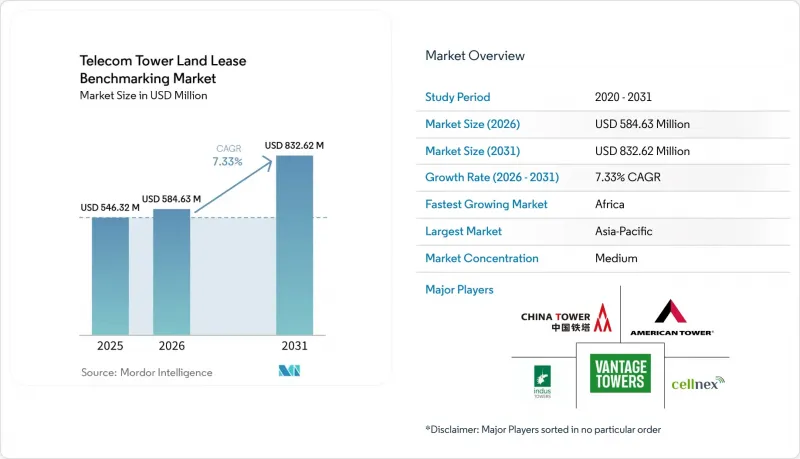
全球電信鐵塔土地租賃基準市場趨勢與洞察。
提高5G密度並擴展網路容量
下一代中頻段的部署仍然是通訊鐵塔土地租賃基準市場新活動的主要驅動力。每次天線安裝、共址申請或站點升級可能需要簽署新的租賃協議或修改現有協議。美國鐵塔公司 (American Tower Corporation) 報告稱,共址數量和申請總數均實現了顯著的同比成長,這反映了網路活動的規模。由於中波頻率的傳播距離比低頻短,營運商需要運作在以往網路設計中價值較低的基地台。這使得以往競爭力較弱的基地台的租金、進入許可權和租金成長率的比較數據變得更加重要。這是因為通訊鐵塔土地租賃基準市場需要區分每個站點的歷史合約條款及其當前的網路價值。與新建站點相比,共址建設可以延長現有站點的經濟壽命,但同時也增加了長期租金風險,尤其是在多個營運商需要相同覆蓋資產的高利用率走廊區域。這確保了即使在成熟地區新建廣域基地台數量有限的情況下,租賃比較仍然效用。
本地電信網路發展計畫和公共連接資金
公共寬頻計畫正在催生對租賃先例有限的地區站點存取的需求。美國農業部 (USDA) 透過其「社區連結補助計畫」(Community 津貼 Program) 為缺乏現有寬頻服務的社區提供支援。 「寬頻接入發展計畫」(BEAD program) 在大多數州提供大量過渡性資金,受益者包括當地電力公司和電信業者。對於農村走廊地區的新站點,由於可能沒有既定的租金標準,因此需要進行本地化的租金比較。此外,電信塔土地租賃基準市場需要反映當地需求、存取限制以及站點實際用途的證據。當土地登記記錄分散、當地價格歷史有限且站點接入是新近協商確定時,這項工作尤其具有挑戰性。由此產生的租賃估值和文件編制需求將長期支撐電信塔土地租賃基準市場。有關進入許可權、租賃條款和租金調整的本地記錄也變得越來越重要。
基礎設施共用飽和度及租戶更替
基礎設施共用可能會限制現有站點的新託管交易和租賃變更數量。行動通訊業者在頻段整合和網路整合後,可能會減少網路覆蓋範圍的重疊。這將縮小通訊鐵塔土地租賃基準市場的部分新業務來源,同時續約和終止談判也將變得更加複雜。美國三大上市鐵塔公司報告稱,2025年的解約率上升,並預計這種壓力將持續到2026年,尤其是來自Sprint的租賃終止和DISH Wireless的違約。這將縮小支持租賃比較的交易基礎,即使鐵塔總數仍然很高。美國鐵塔公司報告稱,2025年,合約中遞增條款帶來的部分成長被較低的續約率所抵銷。通訊鐵塔土地租賃基準市場必須適應一些成熟站點活躍交易對象減少以及剩餘位置續約談判日益複雜的情況。因此,人們的關注點正從交易數量轉向合約記錄的品質和可比性。
細分市場分析
預計到2025年,土地租賃將佔市場佔有率的55.24%,並將以7.66%的複合年成長率成長至2031年。這一主導地位反映了地面宏觀基礎設施在撒哈拉以南非洲以及南亞和東南亞地區持續的重要性。這些地區的新建鐵塔通常需要簽訂第一代土地使用契約,而通訊鐵塔土地租賃的基準市場可以幫助土地所有者和運營商在當地案例研究有限的情況下進行談判,從而確定初始合約條款。美國鐵塔公司計劃領先於美國進行的收購後,收購更多土地權益。永久地役權和預付租賃可以用資本支出取代定期租金支付。這項策略既展現了對地面資產的持續信心,也降低了鐵塔所有者未來租金波動的風險,並改變了未來可供比較的租賃交易組成。
在歐洲,由於相關法規優先考慮現有建築物而非新建基地台,屋頂租賃的重要性日益凸顯。電信塔土地租賃的基準市場需要評估建築物的管理義務、結構限制以及市政當局對這些地點的要求。此外,隨著小型基地台安裝在電線杆和街道基礎設施上,地役權和通行權的範圍也不斷擴大。在許多情況下,屋頂租賃的單站收益低於地面或屋頂租賃。其他類型的接入方式包括水塔、輸電塔和非電信設施。這些租賃類型尚未標準化,因此需要對當地的進入許可權和營運義務進行更詳細的評估。
2025年,宏塔站點佔通訊塔土地租賃基準市場規模的58.72%。這一規模反映了宏塔部署的大規模成功以及在成熟位置進行共址建設的持續價值。由於宏塔建設在新興市場仍然至關重要,因為這些市場仍需要擴展4G覆蓋範圍並建造5G核心站點,因此通訊塔土地租賃基準市場將繼續涵蓋成熟資產的續租和新站點的開發。 Indus Towers在2025年大幅擴展了其在印度的塔架組合,顯示宏塔仍然是網路擴展的核心。這些站點通常簽訂長期土地租賃協議,並容納多個租戶。由於需要持續支付租金,因此對於土地所有者和塔架公司而言,可比租金資料和租金遞增條款資料都非常重要,尤其是在合約續約或修訂日期臨近時。
預計到2031年,小型基地台基地台將以7.72%的複合年成長率成長,成為所有基地台配置中成長最快的。小型基地台能夠提供宏基地台無法充分覆蓋的高密度中頻段和毫米波頻段。 2026年5月,Crown Castle將其小型基地台業務出售,將其主要的都市區接入業務組合轉移給了Allium Networks。屋頂基地台通常由業主、物業管理公司或地方政府負責建造。室內和分散式天線系統(DAS)基地台則用於機場、交通走廊、體育場館和其他場所。這些基地台建設成本高昂,需要特殊的接入和設計條件,並且需要與物業管理公司和公共機構協調,因此在所有安裝地點中所佔比例較小。
區域分析
到2025年,亞太地區將佔據31.27%的市場。中國鐵塔經營著廣泛的鐵塔網路,並擁有大規模的資產基礎。在印度,下一代行動網路部署週期已較為成熟,各方關注的焦點正轉向合約續約條款和託管協議的修訂。在印尼和其他東南亞市場,服務仍然不足,需要繼續協商新安裝站點的准入安排。 edotco在馬來西亞、孟加拉、柬埔寨、緬甸、巴基斯坦、斯里蘭卡和菲律賓經營廣泛的鐵塔網路。由於該地區存在國家主導、獨立和分散的業主模式,因此在討論租金、合約條款和租金成長率時,國家和地區層面的比較比單一的區域基準更為有效。
在北美,土地租賃基礎設施已趨於成熟,25至50年的租賃合約正進入續約階段。與前一年相比,美國鐵塔公司(American Tower Corporation)在2025年大幅增加了其在美國收購土地租賃權的支出。該地區的租賃基準分析活動得益於複雜的續約談判和土地使用權的購買。 Telion在加拿大的成立,使其成為擁有龐大站點組合的專業鐵塔運營商,其資產組合基於與加拿大電信公司(TELUS)簽訂的長期主回租協議。歐洲的特點是各國城市規劃法規、產權和租賃慣例各不相同。 Celnex、Vantage Towers、Totem、Deutsche Funkturm和GD Towers等公司在這種多元化的環境中運營,這需要具備當地監管和房地產方面的知識。
預計到2031年,非洲將以7.88%的複合年成長率成長,成為所有地區中成長最快的地區。該地區的成長得益於現有行動網路的整合以及在許多農村地區簽署新合約的市場中下一代網路的早期部署。 Helios Towers報告稱其租戶比例上升。 MTN宣布擬收購IHS Towers,這將影響其在多個非洲市場的鐵塔所有權。在南美洲,租賃活動主要集中在巴西、哥倫比亞和中美洲,這得益於其龐大的鐵塔組合。在中東,沙烏地阿拉伯的TAWAL計畫以及與基礎設施投資計畫相關的中立東道國框架的製定,正在推動該地區的發展。
其他好處:
- Excel格式的市場預測(ME)表
- 3個月的分析師支持
目錄
第1章:引言
- 研究假設和市場定義
- 調查範圍
第2章:調查方法
第3章執行摘要
第4章 市場狀況
- 市場概覽
- 市場促進因素
- 提高5G密度並擴展網路容量
- 為農村地區提供服務的計劃以及為公共電信基礎設施發展提供資金。
- TowerCo的售後回租與資產貨幣化
- 城市地區小型基地台和屋頂安裝地點短缺。
- 在投資組合層級匯總租賃協議並利用數據進行談判。
- 對涉及地表權收購的房產進行數位化孿生篩檢。
- 市場限制因素
- 基礎設施共用飽和與租戶流失
- 與分區、授權和獲得社區同意相關的延誤。
- 土地整合公司的議價能力和租金重新計算。
- 假設無網路情況下,更新評估存在不確定性
- 產業價值/價值鏈分析
- 監理情勢
- 宏觀經濟因素對市場的影響
- 技術展望
- 波特五力分析
第5章 市場規模與成長預測
- 按土地利用類型
- 地表權
- 屋頂租賃
- 地役權和通行權
- 其他土地使用方式
- 按站點結構
- 宏塔站點
- 小型基地台基地台
- 屋頂安裝類型
- 室內及分散式天線站點
- 按客戶/交易對象
- 獨立塔樓管理公司
- 行動網路營運商專用基礎設施
- 中立主機提供商
- 公共部門網路營運商
- 專用無線和企業網路
- 租賃經濟學
- 固定年扶梯
- 與消費者物價指數掛鉤的自動調整條款
- 混合指數和固定扶梯
- 收益分成及與共址相關的租金
- 一次預付款
- 按地區
- 北美洲
- 美國
- 加拿大
- 墨西哥
- 南美洲
- 巴西
- 阿根廷
- 哥倫比亞
- 其他南美國家
- 歐洲
- 德國
- 英國
- 法國
- 義大利
- 俄羅斯
- 其他歐洲國家
- 亞太地區
- 中國
- 印度
- 日本
- 印尼
- 其他亞太國家
- 中東
- 沙烏地阿拉伯
- 阿拉伯聯合大公國
- 土耳其
- 其他中東國家
- 非洲
- 奈及利亞
- 南非
- 肯亞
- 其他非洲國家
- 北美洲
第6章 競爭情勢
- 市場集中度
- 策略趨勢
- 市佔率分析
- 公司簡介
- American Tower Corporation
- Cellnex Telecom, SA
- Vantage Towers AG
- GD Towers Holding GmbH
- SBA Communications Corporation
- Crown Castle Inc.
- China Tower Corporation Limited
- Indus Towers Limited
- IHS Holding Limited
- Helios Towers plc
- Phoenix Tower International
- edotco Group Sdn Bhd
- TOTEM
- Vertical Bridge REIT, LLC
- Atlas Tower Group
- TAWAL
- Telesites SAB de CV
- Deutsche Funkturm GmbH
- Tillman Infrastructure LLC
- Boldyn Networks
第7章 市場機會與未來展望
According to Mordor Intelligence, the telecom tower land lease benchmarking market size is projected to expand from USD 546.32 million in 2025 and USD 584.63 million in 2026 to USD 832.62 million by 2031, registering a CAGR of 7.33% between 2026 to 2031.
Global Telecom Tower Land Lease Benchmarking Market Trends and Insights
5G Densification and Network Capacity Expansion
Next-generation mid-band deployment remains the main source of new activity in the telecom tower land lease benchmarking market. Each antenna installation, colocation request, or site upgrade can require a new lease or an amendment to an existing agreement. American Tower reported a substantial year-over-year increase in colocation and total applications, demonstrating the scale of network activity underway. Mid-band spectrum has a shorter propagation range than lower-frequency spectrum, so operators must activate sites that held less value under earlier-generation network designs. This makes comparable rent, access, and escalation data more important for sites that were previously not heavily contested, because the telecom tower land lease benchmarking market needs to separate historical terms from current network value in each location. The preference for colocation over new construction also prolongs the economic life of established locations and increases long-term rent exposure in busy corridors, especially where several operators need the same coverage assets. This keeps lease comparison relevant even when new macro construction is limited in mature areas.
Rural Coverage Programs and Public Connectivity Funding
Public broadband programs are creating demand for site access in areas with limited lease precedents. The U.S. Department of Agriculture is supporting communities without existing broadband service through its Community Connect Grant Program. The BEAD program had provisionally awarded substantial funding across most states, with rural electric and telecommunications providers among the recipients. New sites in rural corridors need locally relevant rental comparisons because established rates may not exist, and the telecom tower land lease benchmarking market needs evidence that reflects local demand, access constraints, and the site's practical operating role. This work is more demanding where land records are fragmented, local pricing history is limited, and site access is newly negotiated. The resulting need for lease valuation and documentation supports the telecom tower land lease benchmarking market over a longer period. It also places more weight on local records of access rights, lease duration, and rent adjustments.
Infrastructure-Sharing Saturation and Tenant Churn
Infrastructure sharing can limit the number of new colocation events and lease amendments at existing sites. Mobile operators may reduce overlapping network footprints after spectrum consolidation or network integration, which narrows some sources of new work for the telecom tower land lease benchmarking market, even as renewal and exit negotiations become more detailed. The three large U.S. public tower companies reported elevated churn in 2025 and expected continuing pressure during 2026, particularly from Sprint lease terminations and DISH Wireless defaults. This reduces the transaction base that supports lease comparisons even when total tower counts remain high. American Tower reported that churn offset part of contractual escalator gains in 2025. The telecom tower land lease benchmarking market must adapt to fewer active counterparties at some mature sites and more complex renewal discussions at the remaining locations. This shifts attention from volume of transactions toward the quality and comparability of contract records.
Other drivers and restraints analyzed in the detailed report include:
- TowerCo Sale-and-Leaseback and Asset Monetization
- Urban Small-Cell and Rooftop Site Scarcity
- Zoning, Permitting and Community-Consent Delays
For complete list of drivers and restraints, kindly check the Table Of Contents.
Segment Analysis
Ground leases accounted for 55.24% share in 2025 and are projected to expand at a 7.66% CAGR through 2031. This lead reflects the continuing importance of ground-level macro infrastructure in Sub-Saharan Africa and South and Southeast Asia. New towers in these areas frequently require first-generation agreements for land access, and the telecom tower land lease benchmarking market can support discussions where landowners and operators have limited local evidence for setting initial contract terms. American Tower planned additional ground-interest acquisitions following prior investments in U.S. acquisitions. Perpetual easements and prepaid leases can replace recurring rent with a capital commitment. The strategy shows continued confidence in ground-level assets while reducing future rent variability for the tower owner, and it changes the pool of leases available for later comparison.
Rooftop leases are becoming more important in Europe, where restrictions on new mast construction favor existing buildings. The telecom tower land lease benchmarking market must assess building management obligations, structural limitations, and municipal requirements for these sites. Easements and rights-of-way are also expanding with small cells placed on utility poles and street furniture. Their revenue per site is lower than ground or rooftop arrangements in many cases. Other access types include water towers, utility pylons, and nontelecom structures. These arrangements are less standardized, so they require more detailed assessment of local access rights and operating obligations.
Macro tower sites held 58.72% share of the telecom tower land lease benchmarking market size in 2025. Their scale reflects the large installed base and the continued value of colocation at established locations. Macro construction remains important in emerging markets where 4G coverage extension and 5G anchor sites are still needed, so the telecom tower land lease benchmarking market continues to cover both mature asset renewals and new site origination. Indus Towers significantly expanded its tower portfolio in India during 2025, demonstrating that macro towers remain central to network expansion. These sites normally have long-term ground agreements and multiple tenants. Their recurring lease commitments make comparable rental and escalator data important for both landowners and tower companies, particularly when agreements approach renewal or amendment dates.
Small-cell sites are projected to expand at a 7.72% CAGR through 2031, the fastest rate among site configurations. They support dense mid-band and millimeter-wave coverage where macro towers cannot supply sufficient capacity alone. Crown Castle's May 2026 small-cell sale transferred a major urban access portfolio to Arium Networks. Rooftop sites commonly involve building owners, management companies, or municipalities. In-building and distributed antenna system sites serve airports, transit corridors, and stadiums. These sites have high unit values but account for a smaller share of total locations because they need specialized access, design terms, and coordination with property managers or public agencies.
Complete Report Scope:
- By Land Access Type
- Ground Lease
- Rooftop Lease
- Easement and Right-of-Way
- Other Land Access Types
- By Site Configuration
- Macro Tower Site
- Small-Cell Site
- Rooftop Site
- In-Building and Distributed Antenna Site
- By Customer / Counterparty
- Independent Towerco
- MNO Captive Infrastructure
- Neutral Host Provider
- Public-Sector Network Operator
- Private Wireless and Enterprise Network
- By Lease Economics
- Fixed Annual Escalator
- CPI-Linked Escalator
- Hybrid Index and Fixed Escalator
- Revenue-Share and Colocation-Linked Rent
- One-Time Upfront Consideration
- By Geography
- North America
- United States
- Canada
- Mexico
- South America
- Brazil
- Argentina
- Colombia
- Rest of South America
- Europe
- Germany
- United Kingdom
- France
- Italy
- Russia
- Rest of Europe
- Asia-Pacific
- China
- India
- Japan
- Indonesia
- Rest of Asia-Pacific
- Middle East
- Saudi Arabia
- United Arab Emirates
- Turkey
- Rest of Middle East
- Africa
- Nigeria
- South Africa
- Kenya
- Rest of Africa
- North America
Geography Analysis
Asia-Pacific commanded 31.27% share in 2025. China Tower operated an extensive tower portfolio and maintained a substantial asset base. India has a more mature next-generation mobile deployment cycle, which shifts attention toward renewal terms and colocation amendments. Indonesia and other Southeast Asian markets remain underserved and continue to need new site access arrangements. edotco operates an extensive tower portfolio across Malaysia, Bangladesh, Cambodia, Myanmar, Pakistan, Sri Lanka, and the Philippines. The region includes state-led, independent, and fragmented landlord models, so national and local comparisons are more useful than a single regional benchmark for rent, term, and escalation discussions.
North America has a mature land lease base, with 25- to 50-year contracts moving into renewal periods. American Tower increased its spending on U.S. ground-lease acquisitions substantially in 2025 compared with the previous year. This regional lease benchmarking activity is supported by complex renewal discussions and ground-interest buyouts. Terrion's formation in Canada created a dedicated tower operator with an extensive site portfolio under a long-term master leaseback with TELUS. Europe is shaped by varied national planning rules, property rights, and lease conventions. Cellnex, Vantage Towers, TOTEM, Deutsche Funkturm, and GD Towers operate in this diverse setting, which requires local regulatory and property knowledge.
Africa is projected to expand at a 7.88% CAGR through 2031, the fastest regional rate. The region is supported by established mobile network consolidation and early next-generation deployments in markets where many rural agreements are newly established. Helios Towers reported an increase in its tenancy ratio. MTN announced a proposed acquisition of IHS Towers that would affect tower ownership across several African markets. South America has lease activity concentrated in Brazil, Colombia, and Central America through major tower portfolios. The Middle East is supported by Saudi Arabia's TAWAL and developing neutral-host frameworks linked to infrastructure investment programs.
- American Tower Corporation
- Cellnex Telecom, S.A.
- Vantage Towers AG
- GD Towers Holding GmbH
- SBA Communications Corporation
- Crown Castle Inc.
- China Tower Corporation Limited
- Indus Towers Limited
- IHS Holding Limited
- Helios Towers plc
- Phoenix Tower International
- edotco Group Sdn Bhd
- TOTEM
- Vertical Bridge REIT, LLC
- Atlas Tower Group
- TAWAL
- Telesites S.A.B. de C.V.
- Deutsche Funkturm GmbH
- Tillman Infrastructure LLC
- Boldyn Networks
Additional Benefits:
- The market estimate (ME) sheet in Excel format
- 3 months of analyst support
TABLE OF CONTENTS
1 INTRODUCTION
- 1.1 Study Assumptions and Market Definition
- 1.2 Scope of the Study
2 RESEARCH METHODOLOGY
3 EXECUTIVE SUMMARY
4 MARKET LANDSCAPE
- 4.1 Market Overview
- 4.2 Market Drivers
- 4.2.1 5G Densification and Network Capacity Expansion
- 4.2.2 Rural Coverage Programs and Public Connectivity Funding
- 4.2.3 Towerco Sale-and-Leaseback and Asset Monetization
- 4.2.4 Urban Small-Cell and Rooftop Site Scarcity
- 4.2.5 Portfolio-Level Lease Aggregation and Data-Enabled Negotiation
- 4.2.6 Digital-Twin Screening of Ground-Lease Buyout Targets
- 4.3 Market Restraints
- 4.3.1 Infrastructure-Sharing Saturation and Tenant Churn
- 4.3.2 Zoning, Permitting and Community-Consent Delays
- 4.3.3 Land Aggregator Bargaining Power and Rent Repricing
- 4.3.4 Renewal Valuation Uncertainty Under No-Network Assumptions
- 4.4 Industry Value / Supply-Chain Analysis
- 4.5 Regulatory Landscape
- 4.6 Impact of Macroeconomic Factors on the Market
- 4.7 Technological Outlook
- 4.8 Porter's Five Forces Analysis
- 4.8.1 Threat of New Entrants
- 4.8.2 Bargaining Power of Landowners
- 4.8.3 Bargaining Power of Towercos and MNOs
- 4.8.4 Threat of Substitutes
- 4.8.5 Competitive Rivalry
5 MARKET SIZE AND GROWTH FORECASTS (VALUE)
- 5.1 By Land Access Type
- 5.1.1 Ground Lease
- 5.1.2 Rooftop Lease
- 5.1.3 Easement and Right-of-Way
- 5.1.4 Other Land Access Types
- 5.2 By Site Configuration
- 5.2.1 Macro Tower Site
- 5.2.2 Small-Cell Site
- 5.2.3 Rooftop Site
- 5.2.4 In-Building and Distributed Antenna Site
- 5.3 By Customer / Counterparty
- 5.3.1 Independent Towerco
- 5.3.2 MNO Captive Infrastructure
- 5.3.3 Neutral Host Provider
- 5.3.4 Public-Sector Network Operator
- 5.3.5 Private Wireless and Enterprise Network
- 5.4 By Lease Economics
- 5.4.1 Fixed Annual Escalator
- 5.4.2 CPI-Linked Escalator
- 5.4.3 Hybrid Index and Fixed Escalator
- 5.4.4 Revenue-Share and Colocation-Linked Rent
- 5.4.5 One-Time Upfront Consideration
- 5.5 By Geography
- 5.5.1 North America
- 5.5.1.1 United States
- 5.5.1.2 Canada
- 5.5.1.3 Mexico
- 5.5.2 South America
- 5.5.2.1 Brazil
- 5.5.2.2 Argentina
- 5.5.2.3 Colombia
- 5.5.2.4 Rest of South America
- 5.5.3 Europe
- 5.5.3.1 Germany
- 5.5.3.2 United Kingdom
- 5.5.3.3 France
- 5.5.3.4 Italy
- 5.5.3.5 Russia
- 5.5.3.6 Rest of Europe
- 5.5.4 Asia-Pacific
- 5.5.4.1 China
- 5.5.4.2 India
- 5.5.4.3 Japan
- 5.5.4.4 Indonesia
- 5.5.4.5 Rest of Asia-Pacific
- 5.5.5 Middle East
- 5.5.5.1 Saudi Arabia
- 5.5.5.2 United Arab Emirates
- 5.5.5.3 Turkey
- 5.5.5.4 Rest of Middle East
- 5.5.6 Africa
- 5.5.6.1 Nigeria
- 5.5.6.2 South Africa
- 5.5.6.3 Kenya
- 5.5.6.4 Rest of Africa
- 5.5.1 North America
6 COMPETITIVE LANDSCAPE
- 6.1 Market Concentration
- 6.2 Strategic Moves
- 6.3 Market Share Analysis
- 6.4 Company Profiles (includes Global Level Overview, Market Level Overview, Core Segments, Financials as available, Strategic Information, Market Rank/Share, Products and Services, Recent Developments)
- 6.4.1 American Tower Corporation
- 6.4.2 Cellnex Telecom, S.A.
- 6.4.3 Vantage Towers AG
- 6.4.4 GD Towers Holding GmbH
- 6.4.5 SBA Communications Corporation
- 6.4.6 Crown Castle Inc.
- 6.4.7 China Tower Corporation Limited
- 6.4.8 Indus Towers Limited
- 6.4.9 IHS Holding Limited
- 6.4.10 Helios Towers plc
- 6.4.11 Phoenix Tower International
- 6.4.12 edotco Group Sdn Bhd
- 6.4.13 TOTEM
- 6.4.14 Vertical Bridge REIT, LLC
- 6.4.15 Atlas Tower Group
- 6.4.16 TAWAL
- 6.4.17 Telesites S.A.B. de C.V.
- 6.4.18 Deutsche Funkturm GmbH
- 6.4.19 Tillman Infrastructure LLC
- 6.4.20 Boldyn Networks
7 MARKET OPPORTUNITIES AND FUTURE OUTLOOK
- 7.1 White-Space and Unmet-Need Assessment

 通訊塔市場規模、佔有率和趨勢分析報告:按塔型、安裝位置、所有權類型、電源、地區和細分市場預測(2026-2033 年)
 美國電信塔:市場佔有率分析、行業趨勢和統計數據、成長預測(2026-2031 年)非洲電信塔及相關設備市場:市場佔有率分析、產業趨勢與統計及成長預測(2026-2031年)電信塔:市場佔有率分析、產業趨勢與統計、成長預測(2026-2031)
 通訊塔市場規模、佔有率、趨勢和預測:按塔型、燃料類型、安裝方式、所有權方式和地區分類,2026-2034 年
 隱蔽通訊塔市場規模、佔有率和成長分析:按偽裝設計/類型、塔架結構、頻率/頻段相容性、安裝位置和地區分類-2026-2033年產業預測
 行動電話基地台管理市場:依接取技術、塔型、安裝方式、服務類型、高度等級、組件類型及最終用戶產業分類-2026-2032年全球市場預測
 2026年全球數位雙胞胎市場報告
 2026-2030年全球電信塔市場
 塔架管理軟體市場 - 全球產業規模、佔有率、趨勢、機會及預測(按部署類型、塔架類型、功能、最終用戶、地區和競爭格局分類,2021-2031 年)