


 |
市場調查報告書
商品編碼
2154429
企業溝通服務:市場佔有率分析、產業趨勢與統計、成長預測(2026-2031 年)Corporate Communications Services - Market Share Analysis, Industry Trends & Statistics, Growth Forecasts (2026 - 2031) |
||||||

※ 本網頁內容可能與最新版本有所差異。詳細情況請與我們聯繫。
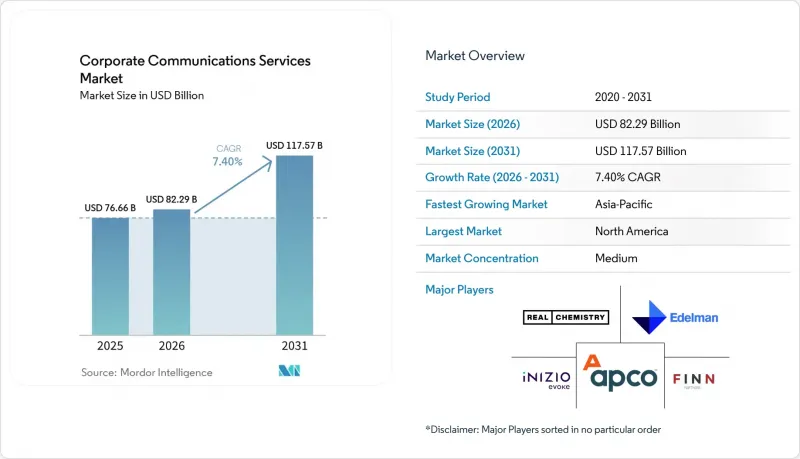
根據 Mordor Intelligence 預測,企業通訊服務市場規模預計將在 2025 年達到 766.6 億美元,2026 年達到 822.9 億美元,到 2031 年達到 1,175.7 億美元,2026 年至 2031 年的複合年成長率為 7.40%。
全球企業通訊服務市場趨勢與洞察
董事會層面對於聲譽管理和相關人員/諮詢服務的需求日益成長。
董事會越來越重視企業聲譽,不再僅僅將其視為公關團隊的職責,而是將其視為公司管治的一項重要責任,尤其是在相關人員的期望可能影響公司業務永續營運能力的情況下。 IESE商學院2026年對24個國家、18個產業的130家公司進行的一項調查顯示,56%的董事會已將永續發展納入議程,61%的董事會已將其融入經營模式。 2026年2月,高盛將其聲譽、企業文化和相關人員關係策略的監督權委託給一個“公共責任委員會”,這正是透過董事會委員會架構正式確立這些職責的一個典型例子。這種方法支援與公司管治、相關人員定位、聲譽風險、資訊揭露準備以及重大公司事件前的溝通規劃相關的諮詢服務。如果此類外包服務獲得財務、法務和董事會領導的批准,而不是僅僅被視為一項公關支出,那麼企業傳播服務市場將從中受益。在管治、相關人員理論、公司定位和複雜的聲譽問題方面擁有經驗的公司,在需要值得信賴的高階主管參與、精心準備、可靠的揭露支援和務實判斷的交易中,尤其是在利害關係人的關注點與法律、財務、營運或公共政策議題訂單的情況下,更有優勢參與競爭。
混合辦公模式的推廣以及員工溝通的需求
隨著混合辦公模式的興起,內部溝通的範圍已不再局限於向總部員工提供訊息,因此,對於所有分散辦公的員工而言,溝通品質都變得至關重要。企業需要在所有管道和工作方式(包括辦公室、遠端和現場團隊)中,提供一致的經營團隊訊息、員工指導、管理支援以及與變革相關的溝通。因此,企業通訊服務市場在通路規劃、員工內容、領導溝通以及併購、業務重組、技術應用和組織變革期間的溝通支援等領域蘊藏著機會。整合式員工體驗平台也吸引了投資,因為它們可以透過單一系統連接文書工作員工和現場工作人員。當大規模企業必須在多個地點、職能部門、語言和業務單位之間保持一致的訊息,同時避免在地化誤解時,這種需求尤其突出。此外,這為能夠將管理溝通、員工回饋、內容個人化、管理培訓和可操作的互動相結合的服務提供者創造了新的商機,尤其是在員工不確定性加劇的時期,經營團隊需要確保員工理解新的組織結構、新的系統、新的領導優先事項或改進的工作方式。
透過內部內容工作室和傳播團隊將代理成本內部化。
將溝通任務轉移到內部團隊仍然是外部機構收入的一大限制因素,因為這使得企業能夠更嚴格地管理高度敏感的新聞事件和組織內部資訊。根據南加大安納伯格傳播學院發布的《2024年全球傳播報告》,目前64%的企業傳播活動都在內部進行。內部團隊可以利用數位化工具大規模處理日常內容,並與經營團隊、法務、人力資源和營運團隊進行更直接的協作。這給內容創作、媒體宣傳、社交媒體管理、平面設計、翻譯以及其他可以標準化的活動帶來了最大的壓力。企業傳播服務市場在危機應變、股東權益、IPO傳播、跨境聲譽管理以及客戶需要外部觀點和專業網路的場合中繼續發揮至關重要的作用。服務提供者必須在高階管理層的判斷力、專業知識、速度、保密性以及在複雜情況下高效執行的能力方面展現出明顯的優勢,才能維持持續的合約關係,尤其是在企業缺乏處理特殊相關人員、爭議性問題、突發危機或跨境利益相關者挑戰的內部經驗時。
細分市場分析
至2025年,「企業聲譽與定位」服務將佔服務收入的34.73%。這反映出董事會越來越重視在企業故事敘述和管理聲譽風險方面發揮主導作用。這項服務涵蓋高價值交易,高階主管需要就如何協調業務、法律和相關人員的考慮提供建議,例如併購諮詢、應對激進投資者的措施以及IPO中的故事管理。這些交易需要與法律和財務顧問密切合作,因為溝通的內容會影響投資者信心、監管機構的關注以及公眾的監督。公共關係和媒體關係仍然是重要的相關服務,但自動化技術的進步正在降低常規媒體監控、自動宣傳和其他活動的價值。隨著公司需要透過不同的管道與機構投資者、散戶投資者和被動投資者溝通,並保持一致的資訊揭露,投資者關係和財務溝通的複雜性也在增加。
ESG(環境、社會和治理)及永續發展溝通預計將在2026年至2031年間以8.32%的複合年成長率成長,在所有服務類別中增速最高。儘管全球監管揭露要求不斷擴大,但一些公司在發布自願性永續發展公開聲明方面變得更加謹慎。這種差異催生了對系統性溝通的需求,以向員工、投資者、客戶和其他相關人員解釋必要的揭露內容。隨著經營團隊尋求在投資者簡報、公佈財報和企業轉型中發揮更強大的作用,經營團隊的定位和思想領導變得日益重要。危機和議題管理、內容開發和分發以及內部和轉型溝通,在數位化變革、混合辦公、人工智慧應用和併購後整合的背景下,為相關人員在其整個生命週期中提供支援。
區域分析
到2025年,北美將佔據企業傳播服務市場36.93%的佔有率,成為最大的區域市場。這一地位反映出北美成熟的投資者關係環境,為完善的企業管治實踐、複雜的併購活動以及高階諮詢服務提供了支持。許多此類交易集中在美國,尤其是在財務溝通、交易支援、股東互動以及涉及上市公司的關鍵聲譽問題方面。由企業總部、顧問、資本市場參與者和專業傳播公司組成的緊密網路,支撐著一個尋求高階諮詢服務的龐大市場。加拿大透過資源產業的管治要求和跨境交易做出貢獻,而墨西哥則因近岸外包和製造地轉移而需求不斷成長。在北美,隨著企業內部團隊越來越負責內容和媒體關係,最具吸引力的外包機會正逐漸局限於那些需要獨立觀點、與高階主管建立聯繫以及快速回應的領域。這一趨勢給中層行政運營帶來了壓力,同時也推動了對能夠為董事會、法負責人和財務人員提供諮詢的專業公司的需求。
預計亞太地區在2026年至2031年間將以9.03%的複合年成長率成長,成為受訪地區中成長最快的地區。跨國公司和領先的區域性企業正在建立跨越不同監管框架、資本市場、媒體環境和國家商業文化的相關人員和溝通能力。在印度,隨著上市公司和私募股權支持的科技公司系統化其溝通活動並滿足不斷變化的資訊揭露預期,投資者關係和聲譽管理專案的需求日益成長。在中國,政策敏感產業需要建立政府關係和進行聲譽風險管理,因此對當地情況的了解和謹慎的溝通仍然至關重要。在日本,需要就正在進行的管治改革相關的危機管理溝通提供諮詢;而在韓國,正在為旨在講述企業集團轉型故事的經營團隊溝通項目提供支援。在澳大利亞,正在為與氣候變遷資訊揭露里程碑相關的ESG溝通提供支持,這為諮詢工作增添了新的監管層面。 2026年7月,Real Chemistry收購了新加坡的Sparwing Communications Ltd.,從而在亞太地區建立了其首個戰略基地。這凸顯了市場對區域市場、醫療保健傳播和策略企業傳播日益成長的需求。
2025年,歐洲將成為全球第二大企業傳播服務市場,其中英國將成為金融傳播的重要中心,德國將成為ESG(環境、社會和治理)相關相關人員的樞紐。倫敦、法蘭克福和巴黎仍然是高價值交易、投資者關係、公共事務和聲譽管理等需要跨境協調的關鍵樞紐。在法國、義大利、西班牙和其他歐洲國家,隨著企業應對日益複雜的法規結構和多元化的相關人員期望,市場需求不斷成長。在此環境下,企業傳訊傳播顧問在解讀監管揭露、管理聲譽以及協調各國市場的訊息方面發揮著重要作用。在中東,隨著主權財富基金投資組合、「2030願景」下的企業轉型以及可能需要雙語策略傳播的跨境併購,諮詢需求也在不斷成長。非洲仍處於發展初期,充滿機遇,南非、埃及和奈及利亞在資本市場深化和跨國公司與當地相關人員建立正式聯繫方面發揮主導作用。在這些市場中,了解當地政策環境並能將區域傳播與全球企業故事連結起來的公司,顯然有很多機會贏得交易。
其他好處:
- Excel格式的市場預測(ME)表
- 3個月的分析師支持
目錄
第1章:引言
- 研究假設和市場定義
- 調查範圍
第2章:調查方法
第3章執行摘要
第4章 市場狀況
- 市場概覽
- 市場促進因素
- 董事會層面對於聲譽管理和相關人員/諮詢服務的需求日益成長。
- 混合辦公模式的擴展及員工的溝通需求
- 高階主管意見領袖和多管道贏得內容拓展
- 擴大人工智慧分析和個人化技術在傳播項目的應用。
- 需要利用生成式人工智慧最佳化企業故事,以促進資訊發現。
- 個人投資者的崛起以及他們與另類金融媒體日益密切的互動。
- 市場限制因素
- 將廣告代理商費用內部化,由公司內部內容工作室和公關團隊承擔。
- 審查預算和衡量投資報酬率的壓力
- CEO們在關鍵溝通中人工智慧素養的差距。
- 綠色環保方面的騷擾和法律上的謹慎立場抑制了建構外部敘事的願望。
- 宏觀經濟因素對市場的影響
- 產業價值鏈分析
- 監理情勢
- 技術展望
- 波特五力分析
第5章 市場規模與成長預測
- 按服務類型
- 企業聲譽和定位
- 公共關係與媒體關係
- 經營團隊定位和思想領袖
- 投資者關係和財務溝通
- 內部溝通與變革相關溝通
- 危機/問題管理
- 環境、社會及公司治理(ESG)及永續發展溝通
- 內容開發與散佈
- 按最終用戶行業分類
- 零售與電子商務
- 媒體與娛樂
- 醫療保健和生命科學
- 旅遊與飯店
- 消費品
- 其他行業(銀行、金融服務和保險、教育、汽車、IT和電信)
- 按地區
- 北美洲
- 美國
- 加拿大
- 墨西哥
- 南美洲
- 巴西
- 阿根廷
- 智利
- 其他南美國家
- 歐洲
- 德國
- 英國
- 法國
- 義大利
- 西班牙
- 其他歐洲國家
- 亞太地區
- 中國
- 日本
- 印度
- 韓國
- 澳洲
- 其他亞太國家
- 中東
- 沙烏地阿拉伯
- 阿拉伯聯合大公國
- 卡達
- 其他中東國家
- 非洲
- 南非
- 埃及
- 奈及利亞
- 其他非洲國家
- 北美洲
第6章 競爭情勢
- 市場集中度
- 策略趨勢
- 市佔率分析
- 公司簡介
- Daniel J. Edelman, Inc.
- Real Chemistry, LLC
- APCO Worldwide LLC
- FINN Partners, Inc.
- Ruder Finn, Inc.
- Brunswick Group Partnership Limited
- FGS Global(UK)Limited
- Teneo Holdings LLC
- FTI Consulting, Inc.
- ICR, LLC
- Prosek Partners, LLC
- Weber Shandwick
- FleishmanHillard Inc.
- Ketchum Inc.
- Burson Cohn & Wolfe, Inc.
- Golin, Inc.
- MSL Group, Inc.
- Allison+Partners, Inc.
- Grayling Limited
- Clarity Global Group Limited
- Dix & Eaton, Inc.
- Inizio Evoke Limited
- LLYC(Llorente y Cuenca)
- H/Advisors
第7章 市場機會與未來展望
According to Mordor Intelligence, the corporate communications services market size is projected to be USD 76.66 billion in 2025, USD 82.29 billion in 2026, and reach USD 117.57 billion by 2031, growing at a CAGR of 7.40% from 2026 to 2031.
Global Corporate Communications Services Market Trends and Insights
Rising Board-Level Demand for Reputation and Stakeholder Advisory
Boards are treating corporate reputation as a governance responsibility rather than a function delegated only to communications teams, especially where stakeholder expectations can affect a company's license to operate. The 2026 IESE survey of 130 companies in 24 countries and 18 industries found that 56% of boards integrated sustainability into their agendas, while 61% embedded it in business models. Goldman Sachs assigned its Public Responsibilities Committee oversight of strategies for reputation, culture, and stakeholder relationships in February 2026, showing how these responsibilities can be formalized through board committee structures. This approach supports advisory work involving governance, stakeholder positioning, reputational risk, disclosure preparation, and communications planning before material corporate events occur. The corporate communications services market benefits when such mandates are approved by finance, legal, and board leaders rather than being treated as only a communications department expense. Firms with experience in governance, stakeholder theory, corporate positioning, and complex reputation matters are better placed to compete for assignments that require trusted senior involvement, careful preparation, credible disclosure support, and practical judgment when stakeholder concerns overlap with legal, financial, operational, or public policy issues.
Expansion of Hybrid Workforce and Employee Communications Needs
Hybrid work has widened the remit of internal communications beyond headquarters-based employee updates, making communication quality more important across dispersed workforces. Organizations need consistent executive messaging, workforce guidance, manager support, and change communications across office, remote, and frontline teams that may use different channels and work patterns. The corporate communications services market, therefore, has opportunities in channel planning, employee content, leadership communication, and communications support during M&A, restructuring, technology adoption, and organizational change. Unified employee experience platforms are also drawing investment because they can connect desk-based and frontline staff through one system. This demand is strongest where large employers must coordinate messages across many locations, functions, languages, and business units while avoiding inconsistent local interpretation. It also creates work for providers that can combine executive communication, employee listening, content personalization, manager guidance, and practical engagement during periods of workforce uncertainty, particularly when organizations need employees to understand new structures, new systems, new leadership priorities, or revised ways of working.
In-House Content Studios and Communications Teams Insourcing Agency Spend
The transfer of communications work to internal teams remains a material constraint on external agency revenue because companies can retain greater control over sensitive narratives and institutional knowledge. The USC Annenberg 2024 Global Communication Report found that 64% of corporate communications activities were conducted in-house. Internal teams can use digital tools to handle routine content at scale and can coordinate more directly with leadership, legal, human resources, and operating teams. This places the greatest pressure on content production, earned media execution, social media management, graphics, translation, and other recurring activities that can be standardized. The corporate communications services market retains a stronger role in crisis response, shareholder activism, IPO communications, cross-border reputation matters, and situations where clients need an external perspective or specialized networks. Providers must show a clear advantage in senior judgment, specialist knowledge, speed, confidentiality, and the ability to work effectively in complex situations to sustain retainer relationships, especially when an organization lacks internal experience with an unusual transaction, contested issue, sudden crisis, or cross-border stakeholder challenge.
Other drivers and restraints analyzed in the detailed report include:
- Growth in Executive Thought Leadership and Multi-Channel Earned Content
- Increasing Use of AI-Enabled Analytics and Personalization in Communications Programs
- Budget Scrutiny and Return-on-Investment Measurement Pressure
For complete list of drivers and restraints, kindly check the Table Of Contents.
Segment Analysis
Corporate Reputation and Positioning held 34.73% of service type revenue in 2025, reflecting the priority boards' place on controlling narratives and managing reputational risk. The service covers high-value mandates such as M&A advisory, activist investor defense, and IPO narrative management, where senior executives need advice that aligns business, legal, and stakeholder considerations. These assignments require close coordination with legal and financial advisers because messages can influence investor confidence, regulatory attention, and public scrutiny. Public Relations and Media Relations remain an important adjacent service, although automation is reducing the value of routine media monitoring, automated pitching, and other execution-led activities. Investor Relations and Financial Communications is also gaining complexity as companies communicate with institutional, retail, and passive investors through different channels while maintaining consistent disclosures.
ESG and Sustainability Communications is projected to expand at a CAGR of 8.32% from 2026 to 2031, the fastest rate among the listed service types. Regulatory disclosure requirements are expanding globally, while some companies are becoming more cautious about voluntary public sustainability claims. This difference creates demand for structured communications work that explains required disclosures to employees, investors, customers, and other stakeholders. Executive Positioning and Thought Leadership is gaining importance as leadership teams seek a stronger presence around investor days, earnings communications, and corporate change. Crisis and Issues Management, Content Development and Distribution, and Internal and Change Communications support the broader stakeholder lifecycle during digital disruption, hybrid work, AI adoption, and post-merger integration.
Complete Report Scope:
- By Service Type
- Corporate Reputation and Positioning
- Public Relations and Media Relations
- Executive Positioning and Thought Leadership
- Investor Relations and Financial Communications
- Internal and Change Communications
- Crisis and Issues Management
- ESG and Sustainability Communications
- Content Development and Distribution
- By End-User Industry
- Retail and E-commerce
- Media and Entertainment
- Healthcare and Life Sciences
- Travel and Hospitality
- Consumer Goods
- Other Industry Verticals (BFSI, Education, Automotive, IT and Telecom)
- By Geography
- North America
- United States
- Canada
- Mexico
- South America
- Brazil
- Argentina
- Chile
- Rest of South America
- Europe
- Germany
- United Kingdom
- France
- Italy
- Spain
- Rest of Europe
- Asia-Pacific
- China
- Japan
- India
- South Korea
- Australia
- Rest of Asia-Pacific
- Middle East
- Saudi Arabia
- United Arab Emirates
- Qatar
- Rest of Middle East
- Africa
- South Africa
- Egypt
- Nigeria
- Rest of Africa
- North America
Geography Analysis
North America held 36.93% of the corporate communications services market share in 2025, making it the largest regional market. The region's position reflects established corporate governance practices, complex M&A activity, and a developed investor relations environment that supports premium advisory assignments. The United States concentrates many of these assignments, particularly in financial communications, transaction support, shareholder engagement, and high-stakes reputation matters involving public companies. Its dense network of corporate headquarters, advisers, capital markets participants, and specialist communications firms supports a deep market for sophisticated counsel. Canada contributes through resource-sector governance requirements and cross-border transactions, while Mexico is developing demand linked to nearshoring and manufacturing relocation. In-house teams in North America are also taking more content and media relations work, which narrows the most attractive external mandates to areas that require an independent perspective, senior relationships, and rapid response. This pattern puts pressure on mid-tier execution work while supporting demand for specialist firms that can advise boards, general counsels, and finance leaders.
Asia-Pacific is projected to expand at a CAGR of 9.03% from 2026 to 2031, the fastest pace among the geographic areas identified. Multinational companies and regional champions are building stakeholder engagement capabilities across diverse regulatory systems, capital markets, media environments, and national business cultures. India is developing demand for investor relations and reputation programs as listed companies and private equity-backed technology businesses formalize communications activity and respond to evolving disclosure expectations. China requires government relations and reputation risk management in policy-sensitive sectors, where local understanding and careful engagement remain important. Japan needs crisis communications advice related to ongoing governance reforms, while South Korea supports executive communications programs for chaebol transformation narratives. Australia supports ESG communications linked to climate disclosure milestones, adding another regulatory dimension to advisory mandates. Real Chemistry acquired Spurwing Communications in Singapore in July 2026 to establish its first Asia-Pacific strategic hub, highlighting demand for regional market access, medical communications, and strategic corporate communications.
Europe was the second-largest geographic area in the corporate communications services market in 2025, with the United Kingdom serving as a major center for financial communications and Germany anchoring ESG-related stakeholder engagement. London, Frankfurt, and Paris remain important locations for high-value transaction, investor, public affairs, and reputation mandates that require cross-border coordination. France, Italy, Spain, and the rest of Europe contribute demand as companies respond to more complex regulatory frameworks and diverse stakeholder expectations. This environment gives corporate communications advisers a role in explaining regulated disclosures, managing reputation, and coordinating messages across national markets. The Middle East is developing advisory needs connected with sovereign wealth fund portfolios, Vision 2030 corporate transformations, and cross-border M&A that may require bilingual strategic communications. Africa remains an earlier-stage opportunity, led by South Africa, Egypt, and Nigeria as capital market depth expands and multinational companies formalize local stakeholder engagement. Across these markets, firms that understand local policy conditions and can connect regional communications with a global corporate narrative have a clearer opportunity to win mandates.
- Daniel J. Edelman, Inc.
- Real Chemistry, LLC
- APCO Worldwide LLC
- FINN Partners, Inc.
- Ruder Finn, Inc.
- Brunswick Group Partnership Limited
- FGS Global (UK) Limited
- Teneo Holdings LLC
- FTI Consulting, Inc.
- ICR, LLC
- Prosek Partners, LLC
- Weber Shandwick
- FleishmanHillard Inc.
- Ketchum Inc.
- Burson Cohn & Wolfe, Inc.
- Golin, Inc.
- MSL Group, Inc.
- Allison+Partners, Inc.
- Grayling Limited
- Clarity Global Group Limited
- Dix & Eaton, Inc.
- Inizio Evoke Limited
- LLYC (Llorente y Cuenca)
- H/Advisors
Additional Benefits:
- The market estimate (ME) sheet in Excel format
- 3 months of analyst support
TABLE OF CONTENTS
1 INTRODUCTION
- 1.1 Study Assumptions and Market Definition
- 1.2 Scope of the Study
2 RESEARCH METHODOLOGY
3 EXECUTIVE SUMMARY
4 MARKET LANDSCAPE
- 4.1 Market Overview
- 4.2 Market Drivers
- 4.2.1 Rising Board-Level Demand for Reputation and Stakeholder Advisory
- 4.2.2 Expansion of Hybrid Workforce and Employee Communications Needs
- 4.2.3 Growth in Executive Thought Leadership and Multi-Channel Earned Content
- 4.2.4 Increasing Use of AI-Enabled Analytics and Personalization in Communications Programs
- 4.2.5 Need to Optimize Corporate Narratives for Generative AI Discovery
- 4.2.6 Rise of Retail Investor and Alternative Financial Media Engagement
- 4.3 Market Restraints
- 4.3.1 In-House Content Studios and Communications Teams Insourcing Agency Spend
- 4.3.2 Budget Scrutiny and ROI Measurement Pressure
- 4.3.3 CEO AI Literacy Gap in High-Stakes Communications
- 4.3.4 Greenhushing and Legal Caution Reducing External Narrative Ambition
- 4.4 Impact of Macroeconomic Factors on the Market
- 4.5 Industry Value Chain Analysis
- 4.6 Regulatory Landscape
- 4.7 Technological Outlook
- 4.8 Porter's Five Forces Analysis
- 4.8.1 Bargaining Power of Buyers
- 4.8.2 Bargaining Power of Suppliers
- 4.8.3 Threat of New Entrants
- 4.8.4 Threat of Substitutes
- 4.8.5 Intensity of Competitive Rivalry
5 MARKET SIZE AND GROWTH FORECASTS (VALUE)
- 5.1 By Service Type
- 5.1.1 Corporate Reputation and Positioning
- 5.1.2 Public Relations and Media Relations
- 5.1.3 Executive Positioning and Thought Leadership
- 5.1.4 Investor Relations and Financial Communications
- 5.1.5 Internal and Change Communications
- 5.1.6 Crisis and Issues Management
- 5.1.7 ESG and Sustainability Communications
- 5.1.8 Content Development and Distribution
- 5.2 By End-User Industry
- 5.2.1 Retail and E-commerce
- 5.2.2 Media and Entertainment
- 5.2.3 Healthcare and Life Sciences
- 5.2.4 Travel and Hospitality
- 5.2.5 Consumer Goods
- 5.2.6 Other Industry Verticals (BFSI, Education, Automotive, IT and Telecom)
- 5.3 By Geography
- 5.3.1 North America
- 5.3.1.1 United States
- 5.3.1.2 Canada
- 5.3.1.3 Mexico
- 5.3.2 South America
- 5.3.2.1 Brazil
- 5.3.2.2 Argentina
- 5.3.2.3 Chile
- 5.3.2.4 Rest of South America
- 5.3.3 Europe
- 5.3.3.1 Germany
- 5.3.3.2 United Kingdom
- 5.3.3.3 France
- 5.3.3.4 Italy
- 5.3.3.5 Spain
- 5.3.3.6 Rest of Europe
- 5.3.4 Asia-Pacific
- 5.3.4.1 China
- 5.3.4.2 Japan
- 5.3.4.3 India
- 5.3.4.4 South Korea
- 5.3.4.5 Australia
- 5.3.4.6 Rest of Asia-Pacific
- 5.3.5 Middle East
- 5.3.5.1 Saudi Arabia
- 5.3.5.2 United Arab Emirates
- 5.3.5.3 Qatar
- 5.3.5.4 Rest of Middle East
- 5.3.6 Africa
- 5.3.6.1 South Africa
- 5.3.6.2 Egypt
- 5.3.6.3 Nigeria
- 5.3.6.4 Rest of Africa
- 5.3.1 North America
6 COMPETITIVE LANDSCAPE
- 6.1 Market Concentration
- 6.2 Strategic Moves
- 6.3 Market Share Analysis
- 6.4 Company Profiles (includes Global Level Overview, Market Level Overview, Core Segments, Financials as available, Strategic Information, Market Rank/Share, Products and Services, Recent Developments)
- 6.4.1 Daniel J. Edelman, Inc.
- 6.4.2 Real Chemistry, LLC
- 6.4.3 APCO Worldwide LLC
- 6.4.4 FINN Partners, Inc.
- 6.4.5 Ruder Finn, Inc.
- 6.4.6 Brunswick Group Partnership Limited
- 6.4.7 FGS Global (UK) Limited
- 6.4.8 Teneo Holdings LLC
- 6.4.9 FTI Consulting, Inc.
- 6.4.10 ICR, LLC
- 6.4.11 Prosek Partners, LLC
- 6.4.12 Weber Shandwick
- 6.4.13 FleishmanHillard Inc.
- 6.4.14 Ketchum Inc.
- 6.4.15 Burson Cohn & Wolfe, Inc.
- 6.4.16 Golin, Inc.
- 6.4.17 MSL Group, Inc.
- 6.4.18 Allison+Partners, Inc.
- 6.4.19 Grayling Limited
- 6.4.20 Clarity Global Group Limited
- 6.4.21 Dix & Eaton, Inc.
- 6.4.22 Inizio Evoke Limited
- 6.4.23 LLYC (Llorente y Cuenca)
- 6.4.24 H/Advisors
7 MARKET OPPORTUNITIES AND FUTURE OUTLOOK
- 7.1 White-Space and Unmet-Need Assessment

 加州大學與數位服務:研究訂閱
 視覺化協作軟體市場:全球市場預測,2026-2032年思科硬體經銷商市場報告:趨勢、預測和競爭分析(至 2035 年)無線音訊會議系統市場-2026年至2032年全球市場預測
 旅遊、飯店與客運業通訊與協作成長機會:全球,2026-2029 年
 企業通訊領域的OTT:市佔率分析、產業趨勢與統計及成長預測(2026-2031年)整合通訊市場:按組件、解決方案、部署類型、組織規模、應用和最終用戶產業分類-2026-2032年全球市場預測工業製造領域工人技術:市場佔有率分析、產業趨勢與統計及成長預測(2026-2031)
 整合通訊市場-全球產業規模、佔有率、趨勢、機會、預測:按產品、解決方案、組織規模、應用、地區和競爭對手分類,2021-2031年醫療產業的整合通訊即服務:市場佔有率分析、產業趨勢和統計數據以及成長預測(2026-2031 年)