


 |
市場調查報告書
商品編碼
2118033
企業通訊領域的OTT:市佔率分析、產業趨勢與統計及成長預測(2026-2031年)OTT For Corporate Communications - Market Share Analysis, Industry Trends & Statistics, Growth Forecasts (2026 - 2031) |
||||||

※ 本網頁內容可能與最新版本有所差異。詳細情況請與我們聯繫。
根據 Mordor Intelligence 預測,企業通訊 OTT 市場規模將從 2025 年的 29.3 億美元和 2026 年的 32.3 億美元成長到 2031 年的 55.9 億美元,2026 年至 2031 年的複合年成長率為 11.59%。
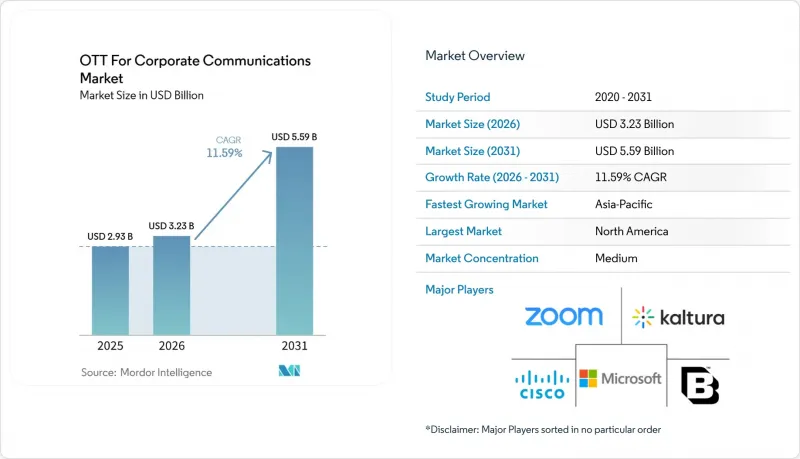
本報告按設備類型(智慧型手機和平板電腦、智慧電視、筆記型電腦和桌上型電腦等)、內容類型(直播、點播影片、存檔影片庫)、終端用戶產業(醫療保健和生命科學、資訊科技和通訊、製造業、教育等)以及地區進行細分。市場預測以美元(USD)為單位。
全球OTT市場趨勢及企業通訊洞察
對安全可靠的內部和外部視訊通訊的需求日益成長。
在企業通訊OTT市場,安全性已成為一項重要的購買考量因素,因為受監管的公司現在期望視訊系統達到與其他受管理業務記錄相同的標準。受MiFID II約束的金融公司必須記錄相關的電子通訊,並且至少保留五年,同時還要確保監管機構能夠搜尋和存取這些記錄。類似的合規要求正在擴大企業通訊OTT市場的潛在基本客群,因為醫療保健、法律和專業服務行業的團隊也需要更強大的存取控制、審計日誌和明確的保留規則。據Digital Samba稱,合規部署需要靜態和傳輸加密、基於角色的存取控制、審計日誌以及與歸檔系統的整合,從而提升了專業企業平台的價值。此外,由於許多公司不希望將所有敏感的內部視訊流量儲存在標準的多租戶環境中,這一趨勢正推動企業通訊OTT市場轉向私有雲端、主權託管和本地部署等方案。
混合型和分散式辦公模式日益成長的溝通需求
隨著能夠遠距辦公的員工繼續採用線上線下混合辦公模式,混合辦公仍然是企業通訊OTT市場結構性驅動力。蓋洛普的一份報告顯示,到2026年,53%的美國遠距辦公員工將採用混合辦公模式,凸顯了在不同時區和工作時間安排的環境中,非同步內部視訊通訊的重要性。企業通訊OTT市場正受惠於此趨勢,因為即時參與不再是公司全體會議、新員工培訓和經營團隊報告的唯一要求。此外,微軟的研究表明,人工智慧在職場的應用與系統整合和管理支援密切共用。這意味著視訊工具需要無縫整合到日常工作流程中,而不是作為孤立的管道存在。因此,企業正在增加對支援實況活動和回放的全天候視訊中心的運作,這使得企業通訊OTT市場的使用模式比一次性活動軟體更加穩定。
與傳統企業系統整合的複雜性
由於視訊平台需要與身分管理系統、人力資源工具、學習系統和歸檔環境整合,整合仍是企業通訊OTT市場的主要瓶頸。微軟的研究表明,人工智慧部署的成功與否很大程度上取決於工具與現有系統的整合程度,這證實了將人工智慧深度整合到工作流程中而非孤立部署的必要性。如果企業缺乏將單一登入 (SSO)、合規歸檔和員工目錄整合到單一體驗中的技術資源,企業通訊OTT市場的成長速度將會放緩。對於中型企業而言,這是一個更為嚴重的問題,因為它們通常需要企業級功能,但卻缺乏大規模跨國公司所擁有的內部整合團隊。雖然供應商可以透過預先建置的連接器來緩解部分摩擦,但在傳統環境高度客製化的地區,企業通訊市場的OTT部署仍然進展緩慢。
細分市場分析
到2025年,筆記型電腦和桌上型電腦將佔企業通訊OTT市場47.16%的佔有率,這意味著託管工作站仍將是企業視訊的主要網路基地台。在企業通訊OTT市場中,這些設備非常適合按需培訓、重播、策略更新和日常內部溝通,能夠無縫融入現有的辦公室工作流程。智慧型手機和平板電腦構成了第二層存取方式,尤其適用於製造、物流和零售業的現場團隊,因為他們不依賴固定的桌面環境。即使在非文書工作辦公崗位,即使觀看時間較短且以任務主導,企業通訊OTT市場的重要性依然不容忽視。
預計2026年至2031年間,智慧電視的複合年成長率將達到12.57%。隨著企業將視訊應用擴展到會議室、經營團隊簡報室和員工共用區域,智慧電視領域的企業通訊OTT市場也蓬勃發展。這項轉變意義重大,因為智慧電視使企業能夠向團隊發布領導訊息和內部新聞,而無需用戶每次都登入。在企業通訊OTT市場,這正在推動工作環境中從個人觀看到共用螢幕通訊的廣泛轉變。隨著企業觀看習慣日益多樣化,能夠最佳化應用程式交付、裝置管理以及跨多種螢幕類型播放一致性的供應商有望鞏固其市場地位。
區域分析
預計到2025年,北美將佔據企業通訊OTT市場38.14%的佔有率,成為最大的區域貢獻者。該地區受益於大型企業密集的基礎設施、混合管治模式的廣泛應用以及對內部視訊規範化的強勁需求。蓋洛普和微軟都指出,混合辦公模式的建立和人工智慧驅動的工作流程的擴展是該地區企業持續投資於支援即時和非同步通訊的視訊系統的原因。由於金融服務、醫療保健和科技業的採購負責人面臨預算限制和合規壓力,美國仍是企業通訊OTT市場的主要需求來源。加拿大和墨西哥的企業通訊OTT市場規模雖小,但受益於跨國業務活動和分散式團隊結構,這些都需要可靠的內部視訊傳輸。
歐洲仍然是第二大市場,其企業通訊OTT市場深受GDPR和受監管環境下的影像要求的影響。據Digital Samba稱,金融業合規的影片部署需要明確的保留期限、審計日誌和以歐盟為中心的基礎設施控制,這推動了對特定區域託管和管治能力的需求。德國、英國和法國的企業通訊OTT市場由更重視資料管理、身分驗證和正式歸檔實務的企業買家所支持。因此,歐洲的採購活動往往優先考慮合規性而非便利性,這可能有利於那些擁有更強大的資料駐留和政策框架的供應商。
預計到2031年,亞太地區將以12.08%的複合年成長率成長,企業通訊OTT市場將隨著大規模服務中心和跨國公司擴大使用內部視訊來觸達分散的員工而不斷擴張。印度的企業通訊OTT市場主要由技術服務和外包活動驅動,這些活動依賴快速入職、培訓和跨地域的團隊協作。在亞太地區的多個國家,行動端觀看的重要性正在超過桌面端,這影響了輕量級應用和自我調整串流等設計重點。雖然中東和非洲的企業通訊OTT市場仍處於發展初期,但Mangomolo在2026年報告稱,將為歐洲、中東和非洲的客戶推出人工智慧驅動的個人化和工作流程整合功能,並持續增強其OTT平台。此類平台擴展顯示區域基礎設施正在日趨完善,預計將逐步提高這些新興市場企業採用內部串流媒體的可行性。
其他好處:
- Excel格式的市場預測(ME)表
- 3個月的分析師支持
目錄
第1章:引言
- 研究假設和市場定義
- 調查範圍
第2章:調查方法
第3章執行摘要
第4章 市場狀況
- 市場概覽
- 市場促進因素
- 對安全可靠的內部和外部視訊通訊的需求日益成長。
- 混合型和分散式辦公模式下日益成長的溝通需求。
- 拓展品牌企業影片入口網站和應用程式
- 人工智慧驅動的影片搜尋、轉錄和摘要。
- 內容管治、歸檔和合規性要求
- 向可衡量的溝通分析過渡
- 市場限制因素
- 與傳統企業系統整合的複雜性
- 與資料隱私、安全性和存取控制相關的挑戰。
- 託管串流媒體和廣播級工作流程的高成本
- 跨多個溝通管道的用戶採納障礙
- 產業價值鏈分析
- 監理情勢
- 技術展望
- 波特五力分析
- 宏觀經濟因素對市場的影響
第5章 市場規模與成長預測
- 依設備類型
- 智慧型手機和平板電腦
- 智慧電視
- 筆記型電腦和桌上型電腦
- 其他設備類型
- 按內容類型
- 直播
- 點播影片
- 影片庫存檔
- 按最終用戶行業分類
- BFSI
- 醫療保健和生命科學
- 資訊科技/通訊
- 製造業
- 零售和消費品
- 教育
- 其他終端用戶產業
- 按地區
- 北美洲
- 美國
- 加拿大
- 墨西哥
- 南美洲
- 巴西
- 阿根廷
- 智利
- 其他南美國家
- 歐洲
- 德國
- 英國
- 法國
- 義大利
- 西班牙
- 其他歐洲國家
- 亞太地區
- 中國
- 日本
- 印度
- 韓國
- 澳洲
- 其他亞太國家
- 中東
- 沙烏地阿拉伯
- 阿拉伯聯合大公國
- 卡達
- 其他中東國家
- 非洲
- 南非
- 埃及
- 奈及利亞
- 其他非洲國家
- 北美洲
第6章 競爭情勢
- 市場集中度
- 策略趨勢
- Vendor Positioning Analysis
- 公司簡介
- Microsoft Corporation
- Zoom Video Communications, Inc.
- Cisco Systems, Inc.
- Kaltura, Inc.
- Brightcove, Inc.
- Panopto, Inc.
- Vimeo, Inc.
- Vidyard, Inc.
- Haivision Systems Inc.
- Kollective Technology, Inc.
- Vbrick Systems, Inc.
- MediaPlatform, Inc.
- Wistia, Inc.
- Dacast, Inc.
- IBM Corporation
- Adobe Inc.
- Amazon Web Services, Inc.
- Google LLC
- RingCentral, Inc.
- Staffbase GmbH
- Firstup, Inc.
- Poppulo
- Simpplr Inc.
- LumApps
- Workvivo Limited
第7章 市場機會與未來展望
According to Mordor Intelligence, the OTT for corporate communications market size is projected to expand from USD 2.93 billion in 2025 and USD 3.23 billion in 2026 to USD 5.59 billion by 2031, registering a CAGR of 11.59% between 2026 and 2031.
This report is Segmented by Device Type (Smartphones and Tablets, Smart TVs, Laptops and Desktops, and More), Content Type (Live Streaming, On-Demand Video, and Archived Video Libraries), End User Industry (Healthcare and Life Sciences, Information Technology and Telecommunications, Manufacturing, Education, and More), and Geography. The Market Forecasts are Provided in Terms of Value (USD).
Global OTT For Corporate Communications Market Trends and Insights
Rising Demand for Secure Internal and External Video Communications
Security has become a core buying factor in the OTT for corporate communications market, as regulated enterprises now expect video systems to meet the same standards as other controlled business records. Financial firms covered by MiFID II must record relevant electronic communications, retain them for at least 5 years, and keep them searchable and accessible for regulators. The same compliance logic is expanding the addressable base for the OTT corporate communications market, as healthcare, legal, and professional services teams also need stronger access controls, audit logs, and defined retention rules. Digital Samba states that compliant deployments require encryption at rest and in transit, role-based access control, audit logging, and archival integration, thereby enhancing the value of specialized enterprise platforms. This is also pushing the OTT for corporate communications market toward private cloud, sovereign hosting, and on-premises options, as many enterprises do not want all sensitive internal video traffic to reside in a standard multi-tenant setup.
Growth of Hybrid and Distributed Workforce Communication Needs
Hybrid work remains a structural demand driver for the OTT corporate communications market, as remote-capable employees continue to work across a mix of office and remote work patterns. Gallup reported that 53% of remote-capable U.S. employees worked in hybrid arrangements in 2026, which underscores the importance of asynchronous internal video for communication across time zones and schedules. The OTT for corporate communications market benefits from this pattern because live attendance is no longer the only expectation for all-hands meetings, onboarding, and executive updates. Microsoft also shows that AI adoption at work is tied closely to system integration and manager support, which means video tools now need to fit naturally into daily workflows rather than stand apart as isolated channels. As a result, enterprises are spending more on persistent video hubs that support both live events and replay access, which gives the OTT for corporate communications market a steadier usage pattern than one-time event software.
Integration Complexity with Legacy Enterprise Systems
Integration work remains a major brake on the OTT for corporate communications market because video platforms need to connect with identity systems, HR tools, learning systems, and archiving environments. Microsoft shows that successful AI adoption depends heavily on how well tools integrate with existing systems, reinforcing the need for deep workflow integration rather than isolated deployment. This slows the OTT for the corporate communications market when enterprises lack the technical resources to link SSO, compliance archives, and employee directories into a single experience. It is a sharper issue for mid-sized companies because they often want enterprise-grade capabilities but lack the same internal integration teams as large global buyers. Vendors can reduce some of this friction with prebuilt connectors, but the OTT for corporate communications market still faces slower rollouts wherever legacy environments remain heavily customized.
Other drivers and restraints analyzed in the detailed report include:
- AI-Enabled Video Search, Transcription, and Summarization
- Expansion of Branded Corporate Video Portals and Apps
- Data Privacy, Security, and Access Control Challenges
For complete list of drivers and restraints, kindly check the Table Of Contents.
Segment Analysis
Laptops and desktops accounted for 47.16% of OTT for corporate communications market in 2025, indicating that managed workstations remained the primary access point for enterprise video. In the OTT for corporate communications market, these devices still suit on-demand training, replay viewing, policy updates, and routine internal communications because they fit established office workflows. Smartphones and tablets formed the second access tier, especially for frontline teams in manufacturing, logistics, and retail that do not rely on assigned desktop setups. This keeps the OTT for corporate communications market relevant outside desk-based roles, even when viewing sessions are shorter and more task-driven.
Smart TVs are projected to grow at a 12.57% CAGR from 2026 to 2031, and the OTT for corporate communications market for this device segment is growing as enterprises extend video to conference rooms, executive briefing spaces, and shared employee areas. The shift matters because smart TVs enable companies to distribute leadership messages and corporate news to groups without requiring individual logins at every moment. In the OTT for corporate communications market, this also supports a broader move from personal viewing to shared-screen communication in operational settings. Vendors that optimize app delivery, device management, and playback consistency across multiple screen types are likely to strengthen their position as enterprise viewing habits become more mixed.
Complete Report Scope:
- By Device Type
- Smartphones and Tablets
- Smart TVs
- Laptops and Desktops
- Other Device Types
- By Content Type
- Live Streaming
- On-Demand Video
- Archived Video Libraries
- By End User Industry
- BFSI
- Healthcare and Life Sciences
- Information Technology and Telecommunications
- Manufacturing
- Retail and Consumer Goods
- Education
- Other End User Industries
- By Geography
- North America
- United States
- Canada
- Mexico
- South America
- Brazil
- Argentina
- Chile
- Rest of South America
- Europe
- Germany
- United Kingdom
- France
- Italy
- Spain
- Rest of Europe
- Asia-Pacific
- China
- Japan
- India
- South Korea
- Australia
- Rest of Asia-Pacific
- Middle East
- Saudi Arabia
- United Arab Emirates
- Qatar
- Rest of Middle East
- Africa
- South Africa
- Egypt
- Nigeria
- Rest of Africa
- North America
Geography Analysis
North America held 38.14% of the OTT for corporate communications market share in 2025, which made it the largest regional contributor. The region benefits from a dense base of large enterprises, broad hybrid work adoption, and stronger demand for formal governance around internal video. Gallup and Microsoft both point to persistent hybrid work and growing AI-enabled workflows, which help explain why enterprises in this region continue to invest in video systems that support both live and asynchronous communication. In the OTT for corporate communications market, the United States remains the main source of demand because financial services, healthcare, and technology buyers have both budget capacity and compliance pressure. The OTT for corporate communications market in Canada and Mexico is smaller, but it still benefits from cross-border enterprise operations and distributed team structures that require stable internal video delivery.
Europe remained the second-largest region, and the OTT for corporate communications market there is shaped strongly by GDPR and video recording obligations in regulated settings. Digital Samba states that compliant financial video deployments need clear retention, audit logging, and EU-centered infrastructure controls, which supports demand for region-specific hosting and governance features. The OTT for corporate communications market in Germany, the United Kingdom, and France is supported by enterprise buyers that place more weight on data control, certification, and formal archiving practices. This makes European procurement more compliance-led than convenience-led, which can favor vendors with stronger data residency and policy frameworks.
Asia-Pacific is projected to grow at a 12.08% CAGR through 2031, and the OTT for corporate communications market size for this region is strengthening as large service hubs and multinational employers scale internal video across dispersed workforces. The OTT for corporate communications market in India is supported by technology services and outsourcing activity that depends on rapid onboarding, training, and team alignment across locations. In several Asia-Pacific countries, mobile viewing matters more than desktop-first delivery, which affects design priorities such as lighter apps and adaptive streaming. The OTT for corporate communications market in the Middle East and Africa is earlier in development, but Mangomolo reported continued enhancement of its OTT platform in 2026 with AI personalization and workflow integration for clients across Europe, the Middle East, and Africa. That kind of platform expansion shows that regional infrastructure is becoming more capable, which should gradually improve the enterprise case for internal streaming across newer adoption markets.
- Microsoft Corporation
- Zoom Video Communications, Inc.
- Cisco Systems, Inc.
- Kaltura, Inc.
- Brightcove, Inc.
- Panopto, Inc.
- Vimeo, Inc.
- Vidyard, Inc.
- Haivision Systems Inc.
- Kollective Technology, Inc.
- Vbrick Systems, Inc.
- MediaPlatform, Inc.
- Wistia, Inc.
- Dacast, Inc.
- IBM Corporation
- Adobe Inc.
- Amazon Web Services, Inc.
- Google LLC
- RingCentral, Inc.
- Staffbase GmbH
- Firstup, Inc.
- Poppulo
- Simpplr Inc.
- LumApps
- Workvivo Limited
Additional Benefits:
- The market estimate (ME) sheet in Excel format
- 3 months of analyst support
TABLE OF CONTENTS
1 INTRODUCTION
- 1.1 Study Assumptions and Market Definition
- 1.2 Scope of The Study
2 RESEARCH METHODOLOGY
3 EXECUTIVE SUMMARY
4 MARKET LANDSCAPE
- 4.1 Market Overview
- 4.2 Market Drivers
- 4.2.1 Rising Demand for Secure Internal and External Video Communications
- 4.2.2 Growth of Hybrid and Distributed Workforce Communication Needs
- 4.2.3 Expansion of Branded Corporate Video Portals and Apps
- 4.2.4 AI-Enabled Video Search, Transcription, and Summarization
- 4.2.5 Content Governance, Archiving, and Compliance Requirements
- 4.2.6 Shift Toward Measurable Communications Analytics
- 4.3 Market Restraints
- 4.3.1 Integration Complexity With Legacy Enterprise Systems
- 4.3.2 Data Privacy, Security, and Access Control Challenges
- 4.3.3 High Cost of Managed Streaming and Broadcast-Grade Workflows
- 4.3.4 User Adoption Friction Across Multiple Communication Channels
- 4.4 Industry Value Chain Analysis
- 4.5 Regulatory Landscape
- 4.6 Technological Outlook
- 4.7 Porter's Five Forces Analysis
- 4.7.1 Bargaining Power of Buyers
- 4.7.2 Bargaining Power of Suppliers
- 4.7.3 Threat of New Entrants
- 4.7.4 Threat of Substitutes
- 4.7.5 Intensity of Competitive Rivalry
- 4.8 Impact of Macroeconomic Factors on the Market
5 MARKET SIZE AND GROWTH FORECASTS (VALUE)
- 5.1 By Device Type
- 5.1.1 Smartphones and Tablets
- 5.1.2 Smart TVs
- 5.1.3 Laptops and Desktops
- 5.1.4 Other Device Types
- 5.2 By Content Type
- 5.2.1 Live Streaming
- 5.2.2 On-Demand Video
- 5.2.3 Archived Video Libraries
- 5.3 By End User Industry
- 5.3.1 BFSI
- 5.3.2 Healthcare and Life Sciences
- 5.3.3 Information Technology and Telecommunications
- 5.3.4 Manufacturing
- 5.3.5 Retail and Consumer Goods
- 5.3.6 Education
- 5.3.7 Other End User Industries
- 5.4 By Geography
- 5.4.1 North America
- 5.4.1.1 United States
- 5.4.1.2 Canada
- 5.4.1.3 Mexico
- 5.4.2 South America
- 5.4.2.1 Brazil
- 5.4.2.2 Argentina
- 5.4.2.3 Chile
- 5.4.2.4 Rest of South America
- 5.4.3 Europe
- 5.4.3.1 Germany
- 5.4.3.2 United Kingdom
- 5.4.3.3 France
- 5.4.3.4 Italy
- 5.4.3.5 Spain
- 5.4.3.6 Rest of Europe
- 5.4.4 Asia-Pacific
- 5.4.4.1 China
- 5.4.4.2 Japan
- 5.4.4.3 India
- 5.4.4.4 South Korea
- 5.4.4.5 Australia
- 5.4.4.6 Rest of Asia-Pacific
- 5.4.5 Middle East
- 5.4.5.1 Saudi Arabia
- 5.4.5.2 United Arab Emirates
- 5.4.5.3 Qatar
- 5.4.5.4 Rest of Middle East
- 5.4.6 Africa
- 5.4.6.1 South Africa
- 5.4.6.2 Egypt
- 5.4.6.3 Nigeria
- 5.4.6.4 Rest of Africa
- 5.4.1 North America
6 COMPETITIVE LANDSCAPE
- 6.1 Market Concentration
- 6.2 Strategic Moves
- 6.3 Vendor Positioning Analysis
- 6.4 Company Profiles (includes Global Level Overview, Market Level Overview, Core Segments, Financials as available, Strategic Information, Market Rank/Share, Products and Services, Recent Developments)
- 6.4.1 Microsoft Corporation
- 6.4.2 Zoom Video Communications, Inc.
- 6.4.3 Cisco Systems, Inc.
- 6.4.4 Kaltura, Inc.
- 6.4.5 Brightcove, Inc.
- 6.4.6 Panopto, Inc.
- 6.4.7 Vimeo, Inc.
- 6.4.8 Vidyard, Inc.
- 6.4.9 Haivision Systems Inc.
- 6.4.10 Kollective Technology, Inc.
- 6.4.11 Vbrick Systems, Inc.
- 6.4.12 MediaPlatform, Inc.
- 6.4.13 Wistia, Inc.
- 6.4.14 Dacast, Inc.
- 6.4.15 IBM Corporation
- 6.4.16 Adobe Inc.
- 6.4.17 Amazon Web Services, Inc.
- 6.4.18 Google LLC
- 6.4.19 RingCentral, Inc.
- 6.4.20 Staffbase GmbH
- 6.4.21 Firstup, Inc.
- 6.4.22 Poppulo
- 6.4.23 Simpplr Inc.
- 6.4.24 LumApps
- 6.4.25 Workvivo Limited
7 MARKET OPPORTUNITIES AND FUTURE OUTLOOK
- 7.1 White-Space and Unmet-Need Assessment

 旅遊、飯店與客運業通訊與協作成長機會:全球,2026-2029 年
 整合通訊市場:按組件、解決方案、部署類型、組織規模、應用和最終用戶產業分類-2026-2032年全球市場預測
 工業製造領域工人技術:市場佔有率分析、產業趨勢與統計及成長預測(2026-2031)
 整合通訊市場機會、成長要素、產業趨勢分析及2026-2035年預測整合通訊(UC)硬體:市場佔有率分析、產業趨勢和統計數據以及成長預測(2026-2031 年)
 整合通訊市場-全球產業規模、佔有率、趨勢、機會、預測:按產品、解決方案、組織規模、應用、地區和競爭對手分類,2021-2031年醫療產業的整合通訊即服務:市場佔有率分析、產業趨勢和統計數據以及成長預測(2026-2031 年)
 整合通訊(UC) 和商務耳機市場預測至 2034 年—按產品類型、類別、價格、分銷管道、應用、最終用戶和地區分類的全球分析
 整合通訊即服務 (UCaaS) 市場報告:按解決方案類型、組織規模、部署類型、產業和地區分類 (2026–2034)
 2026年全球通訊與協作市場報告