


 |
市場調查報告書
商品編碼
2099264
工業製造領域工人技術:市場佔有率分析、產業趨勢與統計及成長預測(2026-2031)Frontline Worker Technology In Industrial Manufacturing - Market Share Analysis, Industry Trends & Statistics, Growth Forecasts (2026 - 2031) |
||||||

※ 本網頁內容可能與最新版本有所差異。詳細情況請與我們聯繫。
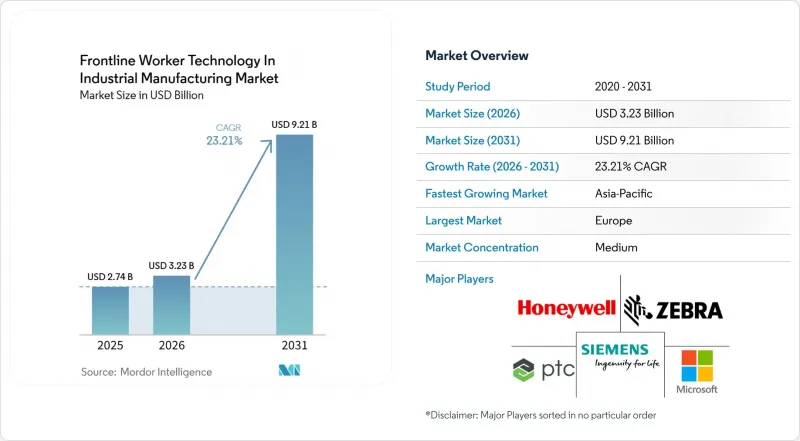
根據 Mordor Intelligence 預測,工業製造領域工人的技術市場規模將從 2025 年的 27.4 億美元成長到 2026 年的 32.3 億美元,到 2031 年將達到 92.1 億美元,2026 年至 2031 年的複合年成長率為 23.31 億美元,2026 年至 2031 年的複合年成長率為 23.31%。
本報告按組件(軟體和服務)、部署方式(雲端、混合和本地部署)、組織規模(大型企業和中小企業)、應用領域(例如員工溝通和互動)、最終用戶行業(例如汽車行業)以及地區進行細分。市場預測以美元計價。
全球工業製造一線工人技術市場趨勢與洞察
擴大人工智慧驅動的危險檢測和預測性安全分析的應用。
工業製造現場作業人員技術市場正受益於人工智慧系統的普及,這些系統能夠直接讀取工作場所近距離的影像、音訊和感測器數據。 2025 年的最新研究表明,基於穿戴式裝置的模型,例如隨機森林和支援向量機,能夠近乎即時地檢測推、拉、鑽孔等作業過程中的不安全姿勢。這正在改變工廠實施安全措施的方式,因為警報可以在事故發生之前發出,而不是在受傷之後。此外,其商業價值也在不斷提升,因為同樣的商業性和位置資料可以用於揭示工作流程設計缺陷、反覆出現的擁塞點以及僅靠人工檢查難以發現的監管盲點。隨著這些模型從工廠車間越來越多的數據中學習,早期採用者正在建立更強大的內部資料集,使得後進企業難以在性能上趕上。這些趨勢增加了轉換成本,軟體品質在工業製造現場作業人員技術市場的購買決策中扮演著越來越重要的角色。
人手不足正在加速考勤管理、合規性和生產力追蹤的自動化進程。
工業製造領域工廠第一線工人的技術市場也受到勞動力短缺的推動,而勞動力短缺在製造業已不再被視為短期問題。近期報告顯示,17.9%的德國製造業預計技能短缺將在2025年第二季對其營運造成影響,這一比例遠高於1991年至2010年間3.7%的長期平均水平。工廠面臨的壓力尤其顯著,因為工廠需要比以往任何時候都更持續地追蹤新員工的培訓週期、資格認證、輪班出勤情況和工作分配。在技術純熟勞工難以替代的背景下,考勤管理、合規記錄和生產力追蹤的自動化正日益受到關注,成為維持穩定生產水準的實用工具。這種需求不僅限於生產速度;製造商還需要更快地提升員薪資質,並需要更可靠的證據來證明關鍵任務是由合格人員完成的。這使得數位化勞動力管理系統成為業務永續營運的關鍵要素,也解釋了為什麼工業製造領域工廠第一線工人的技術不僅受到傳統安全預算的關注,也吸引了更多關注。
硬體、軟體和現場整合的初始成本較高。
工業製造現場工作人員的技術持續面臨成本壓力,因為完整的部署通常需要同時進行硬體、軟體、連接基礎設施和整合工作。與典型的辦公室軟體不同,這些系統通常需要逐一專案地進行設備配置、網路配置和現場模型校準。根據CPWR和Dodge共同發布的《2026年安全管理智慧市場》報告,只有不到10%的受訪承包商使用預測分析工具或穿戴式裝置。這表明,鑑於預算緊張和難以證明投資回報期,技術的普及率仍然有限。中型承包商也面臨年度資本預算與企劃為基礎支出週期不符的問題,這使得他們難以證明長期投入某個平台的合理性。雖然供應商正在透過訂閱定價和硬體即服務(HaaS)模式來解決這個問題,但前期成本的負擔仍然阻礙著工業製造現場工作人員採用這些技術。
細分市場分析
到2025年,軟體將佔據工業製造現場作業人員技術領域82.11%的市場佔有率,顯示支出正顯著轉向能夠長期管理資料、工作流程和智慧的平台。在工業製造現場作業人員技術市場,這一地位反映了持續訂閱、更廣泛的系統控制以及許多連網設備不再是投資決策的核心,而是被視為可互換終端這一事實的價值。買家越來越重視平台處理工單、分析、合規記錄和互通性,而不是硬體本身。因此,軟體是該領域營收成長和客戶維繫的基礎。
預計到2031年,服務市場將以24.19%的複合年成長率成長,這顯示隨著應用範圍的擴大,實施支援的重要性日益凸顯。這反映了工業製造領域現場工作人員技術市場的現狀:使用者通常需要工作流程重新設計、實施支援和變更管理,以確保技術的穩定應用。 2025年下半年人工智慧和擴增實境(AR)平台的擴展表明,軟體供應商如何透過將新功能與可操作的實施支援相結合,為互聯工作人員創造更多價值。因此,工業製造領域現場工作人員技術正在向一種新模式轉變:軟體確保持續的收入來源,而服務則保證應用的品質。隨著客戶從試點站點擴展到更廣泛的工廠網路,能夠同時支援這兩個領域的供應商將能夠留住基本客群。
預計到2025年,基於雲端的部署將佔工業製造現場作業人員技術市場76.61%的佔有率,到2031年,其複合年成長率預計將達到25.44%。這表明,工業製造現場作業人員技術市場並非雲端模式和本地部署模式平分秋色,因為雲端模式在大多數新部署中已經佔據主導地位。買家更青睞雲端部署帶來的快速部署、便利更新以及對本地基礎設施負擔的減輕。這與模組化商業模式也十分契合,該模式允許每個網站隨著時間的推移添加使用者和功能。
隨著製造商要求在雲端保持分析和報告功能的同時,對敏感資料進行本地管理,混合部署的重要性日益凸顯。在工業製造現場工作人員技術市場,這種平衡在法規環境中尤其關鍵,因為資料處理法規、網路安全標準或內部 IT 政策限制了完全純雲端的設計。一項於 2025 年進行的聯合研究表明,透過合規的雲端環境,而非完全隔離的環境,可以提供安全、互聯的維護操作人員支援。本地部署系統在高度管控的設施中仍然很重要,但其目標使用者群體比以往任何時候都更加狹窄。因此,工業製造現場工作人員技術正在圍繞「雲端優先」架構進行整合,而混合設計則為高度敏感的操作提供了一種切實可行的折衷方案。
區域分析
到2025年,歐洲將佔據工業製造業現場作業人員技術市場33.11%的佔有率,成為最大的區域市場。歐洲工業製造業現場作業人員技術市場的強勁成長,得益於該地區先進製造群的高度集中,以及鼓勵雇主全面記錄工人安全和操作規範的法規環境。德國尤其重要,其高度自動化程度使得工廠車間對清晰的人機互動需求日益成長。最新產業數據顯示,到2025年,德國每1萬名製造業工人將擁有449台機器人,躋身全球自動化程度最高的製造業經濟體。然而,即便自動化程度如此之高,對連網作業人員工具的需求也並未減少,因為自動化往往增加了對即時監控、任務引導以及更清晰的人機互動規則的需求。
預計到2031年,亞太地區將以28.99%的複合年成長率成長,成為預測期內工業製造現場作業人員技術市場規模成長最快的地區。在該地區,隨著大規模生產、人事費用上升以及智慧工廠專案的推進,企業紛紛轉向更先進的數位化勞動力管理,工業製造現場作業人員技術市場正迅速擴張。日本的情況尤其突出,當地企業正主導現場作業人工智慧工具的開發。 2025年10月,一項重要的策略合作拓展至為生產線和公共基礎設施上的現場作業人員開發人工智慧代理。韓國也是一個重要的市場,這得益於其高密度的機器人部署,需要更強大的軟體支援來管理工人、溝通和任務流程。印度和東南亞也備受關注,因為電子產品生產的擴張需要對新員工進行系統性的指導、培訓和大規模的監督。
2025年,北美在工業製造車間工人技術領域佔據了相當大的市場。人事費用和監管日益嚴格帶來的壓力,使得人們對採用智慧製造技術的興趣持續高漲,尤其是在缺勤率、機器安全和責任制等問題會影響生產效率的領域。旨在預防事故的國家優先項目將持續到2025年和2026年,促使人們更加關注機器相關安全措施的即時監控和記錄。儘管南美市場尚不成熟,但隨著包括汽車、食品飲料和化工在內的眾多行業的數位轉型,該市場正在蓬勃發展。中東和非洲的市場佔有率仍然較小,但海灣國家對智慧製造的投資以及一些非洲製造地的逐步數位化,正穩步支撐著該地區的長期發展。
其他好處:
- Excel格式的市場預測(ME)表
- 3個月的分析師支持
目錄
第1章:引言
- 研究假設和市場定義
- 調查範圍
第2章:調查方法
第3章執行摘要
第4章 市場狀況
- 市場概覽
- 市場促進因素
- 對複雜工作環境中工作人員即時視覺化的需求日益成長。
- 建築工地安全合規壓力日益增大
- 擴大人工智慧驅動的危險檢測和預測性安全分析的應用。
- 智慧個人防護裝備和智慧穿戴裝置的廣泛應用。
- 人手不足正在加速考勤管理、合規性和生產力追蹤的自動化進程。
- 對數位化員工資質認證和現場存取控制的需求日益成長。
- 市場限制因素
- 硬體、軟體和站點整合的初始成本較高
- 與隱私、勞資關係和工人接受度相關的問題
- 與傳統建築系統的互通性低
- 在惡劣的野外環境下,電池壽命、耐用性和連接性都受到限制。
- 宏觀經濟因素對市場的影響
- 產業價值鏈分析
- 科技趨勢
- 監理情勢
- 波特五力分析
第5章 市場規模與成長預測
- 按組件
- 軟體
- 服務
- 不同的發展
- 基於雲端的
- 混合
- 現場
- 按組織規模
- 大公司
- 小型企業
- 透過使用
- 員工溝通與參與
- 勞動力執行與任務管理
- 人員排班和協調
- 學習與知識應用
- 勞動分析與績效管理
- 安全與合規管理
- 其他用途
- 按最終用戶行業分類
- 車
- 電子和半導體
- 工業機械和設備
- 藥品和化學品
- 食品/飲料
- 航太/國防
- 其他終端用戶產業
- 按地區
- 北美洲
- 美國
- 加拿大
- 墨西哥
- 南美洲
- 巴西
- 阿根廷
- 其他南美國家
- 歐洲
- 德國
- 英國
- 法國
- 義大利
- 西班牙
- 俄羅斯
- 其他歐洲國家
- 亞太地區
- 中國
- 印度
- 日本
- 韓國
- 澳洲
- 其他亞太國家
- 中東和非洲
- 中東
- 沙烏地阿拉伯
- 阿拉伯聯合大公國
- 其他中東國家
- 非洲
- 南非
- 奈及利亞
- 其他非洲國家
- 中東
- 北美洲
第6章 競爭情勢
- 市場集中度
- 策略趨勢
- 市佔率分析
- 公司簡介
- 36Zero Group Ltd.
- Aatmunn, Inc.
- Aetheer, Inc.
- Augmentir, Inc.
- Epicore Biosystems, Inc.
- Zebra Technologies
- Hexagon AB
- Honeywell International Inc.
- StrongArm Technologies
- Librestream Technologies Inc.
- MakuSafe, Inc.
- Microsoft Corporation
- PTC Inc.
- ProGlove GmbH
- RealWear Inc.
- RedZone, Inc.
- Siemens AG
- SlateSafety, Inc.
- Trimble Inc.
- Vuzix Corporation
第7章 市場機會與未來展望
According to Mordor Intelligence, the frontline worker technology market in industrial manufacturing is expected to increase from USD 2.74 billion in 2025 to USD 3.23 billion in 2026 and reach USD 9.21 billion by 2031, growing at a CAGR of 23.31% over 2026-2031.
This report is Segmented by Component (Software, and Services), Deployment (Cloud-Based, Hybrid, and On-Premises), Organization Size (Large Enterprises, and Small and Medium Enterprises), Application (Employee Communication and Engagement, and More), End-User Industry (Automotive, and More), and Geography. The Market Forecasts are Provided in Terms of Value (USD).
Global Frontline Worker Technology In Industrial Manufacturing Market Trends and Insights
Growing Use of AI-Powered Hazard Detection and Predictive Safety Analytics
The frontline worker technology in industrial manufacturing market is gaining from the wider use of AI systems that can read video, audio, and sensor data directly near the workstation. Recent 2025 research showed that wearable-based models, such as random forests and support vector machines, were able to detect unsafe posture during tasks like pushing, pulling, and drilling in near real time. This is changing how factories approach safety because alerts can now be issued before an incident develops, rather than after an injury has already occurred. The commercial value is also broadening, as the same behavior and location data can reveal weak workflow design, recurring congestion points, and supervisor blind spots that are difficult to spot through manual checks alone. As these models learn from more plant-floor data, early adopters build stronger internal datasets, making it harder for later entrants to match their performance. That dynamic is raising switching costs and giving software quality a more central role in purchasing decisions across the frontline worker technology market in industrial manufacturing.
Labor Shortages Accelerating Automation of Attendance, Compliance, And Productivity Tracking
The frontline worker technology in industrial manufacturing market is also being supported by labor shortages that are no longer treated as a short cycle issue in manufacturing. Recent reports indicate that 17.9% of manufacturing enterprises in Germany said skill shortages were affecting operations in Q2 2025, far above the long-run average of 3.7% recorded between 1991 and 2010. The pressure is especially evident in plants, where onboarding time, certification status, shift attendance, and work allocation must be tracked with greater consistency than before. In that setting, automated attendance, compliance logging, and productivity tracking are becoming practical tools for maintaining stable output when skilled labor is hard to replace. The demand is not limited to production speed because manufacturers also need faster worker credentialing and more reliable proof that critical tasks were performed by qualified staff. This makes digital workforce systems part of operational resilience, which is why the frontline worker technology in industrial manufacturing market is drawing attention beyond traditional safety budgets.
High Upfront Cost of Hardware, Software, And Site Integration
The frontline worker technology in construction market still faces cost pressure because full deployment usually requires hardware, software, connectivity infrastructure, and integration work at the same time. Unlike standard office software, these systems often need project-specific device configuration, network setup, and model calibration for each site. The 2026 Safety Management SmartMarket report from CPWR and Dodge found that predictive analytics tools and wearables were used by fewer than 10% of surveyed contractors, indicating that adoption remains limited when budgets are tight and payback periods are hard to prove. Mid-sized contractors also face a mismatch between annual capital budgets and project-based spending cycles, which makes long-term platform commitments harder to justify. Vendors are responding with subscription pricing and hardware-as-a-service models, but the upfront burden still slows expansion across the frontline worker technology in construction market.
Other drivers and restraints analyzed in the detailed report include:
- Rising Demand for Real-Time Worker Visibility on Complex Manufacturing Sites
- Increasing Adoption of Connected PPE and Smart Wearables
- Privacy, Labor Relations, and Worker Acceptance Challenges
For complete list of drivers and restraints, kindly check the Table Of Contents.
Segment Analysis
Software held 82.11% of the frontline worker technology in industrial manufacturing market share in 2025, showing how strongly spending has shifted toward platforms that manage data, workflows, and intelligence over time. In the frontline worker technology in industrial manufacturing market, this position reflects recurring subscription value, broader system control, and the fact that many connected devices are now treated as replaceable endpoints rather than the center of the investment case. Buyers are putting more weight on how well platforms handle work instructions, analytics, compliance records, and interoperability than on the hardware itself. That is why software has become the anchor of both revenue capture and customer retention in this space.
Services are projected to grow at a 24.19% CAGR through 2031, indicating that implementation support is becoming increasingly important as deployments deepen. This reflects the reality that the frontline worker technology in industrial manufacturing market often requires workflow redesign, onboarding support, and change management before users see steady adoption. Recent platform expansions combining AI with augmented reality in late 2025 demonstrated how software providers are expanding their value by pairing new functionality with practical deployment support for connected workers. The frontline worker technology in industrial manufacturing industry is therefore moving toward a model where software captures the recurring layer and services help secure adoption quality. Vendors that can support both areas are better placed to defend accounts when customers scale from pilot sites to wider plant networks.
Cloud-based deployment accounted for 76.61% share of the frontline worker technology in industrial manufacturing market size in 2025, and it also recorded the fastest projected CAGR at 25.44% through 2031. That combination shows the frontline worker technology in industrial manufacturing market is not splitting evenly between cloud and on-premises models, because cloud is already the dominant direction for most new deployments. Buyers prefer the faster rollout, easier updates, and lower internal infrastructure burden that come with cloud delivery. It also aligns well with modular commercial models that let sites add users or functions over time.
Hybrid deployment is becoming increasingly relevant as manufacturers seek local control over sensitive data while keeping analytics and reporting in the cloud. In the frontline worker technology in industrial manufacturing market, that balance matters most in regulated settings where data handling rules, cybersecurity standards, or internal IT policies limit a fully cloud-only design. Recent collaborative work in 2025 showed how secure connected worker support could be delivered through compliant cloud environments for sustainment operations, rather than relying on a fully isolated build. On-premises systems still matter in tightly controlled facilities, but they are serving a narrower group of users than before. The frontline worker technology in industrial manufacturing industry is therefore consolidating around cloud-first architecture, with hybrid design acting as the practical middle ground for more sensitive operations.
Complete Report Scope:
- By Component
- Software
- Services
- By Deployment
- Cloud-Based
- Hybrid
- On-Premises
- By Organization Size
- Large Enterprises
- Small and Medium Enterprises
- By Application
- Employee Communication and Engagement
- Workforce Execution and Task Management
- Workforce Scheduling and Coordination
- Learning and Knowledge Enablement
- Workforce Analytics and Performance Management
- Safety and Compliance Management
- Other Applications
- By End-user Industry
- Automotive
- Electronics and Semiconductors
- Industrial Machinery and Equipment
- Pharmaceuticals and Chemicals
- Food and Beverage
- Aerospace and Defense
- Other End-user Industries
- By Geography
- North America
- United States
- Canada
- Mexico
- South America
- Brazil
- Argentina
- Rest of South America
- Europe
- Germany
- United Kingdom
- France
- Italy
- Spain
- Russia
- Rest of Europe
- Asia-Pacific
- China
- India
- Japan
- South Korea
- Australia
- Rest of Asia-Pacific
- Middle East and Africa
- Middle East
- Saudi Arabia
- United Arab Emirates
- Rest of Middle East
- Africa
- South Africa
- Nigeria
- Rest of Africa
- Middle East
- North America
Geography Analysis
Europe held 33.11% of the frontline worker technology in industrial manufacturing market share in 2025, which made it the largest regional market. The frontline worker technology in industrial manufacturing market has been strong in Europe because the region combines dense advanced manufacturing clusters with a regulatory environment that pushes employers toward better documentation of worker safety and operating practices. Germany remains especially important because high automation density increases the need for clear human-machine coordination on the factory floor. Recent industry data reported that Germany had 449 robots per 10,000 manufacturing employees in 2025, ranking it among the most automated manufacturing economies in the world. That level of automation does not reduce the need for connected worker tools, because it often increases the need for live supervision, guided tasks, and clearer interaction rules between people and machines.
Asia-Pacific is projected to grow at a 28.99% CAGR through 2031, and it represents the fastest-growing part of the frontline worker technology in industrial manufacturing market size over the forecast period. The frontline worker technology in industrial manufacturing market is expanding quickly in the region because large-scale manufacturing, rising labor costs, and smart factory programs are pushing companies toward more digital workforce control. Japan has shown this direction clearly through company-led development of AI tools for frontline operations. A major strategic alliance expanded in October 2025 to develop AI agents for frontline worker operations in manufacturing lines and social infrastructure. South Korea is also relevant because high robotics density creates a practical need for stronger software support around worker supervision, communication, and task flow. India and Southeast Asia are gaining attention as electronics production expands and newly onboarded workforces need structured guidance, training, and oversight at scale.
North America accounted for a significant share of revenue in 2025 across the frontline worker technology in industrial manufacturing market. Labor cost pressure and stricter enforcement have kept interest in adoption high, especially where absenteeism, machine safety, and task accountability affect output. A national emphasis program on amputations in manufacturing remained active through 2025 and into 2026, which kept attention on real-time monitoring and documented machine-related safety controls. South America remained less mature, but it is developing alongside broader industrial digitization in sectors such as automotive, food and beverage, and chemicals. Middle East and Africa still represented a smaller share, though smart manufacturing investment in Gulf economies and the gradual digitalization of selected African manufacturing sites are supporting steady long-term interest.
- 36Zero Group Ltd.
- Aatmunn, Inc.
- Aetheer, Inc.
- Augmentir, Inc.
- Epicore Biosystems, Inc.
- Zebra Technologies
- Hexagon AB
- Honeywell International Inc.
- StrongArm Technologies
- Librestream Technologies Inc.
- MakuSafe, Inc.
- Microsoft Corporation
- PTC Inc.
- ProGlove GmbH
- RealWear Inc.
- RedZone, Inc.
- Siemens AG
- SlateSafety, Inc.
- Trimble Inc.
- Vuzix Corporation
Additional Benefits:
- The market estimate (ME) sheet in Excel format
- 3 months of analyst support
TABLE OF CONTENTS
1 INTRODUCTION
- 1.1 Study Assumptions and Market Definition
- 1.2 Scope of the Study
2 RESEARCH METHODOLOGY
3 EXECUTIVE SUMMARY
4 MARKET LANDSCAPE
- 4.1 Market Overview
- 4.2 Market Drivers
- 4.2.1 Rising Demand for Real-Time Worker Visibility on Complex Jobsites
- 4.2.2 Rising Safety Compliance Pressure Across Construction Sites
- 4.2.3 Growing Use of AI-Powered Hazard Detection and Predictive Safety Analytics
- 4.2.4 Increasing Adoption of Connected PPE and Smart Wearables
- 4.2.5 Labor Shortages Accelerating Automation of Attendance, Compliance, and Productivity Tracking
- 4.2.6 Rising Demand for Digital Worker Credentialing and Site Access Control
- 4.3 Market Restraints
- 4.3.1 High Upfront Cost of Hardware, Software, and Site Integration
- 4.3.2 Privacy, Labor Relations, and Worker Acceptance Challenges
- 4.3.3 Poor Interoperability with Legacy Construction Systems
- 4.3.4 Battery Life, Durability, and Connectivity Limitations in Harsh Site Conditions
- 4.4 Impact of Macroeconomic Factors on the Market
- 4.5 Industry Value Chain Analysis
- 4.6 Technology Outlook
- 4.7 Regulatory Landscape
- 4.8 Porter's Five Forces Analysis
- 4.8.1 Threat of New Entrants
- 4.8.2 Bargaining Power of Suppliers
- 4.8.3 Bargaining Power of Buyers
- 4.8.4 Threat of Substitutes
- 4.8.5 Intensity of Competitive Rivalry
5 MARKET SIZE AND GROWTH FORECASTS (VALUE)
- 5.1 By Component
- 5.1.1 Software
- 5.1.2 Services
- 5.2 By Deployment
- 5.2.1 Cloud-Based
- 5.2.2 Hybrid
- 5.2.3 On-Premises
- 5.3 By Organization Size
- 5.3.1 Large Enterprises
- 5.3.2 Small and Medium Enterprises
- 5.4 By Application
- 5.4.1 Employee Communication and Engagement
- 5.4.2 Workforce Execution and Task Management
- 5.4.3 Workforce Scheduling and Coordination
- 5.4.4 Learning and Knowledge Enablement
- 5.4.5 Workforce Analytics and Performance Management
- 5.4.6 Safety and Compliance Management
- 5.4.7 Other Applications
- 5.5 By End-user Industry
- 5.5.1 Automotive
- 5.5.2 Electronics and Semiconductors
- 5.5.3 Industrial Machinery and Equipment
- 5.5.4 Pharmaceuticals and Chemicals
- 5.5.5 Food and Beverage
- 5.5.6 Aerospace and Defense
- 5.5.7 Other End-user Industries
- 5.6 By Geography
- 5.6.1 North America
- 5.6.1.1 United States
- 5.6.1.2 Canada
- 5.6.1.3 Mexico
- 5.6.2 South America
- 5.6.2.1 Brazil
- 5.6.2.2 Argentina
- 5.6.2.3 Rest of South America
- 5.6.3 Europe
- 5.6.3.1 Germany
- 5.6.3.2 United Kingdom
- 5.6.3.3 France
- 5.6.3.4 Italy
- 5.6.3.5 Spain
- 5.6.3.6 Russia
- 5.6.3.7 Rest of Europe
- 5.6.4 Asia-Pacific
- 5.6.4.1 China
- 5.6.4.2 India
- 5.6.4.3 Japan
- 5.6.4.4 South Korea
- 5.6.4.5 Australia
- 5.6.4.6 Rest of Asia-Pacific
- 5.6.5 Middle East and Africa
- 5.6.5.1 Middle East
- 5.6.5.1.1 Saudi Arabia
- 5.6.5.1.2 United Arab Emirates
- 5.6.5.1.3 Rest of Middle East
- 5.6.5.2 Africa
- 5.6.5.2.1 South Africa
- 5.6.5.2.2 Nigeria
- 5.6.5.2.3 Rest of Africa
- 5.6.5.1 Middle East
- 5.6.1 North America
6 COMPETITIVE LANDSCAPE
- 6.1 Market Concentration
- 6.2 Strategic Moves
- 6.3 Market Share Analysis
- 6.4 Company Profiles (includes Global Level Overview, Market Level Overview, Core Segments, Financials as available, Strategic Information, Market Rank/Share, Products and Services, Recent Developments)
- 6.4.1 36Zero Group Ltd.
- 6.4.2 Aatmunn, Inc.
- 6.4.3 Aetheer, Inc.
- 6.4.4 Augmentir, Inc.
- 6.4.5 Epicore Biosystems, Inc.
- 6.4.6 Zebra Technologies
- 6.4.7 Hexagon AB
- 6.4.8 Honeywell International Inc.
- 6.4.9 StrongArm Technologies
- 6.4.10 Librestream Technologies Inc.
- 6.4.11 MakuSafe, Inc.
- 6.4.12 Microsoft Corporation
- 6.4.13 PTC Inc.
- 6.4.14 ProGlove GmbH
- 6.4.15 RealWear Inc.
- 6.4.16 RedZone, Inc.
- 6.4.17 Siemens AG
- 6.4.18 SlateSafety, Inc.
- 6.4.19 Trimble Inc.
- 6.4.20 Vuzix Corporation
7 MARKET OPPORTUNITIES AND FUTURE OUTLOOK
- 7.1 White-Space and Unmet-Need Assessment

 旅遊、飯店與客運業通訊與協作成長機會:全球,2026-2029 年
 企業通訊領域的OTT:市佔率分析、產業趨勢與統計及成長預測(2026-2031年)
 整合通訊市場:按組件、解決方案、部署類型、組織規模、應用和最終用戶產業分類-2026-2032年全球市場預測
 整合通訊市場機會、成長要素、產業趨勢分析及2026-2035年預測整合通訊(UC)硬體:市場佔有率分析、產業趨勢和統計數據以及成長預測(2026-2031 年)
 整合通訊市場-全球產業規模、佔有率、趨勢、機會、預測:按產品、解決方案、組織規模、應用、地區和競爭對手分類,2021-2031年醫療產業的整合通訊即服務:市場佔有率分析、產業趨勢和統計數據以及成長預測(2026-2031 年)
 整合通訊(UC) 和商務耳機市場預測至 2034 年—按產品類型、類別、價格、分銷管道、應用、最終用戶和地區分類的全球分析
 整合通訊即服務 (UCaaS) 市場報告:按解決方案類型、組織規模、部署類型、產業和地區分類 (2026–2034)
 2026年全球通訊與協作市場報告