


 |
市場調查報告書
商品編碼
2154427
硬脂酸鈷:市場佔有率分析、產業趨勢與統計、成長預測(2026-2031)Cobalt Stearate - Market Share Analysis, Industry Trends & Statistics, Growth Forecasts (2026 - 2031) |
||||||

※ 本網頁內容可能與最新版本有所差異。詳細情況請與我們聯繫。
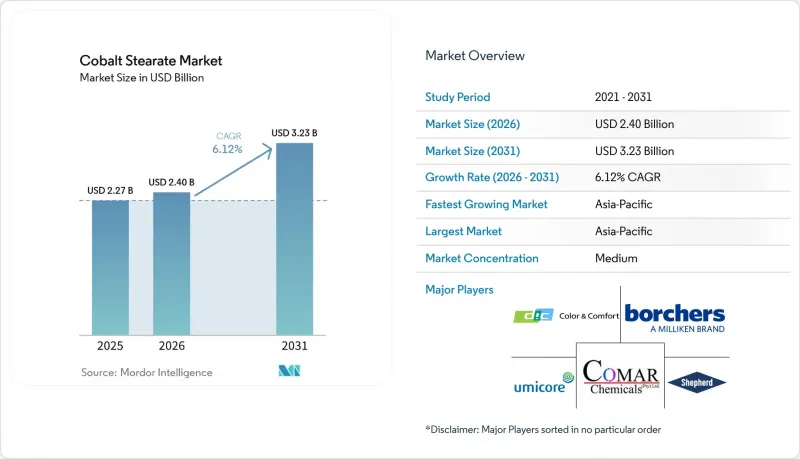
據 Mordor Intelligence 稱,2025 年硬脂酸鈷市場規模估計為 22.7 億美元,預計在預測期(2026-2031 年)內將以 6.12% 的複合年成長率成長,從 2026 年的 24 億美元成長到 2031 年的 32.3 億美元。
全球硬脂酸鈷市場趨勢及洞察
鋼絲子午線輪胎產量的增加支撐了市場需求。
鋼絲子午線輪胎仍是全球硬脂酸鈷的主要終端應用領域。隨著開發中國家商用車輛車隊從斜交輪胎結構轉向子午線輪胎結構,硬脂酸鈷市場正從中受益。這種轉變推動了印度和東協市場乘用車和商用車輪胎需求的成長。預計2025年,中國將生產12.07億條橡膠外胎,成為輪胎製造材料的大規模生產基地。預計2025年,中國還將生產1.49億條全鋼輪胎,年增7.19%。基礎設施和礦業機械是推動全鋼輪胎需求的主要因素。 ISO 23475-2:2025標準制定了鋼製輪胎簾子線黏合力的標準化拉拔試驗方法,這進一步增加了對可靠且配方精確的黏合促進劑的需求。由於這些品質要求,除非有經過檢驗的替代方案,否則輪胎製造商不願更換現有的黏合系統。鈷硬質合金市場也受益於中國以外地區出口型子午線輪胎產能的穩定擴張,因為這些工廠對即使在惡劣的運作條件下也能保持橡膠與金屬粘合的材料產生了需求。
對高性能輪胎黏合劑的需求不斷成長,擴大了硬脂酸鈷的技術效用。
高性能輪胎規格要求橡膠化合物與增強材料之間具有持久的黏合力。這項要求在高階乘用車輪胎和OEM輪胎專案中尤為重要。倍耐力報告稱,自2019年以來,其「Elect」系列輪胎已獲得500多項型式認證,這反映了電動車和插電式混合動力汽車輪胎所需的檢驗規模。這些項目旨在測試橡膠簾線在高扭矩負載和嚴苛駕駛條件下的黏合力。硬脂酸鈷市場正在滿足這一需求,因為鈷基黏合系統在子午線輪胎配方中仍然佔據重要地位。類似的化學特性也被應用於輸送機、鋼絲編織橡膠軟管以及採用類似橡膠-金屬黏合系統的非公路設備,從而將基本客群擴展到乘用車輪胎製造之外。鈷含量和材料品質的一致性至關重要,因為最終用戶需要在更改配方之前檢驗黏合性能。因此,在需要長期黏合耐久性的應用中,硬脂酸鈷市場發揮難以取代的技術作用。
遵守鈷危害分類和職業接觸法規正在推高配方和處理成本。
對於下游混煉商而言,鈷化合物的監管要求正變得日益嚴格。 2025年7月,歐盟委員會提議將鈷和無機鈷化合物的可吸入職業暴露限值設定為0.01 mg/m³,過渡限值為0.02 mg/m³。歐盟委員會也提案將吸入限值設定為0.0025 mg/m³,過渡限值為0.0042 mg/m³,並提案在採用新限值後有六年的適應期。處理硬脂酸鈷作為橡膠化合物或包裝添加劑的設施可能需要加強工程控制和監測系統。合規要求也會影響化學品安全報告以及與下游用戶的資訊共用。在硬脂酸鈷市場,當該材料用於開放式粉末系統時,會產生額外的處理成本。封閉式處理、微丸和液體分散體可能是更具吸引力的選擇,因為它們可以降低空氣中鈷顆粒物的風險。這些變化可能會改變銷往歐洲生產設施的產品形式。此外,這些要求可能會影響向歐洲客戶供貨的非歐洲供應商的採購決策。配方和製程的投資可能會導致成本增加,同時也會產生對更安全操作方法的需求。
細分市場分析
2025年,工業級硬脂酸鈷佔了57.34%的市場佔有率,成為最大的細分市場。這一地位反映了輪胎和橡膠加工對這種材料的巨大需求。預計2026年至2031年,高純度級硬脂酸鈷的複合年成長率將達6.86%。 PET包裝和特殊聚合物化合物的加工商對金屬含量和重金屬污染的要求更為嚴格。高純度硬脂酸鈷的市場規模主要受那些需要在加工溫度下保持穩定催化性能的應用需求所驅動。食品接觸包裝也需要嚴格控制,以降低泛黃和異味的風險。這些要求鞏固了高純度產品的高階地位。由於橡膠化合物仍然是硬脂酸鈷市場的主要需求來源,因此工業級材料仍然非常重要。
優美科的「ECOS S 9.5」和「ECOS S 9.5 V」系列產品展示了特種級產品在吸氧包裝的應用。採用生物基脂肪酸的版本滿足了關注採購慣例和永續性的客戶的需求。技術級產品介於工業級和高純度級之間,供應給尋求可靠乾燥劑活性但又無需滿足食品接觸包裝嚴格雜質要求的塗料製造商。在鈷價高企時期,工業級產品可能面臨更大的壓力,需要被無鈷配方所取代。如果經認證的替代品無法滿足加工溫度和透明度要求,高純度級產品的替代風險較低。最終用途的差異使得大規模生產的橡膠製品和高價值特種產品之間形成了鮮明的對比。由於性能要求和採購標準不同,硬脂酸鈷市場同時支撐這兩個細分市場。因此,供應商必須在擴大工業級產品的生產規模和為高純度級客戶提供技術支援之間取得平衡。
區域分析
預計到2025年,亞太地區將佔全球銷售額的36.13%,並在2026年至2031年間以6.91%的複合年成長率成長。該地區擁有大規模的輪胎製造能力、不斷擴大的PET包裝應用以及正在發展的鈷供應鏈。預計2025年,中國橡膠輪胎產量將達到12.07億條,為硬脂酸鈷的消費提供重要基礎。日本2025年的輪胎橡膠產量將達到933,243噸,年增0.8%,這是四年來的首次成長。印度正透過生產激勵措施和OEM製造商的在地化,成為子午線輪胎生產中心,從而在印度和東協市場創造了對硬脂酸鈷的新需求。亞太地區結合了中國成熟的規模優勢和全部區域的新興產能。
北美和歐洲雖然總合在硬脂酸鈷市場中所佔佔有率較小,但在高價值等級產品中仍佔據著重要的戰略地位。北美受益於其國內產能以及對可追溯性文件要求的汽車供應鏈。 Shepard Chemicals 在美國設有基地,業務涵蓋脂肪酸和鈷基金屬羧酸鹽領域,為該地區的輪胎和特殊化學品客戶提供支援。在歐洲,更嚴格的職業接觸法規和 REACH 法規提高了含鈷材料的合規要求。同時,電動車輪胎的發展也推動了對高性能輪胎化合物所需材料的需求。 UmiCore 報告稱,在鈷市場趨勢和對優質材料的需求支撐下,其專門食品材料業務在 2026 年第一季實現了強勁的盈利。在這些地區,品質、可追溯性和符合法規的產品形式比規模更為重要。
南美洲、中東和非洲是鈷硬脂酸酯市場的新興需求區域。在巴西,需求成長不僅源自於輪胎產能,也源自於食品和飲料包裝。在阿根廷,農業和食品包裝企業以及遠距離配送的需求推動了聚對苯二甲酸乙二醇酯(PET)的吸氧性能。中東和非洲與建築、採礦和商用車相關活動密切相關。沙烏地阿拉伯和南非是重要的市場,傳送帶和其他橡膠製品支撐著當地的工業活動。基礎設施的限制和小規模的本地特種化學品分銷網路阻礙了鈷硬脂酸酯的快速普及。然而,由於向子午線輪胎的轉變和包裝市場的成長,這些地區的需求可能會在長期內逐步增加,因此它們仍然是重要的市場。雖然與亞太地區相比,這些地區的商機更具局部,但區域供應商和經銷商仍有充足的發展空間。能否觸及這些分散的需求群取決於客戶管道和技術服務能力。
其他好處:
- Excel格式的市場預測(ME)表
- 3個月的分析師支持
目錄
第1章:引言
- 研究假設和市場定義
- 調查範圍
第2章:調查方法
第3章執行摘要
第4章 市場狀況
- 市場概覽
- 市場促進因素
- 擴大鋼絲子午線輪胎的生產
- 對高性能橡膠黏合劑的需求日益成長
- PET吸氧包裝的成長
- 擴大精密設計的金屬羧酸鹽的應用
- 電動車輪胎黏合劑含量增加
- 市場限制因素
- 遵守有關鈷危害分類和職業接觸的法規。
- 鈷價格波動與供應集中度
- 無鈷和低鈷黏合劑系統的替代方案
- 價值鏈分析
- 波特五力分析
第5章 市場規模與成長預測
- 按年級
- 工業級
- 高純度
- 技術級
- 按形式
- 粉末
- 顆粒/丸劑
- 微顆粒
- 液體分散劑和定製劑型
- 透過使用
- 橡膠和輪胎加工
- PET氧氣吸收劑
- 油漆和塗料
- 塑膠和聚合物製劑
- 其他應用(黏合劑和密封劑、印刷油墨、特殊化學品和催化劑)
- 按地區
- 亞太地區
- 中國
- 印度
- 日本
- 韓國
- 東南亞國協
- 其他亞太國家
- 北美洲
- 美國
- 加拿大
- 墨西哥
- 歐洲
- 德國
- 英國
- 法國
- 義大利
- 北歐國家
- 其他歐洲國家
- 南美洲
- 巴西
- 阿根廷
- 其他南美國家
- 中東和非洲
- 沙烏地阿拉伯
- 南非
- 其他中東和非洲國家
- 亞太地區
第6章 競爭情勢
- 市場集中度
- 策略趨勢
- 市佔率和排名分析
- 公司簡介
- Comar Chemicals
- Dalian Advance Performance Specialty Chemicals Co., Ltd.
- DIC CORPORATION
- Ege Kimya
- Guangsheng Xiangsu
- Jiangsu Yixing Kaou Chemical Co., Ltd.
- Jiangyin Sanliang Rubber & Plastic New Material Co., Ltd.
- Jinchuan Group International Resources Co. Ltd
- Milliken & Company
- Peter Greven GmbH & Co. KG.
- Shandong Yanggu Huatai Chemical Co., Ltd.
- Shepherd Chemical
- Sun Ace Kakoh(Pte.)Ltd.
- Umicore
- Wuhan Jiacheng Biotechnology Co., Ltd.
- Zibo Haiyue New Materials Co., Ltd.
第7章 市場機會與未來展望
According to Mordor Intelligence, the cobalt stearate market size was estimated at USD 2.27 billion in 2025 and is estimated to grow from USD 2.40 billion in 2026 to USD 3.23 billion by 2031, at a CAGR of 6.12% during the forecast period (2026-2031).
Global Cobalt Stearate Market Trends and Insights
Expansion of Steel-Belted Radial Tire Production Anchors Baseline Demand
Steel-belted radial tires remain the primary end use for cobalt stearate worldwide. The cobalt stearate market benefits as commercial vehicle fleets in developing economies transition from bias-ply to radial tire construction. This shift extends demand across passenger and commercial tire categories in India and ASEAN markets. China produced 1.207 billion rubber outer tires in 2025, providing a large manufacturing base for materials used in tire construction. China also reported output of 149 million all-steel tires in 2025, a 7.19% increase from the prior year, with infrastructure and mining equipment supporting demand for all-steel tires. ISO 23475-2:2025 established a standardized pull-out test for steel tire-cord adhesion, reinforcing the need for reliable and precisely dosed adhesion-promoting materials. The resulting quality requirements make tire producers less willing to replace established adhesion systems without validated alternatives. The cobalt stearate market also benefits from the steady expansion of export-oriented radial capacity outside China, as these plants create demand for materials that can maintain rubber-to-metal bonding under demanding operating conditions.
Rising Demand for High-Performance Rubber Adhesion Extends Cobalt Stearate's Technical Utility
High-performance tire specifications require durable adhesion between rubber compounds and reinforcement materials. This requirement is especially relevant for premium consumer tires and original-equipment tire programs. Pirelli has reported more than 500 homologations for its Elect tire range since 2019, reflecting the scale of validation required for tires designed for electric and plug-in hybrid vehicles. These programs test rubber-cord bonding under higher torque loads and demanding operating conditions. The cobalt stearate market serves this need because cobalt-based adhesion systems remain well established in radial tire formulations. The same chemistry applies to conveyor belts, steel-braided rubber hoses, and off-highway equipment that use comparable rubber-to-metal bonding systems, broadening the customer base beyond passenger tire manufacturing. Consistency in cobalt content and material quality is important because end users must validate adhesion performance before changing formulations. The cobalt stearate market, therefore, holds a technical role that is difficult to replace in applications requiring long-term bond durability.
Cobalt Hazard Classification and Occupational-Exposure Compliance Raise Formulation and Handling Costs
Regulatory requirements for cobalt compounds are becoming more demanding for downstream formulators. In July 2025, the European Commission proposed an inhalable occupational exposure limit of 0.01 mg/m3 for cobalt and inorganic cobalt compounds, with a transitional limit of 0.02 mg/m3. It also proposed a respirable limit of 0.0025 mg/m3, a transitional limit of 0.0042 mg/m3, and a six-year adaptation period after adoption. Facilities that handle cobalt stearate for rubber compounding and as a packaging additive may need improved engineering controls and monitoring. Compliance requirements also affect chemical safety reporting and communication with downstream users. The cobalt stearate market incurs additional handling costs when materials are used in open powder systems. Closed handling, micropellets, and liquid dispersions can become more attractive because they reduce the risk of airborne cobalt particulate. These changes can alter the mix of forms sold into European production sites. The requirement can also influence purchasing decisions for non-European suppliers serving European customers. Formulation and process investments may raise costs, even as they create demand for safer handling formats.
Other drivers and restraints analyzed in the detailed report include:
- Growth of Polyethylene Terephthalate (PET) Oxygen-Scavenging Packaging Diversifies the Demand Base
- Increasing Use of Precision-Engineered Metal Carboxylates Supports Higher-Value Demand
- Cobalt Price Volatility and Supply Concentration Compress Margins and Disrupt Planning Cycles
For complete list of drivers and restraints, kindly check the Table Of Contents.
Segment Analysis
Industrial-grade accounted for 57.34% of the cobalt stearate market share in 2025, making it the largest segment. This position reflects the large quantity of material required for tire and rubber processing. High-purity grade is projected to grow at a CAGR of 6.86% from 2026 to 2031. PET packaging converters and specialty polymer compounders require tighter metal-content tolerances and lower heavy-metal contamination. The cobalt stearate market size for high-purity material is driven by applications where catalyst performance must remain stable at processing temperatures. Food-contact packaging also requires controls to limit the risks of yellowing and off-flavor. These requirements support a premium position for high-purity products. Industrial-grade material remains important because rubber compounding continues to be the anchor of demand for the cobalt stearate market.
Umicore's ECOS S 9.5 and ECOS S 9.5 V lines illustrate the use of specialized grades in oxygen-scavenging packaging. The bio-based fatty acid version addresses customer interest in sourcing practices and sustainability commitments. Technical grade sits between industrial and high-purity material, serving coatings producers that need reliable drier activity without the strict impurity requirements of food-contact packaging. During cobalt price increases, industrial-grade products can face greater substitution pressure from cobalt-free formulations. High-purity grades are less exposed to substitution where qualified alternatives cannot meet processing-temperature and clarity requirements. The difference in end-use requirements creates a clear split between high-quantity rubber products and higher-value specialty products. The cobalt stearate market retains both segments because their performance needs and purchasing criteria differ. Suppliers must therefore balance scale in industrial material with technical support for higher-purity customers.
Complete Report Scope:
- By Grade
- Industrial Grade
- High-Purity Grade
- Technical Grade
- By Form
- Powder
- Granules/Pellets
- Micropellets
- Liquid Dispersions and Customized Forms
- By Application
- Rubber and Tire Processing
- PET Oxygen Scavenging
- Paints and Coatings
- Plastics and Polymer Processing
- Others (Adhesives and Sealants, Printing Inks, Specialty Chemical and Catalyst Uses)
- By Geography
- Asia-Pacific
- China
- India
- Japan
- South Korea
- ASEAN Countries
- Rest of Asia-Pacific
- North America
- United States
- Canada
- Mexico
- Europe
- Germany
- United Kingdom
- France
- Italy
- NORDIC Countries
- Rest of Europe
- South America
- Brazil
- Argentina
- Rest of South America
- Middle-East and Africa
- Saudi Arabia
- South Africa
- Rest of Middle-East and Africa
- Asia-Pacific
Geography Analysis
Asia-Pacific held 36.13% of revenue in 2025 and is forecast to grow at a CAGR of 6.91% from 2026 to 2031. The region combines large tire manufacturing capacity, expanding PET packaging use, and developing cobalt supply chains. China's production of 1.207 billion units of rubber outer tires in 2025 provides a large base for cobalt stearate consumption. Japan produced 933,243 tons of tire rubber in 2025, an increase of 0.8% from the previous year and the first increase in four years. India is becoming a radial tire production hub through production incentives and original-equipment manufacturer localization, creating new demand for cobalt stearate in India and ASEAN markets. Asia-Pacific combines established Chinese scale with new manufacturing capacity across the region.
North America and Europe account for a smaller combined share of the cobalt stearate market but remain strategically important for high-value grades. North America benefits from domestic manufacturing capacity and automotive supply chains that require traceability documentation. Shepherd Chemical maintains a US-based presence in fatty acids and cobalt-based metal carboxylates, supporting regional tire and specialty chemical customers. Europe faces tighter occupational exposure and REACH requirements, increasing compliance needs for cobalt-containing materials. At the same time, electric-vehicle tire development supports demand for materials used in higher-performance tire compounds. Umicore reported strong profitability in its Specialty Materials activities in Q1 2026, supported by cobalt market conditions and demand for premium materials. These regions prioritize quality, traceability, and regulatory-ready product formats over scale.
South America, the Middle-East, and Africa are emerging demand areas for the cobalt stearate market. Brazil combines tire production capacity with growing demand for food and beverage packaging. Argentina supports polyethylene terephthalate (PET) oxygen scavenging through its agri-food packaging activity and the need for longer distribution distances. The Middle-East and Africa are linked to construction, mining, and commercial-vehicle activity. Saudi Arabia and South Africa are relevant markets where conveyor belts and other rubber goods support industrial activity. Infrastructure limitations and small local specialty-chemical distribution networks constrain more rapid adoption. These regions remain relevant as radialization and packaging growth can create incremental demand over time. Their opportunity is more localized than in Asia-Pacific but offers room for regional suppliers and distributors. Reaching these fragmented demand pockets will depend on customer access and technical service capabilities.
- Comar Chemicals
- Dalian Advance Performance Specialty Chemicals Co., Ltd.
- DIC CORPORATION
- Ege Kimya
- Guangsheng Xiangsu
- Jiangsu Yixing Kaou Chemical Co., Ltd.
- Jiangyin Sanliang Rubber & Plastic New Material Co., Ltd.
- Jinchuan Group International Resources Co. Ltd
- Milliken & Company
- Peter Greven GmbH & Co. KG.
- Shandong Yanggu Huatai Chemical Co., Ltd.
- Shepherd Chemical
- Sun Ace Kakoh (Pte.) Ltd.
- Umicore
- Wuhan Jiacheng Biotechnology Co., Ltd.
- Zibo Haiyue New Materials Co., Ltd.
Additional Benefits:
- The market estimate (ME) sheet in Excel format
- 3 months of analyst support
TABLE OF CONTENTS
1 Introduction
- 1.1 Study Assumptions and Market Definition
- 1.2 Scope of the Study
2 Research Methodology
3 Executive Summary
4 Market Landscape
- 4.1 Market Overview
- 4.2 Market Drivers
- 4.2.1 Expansion of Steel-Belted Radial Tire Production
- 4.2.2 Rising Demand for High-Performance Rubber Adhesion
- 4.2.3 Growth of PET Oxygen-Scavenging Packaging
- 4.2.4 Increasing Use of Precision-Engineered Metal Carboxylates
- 4.2.5 Higher Adhesive Loading in Electric-Vehicle Tires
- 4.3 Market Restraints
- 4.3.1 Cobalt Hazard Classification and Occupational-Exposure Compliance
- 4.3.2 Cobalt Price Volatility and Supply Concentration
- 4.3.3 Substitution by Cobalt-Free and Low-Cobalt Adhesion Systems
- 4.4 Value Chain Analysis
- 4.5 Porter's Five Forces Analysis
- 4.5.1 Threat of New Entrants
- 4.5.2 Bargaining Power of Suppliers
- 4.5.3 Bargaining Power of Buyers
- 4.5.4 Threat of Substitutes
- 4.5.5 Competitive Rivalry
5 Market Size and Growth Forecasts (Value)
- 5.1 By Grade
- 5.1.1 Industrial Grade
- 5.1.2 High-Purity Grade
- 5.1.3 Technical Grade
- 5.2 By Form
- 5.2.1 Powder
- 5.2.2 Granules/Pellets
- 5.2.3 Micropellets
- 5.2.4 Liquid Dispersions and Customized Forms
- 5.3 By Application
- 5.3.1 Rubber and Tire Processing
- 5.3.2 PET Oxygen Scavenging
- 5.3.3 Paints and Coatings
- 5.3.4 Plastics and Polymer Processing
- 5.3.5 Others (Adhesives and Sealants, Printing Inks, Specialty Chemical and Catalyst Uses)
- 5.4 By Geography
- 5.4.1 Asia-Pacific
- 5.4.1.1 China
- 5.4.1.2 India
- 5.4.1.3 Japan
- 5.4.1.4 South Korea
- 5.4.1.5 ASEAN Countries
- 5.4.1.6 Rest of Asia-Pacific
- 5.4.2 North America
- 5.4.2.1 United States
- 5.4.2.2 Canada
- 5.4.2.3 Mexico
- 5.4.3 Europe
- 5.4.3.1 Germany
- 5.4.3.2 United Kingdom
- 5.4.3.3 France
- 5.4.3.4 Italy
- 5.4.3.5 NORDIC Countries
- 5.4.3.6 Rest of Europe
- 5.4.4 South America
- 5.4.4.1 Brazil
- 5.4.4.2 Argentina
- 5.4.4.3 Rest of South America
- 5.4.5 Middle-East and Africa
- 5.4.5.1 Saudi Arabia
- 5.4.5.2 South Africa
- 5.4.5.3 Rest of Middle-East and Africa
- 5.4.1 Asia-Pacific
6 Competitive Landscape
- 6.1 Market Concentration
- 6.2 Strategic Moves
- 6.3 Market Share (%)/Ranking Analysis
- 6.4 Company Profiles (includes Global Overview, Market Overview, Core Segments, Financials as available, Strategic Information, Products and Services, and Recent Developments)
- 6.4.1 Comar Chemicals
- 6.4.2 Dalian Advance Performance Specialty Chemicals Co., Ltd.
- 6.4.3 DIC CORPORATION
- 6.4.4 Ege Kimya
- 6.4.5 Guangsheng Xiangsu
- 6.4.6 Jiangsu Yixing Kaou Chemical Co., Ltd.
- 6.4.7 Jiangyin Sanliang Rubber & Plastic New Material Co., Ltd.
- 6.4.8 Jinchuan Group International Resources Co. Ltd
- 6.4.9 Milliken & Company
- 6.4.10 Peter Greven GmbH & Co. KG.
- 6.4.11 Shandong Yanggu Huatai Chemical Co., Ltd.
- 6.4.12 Shepherd Chemical
- 6.4.13 Sun Ace Kakoh (Pte.) Ltd.
- 6.4.14 Umicore
- 6.4.15 Wuhan Jiacheng Biotechnology Co., Ltd.
- 6.4.16 Zibo Haiyue New Materials Co., Ltd.
7 Market Opportunities and Future Outlook
- 7.1 White-Space and Unmet-Need Assessment

 鈷廢棄物回收市場:全球市場預測,2026-2032年
 鈷藍顏料市場報告:趨勢、預測及競爭分析(至2035年)
 鈷酸鋰(LCO):市場佔有率分析、行業趨勢和統計數據、成長預測(2026-2031)鈷:市場佔有率分析、產業趨勢與統計、成長預測(2026-2031)
 2026-2030年全球鈷市場鈷市場:依產品類型、原料來源、形態、純度、應用、終端用戶產業和通路分類-全球預測,2026-2032年
 鈷市場規模、佔有率和成長分析:按產品類型、來源、應用、最終用戶產業、純度等級、分銷管道和地區分類-2026-2033年產業預測
 碳酸鈷市場規模、佔有率和成長分析:按產品類型、純度、應用、終端用戶產業、生產通路、分銷通路和地區分類-2026-2033年產業預測硫酸鈷:市場佔有率分析、產業趨勢與統計、成長預測(2026-2031)
 鈷酸鋰市場機會、成長要素、產業趨勢分析及2026-2035年預測