


 |
市場調查報告書
商品編碼
2117348
鈷:市場佔有率分析、產業趨勢與統計、成長預測(2026-2031)Cobalt - Market Share Analysis, Industry Trends & Statistics, Growth Forecasts (2026 - 2031) |
||||||

※ 本網頁內容可能與最新版本有所差異。詳細情況請與我們聯繫。
據 Mordor Intelligence 稱,2026 年鈷市場規模估計為 2.5899 億噸,高於 2025 年的 2.3766 億噸,預計到 2031 年將達到 3.982 億噸。
預計從 2026 年到 2031 年,其複合年成長率將達到 8.98%。
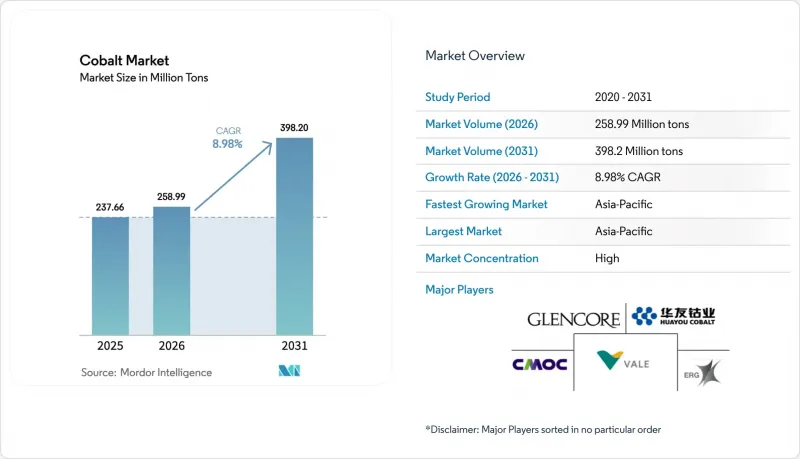
本報告按形式(化合物、金屬、購買的廢料)、應用(電池、合金、催化劑、工具材料、其他)、生產來源(原生和再生)、最終用戶行業(汽車、航太與國防、消費電子、其他)、地區(生產)(澳大利亞、加拿大、中國、其他)和地區(消費)(亞太地區、北美、歐洲、其他)進行分類。
全球鈷市場趨勢與洞察
充電電池使用量增加
2024年,隨著電動車銷量突破1,700萬輛的歷史新高,電池製造商的鈷消耗量佔全球總消耗量的一半以上。儘管人們仍在努力減少富鎳NCM正極材料中鈷的使用量,但鈷仍然是實現高電壓穩定性和長壽命的關鍵金屬。主要電池製造商正積極囤積硫酸鈷以對沖價格波動,這項策略進一步加劇了短期市場波動。此舉也促使各國政府將鈷指定為“戰略材料”,從而為新建提煉和回收設施提供公共資金。隨著供應側投資與電池市場擴張保持同步,這種良性循環正在增強鈷市場。
由於商用航太引擎生產恢復,對高溫合金的需求增加。
隨著民用噴射機生產的復甦,渦輪機製造商正在重啟需要富鈷盤片和燃燒室襯裡的生產線。鈷被明確列入北約2024年“國防關鍵材料清單”,凸顯了這種合金不可取代的耐熱性。由於訂單積壓超過12,000架飛機,原始設備製造商(OEM)預測,到2030年,對超合金的需求將以中等個位數的速度成長。由於高認證門檻使得替代材料難以找到,飛機引擎的供應合約為礦業公司和提煉提供了一個可預測且利潤豐厚的市場。這種穩定的需求與以銷售量主導的電池市場形成互補,並支援長期資源配置。
從礦石中複雜提煉
雖然大部分鈷是銅鎳礦生產的副產品,但其複雜的礦物成分使得下游水相冶金製程難以實施。剛果民主共和國(剛果(金))和印尼的高壓酸浸廠面臨許多挑戰,例如授權核准、試劑物流和能源供應限制。這些挑戰正在減緩產能擴張速度,增加營運成本,並限制鈷市場短期供應成長。此外,環保物流的政策壓力也進一步增加了資金需求,並延長了專案工期。
細分市場分析
到2025年,金屬將佔鈷市場佔有率的47.52%,這反映了鈷在高溫合金、切割刀具和軟磁元件等領域的廣泛應用。高溫合金製造商正在簽訂多年期合約以確保品質穩定,而隨著幾家航太巨頭為應對近期價格飆升而簽訂保證提煉交付的契約,現貨市場供應變得更加緊張。對長期採購合約的偏好可能會延長小規模買家的前置作業時間,這很可能促使他們使用回收的鈷塊作為對沖工具。
隨著區域電池回收廠的日益普及,預計2026年至2031年間,廢棄物收購細分市場的複合年成長率將達到10.82%。監管部門對再生材料含量設定的配額,以及鎳和鋰回收帶來的經濟效益,使得即使在價格適中的情況下,從廢料中提取鈷也具有經濟吸引力。像Electra Battery Materials這樣的公司正在建造專門的廢料濕式冶煉生產線,這表明他們對穩定的原料供應充滿信心。未來,隨著再生原料供應量的增加,原生原料在鈷市場的主導地位預計將會下降,資源利用效率也將提高。
截至2025年,電池將佔鈷市場57.65%的佔有率,預計到2031年,這一成長將以11.63%的複合年成長率持續,主要受電動車普及和高階消費性電子產品需求成長的推動。富鎳NCM正極材料仍含有10%至15%的鈷,以在快速充電條件下保持晶格穩定性,這種需求在中期內不太可能消失。即使部分鈷含量降低,由於電池總產量的快速成長,鈷的絕對需求仍將保持高位。
除了電池領域,合金應用在燃氣渦輪機引擎中仍保持著穩固的市場佔有率;催化劑領域,鈷FISCHER-TROPSCH法(將回收的二氧化碳轉化為合成航空燃料)正受到越來越多的關注。隨著5G基地台的部署,磁性粉末市場穩步成長;陶瓷顏料也向降低鈷含量但同時滿足色牢度標準的配方轉型。如此廣泛的應用領域使得鈷市場能夠在不影響整體成長的前提下,吸收某些應用領域的適度替代品。
區域分析
預計到2025年,亞太地區將佔據51.32%的鈷市場佔有率,並將在2031年之前以11.03%的複合年成長率成長。中國精煉了全球大部分鈷化工產品,並持有剛果民主共和國(剛果(金))眾多礦山的股份,從而確保了從礦山到陰極的穩定供應鏈,鞏固了其在電池領域的領先地位。相較之下,韓國和日本僅持有印尼高壓酸浸(HPAL)業務的少數股份,顯示2020年代後期全球鈷供應結構將更加多元化。符合嚴格ESG標準的精礦日益激烈的競爭,已導致溢價交易的出現。
在北美,受美國《通膨控制法案》和《國防生產法案》的影響,供應鏈在地化進程正在加速。 2024年8月,美國國防部向Electra Battery Materials公司撥款2,000萬美元,用於建立一座永續的硫酸鈷精煉廠。在歐洲,下游產業的強勁需求正透過不斷擴大的電池生態系統得以維持,而歐盟電池法規的支持則將市場准入與生命週期報告掛鉤。
其他好處
- Excel格式的市場預測(ME)表
- 3個月的分析師支持
目錄
第1章:引言
- 研究假設和市場定義
- 調查範圍
第2章:調查方法
第3章執行摘要
第4章 市場狀況
- 市場概覽
- 市場促進因素
- 在高速切削刀具製造上得到更廣泛的應用
- 廣泛應用於可充電電池的製造
- 隨著民用航太引擎生產的恢復,對高溫合金的需求正在擴大。
- 5G 和物聯網部署的加速推動了對高頻磁性材料的需求。
- 監管部門致力於建立無衝突礦產且可追溯的鈷供應鏈。
- 市場限制因素
- 從礦床中提取它需要大規模的提煉過程。
- 中國以外地區溶劑萃取能力短缺
- 對環境、社會及公司治理(ESG)和人權議題的日益關注正在推高供應鏈成本。
- 價值鏈分析
- 波特五力模型
- 價格分析
第5章 市場規模與成長預測
- 按形式
- 化合物
- 金屬
- 購入廢料
- 透過使用
- 電池
- 合金
- 催化劑
- 工具材料
- 磁鐵
- 陶瓷顏料
- 其他
- 按生產來源
- 基本的
- 次要
- 按最終用戶行業分類
- 車
- 航太/國防
- 家用電器
- 能源與公共產業
- 工業機械和工具機
- 區域細分(生產)
- 澳洲
- 加拿大
- 中國
- 剛果民主共和國
- 古巴
- 印尼
- 摩洛哥
- 俄羅斯
- 美國
- 其他
- 區域細分(消費)
- 亞太地區
- 中國
- 印度
- 日本
- 韓國
- 其他亞太國家
- 北美洲
- 美國
- 加拿大
- 墨西哥
- 歐洲
- 德國
- 英國
- 法國
- 義大利
- 其他歐洲國家
- 南美洲
- 巴西
- 智利
- 其他南美國家
- 中東和非洲
- 沙烏地阿拉伯
- 南非
- 其他中東和非洲國家
- 亞太地區
第6章 競爭情勢
- 市場集中度
- 策略趨勢
- 市佔率和排名分析
- 公司簡介
- BHP
- CMOC
- Cobalt Blue Holdings Limited
- Eramet
- Eurasian Resources Group
- First Quantum Minerals Ltd.
- Freeport-McMoRan
- GECAMINES SA.
- Glencore
- Huayou Cobalt Co., Ltd.
- Jervois
- Jinchuan Group International Resources Co. Ltd
- MITSUI MINING & SMELTING CO.,LTD.
- Sherritt International Corporation
- Sumitomo Metal Mining Co., Ltd.
- Umicore
- Vale SA
- Wheaton Precious Metals
第7章 市場機會與未來展望
According to Mordor Intelligence, cobalt market size in 2026 is estimated at 258.99 Million tons, growing from 2025 value of 237.66 Million tons with 2031 projections showing 398.2 Million tons, growing at 8.98% CAGR over 2026-2031.
This report is Segmented by Form (Chemical Compound, Metal, and Purchased Scrap), Application (Batteries, Alloys, Catalysts, Tool Materials, and More), Production Source (Primary and Secondary), End-User Industry (Automotive, Aerospace and Defense, Consumer Electronics, and More), Geography (Production) (Australia, Canada, China, and More), and Geography (Consumption) (Asia-Pacific, North America, Europe, and More).
Global Cobalt Market Trends and Insights
Rising Usage in Rechargeable Batteries
Battery manufacturers consumed over half of total cobalt demand in 2024, driven by record electric-vehicle (EV) sales exceeding 17 million units. Even with ongoing efforts to reduce cobalt intensity in nickel-rich NCM cathodes, the metal remains essential for high-voltage stability and long cycle life. Major cell producers are actively stockpiling cobalt sulfate to hedge against price volatility, a strategy that amplifies short-term market swings. The practice also supports government designation of cobalt as a strategic material, unlocking public financing for new refining and recycling assets. These feedback loops strengthen the cobalt market by ensuring that supply-side investments track expanding battery footprints.
Growing Demand for Superalloys from Commercial Aerospace Engine Restarts
Commercial jet output has rebounded, and turbine manufacturers have restarted lines that rely on cobalt-rich discs and combustor liners. NATO's 2024 defense-critical raw-materials list explicitly includes cobalt, highlighting the alloy's irreplaceable heat resistance. With backlogs above 12,000 aircraft, original equipment makers forecast high-single-digit growth in superalloy demand through 2030. Qualification barriers deter substitution, so aero-engine offtake contracts offer miners and refiners a predictable, high-margin outlet. This stable pull complements the more volume-driven battery segment and supports long-term allocations.
Complex Refining from Ore
Most cobalt originates as a by-product of copper or nickel mining, and complex mineralogy complicates downstream hydrometallurgy. High-pressure acid-leach circuits in the DRC and Indonesia face permitting hurdles, reagent logistics, and energy constraints. These challenges slow capacity ramp-ups and raise operating costs, restraining near-term supply growth in the cobalt market. Policy pressure for more environmentally managed flows adds further capital requirements that extend project timelines.
Other drivers and restraints analyzed in the detailed report include:
- Increasing Adoption of Cobalt-Rich Cutting Tools
- Accelerated 5G/IoT Roll-Out Driving High-Frequency Magnetic Materials
- Limited Solvent Extraction Capacity Outside China
For complete list of drivers and restraints, kindly check the Table Of Contents.
Segment Analysis
Metal accounted for 47.52% of the cobalt market share in 2025, reflecting versatile use in superalloys, cutting tools, and soft magnetic components. High-temperature alloy producers lock in multi-year contracts to secure consistent quality, and recent price spikes led several aerospace primes to negotiate toll-refining deals that guarantee physical delivery, further tightening spot availability. Preference for long-term offtake could lengthen lead times for smaller buyers, encouraging exploration of recycled briquettes as a hedge.
The purchased-scrap sub-segment is forecast to post a 10.82% CAGR from 2026 to 2031 as regional battery recycling plants ramp up. Regulatory quotas for recycled content, paired with economic gains from recovering nickel and lithium, make cobalt extraction from black mass financially attractive even at moderate prices. Companies such as Electra Battery Materials are building hydrometallurgical circuits dedicated to scrap, signalling confidence in steady feedstock supply. Over time, increasing secondary flows will erode metal's dominance in the cobalt market while elevating resource efficiency.
Batteries represented 57.65% of the cobalt market size in 2025 and are on track for an 11.63% CAGR to 2031, powered by EV rollouts and premium consumer electronics. Nickel-rich NCM cathodes still incorporate 10%-15% cobalt to maintain lattice stability under fast-charge conditions, a requirement unlikely to disappear in the medium term. Even partial thrifting leaves absolute tonnage needs high because total cell output is expanding so quickly.
Outside batteries, alloy applications hold a durable niche in gas-turbine engines, while catalysts gain traction from cobalt-based Fischer-Tropsch routes that convert captured CO2 into synthetic aviation fuel. Magnetic powders enjoy steady growth alongside 5G base-station deployments, and ceramic pigments move to lower-cobalt blends that still meet color fastness standards. This broad portfolio allows the cobalt market to absorb moderate substitution in one application without derailing overall growth.
Complete Report Scope:
- By Form
- Chemical Compound
- Metal
- Purchased Scrap
- By Application
- Batteries
- Alloys
- Catalysts
- Tool Materials
- Magnets
- Ceramics and Pigments
- Other Applications
- By Production Source
- Primary
- Secondary
- By End-user Industry
- Automotive
- Aerospace and Defense
- Consumer Electronics
- Energy and Utilities
- Industrial Machinery and Tooling
- Geography (Production)
- Australia
- Canada
- China
- Democratic Republic of Congo
- Cuba
- Indonesia
- Morocco
- Russia
- United States
- Rest of World
- Geography (Consumption)
- Asia-Pacific
- China
- India
- Japan
- South Korea
- Rest of Asia-Pacific
- North America
- United States
- Canada
- Mexico
- Europe
- Germany
- United Kingdom
- France
- Italy
- Rest of Europe
- South America
- Brazil
- Chile
- Rest of South America
- Middle-East and Africa
- Saudi Arabia
- South Africa
- Rest of Middle-East and Africa
- Asia-Pacific
Geography Analysis
Asia-Pacific held 51.32% cobalt market share in 2025 and is forecast to grow at an 11.03% CAGR to 2031. China refines a major portion of the global cobalt chemicals and maintains equity stakes in many DRC mines, securing an integrated mine-to-cathode chain that underpins its battery dominance. South Korea and Japan have responded by taking minority stakes in Indonesian HPAL ventures, pointing toward a more multipolar supply map later in the decade. Heightened competition for concentrates meeting stringent ESG criteria is already driving premium payments.
North America is accelerating supply-chain localization under the United States Inflation Reduction Act and Defense Production Act. In August 2024, the Department of Defense granted USD 20 million to Electra Battery Materials to establish sustainable cobalt-sulfate refining. Europe sustains sizable downstream demand through a growing battery-cell ecosystem backed by the EU Battery Regulation, which links market access to life-cycle reporting.
- BHP
- CMOC
- Cobalt Blue Holdings Limited
- Eramet
- Eurasian Resources Group
- First Quantum Minerals Ltd.
- Freeport-McMoRan
- GECAMINES SA.
- Glencore
- Huayou Cobalt Co., Ltd.
- Jervois
- Jinchuan Group International Resources Co. Ltd
- MITSUI MINING & SMELTING CO.,LTD.
- Sherritt International Corporation
- Sumitomo Metal Mining Co., Ltd.
- Umicore
- Vale S.A.
- Wheaton Precious Metals
Additional Benefits:
- The market estimate (ME) sheet in Excel format
- 3 months of analyst support
TABLE OF CONTENTS
1 Introduction
- 1.1 Study Assumptions and Market Definition
- 1.2 Scope of the Study
2 Research Methodology
3 Executive Summary
4 Market Landscape
- 4.1 Market Overview
- 4.2 Market Drivers
- 4.2.1 Rising Usage in the Production of High Speed Cutting Tools
- 4.2.2 Extensive Usage in the Manufacturing of Rechargeable Batteries
- 4.2.3 Growing Demand for Superalloy from Commercial Aerospace Engine Restarts
- 4.2.4 Accelerated 5G/IoT Roll-out Driving Demand for High-Frequency Magnetic Materials
- 4.2.5 Regulatory Push for Conflict-Free, Traceable Cobalt Supply Chains
- 4.3 Market Restraints
- 4.3.1 Extensive Refining Process Required to Extract From Ore Deposits
- 4.3.2 Limited Solvent Extraction Capacity Outside China
- 4.3.3 ESG and Human-Rights Scrutiny Increasing Supply-chain Costs
- 4.4 Value Chain Analysis
- 4.5 Porter's Five Forces
- 4.5.1 Bargaining Power of Suppliers
- 4.5.2 Bargaining Power of Buyers
- 4.5.3 Threat of New Entrants
- 4.5.4 Threat of Substitutes
- 4.5.5 Degree of Competition
- 4.6 Pricing Analysis
5 Market Size and Growth Forecasts (Volume)
- 5.1 By Form
- 5.1.1 Chemical Compound
- 5.1.2 Metal
- 5.1.3 Purchased Scrap
- 5.2 By Application
- 5.2.1 Batteries
- 5.2.2 Alloys
- 5.2.3 Catalysts
- 5.2.4 Tool Materials
- 5.2.5 Magnets
- 5.2.6 Ceramics and Pigments
- 5.2.7 Other Applications
- 5.3 By Production Source
- 5.3.1 Primary
- 5.3.2 Secondary
- 5.4 By End-user Industry
- 5.4.1 Automotive
- 5.4.2 Aerospace and Defense
- 5.4.3 Consumer Electronics
- 5.4.4 Energy and Utilities
- 5.4.5 Industrial Machinery and Tooling
- 5.5 Geography (Production)
- 5.5.1 Australia
- 5.5.2 Canada
- 5.5.3 China
- 5.5.4 Democratic Republic of Congo
- 5.5.5 Cuba
- 5.5.6 Indonesia
- 5.5.7 Morocco
- 5.5.8 Russia
- 5.5.9 United States
- 5.5.10 Rest of World
- 5.6 Geography (Consumption)
- 5.6.1 Asia-Pacific
- 5.6.1.1 China
- 5.6.1.2 India
- 5.6.1.3 Japan
- 5.6.1.4 South Korea
- 5.6.1.5 Rest of Asia-Pacific
- 5.6.2 North America
- 5.6.2.1 United States
- 5.6.2.2 Canada
- 5.6.2.3 Mexico
- 5.6.3 Europe
- 5.6.3.1 Germany
- 5.6.3.2 United Kingdom
- 5.6.3.3 France
- 5.6.3.4 Italy
- 5.6.3.5 Rest of Europe
- 5.6.4 South America
- 5.6.4.1 Brazil
- 5.6.4.2 Chile
- 5.6.4.3 Rest of South America
- 5.6.5 Middle-East and Africa
- 5.6.5.1 Saudi Arabia
- 5.6.5.2 South Africa
- 5.6.5.3 Rest of Middle-East and Africa
- 5.6.1 Asia-Pacific
6 Competitive Landscape
- 6.1 Market Concentration
- 6.2 Strategic Moves
- 6.3 Market Share(%)/Ranking Analysis
- 6.4 Company Profiles (includes Global level Overview, Market level overview, Core Segments, Financials as available, Strategic Information, Market Rank/Share for key companies, Products and Services, and Recent Developments)
- 6.4.1 BHP
- 6.4.2 CMOC
- 6.4.3 Cobalt Blue Holdings Limited
- 6.4.4 Eramet
- 6.4.5 Eurasian Resources Group
- 6.4.6 First Quantum Minerals Ltd.
- 6.4.7 Freeport-McMoRan
- 6.4.8 GECAMINES SA.
- 6.4.9 Glencore
- 6.4.10 Huayou Cobalt Co., Ltd.
- 6.4.11 Jervois
- 6.4.12 Jinchuan Group International Resources Co. Ltd
- 6.4.13 MITSUI MINING & SMELTING CO.,LTD.
- 6.4.14 Sherritt International Corporation
- 6.4.15 Sumitomo Metal Mining Co., Ltd.
- 6.4.16 Umicore
- 6.4.17 Vale S.A.
- 6.4.18 Wheaton Precious Metals
7 Market Opportunities and Future Outlook
- 7.1 White-space and Unmet-Need Assessment
- 7.2 Commercialization of Environmentally Friendly Recyclable Cobalt

 2026-2030年全球鈷市場
 鈷市場:依產品類型、原料來源、形態、純度、應用、終端用戶產業和通路分類-全球預測,2026-2032年
 鈷市場規模、佔有率和成長分析:按產品類型、來源、應用、最終用戶產業、純度等級、分銷管道和地區分類-2026-2033年產業預測
 碳酸鈷市場規模、佔有率和成長分析:按產品類型、純度、應用、終端用戶產業、生產通路、分銷通路和地區分類-2026-2033年產業預測
 硫酸鈷:市場佔有率分析、產業趨勢與統計、成長預測(2026-2031)
 鈷酸鋰市場機會、成長要素、產業趨勢分析及2026-2035年預測鈷合金粉末:市場佔有率分析、產業趨勢與統計、成長預測(2026-2031)
 硫酸鈷市場報告:按形態、應用和地區分類(2026-2034 年)硬脂酸鈷市場:依形態、等級、應用、終端用戶產業及銷售管道分類-2026-2032年全球市場預測碳酸鈷市場:依純度等級、形態、應用及通路分類-2026-2032年全球市場預測