


 |
市場調查報告書
商品編碼
2154420
鈷酸鋰(LCO):市場佔有率分析、行業趨勢和統計數據、成長預測(2026-2031)Lithium Cobalt Oxide (LCO) - Market Share Analysis, Industry Trends & Statistics, Growth Forecasts (2026 - 2031) |
||||||

※ 本網頁內容可能與最新版本有所差異。詳細情況請與我們聯繫。
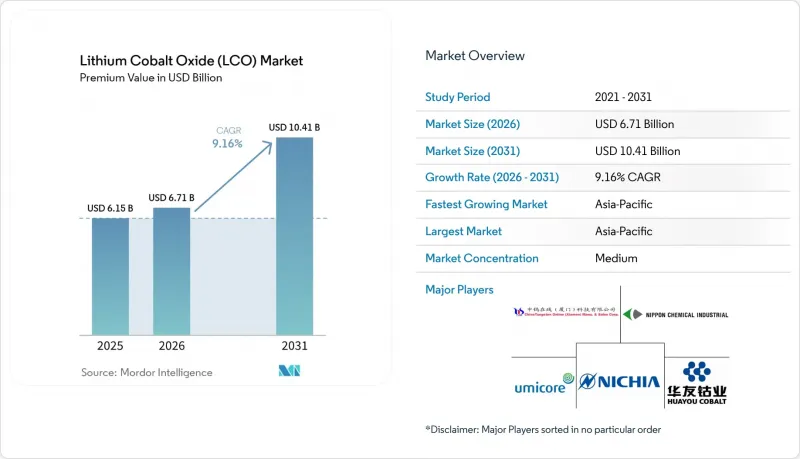
據 Mordor Intelligence 稱,2025 年鈷酸鋰 (LCO) 市場價值為 61.5 億美元,預計到 2031 年將從 2026 年的 67.1 億美元成長至 104.1 億美元,預測期(2026-2031 年)的複合成長率預計為 9.16%。
全球鈷酸鋰(LCO)市場趨勢及洞察
高階攜帶式電子設備對高能量密度的需求
由於高階智慧型手機的電池規格要求在嚴格控制的設備尺寸內實現高體積能量密度,因此它們仍然是鈷酸鋰電池的主要市場。設備製造商正擴大採用高壓鈷酸鋰正極和碳矽負極的組合,以在不增加電池尺寸的情況下提高電芯能量密度。 2025年,Syensqo宣布其電解添加劑Energain SA076將應用於工作電壓超過4.53V的鈷酸鋰電池系統。該公司持續致力於提高工作電壓並維持電解穩定性,預計產品將於2026年在4.55V旗艦平台上得到更廣泛的應用。隨著人工智慧處理、高刷新率顯示器和新型數據機負載的出現,旗艦智慧型手機對電池容量的需求不斷成長,因此能源效率在設備設計中變得越來越重要。即使智慧型手機的銷售成長速度沒有與之同步,這些需求也可能導致每個裝置的正極電荷量增加。
穿戴式裝置、折疊式設備、無人機和醫療植入。
鋰鈷氧化物市場正受益於那些既需要小型電池又不影響運作的設備。折疊式智慧型手機以及擴增實境(AR) 和虛擬實境 (VR) 裝置需要能夠適應其更複雜結構的超薄電池設計。穿戴式醫療設備也推動了這項需求,因為電池化學成分的變化可能需要對設備進行重新認證。美國食品藥物管理局(FDA) 的品質體係法規適用於醫療設備的生產,並對已核准的產品設計實施了正式的控制措施。無人機 (UAV) 使用高能量密度電池來延長飛行時間,同時保持負載容量範圍內。雖然這些應用場景的規模不如消費性電子產品,但它們正在推動檢測、農業、醫療和國防等領域的需求。
鈷價格波動與供應集中度
鈷是鋰鈷氧化物正極材料的主要成本組成部分,因此,鈷價波動和供應集中度限制市場。剛果民主共和國已通過配額制度,將其2026年的氫氧化鈷出口量限制在8.7萬噸。根據鈷業協會報告,2025年全球鈷礦供應量將達27萬噸,其中剛果民主共和國將佔73%。該協會也報告稱,若不計入剛果民主共和國的供應量,2025年全球鈷礦供應量將短缺9.6萬噸。預計2025年氫氧化鈷價格將持續上漲,推高正極材料和電池製造商的原料成本。原物料成本上漲可能會對消費性電子產品製造商的利潤率造成壓力,因為消費性電子產品的最終產品定價較為敏感。
細分市場分析
到2025年,電池級鈷酸鋰將佔據65.78%的市場佔有率,預計到2031年將以9.74%的複合年成長率成長。高階智慧型手機和行動裝置供應鏈對純度標準的嚴格要求推動了這一細分市場的成長,因為即使是微小的材料差異也會影響電池性能。電池級材料通常需要高鈷純度、可控的顆粒形貌和一致的振實密度,以確保可靠的生產製造。這些特性使得電池即使在工作電壓超過4.45V或設備製造商需要大於固定電池容量的容量時,也能保持性能。高階設備製造商採用電池級正極材料,是因為低等級原料在高電壓下容量會快速衰減。工業級鈷酸鋰用於陶瓷著色劑、磁性材料和催化劑等領域,雖然其需求較為穩定,但成長較為緩慢。
電池級材料的需求也得益於鈷在正極材料生產中二次利用的擴大。中國於2025年8月取消了對鈷黑塊的進口限制,允許海外的再生電池材料流入國內精煉產能,擴大了潛在的原料來源。這項變化有望改善鋰鈷氧化物產業,特別是擁有精煉和材料加工能力的生產商的再生鈷原料供應。 DOWA ECO-SYSTEM於2026年6月建立了一套從廢棄鋰離子電池中回收硫酸鎳和硫酸鈷的綜合製程。回收的材料作為樣品提供給正極材料製造商,用於在全面商業化部署前進行性能檢驗。此綜合回收系統可減少對未利用原料的依賴,使採購管道多樣化,並提高電池級材料製造商的供應韌性。
區域分析
預計到2025年,亞太地區將佔據52.86%的市場佔有率,並將以9.89%的複合年成長率持續成長至2031年。中國在鈷精煉、正極材料生產、電池製造和設備組裝發揮核心作用。這一一體化的供應鏈鞏固了該地區在鈷酸鋰市場的領先地位。日本在高精度家用電子電器和高純度正極材料領域保持其專業優勢。韓國憑藉其成熟的正極材料製造能力,為全球目的地設備製造商(OEM)提供產品。此外,該地區的零件供應商、電池製造商和設備組裝製造商之間也建立了緊密的合作關係。
北美和歐洲構成了一個以供應鏈管理和差異化技術為核心的區域需求基地。在北美,先進製造業的激勵措施支持了電池材料領域的本地投資,但除亞洲以外,電池用鈷酸鋰的產能仍然有限。歐洲的電池法規要求提供更詳細的電池材料供應鏈信息,包括鈷的可追溯性。這些要求可能有利於那些擁有可記錄的採購管道和可審計生產流程的供應商。北京億泉材料科技有限公司目前正在芬蘭科特卡興建一座正極活性材料工廠,預計2027年開始商業化生產。
南美洲、中東和非洲是需求不斷成長的地區,消費與消費性電子產品的普及密切相關。在巴西和阿根廷,智慧型手機的普及和國內電子產品組裝的發展正在推動區域需求成長。在中東,先進製造業的規劃可能會使電池材料市場長期保持成長動能。剛果民主共和國仍是重要的鈷供應國,而非鈷酸鋰消費國。其出口配額決策會影響全球鈷酸鋰生產商的原料供應和成本。在鈷酸鋰市場,對該地區的依賴主要是一種供應的考量,而非當地消費的促進因素。南非可以在鈷加工方面發揮輔助作用,但其商業化準備仍不明朗。
其他好處:
- Excel格式的市場預測(ME)表
- 3個月的分析師支持
目錄
第1章:引言
- 研究假設和市場定義
- 調查範圍
第2章:調查方法
第3章執行摘要
第4章 市場狀況
- 市場概覽
- 市場促進因素
- 高階可攜式電子設備的高密度需求
- 穿戴式裝置、折疊式設備、無人機和醫療植入領域的成長
- 電池級純度與創新塗層技術
- 可攜式和分散式儲能技術的擴展
- 鈷回收的經濟可行性及再生原料的可用性
- 市場限制因素
- 鈷價格波動與供應集中度
- 高充電狀態下有熱失控風險
- 以磷酸鐵鋰 (LFP)、鎳鈷錳酸鉀 (NMC)、鎳鈷鋁酸鉀 (NCA) 和無鈷材料取代
- 價值鏈分析
- 波特五力分析
第5章 市場規模與成長預測
- 按年級
- 電池級
- 工業級
- 透過使用
- 家用電子產品
- 電動車
- 醫療器材
- 能源儲存系統
- 電訊
- 按地區
- 亞太地區
- 中國
- 印度
- 日本
- 韓國
- 東南亞國協
- 其他亞太國家
- 北美洲
- 美國
- 加拿大
- 墨西哥
- 歐洲
- 德國
- 英國
- 法國
- 義大利
- 北歐國家
- 其他歐洲國家
- 南美洲
- 巴西
- 阿根廷
- 其他南美國家
- 中東和非洲
- 沙烏地阿拉伯
- 南非
- 其他中東和非洲國家
- 亞太地區
第6章 競爭情勢
- 市場集中度
- 策略趨勢
- 市佔率和排名分析
- 公司簡介
- BASF
- Beijing Easpring Material Technology Co., Ltd.
- Cosmo Advanced Materials & Technology Co., Ltd.
- GEM Co., Ltd.
- Huayou Cobalt Co., Ltd.
- Hunan Changyuan Lico Co., Ltd.
- Hunan Shanshan Energy Technology Co., Ltd.
- NICHIA CORPORATION
- Nippon Chemical Industrial CO., LTD.
- POSCO FUTURE M
- Reshine New Material Co., Ltd.
- Tianjin B&M Science and Technology Co., Ltd.
- Umicore
- Xiamen Tungsten Co., Ltd.
第7章 市場機會與未來展望
According to Mordor Intelligence, the lithium cobalt oxide (LCO) market size was valued at USD 6.15 billion in 2025 and is estimated to grow from USD 6.71 billion in 2026 to reach USD 10.41 billion by 2031, at a CAGR of 9.16% during the forecast period (2026-2031).
Global Lithium Cobalt Oxide (LCO) Market Trends and Insights
High-Density Demand in Premium Portable Electronics
Premium smartphones remain a major outlet for the lithium cobalt oxide market because their battery specifications favor high volumetric energy density within tightly controlled device dimensions. Device makers increasingly use silicon-carbon anodes with high-voltage lithium cobalt oxide cathodes to increase cell-level energy density without increasing battery size. Syensqo stated in 2025 that its Energain SA076 electrolyte additive had entered commercial use in lithium cobalt oxide battery systems operating above 4.53 V. The company expected broader deployment on 4.55 V flagship platforms during 2026, reflecting continued work to raise operating voltage while managing electrolyte stability. Artificial intelligence-enabled processing, high-refresh-rate displays, and newer modem loads increase battery capacity needs in flagship handsets and make energy efficiency more important to device design. These requirements can raise cathode loading per device even when handset unit sales do not increase at the same pace.
Growth in Wearables, Foldables, Drones and Medical Implants
The lithium cobalt oxide market gains from devices that require compact battery cells without compromising operating time. Foldable phones and augmented reality or virtual reality devices need thin battery designs that can accommodate their more complex structures. Wearable medical devices also support demand because battery chemistry changes can require renewed device qualification. The Food and Drug Administration's Quality System Regulation applies to medical-device manufacturing, creating formal controls around approved product designs. Unmanned Aerial Vehicles (UAVs) use energy-dense cells to extend flight times while staying within payload limits. These use cases are smaller than mass consumer electronics, but they add demand across inspection, agricultural, health care, and defense applications.
Cobalt Price Volatility and Supply Concentration
Cobalt price volatility and supply concentration constrain the lithium cobalt oxide market because cobalt is a key cost component in lithium cobalt oxide cathode materials. The Democratic Republic of the Congo limited cobalt hydroxide exports to 87,000 metric tons in 2026 under its quota system. The Cobalt Institute reported a global mined cobalt supply of 270 kilotons in 2025, with the Democratic Republic of the Congo contributing 73% of the supply. The institute also reported a 96-kiloton ex-Democratic Republic of the Congo supply deficit during 2025. Cobalt hydroxide prices increased during 2025, raising input costs for cathode and battery producers. Higher raw-material costs can pressure margins in consumer devices, where manufacturers are sensitive to final product pricing.
Other drivers and restraints analyzed in the detailed report include:
- Battery Grade Purity and Coating Innovation
- Expansion of Portable and Distributed Energy Storage
- Substitution by LFP, NMC, NCA and Cobalt-Free Chemistries
For complete list of drivers and restraints, kindly check the Table Of Contents.
Segment Analysis
Battery grade held 65.78% of the lithium cobalt oxide market share in 2025 and is projected to advance at a 9.74% CAGR through 2031. The segment benefits from stricter purity standards across premium smartphone and portable-device supply chains, where minor material variation can affect cell performance. Battery grade material generally requires high cobalt purity, controlled particle morphology, and consistent tap density to support reliable manufacturing. These characteristics help cells maintain performance as operating voltage moves beyond 4.45 V and as device makers seek greater capacity from a fixed battery volume. Premium device makers use battery grade cathodes because lower grade feedstocks can experience faster capacity loss at high voltage. Industrial grade lithium cobalt oxide serves ceramic colorants, magnetic materials, and catalyst applications, providing a more stable but slower-moving demand base.
Battery grade demand is also supported by efforts to increase secondary cobalt use in cathode production. China removed its restriction on black-mass imports in August 2025, allowing overseas secondary battery material to enter domestic refining capacity and expanding potential feedstock sources. This change can improve the availability of recycled cobalt feedstock for the lithium cobalt oxide industry, particularly for producers with refining and material-processing capabilities. DOWA ECO-SYSTEM established an integrated process for recovering nickel and cobalt sulfates from used lithium-ion batteries in June 2026. The recovered materials were supplied to cathode material producers as samples for performance verification before wider commercial adoption. Integrated recovery systems can reduce reliance on virgin feedstock, diversify procurement options, and improve supply resilience for battery grade manufacturers.
Complete Report Scope:
- By Grade
- Battery Grade
- Industrial Grade
- By Application
- Consumer Electronics
- Electric Vehicles
- Medical Devices
- Energy Storage Systems
- Telecommunications
- By Geography
- Asia-Pacific
- China
- India
- Japan
- South Korea
- ASEAN Countries
- Rest of Asia-Pacific
- North America
- United States
- Canada
- Mexico
- Europe
- Germany
- United Kingdom
- France
- Italy
- NORDIC Countries
- Rest of Europe
- South America
- Brazil
- Argentina
- Rest of South America
- Middle-East and Africa
- Saudi Arabia
- South Africa
- Rest of Middle-East and Africa
- Asia-Pacific
Geography Analysis
Asia-Pacific held 52.86% of the market share in 2025 and is projected to advance at a 9.89% CAGR through 2031. China has a central role in cobalt refining, cathode production, battery-cell manufacturing, and device assembly. This integrated supply chain supports the region's leadership in the lithium cobalt oxide market. Japan retains a specialized role in high-precision consumer electronics and high-purity cathode materials. South Korea supplies global original equipment manufacturer, or OEM, customers through established cathode-material capabilities. The region also has strong links between component suppliers, cell manufacturers, and device assemblers.
North America and Europe represent a regional demand base focused on supply-chain controls and differentiated technologies. In North America, advanced-manufacturing incentives support local battery-material investment, although battery grade lithium cobalt oxide capacity remains limited outside Asia. Europe's Battery Regulation requires more detailed supply-chain information for battery materials, including cobalt traceability. These requirements can favor suppliers with documented sourcing and auditable production processes. Beijing Easpring Material Technology Co., Ltd. is developing a cathode active material plant in Kotka, Finland, that is expected to begin commercial production in 2027.
South America, and Middle-East and Africa are developing demand regions, where consumption is tied mainly to consumer electronics adoption. Brazil and Argentina support regional uptake through growing smartphone use and domestic electronics assembly. In the Middle-East, advanced manufacturing plans may create longer-term interest in battery materials. The Democratic Republic of the Congo remains more important as a cobalt supplier than as a lithium cobalt oxide consumer. Its export quota decisions affect raw material availability and cost for lithium cobalt oxide producers worldwide. For the lithium cobalt oxide market, this regional exposure is primarily a supply-side consideration rather than a local consumption driver. South Africa could develop a supporting role in cobalt processing, although commercial readiness remains uncertain.
- BASF
- Beijing Easpring Material Technology Co., Ltd.
- Cosmo Advanced Materials & Technology Co., Ltd.
- GEM Co., Ltd.
- Huayou Cobalt Co., Ltd.
- Hunan Changyuan Lico Co., Ltd.
- Hunan Shanshan Energy Technology Co., Ltd.
- NICHIA CORPORATION
- Nippon Chemical Industrial CO., LTD.
- POSCO FUTURE M
- Reshine New Material Co., Ltd.
- Tianjin B&M Science and Technology Co., Ltd.
- Umicore
- Xiamen Tungsten Co., Ltd.
Additional Benefits:
- The market estimate (ME) sheet in Excel format
- 3 months of analyst support
TABLE OF CONTENTS
1 Introduction
- 1.1 Study Assumptions and Market Definition
- 1.2 Scope of the Study
2 Research Methodology
3 Executive Summary
4 Market Landscape
- 4.1 Market Overview
- 4.2 Market Drivers
- 4.2.1 High-Density Demand in Premium Portable Electronics
- 4.2.2 Growth in Wearables, Foldables, Drones and Medical Implants
- 4.2.3 Battery Grade Purity and Coating Innovation
- 4.2.4 Expansion of Portable and Distributed Energy Storage
- 4.2.5 Cobalt Recovery Economics and Circular Feedstock Availability
- 4.3 Market Restraints
- 4.3.1 Cobalt Price Volatility and Supply Concentration
- 4.3.2 Thermal Runaway Risk at High Charge Rates
- 4.3.3 Substitution by LFP, NMC, NCA and Cobalt-Free Chemistries
- 4.4 Value Chain Analysis
- 4.5 Porter's Five Forces Analysis
- 4.5.1 Bargaining Power of Suppliers
- 4.5.2 Bargaining Power of Buyers
- 4.5.3 Threat of New Entrants
- 4.5.4 Threat of Substitutes
- 4.5.5 Competitive Rivalry
5 Market Size and Growth Forecasts (Value)
- 5.1 By Grade
- 5.1.1 Battery Grade
- 5.1.2 Industrial Grade
- 5.2 By Application
- 5.2.1 Consumer Electronics
- 5.2.2 Electric Vehicles
- 5.2.3 Medical Devices
- 5.2.4 Energy Storage Systems
- 5.2.5 Telecommunications
- 5.3 By Geography
- 5.3.1 Asia-Pacific
- 5.3.1.1 China
- 5.3.1.2 India
- 5.3.1.3 Japan
- 5.3.1.4 South Korea
- 5.3.1.5 ASEAN Countries
- 5.3.1.6 Rest of Asia-Pacific
- 5.3.2 North America
- 5.3.2.1 United States
- 5.3.2.2 Canada
- 5.3.2.3 Mexico
- 5.3.3 Europe
- 5.3.3.1 Germany
- 5.3.3.2 United Kingdom
- 5.3.3.3 France
- 5.3.3.4 Italy
- 5.3.3.5 NORDIC Countries
- 5.3.3.6 Rest of Europe
- 5.3.4 South America
- 5.3.4.1 Brazil
- 5.3.4.2 Argentina
- 5.3.4.3 Rest of South America
- 5.3.5 Middle-East and Africa
- 5.3.5.1 Saudi Arabia
- 5.3.5.2 South Africa
- 5.3.5.3 Rest of Middle-East and Africa
- 5.3.1 Asia-Pacific
6 Competitive Landscape
- 6.1 Market Concentration
- 6.2 Strategic Moves
- 6.3 Market Share (%)/Ranking Analysis
- 6.4 Company Profiles (includes Global Overview, Market Overview, Core Segments, Financials as available, Strategic Information, Products and Services, and Recent Developments)
- 6.4.1 BASF
- 6.4.2 Beijing Easpring Material Technology Co., Ltd.
- 6.4.3 Cosmo Advanced Materials & Technology Co., Ltd.
- 6.4.4 GEM Co., Ltd.
- 6.4.5 Huayou Cobalt Co., Ltd.
- 6.4.6 Hunan Changyuan Lico Co., Ltd.
- 6.4.7 Hunan Shanshan Energy Technology Co., Ltd.
- 6.4.8 NICHIA CORPORATION
- 6.4.9 Nippon Chemical Industrial CO., LTD.
- 6.4.10 POSCO FUTURE M
- 6.4.11 Reshine New Material Co., Ltd.
- 6.4.12 Tianjin B&M Science and Technology Co., Ltd.
- 6.4.13 Umicore
- 6.4.14 Xiamen Tungsten Co., Ltd.
7 Market Opportunities and Future Outlook
- 7.1 White-Space and Unmet-Need Assessment

 鈷廢棄物回收市場:全球市場預測,2026-2032年
 鈷藍顏料市場報告:趨勢、預測及競爭分析(至2035年)
 硬脂酸鈷:市場佔有率分析、產業趨勢與統計、成長預測(2026-2031)鈷:市場佔有率分析、產業趨勢與統計、成長預測(2026-2031)
 2026-2030年全球鈷市場鈷市場:依產品類型、原料來源、形態、純度、應用、終端用戶產業和通路分類-全球預測,2026-2032年
 鈷市場規模、佔有率和成長分析:按產品類型、來源、應用、最終用戶產業、純度等級、分銷管道和地區分類-2026-2033年產業預測
 碳酸鈷市場規模、佔有率和成長分析:按產品類型、純度、應用、終端用戶產業、生產通路、分銷通路和地區分類-2026-2033年產業預測硫酸鈷:市場佔有率分析、產業趨勢與統計、成長預測(2026-2031)
 鈷酸鋰市場機會、成長要素、產業趨勢分析及2026-2035年預測