


 |
市場調查報告書
商品編碼
2154390
商用風扇:市場佔有率分析、產業趨勢與統計、成長預測(2026-2031)Commercial Fans - Market Share Analysis, Industry Trends & Statistics, Growth Forecasts (2026 - 2031) |
||||||

※ 本網頁內容可能與最新版本有所差異。詳細情況請與我們聯繫。
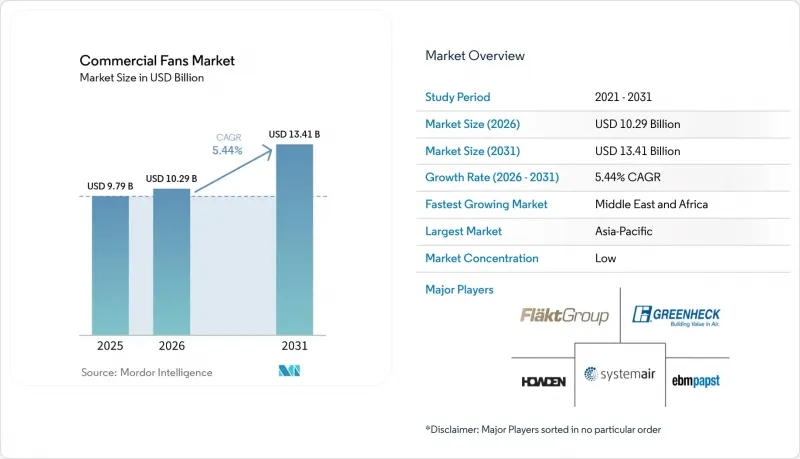
根據 Mordor Intelligence 預測,商用風扇市場規模將從 2025 年的 97.9 億美元成長到 2026 年的 102.9 億美元,然後在 2031 年達到 134.1 億美元,2026 年至 2031 年的複合年成長率為 5.44%。
全球商用風機市場趨勢與洞察
資料中心和人工智慧冷卻基礎設施
預計2026年至2030年間,全球整體將新增約100吉瓦的資料中心容量,使該產業的年複合成長率達到14%。這項建設計畫推動了對機房空調機組和伺服器機房排氣系統中高精度EC風扇的需求。對於需要對高密度計算設備進行可靠熱控制的設施而言,這種需求尤其顯著。在每機架30千瓦以下的範圍內,風冷仍然普遍存在。這確保了即使液冷技術發展迅速,風扇需求也能維持,使供應商能夠為現有設施和升級改造項目提供服務。此外,即使在每機架40千瓦及以上的AI叢集中,在完全維修到液冷技術之前,風冷輔助設備仍然是必要的,這擴大了風扇系統在基礎設施改造中間階段的作用。 2026年6月,Ziehl-Abegg宣布將在歐洲、美國和亞洲追加9,000萬歐元(約1.035億美元)的產能投資,並將AI資料中心視為關鍵促進因素。資料中心專案建置能力緊張,這可能有利於能夠提供認證產品、可靠前置作業時間和適用於各種冷卻配置的設備的供應商。
商業建築通風和暖通空調維修的需求
商用風機市場正受惠於維修需求。這是因為已安裝通風系統的更換週期與新建建築不同,而且解決性能不足或不符合法規要求的問題並非總是可以推遲的。暖通空調系統佔商業建築能耗的35%至50%,在醫院和飯店甚至高達70%。標準「62.1-2025」新增了濕度控制、需量反應通風和排氣流量方面的要求。如果這些規定被採納,並且當地建築規範引用了該標準,則可能會促進設備升級。此外,即使整體辦公室需求疲軟,現有建築也需要更好的通風系統才能保持對租戶的吸引力並滿足當前的營運預期。如果業主直接支付電費並能證明降低能耗的益處,高效能風機可以降低營運成本。另一方面,如果租戶根據傳統租賃協議承擔能源成本,則獎勵的不匹配可能會導致維修延期,尤其是在資本預算有限的多租戶物業中。
先進高效率風扇系統的初始成本較高
EC馬達風扇在購買時的價格可能比感應感應馬達高出30%到60%,即使運轉成本更低,高昂的價格也成為一大障礙。這種價格差異限制了小規模業主和優先考慮初始預算的買家採用EC馬達風扇。在資本支出核准和能源管理分離的市場,這種趨勢尤其明顯。雖然公用事業公司提供的補貼可以抵銷20%到30%的符合條件的維修費用,但補貼的覆蓋範圍因地區而異,而且對於沒有專門能源管理團隊的營運商來說,管理補貼專案可能十分困難。在傳統的租賃結構中,租戶承擔電費,削弱了業主的獎勵,買家也無法直接受益於潛在的節能效益。此外,電費結構的差異使得在不同國家和不同建築群中製定通用的採購方案變得困難。即使營運成本支持維修,老舊都市區建築中低風量、低轉速風扇的維修也可能因結構淨空不足而進一步受限。
細分市場分析
到2025年,軸流風扇將佔商用風機市場的42.4%。其成本和性能使其適用於中低靜壓應用,例如暖通空調管道、屋頂排氣和倉庫空氣循環,而定期更換的需求也支撐了其廣泛應用。離心風機在需要更高壓力和穩定運轉特性的風管系統中繼續發揮重要作用。隨著建築法規日益嚴格,營運商開始權衡總營運成本,其較大的面積和能耗正受到越來越多的關注。排氣扇在廚房、醫院和類似環境中保持穩定的地位,因為它們必須滿足通風要求,即使其他商業應用更容易受到建築週期的影響。
預計到2031年,混流式風扇的年複合成長率將達到5.7%。其設計結合了高軸流風量和離心壓能力,為傳統的軸流式和離心式風扇提供了有效的中間選擇。這使得它們適用於緊湊型資料中心的機架冷卻、低矮風管以及安裝空間有限的屋頂系統。 2025年12月,GreenHeck推出了RSQ,這是一款採用混流技術的直驅式屋頂風扇。該產品最大風量可達27,100 cfm,並已獲得AMCA的FEI、空氣性能和噪音性能認證。對間隙式流控導風罩的進一步研發表明,GreenHeck持續致力於提高壓升和降低噪音,預計這將縮小其與離心式風扇在空間和聲學性能至關重要的應用領域的差距。
區域分析
到2025年,亞太地區將佔據商用風扇市場42.1%的佔有率。在中國,除製造業、倉儲業和商業地產外,超大規模資料中心的建設計畫不斷擴大,帶動了多個關鍵風扇應用領域的需求成長。到2025年,空氣冷卻將佔該地區資料中心冷卻收入的60%,從而支撐對機房空調和精密冷卻設備的需求。在印度、越南、印尼和泰國,城市發展和早期資料中心建設推動了需求成長,進而帶動了該地區商用通風設備需求的增加。在日本和韓國,基於能源效率要求的高規格升級需求正在推動市場發展,其中變速EC系統發揮關鍵作用。
北美和歐洲是商用風扇市場技術領導地位的基石。在北美,資料中心的建設和老舊商業建築的出現推動了新安裝和維修的需求,而成熟的產品性能在產品規格製定中備受重視。在歐洲,2026年7月實施的第2024/1834號法規引發了以合規性為主要驅動力的更新週期。德國、法國、英國和波蘭是歐洲重要的市場,銷售量佔比很高,其中波蘭作為資料中心和物流樞紐的重要性也日益凸顯。在巴西和智利,主要城市商業建築和食品加工對通風的需求推動了市場成長,但基礎設施和外匯狀況限制了成長速度。
預計到2031年,中東和非洲地區的複合年成長率將達到5.9%。沙烏地阿拉伯和阿拉伯聯合大公國的資料中心、機場容量、飯店設施和綜合用途項目數量不斷成長,從而帶動了通風設備的高需求。極端高溫天氣也推動了對具備可靠連續運轉和卓越散熱性能的設備的需求。南非和埃及是醫療保健和零售業暖通空調投資的次要需求中心。海灣國家的規範通常要求採用IP防護等級機殼、耐熱電機繞組和耐腐蝕塗層,這導致產品成本更高,也凸顯了該地區特定的產品要求。
其他好處:
- Excel格式的市場預測(ME)表
- 3個月的分析師支持
目錄
第1章:引言
- 研究假設和市場定義
- 調查範圍
第2章:調查方法
第3章執行摘要
第4章 市場狀況
- 市場概覽
- 市場促進因素
- 資料中心和人工智慧冷卻基礎設施的擴建
- 商業建築通風和空調系統維修的需求
- 能源效率和室內空氣品質法規
- 工業化以及倉庫和物流中心的擴張
- 在棕地空調機組中引入模組化風扇牆。
- 根據風機能效指數和數位化性能檢驗。
- 市場限制因素
- 先進高效率風扇系統的初始成本較高
- 整合式暖通空調和替代空氣循環技術的可用性
- 大風量低轉速風扇維修中的結構與間隙限制。
- 稀土元素磁鐵和特種合金的供應風險
- 供應鏈分析
- 波特五力分析
- 科技趨勢
- 監理情勢
- 投資分析
第5章 市場規模與成長預測
- 風扇型
- 軸流風扇
- 離心風扇
- 混流風扇
- 排氣扇
- 其他商用風扇類型
- 透過使用
- 一般通風
- 暖通空調和空調
- 冷卻和空氣循環
- 廢氣和煙氣處理
- 其他用途
- 最終用戶
- 辦公大樓
- 零售和購物中心
- 飯店及餐飲業
- 餐廳和商用廚房
- 醫院和醫療機構
- 教育機構
- 倉庫和物流中心
- 資料中心
- 交通基礎設施
- 其他商業設施
- 按地區
- 北美洲
- 美國
- 加拿大
- 墨西哥
- 歐洲
- 德國
- 法國
- 義大利
- 西班牙
- 英國
- 波蘭
- 俄羅斯
- 其他歐洲國家
- 亞太地區
- 中國
- 印度
- 日本
- 韓國
- 澳洲
- 印尼
- 越南
- 泰國
- 其他亞太國家
- 南美洲
- 巴西
- 阿根廷
- 智利
- 其他南美國家
- 中東和非洲
- 沙烏地阿拉伯
- 阿拉伯聯合大公國
- 埃及
- 南非
- 摩洛哥
- 其他中東和非洲國家
- 北美洲
第6章 競爭情勢
- 市場集中度
- 策略趨勢
- 市佔率分析
- 公司簡介
- Air Systems Components, Inc.
- Carrier Global Corporation
- Cincinnati Fan
- Daikin Industries, Ltd.
- ebm-papst Group
- FlaktGroup Holding GmbH
- Greenheck Fan Corporation
- Howden Group Ltd
- Johnson Controls International plc
- Loren Cook Company
- Munters Group AB
- New York Blower Company
- Rosenberg Ventilatoren GmbH
- Soler & Palau Ventilation Group
- Systemair AB
- Trane Technologies plc
- Twin City Fan Companies, Ltd.
- Vent-Axia
- Zhejiang Shangfeng Industrial Group Co., Ltd.
- Zhejiang Yilida Ventilator Co., Ltd.
第7章 市場機會與未來展望
According to Mordor Intelligence, the commercial fans market size is expected to grow from USD 9.79 billion in 2025 to USD 10.29 billion in 2026 and is forecast to reach USD 13.41 billion by 2031 at 5.44% CAGR over 2026-2031.
Global Commercial Fans Market Trends and Insights
Data Center and AI Cooling Infrastructure
Nearly 100 GW of data center capacity is expected to be added globally between 2026 and 2030, which supports a 14% CAGR for the sector. This construction pipeline raises demand for precision EC fans in computer room air-handling units and server-room exhaust systems, particularly in facilities that need dependable thermal control around dense computing equipment. Air cooling remains widely used below 30 kW per rack, which keeps fan demand relevant as liquid cooling expands and allows suppliers to serve both established and upgrading facilities. AI clusters operating above 40 kW per rack also need air-assist equipment before full liquid-cooling retrofits are completed, extending the role of fan systems during an intermediate stage of infrastructure change. Ziehl-Abegg announced an additional EUR 90 million investment, equivalent to USD 103.5 million, in European, U.S., and Asian capacity in June 2026 and identified AI data centers as a key driver. Tight construction capacity in data center projects can favor suppliers that can provide certified products, dependable lead times, and equipment suited to different cooling configurations.
Commercial Building Ventilation and HVAC Retrofit Demand
The commercial fans market benefits from retrofit demand because installed ventilation equipment has a different replacement cycle from new construction and cannot always be deferred when performance or compliance falls short. HVAC systems accounted for 35% to 50% of commercial building energy use, while hospitals and hotels can reach 70%. Standard 62.1-2025 added humidity control, demand-controlled ventilation, and updated exhaust-airflow requirements, which can prompt upgrades where those provisions are adopted, and local codes refer to the standard. Existing buildings also need better ventilation to remain attractive to tenants and comply with current operating expectations, even when broader office demand is weak. Efficient fans can lower operating costs where owners directly pay electricity bills and can document the benefits of lower electricity use. Split incentives can slow upgrades where tenants pay energy costs under legacy leases, especially in multi-tenant properties with limited capital budgets.
High Upfront Cost of Advanced Energy-Efficient Fan Systems
EC-motor fans can cost 30% to 60% more than induction-motor alternatives at purchase, creating an immediate barrier even when the operating cost is favorable. This price gap limits adoption by smaller owners and buyers focused on initial budgets, particularly in markets where capital approvals are separated from energy management. Utility rebates can offset 20% to 30% of qualifying upgrade costs, but access varies by location, and program administration can be difficult for operators without dedicated energy teams. Legacy lease structures weaken the owner's incentive when tenants bear electricity costs, leaving the buyer without a direct share of the potential savings. Differences in electricity tariffs also make a common procurement case harder to prepare across countries and building portfolios. Low structural clearances can further limit high-volume, low-speed fan retrofits in older urban buildings, even where operating economics support an upgrade.
Other drivers and restraints analyzed in the detailed report include:
- Energy Efficiency and Indoor Air Quality Regulations
- Warehouses, Modular Fan Walls, and Digital Verification
- Availability of Integrated HVAC and Alternative Air-Movement Technologies
For complete list of drivers and restraints, kindly check the Table Of Contents.
Segment Analysis
Axial fans held 42.4% of the commercial fans market in 2025. Their cost and performance suit low-to-medium static-pressure work in HVAC distribution, rooftop exhaust, and warehouse circulation, where broad deployment supports repeat replacement demand. Centrifugal fans remain important in ducted systems that need higher pressure and a stable operating profile. Their larger footprint and energy use face greater scrutiny as building rules tighten and operators compare full operating costs. Exhaust fans retain a stable role because kitchens, hospitals, and similar settings must meet ventilation requirements, even when other commercial applications are more exposed to construction cycles.
Mixed-flow fans are projected to grow at a 5.7% CAGR through 2031. Their design combines high axial airflow with centrifugal pressure capability, offering a useful option between conventional axial and centrifugal designs. This makes them suitable for compact data center cooling racks, low-height duct runs, and rooftop systems with limited installation space. Greenheck introduced its RSQ direct-drive rooftop fan with mixed-flow technology in December 2025, with performance up to 27,100 cfm and AMCA licenses for FEI, air, and sound performance. Further work on clearance-flow-control shrouds points to continued efforts to improve pressure rise and reduce sound, narrowing the gap with centrifugal products in applications where space and acoustic performance are important.
Complete Report Scope:
- By Fan Type
- Axial Fans
- Centrifugal Fans
- Mixed-Flow Fans
- Exhaust Fans
- Other Commercial Fan Types
- By Application
- General Ventilation
- HVAC and Air Conditioning
- Cooling and Air Circulation
- Exhaust and Fume Extraction
- Other Applications
- By End User
- Office Buildings
- Retail and Shopping Centers
- Hotels and Hospitality
- Restaurants and Commercial Kitchens
- Hospitals and Healthcare Facilities
- Educational Institutions
- Warehouses and Distribution Centers
- Data Centers
- Transportation Infrastructure
- Other Commercial Facilities
- By Geography
- North America
- United States
- Canada
- Mexico
- Europe
- Germany
- France
- Italy
- Spain
- United Kingdom
- Poland
- Russia
- Rest of Europe
- Asia-Pacific
- China
- India
- Japan
- South Korea
- Australia
- Indonesia
- Vietnam
- Thailand
- Rest of Asia-Pacific
- South America
- Brazil
- Argentina
- Chile
- Rest of South America
- Middle East and Africa
- Saudi Arabia
- United Arab Emirates
- Egypt
- South Africa
- Morocco
- Rest of Middle East and Africa
- North America
Geography Analysis
Asia-Pacific held 42.1% of the commercial fans market in 2025. China combines manufacturing, warehousing, commercial real estate, and a growing hyperscale data center pipeline, creating demand across several major fan applications. Air-based cooling accounted for 60% of regional data center cooling revenue in 2025, which sustains demand for computer room air-handling and precision-cooling equipment. India, Vietnam, Indonesia, and Thailand add demand through urban development and early-stage data center construction, expanding the regional need for commercial ventilation equipment. Japan and South Korea support high-specification replacement demand under energy-efficiency requirements, where variable-speed EC systems are relevant.
North America and Europe form the technology leadership base for the commercial fans market. North American data center construction and aging commercial buildings support both new installations and retrofits, while specification work places a high value on tested product performance. Europe entered a compliance-led replacement cycle when Regulation 2024/1834 became enforceable in July 2026. Germany, France, the United Kingdom, and Poland are important European markets by volume, with Poland also gaining relevance as a data center and logistics location. Brazil and Chile provide growth from commercial construction in large cities and food-processing ventilation, although infrastructure and currency conditions limit the pace.
Middle East and Africa are projected to grow at a 5.9% CAGR through 2031. Saudi Arabia and the United Arab Emirates are adding data centers, airport capacity, hospitality properties, and mixed-use projects, which support higher-capacity ventilation demand. Extreme heat creates demand for equipment with reliable continuous operation and stronger thermal performance. South Africa and Egypt are secondary demand centers for healthcare and retail HVAC investment. Gulf specifications often require IP-rated housings, high-temperature motor windings, and corrosion-resistant coatings, which can support higher unit values and distinguish regional product requirements.
- Air Systems Components, Inc.
- Carrier Global Corporation
- Cincinnati Fan
- Daikin Industries, Ltd.
- ebm-papst Group
- FlaktGroup Holding GmbH
- Greenheck Fan Corporation
- Howden Group Ltd
- Johnson Controls International plc
- Loren Cook Company
- Munters Group AB
- New York Blower Company
- Rosenberg Ventilatoren GmbH
- Soler & Palau Ventilation Group
- Systemair AB
- Trane Technologies plc
- Twin City Fan Companies, Ltd.
- Vent-Axia
- Zhejiang Shangfeng Industrial Group Co., Ltd.
- Zhejiang Yilida Ventilator Co., Ltd.
Additional Benefits:
- The market estimate (ME) sheet in Excel format
- 3 months of analyst support
TABLE OF CONTENTS
1 INTRODUCTION
- 1.1 Study Assumptions and Market Definition
- 1.2 Scope of the Study
2 RESEARCH METHODOLOGY
3 EXECUTIVE SUMMARY
4 MARKET LANDSCAPE
- 4.1 Market Overview
- 4.2 Market Drivers
- 4.2.1 Expansion of Data Center and AI Cooling Infrastructure
- 4.2.2 Commercial Building Ventilation and HVAC Retrofit Demand
- 4.2.3 Energy-Efficiency and Indoor-Air-Quality Regulations
- 4.2.4 Industrialization and Expansion of Warehouses and Distribution Centers
- 4.2.5 Modular Fan-Wall Adoption in Brownfield Air-Handling Units
- 4.2.6 Fan-Energy-Index-Based Procurement and Digital Performance Verification
- 4.3 Market Restraints
- 4.3.1 High Upfront Cost of Advanced Energy-Efficient Fan Systems
- 4.3.2 Availability of Integrated HVAC and Alternative Air-Movement Technologies
- 4.3.3 Structural and Clearance Constraints for High-Volume Low-Speed Fan Retrofits
- 4.3.4 Rare-Earth Magnet and Specialty-Alloy Supply Exposure
- 4.4 Supply-Chain Analysis
- 4.5 Porter's Five Forces Analysis
- 4.5.1 Bargaining Power of Suppliers
- 4.5.2 Bargaining Power of Buyers
- 4.5.3 Threat of New Entrants
- 4.5.4 Threat of Substitutes
- 4.5.5 Competitive Rivalry
- 4.6 Technology Outlook
- 4.7 Regulatory Landscape
- 4.8 Investment Analysis
5 MARKET SIZE AND GROWTH FORECASTS
- 5.1 By Fan Type
- 5.1.1 Axial Fans
- 5.1.2 Centrifugal Fans
- 5.1.3 Mixed-Flow Fans
- 5.1.4 Exhaust Fans
- 5.1.5 Other Commercial Fan Types
- 5.2 By Application
- 5.2.1 General Ventilation
- 5.2.2 HVAC and Air Conditioning
- 5.2.3 Cooling and Air Circulation
- 5.2.4 Exhaust and Fume Extraction
- 5.2.5 Other Applications
- 5.3 By End User
- 5.3.1 Office Buildings
- 5.3.2 Retail and Shopping Centers
- 5.3.3 Hotels and Hospitality
- 5.3.4 Restaurants and Commercial Kitchens
- 5.3.5 Hospitals and Healthcare Facilities
- 5.3.6 Educational Institutions
- 5.3.7 Warehouses and Distribution Centers
- 5.3.8 Data Centers
- 5.3.9 Transportation Infrastructure
- 5.3.10 Other Commercial Facilities
- 5.4 By Geography
- 5.4.1 North America
- 5.4.1.1 United States
- 5.4.1.2 Canada
- 5.4.1.3 Mexico
- 5.4.2 Europe
- 5.4.2.1 Germany
- 5.4.2.2 France
- 5.4.2.3 Italy
- 5.4.2.4 Spain
- 5.4.2.5 United Kingdom
- 5.4.2.6 Poland
- 5.4.2.7 Russia
- 5.4.2.8 Rest of Europe
- 5.4.3 Asia-Pacific
- 5.4.3.1 China
- 5.4.3.2 India
- 5.4.3.3 Japan
- 5.4.3.4 South Korea
- 5.4.3.5 Australia
- 5.4.3.6 Indonesia
- 5.4.3.7 Vietnam
- 5.4.3.8 Thailand
- 5.4.3.9 Rest of Asia-Pacific
- 5.4.4 South America
- 5.4.4.1 Brazil
- 5.4.4.2 Argentina
- 5.4.4.3 Chile
- 5.4.4.4 Rest of South America
- 5.4.5 Middle East and Africa
- 5.4.5.1 Saudi Arabia
- 5.4.5.2 United Arab Emirates
- 5.4.5.3 Egypt
- 5.4.5.4 South Africa
- 5.4.5.5 Morocco
- 5.4.5.6 Rest of Middle East and Africa
- 5.4.1 North America
6 COMPETITIVE LANDSCAPE
- 6.1 Market Concentration
- 6.2 Strategic Moves
- 6.3 Market Share Analysis
- 6.4 Company Profiles (includes Global Level Overview, Market Level Overview, Core Segments, Financials as available, Strategic Information, Market Rank/Share, Products and Services, Recent Developments)
- 6.4.1 Air Systems Components, Inc.
- 6.4.2 Carrier Global Corporation
- 6.4.3 Cincinnati Fan
- 6.4.4 Daikin Industries, Ltd.
- 6.4.5 ebm-papst Group
- 6.4.6 FlaktGroup Holding GmbH
- 6.4.7 Greenheck Fan Corporation
- 6.4.8 Howden Group Ltd
- 6.4.9 Johnson Controls International plc
- 6.4.10 Loren Cook Company
- 6.4.11 Munters Group AB
- 6.4.12 New York Blower Company
- 6.4.13 Rosenberg Ventilatoren GmbH
- 6.4.14 Soler & Palau Ventilation Group
- 6.4.15 Systemair AB
- 6.4.16 Trane Technologies plc
- 6.4.17 Twin City Fan Companies, Ltd.
- 6.4.18 Vent-Axia
- 6.4.19 Zhejiang Shangfeng Industrial Group Co., Ltd.
- 6.4.20 Zhejiang Yilida Ventilator Co., Ltd.
7 MARKET OPPORTUNITIES AND FUTURE OUTLOOK
- 7.1 White-Space and Unmet-Need Assessment

 氣密控制氣氛門市場:全球市場預測,2026-2032年工業循環風機市場:全球市場預測,2026-2032年
 智慧吹灰系統市場規模、佔有率和成長分析:按系統類型、吹氣介質、技術、應用、終端用戶產業和地區分類 - 產業預測,2026-2033年
 工業和商業暖通空調應用風機:市場佔有率分析、行業趨勢和統計數據以及成長預測(2026-2031 年)工業風扇:市場佔有率分析、產業趨勢與統計、成長預測(2026-2031)歐洲風機市場:市場佔有率分析、產業趨勢與統計及成長預測(2026-2031)
 風扇和鼓風機市場規模、佔有率和成長分析:按產品類型、應用、最終用戶產業、額定功率、安裝類型、技術和地區分類-2026-2033年產業預測
 2026-2034年全球風扇和鼓風機市場規模、佔有率、趨勢和成長分析報告
 個人風扇市場規模、佔有率和成長分析:按產品類型、電源、葉片配置、價格範圍、銷售管道和地區分類-2026-2033年產業預測工業及商業風機及鼓風機市場:依風機類型、壓力類型、技術、終端用戶產業及通路分類-2026-2032年全球市場預測