


 |
市場調查報告書
商品編碼
2119332
工業風扇:市場佔有率分析、產業趨勢與統計、成長預測(2026-2031)Industrial Fans - Market Share Analysis, Industry Trends & Statistics, Growth Forecasts (2026 - 2031) |
||||||

※ 本網頁內容可能與最新版本有所差異。詳細情況請與我們聯繫。
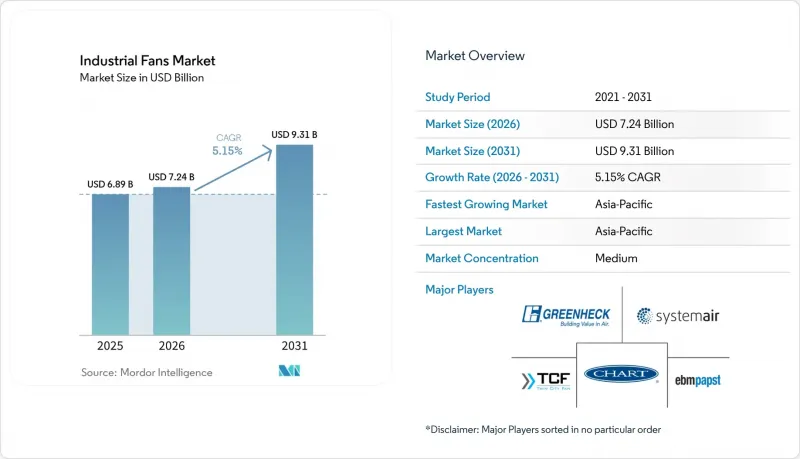
根據 Mordor Intelligence 預測,工業風扇市場規模將從 2025 年的 68.9 億美元和 2026 年的 72.4 億美元成長到 2031 年的 93.1 億美元,2026 年至 2031 年的年複合成長率(CAGR)為 5.15%。
本報告按風機類型(軸流式、離心式、混流式)、應用領域(通風、冷卻、除塵及其他)、最終用戶(製造業、採礦業、水泥業、電力業、化工業、石油天然氣業、金屬業、食品飲料業、製藥業、用水和污水及其他)以及地區(北美、歐洲、亞太、南美、中東和非洲)進行細分。市場預測以美元計價。
全球工業風機市場趨勢與洞察
工業能源效率法規
能源法規正日益成為工業風機採購和更換計畫的核心因素。歐盟生態設計法規(EU/2024/1834)將於2026年7月24日起適用於功率範圍為125瓦至500千瓦的風扇。該法規設定了更新的能源效率要求,強制要求提供部分負載下的性能信息,並包含有關可維修性的規定。歐盟委員會表示,到2030年,該法規可望使歐盟工業風機的年耗電量減少31太瓦時,為企業每年節省40億歐元的成本。製造商現在需要可靠的性能文檔,而能夠支援產品選擇、合規記錄和售後配件供應的供應商則更具優勢。因此,隨著用戶根據新的操作和文件要求評估舊設備,歐洲工業風扇市場正在形成更清晰的更換路徑。
遵守空氣品質、工人安全和排放法規。
空氣品質和工人安全要求推動了對除塵、排氣和製程通風系統的需求。採礦、水泥、化學和金屬加工廠需要風機系統來控制含塵空氣,以保障更安全的操作環境。工業風機市場受益於這些需求,因為設備升級通常與合規期限掛鉤,而非出於可選的產能擴張。離心式系統因其適用於高靜壓、波動的製程負荷和複雜的氣流環境,在這些環境中繼續發揮至關重要的作用。在美國,上述二氧化矽法規進一步增加了礦場對改善通風和粉塵控制系統的需求,儘管該法規的草案並未包含政府官方提供的實施細則連結。當現有設備無法滿足所需的風量、過濾或除塵性能時,這種監管要求也推動了設備升級的需求。
先進的風扇系統和較高的初始安裝成本
與傳統感應馬達相比,配備變頻驅動裝置、感測器和電子整流馬達的先進系統初始投資成本更高。即使營運成本降低,這種成本負擔也可能延緩小規模工業設施的升級決策。在化學、石化和海上環境中使用的防爆和耐腐蝕型號中,這個問題尤其突出。這些設計需要特殊的材料和認證,這增加了設備和安裝成本。雖然節能專案的資金籌措方案可以緩解此障礙,但其可用性在不同地區仍有差異。因此,在用戶優先考慮初始購買價格而非總營運成本的地區,高性能系統在工業風機市場的普及速度可能會比較緩慢。
細分市場分析
到2025年,離心風機將佔工業風機市場57.2%的佔有率。這一佔有率反映了離心風機在高壓、高粉塵和高溫應用中的廣泛使用,例如水泥窯的感應通風系統、化學洗滌器的排氣系統以及鍋爐的強制通風迴路。世界水泥雜誌指出,粉塵負荷、高溫和製程波動是水泥廠風扇面臨的主要挑戰。這些條件要求設備即使在嚴苛的運作條件下也能保持性能。在工業風機市場,當其他更簡單的替代方案無法滿足所需的壓力和製程條件時,離心風機仍然是首選。
軸流風扇在低壓、強風量應用中仍然十分有用,例如礦井通風、冷卻塔和廣域送風,但標準產品類型的價格競爭仍然激烈。混流風機是成長最快的風機類型,預計到2031年,該細分市場的工業風機規模將以6.4%的複合年成長率成長。這些風扇兼具高風量和適中的壓升,使其適用於熱通道封閉和其他資料中心冷卻佈局。 ebm-papst公司正在開發用於資料中心冷卻應用的馬達整合風機產品,並擴大其在印度的產能。此外,歐洲新的能源效率要求正在推動風扇設計的發展,使其能夠在部分負載下保持良好的性能並支援變速控制。
區域分析
預計到2025年,亞太地區將佔工業風機市場43.1%的佔有率,並在2031年之前以7.1%的複合年成長率成長。該地區擁有大規模的工業基礎,並伴隨著新興製造業和基礎設施建設活動。在中國,水泥、鋼鐵、化工和製造業的蓬勃發展支撐著龐大的市場需求。在印度,水泥、鋼鐵、電力、製藥和化工項目也推動了市場需求。越南、印尼和泰國也在電子、食品加工和紡織等產業進行製造業投資。因此,亞太地區的工業風機市場既包括新安裝項目,也包括現有系統的更換。
北美是本草案中第二大區域市場。現有工業設施的維修和售後市場活動是推動市場需求的主要因素,包括石油化學煉製和發電行業的冷卻塔和空冷式熱交換器等應用。豪頓致力於為這些客戶群提供區域性產品,其位於北美的葉片製造工廠將於2026年投產。歐洲市場的特點是,為了符合生態設計框架下的法規要求,需要進行大量的更換活動。歐洲工業風機市場的規模得益於營運商在製定更換計劃時會考慮風機的效率、部分負載下的性能、產品文件以及零件的可用性。
儘管規模較小,但南美洲、中東和非洲仍然是服務於流程工業的供應商的重要市場。在巴西,紙漿和造紙、採礦以及食品加工行業的需求是主要驅動力;智利和阿根廷的採礦相關需求也貢獻了部分需求。沙烏地阿拉伯和阿拉伯聯合大公國正在建造石化、煉油、海水淡化廠和基礎設施項目,Systemair公司表示,其沙烏地阿拉伯工廠將於2025年下半年運作,這將進一步鞏固其在該地區的市場地位。南非、摩洛哥和埃及透過採礦業和不斷擴大的製造業活動,正在非洲創造需求。這些地區的工業風機市場高度依賴當地的服務基礎設施、適用於惡劣環境的產品以及便利的本地供應鏈。
其他好處:
- Excel格式的市場預測(ME)表
- 3個月的分析師支持
目錄
第1章:引言
- 研究假設和市場定義
- 調查範圍
第2章:調查方法
第3章執行摘要
第4章 市場狀況
- 市場概覽
- 市場促進因素
- 工業部門強制性能源效率
- 新興經濟體的工業化與製造業擴張
- 遵守空氣品質、工人安全和排放法規
- 智慧通風和工業自動化簡介
- 由於電氣化和變速驅動裝置升級,對維修的需求日益成長。
- 針對製程熱量和粉塵負荷的波動,最佳化風機系統。
- 市場限制因素
- 高階風扇系統和較高的初始安裝成本。
- 原物料價格波動與供應風險
- 惡劣環境下因黏合劑污染和維護造成的運作。
- 由於噪音、防爆和空間限制等因素,性能上有所取捨。
- 供應鏈分析
- 波特五力分析
- 科技趨勢
- 監理情勢
- 投資分析
第5章 市場規模與成長預測
- 風扇型
- 軸流風扇
- 離心風扇
- 混流風扇
- 透過使用
- 通風
- 冷卻
- 除塵
- 其他用途
- 最終用戶
- 製造業
- 採礦和礦產
- 水泥
- 發電
- 化工/石油化工
- 石油和天然氣
- 金屬和鋼鐵
- 食品/飲料
- 紙漿和造紙
- 製藥
- 供水和廢水處理
- 其他終端用戶產業
- 按地區
- 北美洲
- 美國
- 加拿大
- 墨西哥
- 歐洲
- 德國
- 法國
- 義大利
- 西班牙
- 英國
- 波蘭
- 俄羅斯
- 其他歐洲國家
- 亞太地區
- 中國
- 印度
- 日本
- 韓國
- 澳洲
- 印尼
- 越南
- 泰國
- 其他亞太國家
- 南美洲
- 巴西
- 阿根廷
- 智利
- 其他南美國家
- 中東和非洲
- 沙烏地阿拉伯
- 阿拉伯聯合大公國
- 埃及
- 南非
- 摩洛哥
- 其他中東和非洲國家
- 北美洲
第6章 競爭情勢
- 市場集中度
- 策略趨勢
- 市佔率分析
- 公司簡介
- Acme Engineering and Manufacturing Corporation
- Air Control Industries Ltd.
- Cincinnati Fan
- Chart Industries, Inc.
- Continental Fan Manufacturing Inc.
- EBARA CORPORATION
- ebm-papst Group
- Elektror Airsystems GmbH
- FlaktGroup
- Greenheck Fan Corporation
- Loren Cook Company
- Soler & Palau Ventilation Group
- Systemair AB
- The New York Blower Company
- TLT-Turbo GmbH
- Twin City Fan Companies, Ltd.
- Ziehl-Abegg SE
第7章 市場機會與未來展望
According to Mordor Intelligence, the industrial fans market size is projected to expand from USD 6.89 billion in 2025 and USD 7.24 billion in 2026 to USD 9.31 billion by 2031, at a CAGR of 5.15% between 2026 and 2031.
This report is Segmented by Fan Type (Axial, Centrifugal, Mixed Flow), Application (Ventilation, Cooling, Dust Collection, Others), End User (Manufacturing, Mining, Cement, Power, Chemicals, Oil & Gas, Metals, Food & Beverage, Pharma, Water & Wastewater, and Others), and Geography (North America, Europe, Asia-Pacific, South America, and Middle East and Africa). Market Forecasts are Provided in Value (USD).
Global Industrial Fans Market Trends and Insights
Industrial Energy-Efficiency Mandates
Energy regulations are becoming a central factor in industrial fan procurement and replacement planning. EU Ecodesign Regulation EU/2024/1834 applies from July 24, 2026, to fans in the 125 W to 500 kW range. The regulation sets updated efficiency requirements, requires part-load performance information, and includes repairability provisions. The European Commission stated that the rules could reduce electricity use from industrial fans in the European Union by 31 TWh annually by 2030 and deliver EUR 4 billion in annual business savings. Manufacturers now need reliable performance documentation, which favors suppliers that can support product selection, compliance records, and aftermarket parts. The industrial fans market, therefore, has a clearer replacement path in Europe as users assess older units against new operating and documentation requirements.
Air Quality, Worker Safety, and Emissions Compliance
Air-quality and worker-safety requirements support demand for dust extraction, exhaust, and process ventilation equipment. Mining, cement, chemical, and metals facilities need fan systems that manage dust-laden air and support safer operating conditions. The industrial fans market gains from these needs because upgrades are often tied to compliance deadlines rather than optional capacity expansion. Centrifugal equipment remains important in these settings because it is suited to high static pressure, variable process loads, and difficult air streams. In the United States, the cited silica rule strengthens the case for improved mine ventilation and dust-control systems, although the source draft did not provide a qualifying primary government link for the stated implementation detail. This regulatory need also supports replacement demand where installed equipment cannot meet the required airflow, filtration, or extraction performance.
High Initial Cost of Advanced Fan Systems and Installation
Advanced systems with variable frequency drives, sensors, and electronically commutated motors require more upfront capital than conventional induction-motor alternatives. The expense can delay replacement decisions at smaller industrial facilities, even when operating savings support the business case. The issue is especially material for explosion-proof and corrosion-resistant models used in chemical, petrochemical, and offshore settings. These designs require specialized materials and certifications, which increase equipment and installation costs. Financing arrangements for energy-efficiency projects can reduce this barrier, but their availability remains uneven across regions. The industrial fans market can therefore face slower adoption of premium systems where users focus on initial purchase price rather than total operating cost.
Other drivers and restraints analyzed in the detailed report include:
- Smart Ventilation and Industrial Automation Adoption
- Retrofit Demand from Electrification and Variable-Speed Drive Upgrades
- Raw-Material Price Volatility and Supply Risk
For complete list of drivers and restraints, kindly check the Table Of Contents.
Segment Analysis
Centrifugal fans accounted for 57.2% of the industrial fans market in 2025. Their position reflects use in high-pressure, dust-laden, and high-temperature applications, including cement kiln induced-draft systems, chemical scrubber exhausts, and boiler forced-draft circuits. World Cement identifies dust load, high temperature, and process variation as key challenges for cement-plant fans. These conditions require equipment that can maintain performance under demanding operating requirements. The industrial fans market continues to rely on centrifugal designs where simpler alternatives cannot meet the required pressure or process conditions.
Axial fans remain useful for lower-pressure, high-volume duties such as mine ventilation, cooling towers, and large-area air supply, while price competition remains strong in standard product categories. Mixed flow fans are the fastest-growing fan type, with the industrial fans market size for this segment forecast to grow at a 6.4% CAGR through 2031. They combine high volumetric flow with moderate pressure rise, which suits hot-aisle containment and other data-center cooling layouts. ebm-papst is developing motor-integrated fan products for data-center cooling applications and is expanding production capacity in India. New European efficiency requirements also favor fan designs that perform well at part load and work with variable-speed control.
Complete Report Scope:
- By Fan Type
- Axial Fans
- Centrifugal Fans
- Mixed Flow Fans
- By Application
- Ventilation
- Cooling
- Dust Collection
- Other Applications
- By End User
- Manufacturing
- Mining and Minerals
- Cement
- Power Generation
- Chemicals and Petrochemicals
- Oil and Gas
- Metals and Steel
- Food and Beverage
- Pulp and Paper
- Pharmaceuticals
- Water and Wastewater Treatment
- Other End-Use Industries
- By Geography
- North America
- United States
- Canada
- Mexico
- Europe
- Germany
- France
- Italy
- Spain
- United Kingdom
- Poland
- Russia
- Rest of Europe
- Asia-Pacific
- China
- India
- Japan
- South Korea
- Australia
- Indonesia
- Vietnam
- Thailand
- Rest of Asia-Pacific
- South America
- Brazil
- Argentina
- Chile
- Rest of South America
- Middle East and Africa
- Saudi Arabia
- United Arab Emirates
- Egypt
- South Africa
- Morocco
- Rest of Middle East and Africa
- North America
Geography Analysis
Asia-Pacific held 43.1% of the industrial fans market share in 2025 and is forecast to grow at a 7.1% CAGR through 2031. The region combines a large industrial base with new manufacturing and infrastructure activity, and China supports volume demand through cement, steel, chemical, and manufacturing operations. India adds demand from cement, steel, power, pharmaceutical, and chemical projects. Vietnam, Indonesia, and Thailand also receive manufacturing investment across electronics, food processing, and textiles. The industrial fans market in Asia-Pacific, therefore, includes both first-time installations and upgrades of older systems.
North America is the second-largest regional market in the source draft. Its demand is supported by retrofit and aftermarket activity in established industrial facilities, including cooling tower and air-cooled heat-exchanger applications in petrochemical refining and power generation. Howden began production at a North American blade facility in 2026, indicating a commitment to regional supply for these customer groups. Europe is characterized by compliance-led replacement activity under the Ecodesign framework. The industrial fans market size in Europe benefits as operators consider fan efficiency, part-load performance, product documentation, and parts availability in replacement planning.
South America and the Middle East and Africa are smaller regional opportunities, but they remain relevant to suppliers serving process industries. Brazil supports demand through pulp and paper, mining, and food processing, while Chile and Argentina add mining-related requirements, and Saudi Arabia and the United Arab Emirates are developing petrochemical, refinery, desalination, factory, and infrastructure projects, and Systemair stated that its Saudi Arabia factory became operational in late 2025, supporting its local position in the region. South Africa, Morocco, and Egypt provide African demand through mining and expanding manufacturing activity. The industrial fans market in these areas depends heavily on local service capability, product fit for harsh conditions, and access to regional supply.
- Acme Engineering and Manufacturing Corporation
- Air Control Industries Ltd.
- Cincinnati Fan
- Chart Industries, Inc.
- Continental Fan Manufacturing Inc.
- EBARA CORPORATION
- ebm-papst Group
- Elektror Airsystems GmbH
- FlaktGroup
- Greenheck Fan Corporation
- Loren Cook Company
- Soler & Palau Ventilation Group
- Systemair AB
- The New York Blower Company
- TLT-Turbo GmbH
- Twin City Fan Companies, Ltd.
- Ziehl-Abegg SE
Additional Benefits:
- The market estimate (ME) sheet in Excel format
- 3 months of analyst support
TABLE OF CONTENTS
1 INTRODUCTION
- 1.1 Study Assumptions and Market Definition
- 1.2 Scope of the Study
2 RESEARCH METHODOLOGY
3 EXECUTIVE SUMMARY
4 MARKET LANDSCAPE
- 4.1 Market Overview
- 4.2 Market Drivers
- 4.2.1 Industrial Energy-Efficiency Mandates
- 4.2.2 Industrialization and Manufacturing Expansion in Emerging Economies
- 4.2.3 Air-Quality, Worker-Safety, and Emissions Compliance
- 4.2.4 Smart Ventilation and Industrial Automation Adoption
- 4.2.5 Retrofit Demand from Electrification and Variable-Speed Drive Upgrades
- 4.2.6 Fan-System Optimization for Process Heat and Dust-Load Variability
- 4.3 Market Restraints
- 4.3.1 High Initial Cost of Advanced Fan Systems and Installation
- 4.3.2 Raw-Material Price Volatility and Supply Risk
- 4.3.3 Harsh-Environment Fouling and Maintenance Downtime
- 4.3.4 Performance Trade-offs from Noise, Explosion-Proofing, and Space Constraints
- 4.4 Supply-Chain Analysis
- 4.5 Porter's Five Forces Analysis
- 4.5.1 Bargaining Power of Suppliers
- 4.5.2 Bargaining Power of Buyers
- 4.5.3 Threat of New Entrants
- 4.5.4 Threat of Substitutes
- 4.5.5 Competitive Rivalry
- 4.6 Technology Outlook
- 4.7 Regulatory Landscape
- 4.8 Investment Analysis
5 MARKET SIZE AND GROWTH FORECASTS
- 5.1 By Fan Type
- 5.1.1 Axial Fans
- 5.1.2 Centrifugal Fans
- 5.1.3 Mixed Flow Fans
- 5.2 By Application
- 5.2.1 Ventilation
- 5.2.2 Cooling
- 5.2.3 Dust Collection
- 5.2.4 Other Applications
- 5.3 By End User
- 5.3.1 Manufacturing
- 5.3.2 Mining and Minerals
- 5.3.3 Cement
- 5.3.4 Power Generation
- 5.3.5 Chemicals and Petrochemicals
- 5.3.6 Oil and Gas
- 5.3.7 Metals and Steel
- 5.3.8 Food and Beverage
- 5.3.9 Pulp and Paper
- 5.3.10 Pharmaceuticals
- 5.3.11 Water and Wastewater Treatment
- 5.3.12 Other End-Use Industries
- 5.4 By Geography
- 5.4.1 North America
- 5.4.1.1 United States
- 5.4.1.2 Canada
- 5.4.1.3 Mexico
- 5.4.2 Europe
- 5.4.2.1 Germany
- 5.4.2.2 France
- 5.4.2.3 Italy
- 5.4.2.4 Spain
- 5.4.2.5 United Kingdom
- 5.4.2.6 Poland
- 5.4.2.7 Russia
- 5.4.2.8 Rest of Europe
- 5.4.3 Asia-Pacific
- 5.4.3.1 China
- 5.4.3.2 India
- 5.4.3.3 Japan
- 5.4.3.4 South Korea
- 5.4.3.5 Australia
- 5.4.3.6 Indonesia
- 5.4.3.7 Vietnam
- 5.4.3.8 Thailand
- 5.4.3.9 Rest of Asia-Pacific
- 5.4.4 South America
- 5.4.4.1 Brazil
- 5.4.4.2 Argentina
- 5.4.4.3 Chile
- 5.4.4.4 Rest of South America
- 5.4.5 Middle East and Africa
- 5.4.5.1 Saudi Arabia
- 5.4.5.2 United Arab Emirates
- 5.4.5.3 Egypt
- 5.4.5.4 South Africa
- 5.4.5.5 Morocco
- 5.4.5.6 Rest of Middle East and Africa
- 5.4.1 North America
6 COMPETITIVE LANDSCAPE
- 6.1 Market Concentration
- 6.2 Strategic Moves
- 6.3 Market Share Analysis
- 6.4 Company Profiles (includes Global Level Overview, Market Level Overview, Core Segments, Financials as available, Strategic Information, Market Rank/Share, Products and Services, Recent Developments)
- 6.4.1 Acme Engineering and Manufacturing Corporation
- 6.4.2 Air Control Industries Ltd.
- 6.4.3 Cincinnati Fan
- 6.4.4 Chart Industries, Inc.
- 6.4.5 Continental Fan Manufacturing Inc.
- 6.4.6 EBARA CORPORATION
- 6.4.7 ebm-papst Group
- 6.4.8 Elektror Airsystems GmbH
- 6.4.9 FlaktGroup
- 6.4.10 Greenheck Fan Corporation
- 6.4.11 Loren Cook Company
- 6.4.12 Soler & Palau Ventilation Group
- 6.4.13 Systemair AB
- 6.4.14 The New York Blower Company
- 6.4.15 TLT-Turbo GmbH
- 6.4.16 Twin City Fan Companies, Ltd.
- 6.4.17 Ziehl-Abegg SE
7 MARKET OPPORTUNITIES AND FUTURE OUTLOOK
- 7.1 White-Space and Unmet-Need Assessment

 工業和商業暖通空調應用風機:市場佔有率分析、行業趨勢和統計數據以及成長預測(2026-2031 年)歐洲風機市場:市場佔有率分析、產業趨勢與統計及成長預測(2026-2031)
 風扇和鼓風機市場規模、佔有率和成長分析:按產品類型、應用、最終用戶產業、額定功率、安裝類型、技術和地區分類-2026-2033年產業預測
 工業風機及鼓風機市場機會、成長促進因素、產業趨勢分析及2026-2035年預測
 2026-2034年全球風扇和鼓風機市場規模、佔有率、趨勢和成長分析報告
 個人風扇市場規模、佔有率和成長分析:按產品類型、電源、葉片配置、價格範圍、銷售管道和地區分類-2026-2033年產業預測
 工業及商業風機及鼓風機市場:依風機類型、壓力類型、技術、終端用戶產業及通路分類-2026-2032年全球市場預測靜電放電風扇市場:依產品類型、技術、電源、應用和最終用戶分類,全球預測,2026-2032年工業交流風扇市場:按產品類型、風量、安裝方式、馬達類型、最終用途產業和應用分類-全球預測,2026-2032年靜電消除風扇市場:按類型、應用、最終用戶和分銷管道分類,全球預測,2026-2032年