


 |
市場調查報告書
商品編碼
2119307
工業和商業暖通空調應用風機:市場佔有率分析、行業趨勢和統計數據以及成長預測(2026-2031 年)Industrial and Commercial Fan For HVAC Applications - Market Share Analysis, Industry Trends & Statistics, Growth Forecasts (2026 - 2031) |
||||||

※ 本網頁內容可能與最新版本有所差異。詳細情況請與我們聯繫。
根據 Mordor Intelligence 預測,用於 HVAC 應用的工業和商業風扇市場預計將從 2025 年的 59.6 億美元成長到 2026 年的 62.5 億美元,然後在 2031 年達到 80.5 億美元,2026 年至 2031 年的複合年成長率為 5.19%。
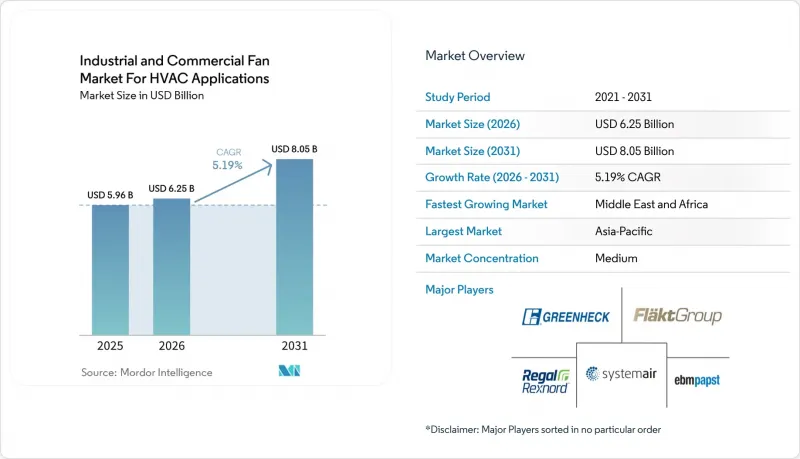
本報告按風機類型(軸流風機、離心風機、混流風機)、暖通空調應用(通風、空調、暖氣)、最終用戶(商業、工業)和地區(北美、歐洲、亞太、南美、中東和非洲)進行細分。市場預測以美元計價。
工業和商業暖通空調應用風扇市場的洞察與趨勢
節能型暖通空調系統的現代化
由於建築脫碳政策的推進,用於暖通空調(HVAC)應用的工業和商業風機正轉向以符合法規要求為目標的更換活動,這些活動遍及商業和工業設施。歐盟法規 (EU) 2024/1834 對整個風機組件(包括馬達、葉輪和定子)進行評估,而不是將風扇零件視為單獨的能源效率項目。這意味著,以前符合部件要求但未達到整體系統測試標準的舊式AC馬達離心風機可能被認定為不合規。歐盟委員會預計,到 2030 年,該法規將使工業風機的年耗電量減少 31 太瓦時(TWh),與沒有該政策的基準相比,每年可節省 40 億歐元。整合式 EC 馬達模組具有優勢,因為它們的運作效率符合監管方向。 2025 年的修訂以及 Eurovent、AMCA 和 EVIA 於 2026 年 5 月發布的常見問題解答指南,闡明了採購團隊面臨的技術和過渡挑戰。
資料中心和人工智慧基礎設施的冷卻需求
資料中心的發展催生了對高性能工業和商用暖通空調風扇的需求。超大規模資料中心營運商需要能夠在超過 2.5 mmH2O 的靜壓下連續運作的電腦輔助冷凍空調 (CRAH) 和風扇牆系統,這限制了通用產品的應用範圍。這些要求有利於能夠提供涵蓋廣泛產品範圍的認證系統並處理大規模專案訂單的供應商。大型科技公司對人工智慧基礎設施的投資也推動了對精密冷卻和高負載氣流系統的需求。電網容量限制可能會延遲一些已規劃的資料中心項目,並可能導致短期內需求集中在電力供應穩定的地區。
先進風扇系統的初始成本較高
對於暖通空調(HVAC)應用中的工業和商業風機而言,高昂的初始投資成本仍然是阻礙因素,尤其是在業主優先考慮短期採購預算的情況下。配備變速驅動器和網路連接控制的EC馬達系統,其成本可能是同類傳統AC馬達的兩到三倍。在典型的商業建築中,四到六年的投資回收期對於許多中型業主而言,在正常的再融資條件下,可能是難以接受的。在中東和南亞部分地區,這種差距甚至更大,因為電力價格補貼會降低節能帶來的經濟效益。能源績效合約和「風機即服務」模式可以解決部分障礙,但其應用仍集中在西歐和北美。雖然歐美地區的監管合規要求可以克服這一限制,但在缺乏類似監管的市場,這些市場只能依靠自願性的商業案例,並面臨缺乏熟練的服務和試運行能力的問題。
細分市場分析
到2025年,離心風機將佔暖通空調(HVAC)產業和商用風機市場佔有率的58.1%。這是因為離心風機能夠提供高靜壓,並且適用於老舊商業和工業建築中常見的狹窄風道佈局。現有的風道系統是根據離心風機的性能曲線設計的,因此即使需要更換風機,更換整個系統的成本也很高。這種現有設備的影響將在短期和中期內支撐離心風機的銷售。軸流風扇以其緊湊的直驅設計,適用於屋頂通風、停車場和隧道排氣等大風量、低壓應用。
預計到2031年,混流式風扇將以每年6.2%的速度成長,成為暖通空調(HVAC)應用中成長最快的工業和商業風機類型。這類風機結合了軸流式風扇的氣流和離心式風扇的靜壓性能。當這些葉輪與EC馬達搭配使用時,即使在額定轉速的30%至50%下也能保持效率,從而降低部分負載下的能耗。 2024年9月,GreenHeck推出了採用混流式葉輪技術的RSQ罩式屋頂風扇。本產品已獲得AMCA認證,其風機能效指數(FEE)、空氣性能和噪音性能均符合標準。 AMCA認證要求正日益被納入資料中心和商業設施的維修規範中,提高了對新供應商的資格要求。
區域分析
2025年,亞太地區銷售額佔比達33.4%。這一規模主要歸功於幾個關鍵經濟區域的城市發展和製造業活動。中國正透過其「碳排放峰值和碳中和」目標以及英國能源效率標準,推動商用暖通空調(HVAC)的規範化發展。同時,由於資料中心投資、「智慧城市」建設以及夏季氣溫上升,印度也成為該地區的主要成長點。 2025年8月,SystemAir完成了對位於清奈的NADI Airtechnics公司的收購,將一家印度工業鼓風機和鐵路風扇製造商納入其產品組合。
日本和韓國是成熟的市場,對新建商業設施的數位化和符合BACnet標準的風機管理有嚴格的要求。北美和歐洲是成熟的翻新市場,相比新建項目,為滿足監管要求而維修更容易預測。歐盟法規(EU) 2024/1834正在推動功率範圍從125瓦到500千瓦的風扇更換,這些風扇不符合修訂後的能源效率標準。在北美,風機能效指數(FEI)要求和參考ASHRAE 90.1標準的能源法規也支援類似的能源效率提升週期。對於用於暖通空調(HVAC)應用的工業和商業風機而言,從2025年到2026年,超大規模採購在這兩個地區都成為一項盈利的收入來源,有助於抵消眾多供應商住宅暖通空調銷售的下滑。
預計到2031年,中東和非洲地區用於暖通空調(HVAC)應用的工業和商業風機市場將以5.8%的複合年成長率成長,成為所有地區中成長最快的地區。海灣合作理事會(GCC)國家政府主導的基礎設施項目對氣候敏感型建築的精密氣流控制設備提出了更高的要求。波灣合作理事會區域供冷系統的擴張以及杜拜和阿布達比的醫院建設項目,都推動了對高階商用暖通空調設備的需求。沙烏地阿拉伯的標準和阿拉伯聯合大公國的能源效率要求也促進了現有商業建築的更換需求。南非的SANS 10400-XA標準正逐步提高人們對建築能源效率的期望,約翰尼斯堡和開普敦的商業競標中也開始提及風機的最低能源效率標準。
其他好處:
- Excel格式的市場預測(ME)表
- 3個月的分析師支持
目錄
第1章:引言
- 研究假設和市場定義
- 調查範圍
第2章:調查方法
第3章執行摘要
第4章 市場狀況
- 市場概覽
- 市場促進因素
- 節能型暖通空調系統的現代化
- 資料中心和人工智慧基礎設施的冷卻需求
- 遵守有關室內空氣品質和通風的法規
- 工業自動化和製程冷卻的擴展
- 在高密度設施中引入風扇牆
- 透過 EC 馬達和變速運行,在整個生命週期中實現節能。
- 市場限制因素
- 先進風扇系統的初始成本較高
- 對維護和專業服務的限制
- 維修和整合老舊暖通空調系統的複雜性。
- 規格細化和基於項目的客製化
- 供應鏈分析
- 波特五力分析
- 監理情勢
- 科技趨勢
- 投資分析
第5章 市場規模與成長預測
- 風扇型
- 軸流風扇
- 離心風扇
- 混流風扇
- 透過暖通空調應用
- 通風
- 空調
- 加熱
- 最終用戶
- 商業
- 產業
- 按地區
- 北美洲
- 美國
- 加拿大
- 墨西哥
- 歐洲
- 英國
- 德國
- 法國
- 西班牙
- 北歐國家
- 俄羅斯
- 其他歐洲國家
- 亞太地區
- 中國
- 印度
- 日本
- 韓國
- 東南亞國協
- 其他亞太國家
- 南美洲
- 巴西
- 阿根廷
- 哥倫比亞
- 其他南美國家
- 中東和非洲
- 沙烏地阿拉伯
- 阿拉伯聯合大公國
- 南非
- 其他中東和非洲國家
- 北美洲
第6章 競爭情勢
- 市場集中度
- 策略趨勢
- 市佔率分析
- 公司簡介
- Aerovent, Inc.
- Chicago Blower Corporation
- Continental Fan Manufacturing Inc.
- ebm-papst Group
- FlaktGroup Holding GmbH
- Greenheck Fan Corporation
- Hartzell Air Movement
- Howden Group Ltd.
- Kruger Ventilation Industries Pte Ltd
- Loren Cook Company
- New York Blower Company
- Regal Rexnord Corporation
- Rosenberg Ventilatoren GmbH
- Soler & Palau Ventilation Group
- Systemair AB
- Twin City Fan Companies, Ltd.
- Vent-Axia Group Limited
- Ziehl-Abegg SE
第7章 市場機會與未來展望
According to Mordor Intelligence, the industrial and Commercial Fan Market For HVAC Applications Industry size is expected to grow from USD 5.96 billion in 2025 to USD 6.25 billion in 2026 and is forecast to reach USD 8.05 billion by 2031 at 5.19% CAGR over 2026-2031.
This report is Segmented by Fan Type (Axial Fans, Centrifugal Fans, Mixed Flow Fans), HVAC Application (Ventilation, Air Conditioning, Heating), End User (Commercial, Industrial), and Geography (North America, Europe, Asia-Pacific, South America, and Middle East and Africa). The Market Forecasts are Provided in Terms of Value (USD).
Insights and Trends of Industrial and Commercial Fan Market For HVAC Applications
Energy-Efficient HVAC Modernization
Building decarbonization policies are moving the industrial fans for the HVAC market toward compliance-led replacement activity across commercial and industrial sites. Regulation (EU) 2024/1834 assesses the full fan assembly, including the motor, impeller, and stator, instead of treating its components as separate efficiency items. This approach can disqualify older AC-motor centrifugal fans that met earlier component-based requirements but do not meet the full-system test. The European Commission expects the rules to lower electricity use from industrial fans by 31 TWh annually by 2030 against a no-policy baseline and to deliver EUR 4 billion in annual savings. Integrated EC-motor modules are well-positioned because their operating efficiency aligns with the direction of the regulation. The 2025 amendment and the May 2026 FAQ guide from Eurovent, AMCA, and EVIA clarified technical and transition issues for procurement teams.
Data Center and AI Infrastructure Cooling Demand
Data center development has created a high-performance source of demand for industrial fans for the HVAC market. Hyperscale operators require CRAH and fan-wall systems that can operate continuously at static pressures above 2.5 mm H2O, which limits the role of commodity products. These requirements favor suppliers that can provide qualified systems across a broad product range and support large project orders. Large technology companies' investment in AI infrastructure is sustaining demand for precision cooling and higher-duty airflow systems. Grid capacity constraints could delay some planned data center projects, concentrating near-term demand in locations with stronger power availability.
High Upfront Cost of Advanced Fan Systems
High capital costs remain a constraint on the industrial fans for the HVAC market, particularly where building owners focus on immediate procurement budgets. EC-motor systems with variable-speed drives and connected controls can cost 2 to 3 times more to install than comparable legacy AC-motor units. Their payback period in standard commercial buildings can range from 4 to 6 years, which many mid-sized owners may not accept under normal financing conditions. The difference is bigger in parts of the Middle East and South Asia where subsidized power prices reduce the financial value of energy savings. Energy-performance contracts and fan-as-a-service models address part of the barrier, but their adoption remains concentrated in Western Europe and North America. Compliance requirements in Europe and the United States can overcome this constraint, while markets without similar rules must rely on a voluntary business case and face a shortage of skilled service and commissioning capacity.
Other drivers and restraints analyzed in the detailed report include:
- Indoor Air Quality and Ventilation Compliance
- Fan-Wall Adoption in High-Density Facilities
- Retrofit Integration Complexity in Legacy HVAC Systems
For complete list of drivers and restraints, kindly check the Table Of Contents.
Segment Analysis
Centrifugal fans accounted for 58.1% of the industrial fans for the HVAC market size in 2025 because they can provide high static pressure and fit the narrow duct layouts common in older commercial and industrial buildings. Existing duct systems were designed around centrifugal performance curves, which makes a full system change costly, even when the fan is due for replacement. This installed-base effect supports centrifugal fan volumes in the near and medium term. Axial fans remain suited to high-volume, low-pressure work in roof ventilation, parking structures, and tunnel extraction because of their compact direct-drive design.
Mixed flow fans are forecast to grow at 6.2% through 2031, making them the fastest-growing fan type in the industrial fans for HVAC market. They combine axial-style airflow volume with centrifugal-style static-pressure capability. Pairing these impellers with EC motors can preserve efficiency at 30% to 50% of rated speed and reduce part-load energy use. Greenheck introduced its RSQ hooded rooftop fan with mixed-flow wheel technology in September 2024, with AMCA licensing for Fan Energy Index, air, and sound performance. AMCA credentials are increasingly included in data center and commercial renovation specifications, which raises qualification requirements for new suppliers.
Complete Report Scope:
- By Fan Type
- Axial Fans
- Centrifugal Fans
- Mixed Flow Fans
- By HVAC Application
- Ventilation
- Air Conditioning
- Heating
- By End User
- Commercial
- Industrial
- By Geography
- North America
- United States
- Canada
- Mexico
- Europe
- United Kingdom
- Germany
- France
- Spain
- Nordic Countries
- Russia
- Rest of Europe
- Asia-Pacific
- China
- India
- Japan
- South Korea
- ASEAN Countries
- Rest of Asia-Pacific
- South America
- Brazil
- Argentina
- Colombia
- Rest of South America
- Middle East and Africa
- Saudi Arabia
- United Arab Emirates
- South Africa
- Rest of Middle East and Africa
- North America
Geography Analysis
Asia-Pacific held 33.4% of revenue in 2025. Its scale comes from urban development and manufacturing activity across several large economies. China is advancing commercial HVAC specifications through dual-carbon objectives and GB energy-efficiency standards, while India is a key regional growth area because of data center investment, Smart Cities Mission construction, and hotter summer conditions. Systemair completed its acquisition of Chennai-based NADI Airtechnics in August 2025, adding an Indian manufacturer of industrial blowers and railway fans to its portfolio.
Japan and South Korea are mature markets with demanding requirements for digital, BACnet-compatible fan management in new commercial installations. North America and Europe are mature replacement markets where compliance-led retrofits offer more predictable demand than new construction. Regulation (EU) 2024/1834 is driving upgrades of fans from 125 W to 500 kW that do not meet revised efficiency thresholds. In North America, Fan Efficiency Index requirements and energy codes referring to ASHRAE 90.1 support a similar efficiency upgrade cycle. For the industrial fans for the HVAC market, hyperscale procurement became a high-value revenue source in both regions during 2025 and 2026, helping offset weaker residential HVAC volumes for broader suppliers.
The Middle East and Africa segment of the industrial fans for HVAC market is forecast to record a 5.8% CAGR through 2031, the fastest regional rate. State-backed infrastructure projects in Gulf Cooperation Council countries require precision airflow equipment for climate-sensitive buildings. District cooling growth in the United Arab Emirates and hospital projects in Dubai and Abu Dhabi support premium commercial HVAC demand. Saudi standards and United Arab Emirates energy-efficiency requirements also support replacement demand in existing commercial buildings. South Africa's SANS 10400-XA requirements are progressively tightening building energy performance expectations, with commercial tenders in Johannesburg and Cape Town beginning to reference minimum fan efficiency standards.
- Aerovent, Inc.
- Chicago Blower Corporation
- Continental Fan Manufacturing Inc.
- ebm-papst Group
- FlaktGroup Holding GmbH
- Greenheck Fan Corporation
- Hartzell Air Movement
- Howden Group Ltd.
- Kruger Ventilation Industries Pte Ltd
- Loren Cook Company
- New York Blower Company
- Regal Rexnord Corporation
- Rosenberg Ventilatoren GmbH
- Soler & Palau Ventilation Group
- Systemair AB
- Twin City Fan Companies, Ltd.
- Vent-Axia Group Limited
- Ziehl-Abegg SE
Additional Benefits:
- The market estimate (ME) sheet in Excel format
- 3 months of analyst support
TABLE OF CONTENTS
1 INTRODUCTION
- 1.1 Study Assumptions and Market Definition
- 1.2 Scope of the Study
2 RESEARCH METHODOLOGY
3 EXECUTIVE SUMMARY
4 MARKET LANDSCAPE
- 4.1 Market Overview
- 4.2 Market Drivers
- 4.2.1 Energy-Efficient HVAC Modernization
- 4.2.2 Data Center and AI Infrastructure Cooling Demand
- 4.2.3 Indoor Air Quality and Ventilation Compliance
- 4.2.4 Industrial Automation and Process-Cooling Expansion
- 4.2.5 Fan-Wall Adoption in High-Density Facilities
- 4.2.6 Lifecycle Energy Savings from EC Motors and Variable-Speed Operation
- 4.3 Market Restraints
- 4.3.1 High Upfront Cost of Advanced Fan Systems
- 4.3.2 Maintenance and Skilled-Service Constraints
- 4.3.3 Retrofit Integration Complexity in Legacy HVAC Systems
- 4.3.4 Specification Fragmentation and Project-Level Customization
- 4.4 Supply-Chain Analysis
- 4.5 Porter's Five Forces Analysis
- 4.5.1 Bargaining Power of Suppliers
- 4.5.2 Bargaining Power of Buyers
- 4.5.3 Threat of New Entrants
- 4.5.4 Threat of Substitutes
- 4.5.5 Competitive Rivalry
- 4.6 Regulatory Landscape
- 4.7 Technology Outlook
- 4.8 Investment Analysis
5 MARKET SIZE AND GROWTH FORECASTS
- 5.1 By Fan Type
- 5.1.1 Axial Fans
- 5.1.2 Centrifugal Fans
- 5.1.3 Mixed Flow Fans
- 5.2 By HVAC Application
- 5.2.1 Ventilation
- 5.2.2 Air Conditioning
- 5.2.3 Heating
- 5.3 By End User
- 5.3.1 Commercial
- 5.3.2 Industrial
- 5.4 By Geography
- 5.4.1 North America
- 5.4.1.1 United States
- 5.4.1.2 Canada
- 5.4.1.3 Mexico
- 5.4.2 Europe
- 5.4.2.1 United Kingdom
- 5.4.2.2 Germany
- 5.4.2.3 France
- 5.4.2.4 Spain
- 5.4.2.5 Nordic Countries
- 5.4.2.6 Russia
- 5.4.2.7 Rest of Europe
- 5.4.3 Asia-Pacific
- 5.4.3.1 China
- 5.4.3.2 India
- 5.4.3.3 Japan
- 5.4.3.4 South Korea
- 5.4.3.5 ASEAN Countries
- 5.4.3.6 Rest of Asia-Pacific
- 5.4.4 South America
- 5.4.4.1 Brazil
- 5.4.4.2 Argentina
- 5.4.4.3 Colombia
- 5.4.4.4 Rest of South America
- 5.4.5 Middle East and Africa
- 5.4.5.1 Saudi Arabia
- 5.4.5.2 United Arab Emirates
- 5.4.5.3 South Africa
- 5.4.5.4 Rest of Middle East and Africa
- 5.4.1 North America
6 COMPETITIVE LANDSCAPE
- 6.1 Market Concentration
- 6.2 Strategic Moves
- 6.3 Market Share Analysis
- 6.4 Company Profiles (includes Global Level Overview, Market Level Overview, Core Segments, Financials as available, Strategic Information, Market Rank/Share, Products and Services, Recent Developments)
- 6.4.1 Aerovent, Inc.
- 6.4.2 Chicago Blower Corporation
- 6.4.3 Continental Fan Manufacturing Inc.
- 6.4.4 ebm-papst Group
- 6.4.5 FlaktGroup Holding GmbH
- 6.4.6 Greenheck Fan Corporation
- 6.4.7 Hartzell Air Movement
- 6.4.8 Howden Group Ltd.
- 6.4.9 Kruger Ventilation Industries Pte Ltd
- 6.4.10 Loren Cook Company
- 6.4.11 New York Blower Company
- 6.4.12 Regal Rexnord Corporation
- 6.4.13 Rosenberg Ventilatoren GmbH
- 6.4.14 Soler & Palau Ventilation Group
- 6.4.15 Systemair AB
- 6.4.16 Twin City Fan Companies, Ltd.
- 6.4.17 Vent-Axia Group Limited
- 6.4.18 Ziehl-Abegg SE
7 MARKET OPPORTUNITIES AND FUTURE OUTLOOK
- 7.1 White-Space and Unmet-Need Assessment

 工業風扇:市場佔有率分析、產業趨勢與統計、成長預測(2026-2031)歐洲風機市場:市場佔有率分析、產業趨勢與統計及成長預測(2026-2031)
 風扇和鼓風機市場規模、佔有率和成長分析:按產品類型、應用、最終用戶產業、額定功率、安裝類型、技術和地區分類-2026-2033年產業預測
 工業風機及鼓風機市場機會、成長促進因素、產業趨勢分析及2026-2035年預測
 2026-2034年全球風扇和鼓風機市場規模、佔有率、趨勢和成長分析報告
 個人風扇市場規模、佔有率和成長分析:按產品類型、電源、葉片配置、價格範圍、銷售管道和地區分類-2026-2033年產業預測
 工業及商業風機及鼓風機市場:依風機類型、壓力類型、技術、終端用戶產業及通路分類-2026-2032年全球市場預測靜電放電風扇市場:依產品類型、技術、電源、應用和最終用戶分類,全球預測,2026-2032年工業交流風扇市場:按產品類型、風量、安裝方式、馬達類型、最終用途產業和應用分類-全球預測,2026-2032年靜電消除風扇市場:按類型、應用、最終用戶和分銷管道分類,全球預測,2026-2032年