


 |
市場調查報告書
商品編碼
2154285
歐洲輪胎製造設備:市場佔有率分析、行業趨勢和統計數據、成長預測(2026-2031 年)Europe Tire Manufacturing Equipment - Market Share Analysis, Industry Trends & Statistics, Growth Forecasts (2026 - 2031) |
||||||

※ 本網頁內容可能與最新版本有所差異。詳細情況請與我們聯繫。
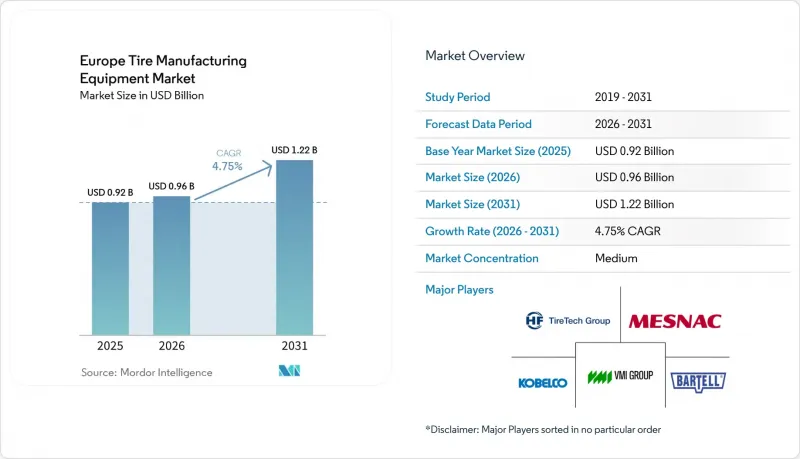
據 Mordor Intelligence 稱,歐洲輪胎製造設備市場預計將從 2025 年的 9.2 億美元成長到 2026 年的 9.6 億美元,到 2031 年達到 12.2 億美元,預計 2026 年至 2031 年的複合年成長率為 4.75%。
歐洲輪胎製造設備市場的趨勢與洞察
電動車 (EV) 的發展推動了對高矽徑向化合物的需求激增,這需要先進的混合和擠出生產線。
電動車輪胎的單軸重量更重,且含有二氧化矽,因此需要剪切力更高的混煉機來防止燒焦。神鋼的「5THR」轉子可將生產效率提高43%,使整車製造商無需額外混煉機即可滿足電動車的交貨期限。在米其林位於馬格諾利亞的工廠,人工智慧控制的螺桿轉速調節可有效控制二氧化矽的聚集,從而實現高效的擠出速度。在Bridgestone位於布爾戈斯的工廠,為了擴大高輪圈直徑電動車輪胎的產能,需要使用更寬的擠出頭。贏創的新型沉澱二氧化矽牌號具有更嚴格的分散公差,使得轉子耐磨塗層成為標準製程。隨著製造商努力降低缺陷率,數位孿生和預測性維護演算法的引入顯著提高了設備的運轉率。
歐洲輪胎製造商不斷擴大產能,推動了對成型機的新資本投資。
Bridgestone已在西班牙進行了大量投資,並計劃擴大產能。此次擴建將需要引入模組化滾筒和伺服驅動的簾布層送料器,這將加快產品規格的切換速度。同時,阿波羅和諾記分別在匈牙利和羅馬尼亞擴大生產規模,並預計2028年,新型成型機的需求將會激增。 HF TireTech的「HF ONE」技術提高了換型效率,並可適應多種產品規格。 MESNAC的NPS單級成型機週期短,是小批量生產的理想選擇。根據《歐洲橡膠雜誌》報道,2025年已宣布了多項重大資本投資計劃,其中大部分預算將用於生產車間設備的購買。
天然橡膠和石化產品的價格波動導致設備採購延遲。
2024年,橡膠價格達到十多年來的最高水平,導致現貨市場劇烈波動。這些價格波動擠壓了輪胎製造商的利潤空間,並導致高價混煉機的訂單停滯不前。同時,與原油價格走勢密切相關的合成原料價格也加劇了投入成本的不確定性。因此,世紀公司暫停了其在西班牙的待開發區項目,並正在重新評估其假設。此外,許多中型企業目前都在尋求價格穩定期,然後再決定是否要投資新的生產線。鑑於原物料成本在輪胎成本中佔很大比例,原物料風險的上升將直接影響資本預算。
細分市場分析
硫化和檢測生產線預計將以9.33%的複合年成長率成長,超過所有其他類別,這主要得益於工廠壓平機電氣化以及顆粒物排放法規的日益嚴格。儘管工程機械在歐洲輪胎製造設備市場仍佔據相當大的市場佔有率,預計到2025年將達到42.35%,但隨著原始設備製造商(OEM)將預算轉向節能型硫化機,其市場佔有率正在下降。可整合到現有框架中的電加熱轉換套件無需土建工程即可實現快速更換。採用人工智慧影像分析的偵測系統與新型壓平機捆綁銷售,為HF和VMI等供應商創造了交叉銷售機會。
上游工程混煉機和壓延機仍然至關重要,尤其是在高矽電動車配方中。神鋼的「5THR」和科邁瑞的「ZEUS」壓延機表明,即使在成長明顯放緩的情況下,生產效率的逐步提高和面積的減少仍然訂單的成長。帶材捲繞機和輪胎邊緣捲繞機的需求因Bridgestone和諾記的產能擴張而增加,但它們的整體成長速度落後於硫化生產線。這是因為硫化生產線同時滿足了歐7排放標準和碳中和目標。
預計到2025年,子午線輪胎機械將佔銷售額的89.04%,並維持5.45%的複合年成長率直至2031年。在歐洲輪胎製造設備市場,斜交輪胎工具的佔有率仍然很小,主要供應摩托車和一些小眾越野車市場,而這些市場目前的大部分輪胎都來自亞洲。子午線輪胎製造商需要處理更寬的胎體帶束層以適應18-24英寸搭乘用電動車的輪胎尺寸,這推動了伺服驅動張力控制和即時胎體追蹤技術的升級。
斜紋壓機雖然價格低廉且結構簡單,但由於市場需求低迷,並未吸引到許多歐洲原始設備製造商 (OEM)。那些仍需斜紋輪胎生產能力的工廠,選擇改造現有滾筒以生產子午線輪胎,而不是另行購置生產線。因此,供應商正將研發重點放在子午線輪胎的創新技術上,例如人工智慧驅動的異物檢測技術,該技術可將廢品率降低兩個數量級。
其他好處:
- Excel格式的市場預測(ME)表
- 3個月的分析師支持
目錄
第1章:引言
- 研究假設和市場定義
- 調查範圍
第2章:調查方法
第3章執行摘要
第4章 市場狀況
- 市場概覽
- 市場促進因素
- 受電動車的推動,對高矽徑向化合物的需求激增,這需要先進的混合和擠出生產線。
- 歐洲輪胎製造商產能的提升正在推動對工程機械的新資本投資。
- 基於智慧工廠和工業4.0的設備升級,以提高生產效率和可追溯性。
- 歐盟7輪胎顆粒物排放標準正在加速精密硫化和檢測設備的採用。
- 由於能源成本飆升,節能型全電動印刷機正逐漸成為一種趨勢。
- 歐盟循環經濟法規鼓勵對處理再生/生物填充材的混合生產線進行投資。
- 市場限制因素
- 由於天然橡膠和石油化學產品價格波動,設備採購已被推遲。
- 大額資本投資和較長的投資回收期阻礙了中小型製造商進入該領域。
- 熟練維修人員的短缺限制了整合和複雜機械的採用。
- 擬議的 PFAS 禁令將使設備的標籤規範和更換計劃變得不確定。
- 價值供應鏈分析
- 監理情勢
- 技術展望
- 波特五力分析
第5章 市場規模與成長預測
- 依設備類型
- 上游工程(混合和組分製備)
- 攪拌機/橡膠攪拌機
- 日曆機
- 擠出機
- 切割機
- 其他(冷卻設備等)
- 建築面積
- 繞珠機
- 輪胎製造機械
- 其他(例如,帶材繞線機)
- 固化和檢驗(測試區)
- 硬化壓平機
- 輪胎噴漆機
- 其他(檢測設備等)
- 上游工程(混合和組分製備)
- 輪胎設計
- 偏見
- 徑向
- 車輛類型
- 摩托車
- 三輪車
- 搭乘用車
- 輕型商用車
- 中型和重型商用車輛
- 越野車
- 按輪圈尺寸
- 12英吋或更小
- 12-18英寸
- 18吋或更大
- 最終用戶
- 目的地設備製造商(OEM)
- 替換件/售後市場
- 國家
- 德國
- 英國
- 西班牙
- 義大利
- 法國
- 荷蘭
- 其他歐洲國家
第6章 競爭情勢
- 市場集中度
- 策略趨勢
- 市佔率分析
- 公司簡介
- HF TireTech Group
- VMI Group
- Kobelco Stewart Bolling
- MESNAC Co., Ltd.
- Bartell Machinery Systems
- Comerio Ercole SpA
- KONSTRUKTA-TireTech
- Colmec SpA
- Herbert Maschinenbau
- Pelmar Engineering
- Marangoni Meccanica
- Mitsubishi Heavy Industries Machinery Systems
- Siempelkamp Maschinenbau
- Uzer Makina
- Hebert Maschinen
- Yiyang Rubber and Plastics Machinery
- Tianjin Saixiang Technology
- Larsen and Toubro Rubber Machinery
第7章 市場機會與未來展望
According to Mordor Intelligence, the European tire manufacturing equipment market size is expected to increase from USD 0.92 billion in 2025 to USD 0.96 billion in 2026 and reach USD 1.22 billion by 2031, growing at a 4.75% CAGR over 2026-2031.
Europe Tire Manufacturing Equipment Market Trends and Insights
EV-Led Surge in High-Silica Radial Compounds Needs Advanced Mixing and Extrusion Lines
Mixers now demand higher shear to prevent scorching, as electric-vehicle tires are heavier per axle and incorporate silica. Kobelco's 5THR rotor raises productivity by 43%, enabling OEMs to meet EV delivery windows without extra mixers . At Michelin's Magnolia plant, an AI-controlled screw speed manages silica agglomeration, achieving an efficient extrusion rate. Bridgestone's Burgos facility increased its capacity for high-rim EV sizes, necessitating the use of wider extrusion heads. Evonik's new precipitated-silica grades, which have tighter dispersion tolerances, have made rotor hardfacing a standard practice. As manufacturers aim for improved defect rates, the implementation of digital twins and predictive-maintenance algorithms has significantly enhanced uptime.
Tire-Maker Capacity Expansions Across Europe Drive Fresh Capex for Building Area Machines
Bridgestone, with a significant investment in Spain, is set to enhance its production capacity. This expansion necessitates the use of modular drums and servo ply feeders, enabling swift SKU transitions. Meanwhile, Apollo and Nokian are ramping up production in Hungary and Romania, leading to a surge in demand for new building machines by 2028. HF TireTech's HF ONE technology improves changeover efficiency and accommodates a wide range of SKUs. MESNAC's NPS one-stage builder offers a rapid cycle, perfectly suited for small-batch needs. According to The European Rubber Journal, substantial capital expenditures have been announced for 2025, with a significant portion of the budget allocated to building-area equipment.
Volatile Natural-Rubber and Petrochemical Prices Delay Equipment Purchases
In 2024, rubber prices reached their highest levels in over a decade, with significant spot-market fluctuations. This volatility has tightened margins for tire manufacturers and halted orders for high-value mixers. Meanwhile, synthetic feedstocks, closely tracking crude oil movements, introduced additional uncertainty in input costs. As a result, Sentury has put its Spanish greenfield project on hold, re-evaluating its assumptions. Furthermore, many mid-tier companies are now insisting on a period of stable pricing before they commit to new production lines. Given that raw materials account for a substantial portion of tire costs, any rise in feedstock risk directly impacts capital budgets.
Other drivers and restraints analyzed in the detailed report include:
- Smart-Factory and Industry 4.0 Retrofits for Productivity and Traceability
- Euro 7 Tire-Particle Limits Accelerate Uptake of Precision Curing and Inspection Machines
- High Capex and Long Payback Horizons Deter Smaller Manufacturers
For complete list of drivers and restraints, kindly check the Table Of Contents.
Segment Analysis
Curing and Inspection lines are projected to outpace all other categories at a 9.33% CAGR as plants electrify presses and tighten particle-emission control. The European tire manufacturing equipment market size for Building-area machines remains large, with 42.35% share in 2025, yet its share declines as OEMs divert budgets to energy-saving vulcanizers. Electric-heating retrofits that slot into existing frames allow fast swaps without civil works. Inspection systems using AI image analytics are bundled with new presses, giving suppliers like HF and VMI a cross-selling opportunity.
Upstream mixers and calenders still matter, especially with high-silica EV recipes. Kobelco's 5THR and Comerio's ZEUS calendars demonstrate that incremental productivity and footprint savings win orders even when headline growth lags. Strip winders and bead winders get uplift from Bridgestone and Nokian expansions, but overall growth trails that of curing lines because the latter tackle both Euro 7 compliance and carbon-neutral targets.
Radial machinery captured 89.04% revenue in 2025 and will maintain a 5.45% CAGR growth trajectory through 2031. The European tire manufacturing equipment market share for bias tooling remains marginal, serving two-wheeler and niche off-road segments that now source many tires from Asia. Radial builders must handle wider belts for 18-to-24-inch passenger EV sizes, driving upgrades to servo tensioning and real-time belt tracking.
Bias presses are inexpensive and simple, yet demand is too low to entice most European OEMs. Plants that still need bias capability retrofit radial drums rather than buy standalone lines. Consequently, suppliers concentrate R&D on radial innovations such as AI-assisted foreign-object detection that can cut scrap by double digits.
Complete Report Scope:
- By Equipment Type
- Upstream (Mixer and Component Preparation)
- Mixing Machines / Rubber Mixers
- Calendaring Machines
- Extrusion Machines
- Cutting Machines
- Others (Cooling Units, etc.)
- Building Area
- Bead Winding Machines
- Tire Building Machines
- Others (Strip Winding Machines, etc.)
- Curing and Inspection (Testing Area)
- Curing Press Machines
- Tire Painting Machines
- Others (Inspection Machines, etc.)
- Upstream (Mixer and Component Preparation)
- By Tire Design
- Bias
- Radial
- By Vehicle Type
- Two-Wheelers
- Three-Wheelers
- Passenger Cars
- Light Commercial Vehicles
- Medium and Heavy Commercial Vehicles
- Off-Road Vehicles
- By Rim Size
- Up to 12 inches
- 12 to 18 inches
- Above 18 inches
- By End-User
- Original Equipment Manufacturers (OEMs)
- Replacement / Aftermarket
- By Country
- Germany
- United Kingdom
- Spain
- Italy
- France
- Netherlands
- Rest of Europe
List of Companies Covered in this Report:
- HF TireTech Group
- VMI Group
- Kobelco Stewart Bolling
- MESNAC Co., Ltd.
- Bartell Machinery Systems
- Comerio Ercole S.p.A.
- KONSTRUKTA-TireTech
- Colmec S.p.A.
- Herbert Maschinenbau
- Pelmar Engineering
- Marangoni Meccanica
- Mitsubishi Heavy Industries Machinery Systems
- Siempelkamp Maschinenbau
- Uzer Makina
- Hebert Maschinen
- Yiyang Rubber and Plastics Machinery
- Tianjin Saixiang Technology
- Larsen and Toubro Rubber Machinery
Additional Benefits:
- The market estimate (ME) sheet in Excel format
- 3 months of analyst support
TABLE OF CONTENTS
1 Introduction
- 1.1 Study Assumptions and Market Definition
- 1.2 Scope of the Study
2 Research Methodology
3 Executive Summary
4 Market Landscape
- 4.1 Market Overview
- 4.2 Market Drivers
- 4.2.1 EV-Led Surge in High-Silica Radial Compounds Needs Advanced Mixing and Extrusion Lines
- 4.2.2 Tire-Maker Capacity Expansions Across Europe Drive Fresh Capex for Building Area Machines
- 4.2.3 Smart-Factory and Industry 4.0 Retrofits for Productivity and Traceability
- 4.2.4 Euro 7 Tire-Particle Limits Accelerate Uptake of Precision Curing and Inspection Machines
- 4.2.5 Energy-Cost Spikes Push Migration to Energy-Efficient All-Electric Presses
- 4.2.6 EU Circular-Economy Rules Spur Investment in Mixing Lines That Handle Recycled/Bio Fillers
- 4.3 Market Restraints
- 4.3.1 Volatile Natural-Rubber and Petrochemical Prices Delay Equipment Purchases
- 4.3.2 High Capex and Long Payback Horizons Deter Smaller Manufacturers
- 4.3.3 Skilled-Maintenance Shortage Limits Adoption of Integrated, Complex Machinery
- 4.3.4 Proposed PFAS Ban Clouds Equipment-Seal Specifications and Upgrade Timing
- 4.4 Value / Supply-Chain Analysis
- 4.5 Regulatory Landscape
- 4.6 Technological Outlook
- 4.7 Porter's Five Forces Analysis
- 4.7.1 Threat of New Entrants
- 4.7.2 Bargaining Power of Suppliers
- 4.7.3 Bargaining Power of Buyers
- 4.7.4 Threat of Substitution
- 4.7.5 Intensity of Competitive Rivalry
5 Market Size and Growth Forecasts (Value, USD)
- 5.1 By Equipment Type
- 5.1.1 Upstream (Mixer and Component Preparation)
- 5.1.1.1 Mixing Machines / Rubber Mixers
- 5.1.1.2 Calendaring Machines
- 5.1.1.3 Extrusion Machines
- 5.1.1.4 Cutting Machines
- 5.1.1.5 Others (Cooling Units, etc.)
- 5.1.2 Building Area
- 5.1.2.1 Bead Winding Machines
- 5.1.2.2 Tire Building Machines
- 5.1.2.3 Others (Strip Winding Machines, etc.)
- 5.1.3 Curing and Inspection (Testing Area)
- 5.1.3.1 Curing Press Machines
- 5.1.3.2 Tire Painting Machines
- 5.1.3.3 Others (Inspection Machines, etc.)
- 5.1.1 Upstream (Mixer and Component Preparation)
- 5.2 By Tire Design
- 5.2.1 Bias
- 5.2.2 Radial
- 5.3 By Vehicle Type
- 5.3.1 Two-Wheelers
- 5.3.2 Three-Wheelers
- 5.3.3 Passenger Cars
- 5.3.4 Light Commercial Vehicles
- 5.3.5 Medium and Heavy Commercial Vehicles
- 5.3.6 Off-Road Vehicles
- 5.4 By Rim Size
- 5.4.1 Up to 12 inches
- 5.4.2 12 to 18 inches
- 5.4.3 Above 18 inches
- 5.5 By End-User
- 5.5.1 Original Equipment Manufacturers (OEMs)
- 5.5.2 Replacement / Aftermarket
- 5.6 By Country
- 5.6.1 Germany
- 5.6.2 United Kingdom
- 5.6.3 Spain
- 5.6.4 Italy
- 5.6.5 France
- 5.6.6 Netherlands
- 5.6.7 Rest of Europe
6 Competitive Landscape
- 6.1 Market Concentration
- 6.2 Strategic Moves
- 6.3 Market Share Analysis
- 6.4 Company Profiles (includes Global Level Overview, Market Level Overview, Core Segments, Financials as Available, Strategic Information, Market Rank/Share for Key Companies, Products and Services, SWOT Analysis, and Recent Developments)
- 6.4.1 HF TireTech Group
- 6.4.2 VMI Group
- 6.4.3 Kobelco Stewart Bolling
- 6.4.4 MESNAC Co., Ltd.
- 6.4.5 Bartell Machinery Systems
- 6.4.6 Comerio Ercole S.p.A.
- 6.4.7 KONSTRUKTA-TireTech
- 6.4.8 Colmec S.p.A.
- 6.4.9 Herbert Maschinenbau
- 6.4.10 Pelmar Engineering
- 6.4.11 Marangoni Meccanica
- 6.4.12 Mitsubishi Heavy Industries Machinery Systems
- 6.4.13 Siempelkamp Maschinenbau
- 6.4.14 Uzer Makina
- 6.4.15 Hebert Maschinen
- 6.4.16 Yiyang Rubber and Plastics Machinery
- 6.4.17 Tianjin Saixiang Technology
- 6.4.18 Larsen and Toubro Rubber Machinery
7 Market Opportunities and Future Outlook
- 7.1 White-space and Unmet-Need Assessment

 2026-2030年全球汽車輪胎服務市場2026-2030年全球輪胎和車輪搬運設備市場
 車輪擋塊市場:全球市場預測,2026-2032年
 自動輪胎拆裝機市場規模、佔有率和成長分析:按機器類型、自動化程度、車輛類型、最終用戶、輪圈尺寸範圍和地區分類 - 行業預測,2026-2033 年零壓球囊市場:全球市場預測,2026-2032年乘用車替換輪胎市場:全球市場預測,2026-2032年乘用車輪胎售後市場:全球市場預測,2026-2032年
 歐洲輪胎市場:市場佔有率分析、產業趨勢與統計、成長預測(2026-2031)泰國輪胎市場:市佔率分析、產業趨勢與統計、成長預測(2026-2031)美國輪胎:市場佔有率分析、產業趨勢與統計、成長預測(2026-2031)