

 |
市場調查報告書
商品編碼
2125734
人力資源諮詢:市場佔有率分析、產業趨勢與統計、成長預測(2026-2031)Human Resource Consulting - Market Share Analysis, Industry Trends & Statistics, Growth Forecasts (2026 - 2031) |
||||||

※ 本網頁內容可能與最新版本有所差異。詳細情況請與我們聯繫。
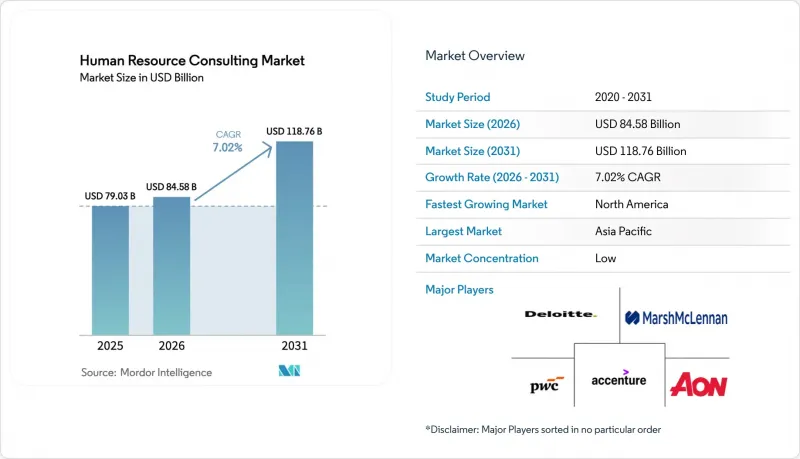
根據 Mordor Intelligence 預測,人力資源諮詢市場規模將從 2025 年的 790.3 億美元成長到 2026 年的 845.8 億美元,然後在 2031 年達到 1,187.6 億美元,2026 年至 2031 年的複合年成長率為 7.02%。
本報告按服務(人力資本策略、薪酬福利、人才管理、組織轉型、學習與發展、人力資源職能、人力資源分析)、最終用戶(IT和電信、銀行、金融服務和保險、醫療保健及其他)以及地區(亞太、北美、歐洲、南美、中東和非洲)進行分類。市場預測以美元計價。
全球人力資源諮詢市場的趨勢與洞察
數位化人力資源技術與分析的實施與整合
隨著全球企業將人工智慧、機器學習和預測分析融入人力資源流程,數據驅動型人才決策的標準也隨之提升。當經營團隊缺乏將數據訊號轉化為可執行人才策略的內部能力時,對諮詢服務的需求激增,但只有21%的人力資源主管認為他們已經彌補了這一差距。從本地部署套件轉向基於雲端的人力資本管理 (HCM) 和單點解決方案生態系統的轉變,為顧問公司創造了大規模部署和變革管理的機會。在亞太地區,中小企業的先驅正在加速平台部署,推動二線城市人力資源諮詢市場的擴張。顧問公司越來越多提供託管分析服務和培訓套餐,使客戶能夠自行管理儀錶板,同時也能購買策略洞察。利用分析來延長員工留任時間的企業,不僅獲得了可衡量的財務收益,也加強了與顧問公司的長期合作關係。這些成功案例凸顯了數據驅動型決策在培養客戶忠誠度和推動永續業務成長方面的策略價值。
監管複雜性增加(多元化、公平性和包容性、薪資透明度、ESG)
涵蓋同工同酬、包容性招聘和永續發展資訊揭露的快速發展的法律規範正在重塑成熟經濟體和新興經濟體的人力資源諮詢市場。歐盟的《工資透明指令》強制要求公佈性別薪資差距指標,而美國多個州則要求揭露薪資範圍,迫使全球跨國公司實施嚴格的審計程序。投資者和監管機構對10-K報告中人力資本指標的審查日益嚴格,推動了資料收集和解釋性報告撰寫的諮詢需求。此外,人力資源部門必須遵守歐盟人工智慧法中關於演算法招募的「人機互動」安全措施,這進一步刺激了對專家風險評估的需求。頻繁的法規修訂意味著,具有前瞻性的客戶正在與外部合作夥伴簽訂持續的顧問協議,而不是進行一次性的差距評估。
常規人力資源諮詢服務的商品化。
人工智慧驅動的工作流引擎實現了以往由初級顧問手動完成的任務自動化,例如政策起草、提案和儀表板創建。這種自動化降低了標準交付成果的差異化程度,為整個人力資源諮詢市場的價格帶來了下行壓力。老字型大小企業正透過轉向人工智慧倫理、氣候友善人才規劃和跨境監管合規等高階領域來應對這項挑戰。而精品服務商則透過將自身獨特的智慧財產權融入訂閱式軟體來應對,從而在合約規模較小的情況下也能獲得持續收入。雖然策略性工作受到的影響相對較小,但商品化工作的不斷增加預計將在中期內使該行業的複合年成長率達到1.3%。
細分市場分析
到2025年,人才管理將佔據人力資源諮詢市場26.02%的最大佔有率。這反映出企業迫切需要獲取稀缺技能並建立繼任人才儲備。人力資源分析雖然市場規模仍然較小,但預計將以12.18%的複合年成長率成長,顯示市場對數據驅動型人才策略的需求非常旺盛。在客戶認知到強大的洞察力能夠降低員工流失成本並提升員工敬業度指標的推動下,與分析相關的人力資源諮詢市場預計將穩步擴張。隨著薪資透明度法規迫使企業進行即時對標並推動跨境協調項目,薪資福利服務正經歷重塑。學習和技能發展領域的諮詢需求正轉向身臨其境型形式,利用延展實境(XR)和自適應學習來縮短技能習得週期。
在招募流程中實施預測模型的企業報告稱,招募時間縮短了30%,凸顯了分析的策略重要性。隨著技能分類體系的演變和零工經濟模式的興起,人才規劃變得日益複雜,即使對於高層人力資源部門而言也是如此,因此人才管理服務仍然保持強勁勢頭。同時,隨著客戶尋求打破財務、IT和第一線領導層之間障礙的無縫人力資源管理模式,人力資本策略專案的重要性也日益凸顯。一項中期評估顯示,只有8%的公司認為自身的分析能力“強大”,導致諮詢項目積壓嚴重。因此,那些將領域專業知識與可擴展的技術訣竅相結合的服務供應商,在人力資源諮詢市場中擁有無可比擬的優勢,能夠提供無與倫比的價值。
區域分析
預計到2025年,北美人力資源諮詢市場佔有率將達到39.88%,這主要得益於先進分析技術的應用和全面的薪酬透明度法規,鞏固了其作為該領域最成熟地區的地位。諮詢業務主要集中在人工智慧管治、永續人才規劃和全面薪酬個人化方面,但由於聯邦預算削減,短期成長有所放緩。受美墨加協定(USMCA)跨境勞動力流動計劃的推動,加拿大和墨西哥的需求正在成長,這為人才戰略項目增添了區域差異。服務供應商正透過針對受監管行業的專有人工智慧加速器來實現差異化,這進一步強化了北美高階定價的趨勢。儘管短期前景疲軟,但該地區客戶的高度成熟度預計將維持人力資源諮詢市場的長期重要性。
歐洲蘊藏著多方面的機遇,包括建立統一的合規運作體系,而歐盟人工智慧法案和工資透明指令等重大監管變革為此提供了支持。 2025年,多個國家將推出新的保護措施,例如德國的舉報人保護制度改革和荷蘭的身心障礙者就業激勵計劃,這些措施將提昇在地化的需求。北歐和比荷盧經濟聯盟的客戶正優先考慮與環境、社會和治理(ESG)掛鉤的薪酬,並積極推動高級薪酬戰略項目。同時,在南歐,中型企業的數位化人才轉型成為當務之急。併購活動正在迅速復甦,交易後的整合工作日益增多,重點在於文化和諧與領導傳承。西歐人口老化進一步推動了繼任計畫的需求,從而增強了人力資源諮詢市場的前景。
亞太地區預計將以8.78%的複合年成長率成長,並將繼續成為人力資源諮詢市場未來成長的主要驅動力,這主要得益於中小微企業數位轉型計畫和跨境貿易的擴張。東南亞人力資本管理(HCM)軟體的蓬勃發展,為本地和全球顧問的實施和管理服務合約提供了強勁的成長動力。在中國和印度,從人工智慧驅動的招募到合規監管等大規模計畫正處於發展前沿。同時,澳洲和日本正大力投資興建卓越分析中心。政府為提升中小企業能力所提供的資金,正在推動二線城市對諮詢服務的需求成長,進而創造新的客戶群。這些趨勢使亞太地區有望挑戰歐洲和美洲的主導地位,並在2030年前重塑全球收入佔有率模式。
其他好處
- Excel格式的市場預測(ME)表
- 3個月的分析師支持
目錄
第1章:引言
- 研究假設和市場定義
- 調查範圍
第2章:調查方法
第3章執行摘要
第4章 市場狀況
- 市場概覽
- 市場促進因素
- 數位化人力資源技術與分析的實施與整合
- 與向混合遠距辦公模式過渡相關的需求
- 監管複雜性增加(多元化、公平性和包容性、薪資透明度、ESG)
- 併購主導的組織結構重組浪潮
- 利用身臨其境型XR技術進行員工技能發展的需求
- 新興市場中小企業加速器計劃
- 市場限制因素
- 常規人力資源諮詢服務的商品化。
- 景氣衰退期間客戶預算削減
- 提升公司的人力資源分析能力
- 與資料隱私和人工智慧倫理相關的合規挑戰
- 價值供應鏈分析
- 技術展望
- 監理情勢
- 波特五力模型
第5章 市場規模與成長預測
- 按服務
- 人力資本策略
- 薪資福利
- 人才管理
- 組織轉型
- 學習與技能發展
- 人力資源職能
- 人力資源分析
- 最終用戶
- IT/通訊
- BFSI
- 衛生保健
- 零售與電子商務
- 其他
- 按組織規模
- 大公司
- 中型公司
- 小規模企業
- 按地區
- 北美洲
- 加拿大
- 美國
- 墨西哥
- 南美洲
- 巴西
- 秘魯
- 智利
- 阿根廷
- 其他南美國家
- 歐洲
- 英國
- 德國
- 法國
- 西班牙
- 義大利
- 比荷盧經濟聯盟
- 北歐的
- 其他歐洲國家
- 亞太地區
- 印度
- 中國
- 日本
- 澳洲
- 韓國
- 東南亞
- 其他亞太國家
- 中東和非洲
- 阿拉伯聯合大公國
- 沙烏地阿拉伯
- 南非
- 奈及利亞
- 其他中東和非洲國家
- 北美洲
第6章 競爭情勢
- 市場集中度
- 策略趨勢
- 市佔率分析
- 公司簡介
- Deloitte
- PwC
- KPMG
- EY
- McKinsey & Company
- Boston Consulting Group
- Bain & Company
- Accenture
- Mercer
- Aon
- Willis Towers Watson
- Korn Ferry
- Randstad
- Adecco
- Hay Group
- Oliver Wyman
- IBM Consulting
- SAP SuccessFactors Services
- Workday Advisory Services
- Tata Consultancy Services
- Infosys
- Capgemini
- HCLTech
第7章 市場機會與未來展望
According to Mordor Intelligence, the human resource consulting market size is expected to grow from USD 79.03 billion in 2025 to USD 84.58 billion in 2026 and is forecast to reach USD 118.76 billion by 2031 at 7.02% CAGR over 2026-2031.
This report Segments by Service (Human Capital Strategy, Compensation and Benefits, Talent Management, Organizational Change, Learning and Development, HR Function, HR Analytics), by End User (IT and Telecom, BFSI, Healthcare, and Other), and by Geography (Asia-Pacific, North America, Europe, South America, Middle East & Africa). The Market Forecasts are Provided in Terms of Value (USD).
Global Human Resource Consulting Market Trends and Insights
Digital HR-tech Adoption & Analytics Integration
Companies worldwide are embedding AI, machine learning, and predictive analytics in people processes, which raises the bar for data-driven workforce decisions. Advisory demand spikes when leadership teams lack internal capability to translate data signals into actionable talent strategies, a gap that only 21% of HR heads believe they have bridged . The shift from on-premises suites to cloud HCM and point-solution ecosystems is generating sizeable implementation and change-management opportunities for consultancies. In the Asia-Pacific region, first-time buyers among SMEs accelerate platform rollouts, extending the human resource consulting market footprint in tier-two cities. Consultants increasingly bundle managed analytics services with training so clients can self-serve dashboards, yet still buy strategic insight. Organizations that have leveraged analytics to enhance retention times demonstrate measurable financial gains while reinforcing enduring advisory relationships. These success stories underscore the strategic value of data-driven decision-making in fostering customer loyalty and driving sustainable business growth.
Regulatory Complexity (DEI, Pay Transparency, ESG)
A fast-evolving rulebook covering equal pay, inclusive hiring, and sustainability disclosure is reshaping the human resource consulting market across mature and emerging economies. The EU Pay Transparency Directive obliges companies to publish gender pay-gap metrics, while several U.S. states enforce salary-range postings, nudging global multinationals toward rigorous audit programs. Heightened scrutiny by investors and regulators on human-capital metrics in 10-K filings fuels consulting around data collection and narrative design. HR teams must also align with the EU AI Act's human-in-the-loop safeguards for algorithmic hiring, a requirement propelling demand for specialized risk reviews . Because legislatures revise statutes frequently, forward-looking clients engage external partners on ongoing retainer models rather than one-off gap assessments.
Commoditization of Routine HR Advisory Tasks
AI-driven workflow engines now draft policies, draft proposals, and prepare dashboards that junior consultants once produced manually. This automation lowers perceived differentiation for standard deliverables and exerts downward pricing pressure across the human resource consulting market. Established firms respond by pivoting toward premium domains such as AI ethics, climate workforce planning, and cross-border regulatory orchestration. Boutique providers counter by embedding domain IP into subscription software, locking in annuity revenue despite lower ticket sizes. Although strategic work remains insulated, the volume of commoditized tasks reduces the sector CAGR by 1.3% in medium-term forecasts.
Other drivers and restraints analyzed in the detailed report include:
- Hybrid/Remote Work Transformation Needs
- M&A-led Organizational Restructuring Wave
- In-house HR Analytics Capabilities Rising
For complete list of drivers and restraints, kindly check the Table Of Contents.
Segment Analysis
In 2025, talent management held the largest slice of the human resource consulting market at 26.02%, reflecting organizations' urgent need to secure scarce skills and craft succession pipelines. HR Analytics, although representing a smaller base, is on course to expand at a 12.18% CAGR, indicating outsized appetite for data-backed talent strategies. The human resource consulting market size for analytics-related engagements is projected to climb steadily, propelled by clients' recognition that robust insights cut turnover costs and lift engagement metrics. Compensation & Benefits work is undergoing a redesign as pay-transparency rules force firms into real-time benchmarking, prompting cross-border harmonization projects. Advisory demand in Learning & Development tilts toward immersive formats that capitalize on XR and adaptive learning to shorten skill cycles.
Organizations that integrated predictive models into hiring processes reported time-to-fill reductions of 30%, underscoring analytics' strategic relevance. Talent Management services remain resilient because evolving skills taxonomies and gig-style labour models complicate workforce planning for even sophisticated HR departments. Meanwhile, Human Capital Strategy projects rise in prominence as clients pursue boundaryless HR operating models that break down silos across finance, IT, and line leadership. Mid-cycle reviews show that only 8% of enterprises rate their analytics muscle as "strong," unlocking a sizeable advisory backlog. Consequently, service providers that couple domain expertise with scalable tech playbooks is positioned to capture disproportionate value in the human resource consulting market.
Complete Report Scope:
- By Service
- Human Capital Strategy
- Compensation & Benefits
- Talent Management
- Organizational Change
- Learning & Development
- HR Function
- HR Analytics
- By End-User
- IT & Telecom
- BFSI
- Healthcare
- Retail and E-Commerce
- Other End-Users
- By Organization Size
- Large Enterprises
- Medium Enterprises
- Small Enterprises
- By Geography
- North America
- Canada
- United States
- Mexico
- South America
- Brazil
- Peru
- Chile
- Argentina
- Rest of South America
- Europe
- United Kingdom
- Germany
- France
- Spain
- Italy
- BENELUX
- NORDICS
- Rest of Europe
- Asia-Pacific
- India
- China
- Japan
- Australia
- South Korea
- South-East Asia
- Rest of Asia-Pacific
- Middle East & Africa
- United Arab Emirates
- Saudi Arabia
- South Africa
- Nigeria
- Rest of Middle East & Africa
- North America
Geography Analysis
North America's 39.88% human resource consulting market share in 2025 underscores its status as the sector's most mature region, supported by advanced analytics adoption and comprehensive pay-transparency statutes. Advisory pipelines focus on AI governance, sustainability workforce planning, and total-rewards personalization, although federal budget tightening has tempered short-term growth. Canadian and Mexican demand rises on the back of cross-border labour-mobility programs under USMCA, adding regional nuance to talent-strategy projects. Providers are differentiating through proprietary AI accelerators targeted at regulated industries, reinforcing North America's premium-pricing profile. Despite near-term softness, the region's high client sophistication ensures sustained long-run relevance for the human resource consulting market.
Europe represents a multifaceted opportunity, buoyed by sweeping regulatory changes such as the EU AI Act and Pay Transparency Directive that generate consistent compliance work. In 2025, several countries introduced fresh protections, from Germany's whistle-blower reforms to the Netherlands' disability-hiring incentives, intensifying localization needs. Nordic and BENELUX clients emphasize ESG-linked pay, driving sophisticated reward-strategy projects, while Southern Europe prioritizes digital workforce transformation for mid-cap firms. M&A activity rebounded sharply, sparking post-deal integration assignments centred on cultural harmonization and leadership retention. Aging demographics across Western Europe further boost succession-planning mandates, reinforcing the human resource consulting market outlook.
Asia-Pacific, projected to register an 8.78% CAGR, remains the engine of future expansion for the human resource consulting market, propelled by MSME digitalization programs and rising cross-border trade. Southeast Asia's HCM software boom leads to strong implementation and managed-services contracts for local and global advisers . China and India anchor scale projects, ranging from AI-enabled recruitment to regulatory remediation, while Australia and Japan invest heavily in analytics centers of excellence. Government funds targeting SME capability building spread advisory demand into second-tier cities, creating new client pools. These dynamics position Asia-Pacific to challenge Western dominance and redefine global revenue shares before 2030.
- Deloitte
- PwC
- KPMG
- EY
- McKinsey & Company
- Boston Consulting Group
- Bain & Company
- Accenture
- Mercer
- Aon
- Willis Towers Watson
- Korn Ferry
- Randstad
- Adecco
- Hay Group
- Oliver Wyman
- IBM Consulting
- SAP SuccessFactors Services
- Workday Advisory Services
- Tata Consultancy Services
- Infosys
- Capgemini
- HCLTech
Additional Benefits:
- The market estimate (ME) sheet in Excel format
- 3 months of analyst support
TABLE OF CONTENTS
1 Introduction
- 1.1 Study Assumptions & Market Definition
- 1.2 Scope of the Study
2 Research Methodology
3 Executive Summary
4 Market Landscape
- 4.1 Market Overview
- 4.2 Market Drivers
- 4.2.1 Digital HR-tech adoption & analytics integration
- 4.2.2 Hybrid/remote work transformation needs
- 4.2.3 Regulatory complexity (DEI, pay transparency, ESG)
- 4.2.4 M&A-led organizational restructuring wave
- 4.2.5 Immersive XR-based workforce up-skilling demand
- 4.2.6 SME accelerator programs in emerging markets
- 4.3 Market Restraints
- 4.3.1 Commoditization of routine HR advisory tasks
- 4.3.2 Client budget compression during downturns
- 4.3.3 In-house HR analytics capabilities rising
- 4.3.4 Data-privacy / AI-ethics compliance hurdles
- 4.4 Value / Supply-Chain Analysis
- 4.5 Technological Outlook
- 4.6 Regulatory Landscape
- 4.7 Porter's Five Forces
- 4.7.1 Threat of New Entrants
- 4.7.2 Bargaining Power of Suppliers
- 4.7.3 Bargaining Power of Buyers
- 4.7.4 Threat of Substitutes
- 4.7.5 Competitive Rivalry
5 Market Size & Growth Forecasts (Value)
- 5.1 By Service
- 5.1.1 Human Capital Strategy
- 5.1.2 Compensation & Benefits
- 5.1.3 Talent Management
- 5.1.4 Organizational Change
- 5.1.5 Learning & Development
- 5.1.6 HR Function
- 5.1.7 HR Analytics
- 5.2 By End-User
- 5.2.1 IT & Telecom
- 5.2.2 BFSI
- 5.2.3 Healthcare
- 5.2.4 Retail and E-Commerce
- 5.2.5 Other End-Users
- 5.3 By Organization Size
- 5.3.1 Large Enterprises
- 5.3.2 Medium Enterprises
- 5.3.3 Small Enterprises
- 5.4 By Geography
- 5.4.1 North America
- 5.4.1.1 Canada
- 5.4.1.2 United States
- 5.4.1.3 Mexico
- 5.4.2 South America
- 5.4.2.1 Brazil
- 5.4.2.2 Peru
- 5.4.2.3 Chile
- 5.4.2.4 Argentina
- 5.4.2.5 Rest of South America
- 5.4.3 Europe
- 5.4.3.1 United Kingdom
- 5.4.3.2 Germany
- 5.4.3.3 France
- 5.4.3.4 Spain
- 5.4.3.5 Italy
- 5.4.3.6 BENELUX
- 5.4.3.7 NORDICS
- 5.4.3.8 Rest of Europe
- 5.4.4 Asia-Pacific
- 5.4.4.1 India
- 5.4.4.2 China
- 5.4.4.3 Japan
- 5.4.4.4 Australia
- 5.4.4.5 South Korea
- 5.4.4.6 South-East Asia
- 5.4.4.7 Rest of Asia-Pacific
- 5.4.5 Middle East & Africa
- 5.4.5.1 United Arab Emirates
- 5.4.5.2 Saudi Arabia
- 5.4.5.3 South Africa
- 5.4.5.4 Nigeria
- 5.4.5.5 Rest of Middle East & Africa
- 5.4.1 North America
6 Competitive Landscape
- 6.1 Market Concentration
- 6.2 Strategic Moves
- 6.3 Market Share Analysis
- 6.4 Company Profiles (includes Global level Overview, Market level overview, Core Segments, Financials as available, Strategic Information, Market Rank/Share for key companies, Products & Services, and Recent Developments)
- 6.4.1 Deloitte
- 6.4.2 PwC
- 6.4.3 KPMG
- 6.4.4 EY
- 6.4.5 McKinsey & Company
- 6.4.6 Boston Consulting Group
- 6.4.7 Bain & Company
- 6.4.8 Accenture
- 6.4.9 Mercer
- 6.4.10 Aon
- 6.4.11 Willis Towers Watson
- 6.4.12 Korn Ferry
- 6.4.13 Randstad
- 6.4.14 Adecco
- 6.4.15 Hay Group
- 6.4.16 Oliver Wyman
- 6.4.17 IBM Consulting
- 6.4.18 SAP SuccessFactors Services
- 6.4.19 Workday Advisory Services
- 6.4.20 Tata Consultancy Services
- 6.4.21 Infosys
- 6.4.22 Capgemini
- 6.4.23 HCLTech
7 Market Opportunities & Future Outlook
- 7.1 Generative-AI talent-intelligence advisory
- 7.2 Climate-transition workforce planning services

 人力專業服務市場:依服務類型、最終用戶和地區分類
 人力資源專業服務:市場佔有率分析、產業趨勢與統計、成長預測(2026-2031)
 人力專業服務市場規模、佔有率和成長分析:按服務類型、部署模式、組織規模、最終用戶產業和地區分類-2026-2033年產業預測人力資源轉型服務:市場佔有率分析、產業趨勢與統計、成長預測(2026-2031)
 人力資源(HR)技術市場規模、佔有率和成長分析:按類型、部署模式、組織規模、最終用戶、產業和地區分類-2026-2033年產業預測
 人力資源(HR)技術市場規模、佔有率、趨勢和預測:按應用、類型、最終用戶行業、企業規模和地區分類,2026-2034年
 2026年全球人力資源專業服務市場報告2026年全球人力資源人工智慧市場報告2026年全球人力資源諮詢服務市場報告2026年全球人力資源轉型諮詢市場報告