

 |
市場調查報告書
商品編碼
2125728
歐洲諮詢服務:市場佔有率分析、產業趨勢與統計、成長預測(2026-2031)Europe Consulting Services - Market Share Analysis, Industry Trends & Statistics, Growth Forecasts (2026 - 2031) |
||||||

※ 本網頁內容可能與最新版本有所差異。詳細情況請與我們聯繫。
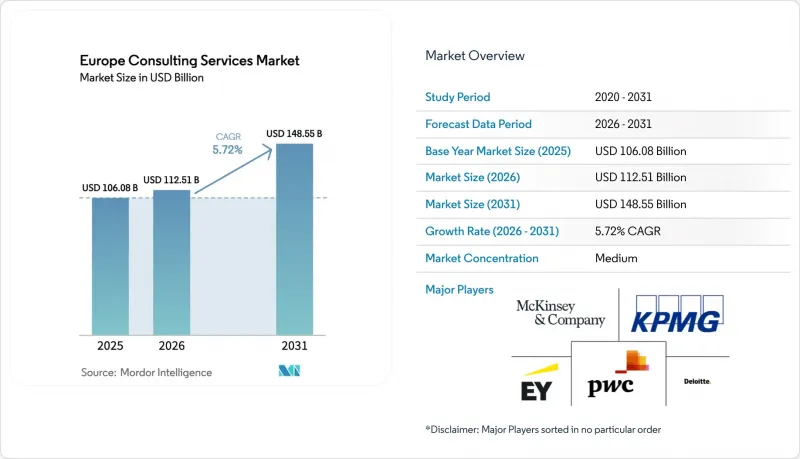
根據 Mordor Intelligence 預測,歐洲諮詢服務市場規模預計將在 2025 年達到 1,060.8 億美元,2026 年達到 1,125.1 億美元,2031 年達到 1,485.5 億美元,2026 年至 2031 年的複合年成長率為 5.71%。
本報告按服務類型(營運、策略、財務諮詢、技術諮詢、人力資源與轉型管理、永續發展與ESG、數位轉型)、客戶產業(銀行、金融服務和保險、製造業、醫療保健、能源等)、公司規模(大型企業、中小企業)、交付模式(現場、遠端、混合)和地區進行細分。市場預測以美元(USD)為單位。
歐洲諮詢服務市場的趨勢與洞察
歐盟綠色交易和共同國家發展指令合規性面臨壓力
大約5萬家歐洲公司將被要求在其2025會計年度報告中發布經審計的永續發展資訊披露,這一數字是之前製度的十倍。諮詢需求主要集中在ESG數據平台、範圍3建模和鑑證準備方面,一家大型公司報告稱,其2025年與CSRD相關的業務量比上一年成長了43%。隨著法律責任延伸至財務總監(CFO),ESG已成為董事會層面的合規重點,而不僅僅是提升聲譽的舉措。該指令的「雙重重要性原則」要求公司量化與氣候相關的財務風險及其環境足跡,但很少有公司具備這種內部能力。德國和法國透過嚴格的國內執法迅速回應,而南歐和東歐成員國則在最終指南發布之前採取更漸進的應對措施。
加速滿足客戶對人工智慧驅動的生產力諮詢服務的需求。
歐洲企業對生成式人工智慧的採用率從2024年初的12%上升至2025年12月的38%。諮詢服務如今涵蓋了從模型選擇和快速工程到歐盟人工智慧法規合規性的方方面面。企業正在將用例藍圖制定、試點實施和員工技能再培訓整合到多年期專案中,並越來越依賴基於績效的定價模式。一家整合商報告稱,其2025年在歐洲開展的人工智慧專案中,有62%採用了基於成功的收費模式。英國和德國憑藉著豐富的人才儲備和成熟的雲端基礎設施,引領著人工智慧領域的支出成長;與此同時,隨著超大規模企業將資料中心在地化以滿足居住法規的要求,南歐市場也在加速發展。
高階分析領域人才長期短缺
預計到2025年12月,德國IT和數據分析領域將有12.4萬個職位空缺,比上一年成長17%。人才短缺推高了薪資水平,擠壓了專案利潤空間,迫使企業收購小型公司或建立近岸基地。英國的移民配額進一步限制了歐盟以外資料科學家的湧入,迫使總部位於倫敦的公司將業務遷至都柏林和華沙。北歐國家的大學培養的電腦科學畢業生數量不足以滿足當地需求,儘管簽證限制有所放寬,但人才短缺問題仍在加劇。受監管的客戶通常更傾向於選擇本土團隊,以此作為降低風險的措施,限制離岸境外外包。
細分市場分析
預計到2025年,策略諮詢將佔據歐洲諮詢服務市場24.11%的最大收入佔有率。然而,受《企業永續性報告指令》(CSRD)最後期限和董事會層面氣候風險監測的推動,永續發展和ESG計畫預計將以6.81%的複合年成長率(CAGR)實現最高成長。隨著客戶將ESG指標整合到ERP和客戶儀錶板中,數位轉型(DX)專案也正在滿足相關需求。由於成本限制和供應鏈波動,營運諮詢依然保持強勁勢頭。金融諮詢受益於可再生能源和醫療保健產業的活躍交易,而技術和網路安全諮詢則在更嚴格的NIS2法規下趨於整合。
永續發展的勢頭正在改變客戶的支出分配方式。檢驗的CSRD調查方法和簡化的範圍3計算工具的公司正在獲得多年續約合約。預計到2031年,歐洲與ESG鑑證相關的諮詢服務市場成長速度將超過其他任何次產業。同時,基於績效的定價模式在營運和數位轉型領域正蓬勃發展,但主要關注無形價值創造的策略和財務諮詢服務仍然主要採用基於時間和材料的收費系統。人力資源和變革管理服務正在向人工智慧驅動的人才規劃轉型,預計到2025年,超過一半的交易將採用生成式人工智慧訓練。
到2025年,銀行、金融和保險(BFSI)產業將佔總薪酬的19.87%,這主要得益於巴塞爾協議IV和《數位營運韌性法案》(DORA)的合規項目。能源和公共產業行業預計將以6.58%的複合年成長率(CAGR)實現最高成長,這反映了歐盟再生能源計劃(REPowerEU)下強制性的電網現代化改造。製造業客戶將繼續大力投資工業4.0並向循環經濟轉型,而醫療保健諮詢業務則在2025年藥品核准數量創歷史新高後不斷擴張。
在公共產業領域,將策略制定、技術藍圖開發和預測性維護分析結合的綜合項目日益增多,推動了歐洲相關諮詢服務市場規模的成長。消費品和零售業的需求正在復甦,主要受全通路整合和永續性標籤的推動。隨著各國政府將快速反應基金(RRF)投入數位化服務,公共部門計畫也不斷擴展;交通運輸業的客戶正與合作夥伴攜手製定符合「Fit for 55」二氧化碳排放標準的脫碳藍圖。
其他好處:
- Excel格式的市場預測(ME)表
- 3個月的分析師支持
目錄
第1章:引言
- 研究假設和市場定義
- 調查範圍
第2章:調查方法
第3章執行摘要
第4章 市場狀況
- 市場概覽
- 市場促進因素
- 協調跨境服務法規
- 加速滿足客戶對人工智慧驅動的生產力諮詢服務的需求。
- 歐盟綠色新政和共同體革命設計條例面臨遵守壓力。
- 歐盟快速反應基金 (RRF)津貼旨在為中小企業提供資金,幫助其提高數位化成熟度。
- 過渡到基於績效的定價模式
- 供應鏈中的地緣政治風險導致近岸外包
- 市場限制因素
- 高階分析領域的人才短缺問題依然存在。
- 透過採購主導的談判降低費用
- 生成式人工智慧 DIY 工具包正在減少入門級工作。
- 對大型系統整合商和顧問公司的併購活動進行監管。
- 產業價值與價值鏈分析
- 監理情勢
- 技術展望
- 波特五力分析
- 宏觀經濟因素對市場的影響
第5章 市場規模與成長預測
- 按服務類型
- 商業諮詢
- 策略諮詢
- 財務諮詢
- 技術諮詢
- 人力資源(HR)與轉型管理
- 永續發展與ESG諮詢
- 數位轉型諮詢
- 按客戶產業
- BFSI
- 製造業和工業
- 醫療保健和生命科學
- 能源公用事業
- 資訊與通訊科技與媒體
- 消費品和零售
- 其他客戶產業
- 按公司規模
- 大公司
- 中小企業
- 按型號提供
- 現場參與
- 遠端/虛擬
- 混合模式
- 國家
- 英國
- 德國
- 法國
- 比荷盧經濟聯盟
- 義大利
- 北歐的
- 西班牙
- 中歐和東歐(包括波蘭)
- 其他歐洲國家
第6章 競爭情勢
- 市場集中度
- 策略趨勢
- 市佔率分析
- 公司簡介
- Deloitte Touche Tohmatsu Limited
- PricewaterhouseCoopers LLP
- Accenture PLC
- Ernst and Young Global Limited
- KPMG International
- McKinsey and Company
- Boston Consulting Group
- Bain and Company
- Kearney
- Roland Berger
- Capgemini Invent
- BearingPoint
- Oliver Wyman
- LEK Consulting
- Alvarez and Marsal
- Grant Thornton International
- BDO Advisory
- PA Consulting Group
- IBM Consulting
- Infosys Consulting
- Atos Consulting
- Wipro Consulting Services
- NTT DATA Business Solutions
- CGI Inc.
- Tata Consultancy Services(TCS)Consulting
第7章 市場機會與未來展望
According to Mordor Intelligence, the Europe consulting services market size is projected to be USD 106.08 billion in 2025, USD 112.51 billion in 2026, and reach USD 148.55 billion by 2031, growing at a CAGR of 5.71% from 2026 to 2031.
This report is Segmented by Service Type (Operations, Strategy, Financial Advisory, Technology Advisory, HR and Change Management, Sustainability and ESG, and Digital Transformation), Client Industry (BFSI, Manufacturing, Healthcare, Energy, and More), Enterprise Size (Large, and SMEs), Delivery Model (On-Site, Remote, and Hybrid), and Geography. Market Forecasts are Provided in Value (USD).
Europe Consulting Services Market Trends and Insights
EU Green Deal and CSRD Compliance Pressures
Roughly 50,000 European companies must publish audited sustainability disclosures beginning with fiscal-year 2025 reports, a tenfold increase versus prior regimes. Advisory demand centers on ESG data platforms, Scope 3 modelling, and assurance readiness, with one large firm citing a 43% year-on-year rise in CSRD-linked work in 2025. Legal liability now extends to chief financial officers, making ESG a board-level compliance priority rather than a reputational initiative. The directive's double-materiality principle requires companies to quantify both climate-related financial risk and their environmental footprint, capabilities rarely found in-house. Germany and France moved fastest due to stringent national enforcement, while Southern and Eastern members are scaling more gradually pending final guidance.
Accelerated Client Demand for AI-Enabled Productivity Consulting
Generative-AI adoption in European enterprises climbed from 12% in early 2024 to 38% by December 2025. Consulting engagements now span model selection, prompt engineering, and EU AI Act compliance. Firms bundle use-case road-mapping, pilot execution, and workforce reskilling into multi-year programs that increasingly rely on outcome-based pricing; 62% of one integrator's European AI projects in 2025 carried success-linked fees. The UK and Germany dominate spend thanks to large talent pools and mature cloud infrastructure, while Southern markets accelerate as hyperscale's localize data centers to satisfy residency rules.
Persistent Talent Deficit in Advanced Analytics
Germany reported 124,000 unfilled IT and data-analytics roles in December 2025, 17% higher than the prior year. Scarcity inflates salaries, squeezes project margins, and drives firms to acquire boutiques or open near-shore hubs. UK immigration caps further restrict non-EU data-scientist inflow, prompting London practices to shift delivery to Dublin and Warsaw. Nordic universities produce fewer computer-science graduates than local demand, exacerbating the deficit despite liberal visa rules. Regulated clients often insist on onshore teams, limiting off shoring as a mitigation lever.
Other drivers and restraints analyzed in the detailed report include:
- SME Digital-Maturity Funding via EU RRF Grants
- Regulatory Convergence for Cross-Border Services
- Fee-Compression from Procurement-Led Negotiations
For complete list of drivers and restraints, kindly check the Table Of Contents.
Segment Analysis
Strategy consulting generated the largest 24.11% share of Europe consulting services market revenue in 2025. Sustainability and ESG projects, however, are forecast to post the highest 6.81% CAGR, propelled by CSRD deadlines and board-level climate-risk oversight. Digital transformation engagements capture adjacent demand as clients embed ESG metrics into ERP and customer dashboards. Operations consulting remains resilient due to cost-containment and supply-chain volatility. Financial advisory benefits from brisk renewable-energy and healthcare deal flow, while technology and cybersecurity advisory converge under the stricter NIS2 regime.
Sustainability's momentum is shifting wallet share. Firms with verified CSRD methodologies and Scope 3 accounting accelerators are winning multi-year retainers. The Europe consulting services market size linked to ESG assurance is projected to grow faster than any other sub-line through 2031. Meanwhile, outcome-based pricing gains traction in operations and digital transformation, though strategy and financial advisory engagements largely remain time and materials due to intangible value creation. HR and change-management practices pivot toward AI-enabled workforce planning, integrating generative-AI training in more than half of 2025 engagements.
BFSI contributed 19.87% of 2025 fees, anchored by Basel IV and Digital Operational Resilience Act compliance programs. Energy and utilities engagements are expected to log the fastest 6.58% CAGR, reflecting grid-modernization mandates under REPowerEU. Manufacturing clients sustain robust spend on Industry 4.0 and circular-economy transitions, while healthcare consulting expands alongside record drug approvals in 2025.
Utilities projects increasingly bundle strategy, technology road-mapping, and predictive-maintenance analytics, lifting the Europe consulting services market size attached to the sector. Consumer and retail demand rebounds, centering on omnichannel integration and sustainability labelling. Public-sector engagements grow as governments deploy RRF funds for digital services, and transportation client's partner on decarbonization roadmaps aligned with Fit for 55 CO2 standards.
Complete Report Scope:
- By Service Type
- Operations Consulting
- Strategy Consulting
- Financial Advisory
- Technology Advisory
- HR and Change Management
- Sustainability and ESG Consulting
- Digital Transformation Consulting
- By Client Industry
- BFSI
- Manufacturing and Industrials
- Healthcare and Life Sciences
- Energy and Utilities
- ICT and Media
- Consumer and Retail
- Rest of Client Industries
- By Enterprise Size
- Large Enterprises
- Small and Medium Enterprises (SMEs)
- By Delivery Model
- On-site Engagement
- Remote/Virtual
- Hybrid Model
- By Country
- United Kingdom
- Germany
- France
- Benelux
- Italy
- Nordics
- Spain
- Central and Eastern Europe (incl. Poland)
- Rest of Europe
List of Companies Covered in this Report:
- Deloitte Touche Tohmatsu Limited
- PricewaterhouseCoopers LLP
- Accenture PLC
- Ernst and Young Global Limited
- KPMG International
- McKinsey and Company
- Boston Consulting Group
- Bain and Company
- Kearney
- Roland Berger
- Capgemini Invent
- BearingPoint
- Oliver Wyman
- L.E.K. Consulting
- Alvarez and Marsal
- Grant Thornton International
- BDO Advisory
- PA Consulting Group
- IBM Consulting
- Infosys Consulting
- Atos Consulting
- Wipro Consulting Services
- NTT DATA Business Solutions
- CGI Inc.
- Tata Consultancy Services (TCS) Consulting
Additional Benefits:
- The market estimate (ME) sheet in Excel format
- 3 months of analyst support
TABLE OF CONTENTS
1 INTRODUCTION
- 1.1 Study Assumptions and Market Definition
- 1.2 Scope of the Study
2 RESEARCH METHODOLOGY
3 EXECUTIVE SUMMARY
4 MARKET LANDSCAPE
- 4.1 Market Overview
- 4.2 Market Drivers
- 4.2.1 Regulatory convergence for cross-border services
- 4.2.2 Accelerated client demand for AI-enabled productivity consulting
- 4.2.3 EU Green Deal and CSRD compliance pressures
- 4.2.4 SME digital-maturity funding via EU RRF grants
- 4.2.5 Shift to outcome-based pricing models
- 4.2.6 Near-shoring driven by geopolitical risk in supply chains
- 4.3 Market Restraints
- 4.3.1 Persistent talent deficit in advanced analytics
- 4.3.2 Fee-compression from procurement-led negotiations
- 4.3.3 Generative-AI DIY toolkits reducing entry-level work
- 4.3.4 Regulatory scrutiny on large integrator-consultant MandA
- 4.4 Industry Value and Supply-Chain Analysis
- 4.5 Regulatory Landscape
- 4.6 Technological Outlook
- 4.7 Porter's Five Forces Analysis
- 4.7.1 Bargaining Power of Suppliers
- 4.7.2 Bargaining Power of Buyers
- 4.7.3 Threat of New Entrants
- 4.7.4 Threat of Substitute Products and Services
- 4.7.5 Intensity of Competitive Rivalry
- 4.8 Impact of Macroeconomic Factors on the Market
5 MARKET SIZE AND GROWTH FORECASTS
- 5.1 By Service Type
- 5.1.1 Operations Consulting
- 5.1.2 Strategy Consulting
- 5.1.3 Financial Advisory
- 5.1.4 Technology Advisory
- 5.1.5 HR and Change Management
- 5.1.6 Sustainability and ESG Consulting
- 5.1.7 Digital Transformation Consulting
- 5.2 By Client Industry
- 5.2.1 BFSI
- 5.2.2 Manufacturing and Industrials
- 5.2.3 Healthcare and Life Sciences
- 5.2.4 Energy and Utilities
- 5.2.5 ICT and Media
- 5.2.6 Consumer and Retail
- 5.2.7 Rest of Client Industries
- 5.3 By Enterprise Size
- 5.3.1 Large Enterprises
- 5.3.2 Small and Medium Enterprises (SMEs)
- 5.4 By Delivery Model
- 5.4.1 On-site Engagement
- 5.4.2 Remote/Virtual
- 5.4.3 Hybrid Model
- 5.5 By Country
- 5.5.1 United Kingdom
- 5.5.2 Germany
- 5.5.3 France
- 5.5.4 Benelux
- 5.5.5 Italy
- 5.5.6 Nordics
- 5.5.7 Spain
- 5.5.8 Central and Eastern Europe (incl. Poland)
- 5.5.9 Rest of Europe
6 COMPETITIVE LANDSCAPE
- 6.1 Market Concentration
- 6.2 Strategic Moves
- 6.3 Market Share Analysis
- 6.4 Company Profiles (includes Global Level Overview, Market Level Overview, Core Segments, Financials as available, Strategic Information, Market Rank/Share, Products and Services, Recent Developments)
- 6.4.1 Deloitte Touche Tohmatsu Limited
- 6.4.2 PricewaterhouseCoopers LLP
- 6.4.3 Accenture PLC
- 6.4.4 Ernst and Young Global Limited
- 6.4.5 KPMG International
- 6.4.6 McKinsey and Company
- 6.4.7 Boston Consulting Group
- 6.4.8 Bain and Company
- 6.4.9 Kearney
- 6.4.10 Roland Berger
- 6.4.11 Capgemini Invent
- 6.4.12 BearingPoint
- 6.4.13 Oliver Wyman
- 6.4.14 L.E.K. Consulting
- 6.4.15 Alvarez and Marsal
- 6.4.16 Grant Thornton International
- 6.4.17 BDO Advisory
- 6.4.18 PA Consulting Group
- 6.4.19 IBM Consulting
- 6.4.20 Infosys Consulting
- 6.4.21 Atos Consulting
- 6.4.22 Wipro Consulting Services
- 6.4.23 NTT DATA Business Solutions
- 6.4.24 CGI Inc.
- 6.4.25 Tata Consultancy Services (TCS) Consulting
7 MARKET OPPORTUNITIES AND FUTURE OUTLOOK
- 7.1 White-Space and Unmet-Need Assessment

 東南亞顧問服務:市場佔有率分析、產業趨勢與統計、成長預測(2026-2031)策略諮詢服務:市場佔有率分析、產業趨勢與統計、成長預測(2026-2031)
 2026-2030年全球諮詢服務市場北美策略諮詢:市場佔有率分析、產業趨勢與統計、成長預測(2026-2031)美國策略諮詢服務:市場佔有率分析、產業趨勢與統計、成長預測(2026-2031)
 人工智慧和機器學習研究服務
 諮詢4.0市場:2026-2032年全球市場預測(按服務類型、類別、交付方式、技術、應用、最終用戶產業和最終用戶分類)亞太地區策略諮詢服務:市場佔有率分析、產業趨勢與統計、成長預測(2026-2031)
 2026年全球營運諮詢市場報告南美供應鏈諮詢服務:市場佔有率分析、產業趨勢與統計、成長預測(2026-2031)