


 |
市場調查報告書
商品編碼
2116683
美國策略諮詢服務:市場佔有率分析、產業趨勢與統計、成長預測(2026-2031)United States Strategic Consulting Services - Market Share Analysis, Industry Trends & Statistics, Growth Forecasts (2026 - 2031) |
||||||

※ 本網頁內容可能與最新版本有所差異。詳細情況請與我們聯繫。
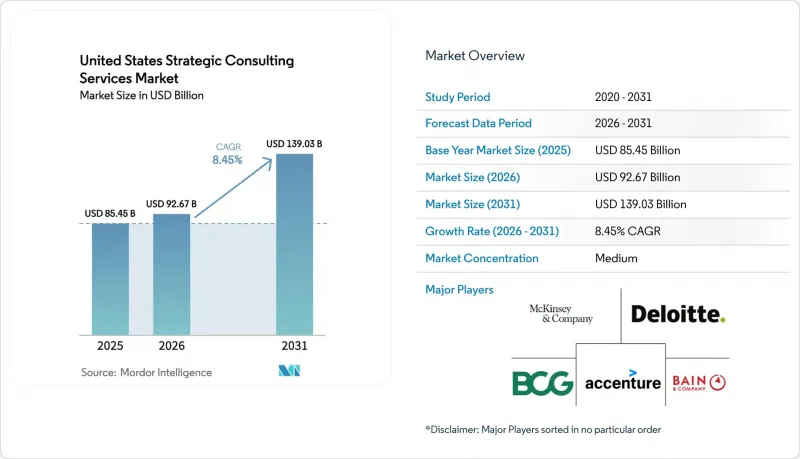
根據 Mordor Intelligence 預測,美國策略諮詢服務市場規模將從 2025 年的 854.5 億美元成長到 2026 年的 926.7 億美元,到 2031 年將達到 1,390.3 億美元,2026 年至 2031 年的複合年成長率為 8.45%。
本報告按客戶行業(醫療保健、銀行、金融和保險業以及其他)和企業規模(大型企業(超過10億美元)、中型企業(1億美元至10億美元)以及中小企業(低於1億美元))進行分類。市場預測以美元計價。
美國策略諮詢服務市場的趨勢與洞察
對數位轉型日益成長的需求
過去18個月中,85%的執行長加快了數位轉型步伐,引發了自2020年以來規模最大的雲端運算、資料平台和自動化專案浪潮。麥肯錫數位部門預計在2023年將創造160億美元的收入,其中40%將來自人工智慧諮詢服務,凸顯了客戶如今將應用分析視為保持競爭力的必要條件。客戶經常聘請外部顧問,在其內部團隊缺乏管理能力的領域進行投資報酬率 (ROI) 基準測試,最佳化網路安全措施,並合理安排敏捷轉型階段。服務供應商正積極回應,推出多領域人工智慧工作室,認證數萬名雲端工程師,並與超大規模資料中心業者公司合作開發參考架構。現場團隊通常會在9至18個月的轉型衝刺階段駐紮,以確保對實現商業目標負責。
針對中型企業的併購活動出現了破紀錄的浪潮。
儘管信貸利差收窄,但到2024年底,全球併購交易額仍將達3.5兆美元。在美國完成的交易中,超過一半涉及收購估值低於50億美元的公司,這些公司熱衷於協同效應、產品優勢和地理擴張。貝恩公司預測,到2025年,三分之一的交易團隊將使用基於人工智慧的生成式實質審查工具,將分析週期從數週縮短至數天,並將諮詢顧問的工作重心轉移到情境檢驗和整合準備上。顧問公司正在擴展其監管合規能力,實施行業特定的操作指南,並完善整合工具包,以便從一開始就協調業務模式。能源和金融服務領域的複雜跨境交易收費高昂,專家因其在製裁風險、地緣政治不確定性和氣候變遷影響建模方面的專業知識而備受重視。
擴大內部戰略團隊
目前,財富500強企業中有82%已建立內部諮詢團隊,並對其處理基礎分析任務的能力感到非常滿意。這一趨勢正將日常工作從外部顧問公司轉移出去,迫使它們優先提供客觀的洞察並利用跨產業標竿分析。外部諮詢顧問也專注於提供內部團隊通常缺乏的專業知識,從而確保自身在競爭環境中的競爭力。此外,這些公司正在設計能力發展計劃,旨在提升內部團隊的技能,從而促進組織的長期發展。透過這種方式,外部諮詢顧問以短期商機為交換,在這些公司中策略性地確立了永續的諮詢角色。這種轉變凸顯了企業生態系中內部諮詢和外部諮詢職能之間動態變化的動態。
細分市場分析
預計醫療保健產業將呈現最快的收入成長,到2031年複合年成長率將達到9.55%,這主要得益於醫療服務提供者不斷創新其服務體系和報銷模式。隨著醫療機構採用人口健康分析、實現預核准流程自動化以及整合ESG合規工作流程,與醫療保健相關的策略諮詢服務市場規模預計將翻倍。銀行、金融服務和保險業將保持最大的市場佔有率,預計到2025年將佔戰略諮詢服務市場佔有率的24.20%,這主要得益於金融機構適應巴塞爾協議III資本監管、應對即時欺詐風險以及重組其核心銀行系統。科技、能源和消費/零售業的客戶正在推動市場成長,分別受人工智慧整合、電網脫碳和全通路重組的驅動。製造業和工業領域正依靠顧問進行可行性研究,以降低全球供應衝擊的風險並實施智慧工廠。
諮詢顧問正在為各行各業量身打造服務交付方案。醫院正在組建由臨床醫生、精算師和數據科學家組成的多部門團隊,以使以金額為準的合約與品質評分相匹配。銀行正在聘請風險專家來調整資本計劃並實施由人工智慧驅動的信用評分引擎。公共產業正在聘請顧問來改造其電網並建造氫能就緒資產模型。零售商正在利用電腦視覺庫存審計來改善其最後一公里物流,從而將缺貨率降低20%。各行各業的公司都在增加管理服務,以維持改進並確保合規性,從而為策略諮詢服務行業帶來持續的收入來源。
其他好處
- Excel格式的市場預測(ME)表
- 3個月的分析師支持
目錄
第1章:引言
- 研究假設和市場定義
- 調查範圍
第2章:調查方法
第3章執行摘要
第4章 市場狀況
- 市場概覽
- 市場促進因素
- 對數位轉型日益成長的需求
- 針對中型企業的併購活動出現了破紀錄的浪潮。
- ESG 和氣候變遷資訊揭露合規性
- 向醫療保健中的價值導向護理轉型
- 鼓勵美國供應鏈回歸美國的獎勵
- 需要檢驗人工智慧生成策略
- 市場限制因素
- 擴大內部戰略團隊
- 採購部門的費用壓力
- 客戶對 GenAI 提供的通用產出結果缺乏信任
- 對審計和諮詢服務合併營運的反壟斷審查
- 價值供應鏈分析
- 監理情勢
- 技術展望
- 波特五力模型
第5章 市場規模與成長預測
- 按客戶產業
- 衛生保健
- BFSI
- 科技與媒體
- 能源與公共產業
- 消費品和零售
- 製造業和工業
- 政府/公共部門
- 按組織規模
- 大型企業(年收入超過10億美元)
- 中型企業(年營業額1億美元至10億美元)
- 中小企業(營業額低於1億美元)
- 美國地區登機
- 東北
- 中西部
- 南部
- 西
第6章 競爭情勢
- 市場集中度
- 策略趨勢
- 市佔率分析
- 公司簡介
- Accenture
- Deloitte
- McKinsey & Company
- Boston Consulting Group
- Bain & Company
- PwC
- EY
- KPMG
- IBM Consulting
- Oliver Wyman
- Booz Allen Hamilton
- Alvarez & Marsal
- LEK Consulting
- Roland Berger
- Kearney
- Capgemini Invent
- EY-Parthenon
- West Monroe
- FTI Consulting
第7章 市場機會與未來展望
According to Mordor Intelligence, the United States strategic consulting services market size is expected to grow from USD 85.45 billion in 2025 to USD 92.67 billion in 2026 and is forecast to reach USD 139.03 billion by 2031 at 8.45% CAGR over 2026-2031.
This report is Segmented by Client Industry (Healthcare, BFSI, and More), by Organization Size (Large Enterprises (Greater Than $1 B), Mid-Market ($100 M-$1 B), and SMEs (Less Than $100 M)). The Market Forecasts are Provided in Terms of Value (USD).
United States Strategic Consulting Services Market Trends and Insights
Intensifying digital-transformation mandates
Eighty-five percent of chief executives accelerated digital agendas in the past 18 months, igniting the largest wave of cloud, data platform, and automation projects since 2020. McKinsey's digital practice generated USD 16 billion in 2023 revenue, with 40% linked to AI consulting, underscoring how clients now view applied analytics as a competitive requirement . Buyers routinely ask external advisors to benchmark technology ROI, calibrate cybersecurity controls, and sequence agile implementation waves that internal teams lack capacity to manage. Providers respond by launching multi-disciplinary AI studios, certifying tens of thousands of cloud engineers, and co-developing reference architectures with hyperscalers. Embedded teams typically remain on site for transformation sprints of 9-18 months, ensuring accountability for business-case realization.
Record mid-market M&A wave
Global M&A volume ended 2024 at USD 3.5 trillion despite tighter credit spreads . More than half of completed U.S. transactions involved acquirers valued below USD 5 billion, a cohort keen on scale synergies, product adjacency, and geographic expansion. Bain expects one in three deal teams to adopt generative-AI diligence tools by 2025, cutting analysis cycles from weeks to days and shifting consultant effort toward scenario validation and integration readiness. Advisory firms expand regulatory benches, deploy industry-specific playbooks, and deepen post-merger integration toolkits that align operating models from Day One. Complex cross-border deals in energy and financial services command premium fees, rewarding specialists fluent in sanctions risk, geopolitical uncertainty, and climate-impact modeling.
In-house strategy teams expansion
Currently, eighty-two percent of Fortune 500 companies have established internal consulting groups, demonstrating strong satisfaction with their ability to handle baseline analytical tasks. This trend has redirected routine operational work away from external consulting firms, compelling them to prioritize delivering objective insights and leveraging cross-sector benchmarking. External consultants are also focusing on offering specialized expertise that internal teams typically lack, ensuring their relevance in a competitive landscape. Furthermore, these firms are designing capability-building programs aimed at enhancing the skills of internal teams, thereby fostering long-term organizational growth. By adopting this approach, external consultants are strategically exchanging short-term revenue opportunities for sustained advisory roles within these corporations. This shift underscores the evolving dynamics between internal and external consulting functions in the corporate ecosystem.
Other drivers and restraints analyzed in the detailed report include:
- ESG and climate-disclosure compliance
- Healthcare value-based-care shift
- Fee pressure from procurement offices
For complete list of drivers and restraints, kindly check the Table Of Contents.
Segment Analysis
Healthcare generated the fastest revenue expansion, clocking a 9.55% CAGR through 2031 as providers overhaul care delivery and reimbursement models. The strategic consulting services market size associated with healthcare is positioned to double because hospitals employ population-health analytics, automate prior authorization, and embed ESG-compliance workflows. Banking, Financial Services, and Insurance retained the largest slice, contributing 24.20% strategic consulting services market share in 2025 as institutions navigate Basel III capital, combat real-time fraud, and re-platform core banking systems. Technology, energy, and consumer-retail clients add momentum, each propelled by AI integration, grid decarbonization, and omnichannel reinvention. Manufacturing and industrials lean on advisors for reshoring feasibility and smart-factory deployments that de-risk global supply shocks.
Consultants tailor delivery blueprints to each vertical. In hospitals, multidisciplinary squads merge clinicians with actuaries and data scientists to align value-based contracts with quality scores. Banks contract risk specialists to recalibrate capital planning and deploy AI credit-scoring engines. Utilities engage advisors to modernize transmission grids and model hydrogen-ready assets. Retailers retool last-mile logistics using computer-vision inventory audits that cut stock-outs twenty percent. Across industries, firms attach managed-services wrappers that sustain improvement and ensure compliance, embedding recurring revenue streams within the strategic consulting services industry.
Complete Report Scope:
- By Client Industry (Value)
- Healthcare
- BFSI
- Technology & Media
- Energy & Utilities
- Consumer & Retail
- Manufacturing & Industrials
- Government & Public Sector
- By Organization Size (Value)
- Large Enterprises (Less than $1 B)
- Mid-Market (USD100 M-$1 B)
- SMEs (Greater than $100 M)
- By U.S. Region (Value)
- Northeast
- Midwest
- South
- West
List of Companies Covered in this Report:
- Accenture
- Deloitte
- McKinsey & Company
- Boston Consulting Group
- Bain & Company
- PwC
- EY
- KPMG
- IBM Consulting
- Strategy& (PwC)
- Oliver Wyman
- Booz Allen Hamilton
- Alvarez & Marsal
- L.E.K. Consulting
- Roland Berger
- Kearney
- Capgemini Invent
- EY-Parthenon
- West Monroe
- FTI Consulting
Additional Benefits:
- The market estimate (ME) sheet in Excel format
- 3 months of analyst support
TABLE OF CONTENTS
1 Introduction
- 1.1 Study Assumptions & Market Definition
- 1.2 Scope of the Study
2 Research Methodology
3 Executive Summary
4 Market Landscape
- 4.1 Market Overview
- 4.2 Market Drivers
- 4.2.1 Intensifying digital-transformation mandates
- 4.2.2 Record mid-market M&A wave
- 4.2.3 ESG & climate-disclosure compliance
- 4.2.4 Healthcare value-based-care shift
- 4.2.5 U.S. supply-chain reshoring incentives
- 4.2.6 AI-generated-strategy validation demand
- 4.3 Market Restraints
- 4.3.1 In-house strategy teams expansion
- 4.3.2 Fee-pressure from procurement offices
- 4.3.3 Client distrust of GenAI-generic outputs
- 4.3.4 Antitrust scrutiny of audit-advisory mixes
- 4.4 Value / Supply-Chain Analysis
- 4.5 Regulatory Landscape
- 4.6 Technological Outlook
- 4.7 Porter's Five Forces
- 4.7.1 Threat of New Entrants
- 4.7.2 Bargaining Power of Buyers
- 4.7.3 Bargaining Power of Suppliers
- 4.7.4 Threat of Substitutes
- 4.7.5 Competitive Rivalry
5 Market Size & Growth Forecasts
- 5.1 By Client Industry (Value)
- 5.1.1 Healthcare
- 5.1.2 BFSI
- 5.1.3 Technology & Media
- 5.1.4 Energy & Utilities
- 5.1.5 Consumer & Retail
- 5.1.6 Manufacturing & Industrials
- 5.1.7 Government & Public Sector
- 5.2 By Organization Size (Value)
- 5.2.1 Large Enterprises (Less than $1 B)
- 5.2.2 Mid-Market (USD100 M-$1 B)
- 5.2.3 SMEs (Greater than $100 M)
- 5.3 By U.S. Region (Value)
- 5.3.1 Northeast
- 5.3.2 Midwest
- 5.3.3 South
- 5.3.4 West
6 Competitive Landscape
- 6.1 Market Concentration
- 6.2 Strategic Moves
- 6.3 Market Share Analysis
- 6.4 Company Profiles (includes Global level Overview, Market level overview, Core Segments, Financials as available, Strategic Information, Market Rank/Share for key companies, Products & Services, Recent Developments)
- 6.4.1 Accenture
- 6.4.2 Deloitte
- 6.4.3 McKinsey & Company
- 6.4.4 Boston Consulting Group
- 6.4.5 Bain & Company
- 6.4.6 PwC
- 6.4.7 EY
- 6.4.8 KPMG
- 6.4.9 IBM Consulting
- 6.4.10 Strategy& (PwC)
- 6.4.11 Oliver Wyman
- 6.4.12 Booz Allen Hamilton
- 6.4.13 Alvarez & Marsal
- 6.4.14 L.E.K. Consulting
- 6.4.15 Roland Berger
- 6.4.16 Kearney
- 6.4.17 Capgemini Invent
- 6.4.18 EY-Parthenon
- 6.4.19 West Monroe
- 6.4.20 FTI Consulting
7 Market Opportunities & Future Outlook
- 7.1 White-space & Unmet-need Assessment

 歐洲諮詢服務:市場佔有率分析、產業趨勢與統計、成長預測(2026-2031)東南亞顧問服務:市場佔有率分析、產業趨勢與統計、成長預測(2026-2031)策略諮詢服務:市場佔有率分析、產業趨勢與統計、成長預測(2026-2031)
 2026-2030年全球諮詢服務市場北美策略諮詢:市場佔有率分析、產業趨勢與統計、成長預測(2026-2031)
 人工智慧和機器學習研究服務
 諮詢4.0市場:2026-2032年全球市場預測(按服務類型、類別、交付方式、技術、應用、最終用戶產業和最終用戶分類)亞太地區策略諮詢服務:市場佔有率分析、產業趨勢與統計、成長預測(2026-2031)
 2026年全球營運諮詢市場報告南美供應鏈諮詢服務:市場佔有率分析、產業趨勢與統計、成長預測(2026-2031)