


 |
市場調查報告書
商品編碼
2125646
硬體防火牆:市場佔有率分析、產業趨勢與統計、成長預測(2026-2031)Hardware Firewall - Market Share Analysis, Industry Trends & Statistics, Growth Forecasts (2026 - 2031) |
||||||

※ 本網頁內容可能與最新版本有所差異。詳細情況請與我們聯繫。
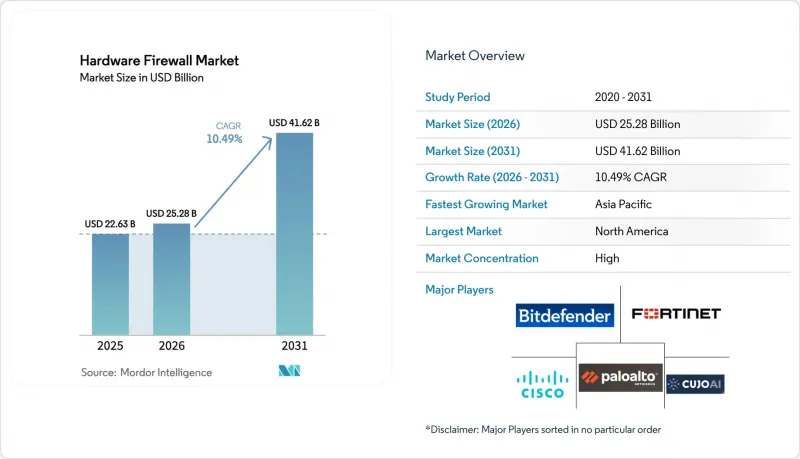
預計硬體防火牆市場將從 2026 年的 252.8 億美元成長到 2031 年的 416.2 億美元,2026 年至 2031 年的複合年成長率為 10.49%。
本報告按組件(設備/系統和服務)、組織規模(中小企業和大型企業)、最終用戶行業(銀行、金融服務和保險 (BFSI)、醫療保健、製造業、政府和國防、IT 和電信、零售和電子商務等)、防火牆類型(封包過濾、電路級閘道器、應用層級/代理等)以及地區進行細分。市場預測以美元 (USD) 為單位。
全球硬體防火牆市場趨勢與洞察
多向量網路攻擊日益複雜,使得使用 ASIC 進行高速測試至關重要。
預計在2025年上半年,結合勒索軟體、分散式阻斷服務 (DDoS) 攻擊和供應鏈漏洞的多向量入侵將佔所有已通報企業安全漏洞的68%。運行在x86處理器上的基於特徵碼的引擎無法以線速關聯網路、應用程式和終端資料流中的指標,導致攻擊者經常將有效載荷拆分到不同的協定中以逃避偵測。專用檢測晶片可以卸載模式匹配和行為分析處理,從而能夠在不影響約定的服務等級的情況下,實現每秒4000萬個資料包的檢測。 2025年1月發布的NIST指南正式強制要求聯邦政府零信任部署採用基於硬體的保障措施,並明確了公共部門採購的ASIC要求。因此,自主設計晶片的供應商比依賴現成晶片的競爭對手領先18個月。
聯邦政府和關鍵基礎設施網路的零信任政策。
14028號行政命令與管理與預算辦公室(OMB)M-22-09號備忘錄要求美國民事機構在2027財政年度之前實現零信任成熟度。該指令禁止基於位置的信任,並強制要求進行會話級加密檢驗,而這種能力在高吞吐量環境下使用軟體防火牆難以實現。根據美國運輸安全管理局(TSA)和國家資訊安全法規(NIS2),歐洲的管道營運商、鐵路營運商和關鍵基礎設施營運商也面臨類似的最後期限。由於美國2026會計年度聯邦網路安全預算的63%必須在2027年第二季之前支出完畢,各機構正在加快硬體採購,並優先選擇已獲得FedRAMP High認證的供應商。
防火牆即服務 (FaaS) 的快速普及正在蠶食對本地部署硬體的需求。
2025年,基於雲端的偵測服務將佔企業新增安全支出的22%,較去年同期成長8個百分點。對於用戶少於50人的小規模辦公室而言,每位用戶每月約8美元的收費系統被認為比擁有價值2000美元的設備三年周期划算得多。根據Palo Alto Networks的報告,2025會計年度41%的新客戶將選擇基於雲端的檢測服務,而目前售價低於5000美元的硬體出貨量正以每年約8%的速度下降。然而,這種市場蠶食是不對稱的。本地部署的設備在資料中心核心和對延遲敏感的營運技術(OT)站點仍然至關重要。因此,將多年硬體租賃與雲端管理相結合的捆綁合約正在成為現有供應商的風險對沖策略。
細分市場分析
預計到2025年,設備和系統領域的硬體防火牆市場規模將達到161.3億美元,佔總營收的71.29%。儘管硬體防火牆在絕對值上仍保持領先地位,但隨著更新預算轉向包含安裝、策略調整和全天候監控等服務,其成長速度正在放緩。由於缺乏內部網路安全團隊,中小企業超過70%的部署都需要專業服務,到2025年,平均每台設備需要應用14個關鍵韌體修補程式。大型企業負責人越來越傾向於將複雜的多重雲端部署視為承包工程,選擇將硬體租賃與三年期託管服務合約捆綁在一起。
相較之下,服務業11.40%的複合年成長率反映了合規性日益複雜以及全球網路安全專業人員短缺340萬的現狀。醫療網路部署防火牆以滿足HIPAA加密要求時,通常需要花費12萬美元用於專業服務,而每部署一台設備的成本僅為8萬美元,這表明諮詢、整合和事件回應成本可能超過實體設備的成本。在整個預測期內,北美和西歐的經常性業務收益預計將與設備收入達到相同水平,這將對仍然依賴底盤出貨量來獲取毛利率的供應商而言,是一個戰略轉折點。
根據2025年的出貨量,下一代平台佔據了硬體防火牆市場佔有率的58.85%,但人工智慧加速型和Terabit特級車型預計將以11.98%的複合年成長率成長。人工智慧最佳化硬體防火牆市場預計將從2026年的約35億美元成長到2031年的超過61億美元。電信業者和超大規模企業是早期採用者,因為加密流量已佔有效載荷的95%以上,而依賴CPU的引擎吞吐量已顯著下降。 Fortinet於2025年3月發布的FortiGate 4800F清晰地展示了這一飛躍,它每秒可處理1.2Terabit的檢測流量,同時將延遲保持在2微秒以下。
低成本人工智慧協處理器正在縮小價格差距,太比Terabit設備和傳統新一代防火牆 (NGFW) 設備之間的價格差異每年縮小約 18%。無狀態封包過濾設備僅在低預算的營運技術 (OT) 閘道器和小規模辦公室中勉強維持,而整合式威脅管理 (UTM) 裝置則隨著客戶將端點、電子郵件和 Web 過濾與網路偵測分離而逐漸失去市場佔有率。應用層級代理程式和電路閘道仍然在一些特定、高可靠性的環境中使用,在這些環境中,監管標準比單純的吞吐量更為重要,例如交易大廳和空氣間隙的防禦區域。
區域分析
到2025年,北美將佔全球收入的38.39%,這主要得益於第14028號行政命令中關於採購和管線安全的指令。僅美國就佔該地區近四分之三的需求,並受益於矽晶片製造回歸美國,這縮短了加密模組的前置作業時間。加拿大電信營運商也根據《關鍵網路系統保護法》升級其邊緣站點,而墨西哥瓜達拉哈拉和蒙特雷的組裝廠則向拉丁美洲供應免稅設備。
歐洲佔全球整體銷售額的26%,而NIS2指令正在推動合規性主導的更新週期。德國佔歐洲總支出的31%,並在歐洲率先採用「IT基礎防護」指南,該指南建議在工業OT骨幹網路中採用基於硬體的隔離措施。英國國家網路安全中心(NCSC)於2025年發布的指南特別建議,對於處理超過10,000筆客戶記錄的組織,應部署硬體防火牆,這將目標市場擴大到英國約87%的企業。
亞太地區是成長最快的市場,預計到2031年將以11.91%的複合年成長率成長。中國的「雙循環」計畫正在資助國內防火牆半導體的發展,而印度42億美元的「數位印度」計畫正在為60萬個村莊提供安全的寬頻服務。日本和韓國仍然是支援高密度5G核心網的Terabit特級平台的重要市場。在中東,到2025年,將有37億美元用於網路安全,其中沙烏地阿拉伯的智慧城市「NEOM」的建設尤為重要。另一方面,非洲僅佔全球收入的3%,但隨著南非「關鍵基礎設施保護法」的實施,該地區正在局部成長。
其他好處:
- Excel格式的市場預測(ME)表
- 3個月的分析師支持
目錄
第1章:引言
- 研究假設和市場定義
- 調查範圍
第2章:調查方法
第3章執行摘要
第4章 市場狀況
- 市場概覽
- 市場促進因素
- 隨著多方面網路攻擊的日益複雜化,使用專用積體電路(ASIC)進行高速偵測變得不可或缺。
- 聯邦政府和關鍵基礎設施網路的零信任政策。
- 邊緣運算和 5G 網路密度的不斷提高,需要分散式的微型防火牆節點。
- 對回流(將生產帶回日本)的優惠待遇和關稅正在促進國內家電生產。
- 從 MPLS 到 SD-WAN 的遷移正在加速硬體 NGFW 的更新週期。
- AI協處理器成本的降低使得面向中階市場的Terabit特級設備成為可能。
- 市場限制因素
- 「防火牆即服務」的快速發展正在蠶食對本地部署硬體的需求。
- 網路處理晶片供應鏈波動性
- 出於隱私原因,限制檢查加密流量。
- 高性能設備的能源成本不斷上漲
- 產業價值鏈分析
- 監理情勢
- 技術展望
- 宏觀經濟因素對市場的影響
- 波特五力分析
第5章 市場規模與成長預測
- 按組件
- 設備/系統
- 服務(實施、支援、管理)
- 按組織規模
- 中小企業
- 大公司
- 按最終用戶行業分類
- BFSI
- 衛生保健
- 製造業
- 政府/國防
- IT/通訊
- 零售與電子商務
- 教育
- 按防火牆類型
- 封包過濾防火牆
- 電路級閘道器
- 應用層級/代理防火牆
- 統一威脅管理 (UTM)
- 新一代防火牆(NGFW)
- AI加速/Terabit特級防火牆
- 按地區
- 北美洲
- 美國
- 加拿大
- 墨西哥
- 南美洲
- 巴西
- 阿根廷
- 其他南美國家
- 歐洲
- 英國
- 德國
- 法國
- 義大利
- 西班牙
- 荷蘭
- 其他歐洲國家
- 亞太地區
- 中國
- 日本
- 韓國
- 印度
- ASEAN
- 其他亞太國家
- 中東
- 沙烏地阿拉伯
- 阿拉伯聯合大公國
- 土耳其
- 其他中東國家
- 非洲
- 南非
- 奈及利亞
- 肯亞
- 其他非洲國家
- 北美洲
第6章 競爭情勢
- 市場集中度
- 策略趨勢
- 市佔率分析
- 公司簡介
- Fortinet Inc.
- Palo Alto Networks Inc.
- Cisco Systems Inc.
- Check Point Software Technologies Ltd.
- Juniper Networks Inc.
- Huawei Technologies Co. Ltd.
- Barracuda Networks Inc.
- SonicWall Inc.
- WatchGuard Technologies Inc.
- Sophos Ltd.
- F5 Inc.
- Forcepoint LLC
- Hillstone Networks Co. Ltd.
- TopSec Technology Group Inc.
- AhnLab Inc.
- Ubiquiti Inc.
- Netgate(Electric Sheep Fencing LLC)
- CUJO LLC
- Bitdefender SRL
- Zscaler Inc.
- Array Networks Inc.
- Sangfor Technologies Inc.
- Stormshield(Airbus CyberSecurity)
第7章 市場機會與未來展望
According to Mordor Intelligence, the hardware firewall market size is projected to expand from USD 25.28 billion in 2026 to reach USD 41.62 billion by 2031, registering a 10.49% CAGR over 2026-2031.
This report is Segmented by Component (Device/System, and Services), Organization Size (SMEs, and Large Enterprises), End-User Industry (BFSI, Healthcare, Manufacturing, Government and Defense, IT and Telecom, Retail and E-Commerce, and More), Firewall Type (Packet-Filtering, Circuit-Level Gateways, Application-Level/Proxy, and More), and Geography. Market Forecasts are Provided in Terms of Value (USD).
Global Hardware Firewall Market Trends and Insights
Increasing Sophistication of Multi-Vector Cyber-Attacks Necessitating ASIC-Accelerated Inspection
Multi-vector incursions blending ransomware, distributed-denial-of-service, and supply-chain compromise climbed to 68% of reported enterprise breaches in the first half of 2025. Signature-based engines running on x86 processors are unable to correlate indicators across network, application, and endpoint streams at line rate, so attackers often fragment payloads across protocols to evade detection. Dedicated inspection silicon now offloads pattern matching and behavioral analytics, enabling 40 million packet inspections per second without breaching agreed service levels. A January 2025 NIST guideline formalized hardware-rooted attestation for federal zero-trust deployments, codifying ASIC requirements for public-sector procurements. Vendors with in-house chip design therefore enjoy an 18-month lead over peers that depend on merchant silicon.
Government Zero-Trust Mandates for Federal and Critical-Infrastructure Networks
Executive Order 14028, together with the Office of Management and Budget's M-22-09 memo, obliges U.S. civilian agencies to attain zero-trust maturity by fiscal 2027. The directive bans location-based trust and compels per-session cryptographic validation, a capability that software firewalls struggle to deliver under high throughput. Pipeline operators, railway carriers, and European critical-infrastructure entities face similar timelines under TSA and NIS2 rules. Because 63% of fiscal-2026 U.S. federal cybersecurity budgets must be spent by second-quarter 2027, agencies are front-loading hardware procurements and favoring vendors already cleared under FedRAMP High.
Rapid Shift to Firewall-as-a-Service Cannibalizing On-Prem Hardware Demand
Cloud-delivered inspection captured 22% of new enterprise security spend in 2025, up eight points year over year. Small offices with fewer than 50 users find per-seat pricing near USD 8 per month materially cheaper than a three-year ownership cycle for a USD 2,000 appliance. Palo Alto Networks reported that 41% of its new customers in fiscal-2025 chose cloud inspection, and hardware unit shipments in the sub-USD 5,000 tier are now falling at roughly 8% annually. The cannibalization is asymmetric, though: data-center cores and latency-sensitive OT sites still mandate on-prem appliances. Bundled cloud management with multi-year hardware leases has therefore emerged as a hedge strategy for incumbent vendors.
Other drivers and restraints analyzed in the detailed report include:
- Edge Computing and 5G Densification Requiring Distributed Micro-Firewall Nodes
- Reshoring Incentives and Tariffs Spurring Domestic Appliance Production
- Supply-Chain Volatility for Network-Processing Chips
For complete list of drivers and restraints, kindly check the Table Of Contents.
Segment Analysis
The hardware firewall market size for the device and system segment reached USD 16.13 billion in 2025, equating to 71.29% of total revenue. Despite dominance in absolute dollars, hardware growth is moderating as refresh budgets shift toward services that wrap installation, policy tuning, and 24/7 monitoring. Professional-service attach rates topped 70% among small and medium-sized enterprises, where internal cyber teams are scarce and firmware patches averaged 14 critical updates per appliance in 2025. Enterprise buyers increasingly treat complex multi-cloud rollouts as turnkey projects, awarding three-year managed-service agreements bundled with hardware rentals.
By contrast, the service segment's 11.40% CAGR reflects rising compliance complexity and a 3.4-million-person global cybersecurity talent shortfall. Health-care networks installing firewalls to meet HIPAA encryption mandates frequently spend USD 120,000 on professional services for every USD 80,000 box deployed, illustrating how advisory, integration, and incident-response fees can eclipse physical gear. Over the forecast horizon, recurring service revenue is positioned to equalize with device revenue in North America and Western Europe, creating a strategic pivot point for suppliers whose gross margins still depend on chassis shipments.
Next-generation platforms held a 58.85% hardware firewall market share in shipments during 2025, yet AI-accelerated and terabit-class models are on track for an 11.98% CAGR. The hardware firewall market size for AI-optimized variants is projected to climb from roughly USD 3.5 billion in 2026 to more than USD 6.1 billion by 2031. Telecom carriers and hyperscale's are first adopters because encrypted traffic already exceeds 95% of their payloads, crippling throughput on CPU-bound engines. Fortinet's FortiGate 4800F, launched in March 2025, illustrated the step-change by moving 1.2 terabits per second of inspected traffic while keeping latency under two microseconds.
Lower-cost AI coprocessors are compressing price premiums, trimming the delta between terabit-class and traditional NGFW appliances by about 18% each year. Stateless packet-filtering boxes survive only in low-budget OT gateways and small offices, while unified-threat-management (UTM) devices are losing share as customers decouple endpoint, email, and web filters from network inspection. Application-level proxies and circuit gateways persist in niche, high-assurance environments such as trading floors and air-gapped defense enclaves where regulatory norms trump raw throughput.
Complete Report Scope:
- By Component
- Device / System
- Services (Installation, Support, Managed)
- By Organization Size
- Small and Medium-Sized Enterprises (SMEs)
- Large Enterprises
- By End-User Industry
- BFSI
- Healthcare
- Manufacturing
- Government and Defense
- IT and Telecom
- Retail and E-Commerce
- Education
- By Firewall Type
- Packet-Filtering Firewalls
- Circuit-Level Gateways
- Application-Level / Proxy Firewalls
- Unified Threat Management (UTM)
- Next-Generation Firewalls (NGFW)
- AI-Accelerated / Terabit-Class Firewalls
- By Geography
- North America
- United States
- Canada
- Mexico
- South America
- Brazil
- Argentina
- Rest of South America
- Europe
- United Kingdom
- Germany
- France
- Italy
- Spain
- Netherlands
- Rest of Europe
- Asia-Pacific
- China
- Japan
- South Korea
- India
- ASEAN
- Rest of Asia-Pacific
- Middle East
- Saudi Arabia
- United Arab Emirates
- Turkey
- Rest of Middle East
- Africa
- South Africa
- Nigeria
- Kenya
- Rest of Africa
- North America
Geography Analysis
North America contributed 38.39% of global revenue in 2025, underpinned by Executive Order 14028 procurements and pipeline-security directives. The United States alone represented nearly three-quarters of regional demand and benefits from reshored silicon fabrication that shortens lead times for cryptographic modules. Canadian carriers are likewise refreshing edge sites under the Critical Cyber Systems Protection Act, while Mexican assembly hubs in Guadalajara and Monterrey supply tariff-free units to Latin America.
Europe accounted for 26% of worldwide sales, with the NIS2 Directive catalysing a compliance-driven refresh cycle. Germany led European spend at 31% of the regional total, leaning on IT-Grundschutz guidelines that favour hardware segmentation for industrial OT backbones. The United Kingdom's National Cyber Security Centre guidance issued in 2025 specifically recommends hardware firewalls for entities handling more than 10,000 customer records, widening the addressable market to roughly 87% of U.K. businesses.
Asia-Pacific is the fastest-growing theater, projected at an 11.91% CAGR through 2031. China's dual-circulation plan funds indigenous firewall silicon, while India's USD 4.2 billion Digital India program extends secure broadband to 600,000 villages. Japan and South Korea remain high-value markets for terabit-class platforms serving dense 5G cores. The Middle East earmarked USD 3.7 billion for cybersecurity in 2025, headlined by Saudi Arabia's NEOM smart-city buildout, whereas Africa lags at 3% of global revenue but shows pockets of growth tied to South Africa's Critical Infrastructure Protection Act.
- Fortinet Inc.
- Palo Alto Networks Inc.
- Cisco Systems Inc.
- Check Point Software Technologies Ltd.
- Juniper Networks Inc.
- Huawei Technologies Co. Ltd.
- Barracuda Networks Inc.
- SonicWall Inc.
- WatchGuard Technologies Inc.
- Sophos Ltd.
- F5 Inc.
- Forcepoint LLC
- Hillstone Networks Co. Ltd.
- TopSec Technology Group Inc.
- AhnLab Inc.
- Ubiquiti Inc.
- Netgate (Electric Sheep Fencing LLC)
- CUJO LLC
- Bitdefender SRL
- Zscaler Inc.
- Array Networks Inc.
- Sangfor Technologies Inc.
- Stormshield (Airbus CyberSecurity)
Additional Benefits:
- The market estimate (ME) sheet in Excel format
- 3 months of analyst support
TABLE OF CONTENTS
1 INTRODUCTION
- 1.1 Study Assumptions and Market Definition
- 1.2 Scope of the Study
2 RESEARCH METHODOLOGY
3 EXECUTIVE SUMMARY
4 MARKET LANDSCAPE
- 4.1 Market Overview
- 4.2 Market Drivers
- 4.2.1 Increasing Sophistication of Multi-Vector Cyber-Attacks Necessitating ASIC-Accelerated Inspection
- 4.2.2 Government Zero-Trust Mandates for Federal and Critical-Infrastructure Networks
- 4.2.3 Edge-Computing and 5G Densification Requiring Distributed Micro-Firewall Nodes
- 4.2.4 Reshoring Incentives and Tariffs Spurring Domestic Appliance Production
- 4.2.5 SD-WAN Replacement of MPLS Driving Hardware NGFW Refresh Cycles
- 4.2.6 Falling AI-Coprocessor Costs Enabling Mid-Market Terabit-Class Appliances
- 4.3 Market Restraints
- 4.3.1 Rapid Shift to Firewall-as-a-Service Cannibalising On-Prem Hardware Demand
- 4.3.2 Supply-Chain Volatility for Network-Processing Chips
- 4.3.3 Privacy-Driven Limits on Encrypted-Traffic Inspection
- 4.3.4 Rising Energy Costs of High-Throughput Appliances
- 4.4 Industry Value-Chain Analysis
- 4.5 Regulatory Landscape
- 4.6 Technological Outlook
- 4.7 Impact of Macroeconomic Factors on the Market
- 4.8 Porter's Five Forces Analysis
- 4.8.1 Bargaining Power of Suppliers
- 4.8.2 Bargaining Power of Buyers
- 4.8.3 Threat of New Entrants
- 4.8.4 Threat of Substitute Products
- 4.8.5 Intensity of Competitive Rivalry
5 MARKET SIZE AND GROWTH FORECASTS (VALUE)
- 5.1 By Component
- 5.1.1 Device / System
- 5.1.2 Services (Installation, Support, Managed)
- 5.2 By Organization Size
- 5.2.1 Small and Medium-Sized Enterprises (SMEs)
- 5.2.2 Large Enterprises
- 5.3 By End-User Industry
- 5.3.1 BFSI
- 5.3.2 Healthcare
- 5.3.3 Manufacturing
- 5.3.4 Government and Defense
- 5.3.5 IT and Telecom
- 5.3.6 Retail and E-Commerce
- 5.3.7 Education
- 5.4 By Firewall Type
- 5.4.1 Packet-Filtering Firewalls
- 5.4.2 Circuit-Level Gateways
- 5.4.3 Application-Level / Proxy Firewalls
- 5.4.4 Unified Threat Management (UTM)
- 5.4.5 Next-Generation Firewalls (NGFW)
- 5.4.6 AI-Accelerated / Terabit-Class Firewalls
- 5.5 By Geography
- 5.5.1 North America
- 5.5.1.1 United States
- 5.5.1.2 Canada
- 5.5.1.3 Mexico
- 5.5.2 South America
- 5.5.2.1 Brazil
- 5.5.2.2 Argentina
- 5.5.2.3 Rest of South America
- 5.5.3 Europe
- 5.5.3.1 United Kingdom
- 5.5.3.2 Germany
- 5.5.3.3 France
- 5.5.3.4 Italy
- 5.5.3.5 Spain
- 5.5.3.6 Netherlands
- 5.5.3.7 Rest of Europe
- 5.5.4 Asia-Pacific
- 5.5.4.1 China
- 5.5.4.2 Japan
- 5.5.4.3 South Korea
- 5.5.4.4 India
- 5.5.4.5 ASEAN
- 5.5.4.6 Rest of Asia-Pacific
- 5.5.5 Middle East
- 5.5.5.1 Saudi Arabia
- 5.5.5.2 United Arab Emirates
- 5.5.5.3 Turkey
- 5.5.5.4 Rest of Middle East
- 5.5.6 Africa
- 5.5.6.1 South Africa
- 5.5.6.2 Nigeria
- 5.5.6.3 Kenya
- 5.5.6.4 Rest of Africa
- 5.5.1 North America
6 COMPETITIVE LANDSCAPE
- 6.1 Market Concentration
- 6.2 Strategic Moves
- 6.3 Market Share Analysis
- 6.4 Company Profiles (includes Global Level Overview, Market Level Overview, Core Segments, Financials as available, Strategic Information, Market Rank/Share, Products and Services, Recent Developments)
- 6.4.1 Fortinet Inc.
- 6.4.2 Palo Alto Networks Inc.
- 6.4.3 Cisco Systems Inc.
- 6.4.4 Check Point Software Technologies Ltd.
- 6.4.5 Juniper Networks Inc.
- 6.4.6 Huawei Technologies Co. Ltd.
- 6.4.7 Barracuda Networks Inc.
- 6.4.8 SonicWall Inc.
- 6.4.9 WatchGuard Technologies Inc.
- 6.4.10 Sophos Ltd.
- 6.4.11 F5 Inc.
- 6.4.12 Forcepoint LLC
- 6.4.13 Hillstone Networks Co. Ltd.
- 6.4.14 TopSec Technology Group Inc.
- 6.4.15 AhnLab Inc.
- 6.4.16 Ubiquiti Inc.
- 6.4.17 Netgate (Electric Sheep Fencing LLC)
- 6.4.18 CUJO LLC
- 6.4.19 Bitdefender SRL
- 6.4.20 Zscaler Inc.
- 6.4.21 Array Networks Inc.
- 6.4.22 Sangfor Technologies Inc.
- 6.4.23 Stormshield (Airbus CyberSecurity)
7 MARKET OPPORTUNITIES AND FUTURE OUTLOOK
- 7.1 White-Space and Unmet-Need Assessment

 新一代防火牆:市場佔有率分析、產業趨勢與統計及成長預測(2026-2031 年)
 企業網路防火牆市場:2026-2032年全球市場預測(依組件、防火牆技術、吞吐量頻寬、企業規模、部署類型、用例和產業分類)網站開發:市場佔有率分析、產業趨勢與統計、成長預測(2026-2031)
 新一代防火牆市場規模、佔有率和成長分析:按產品、部署類型、企業規模、最終用戶產業和地區分類-2026-2033年產業預測
 新一代防火牆市場報告:按類型、部署模式、安全類型、組織規模、產業和地區分類(2026-2034 年)網域名稱系統防火牆:市場佔有率分析、產業趨勢與統計、成長預測(2026-2031)
 域名系統(DNS)防火牆全球市場規模、佔有率、趨勢和成長分析報告(2026-2034)
 2026年全球網站開發市場報告
 全球新一代防火牆市場:按組件、部署方式、企業規模、產業和地區分類新一代防火牆市場:按組件、部署模式、功能、組織規模、產業和銷售管道分類-2026-2032年全球市場預測