


 |
市場調查報告書
商品編碼
2122528
新一代防火牆:市場佔有率分析、產業趨勢與統計及成長預測(2026-2031 年)Next Generation Firewall - Market Share Analysis, Industry Trends & Statistics, Growth Forecasts (2026 - 2031) |
||||||

※ 本網頁內容可能與最新版本有所差異。詳細情況請與我們聯繫。
據 Mordor Intelligence 稱,下一代防火牆市場預計到 2026 年價值 69.7 億美元,高於 2025 年的 61.1 億美元,預計到 2031 年將達到 135.2 億美元。
預計 2026 年至 2031 年的複合年成長率為 14.15%。
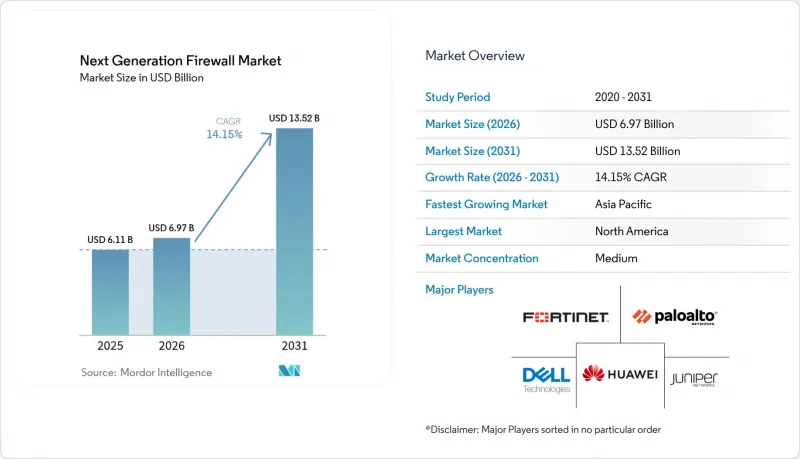
本報告按公司規模(中小企業和大型企業)、解決方案類型(硬體設備和虛擬/雲端解決方案)、部署模式(本地部署、公共雲端等)、最終用戶產業(銀行、金融服務和保險 (BFSI)、資訊科技 (IT) 和電信等)以及地區進行細分。市場預測以價值(美元)表示。
全球新一代防火牆市場趨勢與洞察
雲端遷移的加速發展催生了對 L7 相容的內聯安全的需求。
目前,68% 的企業工作負載運行在公有雲、私有雲或混合雲端上,這導致東西向流量暴露在外,而傳統防火牆無法對其進行檢測。與僅依賴邊界防護的控制措施相比,具備應用感知偵測能力的雲端原生新世代防火牆 (NGFW) 可將平均威脅偵測時間縮短 63%,並將安全事件減少 47%。對微服務的深度可見性使安全團隊能夠維護統一的策略。預計到 2025 年,72% 的企業將增加其雲端預算,因此 NGFW 已穩固確立其作為分散式架構控制平面的地位。
混合辦公模式的普及擴大了攻擊面。
隨著混合辦公模式成為常態,遠端存取終端數量激增,目前已有 42% 的設備處於非託管狀態。採用零信任網路存取機制的新一代防火牆 (NGFW)檢驗所有連接,推動 SonicWall 雲端安全邊緣 (Cloud Secure Edge) 的訂單年增 54%。身分感知策略可防止憑證濫用,有效應對自 2023 年以來成長 37% 的攻擊,同時為企業提供保障員工在公司網路和家庭網路之間切換安全的方法。
ASIC晶片資本密集的發展藍圖阻礙了中小企業價格的下降。
高性能的SSL/TLS解密能力正迫使供應商採用客製化晶片。 Fortinet的SP5處理器顯著降低了功耗,同時將防火牆吞吐量提高了七倍,但研發成本的負擔使得入門級產品價格居高不下,43%的中小型企業表示成本是最大的障礙。雖然ASIC晶片能夠提供更高的能源效率(FortiGate 70G每Gbps的功耗僅為競爭對手的1/62),但對於預算有限的買家來說,初始成本仍然是一筆不小的負擔。
細分市場分析
大型企業憑藉著充足的預算,能夠部署多Gigabit設備,實現加密流量的零延遲偵測,預計到2025年,這些設備將貢獻69.25%的收入。它們仍然傾向於在設備上採用ASIC加速技術,並結合集中式策略編配。相較之下,中小企業預計到2031年將實現16.05%的複合年成長率,主要得益於計量型和降低資本門檻的託管服務。靈活的授權方案和承包管理服務使資源有限的團隊能夠在利用企業級控制的同時,將複雜的任務外包出去。因此,下一代防火牆市場正在提供兩種截然不同的價值提案:為全球跨國公司提供毫不妥協的吞吐量,以及為中小企業提供簡化的、以服務主導的解決方案。
監管義務也在影響支出模式。大規模組織必須遵守嚴格的審計追蹤要求,並展現對資料中心、分店和子公司的精細化控制。同時,中小企業 (SME) 更傾向於將 SD-WAN、IPS 和零信任存取整合到單一堆堆疊中的平台,以避免「工具氾濫」。隨著計量收費虛擬防火牆的日益普及,下一代防火牆市場預計將繼續對新用戶開放,尤其是在資本密集度較高的開發中國家。
到2025年,硬體設備將保持54.35%的市場佔有率,這反映了它們在本地資料中心中可靠的性能特性。旗艦級產品,例如搭載ASIC晶片的FortiGate 700G,可提供164 Gbps的防火牆吞吐量,其能源效率是業界平均的七倍。這清楚地表明了為什麼處理高頻寬的運營商仍然傾向於使用實體設備來確保確定性的延遲。同時,虛擬和雲端解決方案的收入正以15.1%的複合年成長率成長,這得益於彈性工作負載和「基礎設施即代碼」的經濟效益。
雲端託管的新一代防火牆 (NGFW) 在集中式 AI 分析能力方面表現卓越,能夠關聯多個租戶的威脅。 Versa Networks 在獨立安全測試中取得了 99.90% 的得分,展現出與現有硬體供應商相媲美的性能。隨著企業精簡其工具鏈,將防火牆功能整合到全面的 SASE 和 SSE 框架中已成為日益成長的趨勢,從而推動了虛擬產品的普及。這種綜合發展將使下一代防火牆市場能夠同時滿足資料中心對效能的嚴苛需求和敏捷 DevOps 管線的需求。
區域分析
北美保持領先地位,預計到2025年將佔據35.60%的市場。零信任框架的早期應用、NIST指南等合規因素以及主要供應商的存在,都支撐了高支出水準。美國金融服務和醫療保健機構優先考慮對加密流量進行詳細檢查和微隔離,從而推動了對高階設備的需求。聯邦政府的關鍵基礎設施現代化項目也進一步擴大了採購規模。
預計到2031年,亞太地區的年複合成長率將達到15.95%。日本、印度和新加坡的主權雲端政策,以及快速發展的數位服務經濟,正在加速雲端原生防禦技術的普及。 Palo Alto Networks近期將Prisma Access Browser擴展到區域資料中心,凸顯了該公司致力於在滿足居住要求的同時,實現安全遠端存取的承諾。託管安全服務的擴展也有助於彌補技能缺口,使企業無需組建大規模的內部團隊即可部署企業級下一代防火牆(NGFW)功能。
鑑於GDPR和NIS2指令強制要求強而有力的流量檢查和資料處理安全措施,歐洲市場潛力巨大。即將實施的歐盟人工智慧法更加強調在安全產品中負責任地整合人工智慧,這將影響供應商對其威脅偵測引擎的定位。關鍵基礎設施營運商,包括能源、運輸和金融市場基礎設施營運商,對人工智慧的需求尤其強勁。
在中東和非洲地區,隨著5G、智慧城市專案和電子政府平台作為國家數位轉型策略的一部分被廣泛部署,市場呈現強勁成長動能。沙烏地阿拉伯和阿拉伯聯合大公國(阿拉伯聯合大公國)在網路安全領域投入了大量GDP,導致競爭競標激烈。買家需要具備後量子加密能力和靈活的使用模式。儘管市場規模較小,但這些地區正在為下一代防火牆市場帶來多元化,並為系統整合商創造新的銷售機會。
其他好處:
- Excel格式的市場預測(ME)表
- 3個月的分析師支持
目錄
第1章:引言
- 研究假設和市場定義
- 調查範圍
第2章:調查方法
第3章執行摘要
第4章 市場狀況
- 市場概覽
- 市場促進因素
- 隨著雲端遷移的加速,L7 相容的內聯安全變得越來越重要。
- 混合工作方式的廣泛採用正在擴大攻擊目標的範圍。
- 強制在受監管產業實施零信任架構
- 將人工智慧驅動的即時威脅情報來源整合到下一代防火牆中
- Sovereign Cloud 的各項舉措正在推動該地區對新一代防火牆 (NGFW) 的支出。
- 市場限制因素
- ASIC晶片的資本密集發展藍圖限制了面向中小企業的產品的價格下降空間。
- 深層封包檢測人員短缺導致服務成本上升。
- 關於資料儲存位置的法律不一致,正在減緩基於 SaaS 的下一代防火牆在全球範圍內的普及。
- 開放原始碼eBPF 防火牆正在蠶食入門級產品的收入。
- 供應鏈分析
- 監理情勢
- 技術展望
- 波特五力模型
第5章 市場規模與成長預測
- 按公司規模
- 中小企業
- 大公司
- 按解決方案類型
- 硬體設備
- 虛擬/雲端
- 部署模式
- 現場
- 公共雲端
- 私有雲/混合雲端
- 按最終用戶行業分類
- 銀行、金融服務和保險(BFSI)
- 資訊科技(IT)和通訊
- 政府/國防
- 衛生保健
- 製造業
- 零售與電子商務
- 能源公用事業
- 其他
- 按地區
- 北美洲
- 美國
- 加拿大
- 墨西哥
- 南美洲
- 巴西
- 阿根廷
- 其他南美國家
- 歐洲
- 英國
- 德國
- 法國
- 俄羅斯
- 其他歐洲國家
- 亞太地區
- 中國
- 日本
- 印度
- 韓國
- 澳洲和紐西蘭
- 其他亞太國家
- 中東和非洲
- 中東
- 沙烏地阿拉伯
- 阿拉伯聯合大公國
- 土耳其
- 其他中東國家
- 非洲
- 南非
- 奈及利亞
- 其他非洲國家
- 中東
- 北美洲
第6章 競爭情勢
- 市場集中度
- 策略趨勢
- 市佔率分析
- 公司簡介
- Palo Alto Networks Inc.
- Fortinet Inc.
- Cisco Systems Inc.
- Check Point Software Technologies Ltd.
- Juniper Networks Inc.
- Huawei Technologies Co. Ltd.
- Dell Technologies(SonicWall)
- SonicWall Inc.
- Barracuda Networks Inc.
- Forcepoint LLC
- WatchGuard Technologies Inc.
- Sophos Ltd.
- Hillstone Networks
- Zscaler Inc.
- Untangle Inc.
- Trend Micro Inc.
- Alibaba Cloud
- F5 Inc.
- VMware Inc.
- Meraki(Cisco)
- GajShield Infotech
- A10 Networks Inc.
第7章 市場機會與未來展望
According to Mordor Intelligence, next generation firewall market size in 2026 is estimated at USD 6.97 billion, growing from 2025 value of USD 6.11 billion with 2031 projections showing USD 13.52 billion, growing at 14.15% CAGR over 2026-2031.
This report is Segmented by Enterprise Size (SMEs and Large Enterprises), Solution Type (Hardware Appliance and Virtual / Cloud-Based), Deployment Mode (On-Premises, Public Cloud, and More), End-User Industry (Banking, Financial Services and Insurance (BFSI), Information Technology (IT) and Telecom, and More), and Geography. The Market Forecasts are Provided in Terms of Value (USD).
Global Next Generation Firewall Market Trends and Insights
Accelerated cloud migration demands inline L7-aware security
Sixty-eight percent of enterprise workloads now run in public, private, or hybrid clouds, exposing east-west traffic that legacy firewalls cannot inspect. Cloud-native NGFWs equipped with application-aware inspection shorten average threat detection time by 63% and cut security incidents by 47% compared with perimeter-only controls. Deep visibility across microservices lets security teams retain uniform policies as 72% of enterprises boost cloud budgets in 2025, firmly positioning NGFWs as the control plane for distributed architectures.
Hybrid-work proliferation expanding attack surface
Remote access endpoints grew sharply when hybrid work became permanent, with 42% of devices now unmanaged. NGFWs that embed zero-trust network access validate every connection and have driven a 54% year-on-year booking increase for SonicWall's Cloud Secure Edge. Identity-aware policies prevent credential abuse, addressing the 37% rise in such attacks since 2023, and equip firms to secure staff who move between corporate and home networks.
Capital-intensive ASIC road-map limits SMB-grade price declines
High-performance SSL/TLS decryption drives vendors toward custom silicon. Fortinet's SP5 processor gives 7X higher firewall throughput while consuming far less power, yet the research and development outlay keeps entry-level pricing elevated, with 43% of small businesses citing cost as the chief barrier. Although ASICs improve energy efficiency-FortiGate 70G needs 62X fewer watts per Gbps than rivals-the upfront spend remains daunting for budget-constrained buyers.
Other drivers and restraints analyzed in the detailed report include:
- Mandatory zero-trust architecture roll-outs in regulated sectors
- AI-driven threat intelligence transforms detection capabilities
- Shortage of deep-packet-inspection talent raises service costs
For complete list of drivers and restraints, kindly check the Table Of Contents.
Segment Analysis
Large enterprises contributed 69.25% of 2025 revenue as their sizable budgets allowed deployment of multi-gigabit appliances inspecting encrypted traffic without latency. They continue to favor on-appliance ASIC acceleration paired with centralized policy orchestration. In contrast, SMEs are forecast to post a 16.05% CAGR to 2031, propelled by consumption-based subscriptions and managed services that lower capital hurdles. Flexible licensing and turnkey management let resource-limited teams gain enterprise-grade controls while outsourcing complexity. As a result, the next generation firewall market captures two distinct value propositions: uncompromising throughput for global multinationals and simplified, service-led offerings for smaller firms.
Regulatory obligations also shape spending patterns. Larger organizations confront stringent audit trails and must demonstrate granular control across data centers, branches, and subsidiaries. Smaller companies, meanwhile, gravitate toward consolidated platforms that integrate SD-WAN, IPS, and zero-trust access in a single stack, avoiding "tool sprawl." The widening availability of pay-as-you-go virtual firewalls is expected to keep the next generation firewall market accessible to new adopters, especially across developing economies where capital intensity is a concern.
Hardware appliances retained 54.35% share in 2025, reflecting trusted performance characteristics within on-premises data centers. ASIC-laden flagships such as the FortiGate 700G deliver 164 Gbps firewall throughput at 7X better power efficiency than the industry mean, underscoring why high-bandwidth operators continue to prefer physical devices for deterministic latency. Meanwhile, the portion of revenue from virtual and cloud-based offerings is rising at a 15.1% CAGR, accelerated by elastic workloads and the economics of infrastructure-as-code.
Cloud-hosted NGFWs draw strength from centralized AI analytics that correlate threats across multiple tenants. Versa Networks scored 99.90% in independent security tests, signaling parity with hardware incumbents. As enterprises rationalize toolchains, they increasingly embed firewall functions within holistic SASE or SSE frameworks, boosting attach rates for virtual products. This dual-track evolution ensures the next generation firewall market addresses both performance-bound data-center needs and agile DevOps pipelines.
Complete Report Scope:
- By Enterprise Size
- Small and Medium Enterprises (SMEs)
- Large Enterprises
- By Solution Type
- Hardware Appliance
- Virtual / Cloud-based
- By Deployment Mode
- On-premises
- Public Cloud
- Private / Hybrid Cloud
- By End-User Industry
- Banking, Financial Services and Insurance (BFSI)
- Information Technology (IT) and Telecom
- Government and Defense
- Healthcare
- Manufacturing
- Retail and E-commerce
- Energy and Utilities
- Others
- By Geography
- North America
- United States
- Canada
- Mexico
- South America
- Brazil
- Argentina
- Rest of South America
- Europe
- United Kingdom
- Germany
- France
- Russia
- Rest of Europe
- Asia-Pacific
- China
- Japan
- India
- South Korea
- Australia and New Zealand
- Rest of Asia-Pacific
- Middle East and Africa
- Middle East
- Saudi Arabia
- United Arab Emirates
- Turkey
- Rest of Middle East
- Africa
- South Africa
- Nigeria
- Rest of Africa
- Middle East
- North America
Geography Analysis
North America maintained first place with a 35.60% share in 2025. Early adoption of zero-trust frameworks, compliance drivers such as the NIST guidelines, and the presence of leading vendors sustain high spending depths. Financial services and healthcare institutions in the United States prioritize deep inspection of encrypted traffic and micro-segmentation, reinforcing demand for high-end appliances. Federal programs that modernize critical infrastructure further amplify procurement.
Asia-Pacific is projected to grow at 15.95% CAGR through 2031. Sovereign-cloud policies in Japan, India, and Singapore, together with a surging digital-services economy, accelerate rollouts of cloud-native defenses. Palo Alto Networks' recent expansion of Prisma Access Browser to regional data centers underlines vendor efforts to meet residency rules while enabling secure remote access. The climb in managed security services also addresses skills shortages, allowing enterprises to deploy enterprise-grade NGFW capabilities without large in-house teams.
Europe forms a sizable addressable base as GDPR and the NIS2 Directive require robust traffic inspection and data-handling safeguards. The forthcoming EU AI Act places new emphasis on responsible AI integration within security products, influencing how vendors position threat-detection engines. Demand is notable among critical infrastructure operators in energy, transport, and financial market utilities.
The Middle East and Africa are registering solid growth as national digital-transformation agendas roll out 5G, smart-city projects, and e-government platforms. Robust GDP allocation to cybersecurity in Saudi Arabia and the United Arab Emirates stimulates competitive tenders, with buyers looking for post-quantum cryptography readiness and flexible consumption models. Although starting from a smaller base, these regions add diversity to the next generation firewall market and open channel opportunities for system integrators.
- Palo Alto Networks Inc.
- Fortinet Inc.
- Cisco Systems Inc.
- Check Point Software Technologies Ltd.
- Juniper Networks Inc.
- Huawei Technologies Co. Ltd.
- Dell Technologies (SonicWall)
- SonicWall Inc.
- Barracuda Networks Inc.
- Forcepoint LLC
- WatchGuard Technologies Inc.
- Sophos Ltd.
- Hillstone Networks
- Zscaler Inc.
- Untangle Inc.
- Trend Micro Inc.
- Alibaba Cloud
- F5 Inc.
- VMware Inc.
- Meraki (Cisco)
- GajShield Infotech
- A10 Networks Inc.
Additional Benefits:
- The market estimate (ME) sheet in Excel format
- 3 months of analyst support
TABLE OF CONTENTS
1 INTRODUCTION
- 1.1 Study Assumptions and Market Definition
- 1.2 Scope of the Study
2 RESEARCH METHODOLOGY
3 EXECUTIVE SUMMARY
4 MARKET LANDSCAPE
- 4.1 Market Overview
- 4.2 Market Drivers
- 4.2.1 Accelerated cloud migration demands inline L7-aware security
- 4.2.2 Hybrid-work proliferation expanding attack surface
- 4.2.3 Mandatory zero-trust architecture roll-outs in regulated sectors
- 4.2.4 AI-driven, real-time threat-intel feeds embedded in NGFWs
- 4.2.5 Sovereign-cloud initiatives boosting regional NGFW spend
- 4.3 Market Restraints
- 4.3.1 Capital-intensive ASIC road-map limits SMB-grade price declines
- 4.3.2 Shortage of deep-packet-inspection talent raises service costs
- 4.3.3 Fragmented data-residency laws slowing global SaaS NGFW uptake
- 4.3.4 Open-source eBPF firewalls eroding entry-level revenues
- 4.4 Supply Chain Analysis
- 4.5 Regulatory Landscape
- 4.6 Technological Outlook
- 4.7 Porter's Five Forces
- 4.7.1 Threat of New Entrants
- 4.7.2 Bargaining Power of Buyers
- 4.7.3 Bargaining Power of Suppliers
- 4.7.4 Threat of Substitutes
- 4.7.5 Intensity of Competitive Rivalry
5 MARKET SIZE AND GROWTH FORECASTS (VALUE)
- 5.1 By Enterprise Size
- 5.1.1 Small and Medium Enterprises (SMEs)
- 5.1.2 Large Enterprises
- 5.2 By Solution Type
- 5.2.1 Hardware Appliance
- 5.2.2 Virtual / Cloud-based
- 5.3 By Deployment Mode
- 5.3.1 On-premises
- 5.3.2 Public Cloud
- 5.3.3 Private / Hybrid Cloud
- 5.4 By End-User Industry
- 5.4.1 Banking, Financial Services and Insurance (BFSI)
- 5.4.2 Information Technology (IT) and Telecom
- 5.4.3 Government and Defense
- 5.4.4 Healthcare
- 5.4.5 Manufacturing
- 5.4.6 Retail and E-commerce
- 5.4.7 Energy and Utilities
- 5.4.8 Others
- 5.5 By Geography
- 5.5.1 North America
- 5.5.1.1 United States
- 5.5.1.2 Canada
- 5.5.1.3 Mexico
- 5.5.2 South America
- 5.5.2.1 Brazil
- 5.5.2.2 Argentina
- 5.5.2.3 Rest of South America
- 5.5.3 Europe
- 5.5.3.1 United Kingdom
- 5.5.3.2 Germany
- 5.5.3.3 France
- 5.5.3.4 Russia
- 5.5.3.5 Rest of Europe
- 5.5.4 Asia-Pacific
- 5.5.4.1 China
- 5.5.4.2 Japan
- 5.5.4.3 India
- 5.5.4.4 South Korea
- 5.5.4.5 Australia and New Zealand
- 5.5.4.6 Rest of Asia-Pacific
- 5.5.5 Middle East and Africa
- 5.5.5.1 Middle East
- 5.5.5.1.1 Saudi Arabia
- 5.5.5.1.2 United Arab Emirates
- 5.5.5.1.3 Turkey
- 5.5.5.1.4 Rest of Middle East
- 5.5.5.2 Africa
- 5.5.5.2.1 South Africa
- 5.5.5.2.2 Nigeria
- 5.5.5.2.3 Rest of Africa
- 5.5.5.1 Middle East
- 5.5.1 North America
6 COMPETITIVE LANDSCAPE
- 6.1 Market Concentration
- 6.2 Strategic Moves
- 6.3 Market Share Analysis
- 6.4 Company Profiles (includes Global-level Overview, Market-level Overview, Core Segments, Financials as available, Strategic Information, Market Rank/Share, Products and Services, Recent Developments)
- 6.4.1 Palo Alto Networks Inc.
- 6.4.2 Fortinet Inc.
- 6.4.3 Cisco Systems Inc.
- 6.4.4 Check Point Software Technologies Ltd.
- 6.4.5 Juniper Networks Inc.
- 6.4.6 Huawei Technologies Co. Ltd.
- 6.4.7 Dell Technologies (SonicWall)
- 6.4.8 SonicWall Inc.
- 6.4.9 Barracuda Networks Inc.
- 6.4.10 Forcepoint LLC
- 6.4.11 WatchGuard Technologies Inc.
- 6.4.12 Sophos Ltd.
- 6.4.13 Hillstone Networks
- 6.4.14 Zscaler Inc.
- 6.4.15 Untangle Inc.
- 6.4.16 Trend Micro Inc.
- 6.4.17 Alibaba Cloud
- 6.4.18 F5 Inc.
- 6.4.19 VMware Inc.
- 6.4.20 Meraki (Cisco)
- 6.4.21 GajShield Infotech
- 6.4.22 A10 Networks Inc.
7 MARKET OPPORTUNITIES AND FUTURE OUTLOOK
- 7.1 White-space and Unmet Need Analysis

 硬體防火牆:市場佔有率分析、產業趨勢與統計、成長預測(2026-2031)
 企業網路防火牆市場:2026-2032年全球市場預測(依組件、防火牆技術、吞吐量頻寬、企業規模、部署類型、用例和產業分類)網站開發:市場佔有率分析、產業趨勢與統計、成長預測(2026-2031)
 新一代防火牆市場規模、佔有率和成長分析:按產品、部署類型、企業規模、最終用戶產業和地區分類-2026-2033年產業預測
 新一代防火牆市場報告:按類型、部署模式、安全類型、組織規模、產業和地區分類(2026-2034 年)網域名稱系統防火牆:市場佔有率分析、產業趨勢與統計、成長預測(2026-2031)
 域名系統(DNS)防火牆全球市場規模、佔有率、趨勢和成長分析報告(2026-2034)
 2026年全球網站開發市場報告
 全球新一代防火牆市場:按組件、部署方式、企業規模、產業和地區分類新一代防火牆市場:按組件、部署模式、功能、組織規模、產業和銷售管道分類-2026-2032年全球市場預測