


 |
市場調查報告書
商品編碼
2125508
歐洲暖通空調服務:市場佔有率分析、產業趨勢與統計及成長預測(2026-2031 年)Europe HVAC Services - Market Share Analysis, Industry Trends & Statistics, Growth Forecasts (2026 - 2031) |
||||||

※ 本網頁內容可能與最新版本有所差異。詳細情況請與我們聯繫。
根據 Mordor Intelligence 預測,歐洲 HVAC 服務市場規模預計在 2025 年達到 156.4 億美元,2026 年達到 168.2 億美元,2031 年達到 236.3 億美元。
預計從 2026 年到 2031 年,其複合年成長率將達到 7.04%。
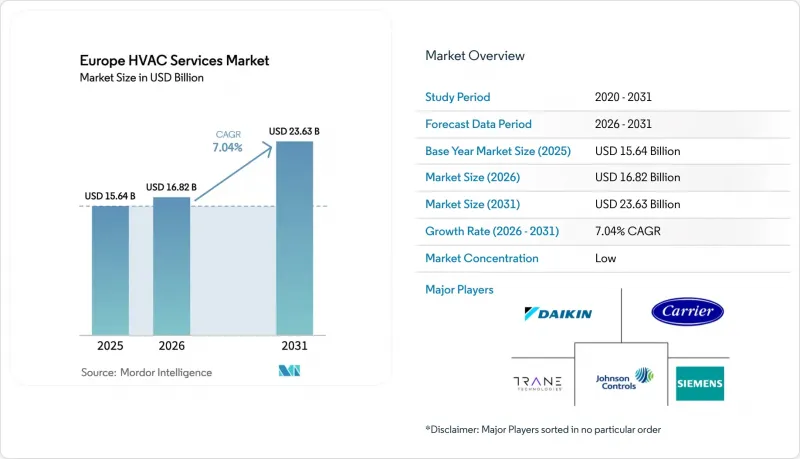
本報告按服務類型(維護/維修、安裝等)、實施方式(新建、既有建築維修)、最終用戶行業(住宅等)、服務交付模式(傳統工時/材料合約、基於結果的能源合約等)和地區進行分類。市場預測以美元計價。
歐洲暖通空調服務市場的趨勢與洞察
歐盟強制推行“革新浪潮”
歐盟委員會的目標是到2030年維修3,500萬棟建築,通常要求維修結合外圍護結構保溫、熱泵和智慧控制系統。德國已累計144.5億美元用於2024年符合資格的維修,補貼高達70%的費用;法國和荷蘭也推出了類似的津貼計劃,將五年服務合約與獎勵付款掛鉤。歐洲約四分之三的建築是在1990年以前按照能源效率標準建造的,因此,預計未來十年,遵守相關法規將為歐洲供暖、通風和空調(HVAC)服務市場創造穩定的需求。合格標準有利於獲得認證的承包商,從而確保持續的維護收入。隨著補貼的持續投入,能夠提供承包維修服務供應商將更有可能獲得高利潤率。
熱泵更換熱潮
到2024年,德國將安裝超過35.6萬台老舊鍋爐,歐盟範圍內數百萬台鍋爐也即將達到使用壽命。鍋爐維修需求燃氣鍋爐更換需求高出40%至60%,推高了歐洲暖氣、通風和空調(HVAC)服務市場的平均交易額。光是波蘭的「我的熱力」(My Heat)計畫就將在2026年前投資32.1億美元用於住宅熱泵的安裝。只要電價與氣價之比保持在4:1以下,從總擁有成本(TCO)的角度來看,電系統將始終更具優勢。然而,由於技術人員短缺,德國的等待時間長達16週,促使供應商加強培訓投入並收購小規模安裝商。
缺乏持有F-gas認證的技術人員
歐洲目前約有36.7萬名認證技術人員,但為達成政策目標,到2030年還需要新增7萬至50萬名技術人員。認證課程長度可達80小時,每位學員的費用在1,605美元至3,210美元之間。由此造成的人手不足導致德國的維修服務費用高達192.60美元,給對價格敏感的住宅項目的利潤率帶來了壓力。這套瓶頸尤其延誤了需要具備複雜整合技能的承包商的維修專案的工期。
細分市場分析
到2025年,基於整個歐洲大陸超過1.8億台暖通空調設備的安裝量,維護和維修將佔總收入的46.74%。然而,智慧互聯營運和維護預計到2031年將以每年7.39%的速度成長,因為機器學習平台可以提前數天預測故障,並將停機時間減少高達35%。該領域向預測分析的轉變已使合約價值從每台設備每年85.60美元成長到超過428美元。安裝服務仍然至關重要,熱泵更換和液冷系統大修等服務維持著7.2%的成長率。在德國,遠距離診斷正在推動利潤成長,因為單次現場維修的平均成本為128.40美元。線上市場的興起使住宅通路的安裝價格下降了高達15%,迫使供應商提供捆綁式10年保固以保障其收入來源。因此,歐洲暖通空調服務市場正在向數位化服務模式轉變,這種模式透過數據而不是人員數量來獲利。
智慧平台還能實現詳細的能源報告,這是多項歐盟指令所要求的。開利公司的「Abound」套件可監控200萬台連網設備,並透過在非尖峰時段安排維護,將工作時間縮短了18%。將收入的4%至6%投資於數位孿生的供應商報告稱,其服務利潤率提高了200至300個基點。同時,如果傳統維護企業不整合物聯網功能,則面臨收入下滑的風險。隨著訂閱制的遠端監控發展到關鍵階段,預計到2020年代末,歐洲暖通空調服務市場中智慧互聯契約的市場規模將超過傳統維護市場。
到2025年,維修工程將佔安裝收入的58.59%,到2031年複合年成長率將達到7.84%,比新建案高出110個基點。考慮到節能和避免碳排放稅,深度節能方案的內部報酬率將高達9%。勘測、石棉清除和舊有系統整合等服務將使每平方公尺維修工程的業務收益比新建工程高出40%至60%。新建市場成長率為6.74%,受益於熱泵在北歐市場成為標準熱源,但與開發商的艱難談判正在擠壓利潤空間。利率上升導致德國2024年住宅量下降18%,維修許可證數量增加了27%。因此,預計在整個預測期內,維修在歐洲暖通空調服務市場的佔有率將持續擴大。
政策失衡是推動這一趨勢的因素。修訂後的《建築能源性能指令》針對的是能源性能排名後15%的現有建築,這意味著如果業主不採取行動,他們的房產價值將面臨下降。補貼計畫更重視徹底的維修,在德國,符合資格的翻新費用最高可獲得70%的津貼。人手不足仍然是一個不確定因素,但它也推動了數位監控工具的應用,從而減少了現場工作時間。最終,與維修活動相關的歐洲暖通空調服務市場規模預計將在長期內推動市場發展,尤其是在碳價格上漲的情況下。
其他好處:
- Excel格式的市場預測(ME)表
- 3個月的分析師支持
目錄
第1章:引言
- 研究假設和市場定義
- 調查範圍
第2章:調查方法
第3章執行摘要
第4章 市場狀況
- 市場概覽
- 市場促進因素
- 歐盟關於「翻新浪潮」的強制規定
- 熱泵更換熱潮
- 節能改造需求維修
- 資料中心冷卻需求激增。
- 「供熱即服務」合約的擴展
- 利用季節性蓄熱系統進行營運和維護 (O&M) 的收入來源。
- 市場限制因素
- 缺乏持有F-gas認證的技術人員
- 舊有系統中物聯網實施成本高
- 熱泵需求激增導致壓縮機供應鏈脆弱性增加
- 遠端維護中資料隱私合規的負擔
- 宏觀經濟因素對市場的影響
- 產業價值鏈分析
- 監理情勢
- 技術展望
- 波特五力分析
- 投資分析
第5章 市場規模與成長預測
- 按服務類型
- 維護/修理
- 安裝
- 智慧互聯運維;
- 按實現類型
- 新建工程
- 現有建築物的維修
- 按最終用戶行業分類
- 住宅
- 非住宅
- 商業的
- 產業
- 對於公共機構
- 按服務交付模式
- 傳統工時和材料合約
- 基於績效的能源合約
- 熱力即服務合約
- 基於訂閱的遠端監控
- 國家
- 德國
- 英國
- 法國
- 義大利
- 西班牙
- 其他歐洲國家
第6章 競爭情勢
- 市場集中度
- 策略趨勢
- 市佔率分析
- 公司簡介
- Johnson Controls International PLC
- Carrier Corporation
- Daikin Industries Ltd
- Vaillant Group
- Aggreko PLC
- Aermec SpA
- Trane Technologies PLC
- Bosch Thermotechnology GmbH
- Siemens Building Technologies
- Honeywell International Inc.
- BDR Thermea Group
- Ingersoll Rand PLC
- Crystal Air Holdings Limited
- Klima Venta
- IAC Vestcold AS
- Airedale International Air Conditioning Ltd
- Envirotec Limited
- Kospel SA
- Spectrum Engineering Limited
- Pentair Inc.
第7章 市場機會與未來展望
According to Mordor Intelligence, the Europe HVAC services market size is projected to be USD 15.64 billion in 2025, USD 16.82 billion in 2026, and reach USD 23.63 billion by 2031, growing at a CAGR of 7.04% from 2026 to 2031.
This report is Segmented by Type of Service (Maintenance and Repair, Installation, and More), Implementation Type (New Construction, and Retrofit Buildings), End-User Industry (Residential, and More), Service Delivery Model (Conventional Time-And-Material Contracts, Performance-Based Energy Contracts, and More), and Geography. The Market Forecasts are Provided in Terms of Value (USD).
Europe HVAC Services Market Trends and Insights
EU Renovation Wave Mandates
The European Commission intends to renovate 35 million buildings by 2030, forcing upgrades that normally bundle envelope insulation, heat pumps, and smart controls. Germany allocated USD 14.45 billion in 2024 to subsidize up to 70% of qualifying retrofit costs, and both France and the Netherlands run parallel grant schemes that link incentive payouts to five-year service contracts. Because roughly three-quarters of Europe's stock predates 1990 efficiency codes, compliance guarantees a decade-long pipeline for the Europe heating, ventilation, and air conditioning services market. Eligibility rules favour certified installers, locking in recurring maintenance revenue. As subsidy budgets roll forward, service providers capable of delivering turnkey retrofits are positioned to capture premium margins.
Heat-Pump Replacement Boom
More than 356,000 units were installed in Germany during 2024, and millions of aging boilers across the bloc are entering end-of-life cycles. Service intensity runs 40%-60% higher than gas-boiler swaps, lifting average ticket sizes for the Europe heating, ventilation, and air conditioning services market. Poland's "My Heat" scheme alone directs USD 3.21 billion toward residential heat-pump adoption by 2026. Total cost-of-ownership models consistently favour electric systems whenever electricity-to-gas price ratios hold below four-to-one. Yet technician scarcity has pushed wait times to 16 weeks in Germany, nudging providers to invest in training and acquisition of smaller installers.
Shortage of F-Gas-Certified Technicians
Europe maintains roughly 367,000 certified technicians, yet needs an additional 70,000-500,000 by 2030 to meet policy targets. Certification courses require up to 80 hours and cost USD 1,605-3,210 per trainee. Resulting labour scarcity inflates service-call fees to USD 192.60 in Germany, eroding margins for price-sensitive residential projects. The bottleneck particularly hampers retrofit timelines where complex integrations demand seasoned installers.
Other drivers and restraints analyzed in the detailed report include:
- Growing Demand for Energy-Efficient Retrofits
- Data-Center Cooling Demand Surge
- High IoT Retrofit Costs for Legacy Systems
For complete list of drivers and restraints, kindly check the Table Of Contents.
Segment Analysis
Maintenance and repair represented 46.74% of revenue in 2025, anchored by an installed base exceeding 180 million HVAC units across the continent. Smart-connected operations and maintenance, however, is expanding at 7.39% to 2031 as machine-learning platforms forecast faults days in advance, cutting downtime by up to 35%. The segment's shift toward predictive analytics elevates contract values from USD 85.60 to beyond USD 428 per unit annually. Installation services are still vital, growing at 7.2% thanks to heat-pump swaps and liquid-cooling overhauls. In Germany, the average truck-roll cost of USD 128.40 incentivizes remote diagnostics, bolstering margins. Online marketplaces are compressing installer prices by as much as 15% in residential channels, compelling providers to bundle ten-year warranties to protect revenue streams. Consequently, the Europe HVAC services market is tilting toward digitally enabled service models that monetize data rather than headcount.
Smart platforms also enable granular energy reporting, a requirement under multiple EU directives. Carrier's Abound suite monitors 2 million connected units, scheduling maintenance during off-peak hours and reducing labour hours by 18%. Providers investing 4%-6% of revenue in digital twin's report service-margin lifts of 200-300 basis points. Meanwhile, traditional maintenance businesses risk erosion unless they integrate IoT competencies. As subscription remote monitoring reaches critical mass, the Europe HVAC services market size for smart-connected contracts is poised to surpass conventional maintenance by the late 2020s.
Retrofit projects accounted for 58.59% of implementation revenue in 2025, and their 7.84% CAGR through 2031 outpaces new construction by 110 basis points. Deep-energy packages yield internal rates of return up to 9% when energy savings and avoided carbon taxes are considered. Each retrofit square meter generates 40%-60% more service revenue than new builds owing to surveys, asbestos mitigation, and legacy system integration. New construction, growing at 6.74%, benefits from heat pumps becoming the default heat source across Nordic markets, yet aggressive developer negotiations compress margins. Rising interest rates trimmed German housing starts by 18% in 2024, whereas retrofit permits climbed 27%. As a result, the retrofit share within the Europe HVAC services market will continue expanding throughout the forecast horizon.
Policy asymmetry reinforces this trend. The revised Energy Performance of Buildings Directive targets the worst 15% of stock, compelling landlords to act or risk asset devaluation. Subsidies tilt further toward retrofit depth, with German grants covering up to 70% of qualifying costs. Labor scarcity remains a wild card but also encourages digital oversight tools that reduce onsite time. Ultimately, the Europe HVAC services market size tied to retrofit activity is likely to dominate long term, particularly as carbon prices tighten.
Complete Report Scope:
- By Type of Service
- Maintenance and Repair
- Installation
- Smart-Connected O&M
- By Implementation Type
- New Construction
- Retrofit Buildings
- By End-User Industry
- Residential
- Non-Residential
- Commercial
- Industrial
- Public and Institutional
- By Service Delivery Model
- Conventional Time-and-Material Contracts
- Performance-Based Energy Contracts
- Heat-as-a-Service Contracting
- Subscription Remote Monitoring
- By Country
- Germany
- United Kingdom
- France
- Italy
- Spain
- Rest of Europe
List of Companies Covered in this Report:
- Johnson Controls International PLC
- Carrier Corporation
- Daikin Industries Ltd
- Vaillant Group
- Aggreko PLC
- Aermec SpA
- Trane Technologies PLC
- Bosch Thermotechnology GmbH
- Siemens Building Technologies
- Honeywell International Inc.
- BDR Thermea Group
- Ingersoll Rand PLC
- Crystal Air Holdings Limited
- Klima Venta
- IAC Vestcold AS
- Airedale International Air Conditioning Ltd
- Envirotec Limited
- Kospel SA
- Spectrum Engineering Limited
- Pentair Inc.
Additional Benefits:
- The market estimate (ME) sheet in Excel format
- 3 months of analyst support
TABLE OF CONTENTS
1 INTRODUCTION
- 1.1 Study Assumptions and Market Definition
- 1.2 Scope of the Study
2 RESEARCH METHODOLOGY
3 EXECUTIVE SUMMARY
4 MARKET LANDSCAPE
- 4.1 Market Overview
- 4.2 Market Drivers
- 4.2.1 EU Renovation Wave Mandates
- 4.2.2 Heat-Pump Replacement Boom
- 4.2.3 Growing Demand for Energy-Efficient Retrofits
- 4.2.4 Data-Center Cooling Demand Surge
- 4.2.5 Expansion of Heat-as-a-Service Contracting
- 4.2.6 Seasonal Thermal-Storage-Enabled O&M Revenue Streams
- 4.3 Market Restraints
- 4.3.1 Shortage of F-Gas-Certified Technicians
- 4.3.2 High IoT Retrofit Costs for Legacy Systems
- 4.3.3 Compressor Supply-Chain Vulnerability Amid Heat-Pump Spike
- 4.3.4 Data-Privacy Compliance Burdens on Remote Maintenance
- 4.4 Impact of Macroeconomic Factors on the Market
- 4.5 Industry Value-Chain Analysis
- 4.6 Regulatory Landscape
- 4.7 Technological Outlook
- 4.8 Porter's Five Forces Analysis
- 4.8.1 Bargaining Power of Suppliers
- 4.8.2 Bargaining Power of Buyers
- 4.8.3 Threat of New Entrants
- 4.8.4 Threat of Substitute Products
- 4.8.5 Intensity of Competitive Rivalry
- 4.9 Investment Analysis
5 MARKET SIZE AND GROWTH FORECASTS (VALUE)
- 5.1 By Type of Service
- 5.1.1 Maintenance and Repair
- 5.1.2 Installation
- 5.1.3 Smart-Connected O&M
- 5.2 By Implementation Type
- 5.2.1 New Construction
- 5.2.2 Retrofit Buildings
- 5.3 By End-User Industry
- 5.3.1 Residential
- 5.3.2 Non-Residential
- 5.3.2.1 Commercial
- 5.3.2.2 Industrial
- 5.3.2.3 Public and Institutional
- 5.4 By Service Delivery Model
- 5.4.1 Conventional Time-and-Material Contracts
- 5.4.2 Performance-Based Energy Contracts
- 5.4.3 Heat-as-a-Service Contracting
- 5.4.4 Subscription Remote Monitoring
- 5.5 By Country
- 5.5.1 Germany
- 5.5.2 United Kingdom
- 5.5.3 France
- 5.5.4 Italy
- 5.5.5 Spain
- 5.5.6 Rest of Europe
6 COMPETITIVE LANDSCAPE
- 6.1 Market Concentration
- 6.2 Strategic Moves
- 6.3 Market Share Analysis
- 6.4 Company Profiles (includes Global Level Overview, Market Level Overview, Core Segments, Financials as available, Strategic Information, Market Rank/Share, Products and Services, Recent Developments)
- 6.4.1 Johnson Controls International PLC
- 6.4.2 Carrier Corporation
- 6.4.3 Daikin Industries Ltd
- 6.4.4 Vaillant Group
- 6.4.5 Aggreko PLC
- 6.4.6 Aermec SpA
- 6.4.7 Trane Technologies PLC
- 6.4.8 Bosch Thermotechnology GmbH
- 6.4.9 Siemens Building Technologies
- 6.4.10 Honeywell International Inc.
- 6.4.11 BDR Thermea Group
- 6.4.12 Ingersoll Rand PLC
- 6.4.13 Crystal Air Holdings Limited
- 6.4.14 Klima Venta
- 6.4.15 IAC Vestcold AS
- 6.4.16 Airedale International Air Conditioning Ltd
- 6.4.17 Envirotec Limited
- 6.4.18 Kospel SA
- 6.4.19 Spectrum Engineering Limited
- 6.4.20 Pentair Inc.
7 MARKET OPPORTUNITIES AND FUTURE OUTLOOK
- 7.1 White-Space and Unmet-Need Assessment

 美國暖通空調設備及服務:市場佔有率分析、產業趨勢與統計及成長預測(2026-2031)美國暖通空調服務:市場佔有率分析、產業趨勢與統計及成長預測(2026-2031 年)暖通空調服務:市場佔有率分析、產業趨勢與統計、成長預測(2026-2031)
 暖通空調服務管理軟體市場-2026-2032年全球市場預測
 2026 年至 2035 年乘用車 HVAC 服務市場的商業機會、成長要素、產業趨勢分析與預測。
 暖氣和冷氣即服務市場-全球產業規模、佔有率、趨勢、機會和預測:按服務模式、服務類型、最終用戶、地區和競爭格局分類,2021-2031年
 暖通空調服務市場規模、佔有率和成長分析:按類型、服務類型、部署模式、最終用途和地區分類-2026-2033年產業預測
 2026年全球電容器更換管服務市場報告
 暖通空調服務市場分析及預測(至2035年):按類型、產品、服務、技術、組件、應用、安裝類型、設施、解決方案和最終用戶分類HVAC清潔服務市場-全球產業規模、佔有率、趨勢、機會和預測:按組件、清潔工具、清潔設備、最終用戶、地區和競爭格局分類,2021-2031年