


 |
市場調查報告書
商品編碼
2124933
美國暖通空調設備及服務:市場佔有率分析、產業趨勢與統計及成長預測(2026-2031)United States HVAC Equipment And Services - Market Share Analysis, Industry Trends & Statistics, Growth Forecasts (2026 - 2031) |
||||||

※ 本網頁內容可能與最新版本有所差異。詳細情況請與我們聯繫。
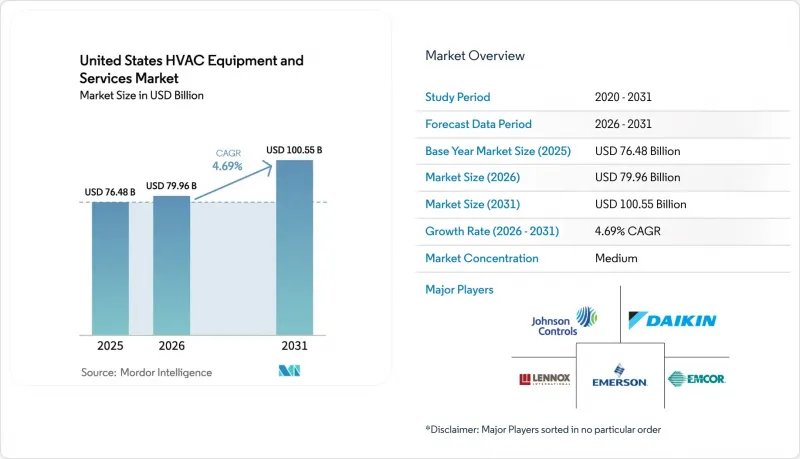
根據 Mordor Intelligence 預測,美國 HVAC 設備和服務市場規模預計將在 2025 年達到 764.8 億美元,2026 年達到 799.6 億美元,到 2031 年達到 1005.5 億美元,2026 年至 2031 年的複合年成長率為 4.69%。
本報告按設備類型(分離式空調、整體式空調、冷卻器及其他)、服務類型(新安裝、維修、維護)、配銷通路(直銷、批發、零售、線上)、最終用戶(住宅、商業、工業、機構)和技術(有管道、無管道、智慧空調)進行細分。市場預測以美元計價。
美國暖通空調設備及服務市場趨勢及洞察。
聯邦政府獎勵升級到高效節能的暖通空調系統。
一項根據《通貨膨脹控制法案》實施的聯邦項目將持續到2032年,該項目為合格的供暖熱泵系統提供高達2000美元的稅額扣抵,正在改變住宅和小型企業計算總擁有成本(TCO)的方式。這項耗資45億美元的「高效節能住宅補貼計畫」面向中低收入家庭,提供高達8,000美元的補貼,並且與各州的計畫相結合,可以抵銷高達70%的安裝成本。已有九個州承諾在2030年將暖氣熱泵的普及率提高到65%,這顯示各州正在協調努力縮短決策週期。加州的「清潔加州技術計畫」(TECH Clean California)除了聯邦獎勵外,還透過為安裝人員提供培訓和技術支持,降低了通常因截止日期而產生的軟成本。這些措施共同將普通家庭的投資回收期縮短到不到五年,促進了暖氣熱泵在美國暖通空調設備和服務市場的普及。
強制分階段減少冷媒使用量將加快設備更換速度。
美國《創新與製造法案》強制規定,自2025年1月起,新型暖通空調系統必須使用全球暖化潛值(GWP)低於700的冷媒,加速了R-410A冷媒的淘汰。製造商正在改造組裝,以適應R-454B和R-32等A2L冷媒,並為技術人員實施安全訓練計劃,以應對輕微的易燃性問題。這種快速轉型顯著提升了設備升級的需求,儘管材料成本不斷上漲,但市場仍鼓勵投資符合標準的解決方案。早期採用者受惠於生命週期排放量的降低,企業買家也實現了環境、社會和治理(ESG)合規。目前,A2L系統已佔新住宅出貨量的60%以上,美國暖通空調設備和服務市場正提前調整產品結構,轉向低GWP產品,遠超過法定截止日期。
HFC替代冷媒價格飆升
R-454B的價格已從每磅17美元上漲至60美元,這將使大型商用系統的成本增加3000至5000美元。此外,預計從2024年起,終端用戶還將額外支出250億美元。目前,R-454B的供應仍嚴重依賴從中國進口,這使得市場極易受到地緣政治風險和運費波動的影響。國內產能有限,在監管過渡期間,供應受到限制,迫使承包商提前採購庫存,加重了他們的流動資金負擔。冷卻器和VRF系統中冷媒負荷的增加進一步影響了商業買家,儘管預期能源效率將顯著提高,但仍導致一些專案延長。
細分市場分析
熱泵是成長最快的設備類別,預計到2031年將以5.89%的複合年成長率成長,這主要得益於獎勵和脫碳措施將預算分配給電加熱解決方案。分離式空調系統將繼續保持其主導地位,憑藉分銷商的專業知識和豐富的產品種類,預計到2025年將佔據36.92%的市場佔有率。然而,隨著住宅和小規模商業場所轉向雙功能熱泵,分離式空調系統的成長速度正在放緩。整體式和屋頂式機組正成為快速商業維修的標配,尤其是在零售商業街和低層辦公大樓等需要即插即用更換的場所。冷水機組仍然是醫院、大學和製造工廠等大規模中央空調系統的主要組成部分,這些場所需要精確的溫度控制。 VRF(冷卻器)解決方案在中型辦公室和酒店行業中越來越受歡迎,因為它們可以透過基於區域的調節顯著降低部分負載下的能耗。空氣調節機、風機盤管和線圈為這些核心系統提供支持,它們的需求與有管道和無管道建築結構的趨勢密切相關。
從管道式分離式空調到無管道迷你分離式空調、混合式空調和地熱系統,熱泵技術的多元化發展正在擴大其適用的氣候範圍。變頻技術的進步使得寒冷氣候型熱泵在攝氏零下15度(5度華氏度)時也能達到100%的製熱能力,從而擴大了其在全部區域的應用範圍。雖然傳統供暖爐在最冷的地區市場仍然佔據主導地位,但隨著雙燃料和全電供暖系統在經濟性方面更具優勢,其市場佔有率正在緩慢下降。窗型和壁掛式空調常用於普通多用戶住宅和臨時建築,但隨著緊湊型迷你分離式空調提供更優異的季節性能效,其市場佔有率正在萎縮。鍋爐在公共設施和配備輻射管道系統的老式高層建築中,作為熱水供應的基礎,仍然發揮著至關重要的作用。由於疫情期間人們對空氣品質的關注度提高,加濕器和除濕器等輔助空氣品質改善設備的銷量穩定成長,但它們仍然是輔助收入來源,而非銷量的主要驅動力。該投資組合構成表明,美國暖通空調設備和服務市場正在逐步但明確地向電動變速熱泵平台轉變。
受商業室內裝修和新建住宅持續成長的需求推動,新安裝量在2025年佔銷售額的43.62%。然而,隨著監管和能源效率要求的提高加速了系統升級,維修和更換市場預計將以5.74%的複合年成長率更快成長。老舊暖通空調設備的平均運作已達15至20年,新的冷媒法規意味著許多R-410A設備在需要大規模時將因技術原因而過時。終端用戶越來越傾向於將設備更換與公共產業補貼、融資和預測性維護訂閱相結合的承包升級方案。
維護合約仍然是穩定的核心收入來源,但數位化工具正在重塑商業模式。基於雲端的診斷功能能夠及早發現異常情況,使服務供應商能夠從被動調度轉向定期干預,從而最大限度地減少停機時間。基於績效的服務合約(承包商共用已證實的節能成果)在市政當局和學區越來越受歡迎。公用事業公司的需量反應計劃透過減少需求來增加收入,從而提高盈利。這些經營模式正在將美國暖通空調設備和服務市場的服務公司定位為長期能源合作夥伴,而不僅僅是一次性的安裝商。
其他好處
- Excel格式的市場預測(ME)表
- 3個月的分析師支持
目錄
第1章:引言
- 研究假設和市場定義
- 調查範圍
第2章:調查方法
第3章執行摘要
第4章 市場狀況
- 市場概覽
- 市場促進因素
- 聯邦政府鼓勵升級到高效節能的暖通空調系統。
- 強制減少冷媒的使用將加速設備的更換。
- 南方頻繁的熱浪推高了空調的需求。
- 主要州強制推行建築物電氣化
- 利用物聯網進行預測性維護以降低成本
- 資料中心冷卻負荷增加
- 市場限制因素
- HFC替代冷媒價格飆升
- 由於技術純熟勞工短缺,安裝成本不斷上漲
- 由於電費上漲,暖通空調設備的運作時間受到限制
- 鋼鐵和銅投入成本的波動性
- 價值鏈分析
- 監理情勢
- 技術展望
- 波特五力分析
- 市場宏觀經濟趨勢的評估
第5章 市場規模與成長預測
- 透過裝置
- 分離式空調(有管道式/無管道式)
- 包裝式/屋頂安裝單元
- 冷卻器
- 空調機組
- 爐
- 風機盤管
- 窗型/穿牆型/PTAC
- 鍋爐
- 熱泵
- 加濕器/除濕器
- 可變冷媒流量(VRF)系統
- 其他設備類型
- 按服務類型
- 新推出
- 維修/更換
- 維護/修理
- 需量反應績效合約
- 透過分銷管道
- 直接銷售(從OEM廠商到最終用戶)
- 暖通空調分銷商/批發商
- 零售/DIY商店
- 線上電子商務平台
- 最終用戶
- 住宅
- 商業
- 產業
- 機構(醫療保健、教育)
- 其他
- 透過技術
- 風管系統
- 無管道迷你分離式空調
- 混合/地熱熱泵系統
- 智慧互聯暖通空調
第6章 競爭情勢
- 市場集中度
- 策略趨勢
- 市佔率分析
- 公司簡介
- Carrier Global Corporation
- Johnson Controls International plc
- Daikin Industries Ltd.
- Trane Technologies plc
- Lennox International Inc.
- Goodman Manufacturing Company LP(Daikin)
- Rheem Manufacturing Company
- Emerson Electric Co.
- Bosch Thermotechnology Corp.
- Mitsubishi Electric US, Inc.
- Uponor Corporation
- Fujitsu General America
- EMCOR Group
- Samsung HVAC America
- Honeywell International Inc.
- Danfoss A/S
- York International Corp.(JCI)
- LG Electronics USA Air Conditioning
- Bosch Thermotechnology
- AAON Inc.
第7章 市場機會與未來展望
According to Mordor Intelligence, the United States HVAC equipment and Services Market size is projected to be USD 76.48 billion in 2025, USD 79.96 billion in 2026, and reach USD 100.55 billion by 2031, growing at a CAGR of 4.69% from 2026 to 2031.
This report is Segmented by Equipment (Split Systems, Packaged Units, Chillers, and More), Service Type (New Installations, Retrofits, Maintenance), Distribution Channel (Direct Sales, Distributors, Retail, Online), End User (Residential, Commercial, Industrial, Institutional), Technology (Ducted, Ductless, Smart HVAC). Market Forecasts are Provided in Terms of Value (USD).
United States HVAC Equipment And Services Market Trends and Insights
Federal Incentives for High-Efficiency HVAC Upgrades
Federal tax credits covering up to USD 2,000 for qualified heat pump systems, extended through 2032 under the Inflation Reduction Act, are changing total-cost-of-ownership calculations for homeowners and small businesses. The USD 4.5 billion High-Efficiency Electric Home Rebate Program targets low- and moderate-income households, offering rebates up to USD 8,000 and stacking with state programs to offset as much as 70% of installed cost. Nine states have pledged to secure 65% heat-pump penetration by 2030, signaling a coordinated policy push that compresses decision cycles. California's TECH Clean California program augments the federal incentives with contractor training and technical assistance, reducing soft costs that often derail projects. Collectively, these measures shorten payback periods to fewer than five years for average households, propelling heat pump adoption in the United States HVAC Equipment and Services market.
Mandatory Refrigerant Phase-Downs Accelerating Equipment Replacement
The American Innovation and Manufacturing Act restricts new HVAC systems to refrigerants under 700 GWP starting January 2025, prompting an abrupt shift away from R-410A. Manufacturers have converted assembly lines to A2L refrigerants such as R-454B and R-32 while deploying technician safety programs to address mild flammability characteristics. Rapid switchover drives a pronounced replacement spike and channels capital toward compliant solutions despite material cost inflation. Early adopters benefit from reduced lifecycle emissions, aiding ESG compliance for corporate buyers. With A2L systems already representing more than 60% of new residential shipments, the United States HVAC Equipment and Services market is realigning its product mix toward low-GWP offerings well ahead of the statutory deadline.
Surging HFC-Alternative Refrigerant Prices
Prices for R-454B have climbed from USD 17 to USD 60 per pound, adding USD 3,000-5,000 to the cost of large commercial systems and transferring roughly USD 25 billion of incremental expense to end users since 2024. Supply remains heavily dependent on imports from China, exposing the market to geopolitical risks and freight volatility. Limited domestic production capacity constrains availability during the regulatory transition, forcing contractors to pre-purchase inventory and strain working capital. Larger refrigerant charges in chillers and VRF systems intensify the effect on commercial buyers, delaying some projects despite compelling efficiency gains.
Other drivers and restraints analyzed in the detailed report include:
- Southern Heat-Wave Frequency Boosting Cooling Demand
- Building-Electrification Mandates in Key States
- Skilled-Labor Shortages Inflating Install Costs
For complete list of drivers and restraints, kindly check the Table Of Contents.
Segment Analysis
Heat pumps represent the fastest-expanding equipment class at a 5.89% CAGR through 2031 as incentives and decarbonization policies redirect budgets toward electric heating solutions. Split systems retain dominance with 36.92% revenue share in 2025 due to entrenched dealer familiarity and broad SKU variety. However, their growth moderates as households and light commercial sites migrate to dual-function heat pumps. Packaged and rooftop units remain staples for quick-turn commercial retrofits, particularly in retail strip centers and low-rise offices that value plug-and-play replacement. Chillers continue to anchor large central plants in hospitals, universities, and manufacturing sites that demand tight temperature controls. VRF solutions gain traction in medium-size offices and hospitality because zone-level modulation slashes part-load energy use. Air-handling units, fan coils, and coils support these core systems, with demand linked to the trajectory of ducted versus ductless architectures.
Heat-pump technological diversity from ducted split to ductless mini-split, hybrid, and geothermal configurations broadens addressable climates. Advancements in variable-speed inverters allow cold-climate models to deliver 100% heating capacity at 5 °F, expanding relevance across the northern tier. Furnaces still dominate in the coldest rural markets but face a measured share decline as homeowner economics improve for dual-fuel or all-electric packages. Window and through-the-wall units serve legacy multifamily buildings and temporary structures, yet their share erodes as compact mini-splits provide superior seasonal efficiency. Boilers continue to underpin hydronic heating in institutions and older high-rise assets where radiant distribution exists. Ancillary air-quality equipment such as humidifiers and dehumidifiers grew steadily after pandemic-era awareness, though they remain supplementary revenue streams rather than volume drivers. The resulting portfolio mix underscores a gradual but clear pivot toward electric, variable-speed heat-pump platforms within the United States HVAC Equipment and Services market.
New installations commanded 43.62% of 2025 revenue, fueled by ongoing commercial fit-outs and residential new-builds. Yet retrofit and replacement workstreams are set to grow more quickly, expanding at a 5.74% CAGR as regulatory and efficiency triggers pull forward system changeouts. Ageing HVAC fleets average 15-20 years in service, and new refrigerant rules now make many R-410A units technically obsolete once major repairs arise. End users are increasingly attracted to turnkey upgrade packages that combine equipment changeouts with utility rebates, financing, and predictive-maintenance subscriptions.
Maintenance contracts remain stable anchor revenue, but digital tools are reshaping execution practices. Cloud-based diagnostics detect anomalies early, allowing service providers to shift from reactive dispatches to scheduled interventions that minimize downtime. Performance-based service agreements, in which contractors share verified energy savings, are gaining traction in municipalities and school districts. Utility demand-response programs augment profitability by creating revenue for capacity curtailment events. These models position service firms as long-term energy partners rather than one-off installers inside the United States HVAC Equipment and Services market.
Complete Report Scope:
- By Equipment
- Split Systems (Ducted and Ductless)
- Packaged and Rooftop Units
- Chillers
- Air-Handling Units
- Furnaces
- Fan Coils
- Window / Through-the-Wall / PTAC
- Boilers
- Heat Pumps
- Humidifiers and Dehumidifiers
- Variable Refrigerant Flow (VRF) Systems
- Other Equipment Types
- By Service Type
- New Installations
- Retrofits / Replacements
- Maintenance and Repair
- Demand-Response and Performance Contracting
- By Distribution Channel
- Direct Sales (OEM to End-User)
- HVAC Distributors / Wholesalers
- Retail / DIY Stores
- Online E-commerce Platforms
- By End User
- Residential
- Commercial
- Industrial
- Institutional (Healthcare, Education)
- Other End-users
- By Technology
- Ducted Systems
- Ductless Mini-Splits
- Hybrid / Geothermal Heat-Pump Systems
- Smart and Connected HVAC
List of Companies Covered in this Report:
- Carrier Global Corporation
- Johnson Controls International plc
- Daikin Industries Ltd.
- Trane Technologies plc
- Lennox International Inc.
- Goodman Manufacturing Company LP (Daikin)
- Rheem Manufacturing Company
- Emerson Electric Co.
- Bosch Thermotechnology Corp.
- Mitsubishi Electric US, Inc.
- Uponor Corporation
- Fujitsu General America
- EMCOR Group
- Samsung HVAC America
- Honeywell International Inc.
- Danfoss A/S
- York International Corp. (JCI)
- LG Electronics USA Air Conditioning
- Bosch Thermotechnology
- AAON Inc.
Additional Benefits:
- The market estimate (ME) sheet in Excel format
- 3 months of analyst support
TABLE OF CONTENTS
1 INTRODUCTION
- 1.1 Study Assumptions and Market Definition
- 1.2 Scope of the Study
2 RESEARCH METHODOLOGY
3 EXECUTIVE SUMMARY
4 MARKET LANDSCAPE
- 4.1 Market Overview
- 4.2 Market Drivers
- 4.2.1 Federal incentives for high-efficiency HVAC upgrades
- 4.2.2 Mandatory refrigerant phase-downs accelerating equipment replacement
- 4.2.3 Southern heat-wave frequency boosting cooling demand
- 4.2.4 Building-electrification mandates in key states
- 4.2.5 IoT-enabled predictive-maintenance cost savings
- 4.2.6 Growth of data-center cooling load
- 4.3 Market Restraints
- 4.3.1 Surging HFC-alternative refrigerant prices
- 4.3.2 Skilled-labor shortages inflating install costs
- 4.3.3 Rising electricity tariffs dampening HVAC run-time
- 4.3.4 Volatility of steel and copper input costs
- 4.4 Value Chain Analysis
- 4.5 Regulatory Landscape
- 4.6 Technological Outlook
- 4.7 Porter's Five Forces Analysis
- 4.7.1 Threat of New Entrants
- 4.7.2 Bargaining Power of Buyers
- 4.7.3 Bargaining Power of Suppliers
- 4.7.4 Threat of Substitutes
- 4.7.5 Intensity of Competitive Rivalry
- 4.8 Assessment of Macro Economic Trends on the Market
5 MARKET SIZE AND GROWTH FORECASTS (VALUES)
- 5.1 By Equipment
- 5.1.1 Split Systems (Ducted and Ductless)
- 5.1.2 Packaged and Rooftop Units
- 5.1.3 Chillers
- 5.1.4 Air-Handling Units
- 5.1.5 Furnaces
- 5.1.6 Fan Coils
- 5.1.7 Window / Through-the-Wall / PTAC
- 5.1.8 Boilers
- 5.1.9 Heat Pumps
- 5.1.10 Humidifiers and Dehumidifiers
- 5.1.11 Variable Refrigerant Flow (VRF) Systems
- 5.1.12 Other Equipment Types
- 5.2 By Service Type
- 5.2.1 New Installations
- 5.2.2 Retrofits / Replacements
- 5.2.3 Maintenance and Repair
- 5.2.4 Demand-Response and Performance Contracting
- 5.3 By Distribution Channel
- 5.3.1 Direct Sales (OEM to End-User)
- 5.3.2 HVAC Distributors / Wholesalers
- 5.3.3 Retail / DIY Stores
- 5.3.4 Online E-commerce Platforms
- 5.4 By End User
- 5.4.1 Residential
- 5.4.2 Commercial
- 5.4.3 Industrial
- 5.4.4 Institutional (Healthcare, Education)
- 5.4.5 Other End-users
- 5.5 By Technology
- 5.5.1 Ducted Systems
- 5.5.2 Ductless Mini-Splits
- 5.5.3 Hybrid / Geothermal Heat-Pump Systems
- 5.5.4 Smart and Connected HVAC
6 COMPETITIVE LANDSCAPE
- 6.1 Market Concentration
- 6.2 Strategic Moves
- 6.3 Market Share Analysis
- 6.4 Company Profiles (includes Global-level Overview, Market-level Overview, Core Segments, Financials as available, Strategic Information, Market Rank/Share, Products and Services, Recent Developments)
- 6.4.1 Carrier Global Corporation
- 6.4.2 Johnson Controls International plc
- 6.4.3 Daikin Industries Ltd.
- 6.4.4 Trane Technologies plc
- 6.4.5 Lennox International Inc.
- 6.4.6 Goodman Manufacturing Company LP (Daikin)
- 6.4.7 Rheem Manufacturing Company
- 6.4.8 Emerson Electric Co.
- 6.4.9 Bosch Thermotechnology Corp.
- 6.4.10 Mitsubishi Electric US, Inc.
- 6.4.11 Uponor Corporation
- 6.4.12 Fujitsu General America
- 6.4.13 EMCOR Group
- 6.4.14 Samsung HVAC America
- 6.4.15 Honeywell International Inc.
- 6.4.16 Danfoss A/S
- 6.4.17 York International Corp. (JCI)
- 6.4.18 LG Electronics USA Air Conditioning
- 6.4.19 Bosch Thermotechnology
- 6.4.20 AAON Inc.
7 MARKET OPPORTUNITIES AND FUTURE OUTLOOK
- 7.1 White-Space and Unmet-Need Assessment

 歐洲暖通空調服務:市場佔有率分析、產業趨勢與統計及成長預測(2026-2031 年)美國暖通空調服務:市場佔有率分析、產業趨勢與統計及成長預測(2026-2031 年)暖通空調服務:市場佔有率分析、產業趨勢與統計、成長預測(2026-2031)
 暖通空調服務管理軟體市場-2026-2032年全球市場預測
 2026 年至 2035 年乘用車 HVAC 服務市場的商業機會、成長要素、產業趨勢分析與預測。
 暖氣和冷氣即服務市場-全球產業規模、佔有率、趨勢、機會和預測:按服務模式、服務類型、最終用戶、地區和競爭格局分類,2021-2031年
 暖通空調服務市場規模、佔有率和成長分析:按類型、服務類型、部署模式、最終用途和地區分類-2026-2033年產業預測
 2026年全球電容器更換管服務市場報告
 暖通空調服務市場分析及預測(至2035年):按類型、產品、服務、技術、組件、應用、安裝類型、設施、解決方案和最終用戶分類HVAC清潔服務市場-全球產業規模、佔有率、趨勢、機會和預測:按組件、清潔工具、清潔設備、最終用戶、地區和競爭格局分類,2021-2031年