


 |
市場調查報告書
商品編碼
2123668
美國暖通空調服務:市場佔有率分析、產業趨勢與統計及成長預測(2026-2031 年)US HVAC Services - Market Share Analysis, Industry Trends & Statistics, Growth Forecasts (2026 - 2031) |
||||||

※ 本網頁內容可能與最新版本有所差異。詳細情況請與我們聯繫。
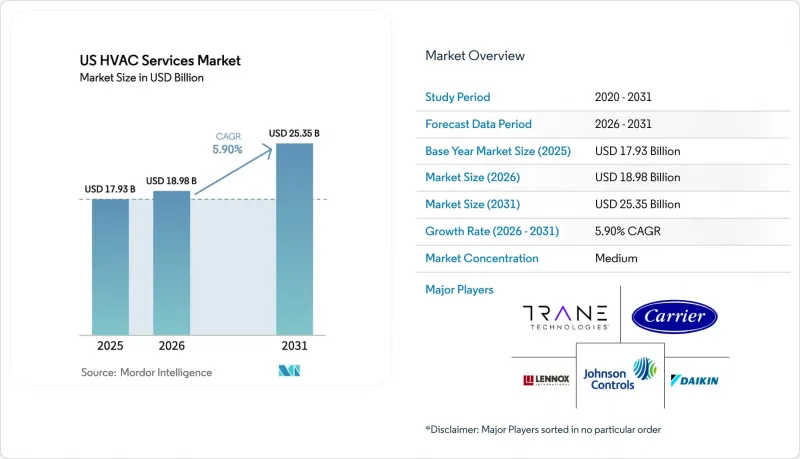
據 Mordor Intelligence 稱,2025 年美國 HVAC 服務市值為 179.3 億美元,預計到 2031 年將達到 253.5 億美元,而 2026 年為 189.8 億美元,預測期(2026-2031 年)的複合成長率為 5.90%。
本報告按實施類型(新建和維修)、服務類型(安裝/更換、維護/維修等)、系統類型(供暖、製冷、通風、室內空氣品質等)、最終用戶(住宅、商業、工業)、應用領域(資料中心、醫療等)和地區進行細分。市場預測以美元計價。
美國暖通空調服務市場的趨勢與洞察
經合組織市場中老化的建築存量需要維修。
到2025年,美國商業建築的平均年齡將達到44年,許多建於1980年之前的建築仍在使用單級屋頂空調機組,這些機組缺乏變速驅動裝置、節熱器或現代控制功能。這些過時的機組比符合最低建築規範要求的系統能耗高出30%至40%。在一些有資訊揭露義務的城市,業主正面臨維修空調系統的壓力。環境、社會和治理(ESG)合規性也推動了維修,因為機構投資者現在已將碳排放強度納入房地產估值。基礎設施投資和就業法案撥款35億美元用於公共部門的維修,這些改造項目通常可以作為私人業主的參考範例。雖然東北部和中西部地區(供暖負荷占主導地位)的維修最為迫切,但陽光地帶的建築也在進行維修,以應對高峰冷氣需求。
冷媒的強制淘汰正在推動維修需求。
美國《創新與製造法案》旨在2036年將氫氟碳化合物(HFC)的產量減少85%,加速從R-410A向全球暖化潛勢(GWP)更低的A2L類冷媒(例如R-32和R-454B)的過渡。由於A2L類冷媒需要感測器、通風系統和防爆組件,許多現有設施無法簡單地重新充注,迫使業主在遠超正常使用壽命週期的早期就決定進行維修或更換。美國暖氣、冷氣與空調工程師學會(ASHRAE)第15號標準將安裝檢測設備的成本增加了2,000至5,000美元。加州和幾個東北部州已將監管合規期限提前至2028年,這壓縮了專案工期,並給服務交付能力帶來了壓力。
技術純熟勞工短缺和人事費用上升
儘管預計2024年至2034年間暖通空調產業的就業人數將增加23,000人,但人員流動仍將造成巨大的缺口,每年將有35,000個職缺。到2025年,平均時薪將上漲至28.50美元,而獲得A2L認證的高級技師時薪將超過40美元。目前,人事費用佔項目總成本的比例已超過55%,高於2020年的48%。學徒計畫正在擴展,但四年的培訓要求意味著解決人手不足需要時間。承包商正在採用擴增實境(AR)指導和遠距離診斷來提高生產效率,但不斷上漲的薪資持續擠壓利潤率,尤其是對中小企業而言。
細分市場分析
預計到2025年,維修項目將佔銷售額的58.49%,並預計在2031年之前以6.23%的年均成長率成長,進一步鞏固其作為美國暖通空調服務市場成長引擎的地位。由於業主們在環保署分階段淘汰計劃之前加快了R-410A系統的更換,美國暖通空調服務市場的維修項目規模正在擴大,形成了一波與設備正常使用壽命結束時間相吻合的翻維修。隨著環境、社會和治理(ESG)要求將資產價值與營運碳排放量掛鉤,資本合作夥伴越來越要求採用變速壓縮機和智慧控制系統,以降低每平方英尺的電力消耗量(千瓦時)。預製模組化套件可以使用起重機在一天內完成安裝,從而顯著減少施工干擾,並使承包商每個工作團隊每月能夠處理更多項目。
儘管新建建築的複合年成長率僅5.40%,略顯緩慢,但仍受惠於設計與施工日益融合的趨勢。在快速發展的大都會圈,開發商正採用熱回收VRF系統來提升租戶的舒適度,並使A級物業脫穎而出。雖然聯邦政府對公共建築的撥款主要集中在維修上,但陽光地帶各州仍保持著蓬勃發展的新計畫儲備,包括從零開始建造醫療保健和工業設施。
到2025年,維護和維修仍將保持最大佔有率,達到46.15%,但最具成長潛力的將是能源效率和維修服務,預計增幅為7.03%。在美國暖通空調服務市場中,最佳化項目的規模受益於公共產業的補貼計劃,這些計劃將投資回收期縮短至三年以內。隨著建築物從獨立式溫控器轉向IP連接平台,控制系統升級的需求增加了6.50%。住宅分離式空調系統更換的安裝服務正面臨商品化趨勢,促使承包商將業務重心轉向包含試運行和多年服務的商業套裝保險契約。
隨著業主在分配資金前要求進行第三方審計,諮詢和其他顧問服務正在加速發展。聯邦設施核准的能源績效合約正在重塑收入確認方式,允許供應商前期投資成本,並根據經檢驗的千瓦時減量收回投資。
其他好處:
- Excel格式的市場預測(ME)表
- 3個月的分析師支持
目錄
第1章:引言
- 研究假設和市場定義
- 調查範圍
第2章:調查方法
第3章執行摘要
第4章 市場狀況
- 市場概覽
- 市場促進因素
- 經合組織國家面臨著對其市場上的老舊建築維修的需要。
- 強制減少冷媒使用量正在推動維修需求。
- 超大規模資料中心建置的擴展
- 「暖通空調即服務」合約所產生的經常性收入
- 預製模組化維修方案正在縮短專案工期。
- 公共產業支持的預測性維護訂閱服務正在提升業務收益。
- 市場限制因素
- 技術純熟勞工短缺和人事費用上升
- 暖通空調組件供應波動與原物料價格上漲
- 互聯建築系統中的網路安全風險
- 在都市區取得 A2L 冷媒儲存許可證變得越來越困難。
- 產業價值鏈分析
- 監理情勢
- 技術展望
- 宏觀經濟因素對市場的影響
- 波特五力分析
- 投資與併購趨勢
第5章 市場規模與成長預測
- 按實現類型
- 新建工程
- 現有建築物的維修
- 按服務類型
- 安裝和更換服務
- 維護和維修服務
- 能源效率和維修服務
- 暖通空調控制系統的升級與整合
- 諮詢及其他服務
- 依系統類型
- 暖氣服務
- 冷凍服務
- 通風和室內空氣品質 (IAQ) 服務
- 綜合建築管理服務
- 最終用戶
- 住宅
- 商業的
- 產業
- 透過使用
- 資料中心
- 醫療機構
- 教育機構
- 飯店及休閒
- 零售空間
- 政府和公共設施
- 其他用途
- 按地區
- 北美洲
- 美國
- 加拿大
- 墨西哥
- 南美洲
- 巴西
- 阿根廷
- 墨西哥
- 其他南美國家
- 歐洲
- 英國
- 德國
- 法國
- 比荷盧經濟聯盟
- 其他歐洲國家
- 亞太地區
- 中國
- 印度
- 日本
- 其他亞太國家
- 中東和非洲
- 中東
- 阿拉伯聯合大公國
- 沙烏地阿拉伯
- 其他中東國家
- 非洲
- 南非
- 其他非洲國家
- 中東
- 北美洲
第6章 競爭情勢
- 市場集中度
- 策略趨勢
- 市佔率分析
- 公司簡介
- Johnson Controls International PLC
- Carrier Global Corporation
- Daikin Industries Ltd.
- Trane Technologies plc
- Lennox International Inc.
- Honeywell International Inc.
- Siemens AG
- LG Electronics Inc.
- Electrolux AB
- Robert Bosch GmbH
- Fujitsu General Ltd.
- Nortek Global HVAC
- Mitsubishi Electric Corporation
- Rheem Manufacturing Company
- Danfoss A/S
- GREE Electric Appliances Inc.
- Midea Group Co. Ltd.
- Johnson Service Group plc
- Comfort Systems USA, Inc.
- EMCOR Group Inc.
第7章 市場機會與未來展望
According to Mordor Intelligence, the US HVAC services market size was valued at USD 17.93 billion in 2025 and is estimated to grow from USD 18.98 billion in 2026 to reach USD 25.35 billion by 2031, at a CAGR of 5.90% during the forecast period (2026-2031).
This report is Segmented by Implementation Type (New Construction, and Retrofit Buildings), Service Type (Installation and Replacement, Maintenance and Repair, and More), System Type (Heating, Cooling, Ventilation and IAQ, and More), End User (Residential, Commercial, Industrial), Application Vertical (Data Centers, Healthcare, and More), and Geography. Market Forecasts are Provided in Terms of Value (USD).
US HVAC Services Market Trends and Insights
Aging Building Stock in OECD Markets Requiring Upgrades
The median commercial building in the United States was 44 years old in 2025, and many structures erected before 1980 still rely on single-stage rooftop units that lack variable-speed drives, economizers, or modern controls. Energy use by those legacy units runs 30%-40% above code-minimum systems, which pressures landlords in cities with disclosure mandates to commit capital to HVAC retrofits. Institutional investors now price carbon intensity into property valuations, so ESG compliance is another trigger. The Infrastructure Investment and Jobs Act allocated USD 3.5 billion for public-sector upgrades that often serve as templates for private owners. Retrofit urgency is highest in the Northeast and Midwest where heating loads dominate, though Sun Belt buildings also pursue upgrades to manage peak cooling demand.
Mandatory Refrigerant Phase-Downs Driving Retrofit Demand
The American Innovation and Manufacturing Act targets an 85% cut in hydrofluorocarbon production by 2036, propelling the transition from R-410A toward lower-GWP A2L blends such as R-32 and R-454B. Because A2L refrigerants require sensors, ventilation, and spark-safe components, most existing equipment cannot simply be recharged, so owners face a retrofit or replacement decision well ahead of normal life cycles. ASHRAE Standard 15 drives up installation cost by USD 2,000-USD 5,000 for detection gear. California and several Northeastern states front-loaded compliance deadlines to 2028, compressing project schedules and crowding service pipelines.
Skilled-Labor Shortages and Escalating Wage Bills
HVAC employment is projected to add 23,000 roles from 2024-2034, but attrition will create 35,000 openings annually, leaving a sizable gap. Median hourly wages climbed to USD 28.50 in 2025, while A2L-certified master technicians topped USD 40. Labor now exceeds 55% of total project cost, up from 48% in 2020. Apprenticeships expand, yet four-year training requirements delay relief. Contractors deploy augmented-reality guidance and remote diagnostics to boost productivity, but wage inflation still squeezes margins, especially for smaller firms.
Other drivers and restraints analyzed in the detailed report include:
- Expansion of Hyperscale Data-Center Build-Outs
- HVAC-as-a-Service Contracts Unlocking Annuity Revenues
- Volatile HVAC Component Supply and Material Inflation
For complete list of drivers and restraints, kindly check the Table Of Contents.
Segment Analysis
Retrofit buildings contributed 58.49% of 2025 revenue and are forecast to rise at 6.23% through 2031, reinforcing their role as the growth engine of the US HVAC services market. The US HVAC services market size for retrofit projects is expanding as owners race to replace R-410A systems ahead of the EPA phase-down calendar, creating a retrofit wave that overlaps with normal end-of-life milestones. ESG mandates tie asset values to operational carbon, so capital partners increasingly insist on variable-speed compressors and smart controls that lower kWh per square foot. Prefabricated modular kits, craned into place in a single day, slash disruption and let contractors deliver more jobs per crew per month.
New construction trails at a 5.40% CAGR yet still benefits from stronger design-build coordination. Developers in growth metros specify heat-recovery VRF systems that improve tenant comfort and differentiate Class A properties. Federal funding for public buildings steers toward retrofits, but ground-up healthcare and industrial facilities keep new-build pipelines active in Sun Belt states.
Maintenance and repair retained the largest share at 46.15% in 2025, yet the highest momentum sits with energy-efficiency and retrofit services, advancing 7.03%. The US HVAC services market size for optimization projects benefits from utility rebates that buy down payback to three years or less. Controls upgrades climb 6.50% as buildings migrate from stand-alone thermostats to IP-connected platforms. Installation services face commoditization in residential split-system changeouts, motivating contractors to pivot toward bundled commercial scopes that fold in commissioning and multi-year service.
Consulting and other advisory work accelerates as owners seek third-party audits before allocating capital. Energy-savings performance contracts, now endorsed for federal facilities, enable providers to front the cost and recover investments from verified kWh reductions, reshaping revenue recognition.
Complete Report Scope:
- By Implementation Type
- New Construction
- Retrofit Buildings
- By Service Type
- Installation and Replacement Services
- Maintenance and Repair Services
- Energy-Efficiency and Retrofit Services
- HVAC Controls Upgrade and Integration
- Consulting and Other Services
- By System Type
- Heating Services
- Cooling Services
- Ventilation and IAQ Services
- Integrated Building-Management Services
- By End User
- Residential
- Commercial
- Industrial
- By Application
- Data Centers
- Healthcare Facilities
- Educational Institutions
- Hospitality and Leisure
- Retail Spaces
- Government and Public Buildings
- Other Applications
- By Geography
- North America
- United States
- Canada
- Mexico
- South America
- Brazil
- Argentina
- Mexico
- Rest of South America
- Europe
- United Kingdom
- Germany
- France
- Benelux
- Rest of Europe
- Asia Pacific
- China
- India
- Japan
- Rest of Asia Pacific
- Middle East and Africa
- Middle East
- United Arab Emirates
- Saudi Arabia
- Rest of Middle East
- Africa
- South Africa
- Rest of Africa
- Middle East
- North America
List of Companies Covered in this Report:
- Johnson Controls International PLC
- Carrier Global Corporation
- Daikin Industries Ltd.
- Trane Technologies plc
- Lennox International Inc.
- Honeywell International Inc.
- Siemens AG
- LG Electronics Inc.
- Electrolux AB
- Robert Bosch GmbH
- Fujitsu General Ltd.
- Nortek Global HVAC
- Mitsubishi Electric Corporation
- Rheem Manufacturing Company
- Danfoss A/S
- GREE Electric Appliances Inc.
- Midea Group Co. Ltd.
- Johnson Service Group plc
- Comfort Systems USA, Inc.
- EMCOR Group Inc.
Additional Benefits:
- The market estimate (ME) sheet in Excel format
- 3 months of analyst support
TABLE OF CONTENTS
1 INTRODUCTION
- 1.1 Study Assumptions and Market Definition
- 1.2 Scope of the Study
2 RESEARCH METHODOLOGY
3 EXECUTIVE SUMMARY
4 MARKET LANDSCAPE
- 4.1 Market Overview
- 4.2 Market Drivers
- 4.2.1 Aging Building Stock in OECD Markets Requiring Upgrades
- 4.2.2 Mandatory Refrigerant Phase-Downs Driving Retrofit Demand
- 4.2.3 Expansion of Hyperscale Data-Center Build-Outs
- 4.2.4 HVAC-as-a-Service Contracts Unlocking Annuity Revenues
- 4.2.5 Prefabricated Modular Retrofit Solutions Accelerating Project Timelines
- 4.2.6 Utility-Backed Predictive-Maintenance Subscriptions Boosting Service Revenues
- 4.3 Market Restraints
- 4.3.1 Skilled-Labor Shortages and Escalating Wage Bills
- 4.3.2 Volatile HVAC Component Supply and Material Inflation
- 4.3.3 Cyber-Security Risks in Connected Building Systems
- 4.3.4 Rising Urban Permitting Barriers for A2L Refrigerant Storage
- 4.4 Industry Value-Chain Analysis
- 4.5 Regulatory Landscape
- 4.6 Technological Outlook
- 4.7 Impact of Macroeconomic Factors on the Market
- 4.8 Porter's Five Forces Analysis
- 4.8.1 Bargaining Power of Suppliers
- 4.8.2 Bargaining Power of Buyers
- 4.8.3 Threat of New Entrants
- 4.8.4 Threat of Substitutes
- 4.8.5 Intensity of Competitive Rivalry
- 4.9 Investment and M&A Landscape
5 MARKET SIZE AND GROWTH FORECASTS (VALUE)
- 5.1 By Implementation Type
- 5.1.1 New Construction
- 5.1.2 Retrofit Buildings
- 5.2 By Service Type
- 5.2.1 Installation and Replacement Services
- 5.2.2 Maintenance and Repair Services
- 5.2.3 Energy-Efficiency and Retrofit Services
- 5.2.4 HVAC Controls Upgrade and Integration
- 5.2.5 Consulting and Other Services
- 5.3 By System Type
- 5.3.1 Heating Services
- 5.3.2 Cooling Services
- 5.3.3 Ventilation and IAQ Services
- 5.3.4 Integrated Building-Management Services
- 5.4 By End User
- 5.4.1 Residential
- 5.4.2 Commercial
- 5.4.3 Industrial
- 5.5 By Application
- 5.5.1 Data Centers
- 5.5.2 Healthcare Facilities
- 5.5.3 Educational Institutions
- 5.5.4 Hospitality and Leisure
- 5.5.5 Retail Spaces
- 5.5.6 Government and Public Buildings
- 5.5.7 Other Applications
- 5.6 By Geography
- 5.6.1 North America
- 5.6.1.1 United States
- 5.6.1.2 Canada
- 5.6.1.3 Mexico
- 5.6.2 South America
- 5.6.2.1 Brazil
- 5.6.2.2 Argentina
- 5.6.2.3 Mexico
- 5.6.2.4 Rest of South America
- 5.6.3 Europe
- 5.6.3.1 United Kingdom
- 5.6.3.2 Germany
- 5.6.3.3 France
- 5.6.3.4 Benelux
- 5.6.3.5 Rest of Europe
- 5.6.4 Asia Pacific
- 5.6.4.1 China
- 5.6.4.2 India
- 5.6.4.3 Japan
- 5.6.4.4 Rest of Asia Pacific
- 5.6.5 Middle East and Africa
- 5.6.5.1 Middle East
- 5.6.5.1.1 United Arab Emirates
- 5.6.5.1.2 Saudi Arabia
- 5.6.5.1.3 Rest of Middle East
- 5.6.5.2 Africa
- 5.6.5.2.1 South Africa
- 5.6.5.2.2 Rest of Africa
- 5.6.5.1 Middle East
- 5.6.1 North America
6 COMPETITIVE LANDSCAPE
- 6.1 Market Concentration
- 6.2 Strategic Moves
- 6.3 Market Share Analysis
- 6.4 Company Profiles (includes Global level Overview, Market level overview, Core Segments, Financials as available, Strategic Information, Market Rank/Share for key companies, Products & Services, and Recent Developments)
- 6.4.1 Johnson Controls International PLC
- 6.4.2 Carrier Global Corporation
- 6.4.3 Daikin Industries Ltd.
- 6.4.4 Trane Technologies plc
- 6.4.5 Lennox International Inc.
- 6.4.6 Honeywell International Inc.
- 6.4.7 Siemens AG
- 6.4.8 LG Electronics Inc.
- 6.4.9 Electrolux AB
- 6.4.10 Robert Bosch GmbH
- 6.4.11 Fujitsu General Ltd.
- 6.4.12 Nortek Global HVAC
- 6.4.13 Mitsubishi Electric Corporation
- 6.4.14 Rheem Manufacturing Company
- 6.4.15 Danfoss A/S
- 6.4.16 GREE Electric Appliances Inc.
- 6.4.17 Midea Group Co. Ltd.
- 6.4.18 Johnson Service Group plc
- 6.4.19 Comfort Systems USA, Inc.
- 6.4.20 EMCOR Group Inc.
7 MARKET OPPORTUNITIES AND FUTURE OUTLOOK
- 7.1 White-Space and Unmet-Need Assessment

 歐洲暖通空調服務:市場佔有率分析、產業趨勢與統計及成長預測(2026-2031 年)美國暖通空調設備及服務:市場佔有率分析、產業趨勢與統計及成長預測(2026-2031)暖通空調服務:市場佔有率分析、產業趨勢與統計、成長預測(2026-2031)
 暖通空調服務管理軟體市場-2026-2032年全球市場預測
 2026 年至 2035 年乘用車 HVAC 服務市場的商業機會、成長要素、產業趨勢分析與預測。
 暖氣和冷氣即服務市場-全球產業規模、佔有率、趨勢、機會和預測:按服務模式、服務類型、最終用戶、地區和競爭格局分類,2021-2031年
 暖通空調服務市場規模、佔有率和成長分析:按類型、服務類型、部署模式、最終用途和地區分類-2026-2033年產業預測
 2026年全球電容器更換管服務市場報告
 暖通空調服務市場分析及預測(至2035年):按類型、產品、服務、技術、組件、應用、安裝類型、設施、解決方案和最終用戶分類HVAC清潔服務市場-全球產業規模、佔有率、趨勢、機會和預測:按組件、清潔工具、清潔設備、最終用戶、地區和競爭格局分類,2021-2031年