


 |
市場調查報告書
商品編碼
2122313
暖通空調服務:市場佔有率分析、產業趨勢與統計、成長預測(2026-2031)HVAC Services - Market Share Analysis, Industry Trends & Statistics, Growth Forecasts (2026 - 2031) |
||||||

※ 本網頁內容可能與最新版本有所差異。詳細情況請與我們聯繫。
據 Mordor Intelligence 稱,2026 年 HVAC 服務市值為 724.8 億美元,預計到 2031 年將達到 987.4 億美元。
這相當於年複合成長率為 6.38%。
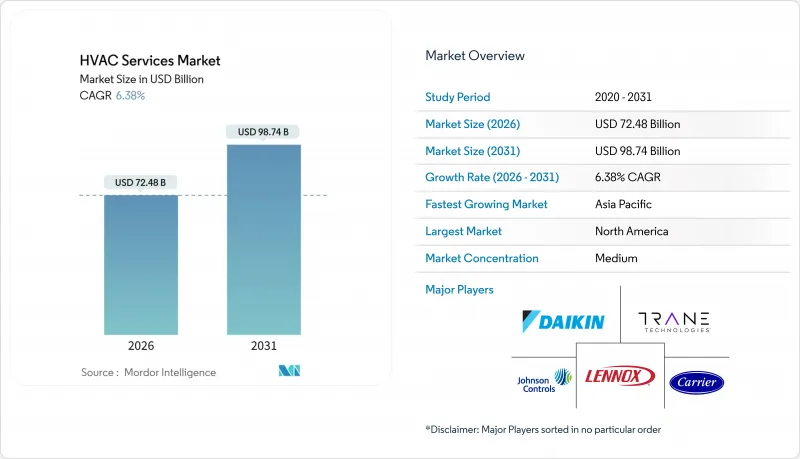
本報告按部署類型(新建和維修)、服務類型(安裝、更換等)、系統類型(供暖、製冷等)、最終用戶(住宅、商業、工業)、應用領域(資料中心等)和地區進行細分。市場預測以美元計價。
全球暖通空調服務市場趨勢與洞察
新興經濟體建設活動的擴張
印度和海灣合作理事會(GCC)強勁的公共工程項目儲備支撐了對新設施的需求。受政府城市住宅計畫的推動,印度建築業預計在2026會計年度將成長8-10%。海灣合作理事會擁有價值3兆美元的專案積壓,其中像NEOM這樣的大型企劃需要區域供冷廠,從而創造了長期的服務機會。開發商正在將變冷媒流量(VRF)系統納入預規範,以獲得綠建築認證,而在地採購規則也迫使跨國供應商在當地建立支援基地。這些因素正在瓦解傳統的供應鏈,使熟悉當地採購標準和語言的本地承包商佔據主導地位。
超大規模資料中心建置的擴展
高密度GPU叢集產生的熱負荷超過每個機架100千瓦,促使營運商採用液冷技術。微軟計劃在2025年推出「晶片級直接冷卻」技術,而Google則選擇了後門式熱交換器,這兩種方案都需要對專用冷卻器進行改造。供應商正在協商與電源使用效率(PUE)指標掛鉤的基於運作的契約,將風險轉移給供應商,迫使他們投資於持續監控。國際能源總署(IEA)預測,到2030年,資料中心的電力需求將加倍,這意味著為了平衡電網負荷,儲熱專案也將同步成長。
技術純熟勞工短缺和人事費用上升
在美國,儘管暖通空調(HVAC)技術人員的薪資中位數成長了12%,達到57,300美元,但預計到2025年,仍有11萬個HVAC技術人員職缺。由於退休和移民限制導致勞動力減少,進一步加劇了這一困境。德國機電一體化相關職位的空缺率高達15%。學徒制計畫至少在三年內不太可能培養出足夠數量的合格人員,而人事費用佔業務收益的一半以上,這將進一步擠壓承包商的利潤空間。
區域分析
北美地區在2025年佔全球收入的38.17%,主要得益於價值2.1兆美元的建築維護項目積壓。使用年限超過15年的老舊系統推動了更換需求,但技術人員短缺和授權流程的延誤延長了專案週期。 《AIM法案》正在加速冷媒的淘汰,而加州第24號法規則加速了未來熱泵的維修。 2025年加拿大的碳價(每噸80加元,約59美元)推動了天然氣燃氣鍋爐的淘汰,而亞伯達的電網限制則限制了熱泵的推廣應用。墨西哥的近岸外包浪潮將推動2025年工業暖通空調需求成長18%。
預計到2031年,亞太地區的複合年成長率將達到7.90%,這主要得益於印度兩位數的建築業成長以及中國覆蓋4億平方米的區域供冷網路。在日本,隨著人口老化,具備遠端監控功能的住宅熱泵的普及率正在上升;而在東南亞,高昂的電費促使屋主採用蓄熱策略。澳洲2025年《建築標準法》引入了全住宅能源預算,並強制要求服務供應商進行綜合能源效率審計。
修訂後的歐洲建築性能指令要求現有建築在2050年前實現零排放,這需要加快維修的步伐。在德國,1980年以前建造的2,100萬套住宅蘊藏著2,000億歐元(2,200億美元)的熱泵安裝潛力,但由於安裝商訂單訂單,進展緩慢。英國7,500英鎊(9,450美元)的熱泵補貼計畫由於持續存在的能源價格差異,尚未達到其安裝目標。在中東海灣合作理事會(GCC)國家,區域冷卻正在大型企劃中得到應用;而在拉丁美洲,貨幣貶值阻礙了進口,推動了巴西變頻空調和阿根廷本地組裝產品的市場成長。
其他好處:
- Excel格式的市場預測(ME)表
- 3個月的分析師支持
目錄
第1章:引言
- 研究假設和市場定義
- 調查範圍
第2章:調查方法
第3章執行摘要
第4章 市場狀況
- 市場概覽
- 市場促進因素
- 新興國家建設活動的擴張
- 超大規模資料中心建置的擴展
- 強制分階段減少冷媒使用正在推動維修需求。
- 經合組織國家市場上的老舊建築亟需維修。
- 透過遠距離診斷和機器人技術降低服務成本
- 「暖通空調即服務」合約所產生的經常性收入
- 市場限制因素
- 技術純熟勞工短缺和人事費用上升
- 暖通空調組件供應波動與原物料價格上漲
- 互聯建築系統中的網路安全風險
- 訂閱制顛覆者擠壓利潤率
- 產業價值鏈分析
- 監理情勢
- 技術展望
- 宏觀經濟因素對市場的影響
- 波特五力分析
- 投資與併購趨勢
第5章 市場規模與成長預測
- 按實現類型
- 新建工程
- 現有建築物的維修
- 按服務類型
- 安裝和更換服務
- 維護和維修服務
- 能源效率和維修服務
- 暖通空調控制系統的升級與整合
- 諮詢及其他服務
- 依系統類型
- 暖氣服務
- 冷凍服務
- 通風和室內空氣品質 (IAQ) 相關服務
- 綜合建築管理服務
- 最終用戶
- 住宅
- 商業
- 產業
- 透過使用
- 資料中心
- 醫療機構
- 教育機構
- 飯店及休閒
- 零售空間
- 政府和公共設施
- 其他
- 按地區
- 北美洲
- 美國
- 加拿大
- 墨西哥
- 南美洲
- 巴西
- 阿根廷
- 墨西哥
- 其他南美國家
- 歐洲
- 英國
- 德國
- 法國
- 比荷盧經濟聯盟
- 其他歐洲國家
- 亞太地區
- 中國
- 印度
- 日本
- 其他亞太國家
- 中東和非洲
- 阿拉伯聯合大公國
- 沙烏地阿拉伯
- 南非
- 其他中東和非洲國家
- 北美洲
第6章 競爭情勢
- 市場集中度
- 策略趨勢
- 市佔率分析
- 公司簡介
- Johnson Controls International PLC
- Carrier Global Corporation
- Daikin Industries Ltd.
- Trane Technologies PLC
- Lennox International Inc.
- Honeywell International Inc.
- Siemens AG
- LG Electronics Inc.
- Electrolux AB
- Robert Bosch GmbH
- Fujitsu General Ltd.
- Nortek Global HVAC
- Mitsubishi Electric Corporation
- Rheem Manufacturing Company
- Danfoss A/S
- GREE Electric Appliances Inc.
- Midea Group Co. Ltd.
- Johnson Service Group PLC
- Comfort Systems USA Inc.
- EMCOR Group Inc.
第7章 市場機會與未來展望
According to Mordor Intelligence, the HVAC services market size is valued at USD 72.48 billion in 2026 and is projected to reach USD 98.74 billion by 2031, reflecting a 6.38% CAGR.
This report is Segmented by Implementation Type (New Construction and Retrofit Buildings), Service Type (Installation and Replacement, and More), System Type (Heating, Cooling, and More), End User (Residential, Commercial, and Industrial), Application Vertical (Data Centers, and More), and Geography. The Market Forecasts are Provided in Terms of Value (USD).
Global HVAC Services Market Trends and Insights
Growing Construction Activity in Emerging Economies
Robust public-works pipelines in India and the Gulf Cooperation Council (GCC) are sustaining new installation demand. India's construction sector is expanding by 8-10% in fiscal 2026, supported by government urban housing schemes. The GCC maintains a USD 3 trillion project backlog, and megaprojects such as NEOM require district-cooling plants that open long-term service opportunities. Developers are pre-specifying variable-refrigerant-flow systems to secure green-building certifications, and local-content rules are pushing multinational vendors to establish in-country support hubs. These factors are fragmenting traditional supply chains and favoring regional contractors fluent in local procurement norms and languages.
Expansion of Hyperscale Data-Center Build-Outs
GPU-dense clusters generate thermal loads exceeding 100 kW per rack, prompting operators to adopt liquid cooling. Microsoft introduced direct-to-chip cooling in 2025, while Google deployed rear-door heat exchangers, each requiring specialized chiller retrofits. Service vendors are negotiating uptime-based contracts tied to power-usage-effectiveness metrics, shifting risk to providers that must invest in continuous monitoring. The International Energy Agency projects data-center electricity demand to double by 2030, implying parallel growth in thermal-storage projects that flatten grid loads.
Skilled-Labor Shortages and Escalating Wage Bills
The United States recorded 110,000 unfilled HVAC technician posts in 2025 despite a 12% median-wage rise to USD 57,300. Retirement-driven attrition and limited immigration inflows intensify constraints, and Germany reports a 15% vacancy rate for mechatronics roles. Apprenticeship programs will not yield fully trained personnel for at least 3 years, squeezing contractor margins, as labor costs account for more than half of service revenue.
Other drivers and restraints analyzed in the detailed report include:
- Mandatory Refrigerant Phase-Downs Driving Retrofit Demand
- Remote Diagnostics and Robotics Lowering Service Costs
- Volatile HVAC Component Supply and Material Inflation
For complete list of drivers and restraints, kindly check the Table Of Contents.
Geography Analysis
North America delivered 38.17% of 2025 revenue, supported by a USD 2.1 trillion backlog of deferred building maintenance. Aging systems exceeding 15 years of service life are driving replacement demand, yet technician shortages and permitting delays lengthen project cycles. The AIM Act accelerates refrigerant phase-outs, and California's Title 24 rules seed future heat-pump retrofits. Canada's carbon price of CAD 80 (USD 59) per ton in 2025 encourages natural-gas boiler conversions, though grid constraints in Alberta temper heat-pump deployment. Mexico's nearshoring wave lifted industrial HVAC demand by 18% in 2025.
Asia-Pacific is forecast to post a 7.90% CAGR to 2031, led by India's double-digit construction growth and China's 400 million m2 of district-cooling networks. Japan's aging demographics spur the adoption of residential heat pumps with remote monitoring, while Southeast Asia's high electricity tariffs push owners toward thermal-storage strategies. Australia's 2025 building code adopts whole-of-home energy budgets, forcing service providers to deliver integrated efficiency audits.
Europe's revised building-performance directive requires zero-emission stock by 2050, compelling accelerated retrofits. Germany's 21 million pre-1980 homes face a EUR 200 billion (USD 220 billion) heat-pump opportunity, although installer backlogs slow progress. The United Kingdom's GBP 7,500 (USD 9,450) heat-pump grants have yet to meet adoption targets due to persistent energy-price differentials. Middle Eastern GCC nations continue to roll out district-cooling for megaprojects, whereas Latin American growth is led by Brazilian inverter air conditioners and Argentine local assembly as currency depreciation hampers imports.
- Johnson Controls International PLC
- Carrier Global Corporation
- Daikin Industries Ltd.
- Trane Technologies PLC
- Lennox International Inc.
- Honeywell International Inc.
- Siemens AG
- LG Electronics Inc.
- Electrolux AB
- Robert Bosch GmbH
- Fujitsu General Ltd.
- Nortek Global HVAC
- Mitsubishi Electric Corporation
- Rheem Manufacturing Company
- Danfoss A/S
- GREE Electric Appliances Inc.
- Midea Group Co. Ltd.
- Johnson Service Group PLC
- Comfort Systems USA Inc.
- EMCOR Group Inc.
Additional Benefits:
- The market estimate (ME) sheet in Excel format
- 3 months of analyst support
TABLE OF CONTENTS
1 INTRODUCTION
- 1.1 Study Assumptions and Market Definition
- 1.2 Scope of the Study
2 RESEARCH METHODOLOGY
3 EXECUTIVE SUMMARY
4 MARKET LANDSCAPE
- 4.1 Market Overview
- 4.2 Market Drivers
- 4.2.1 Growing Construction Activity in Emerging Economies
- 4.2.2 Expansion of Hyperscale Data-Center Build-Outs
- 4.2.3 Mandatory Refrigerant Phase-Downs Driving Retrofit Demand
- 4.2.4 Aging Building Stock in OECD Markets Requiring Upgrades
- 4.2.5 Remote Diagnostics and Robotics Lowering Service Costs
- 4.2.6 HVAC-as-a-Service Contracts Unlocking Annuity Revenues
- 4.3 Market Restraints
- 4.3.1 Skilled-Labor Shortages and Escalating Wage Bills
- 4.3.2 Volatile HVAC Component Supply and Material Inflation
- 4.3.3 Cyber-Security Risks in Connected Building Systems
- 4.3.4 Subscription-Based Disruptors Compressing Margins
- 4.4 Industry Value-Chain Analysis
- 4.5 Regulatory Landscape
- 4.6 Technological Outlook
- 4.7 Impact of Macroeconomic Factors on the Market
- 4.8 Porter's Five Forces Analysis
- 4.8.1 Bargaining Power of Suppliers
- 4.8.2 Bargaining Power of Buyers
- 4.8.3 Threat of New Entrants
- 4.8.4 Threat of Substitutes
- 4.8.5 Intensity of Competitive Rivalry
- 4.9 Investment and M&A Landscape
5 MARKET SIZE AND GROWTH FORECASTS (VALUE)
- 5.1 By Implementation Type
- 5.1.1 New Construction
- 5.1.2 Retrofit Buildings
- 5.2 By Service Type
- 5.2.1 Installation and Replacement Services
- 5.2.2 Maintenance and Repair Services
- 5.2.3 Energy-Efficiency and Retrofit Services
- 5.2.4 HVAC Controls Upgrade and Integration
- 5.2.5 Consulting and Other Services
- 5.3 By System Type
- 5.3.1 Heating Services
- 5.3.2 Cooling Services
- 5.3.3 Ventilation and IAQ Services
- 5.3.4 Integrated Building-Management Services
- 5.4 By End User
- 5.4.1 Residential
- 5.4.2 Commercial
- 5.4.3 Industrial
- 5.5 By Application Vertical
- 5.5.1 Data Centers
- 5.5.2 Healthcare Facilities
- 5.5.3 Educational Institutions
- 5.5.4 Hospitality and Leisure
- 5.5.5 Retail Spaces
- 5.5.6 Government and Public Buildings
- 5.5.7 Others
- 5.6 By Geography
- 5.6.1 North America
- 5.6.1.1 United States
- 5.6.1.2 Canada
- 5.6.1.3 Mexico
- 5.6.2 South America
- 5.6.2.1 Brazil
- 5.6.2.2 Argentina
- 5.6.2.3 Mexico
- 5.6.2.4 Rest of South America
- 5.6.3 Europe
- 5.6.3.1 United Kingdom
- 5.6.3.2 Germany
- 5.6.3.3 France
- 5.6.3.4 Benelux
- 5.6.3.5 Rest of Europe
- 5.6.4 Asia-Pacific
- 5.6.4.1 China
- 5.6.4.2 India
- 5.6.4.3 Japan
- 5.6.4.4 Rest of Asia-Pacific
- 5.6.5 Middle East and Africa
- 5.6.5.1 United Arab Emirates
- 5.6.5.2 Saudi Arabia
- 5.6.5.3 South Africa
- 5.6.5.4 Rest of Middle East and Africa
- 5.6.1 North America
6 COMPETITIVE LANDSCAPE
- 6.1 Market Concentration
- 6.2 Strategic Moves
- 6.3 Market Share Analysis
- 6.4 Company Profiles (includes Global Level Overview, Market Level Overview, Core Segments, Financials as Available, Strategic Information, Market Rank/Share for Key Companies, Products and Services, and Recent Developments)
- 6.4.1 Johnson Controls International PLC
- 6.4.2 Carrier Global Corporation
- 6.4.3 Daikin Industries Ltd.
- 6.4.4 Trane Technologies PLC
- 6.4.5 Lennox International Inc.
- 6.4.6 Honeywell International Inc.
- 6.4.7 Siemens AG
- 6.4.8 LG Electronics Inc.
- 6.4.9 Electrolux AB
- 6.4.10 Robert Bosch GmbH
- 6.4.11 Fujitsu General Ltd.
- 6.4.12 Nortek Global HVAC
- 6.4.13 Mitsubishi Electric Corporation
- 6.4.14 Rheem Manufacturing Company
- 6.4.15 Danfoss A/S
- 6.4.16 GREE Electric Appliances Inc.
- 6.4.17 Midea Group Co. Ltd.
- 6.4.18 Johnson Service Group PLC
- 6.4.19 Comfort Systems USA Inc.
- 6.4.20 EMCOR Group Inc.
7 MARKET OPPORTUNITIES AND FUTURE OUTLOOK
- 7.1 White-Space and Unmet-Need Assessment

 歐洲暖通空調服務:市場佔有率分析、產業趨勢與統計及成長預測(2026-2031 年)美國暖通空調設備及服務:市場佔有率分析、產業趨勢與統計及成長預測(2026-2031)美國暖通空調服務:市場佔有率分析、產業趨勢與統計及成長預測(2026-2031 年)
 暖通空調服務管理軟體市場-2026-2032年全球市場預測
 2026 年至 2035 年乘用車 HVAC 服務市場的商業機會、成長要素、產業趨勢分析與預測。
 暖氣和冷氣即服務市場-全球產業規模、佔有率、趨勢、機會和預測:按服務模式、服務類型、最終用戶、地區和競爭格局分類,2021-2031年
 暖通空調服務市場規模、佔有率和成長分析:按類型、服務類型、部署模式、最終用途和地區分類-2026-2033年產業預測
 2026年全球電容器更換管服務市場報告
 暖通空調服務市場分析及預測(至2035年):按類型、產品、服務、技術、組件、應用、安裝類型、設施、解決方案和最終用戶分類HVAC清潔服務市場-全球產業規模、佔有率、趨勢、機會和預測:按組件、清潔工具、清潔設備、最終用戶、地區和競爭格局分類,2021-2031年