

 |
市場調查報告書
商品編碼
2125460
暖氣設備:市場佔有率分析、產業趨勢與統計、成長預測(2026-2031)Heating Equipment - Market Share Analysis, Industry Trends & Statistics, Growth Forecasts (2026 - 2031) |
||||||

※ 本網頁內容可能與最新版本有所差異。詳細情況請與我們聯繫。
根據 Mordor Intelligence 預測,暖氣設備市場預計將從 2025 年的 451.4 億美元成長到 2026 年的 472.4 億美元,到 2031 年達到 612.1 億美元,2026 年至 2031 年的複合年預計成長率為 5.32%。
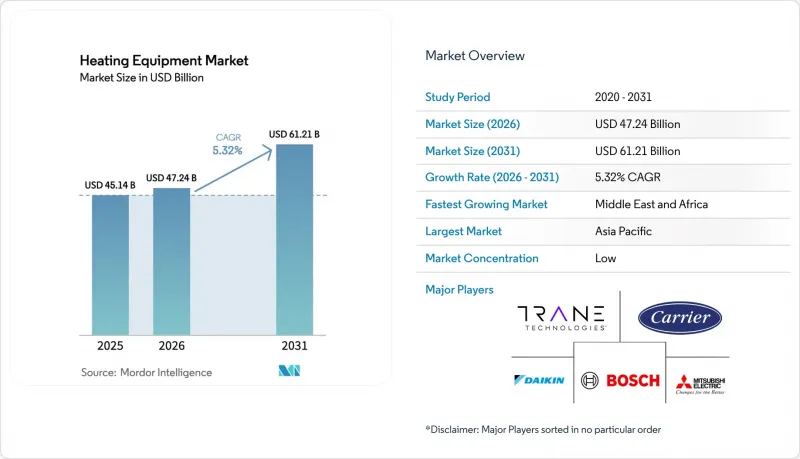
本報告按設備類型(鍋爐、爐灶、熱泵等)、終端用戶行業(住宅、商業、工業、公共/機構)、燃料類型(天然氣、電力、石油等)、技術(冷凝式、非冷凝式等)、安裝類型(新安裝、更換/維修)和地區進行細分。市場預測以美元(USD)計價。
全球暖氣設備市場趨勢及洞察
在寒冷地區推廣維修計畫中的電氣化
在零度以下的地區,公共資金正被用於將燃油和丙烷加熱系統維修為熱泵。紐約州的清潔暖氣計畫已撥款2.5億美元,計畫在2025年前維修10萬戶住宅;魁北克省也已累計3億加幣(約2.22億美元)用於利用剩餘的水力發電。硬體設備已經準備就緒。三菱的Zuba-Central管道式空調機組即使在度C也能保持滿載運行,而開利則將水源熱泵與乙二醇循環系統結合,以防止冷凝。目前的瓶頸正從技術成熟度轉向安裝人員的能力以及電力收費系統,後者仍比硬體創新落後約兩年。
現場熱泵對於實現碳中和的企業園區至關重要。
為了實現範圍1零排放,實踐科學碳目標(SBT)的企業正以大型水源或地熱系統取代鍋爐。微軟已維修了12個資料中心園區,天然氣用量減少了85%,並取消了碳抵銷購買。亞馬遜已在其位於德國和波蘭的倉庫中採用了地熱裝置,聯合利華計劃在2030年將其40家工廠實現電氣化。由於這些項目通常超過500千瓦,並能產生多年的業務收益,原始設備製造商(OEM)往往更傾向於“熱泵即服務”契約,即按提供的千瓦時收費,而不是銷售設備。
在電氣化進程不斷推進的地區,電網容量存在瓶頸。
快速電氣化可能會使冬季用電高峰需求翻倍,可能導致原本為燃氣暖氣住宅設計的變壓器和配電線路過載。英國國家電網指出,大倫敦地區22%的低壓電路需要加固,維修費用約為每戶4,000英鎊(5,200美元),工期長達18個月。由於變電站備用容量不足,EverSource公司推遲了麻州1200項申請。德國電力公司估計,到2035年,電網投資將達到500億歐元(540億美元),這筆成本最終將導致電價上漲。雖然需量反應是抑制用電需求的有效方法,但其實施較為複雜,因為承包商必須註冊用戶並安裝試運行智慧溫控器。
細分市場分析
到2025年,鍋爐仍將佔據37.54%的市場佔有率,這主要得益於工業蒸氣和區域供熱對90 度C以上輸出溫度的需求。同時,熱泵正以6.38%的複合年成長率快速成長,在北美地區逐漸取代強制通風式加熱器,並在歐洲蠶食熱水散熱器市場。在美國,管道式住宅中仍保留加熱器,但目前正被管道式變頻熱泵直接取代。輻射板等小眾設備用於特殊應用,但仍維持較高的利潤率。作為一種競爭趨勢,住宅和小規模商業用戶正在迅速轉向電氣化,而鍋爐在需要高溫的工業生產線中仍將保留,直到氣相和氫混合技術廣泛應用。結合熱泵和鍋爐的混合機組能夠簡化部署,並透過電氣化80%的年度負荷,同時在極端高峰時段提供石化燃料備用,從而平衡對電網的影響並降低住宅的成本。
策略差異化的關鍵在於軟體。特靈的「Tracer」平台能夠預測入住率和天氣狀況,在用電低谷時段進行預熱,並利用公用事業公司降低需求的獎勵。這些功能正推動暖氣設備市場從硬體利潤率轉向終身服務價值,提高了僅以價格競爭的新進入者的准入門檻,同時也鼓勵現有公司提供包含保固和維護服務的分析功能。
預計到2025年,住宅買家將佔市場佔有率的57.83%,到2031年將以6.42%的複合年成長率成長。這一成長主要得益於美國的稅額扣抵、歐洲的房屋維修義務以及中國從煤炭向電力的轉型。同時,優先考慮總擁有成本(TCO)的商業房地產管理公司佔據約25%的市場佔有率,並且傾向於選擇易於與建築自動化整合的單元。
工業客戶佔市場佔有率的12%,他們優先考慮120 度C以上的耐熱性和客製化設計,並且為每台500kW的設備支付超過10萬美元的情況並不少見。 Thermax憑藉這項專業技術,贏得了製藥和乳製品行業的餘熱利用項目。在公共設施中,儘管投資回收期較長,但政策要求仍會推動早期採用。因此,採購行為各不相同:住宅銷售受簡易的補貼方案和資金籌措的驅動;商業交易受需量反應和擔保的驅動;而工業合約則受流程整合深度的驅動。
區域分析
預計到2025年,亞太地區將佔全球銷售額的40.19%,這主要得益於中國燃煤鍋爐的改造、印度中產階級對管道式熱泵的升級以及日本對變頻式機組的補貼。歐洲緊隨其後,約佔30%,這主要得益於德國、法國和英國監管政策的趨同,但電網限制和勞動力短缺限制了成長。北美約佔20%。根據《通膨抑制法案》,每戶最高2,000美元的稅額扣抵正在加速寒冷地區熱泵系統的普及,而加拿大各省也正在利用剩餘的水力發電。中東和非洲地區正以7.78%的複合年成長率推動成長,這主要得益於NEOM等超級項目,該項目強制要求採用太陽能熱混合系統。南美市場規模仍然小規模,但在水力資源豐富的巴西南部各州,隨著分離式熱泵系統在社會住宅中的應用日益廣泛,市場正在迅速發展。
中國市場分為北方集中式區域供熱和南方獨立式空調兩種模式,迫使原始設備製造商(OEM)調整產品線以適應不同地區的需求。在印度,公寓建設的激增推動大金公司2025年的銷售額成長了18%。日本經濟產業省設定了2030年實現500萬套住宅的目標,以減少液化天然氣(LNG)進口。在中東,杜拜的區域供冷網路正在試驗使用熱回收冷卻器為飯店提供熱水,這凸顯了即使在炎熱氣候下也存在供暖需求。
預計到2025年,歐洲將佔據約30%的暖氣設備市場。這主要得益於維修補貼的推出和碳價上漲,推動了鍋爐更換速度的加速。然而,要持續成長,需要清除安裝商的訂單,並加強都市區電力網路建設,尤其是在倫敦和慕尼黑等變壓器交付週期長達18個月的城市。預計到2025年,北美將佔據約20%的需求佔有率,這得益於《通貨膨脹抑制法案》提供的每戶最高2000美元的稅額扣抵,以及加拿大各省針對寒冷氣候提供的補貼,這些因素共同促進了住宅用戶的使用。在美國的超大規模資料中心走廊,資料中心廢熱回收正在創造新的成長潛力,營運商正在探索將其與吸收式熱泵結合,以減少柴油鍋爐的運作。雖然拉丁美洲目前仍是一個小眾市場,但巴西南部各州擁有豐富的水力資源,正在試點鼓勵將熱泵負荷轉移到非高峰時段的收費系統模式,為未來的擴張奠定基礎。
其他好處:
- Excel格式的市場預測(ME)表
- 3個月的分析師支持
目錄
第1章:引言
- 研究假設和市場定義
- 調查範圍
第2章:調查方法
第3章執行摘要
第4章 市場狀況
- 市場概覽
- 市場促進因素
- 在寒冷氣候地區推廣維修工程中的電氣化
- 實現碳中和的企業園區需要配備現場熱泵。
- 用於高溫工業乾燥的氣相熱泵創新技術。
- 基於性能的建築規範正在加速鍋爐的更換。
- 將廢熱和熱泵整合到區域供熱系統中
- 商用鍋爐中綠色氫氣混合的試點項目
- 市場限制因素
- 電氣化地區輸配電網路容量瓶頸
- 多維修專案中技術純熟勞工短缺
- 鎳價波動推高了先進熱泵零件的成本。
- 住宅補貼制度運作上的分歧
- 產業生態系分析
- 監理情勢
- 技術展望
- 宏觀經濟因素的影響
- 波特五力分析
第5章 市場規模與成長預測
- 依設備類型
- 鍋爐
- 爐
- 熱泵
- 散熱器
- 其他類型的加熱器
- 按最終用戶行業分類
- 住宅
- 商業的
- 產業
- 公共機構
- 按燃料類型
- 天然氣
- 電力
- 油
- 生質能
- 與氫相容
- 透過技術
- 濃縮版
- 非冷凝型
- 空氣源熱泵
- 地源熱泵
- 混合系統
- 智慧互聯系統
- 按安裝類型
- 新推出
- 更換/維修
- 按地區
- 北美洲
- 美國
- 加拿大
- 墨西哥
- 南美洲
- 巴西
- 阿根廷
- 其他南美國家
- 歐洲
- 英國
- 德國
- 法國
- 西班牙
- 義大利
- 其他歐洲國家
- 亞太地區
- 中國
- 印度
- 日本
- 澳洲
- 韓國
- 其他亞太國家
- 中東和非洲
- 中東
- 沙烏地阿拉伯
- 阿拉伯聯合大公國
- 土耳其
- 其他中東國家
- 非洲
- 南非
- 肯亞
- 其他非洲國家
- 中東
- 北美洲
第6章 競爭情勢
- 市場集中度
- 策略趨勢
- 市佔率分析
- 公司簡介
- Daikin Industries Ltd.
- Carrier Global Corporation
- Robert Bosch GmbH
- Trane Technologies plc
- Ariston Holding NV
- NIBE Industrier AB
- Danfoss A/S
- Panasonic Holdings Corporation
- Thermax Limited
- Mitsubishi Electric Corporation
- Lennox International Inc.
- Viessmann Climate Solutions SE
- Glen Dimplex Group
- Rheem Manufacturing Company
- BDR Thermea Group BV
- Bradford White Corporation
- AO Smith Corporation
第7章 市場機會與未來展望
According to Mordor Intelligence, the heating equipment market size is expected to increase from USD 45.14 billion in 2025 to USD 47.24 billion in 2026 and reach USD 61.21 billion by 2031, growing at a CAGR of 5.32% over 2026-2031.
This report is Segmented by Equipment Type (Boilers, Furnaces, Heat Pumps, and More), End-User Industry (Residential, Commercial, Industrial, and Public/Institutional), Fuel Type (Natural Gas, Electricity, Oil, and More), Technology (Condensing, Non-Condensing, and More), Installation Type (New Installation, and Replacement/Retrofit), and Geography. The Market Forecasts are Provided in Terms of Value (USD).
Global Heating Equipment Market Trends and Insights
Electrification Push in Cold-Climate Retrofit Programs
Sub-zero regions now direct public money toward heat-pump retrofits that displace fuel-oil and propane systems. New York's Clean Heat program allocated USD 250 million in 2025 for 100,000 residential conversions, while Quebec earmarked CAD 300 million (USD 222 million) to leverage surplus hydro power. Hardware is ready; Mitsubishi's Zuba-Central ducted unit maintains full output at minus-30 °C, and Carrier pairs water-source heat pumps with glycol loops to prevent frosting. The choke point has shifted from technology readiness to installer capacity and utility rate design that still lags hardware innovation by roughly two years.
Carbon-Neutral Corporate Campuses Demand On-Site Heat Pumps
Corporations pursuing Science Based Targets swap boilers for large water-source or ground-source systems to erase Scope 1 emissions. Microsoft retrofitted 12 data-center campuses, cutting natural-gas use 85% and retiring offset purchases. Amazon specified ground-source units for German and Polish warehouses, and Unilever is electrifying 40 factories by 2030. Each job often exceeds 500 kW, carries multi-year service revenue, and favors heat-pump-as-a-service contracts in which OEMs bill per delivered kilowatt-hour rather than equipment sales.
Grid-Capacity Bottlenecks in Electrified Neighborhoods
Rapid electrification can double winter peaks, overloading transformers and feeders sized for gas-heated homes. National Grid flagged 22% of low-voltage circuits in Greater London for reinforcement, with upgrade costs near GBP 4,000 (USD 5,200) per household and lead times stretching 18 months. Eversource delayed 1,200 applications in Massachusetts because substations lacked spare capacity. German utilities estimate EUR 50 billion (USD 54 billion) of network investment by 2035, expenses that ultimately raise delivered electricity prices. Demand-response curtailments help, but add installation complexity when contractors must enroll customers and commission smart thermostats.
Other drivers and restraints analyzed in the detailed report include:
- Gas-Phase Heat Pump Innovations for High-Temperature Industrial Drying
- Performance-Based Building Codes Accelerating Boiler Replacement
- Skilled-Labor Shortages for Multi-Technology Retrofits
For complete list of drivers and restraints, kindly check the Table Of Contents.
Segment Analysis
Boilers still hold 37.54% market share in 2025, anchored by industrial steam and district-energy loads requiring 90 °C-plus output. Heat pumps, however, are advancing at a 6.38% CAGR and increasingly cannibalize forced-air furnace replacements in North America and hydronic radiators in Europe. Furnaces linger in ducted U.S. housing but now face direct substitution via ducted inverter heat pumps. Niche devices such as radiant panels capture specialty applications yet carry premium margins. The competitive divide shows residential and light-commercial customers pivoting hard toward electrification, while high-temperature industrial lines retain boilers until gas-phase technology or hydrogen blending scales. Hybrid heat-pump-plus-boiler packages ease adoption by allowing 80% electrified annual load with fossil backup for extreme peaks, smoothing grid impact and homeowner cost.
Strategic differentiation revolves around software. Trane's Tracer platform forecasts occupancy and weather, pre-heats during off-peak tariffs, and unlocks utility incentives for demand shedding. These features move the heating equipment market from hardware margin to lifetime service value, raising barriers for price-only entrants and encouraging incumbents to bundle analytics with warranty and maintenance.
In 2025, residential buyers made up 57.83% of the market share and are projected to grow at a CAGR of 6.42% through 2031. This growth is bolstered by U.S. tax credits, European retrofit mandates, and China's transition from coal to electricity. Meanwhile, commercial property managers, focusing on total cost of ownership, command a share of about 25%, showing a preference for units primed for building-automation integration.
Industrial customers, at 12%, value 120 °C-plus capability and custom engineering, often paying more than USD 100,000 per 500-kW unit; Thermax leveraged this specialization to win pharmaceutical and dairy waste-heat projects. Public facilities adopt early due to policy mandates despite longer paybacks. Purchase behavior thus varies, residential sales hinge on rebate simplicity and financing, commercial deals on demand-response and warranty, and industrial contracts on process integration depth.
Complete Report Scope:
- By Equipment Type
- Boilers
- Furnaces
- Heat Pumps
- Radiators
- Other Heater Types
- By End-User Industry
- Residential
- Commercial
- Industrial
- Public/Institutiona
- By Fuel Type
- Natural Gas
- Electricity
- Oil
- Biomass
- Hydrogen-Ready
- By Technology
- Condensing
- Non-Condensing
- Air Source Heat Pumps
- Ground Source Heat Pumps
- Hybrid Systems
- Smart Connected Systems
- By Installation Type
- New Installation
- Replacement/Retrofit
- By Geography
- North America
- United States
- Canada
- Mexico
- South America
- Brazil
- Argentina
- Rest of South America
- Europe
- United Kingdom
- Germany
- France
- Spain
- Italy
- Rest of Europe
- Asia-Pacific
- China
- India
- Japan
- Australia
- South Korea
- Rest of Asia-Pacific
- Middle East and Africa
- Middle East
- Saudi Arabia
- United Arab Emirates
- Turkey
- Rest of Middle East
- Africa
- South Africa
- Kenya
- Rest of Africa
- Middle East
- North America
Geography Analysis
Asia-Pacific held 40.19% of 2025 revenue as China converted coal boilers, India's middle class upgraded to ducted heat pumps, and Japan subsidized inverter units. Europe followed at roughly 30% as German, French, and United Kingdom mandates converged, though grid limits and labor shortages temper growth. North America represented about 20%; Inflation Reduction Act credits up to USD 2,000 per home accelerated adoption in cold states, while Canadian provinces leaned on hydro surplus. The Middle East and Africa lead in growth at a 7.78% CAGR amid giga-projects like NEOM that specify solar-thermal-heat-pump hybrids. South America remains small but gains momentum in Brazil's hydro-rich southern states where social housing now opts for split heat-pump systems.
China's market splits between centralized district heating in the north and individual split units in the south, forcing OEMs to tailor product lines. India logged Daikin sales growth of 18% in 2025 as apartment construction boomed. Japan's trade ministry targets 5 million residential units by 2030 to curb liquefied natural-gas imports. In the Middle East, Dubai's district-cooling network pilots heat-recovery chillers to supply hotel hot water, underlining that heating demand exists even in hot climates.
Europe accounted for roughly 30% of the heating equipment market share in 2025 as retrofit grants and rising carbon prices converged to accelerate boiler replacement, yet sustained expansion hinges on clearing installer backlogs and reinforcing urban distribution grids, particularly in cities such as London and Munich that face 18-month transformer lead times. North America held about 20% of 2025 demand, with Inflation Reduction Act tax credits of up to USD 2,000 per household and provincial cold-climate rebates in Canada boosting residential uptake. Data-center waste-heat recovery offers fresh upside across the United States hyperscale corridor, where operators are evaluating absorption-heat-pump pairings to curb diesel-boiler runtime. Latin America remains a niche today, yet Brazil's hydro-rich southern states are piloting tariff structures that reward heat-pump load shifting to off-peak periods, laying groundwork for future scaling.
- Daikin Industries Ltd.
- Carrier Global Corporation
- Robert Bosch GmbH
- Trane Technologies plc
- Ariston Holding N.V.
- NIBE Industrier AB
- Danfoss A/S
- Panasonic Holdings Corporation
- Thermax Limited
- Mitsubishi Electric Corporation
- Lennox International Inc.
- Viessmann Climate Solutions SE
- Glen Dimplex Group
- Rheem Manufacturing Company
- BDR Thermea Group B.V.
- Bradford White Corporation
- A. O. Smith Corporation
Additional Benefits:
- The market estimate (ME) sheet in Excel format
- 3 months of analyst support
TABLE OF CONTENTS
1 INTRODUCTION
- 1.1 Study Assumptions and Market Definition
- 1.2 Scope of the Study
2 RESEARCH METHODOLOGY
3 EXECUTIVE SUMMARY
4 MARKET LANDSCAPE
- 4.1 Market Overview
- 4.2 Market Drivers
- 4.2.1 Electrification Push in Cold-Climate Retrofit Programs
- 4.2.2 Carbon-Neutral Corporate Campuses Demand On-Site Heat Pumps
- 4.2.3 Gas-Phase Heat Pump Innovations for High-Temperature Industrial Drying
- 4.2.4 Performance-Based Building Codes Accelerating Boiler Replacement
- 4.2.5 Waste-Heat-to-Heat-Pump Integration in District Energy
- 4.2.6 Green Hydrogen Blending Pilots in Commercial Boilers
- 4.3 Market Restraints
- 4.3.1 Grid-Capacity Bottlenecks in Electrified Neighborhoods
- 4.3.2 Skilled-Labor Shortages for Multi-Technology Retrofits
- 4.3.3 Volatile Nickel Prices Inflating Advanced Heat-Pump BOM
- 4.3.4 Fragmented Residential Rebate Administration
- 4.4 Industry Ecosystem Analysis
- 4.5 Regulatory Landscape
- 4.6 Technological Outlook
- 4.7 Impact of Macroeconomic Factors
- 4.8 Porter's Five Forces Analysis
- 4.8.1 Bargaining Power of Suppliers
- 4.8.2 Bargaining Power of Buyers
- 4.8.3 Threat of New Entrants
- 4.8.4 Threat of Substitute Products and Services
- 4.8.5 Intensity of Competitive Rivalry
5 MARKET SIZE AND GROWTH FORECASTS (VALUE)
- 5.1 By Equipment Type
- 5.1.1 Boilers
- 5.1.2 Furnaces
- 5.1.3 Heat Pumps
- 5.1.4 Radiators
- 5.1.5 Other Heater Types
- 5.2 By End-User Industry
- 5.2.1 Residential
- 5.2.2 Commercial
- 5.2.3 Industrial
- 5.2.4 Public/Institutiona
- 5.3 By Fuel Type
- 5.3.1 Natural Gas
- 5.3.2 Electricity
- 5.3.3 Oil
- 5.3.4 Biomass
- 5.3.5 Hydrogen-Ready
- 5.4 By Technology
- 5.4.1 Condensing
- 5.4.2 Non-Condensing
- 5.4.3 Air Source Heat Pumps
- 5.4.4 Ground Source Heat Pumps
- 5.4.5 Hybrid Systems
- 5.4.6 Smart Connected Systems
- 5.5 By Installation Type
- 5.5.1 New Installation
- 5.5.2 Replacement/Retrofit
- 5.6 By Geography
- 5.6.1 North America
- 5.6.1.1 United States
- 5.6.1.2 Canada
- 5.6.1.3 Mexico
- 5.6.2 South America
- 5.6.2.1 Brazil
- 5.6.2.2 Argentina
- 5.6.2.3 Rest of South America
- 5.6.3 Europe
- 5.6.3.1 United Kingdom
- 5.6.3.2 Germany
- 5.6.3.3 France
- 5.6.3.4 Spain
- 5.6.3.5 Italy
- 5.6.3.6 Rest of Europe
- 5.6.4 Asia-Pacific
- 5.6.4.1 China
- 5.6.4.2 India
- 5.6.4.3 Japan
- 5.6.4.4 Australia
- 5.6.4.5 South Korea
- 5.6.4.6 Rest of Asia-Pacific
- 5.6.5 Middle East and Africa
- 5.6.5.1 Middle East
- 5.6.5.1.1 Saudi Arabia
- 5.6.5.1.2 United Arab Emirates
- 5.6.5.1.3 Turkey
- 5.6.5.1.4 Rest of Middle East
- 5.6.5.2 Africa
- 5.6.5.2.1 South Africa
- 5.6.5.2.2 Kenya
- 5.6.5.2.3 Rest of Africa
- 5.6.5.1 Middle East
- 5.6.1 North America
6 COMPETITIVE LANDSCAPE
- 6.1 Market Concentration
- 6.2 Strategic Moves
- 6.3 Market Share Analysis
- 6.4 Company Profiles (Includes Global Level Overview, Market Level Overview, Core Segments, Financials as Available, Strategic Information, Market Rank/Share, Products and Services, and Recent Developments)
- 6.4.1 Daikin Industries Ltd.
- 6.4.2 Carrier Global Corporation
- 6.4.3 Robert Bosch GmbH
- 6.4.4 Trane Technologies plc
- 6.4.5 Ariston Holding N.V.
- 6.4.6 NIBE Industrier AB
- 6.4.7 Danfoss A/S
- 6.4.8 Panasonic Holdings Corporation
- 6.4.9 Thermax Limited
- 6.4.10 Mitsubishi Electric Corporation
- 6.4.11 Lennox International Inc.
- 6.4.12 Viessmann Climate Solutions SE
- 6.4.13 Glen Dimplex Group
- 6.4.14 Rheem Manufacturing Company
- 6.4.15 BDR Thermea Group B.V.
- 6.4.16 Bradford White Corporation
- 6.4.17 A. O. Smith Corporation
7 MARKET OPPORTUNITIES AND FUTURE OUTLOOK
- 7.1 White-Space and Unmet-Need Assessment

 全球感應加熱系統市場規模、佔有率、趨勢和成長分析報告(2026-2034年)
 2026 年至 2035 年商用暖氣設備市場的商業機會、成長要素、產業趨勢與預測。
 英國暖氣設備:市場佔有率分析、產業趨勢與統計及成長預測(2026-2031)
 加熱設備市場:2026-2032年全球市場預測(依燃料類型、產品類型、機制、最終用戶及銷售管道分類)
 全球工業製程加熱市場:按燃氣加熱和電加熱、按地區分類 - 預測至 2032 年
 低頻加熱系統市場預測至2034年-按產品類型、類別、應用和地區分類的全球分析
 暖氣設備市場規模、佔有率、趨勢和預測:按產品、應用和地區分類,2026-2034年
 2026年全球熱泵混合式熱水箱市場報告熱風加熱器市場:2026-2032年全球市場預測(依燃料類型、安裝方式、容量範圍、最終用戶和銷售管道)熱水地暖系統市場:依產品類型、地板材料類型、最終用戶、應用和分銷管道分類-2026年至2032年全球預測