


 |
市場調查報告書
商品編碼
2031741
全球工業製程加熱市場:按燃氣加熱和電加熱、按地區分類 - 預測至 2032 年Industrial Process Heating Market by Gas Heating, Electric Heating - Global Forecast to 2032 |
||||||


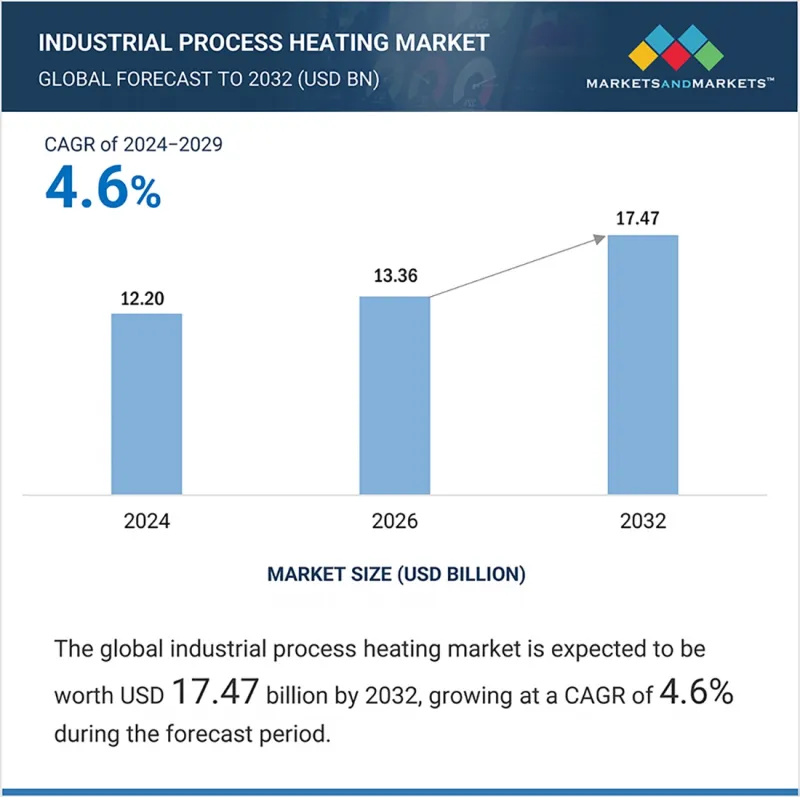
2026年全球工業製程加熱市場價值為133.6億美元,預估至2032年將達174.7億美元,預測期內複合年成長率為4.6%。
隨著金屬、化學、石油天然氣、食品飲料等產業對節能低排放暖氣系統的需求不斷成長,市場也不斷擴大。這些系統能夠實現精確的溫度控制、提高熱效率並增強製程可靠性,進而幫助最佳化工業運作。
| 調查範圍 | |
|---|---|
| 調查期 | 2021-2032 |
| 基準年 | 2025 |
| 預測期 | 2026-2032 |
| 目標單元 | 金額(10億美元) |
| 部分 | 瓦斯暖氣、電暖氣和區域 |
| 目標區域 | 北美、歐洲、亞太地區、其他地區 |
隨著各行業努力減少碳排放並遵守嚴格的環境法規,向電加熱技術和更清潔的替代燃料的轉型正在加速。此外,燃燒器技術、智慧控制系統和數位監控的進步正在提高能源效率和運作安全性,而傳統系統的淘汰和新興國家工業化的進程也持續推動市場成長。
“在預測期內,燃燒器預計將在燃氣加熱市場中實現最高的複合年成長率。”
預計在預測期內,燃燒器市場將以最高的複合年成長率成長,這主要得益於整個行業對高效、低排放加熱解決方案日益成長的需求。先進的燃燒器技術能夠實現精確的溫度控制和更高的燃燒效率。燃料消耗的降低有助於實現成本最佳化和永續性目標。採用低氮氧化物和高效能燃燒器有助於各行業遵守嚴格的環境法規。這些系統確保均勻的熱量分佈,從而提高製程一致性和產品品質。現代燃燒器還支援與自動化和控制系統整合,從而提高運作可靠性。與多種燃料(包括清潔替代燃料)的兼容性增強了工業應用的柔軟性。工業設備升級和維修的投資增加也進一步推動了需求。預計這些因素將推動先進燃燒器系統在工業製程加熱應用中的大規模部署。
“在預測期內,化工行業預計將成為燃氣供暖市場的主要驅動力。”
由於化學工業對連續高溫製作流程的依賴性日益增強,其對工業加熱系統的需求也隨之成長。工業加熱系統對於蒸餾、分解、重整和乾燥等應用至關重要。這些系統能夠提供精確的溫度控制和均勻的熱分佈,從而提高製程效率和產品品質。化工製造的高能耗需求推動了對高效可靠加熱解決方案的需求。先進的加熱技術能夠提高熱效率並降低燃料消耗。與自動化系統的整合可以改善運作控制和安全性。向低排放量和電氣化加熱解決方案的轉變符合永續性目標。製程最佳化可以減少能源損失和營運成本。此外,大規模生產的需求和嚴格的監管標準也進一步推動了這些系統的應用。總而言之,燃氣加熱系統在提高化學製造流程的效率和擴充性方面發揮著至關重要的作用。
“預計到 2025 年,歐洲將在燃氣製程加熱市場佔據相當大的佔有率。”
在對能源效率、永續性和先進工業基礎設施的高度重視的推動下,預計到2025年,歐洲將佔據燃氣製程加熱市場的重要佔有率。該地區在化工、食品飲料、金屬和汽車等行業擁有雄厚的基礎,這些行業對可靠且高性能的加熱系統有著迫切的需求。此外,領先的技術供應商的存在以及對工業現代化持續的投資也促進了創新加熱系統的應用。德國、法國和英國等國家正著力推動電氣化和智慧控制系統的整合,以提高營運效率並減少碳排放。現有基礎設施的維修和自動化程度的提高進一步推動了市場需求。這些因素使歐洲成為燃氣製程加熱市場的領先地區,而永續性舉措和技術進步預計將帶來強勁的成長。
本報告涵蓋的主要公司包括:霍尼韋爾國際公司(美國)、西門子(德國)、艾默生(美國)、安德里茨股份公司(奧地利)、ABB有限公司(瑞士)、Fives集團(法國)、Bloom工程公司(美國)、Fireye有限責任公司(美國)、NOXMAT(德國)、六碳電氣(中國)和華洛電氣公司(中國)和美國沃特洛電氣公司(中國)。
調查範圍:
本報告基於加熱技術(燃氣加熱和電加熱)、產業(金屬、化學、石油天然氣、食品飲料、玻璃、陶瓷、紙漿造紙、紡織等)和地區(北美、歐洲、亞太地區及其他地區),對工業製程加熱市場進行定義、描述和預測。報告詳細分析了影響市場成長的促進因素、阻礙因素、機會和挑戰,並探討了主要參與者為鞏固市場地位而採取的收購、產品發布、業務擴張和策略性舉措等競爭趨勢。
購買本報告的理由:
本報告對整個工業製程加熱市場及其細分市場的收入進行了最精準的估算,旨在幫助市場領導和新參與企業。報告也有助於相關人員了解競爭格局,獲得更深入的洞察,合理定位自身業務,並制定有效的打入市場策略。此外,報告還有助於理解市場動態,並提供有關關鍵促進因素、限制因素、機會和挑戰的資訊。
本報告深入分析了以下幾點:
- 對工業製程加熱市場的關鍵促進因素(製程能力和溫度均勻性)、阻礙因素(製程特定的性能要求限制了技術替代)、機會(主要工業OEM廠商正在積極擴展其電加熱產品組合)和挑戰(高資本密集度和維修複雜性限制了採用速度)進行分析。
- 產品開發/創新:深入了解新興加熱技術、燃燒器和電加熱系統的進步、數位控制解決方案以及工業製程加熱市場正在進行的研究和開發活動。
- 市場發展:有關盈利市場的全面資訊(本報告分析了各地區的工業過程加熱市場)。
- 市場多元化:全面介紹新產品開發、未開發的應用領域、近期產業趨勢、工業製程加熱市場的投資。
- 競爭評估:對主要公司(包括霍尼韋爾國際公司(美國)、西門子(德國)、艾默生(美國)、安德里茨股份公司(奧地利)、ABB有限公司(瑞士)、Fives集團(法國)、Bloom工程公司(美國)、Fireye有限責任公司(美國)、NOXMATbon(德國)、Sixbon)、SBixbon(中國)和華洛電氣產品的市場發展市場佔有率(中國電氣公司)。
目錄
第1章:專案範圍
第2章執行摘要
第3章 市場概覽
- 市場動態
- 促進因素
- 任務
- 重要會議和活動
- 價值鏈分析
- 價格分析
- 監理情勢
第4章:市場規模的計算與預測
- 瓦斯暖氣市場
- 燒錄機
- 熱交換器
- 空氣加熱器
- 燃燒器管理系統
- 燃料和空氣供應解決方案
- 服務
- 電熱市場
- 電熱設備
- 電源和散熱硬體
- 感測器和安全保護組件
- 服務
- 資料中心冷卻熱基礎設施市場
第5章 競爭情勢
- 競爭格局
- 競爭基準
- 瓦斯暖氣
- 電熱
第6章:工業製程加熱市場及公司概況
- 大公司
- HONEYWELL INTERNATIONAL INC.
- SIEMENS
- EMERSON
- ANDRITZ
- ABB
- FIVES
- BLOOM ENGINEERING COMPANY, INC.
- FIREYE, LLC
- NOXMAT
- WATLOW ELECTRIC MANUFACTURING COMPANY
- THERMON
- WEISHAUPT GROUP
- RIELLO SPA
- SPIRAX SARCO LIMITED
- ZEECO, INC.
- COMBUSTION CONCEPT PVT. LTD.
- DUNPHY COMBUSTION LTD.
- DURAG GROUP
- ESA SPA
- INDUSTRIAL COMBUSTION
- JOHN ZINK
- KANTHAL AB
- KARL DUNGS GMBH & CO., KG
- SAACKE GMBH
- SELAS HEAT TECHNOLOGY COMPANY
- TEMPCO ELECTRIC HEATER CORPORATION
第7章 戰略建議
第8章:調查方法
The global industrial process heating market is valued at USD 13.36 billion in 2026 and is projected to reach USD 17.47 billion by 2032, registering a CAGR of 4.6% during the forecast period. The market is advancing as demand for energy-efficient, low-emission heating systems across industries such as metals, chemicals, oil & gas, and food & beverage increases. These systems offer precise temperature control, improved thermal efficiency, and enhanced process reliability, supporting optimized industrial operations.
| Scope of the Report | |
|---|---|
| Years Considered for the Study | 2021-2032 |
| Base Year | 2025 |
| Forecast Period | 2026-2032 |
| Units Considered | Value (USD Billion) |
| Segments | By Gas Heating, Electric Heating and Region |
| Regions covered | North America, Europe, APAC, RoW |
The transition toward electric heating technologies and cleaner fuel alternatives is accelerating as industries aim to reduce carbon emissions and comply with stringent environmental regulations. Additionally, advancements in burner technologies, smart control systems, and digital monitoring are improving energy utilization and operational safety, while the replacement of conventional systems and growing industrialization in emerging economies continue to drive market growth.
"Burners are expected to grow at the highest CAGR of the gas-powered heating market during the forecast period."
Burners are expected to grow at the highest CAGR during the forecast period, driven by increasing demand for efficient, low-emission heating solutions across industries. Advanced burner technologies enable precise temperature control and improved combustion efficiency. Reduced fuel consumption supports cost optimization and sustainability goals. The adoption of low-NOx and high-efficiency burners helps industries comply with stringent environmental regulations. These systems ensure uniform heat distribution, improving process consistency and product quality. Modern burners also support integration with automation and control systems, enhancing operational reliability. Their compatibility with various fuels, including cleaner alternatives, supports flexibility in industrial applications. Growing investments in industrial upgrades and retrofitting further drive demand. These factors support large-scale adoption of advanced burner systems across industrial process heating applications.
"The chemical industry segment is expected to dominate the gas-powered heating market during the forecast period."
Demand from the chemical industry is rising due to its extensive reliance on continuous and high-temperature processing operations. Industrial process heating systems are essential for applications such as distillation, cracking, reforming, and drying. These systems support precise temperature control and uniform heat distribution, improving process efficiency and product quality. High energy demand in chemical manufacturing drives the need for efficient and reliable heating solutions. Advanced heating technologies enhance thermal efficiency and reduce fuel consumption. Integration with automation systems improves operational control and safety. The shift toward low-emission and electrified heating solutions aligns with sustainability goals. Process optimization reduces energy losses and operating costs. Additionally, large-scale production requirements and stringent regulatory standards further drive adoption. Overall, gas-powered heating systems play a critical role in improving efficiency and scalability in chemical manufacturing processes.
"Europe is expected to hold a significant share of the gas-powered process heating market in 2025."
Europe is expected to hold a significant share of the gas-powered process heating market in 2025, driven by its strong focus on energy efficiency, sustainability, and advanced industrial infrastructure. The region has a well-established base in industries such as chemicals, food & beverage, metals, and automotive, which require reliable and high-performance heating systems. Additionally, the presence of leading technology providers and continuous investments in industrial modernization support the adoption of innovative heating systems. Countries such as Germany, France, and the UK are emphasizing electrification and integration of smart control systems to improve operational efficiency and reduce carbon footprints. Retrofitting of existing infrastructure and increasing use of automation further enhance demand. These factors position Europe as a key region in the gas-powered process heating market, with strong growth driven by sustainability initiatives and technological advancements.
- By Company Type: Tier 1 (45%), Tier 2 (35%), and Tier 3 (20%)
- By Designation: Sales & Marketing Heads/Directors (35%), Regional & Global Business Unit Heads (30%), Market Intelligence & Strategy Leads (25%), and Others (10%)
- By Region: North America (37%), Europe (36%), Asia Pacific (22%), and RoW (5%)
The prominent players profiled in this report include Honeywell International Inc. (US), Siemens (Germany), Emerson (US), ANDRITZ AG (Austria), ABB Ltd. (Switzerland), Fives Group (France), Bloom Engineering Company, Inc. (US), Fireye, LLC (US), NOXMAT (Germany), SixCarbon Technology Co. Ltd. (China), and Watlow Electric Manufacturing Company (US).
Research Coverage:
The report defines, describes, and forecasts the industrial process heating market based on heating technology (gas-powered heating and electric-powered heating), industry (metals, chemicals, oil & gas, food & beverage, glass, ceramics, pulp & paper, textiles, and others), and regions (North America, Europe, Asia Pacific, and RoW). It provides detailed information regarding drivers, restraints, opportunities, and challenges influencing the market's growth. It also analyzes competitive developments, including acquisitions, product launches, expansions, and strategic initiatives undertaken by key players to strengthen their market positions.
Reasons to Buy This Report:
The report will help market leaders/new entrants with information on the closest approximations of the revenue for the overall industrial process heating market and its subsegments. The report will help stakeholders understand the competitive landscape and gain deeper insights to better position their business and plan effective go-to-market strategies. The report also helps stakeholders understand the market dynamics and provides information on key drivers, restraints, opportunities, and challenges.
The report will provide insights into the following points:
- Analysis of Key drivers (process throughput and temperature uniformity), restraints (process-specific performance requirements limit cross-technology substitution), opportunities (major industrial OEMs are actively expanding electric process heating portfolios), and challenges (high capital intensity and retrofit complexity limit pace of adoption) of the industrial process heating market.
- Product Development/Innovation: Detailed insights into emerging heating technologies, advancements in burner and electric heating systems, digital control solutions, and ongoing research & development activities in the industrial process heating market.
- Market Development: Comprehensive information about lucrative markets (the report analyzes the industrial process heating market across various regions).
- Market Diversification: Exhaustive information about new product developments, untapped application areas, recent industry developments, and investments in the Industrial process heating market.
- Competitive Assessment: In-depth assessment of market share, growth strategies, and offerings of leading players, including Honeywell International Inc. (US), Siemens (Germany), Emerson (US), ANDRITZ AG (Austria), ABB Ltd. (Switzerland), Fives Group (France), Bloom Engineering Company, Inc. (US), Fireye, LLC (US), NOXMAT GmbH (Germany), SixCarbon Technology Co., Ltd. (China), and Watlow Electric Manufacturing Company (US).
TABLE OF CONTENTS
1. PROJECT SCOPE
2. EXECUTIVE SUMMARY
3. MARKET OVERVIEW
- 3.1. MARKET DYNAMICS
- 3.1.1. DRIVERS
- 3.1.2. CHALLENGES
- 3.2. KEY CONFERENCES AND EVENTS
- 3.3. VALUE CHAIN ANALYSIS
- 3.4. PRICING ANALYSIS
- 3.5. REGULATORY LANDSCAPE
4. MARKET SIZING AND FORECAST
- 4.1. GAS-POWERED HEATING MARKET
- 4.1.1. BURNERS
- 4.1.1.1. Direct Fired Furnace Burners
- 4.1.1.2. Self-Recuperative Burners
- 4.1.1.3. Radiant Tube Burners
- 4.1.1.4. Line & Duct Burners
- 4.1.1.5. Glass & Oxygen Burners
- 4.1.1.6. Immersion Tube Burners
- 4.1.2. HEAT EXCHANGERS
- 4.1.3. AIR HEATERS
- 4.1.3.1. Indirect Air Heaters
- 4.1.3.2. Direct Air Heaters
- 4.1.4. BURNER MANAGEMENT SYSTEMS
- 4.1.4.1. BMS Controllers
- 4.1.4.2. Flame Detectors
- 4.1.5. FUEL & AIR DELIVERY SOLUTIONS
- 4.1.5.1. Valves & Pressure Control Hardware
- 4.1.5.2. Sensors & Safety Instrumentation
- 4.1.5.3. Air & Fuel Supply Equipment
- 4.1.5.4. Actuators
- 4.1.6. SERVICES
- 4.1.1. BURNERS
- 4.2. ELECTRIC-POWERED HEATING MARKET
- 4.2.1. ELECTRIC HEATING EQUIPMENT
- 4.2.1.1. Electric Air Heaters
- 4.2.1.2. Electric Immersion Heaters
- 4.2.1.3. Electric Line/Pre-Heaters
- 4.2.2. POWER & THERMAL CONTROL HARDWARE
- 4.2.2.1. SCR Power Controllers
- 4.2.2.2. Solid State Relays
- 4.2.2.3. Power Contractors
- 4.2.2.4. Electric Heater Control Panels
- 4.2.3. SENSORS & SAFETY PROTECTION COMPONENTS
- 4.2.3.1. Temperature Sensors
- 4.2.3.2. Current Sensors
- 4.2.3.3. Switches
- 4.2.4. SERVICES
- 4.2.1. ELECTRIC HEATING EQUIPMENT
- 4.3. DATA CENTER COOLING THERMAL INFRASTRUCTURE MARKET
5. COMPETITIVE LANDSCAPE
- 5.1. COMPETITIVE LANDSCAPE
- 5.2. COMPETITOR BENCHMARKING
- 5.2.1. GAS-POWERED HEATING
- 5.2.2. ELECTRIC-POWERED HEATING
6. INDUSTRIAL PROCESS HEATING MARKET, COMPANY PROFILES
- 6.1. KEY PLAYERS
- 6.1.1. HONEYWELL INTERNATIONAL INC.
- 6.1.2. SIEMENS
- 6.1.3. EMERSON
- 6.1.4. ANDRITZ
- 6.1.5. ABB
- 6.1.6. FIVES
- 6.1.7. BLOOM ENGINEERING COMPANY, INC.
- 6.1.8. FIREYE, LLC
- 6.1.9. NOXMAT
- 6.1.10. WATLOW ELECTRIC MANUFACTURING COMPANY
- 6.1.11. THERMON
- 6.1.12. WEISHAUPT GROUP
- 6.1.13. RIELLO S.P.A
- 6.1.14. SPIRAX SARCO LIMITED
- 6.1.15. ZEECO, INC.
- 6.1.16. COMBUSTION CONCEPT PVT. LTD.
- 6.1.17. DUNPHY COMBUSTION LTD.
- 6.1.18. DURAG GROUP
- 6.1.19. ESA S.P.A.
- 6.1.20. INDUSTRIAL COMBUSTION
- 6.1.21. JOHN ZINK
- 6.1.22. KANTHAL AB
- 6.1.23. KARL DUNGS GMBH & CO., KG
- 6.1.24. SAACKE GMBH
- 6.1.25. SELAS HEAT TECHNOLOGY COMPANY
- 6.1.26. TEMPCO ELECTRIC HEATER CORPORATION
7. STRATEGIC RECOMMENDATIONS
8. RESEARCH METHODOLOGY

 暖氣設備:市場佔有率分析、產業趨勢與統計、成長預測(2026-2031)
 全球感應加熱系統市場規模、佔有率、趨勢和成長分析報告(2026-2034年)
 2026 年至 2035 年商用暖氣設備市場的商業機會、成長要素、產業趨勢與預測。英國暖氣設備:市場佔有率分析、產業趨勢與統計及成長預測(2026-2031)
 加熱設備市場:2026-2032年全球市場預測(依燃料類型、產品類型、機制、最終用戶及銷售管道分類)
 低頻加熱系統市場預測至2034年-按產品類型、類別、應用和地區分類的全球分析
 暖氣設備市場規模、佔有率、趨勢和預測:按產品、應用和地區分類,2026-2034年
 2026年全球熱泵混合式熱水箱市場報告熱風加熱器市場:2026-2032年全球市場預測(依燃料類型、安裝方式、容量範圍、最終用戶和銷售管道)熱水地暖系統市場:依產品類型、地板材料類型、最終用戶、應用和分銷管道分類-2026年至2032年全球預測