


 |
市場調查報告書
商品編碼
2125378
電力產業無損檢測 (NDT):市場佔有率分析、產業趨勢與統計數據、成長預測 (2026-2031)Power Generation NDT - Market Share Analysis, Industry Trends & Statistics, Growth Forecasts (2026 - 2031) |
||||||

※ 本網頁內容可能與最新版本有所差異。詳細情況請與我們聯繫。
根據 Mordor Intelligence 預測,發電業無損檢測 (NDT) 的市場規模預計將從 2025 年的 41.8 億美元成長到 2026 年的 44.4 億美元,到 2031 年將達到 59.8 億美元,2026 年至 2031 年的複合年成長率為 6.16%。
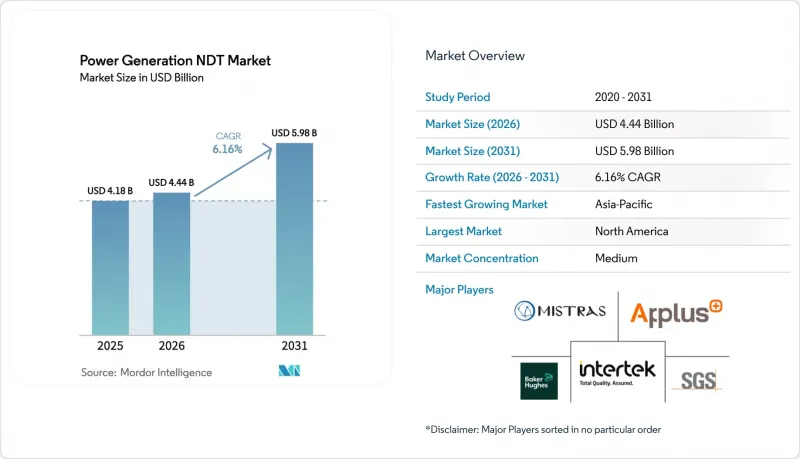
本報告按組件(設備、軟體等)、檢測方法(超音波、射線照相、磁粉檢測等)、技術(傳統/常規和人工智慧賦能)以及地區(北美、南美、歐洲、亞太、中東和非洲)進行細分。市場預測以美元計價。
全球電力產業無損檢測 (NDT) 市場趨勢及洞察。
老舊的火力發電設備已接近使用壽命終點,正在進行檢查週期。
北美和歐洲的發電廠業主正在延長燃煤和燃氣發電機組的運作壽命,使其超過最初的設計壽命,這導致對相位陣列超音波和電腦斷層掃描 (CT) 的需求增加,用於檢測鍋爐管、蒸氣集管和汽輪機殼體的蠕動和疲勞。檢測頻率在運作的最後一年達到高峰,導致單廠支出增加,設備現代化進程加快。電力公司正在採用自動化掃描器來減少停機時間並提高檢測的重複性。隨著監管機構安全審核的日益嚴格,具備行動 CT 能力的服務供應商正獲得越來越多的關注。由於每延長一年運作都需要更詳細、更頻繁的檢測,發電業的無損檢測 (NDT) 市場正從中受益。
延長核能發電廠運轉壽命的要求
監管機構要求許可證續期申請人根據ASME XI和IAEA定期審查規則,檢驗壓力容器的完整性、蒸汽產生器管道的狀況以及主管道的完好性。 ENIQ認證流程每次檢驗費用在50萬至200萬美元之間,鞏固了現有供應商(擁有已驗證技術)的地位。電力公司會撥出多年預算,專門用於針對停機期間的超音波、電渦流檢測和聲發射檢測宣傳活動,從而為認證供應商提供可預測的收入來源。因此,核能產業是發電領域無損檢測市場的基石,有助於緩解石化燃料發電支出週期性波動的影響。結合現場機器人技術和人工智慧分析的供應商正在縮短檢測時間並降低整體輻射暴露量。
ISO 9712/ASNT 三級認證技術人員短缺
退休人數激增和嚴格的認證時間表導致人員短缺25%至30%,進而推高工資並延長專案前置作業時間。核能項目受到的影響尤其嚴重,因為監管機構限制了工人的加班時間,並強制要求對關鍵掃描結果進行複核。服務公司正在投資虛擬實境(VR)培訓模組和人工智慧(AI)驅動的初步篩檢,以減輕檢查員的工作量,但現場部署仍依賴經驗豐富的人員短缺。電力公司為了提前確保技術人員到位,正在簽訂多個電廠的捆綁契約,這降低了他們在計劃外停機時的柔軟性。這種限制限制了可同時進行的專案數量,從而減緩了發電行業無損檢測(NDT)市場的成長。
細分市場分析
對相位陣列超音波機架、自動化掃描儀和高能量CT機架的強勁需求將使設備產業在2025年佔據電力產業無損檢測(NDT)市場46.12%的佔有率。核能發電廠許可證續約和石化燃料電廠延壽計畫需要具備超音波、渦流和射線照相等多重模式的工具包。隨著電力公司採用預測性維護,預計到2031年,軟體銷售額將以7.01%的複合年成長率成長,超過硬體,但仍以硬體為基礎。雲端託管分析平台透過訂閱模式將偵測資料貨幣化,進而改變供應商的收入結構。
偶聯劑、液體滲透探傷檢測材料和射線膠片等耗材是持續的收入來源,將客戶與原始設備製造商 (OEM) 生態系統緊密聯繫起來。服務仍然是至關重要的組成部分,因為複雜的標準和認證系統迫使電廠營運商將維護工作外包,而不是依賴內部員工。隨著勞動力短缺問題日益嚴重,電廠無損檢測 (NDT) 服務市場預計將穩定擴張。提供設備租賃和長期服務合約的供應商的合約續約率高達兩位數。定價機制日趨複雜,內部報酬率 (IRR) 模型現在不僅考慮硬體折舊免稅額,還考慮資料分析的終身使用費。
區域分析
到2025年,北美將佔據發電領域無損檢測(NDT)市場38.22%的收入佔有率,這主要得益於美國90多座核子反應爐運行許可證的續期以及燃煤發電廠報廢檢驗工作的積壓。加拿大CANDU核子反應爐的維修和墨西哥電網現代化計畫也進一步推動了市場成長。明確的法律規範有助於設備認證,而強大的服務供應鏈則確保了多組人員在有限的停機時間內完成部署。
亞太地區是成長最快的地區,預計到2031年將實現6.74%的複合年成長率,主要得益於中國核子反應爐建設、印度燃煤發電廠現代化改造以及東南亞可再生能源目標的推動。當地原始設備製造商(OEM)正在擴大相位陣列的生產,從而縮短前置作業時間並降低實施成本。區域各國政府為人工智慧驅動的檢測系統提供稅額扣抵,加速了數位技術的應用。中國和新加坡的培訓機構正在提升其ISO 9712合規能力,逐步緩解技術熟練人員短缺的問題。
在歐洲,由於嚴格的《核能指令》(ENSREG),核能產業持續穩定成長。該指令強制要求定期進行安全審查,包括超音波、射線照相和渦流檢測等技術。即使在德國分階段退役核能發電廠的過程中,仍需要進行徹底的退役檢查;而法國核能發電廠的延壽則依賴ENIQ認證程序。北海離岸風力發電的擴張催生了對複合材料葉片專業檢測的需求。統一的EN ISO標準促進了跨境服務合約的簽訂,使歐洲成為更廣泛的電力產業無損檢測(NDT)市場中既具有競爭力又易於進入的市場。
其他好處:
- Excel格式的市場預測(ME)表
- 3個月的分析師支持
目錄
第1章:引言
- 研究假設和市場定義
- 調查範圍
第2章:調查方法
第3章執行摘要
第4章 市場狀況
- 市場概覽
- 市場促進因素
- 老舊的石化燃料發電廠已接近使用壽命終點,需要進行檢查。
- 關於延長核子反應爐運作壽命的規定(ASME XI,IAEA 定期安全審查)
- 整合數位孿生和無損檢測 (NDT) 資料湖的預測性維護程序
- 可再生能源的蓬勃發展正在推動陸上和離岸風力發電複合複合材料的無損檢測 (NDT) 協議的發展。
- 雷射和超音波技術的引入使得運作中的鍋爐進行非接觸式檢測成為可能。
- 關稅驅動下的感測器供應鏈本地化正在提高本地可用性。
- 市場限制因素
- ISO 9712認證技術人員短缺/ASNT三級電力產業技術人員短缺
- 對相位陣列、自動化和CT系統進行了大量資本投資。
- 高解析度偵測檔案中資料過多所導致的瓶頸
- 特殊壓電/光學元件的貿易和關稅衝擊
- 產業價值鏈分析
- 宏觀經濟因素的影響
- 監理情勢
- 技術展望
- 波特五力分析
第5章 市場規模與成長預測
- 按組件
- 裝置
- 軟體
- 服務
- 消耗品
- 透過測試方法
- 超音波檢查
- 放射檢查
- 磁粉檢測
- 液體滲透探傷
- 目視檢查
- 電渦流檢測
- 聲發射測試
- 熱成像/紅外線檢測
- 電腦斷層掃描(CT)
- 透過方法
- 傳統型/傳統方法
- 基於人工智慧
- 按地區
- 北美洲
- 美國
- 加拿大
- 墨西哥
- 南美洲
- 巴西
- 阿根廷
- 其他南美國家
- 歐洲
- 德國
- 英國
- 法國
- 義大利
- 西班牙
- 其他歐洲國家
- 亞太地區
- 中國
- 日本
- 印度
- 韓國
- 東南亞
- 其他亞太國家
- 中東
- 沙烏地阿拉伯
- 阿拉伯聯合大公國
- 土耳其
- 其他中東國家
- 非洲
- 南非
- 奈及利亞
- 其他非洲國家
- 北美洲
第6章 競爭情勢
- 市場集中度
- 策略趨勢
- 市佔率分析
- 公司簡介
- Baker Hughes Company
- Mistras Group Inc.
- SGS SA
- Intertek Group plc
- Applus Services SA
- Bureau Veritas SA
- Olympus Corporation(Evident)
- Eddyfi Technologies
- TEAM Inc.
- Acuren Group Inc.
- TUV Rheinland AG
- DEKRA SE
- Element Materials Technology
- Zetec Inc.
- Sonatest Ltd.
- Screening Eagle Technologies AG
- YXLON International GmbH
- Karl Deutsch Pruf-und Messgeratebau GmbH
- Cygnus Instruments Ltd.
- NOVO Test Ltd.
- Sonotron NDT
- Vibra-tion NDT Services Pvt. Ltd.
- Industrial Inspection and Analysis Inc.
- Premier NDT Services Inc.
- Ether NDE Ltd.
- Toshiba Energy Systems and Solutions Corp.
- Buffalo Inspection Services
第7章 市場機會與未來展望
According to Mordor Intelligence, the power generation NDT market size is expected to grow from USD 4.18 billion in 2025 to USD 4.44 billion in 2026 and is forecast to reach USD 5.98 billion by 2031 at 6.16% CAGR over 2026-2031.
This report is Segmented by Component (Equipment, Software, and More), Testing Method (Ultrasonic Testing, Radiographic Testing, Magnetic Particle Testing, and More), Technique (Traditional/Conventional and AI-Enabled), and Geography (North America, South America, Europe, Asia Pacific, Middle East, and Africa). The Market Forecasts are Provided in Terms of Value (USD).
Global Power Generation NDT Market Trends and Insights
Aging Thermal-Fossil Power Fleet Reaching End-of-Life Inspection Cycles
Plant owners in North America and Europe are extending the lives of coal and gas units beyond their original design, which amplifies demand for phased-array ultrasonics and computed tomography to detect creep and fatigue in boiler tubes, steam headers, and turbine casings. Inspection intensity peaks during the final operating years, resulting in increased per-facility spending and accelerated equipment replacement. Utilities are opting for automated scanners that reduce outage durations and improve repeatability. Service providers with mobile CT capabilities are winning short-notice call-outs as regulators tighten safety audits. The power generation NDT market benefits because each incremental year of operation mandates deeper and more frequent examinations.
Nuclear Life-Extension Mandates
Regulators require license-renewal applicants to verify the integrity of their vessels, the condition of their steam generator tubes, and the health of their primary piping under ASME XI and IAEA periodic review rules. ENIQ-qualified procedures cost USD 0.5-2 million each, which entrenches incumbent vendors that already possess validated techniques. Utilities allocate multiyear budgets for outage-specific ultrasonic, eddy-current, and acoustic-emission campaigns, sustaining a predictable revenue stream for certified suppliers. The nuclear segment, therefore, acts as a stability anchor for the power generation NDT market, cushioning cyclical swings in fossil-fired spending. Vendors that combine field robotics with AI-aided interpretation are shortening inspection windows and lowering collective radiation exposure.
Shortage of Certified ISO 9712 / ASNT Level III Technicians
A retiree wave and stringent certification timelines have created a 25-30% talent gap that inflates wages and extends project lead times. Nuclear projects feel the pinch most acutely because regulators cap crew overtime and mandate dual review of critical scans. Service companies are investing in virtual-reality training modules and AI-driven preliminary screening to ease interpreter workloads, yet field deployment still hinges on scarce senior personnel. Utilities are bundling multi-plant contracts to reserve technician rosters in advance, reducing flexibility for unscheduled outages. This constraint tempers growth in the power generation NDT market by limiting the volume of simultaneous campaigns that can be staffed.
Other drivers and restraints analyzed in the detailed report include:
- Predictive-Maintenance Programs Integrating Digital Twins
- Renewables Boom Driving Blade-Composite NDT Protocols
- High Capex for Phased-Array, Automated and CT Systems
For complete list of drivers and restraints, kindly check the Table Of Contents.
Segment Analysis
Equipment captured 46.12% of the 2025 power generation NDT market share thanks to strong demand for phased-array ultrasonic racks, automated scanners, and high-energy CT gantries. Nuclear license renewals and fossil-plant life-extension projects require multi-modality toolkits that include ultrasonic, eddy-current, and radiographic capabilities. As utilities adopt predictive maintenance, software revenues are climbing at a 7.01% CAGR through 2031, outpacing hardware but still building on a hardware foundation. Cloud-hosted analytics platforms monetize inspection data via subscription, reshaping vendor economics.
Consumables such as couplants, penetrants, and radiographic films deliver recurring revenue that locks customers into OEM ecosystems. Services remain a vital layer because complex codes and qualification regimes push plant operators to outsource rather than maintain in-house crews. The power generation NDT market size for services is projected to swell steadily as personnel shortages intensify. Vendors that bundle equipment leasing with long-term service contracts are achieving double-digit renewal rates. Internal rate-of-return models now weigh lifetime data analytics fees alongside hardware depreciation, refining price-discovery mechanisms.
Complete Report Scope:
- By Component
- Equipment
- Software
- Services
- Consumables
- By Testing Method
- Ultrasonic Testing
- Radiographic Testing
- Magnetic Particle Testing
- Liquid Penetrant Testing
- Visual Inspection Testing
- Eddy-Current Testing
- Acoustic Emission Testing
- Thermography / Infrared Testing
- Computed Tomography Testing
- By Technique
- Traditional / Conventional
- AI-enabled
- By Geography
- North America
- United States
- Canada
- Mexico
- South America
- Brazil
- Argentina
- Rest of South America
- Europe
- Germany
- United Kingdom
- France
- Italy
- Spain
- Rest of Europe
- Asia-Pacific
- China
- Japan
- India
- South Korea
- South-East Asia
- Rest of Asia-Pacific
- Middle East
- Saudi Arabia
- United Arab Emirates
- Turkey
- Rest of Middle East
- Africa
- South Africa
- Nigeria
- Rest of Africa
- North America
Geography Analysis
North America accounted for 38.22% of 2025 revenue in the power generation NDT market, driven by over 90 U.S. reactor license renewals and a backlog of coal-plant end-of-life inspections. Canada's CANDU refurbishments and Mexico's grid-modernization projects add further momentum. Well-defined regulatory frameworks ease equipment qualification, while deep service supply chains enable multi-crew deployments during condensed outage windows.
The Asia-Pacific region is the fastest-growing region, with a 6.74% CAGR to 2031, driven by Chinese reactor buildouts, Indian coal fleet modernization, and Southeast Asian renewable energy targets. Local OEMs are scaling phased-array production, compressing lead times and lowering acquisition costs. Regional governments offer tax credits for AI-enabled inspection systems, accelerating digital adoption. Training academies in China and Singapore are expanding ISO 9712 capacity, gradually narrowing the technician gap.
Europe maintains steady growth, underpinned by stringent nuclear directives from ENSREG that require periodic safety reviews encompassing ultrasonic, radiographic, and eddy-current methods. Germany's nuclear phase-out still needs intensive decommissioning scans, while France's fleet life-extension hinges on ENIQ-qualified procedures. Offshore wind expansion across the North Sea is spawning specialized composite-blade inspection demand. Harmonized EN ISO standards encourage cross-border service contracts, making Europe a competitive yet accessible arena within the wider power generation NDT market.
- Baker Hughes Company
- Mistras Group Inc.
- SGS S.A.
- Intertek Group plc
- Applus Services S.A.
- Bureau Veritas S.A.
- Olympus Corporation (Evident)
- Eddyfi Technologies
- TEAM Inc.
- Acuren Group Inc.
- TUV Rheinland AG
- DEKRA SE
- Element Materials Technology
- Zetec Inc.
- Sonatest Ltd.
- Screening Eagle Technologies AG
- YXLON International GmbH
- Karl Deutsch Pruf- und Messgeratebau GmbH
- Cygnus Instruments Ltd.
- NOVO Test Ltd.
- Sonotron NDT
- Vibra-tion NDT Services Pvt. Ltd.
- Industrial Inspection and Analysis Inc.
- Premier NDT Services Inc.
- Ether NDE Ltd.
- Toshiba Energy Systems and Solutions Corp.
- Buffalo Inspection Services
Additional Benefits:
- The market estimate (ME) sheet in Excel format
- 3 months of analyst support
TABLE OF CONTENTS
1 INTRODUCTION
- 1.1 Study Assumptions and Market Definition
- 1.2 Scope of the Study
2 RESEARCH METHODOLOGY
3 EXECUTIVE SUMMARY
4 MARKET LANDSCAPE
- 4.1 Market Overview
- 4.2 Market Drivers
- 4.2.1 Ageing thermal-fossil power fleet reaching end-of-life inspection cycles
- 4.2.2 Nuclear life-extension mandates (ASME XI, IAEA periodic safety review)
- 4.2.3 Predictive-maintenance programs integrating digital twins and NDT data lakes
- 4.2.4 Renewables boom driving blade-composite NDT protocols for on-shore/off-shore wind
- 4.2.5 Laser-ultrasonic adoption enabling in-service, non-contact boiler inspection
- 4.2.6 Tariff-driven regionalization of sensor supply chains improving local availability
- 4.3 Market Restraints
- 4.3.1 Shortage of certified ISO 9712 / ASNT Level III power-sector technicians
- 4.3.2 High capex for phased-array, automated and CT systems
- 4.3.3 Data-overload bottlenecks for high-resolution inspection files
- 4.3.4 Trade-tariff shocks on specialty piezo / opto components
- 4.4 Industry Value Chain Analysis
- 4.5 Impact of Macroeconomic Factors
- 4.6 Regulatory Landscape
- 4.7 Technological Outlook
- 4.8 Porter's Five Forces Analysis
- 4.8.1 Bargaining Power of Suppliers
- 4.8.2 Bargaining Power of Buyers
- 4.8.3 Threat of New Entrants
- 4.8.4 Threat of Substitutes
- 4.8.5 Intensity Competitive Rivalry
5 MARKET SIZE AND GROWTH FORECASTS (VALUE)
- 5.1 By Component
- 5.1.1 Equipment
- 5.1.2 Software
- 5.1.3 Services
- 5.1.4 Consumables
- 5.2 By Testing Method
- 5.2.1 Ultrasonic Testing
- 5.2.2 Radiographic Testing
- 5.2.3 Magnetic Particle Testing
- 5.2.4 Liquid Penetrant Testing
- 5.2.5 Visual Inspection Testing
- 5.2.6 Eddy-Current Testing
- 5.2.7 Acoustic Emission Testing
- 5.2.8 Thermography / Infrared Testing
- 5.2.9 Computed Tomography Testing
- 5.3 By Technique
- 5.3.1 Traditional / Conventional
- 5.3.2 AI-enabled
- 5.4 By Geography
- 5.4.1 North America
- 5.4.1.1 United States
- 5.4.1.2 Canada
- 5.4.1.3 Mexico
- 5.4.2 South America
- 5.4.2.1 Brazil
- 5.4.2.2 Argentina
- 5.4.2.3 Rest of South America
- 5.4.3 Europe
- 5.4.3.1 Germany
- 5.4.3.2 United Kingdom
- 5.4.3.3 France
- 5.4.3.4 Italy
- 5.4.3.5 Spain
- 5.4.3.6 Rest of Europe
- 5.4.4 Asia-Pacific
- 5.4.4.1 China
- 5.4.4.2 Japan
- 5.4.4.3 India
- 5.4.4.4 South Korea
- 5.4.4.5 South-East Asia
- 5.4.4.6 Rest of Asia-Pacific
- 5.4.5 Middle East
- 5.4.5.1 Saudi Arabia
- 5.4.5.2 United Arab Emirates
- 5.4.5.3 Turkey
- 5.4.5.4 Rest of Middle East
- 5.4.6 Africa
- 5.4.6.1 South Africa
- 5.4.6.2 Nigeria
- 5.4.6.3 Rest of Africa
- 5.4.1 North America
6 COMPETITIVE LANDSCAPE
- 6.1 Market Concentration
- 6.2 Strategic Moves
- 6.3 Market Share Analysis
- 6.4 Company Profiles (includes Global level overview, Market level overview, Core segments, Financials as available, Strategic information, Market rank/share, Products and services, Recent developments)
- 6.4.1 Baker Hughes Company
- 6.4.2 Mistras Group Inc.
- 6.4.3 SGS S.A.
- 6.4.4 Intertek Group plc
- 6.4.5 Applus Services S.A.
- 6.4.6 Bureau Veritas S.A.
- 6.4.7 Olympus Corporation (Evident)
- 6.4.8 Eddyfi Technologies
- 6.4.9 TEAM Inc.
- 6.4.10 Acuren Group Inc.
- 6.4.11 TUV Rheinland AG
- 6.4.12 DEKRA SE
- 6.4.13 Element Materials Technology
- 6.4.14 Zetec Inc.
- 6.4.15 Sonatest Ltd.
- 6.4.16 Screening Eagle Technologies AG
- 6.4.17 YXLON International GmbH
- 6.4.18 Karl Deutsch Pruf- und Messgeratebau GmbH
- 6.4.19 Cygnus Instruments Ltd.
- 6.4.20 NOVO Test Ltd.
- 6.4.21 Sonotron NDT
- 6.4.22 Vibra-tion NDT Services Pvt. Ltd.
- 6.4.23 Industrial Inspection and Analysis Inc.
- 6.4.24 Premier NDT Services Inc.
- 6.4.25 Ether NDE Ltd.
- 6.4.26 Toshiba Energy Systems and Solutions Corp.
- 6.4.27 Buffalo Inspection Services
7 MARKET OPPORTUNITIES AND FUTURE OUTLOOK
- 7.1 White-space and Unmet-need Assessment

 全球分散式發電市場規模、佔有率、趨勢和成長分析報告(2026-2034)
 分散式發電:市場佔有率分析、產業趨勢與統計、成長預測(2026-2031)民用發電設備:市場佔有率分析、產業趨勢與統計、成長預測(2026-2031 年)
 建築一體化風力發電市場預測至2034年-按安裝類型、容量、技術、應用、最終用戶和地區分類的全球分析
 分散式發電市場:2026-2032年全球市場預測(依技術平台、電網類型、能源來源、容量、所有權、運作模式、最終用戶和安裝位置分類)微電網和社區規模能源系統市場預測至2034年:按容量範圍、所有權/營運模式、技術、應用和區域分類的全球分析商業分散式能源發電:市場佔有率分析、產業趨勢與統計及成長預測(2026-2031 年)2026年電力生產和分散式能源領域十大成長機會
 專屬式物流市場-全球產業規模、佔有率、趨勢、機會、預測:按服務、應用、區域和競爭格局分類,2021-2031年屋頂風力發電市場:全球產業規模、市場佔有率、趨勢、機會和預測(按技術、應用和地區分類)、競爭格局(2021-2031 年)