

 |
市場調查報告書
商品編碼
2125369
包裝器材:市場佔有率分析、產業趨勢與統計、成長預測(2026-2031)Packaging Machinery - Market Share Analysis, Industry Trends & Statistics, Growth Forecasts (2026 - 2031) |
||||||

※ 本網頁內容可能與最新版本有所差異。詳細情況請與我們聯繫。
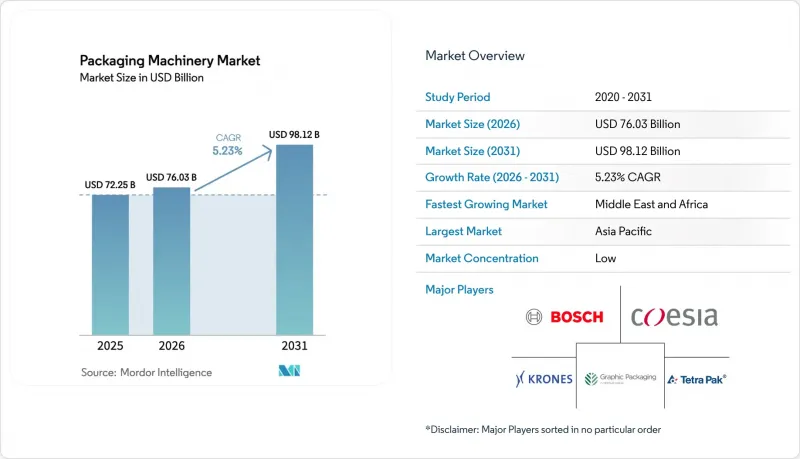
根據 Mordor Intelligence 估計,包裝器材市場在 2026 年的價值將達到 760.3 億美元,高於 2025 年的 722.5 億美元,預計到 2031 年將達到 981.2 億美元。
預計從 2026 年到 2031 年,其複合年成長率將達到 5.23%。
本報告按機器類型(填充稱重機、貼標機、裝飾噴碼機等)、自動化程度(手動等)、終端用戶行業(食品、飲料、製藥等)、技術平台(通用包裝、傳統包裝、調節氣體包裝等)和地區進行細分。市場預測以美元計價。
全球包裝器材市場趨勢與洞察
軟包裝和袋裝產品的推廣應用,推動了高速灌裝生產線的需求。
軟包裝形式正從零食擴展到飲料領域,迫使品牌所有者採用更快的水平和垂直成型-填充-封口 (FFS) 平台。諸如 Mespack 的 UHS Performa 等新型設備提高了運轉率,減少了薄膜浪費,降低了單位成本,同時也有助於實現永續性目標。供應商正在整合薄膜拼接模組,以保持連續運行,從而提高整體設備效率 (OEE)。在亞太地區,消費品製造商傾向於使用軟包裝袋,以便以輕量化包裝進入本地市場,並降低運輸成本。北美飲料製造商正在試用手沖式包裝袋來凸顯其高階果汁的差異化優勢,這增加了對能夠處理高黏度產品的衛生、高速填充頭的需求。
歐洲向永續紙質包裝的快速轉變,催生了對新型紙盒包裝技術的需求。
將於2025年2月生效的《歐洲包裝和包裝廢棄物法規》要求企業以可回收紙質包裝取代塑膠二次包裝。這一轉變正促使紙盒製造商進行一系列改造,以便在不影響密封強度的前提下加工更薄的紙板。帝亞吉歐為尊尼獲加威士忌開發了一種90%紙質瓶,凸顯了該品牌對可減少約47%碳排放的纖維解決方案的濃厚興趣。原始設備製造商(OEM)正在改進沖裁系統、黏合站和品質檢測,並採用視覺引導系統,以確保單材料紙盒的生產線速度與傳統塑膠包裝相當。隨著零售商對其供應商採用類似的環保評分卡,這種向紙質包裝的轉變也正在北美蔓延。
不銹鋼價格飆升,推高了符合高衛生標準的設備的投資成本。
鎳價波動導致不銹鋼價格飆升至每噸700至800美元的高位,對沖洗式填充機、無菌模組和製藥生產線的利潤率帶來壓力。原始設備製造商(OEM)正在重新設計框架,採用混合合金和策略性加固措施,以在不影響剛性的前提下減輕重量。一些買家推遲了採購決策,選擇進行維修,直到金屬市場穩定下來。歐洲供應商透過簽訂長期鋼材合約來規避成本,但同時也將部分成本以附加費的形式轉嫁給了客戶。必須符合316L標準的乳製品和嬰幼兒配方奶粉廠受此次價格上漲的影響最大。
細分市場分析
預計到2025年,灌裝和稱重設備將佔包裝器材市場佔有率的20.08%,凸顯其在食品、飲料和製藥行業的重要角色。同時,得益於歐洲紙質包裝的普及以及電子商務對堅固耐用二次包裝的需求,裝盒設備正以7.56%的複合年成長率成長。 GEA面向中小企業的緊湊型熱成型裝盒機清晰地展現了供應商如何透過即插即用的解決方案瞄準小規模工廠。如今的裝盒機配備了伺服控制的紙坯送料器,能夠處理尺寸差異較大的再生瓦楞紙板。此外,由於日益嚴格的可追溯性法規,與標籤和編碼系統相關的包裝器材市場也在穩步擴張。
在吸塑、熱成型和真空包裝設備的細分市場中,重點在於能夠延長肉品和調理食品保存期限的阻隔性增強薄膜。受高階礦泉水和機能飲料市場成長的推動,灌裝生產線的需求依然強勁。由於倉庫自動化專案優先採用機器人單元而非人工拉伸機,因此碼垛系統的需求也不斷成長。包裝和商品搭售機械的升級改造主要圍繞可變規格技術展開,旨在最佳化薄膜使用,以符合永續性目標。
預計到2025年,全自動和機器人整合生產線將佔包裝器材市場規模的55.12%,並將以7.78%的複合年成長率持續成長至2031年。降低人事費用、提高整體設備效率(OEE)以及增強衛生條件將帶來快速的投資回報。這些優勢在藥品管瓶的處理上尤其顯著。 TM Robotics公司的QPack-1每小時可處理7200管瓶,而人工處理每小時僅能處理2000個,從而降低了污染風險。半自動化生產線對於正在加速升級或管理小批量生產的製造商仍然十分有用。在非洲和東南亞的部分地區,手工操作仍然在以手工藝為主的小規模生產中保留。機器人技術的應用也正在擴展到箱裝和碼垛領域,視覺引導的揀選頭能夠實現混合SKU的堆疊。
在人手不足的背景下,包裝器材市場對方便用戶使用型編程套件的需求激增,這類套件無需編程知識即可快速更改配方。隨著預測性維護分析進一步減少意外停機時間,許多業者現在在進行整條生產線升級之前,會先使用感測器套件對現有設備進行改造。
區域分析
預計到2025年,亞太地區將佔據全球包裝器材市場45.72%的佔有率。這主要得益於中國市場的龐大規模以及印度包裝產品消費量的成長。在「2025中國國際包裝機械展覽會」(ProPak China 2025)上,區域供應商展示了超過2500件與自動化相關的展品,重點展示了人工智慧驅動的檢測和物流整合技術。日本和韓國正在提供高精度機器人技術,而印尼則正在運作新的軟性包裝工廠。政府對智慧製造和工業4.0應用的激勵措施也進一步推動了亞太地區包裝器材市場的發展。
預計中東和非洲將錄得最高成長率,到2031年年均複合成長率將達到6.08%,主要得益於沙烏地阿拉伯、埃及和南非飲料和乳製品加工的在地化。賽德爾公司與其在沙烏地阿拉伯的相關人員達成的協議,清楚地展現了政府為減少進口依賴主導的努力。然而,撒哈拉以南非洲部分地區長期電力短缺推高了營運成本,促使生產商採用太陽能板和高效率馬達。設備供應商正與當地系統整合商合作,以應對進口關稅和服務的挑戰。
在北美,隨著電履約中心投資自動化生產最後階段,市場需求依然強勁。預計到2023年,美國出貨收益將成長5.8%,達到109億美元,反映出設備升級週期持續進行。加拿大食品加工商正在採用機器人裝箱機來應對人手不足,而墨西哥則吸引了跨國飲料公司投資,建立區域中心。在歐洲,響應永續發展法規是當務之急,這促使可回收紙盒和單一材料包裝袋生產線得到更廣泛的應用。在南美洲,巴西和哥倫比亞的成長勢頭良好,但由於缺乏機器人程式設計技能,中小型加工商的應用速度仍然落後。
其他好處:
- Excel格式的市場預測(ME)表
- 3個月的分析師支持
目錄
第1章:引言
- 研究假設和市場定義
- 調查範圍
第2章:調查方法
第3章執行摘要
第4章 市場狀況
- 市場概覽
- 市場促進因素
- 軟包裝和袋裝形式的擴張正在推動高速填充線的普及。
- 歐洲向永續紙質包裝的快速轉變需要新的裝盒技術。
- 在北美,電子商務中「自有貨櫃出貨」模式的採用正在推動流程最後階段的自動化。
- 對整合包裝解決方案的需求日益成長
- 藥品序列化法規(歐盟藥品標籤法規、藥品供應鏈安全法規)正在推動全球標籤檢視和編碼實踐的升級。
- 市場限制因素
- 不銹鋼價格飆升,導致符合高衛生標準的機械設備的購買成本不斷增加。
- 延長的 IQ/OQ 驗證週期正在減緩美國醫療器材的訂單。
- 拉丁美洲中小企業在機器人程式設計方面的技能差距阻礙了自動化進程。
- 電力供應可靠性問題導致非洲瓶裝飲料公司的營運成本上升。
- 供應鏈分析
- 監理展望
- 波特五力分析
第5章 市場規模與成長預測
- 按機器類型
- 灌裝/稱重
- 標籤、裝飾和編碼。
- 案件處理
- 瓶裝線
- 卡特寧
- 碼垛和卸垛
- 包裝/裝訂
- 吸塑包裝/熱成型包裝/貼片包裝/真空包裝
- 其他機器類型
- 按自動化級別
- 手動的
- 半自動
- 全自動/機器人整合
- 按最終用戶行業分類
- 食物
- 飲料
- 製藥
- 化妝品和個人護理
- 工業化學品
- 其他終端用戶產業
- 透過技術平台
- 標準包裝(常規型)
- 調節氣體包裝(MAP)
- 真空包裝
- 無菌包裝線
- 智慧/互聯(相容於2D碼/RFID)包裝線
- 按地區
- 北美洲
- 美國
- 加拿大
- 墨西哥
- 歐洲
- 德國
- 英國
- 法國
- 義大利
- 西班牙
- 俄羅斯
- 其他歐洲國家
- 亞太地區
- 中國
- 印度
- 日本
- 韓國
- 澳洲和紐西蘭
- 其他亞太國家
- 中東和非洲
- 中東
- 阿拉伯聯合大公國
- 沙烏地阿拉伯
- 土耳其
- 其他中東國家
- 非洲
- 南非
- 奈及利亞
- 埃及
- 其他非洲國家
- 中東
- 南美洲
- 巴西
- 阿根廷
- 其他南美國家
- 北美洲
第6章 競爭情勢
- 市場集中度
- 策略趨勢
- 市佔率分析
- 公司簡介
- Tetra Laval Group(Sidel, Tetra Pak)
- Krones AG
- Coesia SpA
- Syntegon Technology GmbH
- IMA Group SpA
- Barry-Wehmiller Companies Inc.
- MULTIVAC Group
- Ishida Co. Ltd.
- SACMI Imola SC
- Graphic Packaging International LLC
- Marchesini Group SpA
- Aetna Group(ROBOPAC)
- ABB Ltd.(Robotics Packaging)
- Fanuc Corp.
- ProMach Inc.
- Bradman Lake Ltd.
- Signode Industrial Group
- KHS GmbH
- Mitsubishi Electric Corp.(Palletizers)
- FUJI MACHINERY CO.,LTD.
- Sidel Group
- Optima Packaging Group
- PacTech Holdings
- Echo Machinery
- Herma GmbH(Labelling)
第7章 市場機會與未來展望
According to Mordor Intelligence, the packaging machinery market size in 2026 is estimated at USD 76.03 billion, growing from 2025 value of USD 72.25 billion with 2031 projections showing USD 98.12 billion, growing at 5.23% CAGR over 2026-2031.
This report is Segmented by Machine Type (Filling and Dosing, Labelling Decorating and Coding, and More), Automation Level (Manual, and More), End-User Industry (Food, Beverages, Pharmaceuticals, and More), Technology Platform (General Packaging Conventional, Modified Atmosphere Packaging MAP, and More), and Geography. The Market Forecasts are Provided in Terms of Value USD.
Global Packaging Machinery Market Trends and Insights
Expansion of Flexibles and Pouch Formats Driving High-Speed Filling Lines
Flexible pack formats are spreading from snacks to beverages, forcing brand owners to install faster horizontal and vertical form-fill-seal platforms. New models such as Mespack's UHS Performa deliver higher uptime and lower film waste, trimming unit costs while improving sustainability targets. Suppliers are embedding film-splicing modules that sustain continuous motion to raise overall equipment effectiveness. In APAC, consumer goods makers favor pouches to reach rural markets with lightweight packs that lower freight expenses. North American beverage firms are testing spouted pouches to differentiate premium juices, spurring demand for hygienic, high-speed dosing heads that handle viscous products.
Rapid Shift to Sustainable Paper-Based Packs in Europe Necessitating New Cartoning Technologies
Europe's Packaging and Packaging Waste Regulation, effective February 2025, pushes companies to replace plastic secondary packs with recyclable paper structures. The transition has triggered a wave of cartoner retrofits that manage thinner board grades without compromising seal integrity. Diageo's 90% paper bottle for Johnnie Walker validates strong brand interest in fiber solutions that cut carbon emissions nearly 47%. OEMs are refining blank handling systems, gluing stations, and vision-guided quality checks to ensure mono-material cartons reach line speeds equal to legacy plastic formats. The paper shift is cascading to North America as retailers adopt similar eco-scorecards for suppliers.
Surge in Stainless-Steel Prices Inflating Capital Cost of High-Hygiene Machinery
Nickel price volatility has pushed stainless-steel quotes toward the upper USD 700-800 per ton range, squeezing margins on wash-down fillers, aseptic blocs, and pharma lines. OEMs are redesigning frames with hybrid alloys and strategic reinforcement to curb weight without sacrificing rigidity. Some buyers delay purchase decisions, opting for refurbishments until metal markets stabilize. European suppliers hedge costs with long-term steel contracts but pass a portion to customers through surcharges. The inflationary effect is most severe for dairy and infant-formula plants that must meet 316L specs.
Other drivers and restraints analyzed in the detailed report include:
- E-commerce "Ship-in-Own-Container" Adoption Boosting End-of-Line Automation in North America
- Rising Need for Integrated Packaging Solutions
- Lengthy IQ/OQ Validation Cycles Slowing Pharma Equipment Orders in USA
For complete list of drivers and restraints, kindly check the Table Of Contents.
Segment Analysis
In 2025, filling and dosing equipment accounted for 20.08% of packaging machinery market share, underscoring its indispensability across food, beverage, and pharma lines. Cartoning units, however, are advancing at a 7.56% CAGR, benefitting from Europe's shift to paper formats and e-commerce demand for robust secondary packs. GEA's compact thermoforming cartoner for SMEs highlights how suppliers target smaller plants with plug-and-play solutions. Cartoners now include servo-controlled blank feeders that handle recycled board with high dimensional variability. Meanwhile, the packaging machinery market size linked to labelling and coding systems is expanding steadily as traceability rules tighten.
The blister, thermoforming, and vacuum equipment niche focuses on barrier-enhancing films that lengthen shelf life for meat and ready meals. Bottling line demand remains resilient, driven by premium water and functional drinks growth. Palletizing systems gain traction from warehouse automation programs that favor end-of-line robotic cells over manual stretch-wrap turntables. Upgrades in wrapping and bundling machines center on variable-format technology that optimizes film usage, aligning with sustainability targets.
Fully automatic and robotics-integrated lines captured 55.12% of packaging machinery market size in 2025 and will compound at 7.78% through 2031. Rapid payback stems from labor savings, higher OEE, and improved hygiene. Pharmaceutical vial handling illustrates the benefits - TM Robotics' QPack-1 processes 7,200 vials per hour versus 2,000 in manual set-ups, cutting contamination risks. Semi-automatic lines remain relevant where producers phase upgrades in stages or manage short runs. Manual stations persist in artisanal or low-volume operations across Africa and parts of Southeast Asia. Robotics adoption is also spreading to case packing and palletizing, where vision-guided pick heads enable mixed-SKU layering.
Driven by labor shortages, the packaging machinery market is witnessing a boom in user-friendly programming suites that allow rapid recipe changes without coding knowledge. Predictive maintenance analytics further reduce unplanned downtime, pushing many operators to retrofit legacy machines with sensor kits before committing to full line replacements.
Complete Report Scope:
- By Machine Type
- Filling and Dosing
- Labelling, Decorating, and Coding
- Case Handling
- Bottling Line
- Cartoning
- Palletizing and Depalletizing
- Wrapping and Bundling
- Blister / Thermoforming / Skin / Vacuum Packaging
- Other Machine Type
- By Automation Level
- Manual
- Semi-Automatic
- Fully Automatic / Robotics-Integrated
- By End-User Industry
- Food
- Beverages
- Pharmaceuticals
- Cosmetics and Personal Care
- Industrial Chemicals
- Other End-use Industry
- By Technology Platform
- General Packaging (Conventional)
- Modified Atmosphere Packaging (MAP)
- Vacuum Packaging
- Aseptic Packaging Lines
- Intelligent / Connected (QR / RFID-Enabled) Packaging Lines
- By Geography
- North America
- United States
- Canada
- Mexico
- Europe
- Germany
- United Kingdom
- France
- Italy
- Spain
- Russia
- Rest of Europe
- Asia-Pacific
- China
- India
- Japan
- South Korea
- Australia and New Zealand
- Rest of Asia-Pacific
- Middle East and Africa
- Middle East
- United Arab Emirates
- Saudi Arabia
- Turkey
- Rest of Middle East
- Africa
- South Africa
- Nigeria
- Egypt
- Rest of Africa
- Middle East
- South America
- Brazil
- Argentina
- Rest of South America
- North America
Geography Analysis
Asia Pacific accounted for 45.72% of packaging machinery market share in 2025, propelled by China's scale and India's rising packaged-goods consumption. Regional suppliers displayed over 2,500 automation exhibits at ProPak China 2025, showcasing AI-driven inspection and logistics integration. Japan and South Korea contribute high-precision robotics, while Indonesia hosts new flexible packaging plants that serve regional snack and noodle brands. The packaging machinery market size in Asia Pacific is further backed by government incentives for smart manufacturing and Industry 4.0 adoption.
The Middle East and Africa record the fastest 6.08% CAGR through 2031 as Saudi Arabia, Egypt, and South Africa localize beverage and dairy processing. Sidel's agreement with Saudi stakeholders illustrates state-supported moves to reduce import dependence. Nonetheless, chronic power outages in parts of Sub-Saharan Africa raise operating costs, prompting producers to install solar arrays and energy-efficient motors. Equipment vendors partner with local integrators to navigate import duties and service challenges.
North America retains strong demand due to e-commerce fulfillment centers investing in end-of-line automation. U.S. shipments climbed 5.8% in 2023 to USD 10.9 billion, reflecting sustained capital replacement cycles. Canada's food processors adopt robotic case packers to offset labor shortages, while Mexico attracts investment from multinational beverage firms establishing regional hubs. Europe focuses on sustainability compliance, driving high uptake of recyclable-ready cartoners and mono-material pouch lines. South America shows growth pockets in Brazil and Colombia, though skills shortages in robot programming slow adoption among smaller converters.
- Tetra Laval Group (Sidel, Tetra Pak)
- Krones AG
- Coesia S.p.A.
- Syntegon Technology GmbH
- IMA Group S.p.A.
- Barry-Wehmiller Companies Inc.
- MULTIVAC Group
- Ishida Co. Ltd.
- SACMI Imola SC
- Graphic Packaging International LLC
- Marchesini Group S.p.A.
- Aetna Group (ROBOPAC)
- ABB Ltd. (Robotics Packaging)
- Fanuc Corp.
- ProMach Inc.
- Bradman Lake Ltd.
- Signode Industrial Group
- KHS GmbH
- Mitsubishi Electric Corp. (Palletizers)
- FUJI MACHINERY CO.,LTD.
- Sidel Group
- Optima Packaging Group
- PacTech Holdings
- Echo Machinery
- Herma GmbH (Labelling)
Additional Benefits:
- The market estimate (ME) sheet in Excel format
- 3 months of analyst support
TABLE OF CONTENTS
1 INTRODUCTION
- 1.1 Study Assumptions and Market Definition
- 1.2 Scope of the Study
2 RESEARCH METHODOLOGY
3 EXECUTIVE SUMMARY
4 MARKET LANDSCAPE
- 4.1 Market Overview
- 4.2 Market Drivers
- 4.2.1 Expansion of Flexibles and Pouch Formats Driving High-Speed Filling Lines
- 4.2.2 Rapid Shift to Sustainable Paper-Based Packs in Europe Necessitating New Cartoning Technologies
- 4.2.3 E-commerce "Ship-in-Own-Container" Adoption Boosting End-of-Line Automation in North America
- 4.2.4 Rising Need For Integrated Packaging Solutions
- 4.2.5 Pharma Serialization Mandates (EU-FMD, DSCSA) Fueling Global Labelling and Coding Upgrades
- 4.3 Market Restraints
- 4.3.1 Surge in Stainless-Steel Prices Inflating Capital Cost of High-Hygiene Machinery
- 4.3.2 Lengthy IQ/OQ Validation Cycles Slowing Pharma Equipment Orders in U.S.
- 4.3.3 Skill-Gaps in Robot Programming Hindering SME Automation in LATAM
- 4.3.4 Power Reliability Issues Elevating Operating Costs for African Bottlers
- 4.4 Supply-Chain Analysis
- 4.5 Regulatory Outlook
- 4.6 Porter's Five Forces Analysis
- 4.6.1 Bargaining Power of Suppliers
- 4.6.2 Bargaining Power of Buyers
- 4.6.3 Threat of New Entrants
- 4.6.4 Threat of Substitutes
- 4.6.5 Intensity of Competitive Rivalry
5 MARKET SIZE AND GROWTH FORECASTS (VALUE)
- 5.1 By Machine Type
- 5.1.1 Filling and Dosing
- 5.1.2 Labelling, Decorating, and Coding
- 5.1.3 Case Handling
- 5.1.4 Bottling Line
- 5.1.5 Cartoning
- 5.1.6 Palletizing and Depalletizing
- 5.1.7 Wrapping and Bundling
- 5.1.8 Blister / Thermoforming / Skin / Vacuum Packaging
- 5.1.9 Other Machine Type
- 5.2 By Automation Level
- 5.2.1 Manual
- 5.2.2 Semi-Automatic
- 5.2.3 Fully Automatic / Robotics-Integrated
- 5.3 By End-User Industry
- 5.3.1 Food
- 5.3.2 Beverages
- 5.3.3 Pharmaceuticals
- 5.3.4 Cosmetics and Personal Care
- 5.3.5 Industrial Chemicals
- 5.3.6 Other End-use Industry
- 5.4 By Technology Platform
- 5.4.1 General Packaging (Conventional)
- 5.4.2 Modified Atmosphere Packaging (MAP)
- 5.4.3 Vacuum Packaging
- 5.4.4 Aseptic Packaging Lines
- 5.4.5 Intelligent / Connected (QR / RFID-Enabled) Packaging Lines
- 5.5 By Geography
- 5.5.1 North America
- 5.5.1.1 United States
- 5.5.1.2 Canada
- 5.5.1.3 Mexico
- 5.5.2 Europe
- 5.5.2.1 Germany
- 5.5.2.2 United Kingdom
- 5.5.2.3 France
- 5.5.2.4 Italy
- 5.5.2.5 Spain
- 5.5.2.6 Russia
- 5.5.2.7 Rest of Europe
- 5.5.3 Asia-Pacific
- 5.5.3.1 China
- 5.5.3.2 India
- 5.5.3.3 Japan
- 5.5.3.4 South Korea
- 5.5.3.5 Australia and New Zealand
- 5.5.3.6 Rest of Asia-Pacific
- 5.5.4 Middle East and Africa
- 5.5.4.1 Middle East
- 5.5.4.1.1 United Arab Emirates
- 5.5.4.1.2 Saudi Arabia
- 5.5.4.1.3 Turkey
- 5.5.4.1.4 Rest of Middle East
- 5.5.4.2 Africa
- 5.5.4.2.1 South Africa
- 5.5.4.2.2 Nigeria
- 5.5.4.2.3 Egypt
- 5.5.4.2.4 Rest of Africa
- 5.5.4.1 Middle East
- 5.5.5 South America
- 5.5.5.1 Brazil
- 5.5.5.2 Argentina
- 5.5.5.3 Rest of South America
- 5.5.1 North America
6 COMPETITIVE LANDSCAPE
- 6.1 Market Concentration
- 6.2 Strategic Moves
- 6.3 Market Share Analysis
- 6.4 Company Profiles (includes Global level Overview, Market level overview, Core Segments, Financials as available, Strategic Information, Market Rank/Share for key companies, Products and Services, and Recent Developments)
- 6.4.1 Tetra Laval Group (Sidel, Tetra Pak)
- 6.4.2 Krones AG
- 6.4.3 Coesia S.p.A.
- 6.4.4 Syntegon Technology GmbH
- 6.4.5 IMA Group S.p.A.
- 6.4.6 Barry-Wehmiller Companies Inc.
- 6.4.7 MULTIVAC Group
- 6.4.8 Ishida Co. Ltd.
- 6.4.9 SACMI Imola SC
- 6.4.10 Graphic Packaging International LLC
- 6.4.11 Marchesini Group S.p.A.
- 6.4.12 Aetna Group (ROBOPAC)
- 6.4.13 ABB Ltd. (Robotics Packaging)
- 6.4.14 Fanuc Corp.
- 6.4.15 ProMach Inc.
- 6.4.16 Bradman Lake Ltd.
- 6.4.17 Signode Industrial Group
- 6.4.18 KHS GmbH
- 6.4.19 Mitsubishi Electric Corp. (Palletizers)
- 6.4.20 FUJI MACHINERY CO.,LTD.
- 6.4.21 Sidel Group
- 6.4.22 Optima Packaging Group
- 6.4.23 PacTech Holdings
- 6.4.24 Echo Machinery
- 6.4.25 Herma GmbH (Labelling)
7 MARKET OPPORTUNITIES AND FUTURE OUTLOOK
- 7.1 White-Space and Unmet-Need Assessment

 成型、填充和封口 (FFS)包裝器材:市場佔有率分析、行業趨勢和統計數據以及成長預測 (2026-2031)
 麵包烘焙包裝機械市場分析與預測(至2035年):類型、產品類型、技術、組件、應用、材料類型、製程、最終用戶、功能
 軟包裝包裝器材市場機會、成長促進因素、產業趨勢分析及2026-2035年預測2026 年至 2035 年包裝和貼標機械的市場機會、成長要素、產業趨勢和預測。茶葉及咖啡包裝器材市場機會、成長要素、產業趨勢分析及2026-2035年預測食品飲料包裝器材市場:商機、成長要素、產業趨勢分析及2026-2035年預測
 包裝器材市場:2026-2032年全球市場預測(依機器類型、自動化程度、包裝類型、技術、應用、最終用戶和銷售管道)瓶蓋安裝機市場:按類型、瓶蓋材料、應用、銷售管道和最終用戶分類-2026-2032年全球市場預測
 食品FFS(成型、填充、封口)包裝器材市場:市場規模、佔有率和趨勢分析(按機器類型、最終用途和地區分類),細分市場預測(2026-2033年)
 包裝器材市場-全球產業規模、佔有率、趨勢、機會和預測:按產品類型、技術、最終用戶、地區和競爭格局分類,2021-2031年