

 |
市場調查報告書
商品編碼
2123618
成型、填充和封口 (FFS)包裝器材:市場佔有率分析、行業趨勢和統計數據以及成長預測 (2026-2031)Form-Fill-Seal (FFS) Packaging Machine - Market Share Analysis, Industry Trends & Statistics, Growth Forecasts (2026 - 2031) |
||||||

※ 本網頁內容可能與最新版本有所差異。詳細情況請與我們聯繫。
根據 Mordor Intelligence 預測,成型、填充、封口 (FFS)包裝器材的市場規模預計將從 2025 年的 100.5 億美元成長到 2026 年的 105.6 億美元,然後在 2031 年達到 135 億美元,2026 年至 2031 年的複合年成長率為 5.03%。
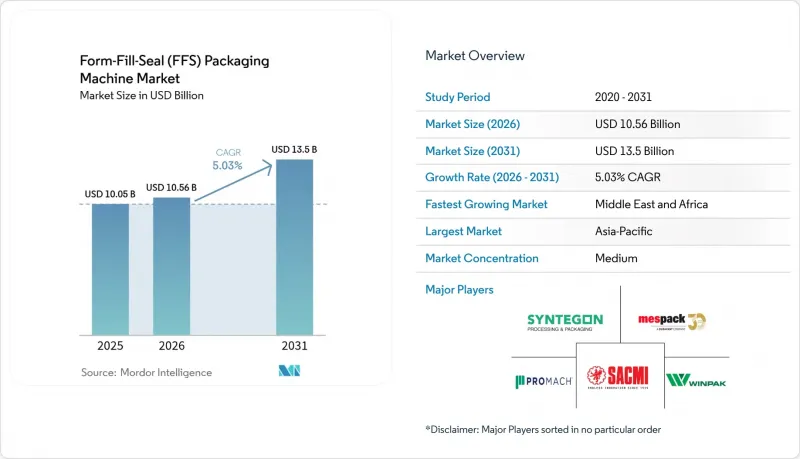
本報告按設備類型(垂直成型、填充和封口機;水平成型、填充和封口機)、自動化程度(全自動;半自動)、適用材料(聚乙烯薄膜;其他)、包裝類型(袋/包裝袋;小袋/條狀包裝;其他)、終端用戶行業(食品飲料;其他)和地區進行細分。市場預測以美元計價。
全球成型、填充與封口 (FFS)包裝器材市場趨勢與洞察
生物製藥和細胞/基因治療領域對無菌包裝的需求日益成長。
為了維持高度敏感的生物製藥和細胞/基因療法的無菌性,製藥公司正在擴大免灌封儲存(FFS)系統的應用。與傳統填充方法相比,即用型容器可將污染風險降低50%,進而減少批次重複處理和浪費。 Syntegon公司的SynTiso液體生產線採用非接觸式處理和即時顆粒監測技術,每分鐘可處理600個容器,這充分展現了原始設備製造商(OEM)如何將最新的歐洲附錄1要求融入其設備設計中。這一投資趨勢最初在北美和歐洲興起,但隨著監管協調的加速,目前正蔓延至亞洲的契約製造基地。這些工廠通常將隔離器技術與線上目視檢測相結合,以縮短驗證週期並簡化FDA和EMA的審核流程。生物製藥處理能力的提升推動了高速系統訂單的增加,也導致主要供應商的售後零件和服務累積訂單積壓。
寵物食品和獸用營養補充品品牌的成長
在「寵物人性化」趨勢的推動下,高階和治療型寵物食品層出不窮,催生了對可控容量包裝的需求,這種包裝能夠保留易揮發的風味成分和有效的營養補充成分。專用營養補充劑的包裝需要兒童安全蓋和防篡改功能,而伺服驅動的水平成型、填充和封口 (HFFS) 設備最適合滿足這些需求,因為它們能夠確保精確稱重和密封強度。頻繁的配方變更促使製造商需要能夠透過人機介面 (HMI) 預設實現免工具切換和配方上傳的設備,從而減少小批量生產的停機時間。雖然北美和歐洲的契約製造製造商引領著這一需求,但在巴西、韓國和印度的都市區也出現了類似的趨勢,這主要得益於可支配收入的成長和寵物擁有率的提高。原始設備製造商 (OEM) 正在透過提供配方管理軟體和遠端支援服務來應對這一需求,從而確保在季節性需求尖峰時段的運作。由於產量增加,加工企業正擴大將半自動生產線升級為具有整合洩漏檢測功能的全自動平台,這導致對現有設備升級的需求日益成長。
低密度產品無利可圖。
當處理堆積密度為0.3 g/cm³或更低的粉末和擠壓膨化食品時,FFS(成型薄膜包裝)系統面臨經濟劣勢,因為單位重量的薄膜消耗量急劇增加。材料成本可能超過產品價值的15%,從而擠壓對價格敏感的發展中市場的利潤空間。紙盒和編織袋等替代方案雖然外觀不如FFS系統美觀,但每公斤成本更低,導致區域品牌商推遲對FFS生產線的投資。原始設備製造商(OEM)正在透過引入管狀設計來解決這一障礙,這種設計可以消除側縫並最佳化垂直間距,但在樹脂價格和外匯波動影響息稅前利潤(EBIT)的地區,這種設計的普及速度仍然緩慢。因此,對於依賴低密度主食產品的新興經濟體而言,這項限制長期阻礙了設備的全面升級。
細分市場分析
到2025年,立式包裝系統將佔據FFS包裝器材市場57.83%的佔有率,這得益於其在阻隔性食品、粉末和工業產品包裝方面的多功能性。同時,受醫藥和高阻隔性零食應用中對均勻導熱的扁平網狀結構的青睞,臥式FFS包裝器材市場預計將以6.58%的複合年成長率更快成長至2031年。有限元素最佳化的模壓封口提升了VFFS的密封質量,減少了密封件內部的產品缺陷,並使其保持市場主導地位。然而,HFFS配置正在推動高階醫藥填充領域的轉變,其符合附件1修訂版的要求,並能夠實現更清潔的產品通道和非接觸式處理。跨國品牌通常採用雙機隊策略,將VFFS用於主流SKU,將HFFS用於高附加價值產品。
實施此技術的決策並非完全基於成本,而是取決於衛生等級、包裝類型和生產線速度目標。用於水平成型包裝機 (HFFS) 的捲材通常採用更高阻隔性的塗層,在更薄的厚度下即可達到相近的保存期限,並部分抵消了材料成本較高的劣勢。兩種包裝方式的操作人員交叉培訓仍然是一項挑戰,原始設備製造商 (OEM) 正在轉向採用通用的人機介面 (HMI) 框架,以縮短學習曲線。因此,儘管隨著亞洲對小包裝袋需求的成長,預計絕對出貨量將會增加,但到 2031 年,立式成型包裝機 (VFFS) 的優勢預計將略有下降。
到2025年,全自動生產線將佔銷售額的71.85%,因為人手不足和日益嚴格的衛生要求使得非接觸式操作成為採購決策的首要因素。預計該細分市場將以6.05%的複合年成長率成長,超過整個FFS包裝器材市場,這主要得益於邊緣人工智慧診斷技術對運作的保障。半自動生產線仍應用於資本投資受限和小批量生產的特殊生產領域,以及開發中國家的中小企業。然而,模組化控制架構支援逐步升級,使用者無需完全更換設備即可對稱重機、取放機器人和伺服軸進行改造。
物聯網儀錶板提供OEE(整體設備效率)指標,工廠管理者可以利用這些指標來證明持續改善的成果,並鞏固經營團隊的支持。此外,電子商務對尺寸的限制要求尺寸一致性,而這只有透過封閉回路型運動控制才能實現,從而進一步加速了這一轉型。在散裝農產品領域,產品差異性給基於攝影機的檢測帶來了挑戰,因此人工填充和包裝仍然有市場。
區域分析
預計到2025年,亞太地區仍將以39.75%的佔有率佔據FFS包裝器材市場最大佔有率,這主要得益於中國、印度和越南不斷擴大的都市區消費和出口導向製造地的發展。印度的本地藥品生產獎勵政策和中國的自動化稅收優惠政策等措施刺激了新增產能的擴張,而泰國和印尼休閒食品出口的成長則提振了對中速生產線的需求。國內薄膜擠出叢集正在建構快速的供應鏈,從而降低進口耗材相關的外匯風險。
北美和歐洲憑藉著對高精度和永續包裝的執著追求,保持著技術領先地位。這兩個地區都專注於升級現有設備,而非待開發區工廠。美國營運商正投資於邊緣人工智慧改造和機器人技術,以彌補員工流動帶來的損失;而歐洲工廠則投資於單一材料相容且節能的加熱器。這兩個地區成熟的法規結構正在加速符合附件一標準的隔離器和即時釋放測試的普及,從而確保專業原始設備製造商(OEM)獲得高利潤。
中東和非洲正崛起為成長最快的地區,預計到2031年將以7.25%的複合年成長率成長。沙烏地阿拉伯、埃及和南非等區域製藥中心正在實現仿製學名藥的在地化生產。冷鏈物流基礎設施的改善進一步提升了對無菌袋灌裝生產線的需求,而可支配收入的成長則推動了新型包裝零食和即飲咖啡產品的上市。設備供應商透過提供包括操作員培訓和售後服務庫存在內的承包支援服務來確保訂單,以彌補當地熟練勞動力的不足。總體而言,地域多元化正在緩解經濟波動,並為FFS包裝器材市場創造一條平衡的全球成長路徑。
其他好處
- Excel格式的市場預測(ME)表
- 3個月的分析師支持
目錄
第1章:引言
- 研究假設和市場定義
- 調查範圍
第2章:調查方法
第3章執行摘要
第4章 市場狀況
- 市場概覽
- 市場促進因素
- 生物製藥和細胞/基因治療領域對無菌包裝的需求不斷成長。
- 寵物食品和獸用營養補充品品牌的成長
- 永續性驅動下的向可回收單材料薄膜轉型
- 近年來,低酸度即飲咖啡產品的上市數量激增。
- 利用邊緣人工智慧技術,透過預測性維護模組減少停機時間。
- 快速消費品產業的按需客製化(後期差異化)
- 市場限制因素
- 低密度產品無利可圖。
- 先進伺服系統熟練勞力短缺
- 聚合物樹脂價格波動
- 加強多層薄膜碳排放稅制度
- 產業價值鏈分析
- 監理情勢
- 技術展望
- 波特五力分析
- 宏觀經濟因素對市場的影響
第5章 市場規模與成長預測
- 依設備類型
- 立式成型、填充與密封 (VFFS)
- 水平成型、填充和密封 (HFFS)
- 按自動化級別
- 全自動
- 半自動
- 材料
- 聚乙烯(PE)薄膜
- 聚丙烯(PP)薄膜
- 生質塑膠可堆肥薄膜
- 鋁層壓阻隔膜
- 按包裝類型
- 袋子和小袋
- 小包裝/條狀包裝
- 無菌瓶和安瓿
- 泡殼包裝/帶狀包裝
- 其他
- 按最終用戶行業分類
- 飲食
- 藥品和生技藥品
- 寵物食品和獸藥
- 居家及個人護理
- 其他
- 按地區
- 北美洲
- 美國
- 加拿大
- 墨西哥
- 南美洲
- 巴西
- 阿根廷
- 智利
- 其他南美國家
- 歐洲
- 德國
- 英國
- 法國
- 義大利
- 西班牙
- 其他歐洲國家
- 亞太地區
- 中國
- 日本
- 印度
- 韓國
- 澳洲
- 其他亞太國家
- 中東和非洲
- 中東
- 沙烏地阿拉伯
- 阿拉伯聯合大公國
- 土耳其
- 其他中東國家
- 非洲
- 南非
- 奈及利亞
- 肯亞
- 其他非洲地區
- 中東
- 北美洲
第6章 競爭情勢
- 市場集中度
- 策略趨勢
- 市佔率分析
- 公司簡介
- Syntegon Technology GmbH
- ProMach Inc.
- SACMI Imola SC
- Winpak Ltd.
- Mespack SL
- HDG Verpackungsmaschinen GmbH
- Huhtamaki Oyj
- Rovema GmbH
- Duravant LLC
- ULMA Packaging, S.Coop.
- ILAPAK International SA
- IMA Industria Macchine Automatiche SpA
- Viking Masek Global Packaging Technologies, LLC
- Nichrome India Ltd.
- Triangle Package Machinery Company
- PFM Group SpA
- Fres-co System USA, Inc.
- Paxiom Group(WeighPack Systems Inc.)
- Multivac Sepp Haggenmller SE and Co. KG
- TNA Australia Pty Ltd
- Schneider Packaging Equipment Co., Inc.
- Bosch Rexroth AG
- Scholle IPN Company, LLC
- ProAmpac Holdings Inc.
第7章 市場機會與未來展望
According to Mordor Intelligence, the form fill seal packaging machine market size is expected to grow from USD 10.05 billion in 2025 to USD 10.56 billion in 2026 and is forecast to reach USD 13.5 billion by 2031 at 5.03% CAGR over 2026-2031.
This report is Segmented by Equipment Type (Vertical Form-Fill-Seal, and Horizontal Form-Fill-Seal), Automation Level (Fully-Automatic, and Semi-Automatic), Material Compatibility (Polyethylene Films, and More), Packaging Type (Bags and Pouches, Sachets and Stick Packs, and More), End-User Industry (Food and Beverage, and More), and Geography. The Market Forecasts are Provided in Terms of Value (USD)
Global Form-Fill-Seal (FFS) Packaging Machine Market Trends and Insights
Rising Demand for Aseptic Packaging in Biologics and Cell-Gene Therapy
Pharmaceutical manufacturers are scaling form fill seal systems that maintain sterility for highly sensitive biologics and cell-gene therapies. Ready-to-use containers lower contamination risks by 50% compared with conventional filling approaches, trimming batch rework and scrap. Syntegon's SynTiso liquid line processes 600 containers per minute using contactless transport and real-time particle monitoring, demonstrating how OEMs embed European Annex 1 updates into machine design. The capital shift first gained traction in North America and Europe but is now spreading to Asian contract manufacturing hubs as regulatory convergence accelerates. These installations typically pair isolator technology with inline vision inspection, shortening validation cycles and easing FDA and EMA audit readiness. Heightened biologic throughput is translating into repeat orders for higher-speed systems, strengthening aftermarket parts and service backlogs for leading suppliers.
Growth of Pet-Food and Veterinary Nutraceutical Brands
Pet-humanization trends have sparked premium and therapeutic pet-food launches requiring portion-controlled pouches that preserve flavor volatiles and active nutraceutical ingredients. Specialty nutraceutical packs mandate child-resistant closures and tamper evidence, which favor servo-driven horizontal form fill seal configurations for precision dosing and seal integrity. Frequent recipe changes force manufacturers to seek equipment that enables tool-less changeovers and recipe upload through HMI presets, shaving downtime in short-run production. North American and European co-packers are spearheading this demand, but similar patterns are emerging in Brazil, South Korea, and urban India as disposable income and pet adoption rise. OEMs have responded by bundling recipe-management software with remote support contracts that guarantee uptime during seasonal demand peaks. Resultant volume growth is elevating installed-base renewals as converters upgrade from semi-automatic lines to fully-automatic platforms with integrated leak detection.
Uneconomical for Low-Density Products
Form fill seal systems face unfavorable economics when handling powders or extruded snacks with bulk densities below 0.3 g/cm3, as film consumption per unit weight rises sharply. Material expenditure can surpass 15% of product value, eroding margin in price-sensitive developing markets. Carton and woven-sack alternatives sometimes deliver lower cost-per-kilogram despite reduced shelf appeal, prompting regional brand owners to delay capex for form fill seal lines. OEMs are tackling the barrier by introducing tubular designs that eliminate side seams and optimize vertical pitch, yet adoption remains tepid where resin prices and currency fluctuations squeeze EBIT. Consequently, the restraint exerts a long-run drag on aggregate equipment replacement in emerging economies reliant on low-density staples.
Other drivers and restraints analyzed in the detailed report include:
- Sustainability-Driven Shift Toward Recyclable Mono-Material Films
- Edge-AI Enabled Predictive Maintenance Reduces Downtime
- Skilled-Labor Shortage for Advanced Servo Systems
For complete list of drivers and restraints, kindly check the Table Of Contents.
Segment Analysis
Vertical systems controlled 57.83% of the form fill seal packaging machine market in 2025, leveraging versatility for granular foods, powders, and industrial products. The form fill seal packaging machine market size for horizontal machines is projected to climb at a faster 6.58% CAGR to 2031 as pharmaceutical and high-barrier snack applications prefer their flat web geometry for even heat distribution. Finite-element-optimized forming collars have improved VFFS seal quality, mitigating product-in-seal defects and sustaining leadership. Yet HFFS configurations enable cleaner product paths and contactless transport that align with Annex 1 revisions, prompting premium drug-filler segments to migrate. Multinational brands often keep a dual-fleet strategy, deploying VFFS for mainstream SKUs while reserving HFFS for value-added formats.
Adoption choices pivot on hygiene class, pack style, and line-speed targets rather than pure cost. HFFS reels usually carry higher barrier coatings, enabling shelf-life parity at thinner gauges and partially neutralizing material-cost disadvantages. Cross-training operators across both formats remains a challenge, nudging OEMs toward common HMI frameworks that lower learning curves. Consequently, the VFFS stronghold will erode slightly through 2031, although absolute shipments rise in line with expanding sachet demand in Asia.
Fully-automatic lines captured 71.85% revenue in 2025 as labor scarcity and stricter hygiene requirements tilted purchasing decisions toward touchless operation. This segment will outpace the broader form fill seal packaging machine market at a 6.05% CAGR, fueled by edge-AI diagnostics that guarantee uptime contracts. Semi-automatic lines persist in specialty runs and developing-nation SMEs where capex constraints and small lot sizes dominate. However, modular control architectures now offer staged upgrades, allowing users to retrofit weighers, pick-and-place robots, and servo axes without wholesale replacement.
IoT dashboards supply OEE metrics that plant managers leverage to justify continuous-improvement bonuses, anchoring management buy-in. Moreover, e-commerce sizing constraints favor dimensional consistency achievable only with closed-loop motion control, further nudging migration upward. Nonetheless, a residual serviceable market for manual loading and bagging continues in bulk agricultural produce where product variability challenges camera-based inspection.
Complete Report Scope:
- By Equipment Type
- Vertical Form-Fill-Seal (VFFS)
- Horizontal Form-Fill-Seal (HFFS)
- By Automation Level
- Fully-Automatic
- Semi-Automatic
- By Material Compatibility
- Polyethylene (PE) Films
- Polypropylene (PP) Films
- Bioplastic and Compostable Films
- Aluminum-Laminate and Barrier Films
- By Packaging Type
- Bags and Pouches
- Sachets and Stick Packs
- Aseptic Bottles and Ampoules
- Blister and Strip Packs
- Other Packaging Types
- By End-user Industry
- Food and Beverage
- Pharmaceuticals and Biologics
- Pet Food and Veterinary
- Home and Personal Care
- Other End-user Industries
- By Geography
- North America
- United States
- Canada
- Mexico
- South America
- Brazil
- Argentina
- Chile
- Rest of South America
- Europe
- Germany
- United Kingdom
- France
- Italy
- Spain
- Rest of Europe
- Asia-Pacific
- China
- Japan
- India
- South Korea
- Australia
- Rest of Asia-Pacific
- Middle East and Africa
- Middle East
- Saudi Arabia
- United Arab Emirates
- Turkey
- Rest of Middle East
- Africa
- South Africa
- Nigeria
- Kenya
- Rest of Africa
- Middle East
- North America
Geography Analysis
Asia-Pacific retained the largest 39.75% slice of the form fill seal packaging machine market in 2025, propelled by rising urban consumption and export-oriented manufacturing bases across China, India, and Vietnam. Policy incentives for localized pharma production in India and tax benefits for automation in China catalyze fresh capacity, while growing snack exports from Thailand and Indonesia add mid-speed line demand. Domestic film extrusion clusters enable fast supply loops, tempering currency risk on imported consumables.
North America and Europe uphold technology leadership through high-precision and sustainable packaging agendas. Both regions engage in replacement, not green-field, cycles: U.S. operators invest in edge-AI retrofits and robotics to offset labor turnover, whereas European plants allocate capex to mono-material compatibility and energy-efficient heaters. Their mature regulatory frameworks accelerate Annex 1-compliant isolators and real-time release testing, locking in premium margins for specialized OEMs.
Middle East and Africa emerge as the fastest-growing cluster at 7.25% CAGR to 2031 as regional pharma hubs in Saudi Arabia, Egypt, and South Africa localize generic production. Infrastructure upgrades in cold-chain logistics draw additional demand for aseptic pouching lines, while rising disposable income supports packaged snacks and RTD coffee launches. Equipment suppliers win orders through turnkey support, including operator training and after-sales stocking, to counter limited local skill pools. Collectively, geographic diversification cushions cyclical swings, granting the form fill seal packaging machine market a balanced global growth runway.
- Syntegon Technology GmbH
- ProMach Inc.
- SACMI Imola S.C.
- Winpak Ltd.
- Mespack S.L.
- HDG Verpackungsmaschinen GmbH
- Huhtamaki Oyj
- Rovema GmbH
- Duravant LLC
- ULMA Packaging, S.Coop.
- ILAPAK International S.A.
- IMA Industria Macchine Automatiche S.p.A.
- Viking Masek Global Packaging Technologies, LLC
- Nichrome India Ltd.
- Triangle Package Machinery Company
- PFM Group S.p.A.
- Fres-co System USA, Inc.
- Paxiom Group (WeighPack Systems Inc.)
- Multivac Sepp Haggenmller SE and Co. KG
- TNA Australia Pty Ltd
- Schneider Packaging Equipment Co., Inc.
- Bosch Rexroth AG
- Scholle IPN Company, LLC
- ProAmpac Holdings Inc.
Additional Benefits:
- The market estimate (ME) sheet in Excel format
- 3 months of analyst support
TABLE OF CONTENTS
1 INTRODUCTION
- 1.1 Study Assumptions and Market Definition
- 1.2 Scope of the Study
2 RESEARCH METHODOLOGY
3 EXECUTIVE SUMMARY
4 MARKET LANDSCAPE
- 4.1 Market Overview
- 4.2 Market Drivers
- 4.2.1 Rising demand for aseptic packaging in biologics and cell-gene therapy
- 4.2.2 Growth of pet-food and veterinary nutraceutical brands
- 4.2.3 Sustainability-driven shift toward recyclable mono-material films
- 4.2.4 Surge in low-acidity ready-to-drink coffee launches
- 4.2.5 Edge-AI enabled predictive-maintenance modules reduce downtime
- 4.2.6 FMCG on-demand customization (late-stage differentiation)
- 4.3 Market Restraints
- 4.3.1 Uneconomical for low-density products
- 4.3.2 Skilled-labor shortage for advanced servo systems
- 4.3.3 Volatility in polymer-resin prices
- 4.3.4 Rising carbon-tax regimes on multilayer films
- 4.4 Industry Value Chain Analysis
- 4.5 Regulatory Landscape
- 4.6 Technological Outlook
- 4.7 Porters Five Forces Analysis
- 4.7.1 Threat of New Entrants
- 4.7.2 Bargaining Power of Consumers
- 4.7.3 Bargaining Power of Suppliers
- 4.7.4 Threat of Substitute Products
- 4.7.5 Intensity of Competitive Rivalry
- 4.8 Impact of Macroeconomic Factors on the Market
5 MARKET SIZE AND GROWTH FORECASTS (VALUE)
- 5.1 By Equipment Type
- 5.1.1 Vertical Form-Fill-Seal (VFFS)
- 5.1.2 Horizontal Form-Fill-Seal (HFFS)
- 5.2 By Automation Level
- 5.2.1 Fully-Automatic
- 5.2.2 Semi-Automatic
- 5.3 By Material Compatibility
- 5.3.1 Polyethylene (PE) Films
- 5.3.2 Polypropylene (PP) Films
- 5.3.3 Bioplastic and Compostable Films
- 5.3.4 Aluminum-Laminate and Barrier Films
- 5.4 By Packaging Type
- 5.4.1 Bags and Pouches
- 5.4.2 Sachets and Stick Packs
- 5.4.3 Aseptic Bottles and Ampoules
- 5.4.4 Blister and Strip Packs
- 5.4.5 Other Packaging Types
- 5.5 By End-user Industry
- 5.5.1 Food and Beverage
- 5.5.2 Pharmaceuticals and Biologics
- 5.5.3 Pet Food and Veterinary
- 5.5.4 Home and Personal Care
- 5.5.5 Other End-user Industries
- 5.6 By Geography
- 5.6.1 North America
- 5.6.1.1 United States
- 5.6.1.2 Canada
- 5.6.1.3 Mexico
- 5.6.2 South America
- 5.6.2.1 Brazil
- 5.6.2.2 Argentina
- 5.6.2.3 Chile
- 5.6.2.4 Rest of South America
- 5.6.3 Europe
- 5.6.3.1 Germany
- 5.6.3.2 United Kingdom
- 5.6.3.3 France
- 5.6.3.4 Italy
- 5.6.3.5 Spain
- 5.6.3.6 Rest of Europe
- 5.6.4 Asia-Pacific
- 5.6.4.1 China
- 5.6.4.2 Japan
- 5.6.4.3 India
- 5.6.4.4 South Korea
- 5.6.4.5 Australia
- 5.6.4.6 Rest of Asia-Pacific
- 5.6.5 Middle East and Africa
- 5.6.5.1 Middle East
- 5.6.5.1.1 Saudi Arabia
- 5.6.5.1.2 United Arab Emirates
- 5.6.5.1.3 Turkey
- 5.6.5.1.4 Rest of Middle East
- 5.6.5.2 Africa
- 5.6.5.2.1 South Africa
- 5.6.5.2.2 Nigeria
- 5.6.5.2.3 Kenya
- 5.6.5.2.4 Rest of Africa
- 5.6.5.1 Middle East
- 5.6.1 North America
6 COMPETITIVE LANDSCAPE
- 6.1 Market Concentration
- 6.2 Strategic Moves
- 6.3 Market Share Analysis
- 6.4 Company Profiles (includes Global level Overview, Market level overview, Core Segments, Financials as available, Strategic Information, Market Rank/Share for key companies, Products and Services, and Recent Developments)
- 6.4.1 Syntegon Technology GmbH
- 6.4.2 ProMach Inc.
- 6.4.3 SACMI Imola S.C.
- 6.4.4 Winpak Ltd.
- 6.4.5 Mespack S.L.
- 6.4.6 HDG Verpackungsmaschinen GmbH
- 6.4.7 Huhtamaki Oyj
- 6.4.8 Rovema GmbH
- 6.4.9 Duravant LLC
- 6.4.10 ULMA Packaging, S.Coop.
- 6.4.11 ILAPAK International S.A.
- 6.4.12 IMA Industria Macchine Automatiche S.p.A.
- 6.4.13 Viking Masek Global Packaging Technologies, LLC
- 6.4.14 Nichrome India Ltd.
- 6.4.15 Triangle Package Machinery Company
- 6.4.16 PFM Group S.p.A.
- 6.4.17 Fres-co System USA, Inc.
- 6.4.18 Paxiom Group (WeighPack Systems Inc.)
- 6.4.19 Multivac Sepp Haggenmller SE and Co. KG
- 6.4.20 TNA Australia Pty Ltd
- 6.4.21 Schneider Packaging Equipment Co., Inc.
- 6.4.22 Bosch Rexroth AG
- 6.4.23 Scholle IPN Company, LLC
- 6.4.24 ProAmpac Holdings Inc.
7 MARKET OPPORTUNITIES AND FUTURE OUTLOOK
- 7.1 White-space and Unmet-need Assessment

 包裝器材:市場佔有率分析、產業趨勢與統計、成長預測(2026-2031)
 麵包烘焙包裝機械市場分析與預測(至2035年):類型、產品類型、技術、組件、應用、材料類型、製程、最終用戶、功能
 軟包裝包裝器材市場機會、成長促進因素、產業趨勢分析及2026-2035年預測2026 年至 2035 年包裝和貼標機械的市場機會、成長要素、產業趨勢和預測。茶葉及咖啡包裝器材市場機會、成長要素、產業趨勢分析及2026-2035年預測食品飲料包裝器材市場:商機、成長要素、產業趨勢分析及2026-2035年預測
 包裝器材市場:2026-2032年全球市場預測(依機器類型、自動化程度、包裝類型、技術、應用、最終用戶和銷售管道)瓶蓋安裝機市場:按類型、瓶蓋材料、應用、銷售管道和最終用戶分類-2026-2032年全球市場預測
 食品FFS(成型、填充、封口)包裝器材市場:市場規模、佔有率和趨勢分析(按機器類型、最終用途和地區分類),細分市場預測(2026-2033年)
 包裝器材市場-全球產業規模、佔有率、趨勢、機會和預測:按產品類型、技術、最終用戶、地區和競爭格局分類,2021-2031年