


 |
市場調查報告書
商品編碼
2083392
食品飲料包裝器材市場:商機、成長要素、產業趨勢分析及2026-2035年預測Food and Beverages Packaging Machine Market Opportunity, Growth Drivers, Industry Trend Analysis, and Forecast 2026 - 2035 |
||||||

預計到 2025 年,全球食品和飲料包裝器材市場價值將達到 242 億美元,並預計以 5.6% 的複合年成長率成長,到 2035 年達到 415 億美元。
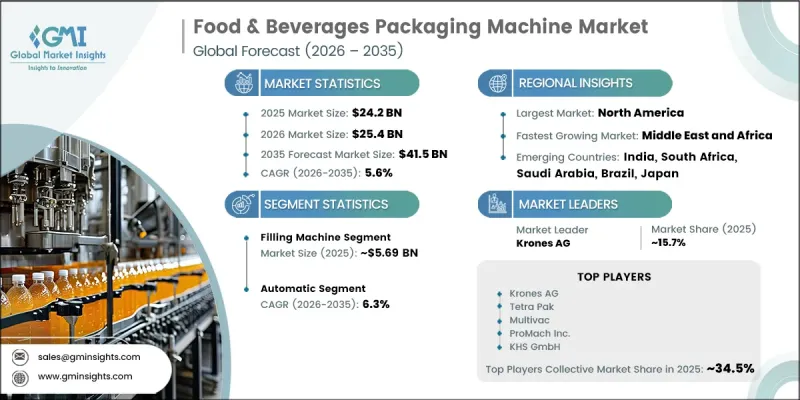
受全球預包裝和加工食品消費量不斷成長的推動,食品飲料包裝器材市場正經歷穩步成長,尤其是在快速都市化的地區。可支配收入的增加、飲食習慣的改變以及現代零售基礎設施的擴張,都顯著提升了對高效包裝系統的需求。同時,已開發國家嚴格的食品安全和衛生法規迫使製造商採用先進的自動化包裝解決方案,以確保產品的完整性、可追溯性以及符合嚴格的品質標準。不斷上漲的人事費用進一步加速了自動化轉型,促使食品加工商投資高速、多功能的包裝設備。製造商正不斷升級其傳統生產線,採用先進的填充、封口、貼標和末端處理系統,以提高效率和產能。主要市場的食品安全合規標準等法規結構,也推動了對衛生且全自動包裝基礎設施的持續投資。
| 市場範圍 | |
|---|---|
| 開始年份 | 2025 |
| 預測期 | 2026-2035 |
| 上市時的市場規模 | 242億美元 |
| 預計金額 | 415億美元 |
| 複合年成長率 | 5.6% |
預計到2025年,灌裝機市場規模將達到56.9億美元,並在2035年之前以4.8%的複合年成長率成長。該細分市場一直是食品飲料包裝器材市場的主要貢獻者,因為它在處理包括液體、粉末、顆粒、膏體和粘稠產品在內的各種產品方面發揮著至關重要的作用。液體灌裝系統的產量最大,這主要得益於飲料和乳製品加工產業的強勁需求。灌裝技術不斷發展,以滿足更高速度、更高精度和更嚴格衛生標準的需求,使其成為大規模食品生產運作中不可或缺的設備。
預計到2025年,自動化領域將佔據56.1%的市場佔有率,並在2035年之前以6.3%的複合年成長率成長。這一主導地位主要源自於市場對高效生產系統日益成長的需求,這些系統能夠提高產品的一致性和運作速度,同時減少人工干預。自動化技術已被廣泛應用於食品加工企業,以提高生產效率、減少誤差並維持嚴格的衛生標準。此外,機器人和半自動化解決方案也越來越受到關注,尤其是在包裝應用領域,這些領域需要針對不同產品類型實現柔軟性、精確操作和更高的產量。
北美食品飲料包裝器材市場由高度發展且技術先進的食品加工業驅動,預計到2025年將佔據29.6%的市場。該地區持續增加對自動化和現代化包裝基礎設施的投資,以提高生產效率並確保符合嚴格的食品安全和品質法規。健全的法規結構強調衛生、可追溯性和預防性安全措施,推動食品飲料生產設施包裝系統的不斷升級。這種對自動化和法規遵循的持續關注,不斷鞏固北美在全球市場的領先地位。
目錄
第1章:調查方法和範圍
第2章執行摘要
第3章 行業洞察
- 產業生態系分析
- 供應商情況
- 利潤率
- 每個階段增加的價值
- 影響價值鏈的因素
- 影響產業的因素
- 促進因素
- 全球對包裝食品和加工食品的需求不斷成長,其促進因素是都市化和生活方式的改變。
- 嚴格的食品安全和衛生法規推動了自動化升級的需求(FDA FSMA,歐盟法規 852/2004)。
- 隨著電子商務通路的擴張,食品飲料產業對高速、靈活的包裝生產線的需求日益成長。
- 人事費用和勞動力短缺帶來的壓力正在加速向自動化包裝系統的轉變。
- 產業潛在風險與挑戰
- 先進的自動化包裝器材需要大量的資金投入,投資回收期較長。
- 智慧包裝系統程式設計、操作和維護方面的熟練勞動力短缺。
- 機會
- 受永續性。
- 包裝機械即服務 (MAAS) 和基於租賃的採購模式降低了中小企業採用包裝機械的門檻。
- 亞太地區和中東及非洲(MEA)食品加工業的快速擴張正在創造新的需求。
- 具備人工智慧驅動的預測性維護和OEE最佳化功能的智慧物聯網連接機械。
- 促進因素
- 成長潛力分析
- 未來市場趨勢
- 技術與創新展望
- 最新科技趨勢
- 新興技術
- 監理情勢
- 美國食品藥物管理局《食品安全現代化法案》(FSMA)的影響
- 歐盟第 852/2004 號法規及包裝及包裝廢棄物指令
- PMMI 和行業協會標準
- 生產者延伸責任制(EPR)政策的影響
- 貿易數據分析
- 按機械類型分類的進出口量和進口額趨勢
- 關稅對主要貿易路線和包裝器材的影響
- 人工智慧和生成式人工智慧對市場的影響
- 利用人工智慧改造現有包裝生產線經營模式
- GenAI 各細分領域的應用案例和實施藍圖(預測性維護、品質檢測、吞吐量最佳化)
- 人工智慧在包裝器材的風險、限制與監管考量
- 價格分析
- 對過去價格趨勢的分析
- 依球員類型分類的定價策略(高級球員、超值球員、成本加成球員)
- 波特的分析
- PESTLE分析
- 消費行為分析
第4章 競爭情勢
- 介紹
- 企業市佔率分析
- 企業矩陣分析
- 主要市場公司的競爭分析
- 競爭定位矩陣
- 主要進展
- 併購
- 夥伴關係和聯盟
- 新產品發布
- 業務拓展計劃
第5章 市場估價與預測:依機器類型分類,2022-2035年
- 主要趨勢
- 灌裝機
- 液體填充機(重力式、活塞式、容積式、流量計式)
- 粉末和顆粒填充機(螺旋式、淨重式、毛重式)
- 膏狀及黏稠產品填充機(活塞式、蠕動式、旋轉式)
- 封口機
- 熱封機(含式封口機、脈衝式封口機、連續式封口機)
- 導引密封機
- 真空密封機
- 貼標機
- 壓敏貼標機
- 套標機(熱縮式,捲筒式)
- 環繞式和熱熔膠貼標機
- 編碼與標記系統(噴墨、雷射、熱轉印)
- 包裝機
- 拉伸纏繞機
- 收縮包裝機(套筒式、全身式)
- 流動式包裝機(水平和立式)
- 成型填色封口 (FFS) 機
- 立式成型、填充和封口 (VFFS) 機
- 臥式成型、填充和封口 (HFFS) 機械
- 熱成型、填充和封口 (TFFS) 機
- 袋式包裝機
- 立式袋包裝機
- 扁平枕形袋包裝機
- 附傾倒嘴和配件的袋式包裝機
- 其他
- 搬運機(水平式和直立式)
- 裝箱機和托盤包裝機
- 碼垛和卸垛機(傳統型和機器人型)
- 檢重秤、目視檢測和金屬檢測系統
第6章 市場估計與預測:依應用領域分類,2022-2035年
- 主要趨勢
- 飲料
- 非酒精飲料(瓶裝水、碳酸飲料、果汁、能量飲料)
- 酒精飲料(啤酒、葡萄酒、烈酒)
- 乳類飲料(牛奶、調味牛奶、植物性飲料)
- 熱飲(即飲咖啡和茶)
- 加工食品
- 即食/預製食品
- 冷凍食品
- 零食和鹹味產品
- 調味料、醬汁、沙拉醬
- 烘焙產品
- 麵包、捲餅、小圓麵包
- 糕點、蛋糕、派餅
- 餅乾和薄脆餅乾
- 糖果糕餅
- 巧克力及巧克力製品
- 糖果甜點、口香糖、果凍
- 肉類、家禽和水產品
- 新鮮和冷藏的肉類和家禽
- 冷凍肉類、家禽和水產品
- 加工食品、鹽漬食品及熟食產品
- 乳製品
- 生牛奶和奶油
- 起司和奶油
- 優格和發酵乳製品
- 水果和蔬菜
- 新鮮和預切農產品(氣調包裝)
- 冷凍水果和蔬菜
- 乾燥和脫水農產品
- 其他(保健食品、營養補充品、嬰兒配方奶粉、寵物食品)
第7章 市場估算與預測:依自動化程度分類,2022-2035年
- 主要趨勢
- 自動包裝機
- 全自動連續運轉系統
- 全自動間歇運轉系統
- 機器人和協作自動化系統
- 半自動包裝機
- 操作員輔助填充和密封系統
- 半自動貼標和編碼系統
- 半自動箱體包裝和捆紮系統
- 手動包裝機
- 手動灌裝封口裝置
- 入門級手動包裝和貼標解決方案
第8章 市場估價與預測:依包裝類型分類,2022-2035年
- 主要趨勢
- 軟包裝
- 收納袋
- 薄膜、包裝、覆膜
- 小包裝和單份裝
- 硬包裝
- 瓶子和罐子(PET、玻璃、HDPE)
- 罐頭和金屬容器(鋁製、馬口鐵)
- 紙箱和紙板箱
- 半剛性包裝
- 熱成型托盤與翻蓋包裝盒
- 泡殼包裝和密著包裝
第9章 市場估價與預測:依通路分類,2022-2035年
- 主要趨勢
- 直接的
- 間接
第10章 市場估價與預測:依地區分類,2022-2035年
- 主要趨勢
- 北美洲
- 美國
- 加拿大
- 歐洲
- 德國
- 法國
- 英國
- 義大利
- 西班牙
- 亞太地區
- 中國
- 日本
- 印度
- 澳洲
- 韓國
- 拉丁美洲
- 巴西
- 墨西哥
- 阿根廷
- 中東和非洲
- 沙烏地阿拉伯
- UAE
- 南非
第11章:公司簡介
- Tetra Pak International SA
- Krones AG
- Syntegon Technology GmbH
- Multivac Group
- IMA Group SpA
- Coesia Group
- KHS GmbH
- ULMA Packaging S. Coop.
- Barry-Wehmiller Companies Inc.
- ProMach Inc.
- Ishida Co., Ltd.
- TNA Solutions Pty Ltd.
- Rovema GmbH
- Gerhard Schubert GmbH
- CAMA Group Srl
- Fuji Machinery Co., Ltd.
- SACMI Group
- Optima Packaging Group GmbH
- Triangle Package Machinery Co.
- Nichrome India Ltd.
- Paxiom Group Inc.
- Omori Machinery
The Global Food & Beverages Packaging Machine Market was valued at USD 24.2 billion in 2025 and is estimated to grow at a CAGR of 5.6% to reach USD 41.5 billion by 2035.
The food & beverages packaging machine market is witnessing steady expansion driven by rising global consumption of packaged and processed food products, particularly in rapidly urbanizing regions. Increasing disposable incomes, changing dietary patterns, and the expansion of modern retail infrastructure are significantly boosting demand for efficient packaging systems. At the same time, stringent food safety and hygiene regulations across developed economies are compelling manufacturers to adopt advanced, automated packaging solutions that ensure product integrity, traceability, and compliance with strict quality standards. Rising labor costs are further accelerating the shift toward automation, encouraging food processors to invest in high-speed, multi-functional packaging equipment. Manufacturers are increasingly upgrading legacy production lines with advanced filling, sealing, labeling, and end-of-line systems to improve efficiency and output capacity. Regulatory frameworks such as food safety compliance standards in major markets are also driving continuous capital investment in hygienic and fully automated packaging infrastructure.
| Market Scope | |
|---|---|
| Start Year | 2025 |
| Forecast Year | 2026-2035 |
| Start Value | $24.2 Billion |
| Forecast Value | $41.5 Billion |
| CAGR | 5.6% |
The filling machine segment generated USD 5.69 billion in 2025 and is expected to grow at a CAGR of 4.8% through 2035. This segment remains a key contributor to the food & beverages packaging machine market due to its critical role in handling a wide range of liquid, powder, granule, paste, and viscous products. Liquid filling systems account for the highest production volumes, driven by strong demand from beverage and dairy processing industries. Filling technologies continue to evolve to support higher speed, improved accuracy, and enhanced hygiene standards, making them essential for large-scale food manufacturing operations.
The automatic segment accounted for 56.1% share in 2025 and is projected to grow at a CAGR of 6.3% during 2035. Its dominance is supported by increasing demand for high-efficiency production systems that reduce manual intervention while improving consistency and operational speed. Automation technologies are widely adopted across food processing facilities to enhance productivity, minimize errors, and maintain strict hygiene standards. In addition, robotic and semi-automated solutions are gaining traction, particularly in packaging applications that require flexibility, precision handling, and improved throughput performance across diverse product categories.
North America Food & Beverages Packaging Machine Market held 29.6% share in 2025, driven by its highly developed and technologically advanced food processing industry. The region continues to invest heavily in automation and modern packaging infrastructure to improve production efficiency and ensure compliance with stringent food safety and quality regulations. Strong regulatory frameworks emphasizing hygiene, traceability, and preventive safety measures are encouraging continuous upgrades in packaging systems across food and beverage manufacturing facilities. This sustained focus on automation and compliance continues to reinforce North America's strong position in the global market.
Major companies operating in the global food & beverages packaging machine market include Syntegon Technology GmbH, Ishida Co., Ltd., Omori Machinery Co., Ltd., Tetra Pak International S.A., Coesia Group, Gerhard Schubert GmbH, Multivac Group, Barry-Wehmiller Companies Inc., ULMA Packaging S. Coop., CAMA Group S.r.l., ProMach Inc., IMA Group S.p.A., KHS GmbH, Nichrome India Ltd., Rovema GmbH, Krones AG, TNA Solutions Pty Ltd., Fuji Machinery Co., Ltd., SACMI Group, Triangle Package Machinery Co., and Optima Packaging Group GmbH. Companies operating in the food & beverages packaging machine market are strengthening their competitive position by investing in advanced automation technologies, smart packaging systems, and high-speed production equipment that improve efficiency and operational accuracy. Many manufacturers are expanding research and development efforts to introduce innovative filling, sealing, and labeling solutions that meet evolving food safety and hygiene requirements. Strategic partnerships with food and beverage producers are helping companies expand market reach and strengthen customer relationships. Businesses are also focusing on modular machine designs, digital monitoring systems, and predictive maintenance capabilities to enhance productivity and reduce downtime.
Table of Contents
Chapter 1 Methodology & Scope
- 1.1 Market scope and definition
- 1.2 Research design
- 1.2.1 Research approach
- 1.2.2 Data collection methods
- 1.3 Data mining sources
- 1.3.1 Global
- 1.3.2 Regional/Country
- 1.4 Base estimates and calculations
- 1.4.1 Base year calculation
- 1.4.2 Key trends for market estimation
- 1.5 Primary research and validation
- 1.5.1 Primary sources
- 1.6 Forecast model
- 1.7 Research assumptions and limitations
Chapter 2 Executive Summary
- 2.1 Industry 360° synopsis
- 2.2 Key market trends
- 2.2.1 Region
- 2.2.2 Machine Type
- 2.2.3 Application
- 2.2.4 Automation Level
- 2.2.5 Packaging Type
- 2.2.6 Distribution channel
Chapter 3 Industry Insights
- 3.1 Industry ecosystem analysis
- 3.1.1 Supplier landscape
- 3.1.2 Profit margin
- 3.1.3 Value addition at each stage
- 3.1.4 Factor affecting the value chain
- 3.2 Industry impact forces
- 3.2.1 Growth drivers
- 3.2.1.1 Rising global demand for packaged & processed food products driven by urbanization & changing lifestyles
- 3.2.1.2 Stringent food safety & hygiene regulations compelling automation upgrades (FDA FSMA, EU Reg 852/2004)
- 3.2.1.3 Growth of e-commerce food & beverage channels requiring high-speed, flexible packaging lines
- 3.2.1.4 Labor cost pressures & workforce shortages accelerating shift to automated packaging systems
- 3.2.2 Industry pitfalls & challenges
- 3.2.2.1 High capital expenditure & long payback periods for advanced automated packaging machinery
- 3.2.2.2 Skilled labor shortage for programming, operation & maintenance of smart packaging systems
- 3.2.3 Opportunities
- 3.2.3.1 Sustainability-driven demand for machinery compatible with recyclable, bio-based & reduced-plastic formats
- 3.2.3.2 Packaging-machine-as-a-service (MAAS) & lease-based procurement models lowering adoption barriers for SMES
- 3.2.3.3 Rapid expansion of food processing industries in Asia Pacific, MEA creating greenfield demand
- 3.2.3.4 Smart & IoT-connected machinery with AI-driven predictive maintenance & OEE optimization
- 3.2.1 Growth drivers
- 3.3 Growth potential analysis
- 3.4 Future market trends
- 3.5 Technology and innovation landscape
- 3.5.1 Current technological trends
- 3.5.2 Emerging technologies
- 3.6 Regulatory landscape
- 3.6.1 U.S. FDA Food Safety Modernization Act (FSMA) Implications
- 3.6.2 EU Regulation 852/2004 & Packaging & Packaging Waste Directive
- 3.6.3 PMMI & Industry Association Standards
- 3.6.4 Extended Producer Responsibility (EPR) Policy Impact
- 3.7 Trade data analysis (HS Code - 8422.30)
- 3.7.1 Import/Export Volume & Value Trends by Machine Type (Driven by Primary Research)
- 3.7.2 Key Trade Corridors & Tariff Impact on Packaging Machinery (Driven by Primary Research)
- 3.8 Impact of AI & generative AI on the market
- 3.8.1 AI-driven Disruption of Existing Packaging Line Business Models
- 3.8.2 GenAI Use Cases & Adoption Roadmap by Segment (Predictive Maintenance, Quality Inspection, Throughput Optimization)
- 3.8.3 Risks, Limitations & Regulatory Considerations of AI in Packaging Machinery
- 3.9 Pricing Analysis
- 3.9.1 Historical Price Trend Analysis (Driven by Primary Research)
- 3.9.2 Pricing Strategy by Player Type (Premium / Value / Cost-plus) (Driven by Primary Research)
- 3.10 Porter's analysis
- 3.11 PESTEL analysis
- 3.12 Consumer Behavior Analysis
Chapter 4 Competitive Landscape, 2025
- 4.1 Introduction
- 4.2 Company market share analysis
- 4.3 Company matrix analysis
- 4.4 Competitive analysis of major market players
- 4.5 Competitive positioning matrix
- 4.6 Key developments
- 4.6.1 Mergers & acquisitions
- 4.6.2 Partnerships & collaborations
- 4.6.3 New product launches
- 4.6.4 Expansion plans
Chapter 5 Market Estimates & Forecast, By Machine Type, 2022 - 2035, (USD Billion) (Million Units)
- 5.1 Key Trends
- 5.2 Filling Machines
- 5.2.1 Liquid Filling Machines (Gravity, Piston, Volumetric, Flow Meter)
- 5.2.2 Powder & Granule Filling Machines (Auger, Net Weigh, Gross Weigh)
- 5.2.3 Paste & Viscous Product Filling Machines (Piston, Peristaltic, Rotary)
- 5.3 Sealing Machines
- 5.3.1 Heat Sealing Machines (Band Sealers, Impulse Sealers, Continuous Sealers)
- 5.3.2 Induction Sealing Machines
- 5.3.3 Vacuum Sealing Machines
- 5.4 Labeling Machines
- 5.4.1 Pressure-Sensitive Labeling Machines
- 5.4.2 Sleeve Labeling Machines (Heat Shrink, Roll-Fed)
- 5.4.3 Wrap-Around & Hot Glue Labeling Machines
- 5.4.4 Coding & Marking Systems (Inkjet, Laser, Thermal Transfer)
- 5.5 Wrapping Machines
- 5.5.1 Stretch Wrapping Machines
- 5.5.2 Shrink Wrapping Machines (Sleeve, Full-Body)
- 5.5.3 Flow Wrapping Machines (Horizontal & Vertical)
- 5.6 Form-Fill-Seal (FFS) Machines
- 5.6.1 Vertical Form-Fill-Seal (VFFS) Machines
- 5.6.2 Horizontal Form-Fill-Seal (HFFS) Machines
- 5.6.3 Thermoform-Fill-Seal (TFFS) Machines
- 5.7 Pouch Packaging Machines
- 5.7.1 Stand-Up Pouch Packaging Machines
- 5.7.2 Flat & Pillow Pouch Packaging Machines
- 5.7.3 Spouted & Fitment Pouch Packaging Machines
- 5.8 Others
- 5.8.1 Cartoning Machines (Horizontal & Vertical)
- 5.8.2 Case Packing & Tray Packing Machines
- 5.8.3 Palletizing & Depalletizing Machines (Conventional & Robotic)
- 5.8.4 Checkweighers, Vision Inspection & Metal Detection Systems
Chapter 6 Market Estimates & Forecast, By Application, 2022 - 2035, (USD Billion) (Million Units)
- 6.1 Key Trends
- 6.2 Beverages
- 6.2.1 Non-Alcoholic Beverages (Bottled Water, Carbonated Soft Drinks, Juices, Energy Drinks)
- 6.2.2 Alcoholic Beverages (Beer, Wine, Spirits)
- 6.2.3 Dairy Beverages (Milk, Flavored Milk, Plant-Based Drinks)
- 6.2.4 Hot Beverages (Ready-to-Drink Coffee & Tea)
- 6.3 Processed Food
- 6.3.1 Ready-to-Eat & Ready-to-Cook Meals
- 6.3.2 Frozen Foods
- 6.3.3 Snacks & Savory Products
- 6.3.4 Condiments, Sauces & Dressings
- 6.4 Bakery Products
- 6.4.1 Bread, Rolls & Buns
- 6.4.2 Pastries, Cakes & Pies
- 6.4.3 Cookies & Crackers
- 6.5 Confectionery
- 6.5.1 Chocolate & Chocolate-Based Products
- 6.5.2 Sugar Confectionery, Gums & Jellies
- 6.6 Meat, Poultry & Seafood
- 6.6.1 Fresh & Chilled Meat & Poultry
- 6.6.2 Frozen Meat, Poultry & Seafood
- 6.6.3 Processed, Cured & Deli Products
- 6.7 Dairy Products
- 6.7.1 Fluid Milk & Cream
- 6.7.2 Cheese & Butter
- 6.7.3 Yogurt & Fermented Dairy Products
- 6.8 Fruits & Vegetables
- 6.8.1 Fresh & Pre-Cut Produce (MAP Packaging)
- 6.8.2 Frozen Fruits & Vegetables
- 6.8.3 Dried & Dehydrated Produce
- 6.9 Others (Health Foods, Nutritional Supplements, Infant Formula, Pet Food)
Chapter 7 Market Estimates & Forecast, By Automation Level, 2022 - 2035, (USD Billion) (Million Units)
- 7.1 Key Trends
- 7.2 Automatic Packaging Machines
- 7.2.1 Fully Automatic Continuous Motion Systems
- 7.2.2 Fully Automatic Intermittent Motion Systems
- 7.2.3 Robotic & Collaborative Automation Systems
- 7.3 Semi-Automatic Packaging Machines
- 7.3.1 Operator-Assisted Filling & Sealing Systems
- 7.3.2 Semi-Automatic Labeling & Coding Systems
- 7.3.3 Semi-Automatic Case Packing & Bundling Systems
- 7.4 Manual Packaging Machines
- 7.4.1 Hand-Operated Filling & Sealing Equipment
- 7.4.2 Entry-Level Manual Wrapping & Labeling Solutions
Chapter 8 Market Estimates & Forecast, By Packaging Type, 2022 - 2035, (USD Billion) (Million Units)
- 8.1 Key Trends
- 8.2 Flexible Packaging
- 8.2.1 Pouches & Bags
- 8.2.2 Films, Wraps & Laminates
- 8.2.3 Sachets & Single-Serve Formats
- 8.3 Rigid Packaging
- 8.3.1 Bottles & Jars (PET, Glass, HDPE)
- 8.3.2 Cans & Metal Containers (Aluminum, Tin)
- 8.3.3 Cartons & Paperboard Boxes
- 8.4 Semi-Rigid Packaging
- 8.4.1 Thermoformed Trays & Clamshells
- 8.4.2 Blister Packs & Skin Packs
Chapter 9 Market Estimates & Forecast, By Distribution Channel, 2022 - 2035, (USD Billion) (Million Units)
- 9.1 Key Trends
- 9.2 Direct
- 9.3 Indirect
Chapter 10 Market Estimates & Forecast, By Region, 2022 - 2035, (USD Billion) (Million Units)
- 10.1 Key Trends
- 10.2 North America
- 10.2.1 U.S.
- 10.2.2 Canada
- 10.3 Europe
- 10.3.1 Germany
- 10.3.2 France
- 10.3.3 UK
- 10.3.4 Italy
- 10.3.5 Spain
- 10.4 Asia Pacific
- 10.4.1 China
- 10.4.2 Japan
- 10.4.3 India
- 10.4.4 Australia
- 10.4.5 South Korea
- 10.5 Latin America
- 10.5.1 Brazil
- 10.5.2 Mexico
- 10.5.3 Argentina
- 10.6 MEA
- 10.6.1 Saudi Arabia
- 10.6.2 UAE
- 10.6.3 South Africa
Chapter 11 Company Profiles
- 11.1 Tetra Pak International S.A.
- 11.2 Krones AG
- 11.3 Syntegon Technology GmbH
- 11.4 Multivac Group
- 11.5 IMA Group S.p.A.
- 11.6 Coesia Group
- 11.7 KHS GmbH
- 11.8 ULMA Packaging S. Coop.
- 11.9 Barry-Wehmiller Companies Inc.
- 11.10 ProMach Inc.
- 11.11 Ishida Co., Ltd.
- 11.12 TNA Solutions Pty Ltd.
- 11.13 Rovema GmbH
- 11.14 Gerhard Schubert GmbH
- 11.15 CAMA Group S.r.l.
- 11.16 Fuji Machinery Co., Ltd.
- 11.17 SACMI Group
- 11.18 Optima Packaging Group GmbH
- 11.19 Triangle Package Machinery Co.
- 11.20 Nichrome India Ltd.
- 11.21 Paxiom Group Inc.
- 11.22 Omori Machinery

 全球食品飲料包裝器材市場規模、佔有率、趨勢及成長分析報告(2026-2034)
 包裝器材:市場佔有率分析、產業趨勢與統計、成長預測(2026-2031)成型、填充和封口 (FFS)包裝器材:市場佔有率分析、行業趨勢和統計數據以及成長預測 (2026-2031)
 麵包烘焙包裝機械市場分析與預測(至2035年):類型、產品類型、技術、組件、應用、材料類型、製程、最終用戶、功能
 軟包裝包裝器材市場機會、成長促進因素、產業趨勢分析及2026-2035年預測2026 年至 2035 年包裝和貼標機械的市場機會、成長要素、產業趨勢和預測。茶葉及咖啡包裝器材市場機會、成長要素、產業趨勢分析及2026-2035年預測
 包裝器材市場:2026-2032年全球市場預測(依機器類型、自動化程度、包裝類型、技術、應用、最終用戶和銷售管道)瓶蓋安裝機市場:按類型、瓶蓋材料、應用、銷售管道和最終用戶分類-2026-2032年全球市場預測
 食品FFS(成型、填充、封口)包裝器材市場:市場規模、佔有率和趨勢分析(按機器類型、最終用途和地區分類),細分市場預測(2026-2033年)