


 |
市場調查報告書
商品編碼
2101590
茶葉及咖啡包裝器材市場機會、成長要素、產業趨勢分析及2026-2035年預測Tea and Coffee Packaging Machinery Market Opportunity, Growth Drivers, Industry Trend Analysis, and Forecast 2026 - 2035 |
||||||

全球茶葉和咖啡包裝器材市場預計到 2025 年將達到 33 億美元,年複合成長率為 6.3%,到 2035 年將達到 61 億美元。
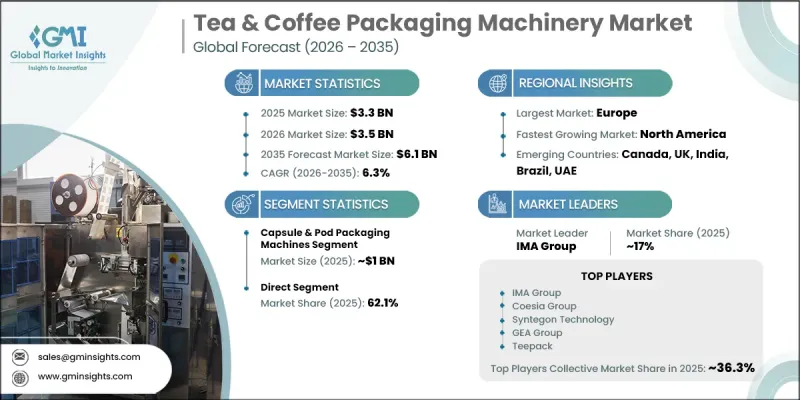
受生活方式改變、城市人口成長和消費者偏好演變的推動,全球飲料消費持續成長,帶動茶和咖啡包裝器材市場穩步發展。消費者對高階飲料、特色產品和客製化包裝解決方案的需求不斷成長,促使製造商採用能夠滿足多樣化包裝需求的先進機械。隨著創新飲料形式的日益普及,市場對高精度、靈活高效且密封性能和搬運能力更佳的包裝系統的需求也日益成長。自動化正成為市場擴張的關鍵驅動力,因為生產商尋求提高營運效率、減少對勞動力的依賴並維持產品品質的穩定性。中小企業擴大採用自動化包裝設備,以在快速變化的市場中有效競爭。同時,線上零售和直銷模式的興起,催生了對高度適應性包裝系統的需求,這些系統能夠支援更短的生產週期、客製化設計和高效的產品分銷。為了滿足不斷變化的消費者期望,製造商越來越重視具有柔軟性、快速規格轉換能力和更高耐用性的設備。預計這些趨勢將在整個預測期內推動茶和咖啡包裝器材市場的持續創新和成長。
| 市場範圍 | |
|---|---|
| 開始年份 | 2025 |
| 預測期 | 2026-2035 |
| 初始市場規模 | 33億美元 |
| 預測金額 | 61億美元 |
| 複合年成長率 | 6.3% |
預計到2025年,膠囊和包裝盒包裝器材市場規模將達到10億美元,並在2026年至2035年間以6.8%的複合年成長率成長。隨著消費者對兼具穩定性、便攜性和易用性的便捷飲料沖泡方式的需求不斷成長,該市場持續擴張。隨著住宅、商用和餐飲業對膠囊和包裝盒包裝機械的需求日益成長,製造商正投資研發旨在實現精準加工和產品保護的先進包裝系統。消費者對保鮮、可靠密封性能和高效物料輸送的需求不斷成長,推動了專用膠囊和包裝盒包裝器材的發展。
預計到2025年,銷售管道將佔據62.1%的市場佔有率,並在2026年至2035年間以6.5%的複合年成長率成長。直銷仍然是首選的分銷方式,因為飲料生產商通常需要根據產能、包裝形式、自動化要求和材料規格來客製化機械解決方案。透過與設備製造商直接合作,企業可以獲得客製化解決方案、全面的技術支援、安裝協助和持續的維護服務。這些優勢能夠幫助生產商提高營運效率、最大限度地減少生產停機時間並提升設備的長期性能。
美國茶和咖啡包裝器材市場預計到2025年將達到7.434億美元,並在2026年至2035年間以6.6%的複合年成長率成長,成為北美最大的成長要素。強勁的飲料消費趨勢、對高級產品類別日益成長的需求以及先進包裝技術的廣泛應用,都支撐了這一成長。成熟的飲料製造商、自有品牌製造商和包裝服務供應商持續推動對自動化、高性能機械的投資。此外,線上銷售管道的拓展以及對客製化包裝解決方案需求的不斷成長,也為美國市場靈活高效的包裝設備創造了新的機會。
目錄
第1章:調查方法和範圍
第2章執行摘要
第3章 行業洞察
- 產業生態系分析
- 供應商情況
- 利潤率
- 每個階段增加的價值
- 影響價值鏈的因素
- 影響產業的因素
- 促進因素
- 全球茶葉和咖啡消費量的不斷成長,推動了對高速包裝生產線的需求。
- 優質化趨勢的日益增強以及特殊形式(金字塔形包裝袋、膠囊、小包裝袋)的擴展,增加了機械的複雜性。
- 中小茶葉和咖啡生產商自動化應用範圍擴大
- 隨著電子商務的擴張,對靈活的小批量包裝能力的需求日益成長。
- 我們對永續發展的承諾正在加速向可處理可堆肥薄膜的機械過渡。
- 產業潛在風險與挑戰
- 包裝材料適用性方面的法規存在區域差異
- 原物料價格波動會影響包裝薄膜和機器零件的成本。
- 機械設備更新周期過長阻礙了市場復甦。
- 機會
- 改造現有生產線,使其能夠適應可生物分解和可堆肥的材料。
- 一次性及攜帶式咖啡機的成長推動了膠囊式和膠囊式咖啡機的需求。
- 整合物聯網和預測性維護平台以減少停機時間
- 自有品牌和合約灌裝服務的成長正在推動中價位機器市場的發展。
- 促進因素
- 成長潛力分析
- 未來市場趨勢
- 技術與創新展望
- 最新科技趨勢
- 新興技術
- 監理情勢
- 標準和合規要求
- 區域監理框架
- 認證標準
- 貿易數據分析
- 進出口量及進口額趨勢
- 主要貿易路線及關稅的影響
- 價格分析
- 對過去價格趨勢的分析
- 按業務類型(高階/低階/大眾市場)分類的定價策略
- 人工智慧和生成式人工智慧對市場的影響
- 利用人工智慧改造現有經營模式
- 按細分市場分類的生成式人工智慧用例和部署藍圖
- 風險、限制和監管考量
- 波特的分析
- PESTLE分析
第4章 競爭情勢
- 介紹
- 企業市佔率分析
- 按地區
- 企業矩陣分析
- 主要市場公司的競爭分析
- 競爭定位矩陣
- 主要進展
- 併購
- 夥伴關係和聯盟
- 新產品發布
- 業務拓展計劃
第5章 市場估價與預測:依機器類型分類,2022-2035年
- 茶包包裝機
- 活頁茶葉袋灌裝機
- 膠囊和豆莢包裝機
- 條狀包裝機
- 二級/三級包裝器材
- 其他設備(真空包裝機、氮氣填充系統、貼標機、檢測系統)
第6章 市場估算與預測:依自動化程度分類,2022-2035年
- 全自動
- 半自動
- 手動的
第7章 市場估價與預測:依包裝類型分類,2022-2035年
- 茶包
- 扁平/長方形茶包
- 圓形茶包
- 金字塔形/三角形茶包
- 小袋子和小包
- 立式袋
- 扁平袋
- Doipack
- 膠囊和藥盒
- 硬殼膠囊
- 軟豆莢
- 棒狀包裝
- 罐子和瓶子
- 真空包裝
- 其他(密封茶包、多包裝)
第8章 市場估價與預測:依包裝材料分類,2022-2035年
- 紙張和紙板
- 塑膠薄膜
- 鋁箔和鋁箔層壓
- 多層複合
- 可生物分解和可堆肥材料
- 尼龍和絲綢
第9章 市場估計與預測:依應用領域分類,2022-2035年
- 茶
- 紅茶
- 綠茶
- 花草茶和功能性茶
- 烏龍茶
- 其他(白茶、特調茶)
- 咖啡
- 研磨咖啡
- 咖啡豆(全穀)
- 即溶咖啡
- 咖啡膠囊和咖啡包
第10章 市場估價與預測:依通路分類,2022-2035年
- 直接的
- 間接
第11章 市場估價與預測:按地區分類,2022-2035年
- 北美洲
- 美國
- 加拿大
- 歐洲
- 德國
- 英國
- 法國
- 義大利
- 西班牙
- 亞太地區
- 中國
- 印度
- 日本
- 韓國
- 澳洲
- 印尼
- 馬來西亞
- 拉丁美洲
- 巴西
- 墨西哥
- 阿根廷
- 中東和非洲
- 沙烏地阿拉伯
- UAE
- 南非
第12章:公司簡介
- 世界公司
- IMA Group
- Syntegon Technology GmbH
- Coesia Group
- GEA Group
- Tetra Pak
- 該地區的領先企業
- Teepack Spezialmaschinen GmbH
- OMAG Srl
- Cama Group
- Pester pac automation GmbH
- Viking Masek
- 新興企業
- Aesus Packaging Systems
- Zhengzhou Longer Machinery
- Paxiom Group
- Fres-co System USA
- Markem-Imaje
The Global Tea & Coffee Packaging Machinery Market was valued at USD 3.3 billion in 2025 and is estimated to grow at a CAGR of 6.3% to reach USD 6.1 billion by 2035.
The tea & coffee packaging machinery market is witnessing steady growth as global beverage consumption continues to increase due to changing lifestyles, expanding urban populations, and evolving consumer preferences. Rising demand for premium beverages, specialty products, and customized packaging solutions is encouraging manufacturers to adopt advanced machinery capable of supporting diverse packaging requirements. The growing popularity of innovative beverage formats is increasing the need for highly accurate, flexible, and efficient packaging systems with improved sealing and handling capabilities. Automation is also becoming an important factor influencing market expansion, as producers seek to improve operational efficiency, reduce labor dependency, and maintain consistent product quality. Small and medium-sized businesses are increasingly adopting automated packaging equipment to compete effectively in a rapidly changing marketplace. At the same time, the growth of online retail and direct sales models is creating demand for adaptable packaging systems that support shorter production cycles, customized designs, and efficient product distribution. Manufacturers are increasingly prioritizing equipment that offers flexibility, faster format changes, and improved durability to meet changing consumer expectations. These trends are expected to drive continued innovation and growth in the tea & coffee packaging machinery market throughout the forecast period.
| Market Scope | |
|---|---|
| Start Year | 2025 |
| Forecast Year | 2026-2035 |
| Start Value | $3.3 Billion |
| Forecast Value | $6.1 Billion |
| CAGR | 6.3% |
The capsule & pod packaging machines segment generated USD 1 billion in 2025 and is expected to grow at a CAGR of 6.8% from 2026 to 2035. This segment continues to expand as demand increases for convenient beverage preparation formats that provide consistency, portability, and ease of use. Growing adoption across residential, commercial, and hospitality applications is encouraging manufacturers to invest in advanced packaging systems designed for precision processing and product protection. Increasing requirements for freshness preservation, reliable sealing performance, and efficient material handling are supporting the development of specialized capsule and pod packaging machinery.
The direct distribution channel accounted for 62.1% share in 2025 and is projected to grow at a CAGR of 6.5% between 2026 and 2035. Direct sales remain the preferred distribution approach because beverage producers often require customized machinery solutions based on production capacity, packaging formats, automation requirements, and material specifications. Working directly with equipment manufacturers allows companies to receive tailored solutions, improved technical assistance, installation support, and ongoing maintenance services. These advantages help producers improve operational efficiency, minimize production interruptions, and achieve better long-term equipment performance.
U.S. Tea & Coffee Packaging Machinery Market was valued at USD 743.4 million in 2025 and is estimated to grow at a CAGR of 6.6% from 2026 to 2035, making it the leading contributor to the North American market. Growth in the country is supported by strong beverage consumption trends, increasing demand for premium product categories, and rising adoption of advanced packaging technologies. The presence of established beverage manufacturers, private-label producers, and packaging service providers continues to encourage investment in automated and high-performance machinery. In addition, expanding online sales channels and increasing demand for customized packaging solutions are creating new opportunities for flexible and efficient packaging equipment across the U.S. market.
Major companies operating in the global tea & coffee packaging machinery market include IMA Group, Syntegon Technology GmbH, Coesia Group, GEA Group, Tetra Pak, Teepack Spezialmaschinen GmbH, OMAG S.r.l., Cama Group, Pester PAC Automation GmbH, Viking Masek, Aesus Packaging Systems, Zhengzhou Longer Machinery, Paxiom Group, Fres-co System USA, and Markem-Imaje. Companies operating in the tea & coffee packaging machinery market are strengthening their competitive position through continuous product innovation, automation advancements, and expansion of customized packaging solutions. Market participants are investing in smart machinery, improved production efficiency, and flexible equipment designs to meet evolving customer requirements. Businesses are also enhancing after-sales services, technical support capabilities, and maintenance solutions to improve customer retention and operational reliability. Strategic partnerships, geographic expansion, and investment in research and development remain key approaches for increasing market presence. Companies are focusing on developing energy-efficient systems, improving machine adaptability, and offering integrated packaging solutions to support manufacturers across different production scales.
Table of Contents
Chapter 1 Methodology & Scope
- 1.1 Market scope and definition
- 1.2 Research design
- 1.2.1 Research approach
- 1.2.2 Data collection methods
- 1.3 Data mining sources
- 1.3.1 Global
- 1.3.2 Regional/Country
- 1.4 Base estimates and calculations
- 1.4.1 Base year calculation
- 1.4.2 Key trends for market estimation
- 1.5 Primary research and validation
- 1.5.1 Primary sources
- 1.6 Forecast model
- 1.7 Research assumptions and limitations
Chapter 2 Executive Summary
- 2.1 Industry 360° synopsis
- 2.2 Key market trends
- 2.2.1 Regional
- 2.2.2 Machine type
- 2.2.3 Automation level
- 2.2.4 Packaging type
- 2.2.5 Packaging material
- 2.2.6 Application
- 2.2.7 Distribution channel
Chapter 3 Industry Insights
- 3.1 Industry ecosystem analysis
- 3.1.1 Supplier landscape
- 3.1.2 Profit margin
- 3.1.3 Value addition at each stage
- 3.1.4 Factor affecting the value chain
- 3.2 Industry impact forces
- 3.2.1 Growth drivers
- 3.2.1.1 Rising global tea & coffee consumption driving demand for high-speed packaging lines
- 3.2.1.2 Growing premiumization & specialty formats (pyramid bags, pods, sachets) expanding machine complexity
- 3.2.1.3 Increasing automation adoption among SME tea & coffee producers
- 3.2.1.4 E-commerce expansion requiring flexible, small-batch packaging capabilities
- 3.2.1.5 Sustainability mandates accelerating transition to compostable-film-compatible machinery
- 3.2.2 Industry pitfalls & challenges
- 3.2.2.1 Regulatory divergence across regions on packaging material compliance
- 3.2.2.2 Raw material price volatility affecting packaging film & mechanical component costs
- 3.2.2.3 Long machine replacement cycles limiting market velocity
- 3.2.3 Opportunities
- 3.2.3.1 Retrofitting existing lines for compostable & biodegradable material compatibility
- 3.2.3.2 Single-serve & on-the-go format growth creating demand for capsule & pod machines
- 3.2.3.3 Integration of IoT & predictive maintenance platforms for reduced downtime
- 3.2.3.4 Private label & contract packing growth opening mid-tier machine segment
- 3.2.1 Growth drivers
- 3.3 Growth potential analysis
- 3.4 Future market trends
- 3.5 Technology and innovation landscape
- 3.5.1 Current technological trends
- 3.5.2 Emerging technologies
- 3.6 Regulatory landscape
- 3.6.1 Standards and compliance requirements
- 3.6.2 Regional regulatory frameworks
- 3.6.3 Certification standards
- 3.7 Trade data analysis (HS Code 842240)
- 3.7.1 Import/export volume & value trends
- 3.7.2 Key trade corridors & tariff impact
- 3.8 Pricing analysis
- 3.8.1 Historical price trend analysis (driven by primary research)
- 3.8.2 Pricing strategy by player type (premium / value / mass market)
- 3.9 Impact of AI & generative AI on the market
- 3.9.1 AI-driven disruption of existing business models
- 3.9.2 GenAI use cases & adoption roadmap by segment
- 3.9.3 Risks, limitations & regulatory considerations
- 3.10 Porter's analysis
- 3.11 PESTEL analysis
Chapter 4 Competitive Landscape, 2025
- 4.1 Introduction
- 4.2 Company market share analysis
- 4.2.1 By Region
- 4.2.1.1 North America
- 4.2.1.2 Europe
- 4.2.1.3 Asia Pacific
- 4.2.1.4 Latin America
- 4.2.1.5 Middle East & Africa
- 4.2.1 By Region
- 4.3 Company matrix analysis
- 4.4 Competitive analysis of major market players
- 4.5 Competitive positioning matrix
- 4.6 Key developments
- 4.6.1 Mergers & acquisitions
- 4.6.2 Partnerships & collaborations
- 4.6.3 New product launches
- 4.6.4 Expansion plans
Chapter 5 Market Estimates & Forecast, By Machine Type, 2022 - 2035, (USD Billion) (Million Units)
- 5.1 Key trends
- 5.2 Tea bag packaging machines
- 5.3 Loose-leaf & pouch filling machines
- 5.4 Capsule & pod packaging machines
- 5.5 Stick pack packaging machines
- 5.6 Secondary & tertiary packaging machines
- 5.7 Others (vacuum packers, nitrogen flush systems, labellers, inspection systems)
Chapter 6 Market Estimates & Forecast, By Automation Level, 2022 - 2035, (USD Billion) (Million Units)
- 6.1 Key trends
- 6.2 Fully automatic
- 6.3 Semi-automatic
- 6.4 Manual
Chapter 7 Market Estimates & Forecast, By Packaging Type, 2022 - 2035, (USD Billion) (Million Units)
- 7.1 Key trends
- 7.2 Tea bags
- 7.2.1 Flat/rectangular tea bags
- 7.2.2 Round tea bags
- 7.2.3 Pyramid/triangle tea bags
- 7.3 Pouches & sachets
- 7.3.1 Stand-up pouches
- 7.3.2 Flat pouches
- 7.3.3 Doy packs
- 7.4 Capsules & pods
- 7.4.1 Hard-shell capsules
- 7.4.2 Soft pods
- 7.5 Stick packs
- 7.6 Canisters & jars
- 7.7 Vacuum packs
- 7.8 Others (enveloped tea bags, multi-packs)
Chapter 8 Market Estimates & Forecast, By Packaging Material, 2022 - 2035, (USD Billion) (Million Units)
- 8.1 Key trends
- 8.2 Paper & paperboard
- 8.3 Plastic films
- 8.4 Aluminum foil & foil laminates
- 8.5 Multi-layer laminates
- 8.6 Biodegradable & compostable materials
- 8.7 Nylon & silk
Chapter 9 Market Estimates & Forecast, By Application, 2022 - 2035, (USD Billion) (Million Units)
- 9.1 Key trends
- 9.2 Tea
- 9.2.1 Black tea
- 9.2.2 Green tea
- 9.2.3 Herbal & functional tea
- 9.2.4 Oolong tea
- 9.2.5 Others (white tea, specialty blends)
- 9.3 Coffee
- 9.3.1 Ground coffee
- 9.3.2 Whole bean coffee
- 9.3.3 Instant coffee
- 9.3.4 Coffee pods & capsules
Chapter 10 Market Estimates & Forecast, By Distribution Channel, 2022 - 2035, (USD Billion) (Million Units)
- 10.1 Key trends
- 10.2 Direct
- 10.3 Indirect
Chapter 11 Market Estimates & Forecast, By Region, 2022 - 2035, (USD Billion) (Million Units)
- 11.1 Key trends
- 11.2 North America
- 11.2.1 U.S.
- 11.2.2 Canada
- 11.3 Europe
- 11.3.1 Germany
- 11.3.2 UK
- 11.3.3 France
- 11.3.4 Italy
- 11.3.5 Spain
- 11.4 Asia Pacific
- 11.4.1 China
- 11.4.2 India
- 11.4.3 Japan
- 11.4.4 South Korea
- 11.4.5 Australia
- 11.4.6 Indonesia
- 11.4.7 Malaysia
- 11.5 Latin America
- 11.5.1 Brazil
- 11.5.2 Mexico
- 11.5.3 Argentina
- 11.6 MEA
- 11.6.1 Saudi Arabia
- 11.6.2 UAE
- 11.6.3 South Africa
Chapter 12 Company Profiles
- 12.1 Global Players
- 12.1.1 IMA Group
- 12.1.2 Syntegon Technology GmbH
- 12.1.3 Coesia Group
- 12.1.4 GEA Group
- 12.1.5 Tetra Pak
- 12.2 Regional Champions
- 12.2.1 Teepack Spezialmaschinen GmbH
- 12.2.2 OMAG S.r.l.
- 12.2.3 Cama Group
- 12.2.4 Pester pac automation GmbH
- 12.2.5 Viking Masek
- 12.3 Emerging Players
- 12.3.1 Aesus Packaging Systems
- 12.3.2 Zhengzhou Longer Machinery
- 12.3.3 Paxiom Group
- 12.3.4 Fres-co System USA
- 12.3.5 Markem-Imaje

 麵包烘焙包裝機械市場分析與預測(至2035年):類型、產品類型、技術、組件、應用、材料類型、製程、最終用戶、功能
 軟包裝包裝器材市場機會、成長促進因素、產業趨勢分析及2026-2035年預測2026 年至 2035 年包裝和貼標機械的市場機會、成長要素、產業趨勢和預測。食品飲料包裝器材市場:商機、成長要素、產業趨勢分析及2026-2035年預測
 包裝器材市場:2026-2032年全球市場預測(依機器類型、自動化程度、包裝類型、技術、應用、最終用戶和銷售管道)瓶蓋安裝機市場:按類型、瓶蓋材料、應用、銷售管道和最終用戶分類-2026-2032年全球市場預測
 食品FFS(成型、填充、封口)包裝器材市場:市場規模、佔有率和趨勢分析(按機器類型、最終用途和地區分類),細分市場預測(2026-2033年)
 包裝器材市場-全球產業規模、佔有率、趨勢、機會和預測:按產品類型、技術、最終用戶、地區和競爭格局分類,2021-2031年
 預混合料包裝機市場預測至2034年-按類型、包裝形式、應用和地區分類的全球分析
 包裝器材市場報告:按機器類型、技術、最終用途和地區分類(2026-2034 年)