


 |
市場調查報告書
商品編碼
2125359
化工閥門:市場佔有率分析、產業趨勢與統計、成長預測(2026-2031)Chemical Industry Valves - Market Share Analysis, Industry Trends & Statistics, Growth Forecasts (2026 - 2031) |
||||||

※ 本網頁內容可能與最新版本有所差異。詳細情況請與我們聯繫。
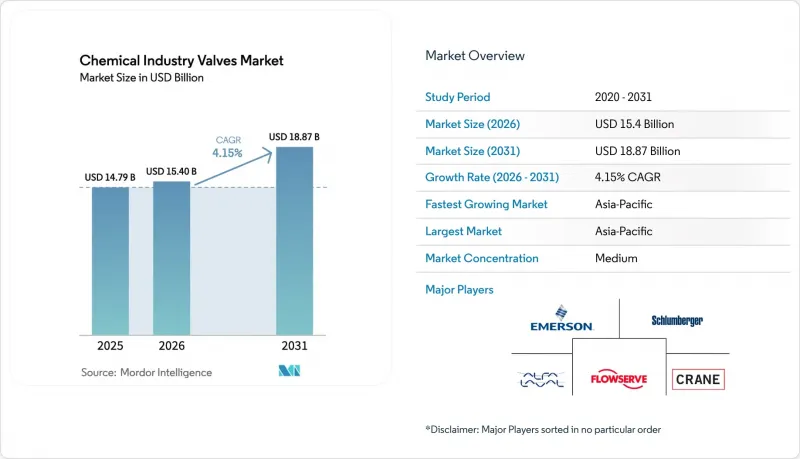
根據 Mordor Intelligence 預測,化學工業閥門市場規模將從 2025 年的 147.9 億美元成長到 2026 年的 154 億美元,然後在 2031 年達到 188.7 億美元,2026 年至 2031 年的複合年成長率為 4.15%。
本報告按閥門類型(球閥、蝶閥、閘閥、截止閥、止回閥等)、材質(不銹鋼、鑄鐵、合金鋼、塑膠/PVC、低溫材料、特種合金)、閥門尺寸(小於1英寸、1-6英寸、6-25英寸、25-50英寸、大於50英寸)、驅動方式(其他細分、氣壓)、驅動方式(其他細分市場)進行電動驅動方式(其他細分市場)。市場預測以美元(USD)計價。
化工產業閥門市場洞察與趨勢
加速工業4.0和智慧控制的普及應用
配備壓力、振動和位置感測器的數位化閥門現已與分散式控制系統無縫整合,可實現預測性維護,並將意外停機時間減少 25% 至 30%,同時提供符合 API 624 低排放法規要求的審計追蹤。營運商正在閥門韌體中添加基於區塊鏈的身份驗證,以防止網路入侵,但每年 5 萬至 20 萬美元的網路保險支出仍然是小規模化工廠的一大障礙。供應商正在透過實施空氣間隙架構來解決這個問題,該架構將關鍵安全迴路與企業網路隔離,從而平衡效能和風險緩解。智慧閥門的採用簡化了人員配置,因為老技術人員正在退休,從而緩解了化學工業閥門市場長期存在的技能短缺問題。隨著概念驗證(PoC)先導計畫向多站點部署過渡,目標使用者群體正在亞太和北美地區迅速擴大。
全球更嚴格的健康、安全和環境法規以及排放標準
API 641、ISO 15848 和歐盟工業排放指令均已修訂採購標準,並更加重視洩漏率低於 100 ppm 的三偏心蝶閥和金屬座球閥。每次違規將面臨 10 萬至 50 萬美元的罰款,迫使營運商採用完全認證的產品線,從而擴大了擁有豐富認證數據的跨國公司與面臨每系列閥門超過 200 萬美元測試成本的利基公司之間的競爭差距。合規要求縮短了成熟工廠的更換週期,並刺激了歐洲和北美地區對氫相容解決方案的待開發區需求。低排放設計產品 20% 至 30% 的溢價可透過避免罰款和減少排放稅來抵消,從而進一步促進了相關規範的採用。
鎳鉬價格波動推高了合金成本。
根據上海金屬市場預測,2024年鎳價波動幅度預計為35%~40%,鉬價波動幅度預計為25%~30%,將導致鎳合金閥門價格預計上漲18%。由於原料成本佔特種閥門製造成本的70%之多,供應商正透過季度提價和設定最低訂購量來維持利潤率。終端用戶則透過延長競標週期和在價格下跌時購買期貨來應對,導致需求波動,並使生產計畫更加複雜。這些限制因素限制了耐腐蝕材料在成本敏感型專案中的應用,短期內將略微減緩化學閥門市場的成長動能。
細分市場分析
在化學閥門市場,球閥預計到2025年市場規模將達到27.3億美元,佔18.44%的最大市場。這主要得益於球閥在腐蝕性介質中可靠的密封性能以及其能夠承受多種ANSI壓力等級。多端口和低溫型號的球閥進一步鞏固了其在連續和間歇製程的應用。供應商提供的球閥與智慧數位定位器結合,可減少20%的維護工作,從而鞏固了其在大型石化企業中的地位。
同時,真空閥預計將以4.92%的複合年成長率成長,到2031年將超過所有其他類別。半導體化學氣相沉積(CVD)生產線和製藥冷凍乾燥室對洩漏率的要求極高,而閘閥或傳統截止閥無法滿足此要求。福斯公司採用無彈簧設計,內部組件採用高純度不銹鋼,顯著提升了性能,滿足了晶圓廠(半導體製造廠)對十億分之一級污染閾值的需求。中國、日本和美國政府為吸引半導體投資的措施進一步推動了這一快速成長,形成了一個多年的真空閥更換週期。
不銹鋼憑藉其優異的耐腐蝕性和成本效益,在2025年仍將佔據化學閥門市場41.29%的主導地位。 316L不銹鋼仍然是處理中性pH有機物的標準規格,而雙相不銹鋼的應用範圍正在擴大,尤其適用於含氯量高的流體。備件的通用和全球庫存網路進一步增強了擁有多家工廠的企業對不銹鋼閥門的支援。
預計對特種合金(尤其是鈦和哈氏合金)的需求將以5.58%的複合年成長率成長,這反映了綠色氫電解槽和硫酸基特種產品生產的需求。鈦的生物相容性使其適用於藥物活性成分(API)生產線,而哈氏合金C-276在混合酸反應器中具有較長的使用壽命。符合NACE MR0175標準進一步加速了酸性氣體衍生產品的應用。即使價格溢價超過300%,這種轉變仍在擴大收入來源,從而提升了化工閥門市場中高合金類別的市場規模。
區域分析
預計到2025年,亞太地區將佔全球收入的38.75%,這主要得益於中國特種化學品產量成長8.2%以及印度製藥業的擴張。浙江榮盛石化等國營企業正在指定使用符合核磁共振成像(MRI)標準的低洩漏閥門,而日本和韓國的製造廠則更傾向於使用超高純度真空閥。區域性原始設備製造商(OEM)正在推進執行器和鑄造製程的本地化,以避免進口關稅,從而進一步加強供應鏈基礎。
北美是第二大區域,其石化投資主要集中在美國墨西哥灣沿岸的頁岩氣衍生石化產品。在更新週期中,API 624認證產品受到重視,以滿足美國環保署(EPA)的LDAR計畫要求。 2030年預算中包含用於預測性維護維修的資金,該改造將整合分析功能。加拿大的藍氫計畫正在推動對耐脆性合金的需求。
在歐洲,一個顯著的特點是受「工業排放指令」的監管主導,企業紛紛增加設備升級投資,從而對洩漏量更低的替換閥門產生了持續的需求。在德斯堪的斯堪地那維亞化工產業叢集中,採用積層製造技術生產的備件正領先;而在英國,隨著NIS 2指令的實施,網路安全性能更強的執行器成為優先考慮的因素。
其他好處:
- Excel格式的市場預測(ME)表
- 3個月的分析師支持
目錄
第1章:引言
- 研究假設和市場定義
- 調查範圍
第2章:調查方法
第3章執行摘要
第4章 市場狀況
- 市場概覽
- 市場促進因素
- 工業4.0和智慧控制技術的應用正在加速推進。
- 全球更嚴格的健康、安全和環境法規以及排放標準
- 亞太地區特種化學品產能快速成長
- 最佳化生命週期成本,使耐腐蝕閥門具有優勢。
- 綠化工生產線的氫相容規範
- 採用積層製造流程製造的模組化閥體零件。
- 市場限制因素
- 鎳鉬價格波動推高了合金成本。
- 認證標準不一致會導致專案延誤。
- 網路保險費阻礙了物聯網的全面普及。
- 亞太地區的技術人才缺口導致人們更傾向於選擇結構相對簡單的閥門。
- 產業生態系分析
- 監理情勢
- 技術展望
- 波特五力分析
第5章 市場規模與成長預測
- 按閥門類型
- 球
- 蝴蝶
- 門
- 手套
- 查看
- 插頭
- 隔膜
- 真空
- 混合
- 其他
- 材料
- 不銹鋼
- 鑄鐵
- 合金體系
- 塑膠/PVC
- 低溫級
- 特種合金(鈦、哈氏合金)
- 按閥門尺寸
- 小於1英寸
- 1-6英寸
- 6-25英寸
- 25-50英寸
- 超過50英寸
- 透過操作技術
- 手動的
- 氣壓
- 電的
- 油壓
- 智慧(相容物聯網)
- 按地區
- 北美洲
- 美國
- 加拿大
- 墨西哥
- 南美洲
- 巴西
- 阿根廷
- 其他南美國家
- 歐洲
- 德國
- 英國
- 法國
- 義大利
- 西班牙
- 其他歐洲國家
- 亞太地區
- 中國
- 印度
- 日本
- 韓國
- ASEAN
- 其他亞太國家
- 中東和非洲
- 中東
- 阿拉伯聯合大公國
- 沙烏地阿拉伯
- 其他中東國家
- 非洲
- 南非
- 奈及利亞
- 其他非洲國家
- 中東
- 北美洲
第6章 競爭情勢
- 市場集中度
- 策略趨勢
- 市佔率分析
- 公司簡介
- Emerson Electric Co.
- Flowserve Corporation
- Schlumberger Limited(Cameron)
- Alfa Laval Corporate AB
- Crane Company
- Rotork plc
- KITZ Corporation
- IMI plc
- Samson Aktiengesellschaft
- Valmet Oyj
- Honeywell International Inc.
- Schneider Electric SE
- Siemens AG
- Parker Hannifin Corporation
- Curtiss-Wright Corporation
- AVK Holding A/S
- Spirax-Sarco Engineering plc
- Velan Inc.
- Neway Valve(Suzhou)Co., Ltd.
- CIRCOR International, Inc.
- Metso Corporation
- Christian Burkert GmbH and Co. KG
- Johnson Controls International plc
- AUMA Riester GmbH and Co. KG
- Pentair plc
第7章 市場機會與未來展望
According to Mordor Intelligence, the chemical industry valves market size is expected to grow from USD 14.79 billion in 2025 to USD 15.4 billion in 2026 and is forecast to reach USD 18.87 billion by 2031 at 4.15% CAGR over 2026-2031.
This report is Segmented by Valve Type (Ball, Butterfly, Gate, Globe, Check, and More), Material (Stainless Steel, Cast Iron, Alloy-Based, Plastic/PVC, Cryogenic-Grade, and Exotic Alloys), Valve Size in Inches (Up To 1", 1"-6", 6"-25", 25"-50", and, Above 50"), Actuation Technology (Manual, Pneumatic, Electric, and More), and Geography. The Market Forecasts are Provided in Terms of Value (USD).
Insights and Trends of Chemical Industry Valves Market
Accelerating Adoption of Industry 4.0 and Smart Control
Digitally enabled valves equipped with pressure, vibration, and position sensors now integrate seamlessly with distributed control systems, allowing predictive maintenance that cuts unplanned downtime by 25-30% while providing the audit trail demanded under API 624 low-emission rules. Operators are layering blockchain-based authentication on valve firmware to deter cyber-intrusions, yet annual cyber-insurance outlays ranging from USD 50,000 to 200,000 remain a barrier for smaller chemical plants. Vendors are responding with air-gapped architectures that isolate critical safety loops from enterprise networks, balancing performance with risk mitigation. Smart-valve retrofits also streamline workforce allocation as aging technicians retire, easing the chemical industry valves market's chronic skills shortage. As proof-of-concept pilots convert into multi-site rollouts, the addressable installed base grows rapidly across Asia-Pacific and North America.
Tightening Global HSE Regulations and Emission Norms
API 641, ISO 15848, and the European Union Industrial Emissions Directive have reframed procurement criteria, elevating triple-offset butterfly and metal-seated ball valves capable of leakage rates below 100 ppm. Fines of USD 100,000-500,000 per violation push operators toward fully certified portfolios, widening the competitive gap between multinationals with extensive qualification data and niche firms facing test costs surpassing USD 2 million per valve family. Compliance mandates are shortening replacement cycles in mature plants and stimulating greenfield demand for hydrogen-ready solutions in Europe and North America. Premium pricing of 20-30% on low-emission designs is offset by avoided penalties and reduced fugitive-emission taxes, reinforcing spec-in momentum.
Volatile Nickel/Molybdenum Prices Inflating Alloy Costs
Nickel prices swung 35-40% and molybdenum 25-30% during 2024, driving an 18% hike in nickel-alloy valve quotations according to Shanghai Metals Market. With raw materials representing up to 70% of exotic valve manufacturing cost, suppliers have adopted quarterly price escalators and minimum order sizes to preserve margins. End-users counter by lengthening bid cycles and forward-buying during price dips, injecting demand volatility that complicates production planning. The restraint constrains the uptake of corrosion-resistant materials in cost-sensitive projects, marginally diluting the chemical industry valves market growth trajectory in the short term.
Other drivers and restraints analyzed in the detailed report include:
- Specialty-Chemical Capacity Surge in APAC
- Lifecycle-Cost Optimization Favoring Corrosion-Resistant Valves
- Cyber-Insurance Premiums Curbing Full IoT Adoption
For complete list of drivers and restraints, kindly check the Table Of Contents.
Segment Analysis
The chemical industry valves market size for ball valves represented USD 2.73 billion in 2025 and held the highest 18.44% share, sustained by reliable shut-off across corrosive media and broad ANSI pressure classes. Multiport and cryogenic variants have further entrenched presence in continuous and batch processes. Vendors bundle ball valves with smart digital positioners that trim maintenance labor by 20%, cementing loyalty among large petrochemical accounts.
Vacuum valves however are projected to outpace all other categories at a 4.92% CAGR through 2031. Semiconductor chemical vapor deposition lines and pharmaceutical freeze-drying chambers demand ultra-low leak rates that gate valves or traditional shuts cannot deliver. Flowserve's spring-less designs featuring high-purity stainless internals illustrate the capability leap favored by fabs targeting parts-per-billion contamination thresholds. The surge is further supported by governments courting chip investments in China, Japan, and the United States, priming a multiyear vacuum-valve upgrade cycle.
Stainless steel retained a commanding 41.29% of chemical industry valves market share in 2025 on its balance of corrosion resistance and cost efficiency. 316L remains the default in neutral-pH organics, while duplex grades expand in chloride-laden streams. Combined spare-parts commonality and global stocking networks reinforce preference among multi-plant operators.
Exotic-alloy demand, particularly titanium and Hastelloy, is set to register a 5.58% CAGR, reflecting green-hydrogen electrolyzer requirements and sulfuric-acid based specialty production. Titanium's biocompatibility aligns with active pharmaceutical ingredient lines, whereas Hastelloy C-276 delivers longevity in mixed-acid reactors. NACE MR0175 compliance further drives uptake in sour-gas derivatives. The shift widens revenue pools even as price premiums exceed 300%, elevating the chemical industry valves market size for high-alloy categories.
Complete Report Scope:
- By Valve Type
- Ball
- Butterfly
- Gate
- Globe
- Check
- Plug
- Diaphragm
- Vacuum
- Hybrid
- Other Valve Types
- By Material
- Stainless Steel
- Cast Iron
- Alloy-Based
- Plastic / PVC
- Cryogenic-Grade
- Exotic Alloys (Ti, Hastelloy)
- By Valve Size (Inches)
- Up to 1"
- 1" - 6"
- 6" - 25"
- 25" - 50"
- Above 50"
- By Actuation Technology
- Manual
- Pneumatic
- Electric
- Hydraulic
- Smart (IoT-enabled)
- By Geography
- North America
- United States
- Canada
- Mexico
- South America
- Brazil
- Argentina
- Rest of South America
- Europe
- Germany
- United Kingdom
- France
- Italy
- Spain
- Rest of Europe
- Asia-Pacific
- China
- India
- Japan
- South Korea
- ASEAN
- Rest of Asia-Pacific
- Middle East and Africa
- Middle East
- United Arab Emirates
- Saudi Arabia
- Rest of Middle East
- Africa
- South Africa
- Nigeria
- Rest of Africa
- Middle East
- North America
Geography Analysis
Asia-Pacific generated 38.75% of 2025 revenue, driven by China's 8.2% rise in specialty-chemical output and India's pharmaceutical build-out. State-backed projects such as Rongsheng Petrochemical's Zhejiang complex specify MRI-compliant low-leak valves, while Japanese and South Korean fabs favor ultra-high-purity vacuum variants. Regional OEMs are localizing actuator and casting operations to sidestep import duties, further cementing supply-chain heft.
North America represents the second-largest region, anchored by shale-gas derived petrochemical investments on the U.S. Gulf Coast. Replacement cycles focus on API 624 certified options to satisfy Environmental Protection Agency LDAR programs, with predictive-maintenance retrofits bundling analytics into 2030 budgets. Canada's blue-hydrogen projects add demand for embrittlement-resistant alloys.
Europe is characterized by regulatory-driven upgrade expenditure under the Industrial Emissions Directive, leading to steady replacement demand for low-fugitive valves. German and Scandinavian chemical clusters are early adopters of additive-manufactured spare parts, while United Kingdom sites prioritize cybersecurity- fortified actuators post-NIS 2 directive.
- Emerson Electric Co.
- Flowserve Corporation
- Schlumberger Limited (Cameron)
- Alfa Laval Corporate AB
- Crane Company
- Rotork plc
- KITZ Corporation
- IMI plc
- Samson Aktiengesellschaft
- Valmet Oyj
- Honeywell International Inc.
- Schneider Electric SE
- Siemens AG
- Parker Hannifin Corporation
- Curtiss-Wright Corporation
- AVK Holding A/S
- Spirax-Sarco Engineering plc
- Velan Inc.
- Neway Valve (Suzhou) Co., Ltd.
- CIRCOR International, Inc.
- Metso Corporation
- Christian Burkert GmbH and Co. KG
- Johnson Controls International plc
- AUMA Riester GmbH and Co. KG
- Pentair plc
Additional Benefits:
- The market estimate (ME) sheet in Excel format
- 3 months of analyst support
TABLE OF CONTENTS
1 INTRODUCTION
- 1.1 Study Assumptions and Market Definition
- 1.2 Scope of the Study
2 RESEARCH METHODOLOGY
3 EXECUTIVE SUMMARY
4 MARKET LANDSCAPE
- 4.1 Market Overview
- 4.2 Market Drivers
- 4.2.1 Accelerating adoption of Industry 4.0 and smart control
- 4.2.2 Tightening global HSE regulations and emission norms
- 4.2.3 Specialty-chemical capacity surge in Asia-Pacific
- 4.2.4 Lifecycle-cost optimisation favouring corrosion-resistant valves
- 4.2.5 Hydrogen-ready specifications for green-chem production lines
- 4.2.6 Additive-manufactured spare-parts and modular valve bodies
- 4.3 Market Restraints
- 4.3.1 Volatile nickel/molybdenum prices inflating alloy costs
- 4.3.2 Fragmented certification standards delaying projects
- 4.3.3 Cyber-insurance premiums curbing full IoT adoption
- 4.3.4 Asia-Pacific skill-gap driving preference for low-complexity valves
- 4.4 Industry Ecosystem Analysis
- 4.5 Regulatory Landscape
- 4.6 Technological Outlook
- 4.7 Porter's Five Forces Analysis
- 4.7.1 Bargaining Power of Suppliers
- 4.7.2 Bargaining Power of Buyers
- 4.7.3 Threat of New Entrants
- 4.7.4 Threat of Substitutes
- 4.7.5 Intensity of Competitive Rivalry
5 MARKET SIZE AND GROWTH FORECASTS (VALUE)
- 5.1 By Valve Type
- 5.1.1 Ball
- 5.1.2 Butterfly
- 5.1.3 Gate
- 5.1.4 Globe
- 5.1.5 Check
- 5.1.6 Plug
- 5.1.7 Diaphragm
- 5.1.8 Vacuum
- 5.1.9 Hybrid
- 5.1.10 Other Valve Types
- 5.2 By Material
- 5.2.1 Stainless Steel
- 5.2.2 Cast Iron
- 5.2.3 Alloy-Based
- 5.2.4 Plastic / PVC
- 5.2.5 Cryogenic-Grade
- 5.2.6 Exotic Alloys (Ti, Hastelloy)
- 5.3 By Valve Size (Inches)
- 5.3.1 Up to 1"
- 5.3.2 1" - 6"
- 5.3.3 6" - 25"
- 5.3.4 25" - 50"
- 5.3.5 Above 50"
- 5.4 By Actuation Technology
- 5.4.1 Manual
- 5.4.2 Pneumatic
- 5.4.3 Electric
- 5.4.4 Hydraulic
- 5.4.5 Smart (IoT-enabled)
- 5.5 By Geography
- 5.5.1 North America
- 5.5.1.1 United States
- 5.5.1.2 Canada
- 5.5.1.3 Mexico
- 5.5.2 South America
- 5.5.2.1 Brazil
- 5.5.2.2 Argentina
- 5.5.2.3 Rest of South America
- 5.5.3 Europe
- 5.5.3.1 Germany
- 5.5.3.2 United Kingdom
- 5.5.3.3 France
- 5.5.3.4 Italy
- 5.5.3.5 Spain
- 5.5.3.6 Rest of Europe
- 5.5.4 Asia-Pacific
- 5.5.4.1 China
- 5.5.4.2 India
- 5.5.4.3 Japan
- 5.5.4.4 South Korea
- 5.5.4.5 ASEAN
- 5.5.4.6 Rest of Asia-Pacific
- 5.5.5 Middle East and Africa
- 5.5.5.1 Middle East
- 5.5.5.1.1 United Arab Emirates
- 5.5.5.1.2 Saudi Arabia
- 5.5.5.1.3 Rest of Middle East
- 5.5.5.2 Africa
- 5.5.5.2.1 South Africa
- 5.5.5.2.2 Nigeria
- 5.5.5.2.3 Rest of Africa
- 5.5.5.1 Middle East
- 5.5.1 North America
6 COMPETITIVE LANDSCAPE
- 6.1 Market Concentration
- 6.2 Strategic Moves
- 6.3 Market Share Analysis
- 6.4 Company Profiles (includes Global level Overview, Market level overview, Core Segments, Financials as available, Strategic Information, Market Rank/Share, Products and Services, Recent Developments)
- 6.4.1 Emerson Electric Co.
- 6.4.2 Flowserve Corporation
- 6.4.3 Schlumberger Limited (Cameron)
- 6.4.4 Alfa Laval Corporate AB
- 6.4.5 Crane Company
- 6.4.6 Rotork plc
- 6.4.7 KITZ Corporation
- 6.4.8 IMI plc
- 6.4.9 Samson Aktiengesellschaft
- 6.4.10 Valmet Oyj
- 6.4.11 Honeywell International Inc.
- 6.4.12 Schneider Electric SE
- 6.4.13 Siemens AG
- 6.4.14 Parker Hannifin Corporation
- 6.4.15 Curtiss-Wright Corporation
- 6.4.16 AVK Holding A/S
- 6.4.17 Spirax-Sarco Engineering plc
- 6.4.18 Velan Inc.
- 6.4.19 Neway Valve (Suzhou) Co., Ltd.
- 6.4.20 CIRCOR International, Inc.
- 6.4.21 Metso Corporation
- 6.4.22 Christian Burkert GmbH and Co. KG
- 6.4.23 Johnson Controls International plc
- 6.4.24 AUMA Riester GmbH and Co. KG
- 6.4.25 Pentair plc
7 MARKET OPPORTUNITIES AND FUTURE OUTLOOK
- 7.1 White-space and Unmet-Need Assessment

 印度工業閥門:市場佔有率分析、產業趨勢與統計及成長預測(2026-2031)歐洲工業閥門:市場佔有率分析、產業趨勢與統計及成長預測(2026-2031)工業閥門:市場佔有率分析、產業趨勢與統計、成長預測(2026-2031)
 工業閥門市場:依產品類型、材料、尺寸、驅動方式、最終用途產業和銷售管道-全球預測,2026-2032年
 全球工業閥門市場(至 2032 年):依閥門類型(截止閥、球閥、蝶閥、電磁閥、旋塞閥、彈簧閥、儲槽排氣閥、夾管閥、閘閥、隔膜閥、先導閥、止回閥、安全閥、針閥、洩壓閥)、尺寸(小於 1 英吋、先導閥、止回閥、安全閥、針閥、洩壓閥)、尺寸(小於 1 英吋、1-6 英吋、25 英吋大於英吋)和介質(液體、氣體、漿料)分類石油和天然氣行業閥門:市場佔有率分析、行業趨勢和統計數據以及成長預測(2026-2031 年)
 工業閥門市場分析及預測(至2035年):類型、產品類型、技術、應用、材質、製程、最終用戶、功能、安裝配置、解決方案
 工業閥門市場規模及預測(2021-2034),全球及區域佔有率、趨勢和成長機會分析報告:按類型、尺寸、等級和行業分類
 工業閥門市場規模、佔有率、趨勢和預測:按產品類型、功能、材質、尺寸、最終用途行業和地區分類(2026-2034 年)拍擊閥市場:材質、尺寸、壓力等級、驅動方式、應用及通路分類-2026-2032年全球市場預測