


 |
市場調查報告書
商品編碼
2121361
工業閥門:市場佔有率分析、產業趨勢與統計、成長預測(2026-2031)Industrial Valves - Market Share Analysis, Industry Trends & Statistics, Growth Forecasts (2026 - 2031) |
||||||

※ 本網頁內容可能與最新版本有所差異。詳細情況請與我們聯繫。
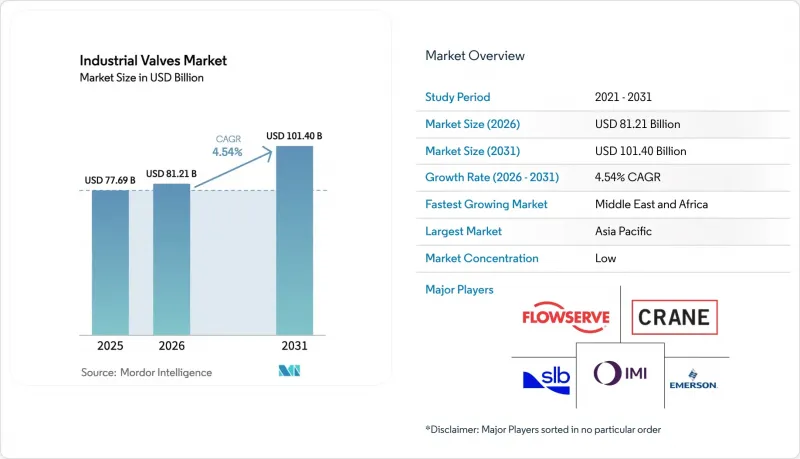
根據 Mordor Intelligence 預測,工業閥門市場預計將從 2025 年的 776.9 億美元成長到 2026 年的 812.1 億美元,到 2031 年達到 1,014 億美元,2026 年至 2031 年的複合年預計成長率為 4.54%。
本報告按閥門類型(球閥、蝶閥、閘閥及其他)、產品類型(直角回轉閥、多轉閥及其他)、閥門功能(截止閥、控制閥及其他)、閥體材質(鋼、合金及其他)、應用領域(石油天然氣、電力及其他)和地區(亞太、北美、歐洲、南美、中東和非洲)進行細分。市場預測以美元計價。
全球工業閥門市場趨勢與洞察
亞太地區LNG接收站興建擴建
2024年,新加坡能源市場管理局授予了該國第二座LNG接收站的合約。該合約規定建造浮體式儲存再氣化裝置(FSRU),預計於2020年代末投入運作。此外,泰國一座年處理能力為750萬噸的非製造廠以及印尼唐古3號生產線(年處理能力為380萬噸)都需要數千個能夠承受低至-162°C低溫的低溫球閥和蝶閥。鎳合金供應緊張導致前置作業時間延長至24週,這有利於擁有自有鑄造廠的原始設備製造商(OEM)。越來越多的閥門採用符合ASME B16.34標準的鎳合金閥體,推高了平均售價,提高了工業閥門市場一體化供應商的利潤率。
海灣合作理事會國家對海水淡化廠的投資激增。
位於阿拉伯聯合大公國的哈西揚海水淡化廠於2025年初簽署了一份價值9.2億美元的EPC總承包契約,預計到2027年日產量將達到1.8億英制加侖,截至2025年2月,該項目已完成55%的建設。該廠採用逆滲透技術,需要耐腐蝕的雙相鋼閥門處理高鹽度鹽水。每座工廠將需要2000至3000個雙相鋼閘閥和蝶閥來處理高鹽度鹽水。由於當地鑄造廠短缺,公共產業面臨著對歐洲和北美供應商進行預認證的壓力,這促使人們重新評估區域支出,創造了合資機會,並進一步提振了沿岸地區工業閥門市場的前景。
由於鎳合金鑄件供不應求,前置作業時間正在延長。
印尼於2020年實施的鎳礦出口禁令,並分別延長至2024年和2025年,加上菲律賓實施的類似法規,導致全球70%至80%的精煉鎳產量集中在中國,造成鎳含量超過20%的雙相鋼和因科鎳合金閥門鑄件供應瓶頸。缺乏預購鎳資金的中小型製造商正退出特種合金市場,將市場佔有率拱手讓給像福斯(Flowserve)和維蘭(Veran)這樣擁有自有鑄造廠或簽訂多年供應合約的垂直整合型企業。預計這種產業結構調整趨勢將持續到2027年至2028年印尼和菲律賓新的鎳提煉產能投入運作為止。
細分市場分析
預計到2025年,球閥將佔據40.48%的市佔率。這反映了球閥在石油、天然氣和化學領域操作簡單(只需四分之一圈即可操作)且密封性能可靠。同時,止回閥預計到2031年將以7.18%的複合年成長率成長,是所有閥門類型中成長率最高的。止回閥的快速成長主要受製程安全法規的推動,這些法規要求在氫氣管道和碳捕集與封存(CCS)網路中實施回流預防,因為回流可能導致災難性的壓力峰值。蝶閥用於大直徑、低壓水和污水處理系統,在公共工程領域比閘閥更具成本優勢,但由於運營商在關鍵的密封應用中優先選擇球閥,蝶閥的市場佔有率保持穩定。
API 6D 標準中日益嚴格的防火安全和低排放要求促使人們更傾向於選擇球閥。同時,雙板止回閥在緊急停機期間保護液化天然氣低溫泵方面發揮著至關重要的作用。蝶閥在供水領域仍佔有重要地位,而閘閥則持續應用於高壓蒸氣系統。塞閥在漿料處理領域佔有了一席之地,並逐漸塑造了工業閥門市場中流量控制類型的市場格局。
到2025年,直角回轉閥將佔據55.18%的市場佔有率,其主導地位源自於其快速的90度開閉操作。這縮短了自動化批次流程和緊急停機系統的循環時間。多轉閥預計將以5.81%的複合年成長率成長,因為閘閥和截止閥的設計被指定用於氫氣和碳捕集與封存(CCS)項目中1000巴壓力下的密封。
電動執行器的普及正在重塑產品配置的經濟格局。艾默生在2024年第三季財報電話會議上指出,多迴轉閥的電動執行器安裝量較去年同期成長12%。這主要得益於石化企業以電動致動器取代氣動系統,從而省去儀表空氣壓縮機,並降低15%至20%的能耗。直角回轉迴轉閥因其安裝靈活且符合ISO 5211標準,在維修工程中仍廣受歡迎。而多迴轉閥的升級改造由於需要客製化套件,成本日益增加,這正在影響整個工業閥門市場的產品選擇趨勢。
區域分析
到2025年,亞太地區將佔全球銷售額的40.47%,這主要得益於LNG接收站和半導體製造廠的需求,這兩個項目都需要數千個精密閥門。中國大陸、台灣和韓國正在支撐半導體製造廠的需求,而東南亞正在擴大其天然氣基礎設施,以取代煤炭。
在北美,得益於龐大的裝機量,售後市場銷售依然強勁。 《晶片法案》(CHIPS Act)提供的390億美元激勵措施,促進了英特爾、美光和三星在亞利桑那州、德克薩斯州和俄亥俄州的晶圓廠建設,並推動了符合嚴格閥門清潔度標準的超純水循環系統的安裝。
預計中東和非洲將實現全球最快的成長速度,到2031年將維持6.57%的複合年成長率,這主要得益於海灣合作理事會(GCC)國家對海水淡化的資本投資以及沙烏地阿拉伯石化產業的擴張。在歐洲,離岸風力發電和二氧化碳捕集與儲存(CCS)設施在一定程度上抵消了石化燃料發電廠逐步淘汰帶來的影響;而在拉丁美洲,鹽層下下層和頁岩氣項目支撐了區域閥門需求,這表明工業閥門市場的地域分佈十分廣泛。
其他好處
- Excel格式的市場預測(ME)表
- 3個月的分析師支持
目錄
第1章:引言
- 研究假設和市場定義
- 調查範圍
第2章:調查方法
第3章執行摘要
第4章 市場狀況
- 市場概覽
- 市場促進因素
- 亞太地區LNG接收站興建擴建
- 海灣合作理事會國家對海水淡化廠的投資激增。
- 北美化工產業的預測性維護設備更換週期
- 大型企劃。
- 半導體製造廠超高純度電子管需求激增
- 市場限制因素
- 由於鎳合金鑄件供不應求,前置作業時間正在延長。
- 中小企業排放氣體檢測成本不斷增加。
- 電動執行器的快速普及正在削弱對手動閥門的需求。
- 價值鏈分析
- 波特五力模型
第5章 市場規模與成長預測
- 按類型
- 球閥
- 蝶閥
- 閘閥
- 球閥
- 塞閥
- 其他
- 依產品
- 直角回轉閥
- 多圈閥
- 其他
- 閥門功能
- 關閉閥
- 調節閥
- 止回閥和安全閥
- 主要材料
- 鋼(碳鋼、不鏽鋼)
- 合金(雙相鋼、因科鎳合金等)
- 鑄鐵/球墨鑄鐵
- 低溫鎳合金
- 其他
- 透過使用
- 石油和天然氣
- 電力
- 用水和污水管理
- 化學品
- 新能源
- 其他
- 按地區
- 亞太地區
- 中國
- 印度
- 日本
- 韓國
- 印尼
- 越南
- 馬來西亞
- 泰國
- 其他亞太國家
- 北美洲
- 美國
- 加拿大
- 墨西哥
- 歐洲
- 德國
- 英國
- 義大利
- 法國
- 北歐國家
- 土耳其
- 俄羅斯
- 西班牙
- 其他歐洲國家
- 南美洲
- 巴西
- 阿根廷
- 哥倫比亞
- 其他南美國家
- 中東和非洲
- 沙烏地阿拉伯
- 阿拉伯聯合大公國
- 卡達
- 埃及
- 奈及利亞
- 南非
- 其他中東和非洲國家
- 亞太地區
第6章 競爭情勢
- 市場集中度
- 策略趨勢
- 市佔率和排名分析
- 公司簡介
- Alfa Laval
- AVK Holding A/S
- Baker Hughes Company
- Circor International Inc.
- Crane Company
- Curtiss-Wright Corporation
- Danfoss A/S
- Emerson Electric Co.
- Engipro Solutions LLP
- Flowserve Corporation
- Georg Fischer Ltd.
- Hitachi Ltd
- Honeywell International Inc.
- IMI Critical Engineering(IMI PLC)
- ITT Inc.
- KITZ Corporation
- KLINGER Holding
- Metso
- Mueller Co. LLC
- Nibco Inc.
- Okano Valve Mfg. Co. Ltd.
- SAMSON AKTIENGESELLSCHAFT
- SLB
- Technipfmc PLC
- The Weir Group PLC
- Valvitalia SpA
- Velan
- Xylem
第7章 市場機會與未來展望
According to Mordor Intelligence, the industrial valves market size is expected to increase from USD 77.69 billion in 2025 to USD 81.21 billion in 2026 and reach USD 101.40 billion by 2031, growing at a CAGR of 4.54% over 2026-2031.
This report is Segmented by Type (Ball, Butterfly, Gate, and More), Product (Quarter-Turn, Multi-Turn, and More), Valve Function (Isolation, Regulation, and More), Body Material (Steel, Alloy-Based, and More), Application (Oil and Gas, Power, and More), and Geography (Asia-Pacific, North America, Europe, South America, and Middle East and Africa). Market Forecasts are Provided in Terms of Value (USD).
Global Industrial Valves Market Trends and Insights
LNG-Terminal Build-Outs Across APAC
Singapore's Energy Market Authority awarded the country's second LNG terminal contract in 2024, specifying a floating storage and regasification unit with 200,000 cubic meters of storage and 5 million tonnes per annum throughput, operational by the end of the decade. Moreover, Thailand's 7.5 million tpa Nong Fab facility and Indonesia's 3.8 million tpa Tangguh Train 3 collectively require thousands of cryogenic ball and butterfly valves rated for -162°C service. Nickel-alloy supply constraints are stretching lead times to 24 weeks, favoring OEMs with captive foundries. Specification drift toward ASME B16.34-qualified nickel-alloy bodies is lifting average selling prices, bolstering margin potential for integrated suppliers in the industrial valves market.
Desalination CAPEX Surge in GCC States
The UAE's Hassyan desalination plant, awarded in early 2025 with a USD 920 million EPC contract, will produce 180 million imperial gallons per day by 2027 and stood 55% complete as of February 2025, employing reverse-osmosis technology that demands corrosion-resistant duplex-steel valves for high-salinity brine handling. Each plant needs 2,000-3,000 duplex-steel gate and butterfly valves to handle high-salinity brine. Local foundry shortages push utilities to pre-qualify European and North American vendors, reallocating regional spend and creating joint-venture openings that enhance Gulf prospects for the industrial valves market.
Nickel-Alloy Casting Shortages Extending Lead Times
Indonesia's 2020 nickel-ore export ban, extended through 2024 and 2025, and the Philippines' parallel restrictions have concentrated 70% to 80% of global refined-nickel output in China, creating a chokepoint for duplex and Inconel valve castings that require nickel content above 20%. Smaller fabricators lacking the balance-sheet strength to pre-purchase nickel are exiting specialty-alloy segments, ceding market share to vertically integrated players such as Flowserve and Velan that operate captive foundries or hold multi-year supply agreements. This consolidation dynamic is likely to persist until new nickel-refining capacity in Indonesia and the Philippines comes online in 2027 to 2028.
Other drivers and restraints analyzed in the detailed report include:
- Predictive-Maintenance-Driven Replacement Cycles in North American Chemicals
- Hydrogen & CCS Mega-Projects Demanding Ultra-High-Pressure Valves
- Stricter Fugitive-Emission Testing Costs for SMEs
For complete list of drivers and restraints, kindly check the Table Of Contents.
Segment Analysis
Ball valves captured 40.48% of market share in 2025, reflecting their quarter-turn simplicity and tight shut-off in oil, gas, and chemical applications, while check valves are expanding at 7.18% CAGR through 2031, the fastest rate among valve types. This acceleration stems from process-safety regulations mandating backflow prevention in hydrogen pipelines and CCS networks, where reverse flow can trigger catastrophic pressure excursions. Butterfly valves serve large-diameter, low-pressure water and wastewater systems, offering cost advantages over gate valves in municipal projects, yet their share remains stable as operators prioritize ball valves for critical isolation duties.
Steeper fire-safe and low-emission revisions to API 6D now favor ball-valve geometries, while dual-plate check valves protect LNG cryogenic pumps during emergency shutdowns. Butterfly valves retain water-sector relevance, and gate valves persist in high-pressure steam service. Plug valves capture slurry niches, rounding out the industrial valves market landscape for flow-control types.
Quarter-turn valves held 55.18% share in 2025, a dominance rooted in their rapid actuation-90 degrees from open to closed-that reduces cycle time in automated batch processes and emergency shutdown systems. Multi-turn valves are projected to grow at a 5.81% CAGR as hydrogen and CCS projects specify gate and globe designs for sealing under 1,000-bar loads.
The shift toward electric actuators is reshaping product-mix economics. Emerson's Q3 2024 earnings call highlighted a 12% year-over-year increase in electric-actuator attachments for multi-turn valves, driven by petrochemical complexes replacing pneumatic systems to eliminate instrument-air compressors and reduce energy consumption by 15% to 20%. ISO 5211 mounting versatility keeps quarter-turn devices popular in retrofit work, while custom kits add cost complexity to multi-turn upgrades, shaping product-choice dynamics across the industrial valves market.
Complete Report Scope:
- By Type
- Ball Valve
- Butterfly Valve
- Gate Valve
- Globe Valve
- Plug Valve
- Other Types
- By Product
- Quarter-Turn Valve
- Multi-Turn Valve
- Other Products
- By Valve Function
- Isolation Valves
- Regulation Valves
- Check and Safety Valves
- By Body Material
- Steel (Carbon and Stainless Steel)
- Alloy-Based (Duplex, Inconel, etc.)
- Cast/Ductile Iron
- Cryogenic Nickel Alloys
- Others
- By Application
- Oil and Gas
- Power
- Water and Wastewater Management
- Chemicals
- New Energy
- Other Applications (Includes Food Processing, Mining, and Marine)
- By Geography
- Asia-Pacific
- China
- India
- Japan
- South Korea
- Indonesia
- Vietnam
- Malaysia
- Thailand
- Rest of Asia-Pacific
- North America
- United States
- Canada
- Mexico
- Europe
- Germany
- United Kingdom
- Italy
- France
- NORDIC Countries
- Turkey
- Russia
- Spain
- Rest of Europe
- South America
- Brazil
- Argentina
- Colombia
- Rest of South America
- Middle East and Africa
- Saudi Arabia
- United Arab Emirates
- Qatar
- Egypt
- Nigeria
- South Africa
- Rest of Middle East and Africa
- Asia-Pacific
Geography Analysis
Asia-Pacific held 40.47% revenue in 2025, led by LNG terminals and semiconductor fabs that each require thousands of precision valves. China, Taiwan, and South Korea underpin fab demand, whereas Southeast Asia scales gas infrastructure to replace coal.
North America generates high aftermarket revenue from its vast installed base. The CHIPS Act's USD 39 billion incentives spurred Intel, Micron, and Samsung fabs in Arizona, Texas, and Ohio, incorporating ultrapure-water loops with stringent valve cleanliness specs.
The Middle East and Africa will post a 6.57% CAGR to 2031, fastest worldwide, on the back of GCC desalination CAPEX and Saudi petrochemical expansions. Europe's offshore wind and CCS hubs partially offset fossil-power retirements, while Latin America's pre-salt and shale projects sustain regional valve demand, illustrating geographic spread in the industrial valves market.
- Alfa Laval
- AVK Holding A/S
- Baker Hughes Company
- Circor International Inc.
- Crane Company
- Curtiss-Wright Corporation
- Danfoss A/S
- Emerson Electric Co.
- Engipro Solutions LLP,
- Flowserve Corporation
- Georg Fischer Ltd.
- Hitachi Ltd
- Honeywell International Inc.
- IMI Critical Engineering (IMI PLC)
- ITT Inc.
- KITZ Corporation
- KLINGER Holding
- Metso
- Mueller Co. LLC
- Nibco Inc.
- Okano Valve Mfg. Co. Ltd.
- SAMSON AKTIENGESELLSCHAFT
- SLB
- Technipfmc PLC
- The Weir Group PLC
- Valvitalia SpA
- Velan
- Xylem
Additional Benefits:
- The market estimate (ME) sheet in Excel format
- 3 months of analyst support
TABLE OF CONTENTS
1 Introduction
- 1.1 Study Assumptions & Market Definition
- 1.2 Scope of the Study
2 Research Methodology
3 Executive Summary
4 Market Landscape
- 4.1 Market Overview
- 4.2 Market Drivers
- 4.2.1 LNG-terminal build-outs across APAC
- 4.2.2 Desalination CAPEX surge in GCC states
- 4.2.3 Predictive-maintenance-driven replacement cycles in NA chemical sector
- 4.2.4 Hydrogen & CCS mega-projects demanding ultra-high-pressure valves
- 4.2.5 Semiconductor-fab ultrapure-valve boom
- 4.3 Market Restraints
- 4.3.1 Nickel-alloy casting shortages extending lead-times
- 4.3.2 Stricter fugitive-emission testing costs for SMEs
- 4.3.3 Rapid shift to electric actuators cannibalising manual-valve demand
- 4.4 Value Chain Analysis
- 4.5 Porter's Five Forces
- 4.5.1 Bargaining Power of Suppliers
- 4.5.2 Bargaining Power of Buyers
- 4.5.3 Threat of New Entrants
- 4.5.4 Threat of Substitutes
- 4.5.5 Degree of Competition
5 Market Size & Growth Forecasts (Value)
- 5.1 By Type
- 5.1.1 Ball Valve
- 5.1.2 Butterfly Valve
- 5.1.3 Gate Valve
- 5.1.4 Globe Valve
- 5.1.5 Plug Valve
- 5.1.6 Other Types
- 5.2 By Product
- 5.2.1 Quarter-Turn Valve
- 5.2.2 Multi-Turn Valve
- 5.2.3 Other Products
- 5.3 By Valve Function
- 5.3.1 Isolation Valves
- 5.3.2 Regulation Valves
- 5.3.3 Check and Safety Valves
- 5.4 By Body Material
- 5.4.1 Steel (Carbon and Stainless Steel)
- 5.4.2 Alloy-Based (Duplex, Inconel, etc.)
- 5.4.3 Cast/Ductile Iron
- 5.4.4 Cryogenic Nickel Alloys
- 5.4.5 Others
- 5.5 By Application
- 5.5.1 Oil and Gas
- 5.5.2 Power
- 5.5.3 Water and Wastewater Management
- 5.5.4 Chemicals
- 5.5.5 New Energy
- 5.5.6 Other Applications (Includes Food Processing, Mining, and Marine)
- 5.6 By Geography
- 5.6.1 Asia-Pacific
- 5.6.1.1 China
- 5.6.1.2 India
- 5.6.1.3 Japan
- 5.6.1.4 South Korea
- 5.6.1.5 Indonesia
- 5.6.1.6 Vietnam
- 5.6.1.7 Malaysia
- 5.6.1.8 Thailand
- 5.6.1.9 Rest of Asia-Pacific
- 5.6.2 North America
- 5.6.2.1 United States
- 5.6.2.2 Canada
- 5.6.2.3 Mexico
- 5.6.3 Europe
- 5.6.3.1 Germany
- 5.6.3.2 United Kingdom
- 5.6.3.3 Italy
- 5.6.3.4 France
- 5.6.3.5 NORDIC Countries
- 5.6.3.6 Turkey
- 5.6.3.7 Russia
- 5.6.3.8 Spain
- 5.6.3.9 Rest of Europe
- 5.6.4 South America
- 5.6.4.1 Brazil
- 5.6.4.2 Argentina
- 5.6.4.3 Colombia
- 5.6.4.4 Rest of South America
- 5.6.5 Middle East and Africa
- 5.6.5.1 Saudi Arabia
- 5.6.5.2 United Arab Emirates
- 5.6.5.3 Qatar
- 5.6.5.4 Egypt
- 5.6.5.5 Nigeria
- 5.6.5.6 South Africa
- 5.6.5.7 Rest of Middle East and Africa
- 5.6.1 Asia-Pacific
6 Competitive Landscape
- 6.1 Market Concentration
- 6.2 Strategic Moves
- 6.3 Market Share(%)/Ranking Analysis
- 6.4 Company Profiles (includes Global level Overview, Market level overview, Core Segments, Financials as available, Strategic Information, Market Rank/Share, Products & Services, Recent Developments)
- 6.4.1 Alfa Laval
- 6.4.2 AVK Holding A/S
- 6.4.3 Baker Hughes Company
- 6.4.4 Circor International Inc.
- 6.4.5 Crane Company
- 6.4.6 Curtiss-Wright Corporation
- 6.4.7 Danfoss A/S
- 6.4.8 Emerson Electric Co.
- 6.4.9 Engipro Solutions LLP,
- 6.4.10 Flowserve Corporation
- 6.4.11 Georg Fischer Ltd.
- 6.4.12 Hitachi Ltd
- 6.4.13 Honeywell International Inc.
- 6.4.14 IMI Critical Engineering (IMI PLC)
- 6.4.15 ITT Inc.
- 6.4.16 KITZ Corporation
- 6.4.17 KLINGER Holding
- 6.4.18 Metso
- 6.4.19 Mueller Co. LLC
- 6.4.20 Nibco Inc.
- 6.4.21 Okano Valve Mfg. Co. Ltd.
- 6.4.22 SAMSON AKTIENGESELLSCHAFT
- 6.4.23 SLB
- 6.4.24 Technipfmc PLC
- 6.4.25 The Weir Group PLC
- 6.4.26 Valvitalia SpA
- 6.4.27 Velan
- 6.4.28 Xylem
7 Market Opportunities & Future Outlook
- 7.1 White-Space & Unmet-Need Assessment
- 7.2 Increasing in demand from food processing industries

 印度工業閥門:市場佔有率分析、產業趨勢與統計及成長預測(2026-2031)歐洲工業閥門:市場佔有率分析、產業趨勢與統計及成長預測(2026-2031)化工閥門:市場佔有率分析、產業趨勢與統計、成長預測(2026-2031)
 工業閥門市場:依產品類型、材料、尺寸、驅動方式、最終用途產業和銷售管道-全球預測,2026-2032年
 全球工業閥門市場(至 2032 年):依閥門類型(截止閥、球閥、蝶閥、電磁閥、旋塞閥、彈簧閥、儲槽排氣閥、夾管閥、閘閥、隔膜閥、先導閥、止回閥、安全閥、針閥、洩壓閥)、尺寸(小於 1 英吋、先導閥、止回閥、安全閥、針閥、洩壓閥)、尺寸(小於 1 英吋、1-6 英吋、25 英吋大於英吋)和介質(液體、氣體、漿料)分類石油和天然氣行業閥門:市場佔有率分析、行業趨勢和統計數據以及成長預測(2026-2031 年)
 工業閥門市場分析及預測(至2035年):類型、產品類型、技術、應用、材質、製程、最終用戶、功能、安裝配置、解決方案
 工業閥門市場規模及預測(2021-2034),全球及區域佔有率、趨勢和成長機會分析報告:按類型、尺寸、等級和行業分類
 工業閥門市場規模、佔有率、趨勢和預測:按產品類型、功能、材質、尺寸、最終用途行業和地區分類(2026-2034 年)拍擊閥市場:材質、尺寸、壓力等級、驅動方式、應用及通路分類-2026-2032年全球市場預測