


 |
市場調查報告書
商品編碼
2116856
歐洲工業閥門:市場佔有率分析、產業趨勢與統計及成長預測(2026-2031)Europe Industrial Valves - Market Share Analysis, Industry Trends & Statistics, Growth Forecasts (2026 - 2031) |
||||||

※ 本網頁內容可能與最新版本有所差異。詳細情況請與我們聯繫。
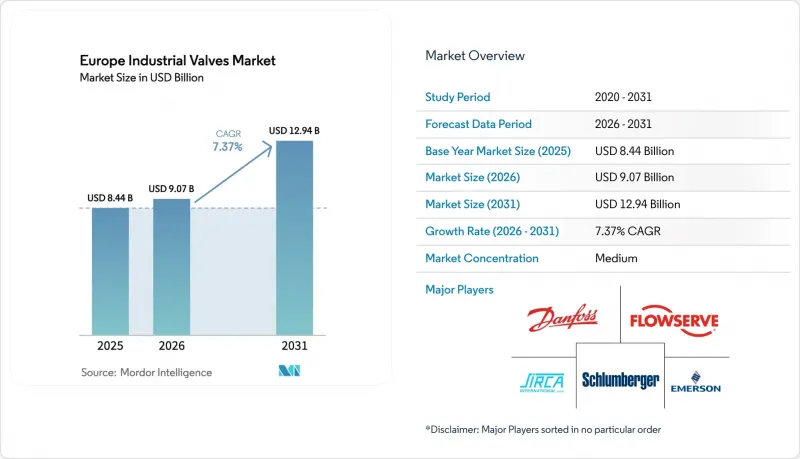
預計到 2026 年,歐洲工業閥門市場規模將達到 90.7 億美元,到 2031 年將擴大到 129.4 億美元,預測期內複合年成長率為 7.37%。
本報告按閥門類型(截止閥、球閥、蝶閥、閘閥等)、操作技術(手動、氣壓、氣動、液壓、電液控制)、材質(碳鋼、不銹鋼等)、終端用戶行業(石油天然氣、電力能源、化工石化、用水和污水等)和國家/地區進行細分。市場預測以美元(USD)計價。
歐洲工業閥門市場的趨勢與洞察
2026年起,氫能和碳捕獲、利用與封存(CCUS)專案管道擴建計劃
根據IPCEI Hy2Infra計劃,32個指定的氫能基礎設施項目將獲得52億歐元(58.8億美元)的國家補貼,預計到2030年將產生約12萬個能夠處理100巴氫氣壓力的閥門需求。德國的H2Global競標和歐盟的工業碳管理策略增加了對低溫和超臨界二氧化碳的設計要求。目前,只有六家歐洲製造商獲得了符合這些規範的認證。漢堡和威廉港的進口碼頭已經指定使用能夠承受-33 度C低溫的球閥,跨境二氧化碳管路則需要使用耐碳酸腐蝕的彈性體密封節流閥。在無人值守的壓縮站,具有故障安全功能的彈簧復位式電液執行器是首選,其在歐洲工業閥門市場的應用正在加速。
洩漏檢測和洩漏排放的強制性標準
EN ISO 15848-1 標準於 2024 年 1 月生效,強制要求煉油廠和化工廠在 2027 年前更換或維修約 40 萬個老舊閥門。透過 Flowserve 的 RedRaven 平台實施的即時聲學監測,可在排放量超過 10 ppm 限值之前向操作人員發出警報,幫助他們避免每次違規最高 50 萬歐元(56.5 萬美元)的罰款。供應商正積極回應,提供動態負載填料和波紋管密封閥蓋,雖然這些產品會使初始成本增加 15-25%,但可顯著降低整個生命週期的人事費用。尤其是在德國和法國,合規的緊迫性正在推動整個歐洲工業閥門市場對認證設計的需求。
由於本地化法規,EPC專案前置作業時間延長。
根據《基本原料法》,到2030年,鎳、鉻和鉬的40%必須在國內加工,這迫使製造商在人事費用和能源成本不斷上漲的情況下將鑄造廠遷回國內。儘管福斯公司在埃森投資4500萬歐元擴建工廠提高了產能,但不銹鋼和鎳合金閥門的交貨週期已延長至38週。歐盟森林砍伐法規下的可追溯性要求增加了行政成本,使歐洲工業閥門市場的中小型供應商處境艱難。
細分市場分析
隨著營運商為符合EN ISO 15848-1標準而增加被動式止回閥功能,預計到2031年,止回閥市場將以7.88%的複合年成長率成長。截至2025年,球閥仍維持34.73%的市場佔有率,這主要得益於直角回轉。閘閥在大口徑水管網中佔據主導地位,但其緩慢的運行速度限制了自動化應用。蝶閥因其低矮的對夾式外形而備受區域供熱系統的青睞。另一方面,截止閥由於其較高的壓力降可以透過精確調節來補償,因此仍廣泛應用於流量控制領域。被動式雙板止回閥的關閉速度比旋啟式止回閥更快,能夠有效抑制離岸風力發電冷卻迴路中的水錘現象。
球閥的優勢在於其與電動和電液執行器的兼容性,這在氫氣和海底應用中至關重要。新型金屬閥座球閥可承受超過10,000次氫脆循環。蝶閥受益於高溫彈性體,可在150 度C的熱水迴路中延長使用壽命。閘閥面臨許多挑戰,現有系統中的更換成本仍然高昂,儘管目前正在改進閥座公差以抑制專用安全閥中的氫氣洩漏。
預計電液執行器將以7.93%的複合年成長率成長,其故障安全彈簧復位功能和高扭力密度在離岸風力發電、核能和氫氣壓縮等領域備受青睞。預計到2025年,電動執行器將佔據39.74%的市場佔有率,其需求成長主要得益於與數位定位器的整合以及預測演算法的應用。在安裝防爆設備成本過高的危險區域,手動操作仍然被採用;而氣動裝置則繼續用於擁有傳統空氣基礎設施的工廠,但其長期能源效率面臨挑戰。
Rotork 的 IQ3 電液設計無需集中式液壓迴路,可將浮體式平台的上部結構重量減輕 30%。 Auma 的最新電動系列產品將每公斤扭力提高了 40%,並可直接驅動大型蝶閥。弗勞恩霍夫研究所的研究表明,從氣動執行器轉向電動執行器可減少 8-12% 的輔助功率,從而加速歐洲工業閥門行業的維修。
其他好處:
- Excel格式的市場預測(ME)表
- 3個月的分析師支持
目錄
第1章:引言
- 研究假設和市場定義
- 調查範圍
第2章:調查方法
第3章執行摘要
第4章 市場狀況
- 市場概覽
- 市場促進因素
- 自2026年起,氫能和碳捕獲、利用與封存(CCUS)計畫儲備將進一步擴大。
- 洩漏檢測和空氣排放的強制性標準(EN ISO 15848-1)
- 棕地流體控制設備數位化維修計劃
- 離岸風力發電周邊設備閥門需求激增
- 歐洲石化產業資本投資復甦(2027-2030 年)
- 中歐、東歐和北歐的集中供熱維修正在不斷擴大。
- 市場限制因素
- 供應鏈本地化法規導致EPC(工程、採購和施工)的前置作業時間延長。
- 歐洲技術純熟勞工短缺
- 鎳及特殊合金價格波動
- 對終端用戶嚴格的網路安全合規要求正在減緩智慧閥門的普及。
- 產業價值鏈分析
- 監理情勢
- 技術展望
- 波特五力分析
第5章 市場規模與成長預測
- 按閥門類型
- Globe
- 球
- 蝴蝶
- 門
- 插頭
- 停止
- 安全/救援
- 其他閥門類型
- 透過驅動技術
- 手動的
- 電的
- 氣壓
- 油壓
- 電液
- 材料
- 碳鋼
- 不銹鋼
- 合金和低溫合金
- 鑄鐵和球墨鑄鐵
- 按最終用戶行業分類
- 石油和天然氣
- 電力和能源(包括核能和可再生能源的配套設施)
- 化工/石油化工
- 供水和污水處理
- 食品/飲料
- 紙漿和造紙
- 其他終端用戶產業
- 國家
- 德國
- 英國
- 法國
- 義大利
- 西班牙
- 其他歐洲國家
第6章 競爭情勢
- 市場集中度
- 策略趨勢
- 市佔率分析
- 公司簡介
- Emerson Electric Co.
- Flowserve Corporation
- Schlumberger Ltd.
- Danfoss A/S
- Pentair plc
- Bray International, Inc.
- Alfa Laval AB
- Crane Company
- Eaton Corporation plc
- KITZ Corporation
- The Weir Group PLC
- Velan Inc.
- Metso Oyj
- Sirca International
- Spirax-Sarco Engineering plc
- SAMSON AG
- SMC Corporation
- Parker-Hannifin Corporation
- Leser GmbH and Co. KG
- Bohmer GmbH
- AVK Holding A/S
- AKO Armaturen and Separationstechnik GmbH
- KLINGER Fluid Control GmbH
- ITT Inc.
- Ari-Armaturen Albert Richter GmbH and Co. KG
第7章 市場機會與未來展望
According to Mordor Intelligence, the Europe industrial valves market size reached USD 9.07 billion in 2026 and is projected to expand to USD 12.94 billion by 2031, translating into a 7.37% CAGR over the forecast period.
This report is Segmented by Valve Type (Globe, Ball, Butterfly, Gate, and More), Actuation Technology (Manual, Electric, Pneumatic, Hydraulic, and Electro-Hydraulic), Material (Carbon Steel, Stainless Steel, and More), End-User Industry (Oil and Gas, Power and Energy, Chemicals and Petrochemicals, Water and Waste-Water, and More), and Country. The Market Forecasts are Provided in Terms of Value (USD).
Europe Industrial Valves Market Trends and Insights
Expanding Hydrogen and CCUS Project Pipeline Post-2026
Thirty-two hydrogen infrastructure projects designated under the IPCEI Hy2Infra scheme unlock EUR 5.2 billion (USD 5.88 billion) in state aid, creating demand for roughly 120,000 valves rated to 100 bar hydrogen service by 2030. Germany's H2Global auctions and the EU Industrial Carbon Management Strategy add parallel requirements for cryogenic and supercritical-carbon-dioxide designs, specifications currently certified by only six European manufacturers. Import terminals in Hamburg and Wilhelmshaven already specify minus 33 °C ball valves, and cross-border CO2 pipelines now call for elastomer-sealed throttling valves resistant to carbonic-acid corrosion. Electro-hydraulic actuators with fail-safe spring return are favored for unmanned compression stations, accelerating adoption across the Europe industrial valves market.
Mandatory Leak-Detection and Fugitive-Emission Norms
EN ISO 15848-1 became enforceable in January 2024, compelling refineries and chemical plants to replace or retrofit roughly 400,000 legacy valves by 2027. Real-time acoustic monitoring, as deployed via Flowserve's RedRaven platform, alerts operators before emissions exceed 10 ppm limits, helping avoid fines of up to EUR 500,000 (USD 565,000) per incident. Suppliers have responded with live-loaded packing and bellows-sealed bonnets that add 15-25% to initial costs but slash lifetime labor. Compliance urgency, especially in Germany and France, is pushing demand for certified designs across the Europe industrial valves market.
Extended EPC Lead-Times from Localization Rules
The Critical Raw Materials Act obliges 40% domestic processing of nickel, chromium, and molybdenum by 2030, prompting manufacturers to re-shore foundries at higher labor and energy costs. Flowserve's EUR 45 million Essen expansion adds capacity but lengthens delivery cycles to 38 weeks for stainless and nickel-alloy valves. Traceability under the EU Deforestation Regulation inflates administrative overhead, squeezing smaller suppliers in the Europe industrial valves market.
Other drivers and restraints analyzed in the detailed report include:
- Digital Retrofit Programs for Brown-Field Assets
- Offshore Wind Balance-of-Plant Valve Demand
- Skilled Valve-Maintenance Labor Shortage
For complete list of drivers and restraints, kindly check the Table Of Contents.
Segment Analysis
Check valves are projected to rise at a 7.88% CAGR through 2031 as operators add passive back-flow prevention to meet EN ISO 15848-1 standards. Ball valves retained 34.73% share in 2025, supported by quarter-turn simplicity in natural-gas and chemical services. Gate valves dominate large-bore water networks, though slow actuation dampens automation prospects. Butterfly valves are preferred for district heating owing to slim wafer profiles, while globe valves continue in throttling duties where precise modulation offsets higher pressure drop. Passive dual-plate designs, closing faster than swing checks, curb water hammer in offshore wind cooling loops.
Ball-valve dominance is reinforced by compatibility with electric and electro-hydraulic actuators, crucial for hydrogen and subsea applications. Recent metal-seated models resist hydrogen embrittlement over 10,000 cycles. Butterfly valves benefit from high-temperature elastomers that boost service life in 150 °C hot-water loops. Gate valves face headwinds except in legacy systems where replacement costs remain prohibitive, whereas specialty safety valves undergo seat-tolerance upgrades to curb hydrogen leakage.
Electro-hydraulic actuators will post a 7.93% CAGR, favored for fail-safe spring return and high torque density in offshore wind, nuclear, and hydrogen compression. Electric actuation, with 39.74% share in 2025, thrives on digital positioner integration and predictive algorithms. Manual operation lingers in hazardous zones where explosion-proof gear is cost-prohibitive, while pneumatic units remain in plants with legacy air infrastructure but face long-term energy-efficiency headwinds.
Rotork's IQ3 electro-hydraulic design eliminates centralized hydraulic circuits, trimming topside weight 30% on floating platforms. Auma's latest electric series delivers 40% more torque per kilogram, enabling direct drive of large butterfly valves. Fraunhofer research indicates shifting from pneumatic to electric actuators can cut auxiliary power by 8-12%, speeding retrofits across the Europe industrial valves industry.
Complete Report Scope:
- By Valve Type
- Globe
- Ball
- Butterfly
- Gate
- Plug
- Check
- Safety / Relief
- Other Valve Types
- By Actuation Technology
- Manual
- Electric
- Pneumatic
- Hydraulic
- Electro-hydraulic
- By Material
- Carbon Steel
- Stainless Steel
- Alloy and Cryogenic Alloys
- Cast Iron and Ductile Iron
- By End-user Industry
- Oil and Gas
- Power and Energy (incl. Nuclear and Renewables BOP)
- Chemicals and Petrochemicals
- Water and Waste-water
- Food and Beverage
- Pulp and Paper
- Other End-user Industries
- By Country
- Germany
- United Kingdom
- France
- Italy
- Spain
- Rest of Europe
List of Companies Covered in this Report:
- Emerson Electric Co.
- Flowserve Corporation
- Schlumberger Ltd.
- Danfoss A/S
- Pentair plc
- Bray International, Inc.
- Alfa Laval AB
- Crane Company
- Eaton Corporation plc
- KITZ Corporation
- The Weir Group PLC
- Velan Inc.
- Metso Oyj
- Sirca International
- Spirax-Sarco Engineering plc
- SAMSON AG
- SMC Corporation
- Parker-Hannifin Corporation
- Leser GmbH and Co. KG
- Bohmer GmbH
- AVK Holding A/S
- AKO Armaturen and Separationstechnik GmbH
- KLINGER Fluid Control GmbH
- ITT Inc.
- Ari-Armaturen Albert Richter GmbH and Co. KG
Additional Benefits:
- The market estimate (ME) sheet in Excel format
- 3 months of analyst support
TABLE OF CONTENTS
1 INTRODUCTION
- 1.1 Study Assumptions and Market Definition
- 1.2 Scope of the Study
2 RESEARCH METHODOLOGY
3 EXECUTIVE SUMMARY
4 MARKET LANDSCAPE
- 4.1 Market Overview
- 4.2 Market Drivers
- 4.2.1 Expanding Hydrogen and CCUS Project Pipeline Post-2026
- 4.2.2 Mandatory Leak-Detection and Fugitive-Emission Norms (EN ISO 15848-1)
- 4.2.3 Digital Retrofit Programs for Brown-Field Flow Control Assets
- 4.2.4 Offshore Wind Balance-of-Plant Valve Demand Surge
- 4.2.5 Revival of European Petrochemical CAPEX (2027-2030)
- 4.2.6 Rising District-Heating Upgrades in CEE and Nordics
- 4.3 Market Restraints
- 4.3.1 Extended EPC Lead-Times Owing to Supply-Chain Localization Rules
- 4.3.2 Skilled Valve-Maintenance Labor Shortage in Europe
- 4.3.3 Price Volatility in Nickel and Special Alloys
- 4.3.4 Stringent End-User Cybersecurity Compliance Delaying Smart-Valve Rollouts
- 4.4 Indusy Value Chain Analysis
- 4.5 Regulatory Landscape
- 4.6 Technological Outlook
- 4.7 Porter's Five Forces Analysis
- 4.7.1 Bargaining Power of Buyers
- 4.7.2 Bargaining Power of Suppliers
- 4.7.3 Threat of New Entrants
- 4.7.4 Threat of Substitute Products
- 4.7.5 Intensity of Competitive Rivalry
5 MARKET SIZE AND GROWTH FORECASTS (VALUE)
- 5.1 By Valve Type
- 5.1.1 Globe
- 5.1.2 Ball
- 5.1.3 Butterfly
- 5.1.4 Gate
- 5.1.5 Plug
- 5.1.6 Check
- 5.1.7 Safety / Relief
- 5.1.8 Other Valve Types
- 5.2 By Actuation Technology
- 5.2.1 Manual
- 5.2.2 Electric
- 5.2.3 Pneumatic
- 5.2.4 Hydraulic
- 5.2.5 Electro-hydraulic
- 5.3 By Material
- 5.3.1 Carbon Steel
- 5.3.2 Stainless Steel
- 5.3.3 Alloy and Cryogenic Alloys
- 5.3.4 Cast Iron and Ductile Iron
- 5.4 By End-user Industry
- 5.4.1 Oil and Gas
- 5.4.2 Power and Energy (incl. Nuclear and Renewables BOP)
- 5.4.3 Chemicals and Petrochemicals
- 5.4.4 Water and Waste-water
- 5.4.5 Food and Beverage
- 5.4.6 Pulp and Paper
- 5.4.7 Other End-user Industries
- 5.5 By Country
- 5.5.1 Germany
- 5.5.2 United Kingdom
- 5.5.3 France
- 5.5.4 Italy
- 5.5.5 Spain
- 5.5.6 Rest of Europe
6 COMPETITIVE LANDSCAPE
- 6.1 Market Concentration
- 6.2 Strategic Moves
- 6.3 Market Share Analysis
- 6.4 Company Profiles (includes Global-level Overview, Market-level Overview, Core Segments, Financials, Strategic Information, Market Rank/Share, Products and Services, Recent Developments)
- 6.4.1 Emerson Electric Co.
- 6.4.2 Flowserve Corporation
- 6.4.3 Schlumberger Ltd.
- 6.4.4 Danfoss A/S
- 6.4.5 Pentair plc
- 6.4.6 Bray International, Inc.
- 6.4.7 Alfa Laval AB
- 6.4.8 Crane Company
- 6.4.9 Eaton Corporation plc
- 6.4.10 KITZ Corporation
- 6.4.11 The Weir Group PLC
- 6.4.12 Velan Inc.
- 6.4.13 Metso Oyj
- 6.4.14 Sirca International
- 6.4.15 Spirax-Sarco Engineering plc
- 6.4.16 SAMSON AG
- 6.4.17 SMC Corporation
- 6.4.18 Parker-Hannifin Corporation
- 6.4.19 Leser GmbH and Co. KG
- 6.4.20 Bohmer GmbH
- 6.4.21 AVK Holding A/S
- 6.4.22 AKO Armaturen and Separationstechnik GmbH
- 6.4.23 KLINGER Fluid Control GmbH
- 6.4.24 ITT Inc.
- 6.4.25 Ari-Armaturen Albert Richter GmbH and Co. KG
7 MARKET OPPORTUNITIES AND FUTURE OUTLOOK
- 7.1 White-space and Unmet-need Assessment

 印度工業閥門:市場佔有率分析、產業趨勢與統計及成長預測(2026-2031)化工閥門:市場佔有率分析、產業趨勢與統計、成長預測(2026-2031)工業閥門:市場佔有率分析、產業趨勢與統計、成長預測(2026-2031)
 工業閥門市場:依產品類型、材料、尺寸、驅動方式、最終用途產業和銷售管道-全球預測,2026-2032年
 全球工業閥門市場(至 2032 年):依閥門類型(截止閥、球閥、蝶閥、電磁閥、旋塞閥、彈簧閥、儲槽排氣閥、夾管閥、閘閥、隔膜閥、先導閥、止回閥、安全閥、針閥、洩壓閥)、尺寸(小於 1 英吋、先導閥、止回閥、安全閥、針閥、洩壓閥)、尺寸(小於 1 英吋、1-6 英吋、25 英吋大於英吋)和介質(液體、氣體、漿料)分類石油和天然氣行業閥門:市場佔有率分析、行業趨勢和統計數據以及成長預測(2026-2031 年)
 工業閥門市場分析及預測(至2035年):類型、產品類型、技術、應用、材質、製程、最終用戶、功能、安裝配置、解決方案
 工業閥門市場規模及預測(2021-2034),全球及區域佔有率、趨勢和成長機會分析報告:按類型、尺寸、等級和行業分類
 工業閥門市場規模、佔有率、趨勢和預測:按產品類型、功能、材質、尺寸、最終用途行業和地區分類(2026-2034 年)拍擊閥市場:材質、尺寸、壓力等級、驅動方式、應用及通路分類-2026-2032年全球市場預測