


 |
市場調查報告書
商品編碼
2125304
歐洲IP電話和UCaaS:市場佔有率分析、行業趨勢和統計數據以及成長預測(2026-2031年)Europe IP Telephony And Unified Communications As-a-service - Market Share Analysis, Industry Trends & Statistics, Growth Forecasts (2026 - 2031) |
||||||

※ 本網頁內容可能與最新版本有所差異。詳細情況請與我們聯繫。
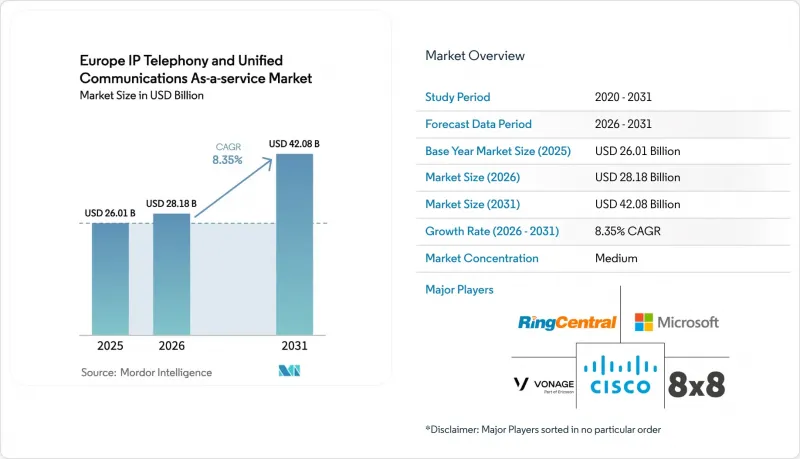
據 Mordor Intelligence 稱,歐洲IP電話和 UCaaS 市場預計到 2026 年價值 281.8 億美元,高於 2025 年的 260.1 億美元,預計到 2031 年將達到 420.8 億美元。
預計 2026 年至 2031 年的複合年成長率為 8.35%。
本報告按解決方案(硬體和軟體)、類型(整合存取 - SIP 中繼、託管 IP PBX、雲端呼叫控制、CPaaS)、組織規模(大型企業和中小企業)、最終用戶(醫療保健、零售、IT 和電信、政府、製造業及其他行業)以及地區進行細分。市場預測以美元計價。
歐洲IP電話和UCaaS市場的趨勢和洞察
5G部署的加速將使低延遲統一通訊即服務(UCaaS)成為可能。
目前,德國和英國的大部分都會區已覆蓋獨立組網的5G網路,為企業提供低於10毫秒的穩定延遲,與電路交換語音通訊相當。營運商正透過網路功能虛擬化(NFV)將語音處理功能部署在網路邊緣,從而減少對集中式資料中心的依賴,並提升客服中心環境下的通話品質。這種架構的優點在於能夠支援即時功能,例如語言翻譯和人工智慧驅動的通話分析。這項轉變正在加速從傳統PBX系統向5G網路的遷移,使歐洲營運商在對延遲敏感的工作負載方面與全球超大規模資料中心業者營運商形成差異化競爭。
歐洲向混合辦公模式過渡
在法國和荷蘭,疫情後的勞動法規已將彈性工作安排合法化,鞏固了對行動優先協作套件的長期需求。北歐國家的雇主表示,在以雲端工具取代傳統硬體PBX系統後,員工滿意度有所提高,這進一步推動了狀態顯示、通訊和視訊功能的應用。對工作與生活平衡的關注正在推動人工智慧會議摘要的普及,以減少下班後的溝通。公共部門機構正在遵循歐盟委員會的數位化工作場所指南,確保了政府機構的穩定需求。
跨國數據主權監管碎片化
儘管已有GDPR,法國、義大利和德國仍各自維護一套獨立的在地化框架,這要求統一通訊即服務(UCaaS)供應商建構重複的基礎設施。這增加了合規成本,也使跨歐洲部署變得更加複雜。跨國公司必須追蹤流向各個司法管轄區的流量,並維護獨立的災害復原區域,從而限制了規模經濟效益。雖然提案的「資料管治法」旨在實現監管協調,但預計要到2027年才能實施,這使得未來的平台架構充滿不不確定性。
細分市場分析
到2025年,軟體解決方案將佔據歐洲IP電話和統一通訊即服務(UCaaS)市場61.45%的佔有率,這主要得益於市場對可擴展、雲端原生平台的需求,這些平台能夠整合到現有工作流程中。預計到2031年,該類別將以10.03%的複合年成長率成長,因為企業越來越傾向於使用API編配而非硬體升級。呼叫控制和PBX軟體直接受益於IP緊急服務的強制性法規,而統一通訊和團隊合作工具則順應了混合辦公模式的趨勢。供應商正在整合以人工智慧為基礎的轉錄和情感分析功能,在無需額外硬體的情況下提升產品價值。
在國防和公共產業等需要認證安全性的實體終端的行業,硬體仍然至關重要。在需要觸覺介面和穩定服務品質的交易大廳,IP桌上型電話仍然被廣泛使用。隨著ISDN的逐步淘汰,VoIP閘道器正在推動過渡,但隨著光纖在區域樞紐的普及,其重要性正在下降。視訊終端正轉向軟體定義會議室,但在通訊品質至關重要的場合,確保通訊品質仍然是重中之重。整體而言,硬體的成長落後於軟體的成長,但它仍然是確保合規性的保障。
到2025年,託管式IP-PBX將佔總營收的41.92%,在以雲端解決方案直接取代本地舊有系統發揮關鍵作用。這種模式將熟悉的PBX功能與雲端的擴充性,使符合緊急呼叫標準變得更加容易。整合SIP中繼仍然是一項核心服務,但其市場佔有率正被包含視訊和通訊的綜合性UCaaS套件蠶食。
儘管規模較小,但CPaaS(通訊平台即服務)是成長最快的類型,預計到2031年複合年成長率將達到8.58%。開發人員正在利用CPaaS API將語音和視訊功能整合到客戶應用程式中,從而無需獨立介面,並促進了垂直領域的創新。託管式IP-PBX對那些希望外包營運任務但又希望保留現場管理以處理敏感工作流程的公司來說極具吸引力。雲端呼叫控制透過將訊號與硬體分離,提供了一種折衷方案,使公司能夠有效地利用其現有投資。這些類型體現了向「可程式設計通訊」正是支撐數位轉型的基礎。
其他好處:
- Excel格式的市場預測(ME)表
- 3個月的分析師支持
目錄
第1章:引言
- 研究假設和市場定義
- 調查範圍
第2章:調查方法
第3章執行摘要
第4章 市場狀況
- 市場概覽
- 市場促進因素
- 5G部署的加速將使低延遲統一通訊即服務(UCaaS)成為可能。
- 歐洲各地向混合辦公政策過渡
- 從ISDN到全IP網路的快速過渡
- 中小企業對能夠降低營運成本的訂閱模式的需求日益成長。
- 與行業特定的SaaS工作流程整合
- 將邊緣運算引入即時語音處理
- 市場限制因素
- 關於跨國資料主權碎片化問題的法規
- 擴大針對雲端電話服務的網路攻擊範圍
- 對供應商鎖定問題的擔憂阻礙了長期合約的簽訂。
- SIP/VoIP網路管理技能差距
- 產業生態系分析
- 監理情勢
- 技術展望
- 宏觀經濟因素的影響
- 波特五力分析
第5章 市場規模與成長預測
- 透過解決方案
- 硬體
- IP桌上型電話
- VoIP閘道器
- 視訊會議終端
- 其他硬體
- 軟體
- 呼叫控制和PBX軟體
- 統一通訊
- 團隊合作平台
- 客服中心應用程式
- 其他軟體
- 硬體
- 按類型
- 整合式存取 - SIP 中繼
- 託管型 IP PBX
- 託管式 IP PBX
- 雲端呼叫控制
- CPaaS
- 按組織規模
- 大公司
- 小型企業
- 最終用戶
- 銀行業、金融服務業及保險業
- 衛生保健
- 零售與電子商務
- 資訊科技/通訊
- 政府/公共部門
- 製造業和工業
- 教育
- 飯店業
- 其他最終用戶
- 按地區
- 英國
- 德國
- 法國
- 義大利
- 西班牙
- 荷蘭
- 其他歐洲國家
第6章 競爭情勢
- 市場集中度
- 策略趨勢
- 市佔率分析
- 公司簡介
- Microsoft Corporation
- Cisco Systems Inc.
- RingCentral Inc.
- 8x8 Inc.
- Vonage Holdings Corp.
- Zoom Video Communications Inc.
- Avaya Holdings Corp.
- Mitel Networks Corporation
- Alcatel-Lucent Enterprise International SAS
- Unify Software and Solutions GmbH and Co. KG
- Wildix Srl
- NFON AG
- Vodafone Group Plc
- BT Group plc
- Orange Business Services SA
- Telefonica SA
- Intermedia Cloud Communications Inc.
- Freshworks Inc.
- Dialpad Inc.
- Ooma Inc.
- Grandstream Networks Inc.
- Ascom Holding AG
- NEC Corporation
- Panasonic Corporation
- Ziff Davis Inc.
第7章 市場機會與未來展望
According to Mordor Intelligence, the Europe IP telephony and Unified Communications As-A-Service market size in 2026 is estimated at USD 28.18 billion, growing from 2025 value of USD 26.01 billion with 2031 projections showing USD 42.08 billion, growing at 8.35% CAGR over 2026-2031.
This report is Segmented by Solution (Hardware, and Software), Type (Integrated Access - SIP Trunking, Managed IP PBX, Hosted IP PBX, Cloud Call Control, Cpaas), Organization Size (Large Enterprises, and SMEs), End User (Healthcare, Retail, IT and Telecom, Government, Manufacturing, and More), and Geography. Market Forecasts are Provided in Terms of Value (USD).
Europe IP Telephony And Unified Communications As-a-service Market Trends and Insights
Accelerated 5G Rollouts Enabling Low-Latency UCaaS
Standalone 5G coverage now blankets most metropolitan areas in Germany and the UK, giving enterprises consistent sub-10 millisecond latency that rivals circuit-switched voice. Operators have placed voice processing functions at the network edge through Network Function Virtualization (NFV), which reduces dependence on centralized data centers and improves call quality in contact center scenarios. These architecture gains support real-time capabilities such as language translation and AI call analytics. The shift differentiates European providers from global hyperscalers in terms of latency-sensitive workloads and accelerates the migration from legacy PBX systems.
Shift Toward Hybrid Work Policies Across Europe
Post-pandemic labor regulations in France and the Netherlands now codify flexible work rights, cementing long-term demand for mobile-first collaboration suites. Nordic employers report high employee satisfaction when cloud tools replace traditional hardware PBX systems, leading to broader rollouts of presence, messaging, and video functions. A policy emphasis on work-life balance drives the uptake of AI-powered meeting summaries that limit after-hours interactions. Public-sector agencies follow the European Commission's own digital workplace guidelines, ensuring steady demand from government accounts.
Fragmented Cross-Border Data-Sovereignty Regulations
Despite the GDPR, France, Italy, and Germany maintain parallel localization frameworks that require UCaaS vendors to duplicate infrastructure, thereby increasing compliance costs and complicating pan-European rollouts. Multinational firms must map traffic flows to each jurisdiction and maintain separate disaster recovery zones, limiting economies of scale. The proposed Data Governance Act aims for harmonization, yet enforcement is not expected to be implemented until 2027, leaving uncertainty over future platform architecture.
Other drivers and restraints analyzed in the detailed report include:
- Rapid Migration From ISDN to All-IP Networks
- Growing SMB Demand For OpEx-Friendly Subscription Models
- Heightened Cyber-Attack Surface in Cloud Telephony
For complete list of drivers and restraints, kindly check the Table Of Contents.
Segment Analysis
Software solutions held 61.45% of the Europe IP Telephony and Unified Communications As-A-Service market share in 2025 due to demand for scalable cloud-native platforms that embed into existing workflows. The category is projected to post a 10.03% CAGR to 2031 as enterprises favor API orchestration over hardware refresh cycles. Call control and PBX software benefit directly from IP emergency service mandates, while unified messaging and team collaboration tools ride the wave of established hybrid work practices. Vendors integrate AI-based transcription and sentiment analytics, boosting value without additional hardware.
Hardware remains essential for sectors that need physical endpoints with certified security, including defense and utilities. IP desk phones continue to serve trading floors that require tactile interfaces and a fixed quality of service. VoIP gateways ease transitional scenarios during the ISDN phase-out, although their relevance declines as fiber reaches regional hubs. Video endpoints are pivoting toward software-defined meeting rooms, but continue to prioritize where guaranteed optics matter. Overall, hardware growth lags behind software, yet it acts as a compliance safeguard.
Hosted IP PBX contributed 41.92% of 2025 revenue, reflecting its role as a direct cloud replacement for on-premises legacy systems. The model delivers familiar PBX features with cloud scalability, easing compliance with emergency calling standards. Integrated SIP trunking remains a backbone service but loses market share to comprehensive UCaaS suites that include video and messaging.
Communication Platform as a Service (CPaaS), although smaller, is the fastest-growing type, with an 8.58% CAGR through 2031. Developers utilize CPaaS APIs to integrate voice and video capabilities into customer applications, thereby eliminating the need for standalone interfaces and promoting vertical innovation. Managed IP PBX appeals to enterprises that want operational outsourcing but still retain on-site control for sensitive workflows. Cloud call control offers a middle path by decoupling signaling from hardware, allowing firms to preserve their sunk investments. Together, these types illustrate a migration continuum toward programmable communications that underpin digital transformation.
Complete Report Scope:
- By Solution
- Hardware
- IP Desk Phones
- VoIP Gateways
- Video Conferencing Endpoints
- Other Hardwares
- Software
- Call Control and PBX Software
- Unified Messaging
- Team Collaboration Platforms
- Contact Center Applications
- Other Softwares
- Hardware
- By Type
- Integrated Access - SIP Trunking
- Managed IP PBX
- Hosted IP PBX
- Cloud Call Control
- Communication Platform as a Service (CPaaS)
- By Organization Size
- Large Enterprises
- Small and Medium Enterprises
- By End User
- Banking, Financial Services and Insurance
- Healthcare
- Retail and E-Commerce
- Information Technology and Telecom
- Government and Public Sector
- Manufacturing and Industrial
- Education
- Hospitality
- Other End Users
- By Geography
- United Kingdom
- Germany
- France
- Italy
- Spain
- Netherlands
- Rest of Europe
List of Companies Covered in this Report:
- Microsoft Corporation
- Cisco Systems Inc.
- RingCentral Inc.
- 8x8 Inc.
- Vonage Holdings Corp.
- Zoom Video Communications Inc.
- Avaya Holdings Corp.
- Mitel Networks Corporation
- Alcatel-Lucent Enterprise International SAS
- Unify Software and Solutions GmbH and Co. KG
- Wildix Srl
- NFON AG
- Vodafone Group Plc
- BT Group plc
- Orange Business Services SA
- Telefonica SA
- Intermedia Cloud Communications Inc.
- Freshworks Inc.
- Dialpad Inc.
- Ooma Inc.
- Grandstream Networks Inc.
- Ascom Holding AG
- NEC Corporation
- Panasonic Corporation
- Ziff Davis Inc.
Additional Benefits:
- The market estimate (ME) sheet in Excel format
- 3 months of analyst support
TABLE OF CONTENTS
1 INTRODUCTION
- 1.1 Study Assumptions and Market Definition
- 1.2 Scope of the Study
2 RESEARCH METHODOLOGY
3 EXECUTIVE SUMMARY
4 MARKET LANDSCAPE
- 4.1 Market Overview
- 4.2 Market Drivers
- 4.2.1 Accelerated 5G Rollouts Enabling Low-Latency UCaaS
- 4.2.2 Shift Toward Hybrid Work Policies Across Europe
- 4.2.3 Rapid Migration From ISDN to All-IP Networks
- 4.2.4 Growing SMB Demand For OpEx-Friendly Subscription Models
- 4.2.5 Integration With Vertical-Specific SaaS Workflows
- 4.2.6 Edge Computing Adoption For Real-Time Voice Processing
- 4.3 Market Restraints
- 4.3.1 Fragmented Cross-Border Data-Sovereignty Regulations
- 4.3.2 Heightened Cyber-attack Surface In Cloud Telephony
- 4.3.3 Vendor Lock-In Concerns Hindering Long-Term Contracts
- 4.3.4 Skills Gap In SIP and VoIP Network Management
- 4.4 Industry Ecosystem Analysis
- 4.5 Regulatory Landscape
- 4.6 Technological Outlook
- 4.7 Impact of Macroeconomic Factors
- 4.8 Porter's Five Forces Analysis
- 4.8.1 Bargaining Power of Suppliers
- 4.8.2 Bargaining Power of Buyers
- 4.8.3 Threat of New Entrants
- 4.8.4 Threat of Substitute Products
- 4.8.5 Intensity of Competitive Rivalry
5 MARKET SIZE AND GROWTH FORECASTS (VALUE)
- 5.1 By Solution
- 5.1.1 Hardware
- 5.1.1.1 IP Desk Phones
- 5.1.1.2 VoIP Gateways
- 5.1.1.3 Video Conferencing Endpoints
- 5.1.1.4 Other Hardwares
- 5.1.2 Software
- 5.1.2.1 Call Control and PBX Software
- 5.1.2.2 Unified Messaging
- 5.1.2.3 Team Collaboration Platforms
- 5.1.2.4 Contact Center Applications
- 5.1.2.5 Other Softwares
- 5.1.1 Hardware
- 5.2 By Type
- 5.2.1 Integrated Access - SIP Trunking
- 5.2.2 Managed IP PBX
- 5.2.3 Hosted IP PBX
- 5.2.4 Cloud Call Control
- 5.2.5 Communication Platform as a Service (CPaaS)
- 5.3 By Organization Size
- 5.3.1 Large Enterprises
- 5.3.2 Small and Medium Enterprises
- 5.4 By End User
- 5.4.1 Banking, Financial Services and Insurance
- 5.4.2 Healthcare
- 5.4.3 Retail and E-Commerce
- 5.4.4 Information Technology and Telecom
- 5.4.5 Government and Public Sector
- 5.4.6 Manufacturing and Industrial
- 5.4.7 Education
- 5.4.8 Hospitality
- 5.4.9 Other End Users
- 5.5 By Geography
- 5.5.1 United Kingdom
- 5.5.2 Germany
- 5.5.3 France
- 5.5.4 Italy
- 5.5.5 Spain
- 5.5.6 Netherlands
- 5.5.7 Rest of Europe
6 COMPETITIVE LANDSCAPE
- 6.1 Market Concentration
- 6.2 Strategic Moves
- 6.3 Market Share Analysis
- 6.4 Company Profiles (includes Global level Overview, Market level overview, Core Segments, Financials as available, Strategic Information, Market Rank/Share for key companies, Products and Services, and Recent Developments)
- 6.4.1 Microsoft Corporation
- 6.4.2 Cisco Systems Inc.
- 6.4.3 RingCentral Inc.
- 6.4.4 8x8 Inc.
- 6.4.5 Vonage Holdings Corp.
- 6.4.6 Zoom Video Communications Inc.
- 6.4.7 Avaya Holdings Corp.
- 6.4.8 Mitel Networks Corporation
- 6.4.9 Alcatel-Lucent Enterprise International SAS
- 6.4.10 Unify Software and Solutions GmbH and Co. KG
- 6.4.11 Wildix Srl
- 6.4.12 NFON AG
- 6.4.13 Vodafone Group Plc
- 6.4.14 BT Group plc
- 6.4.15 Orange Business Services SA
- 6.4.16 Telefonica SA
- 6.4.17 Intermedia Cloud Communications Inc.
- 6.4.18 Freshworks Inc.
- 6.4.19 Dialpad Inc.
- 6.4.20 Ooma Inc.
- 6.4.21 Grandstream Networks Inc.
- 6.4.22 Ascom Holding AG
- 6.4.23 NEC Corporation
- 6.4.24 Panasonic Corporation
- 6.4.25 Ziff Davis Inc.
7 MARKET OPPORTUNITIES AND FUTURE OUTLOOK
- 7.1 White-Space and Unmet-Need Assessment

 銀行業 uCaaS:市佔率分析、產業趨勢與統計及成長預測(2026-2031 年)
 整合通訊即服務 (UCaaS) 市場規模、佔有率和趨勢分析報告:按部署類型、產業、地區和細分市場預測 (2026–2033)
 整合通訊即服務 (UCaaS) 市場規模、佔有率、成長率和全球產業分析:按類型、應用和地區分類的洞察,2026-2034 年預測
 2026年全球整合通訊即服務(UCaaS)市場報告整合通訊即服務 (UCaaS) 市場:策略洞察與預測 (2026–2031)
 整合通訊即服務 (UCaaS) 市場分析及至 2035 年預測:按類型、產品類型、服務、技術、組件、應用、部署類型、最終用戶和解決方案分類全球綜合通訊即服務市場規模、佔有率、趨勢和成長分析報告(2026-2034)
 統一通訊即服務 (UCaaS) 市場 - 全球產業規模、佔有率、趨勢、機會及預測(按服務、部署、部署模式、交付模式、最終用戶、地區和競爭格局分類),2021-2031 年全球統一通訊即服務 (UCaaS) 市場:成長機會(2024-2031 年)能源領域統一通訊即服務 (UCaaS) - 市場佔有率分析、產業趨勢、統計數據和成長預測 (2025-2030)