


 |
市場調查報告書
商品編碼
2113754
銀行業 uCaaS:市佔率分析、產業趨勢與統計及成長預測(2026-2031 年)UCaaS In Banking - Market Share Analysis, Industry Trends & Statistics, Growth Forecasts (2026 - 2031) |
||||||

※ 本網頁內容可能與最新版本有所差異。詳細情況請與我們聯繫。
2025 年銀行業 uCaaS 市值為 109.4 億美元,預計到 2031 年將達到 228.3 億美元,而 2026 年為 123.6 億美元,預測期(2026-2031 年)複合年成長率為 13.02%。
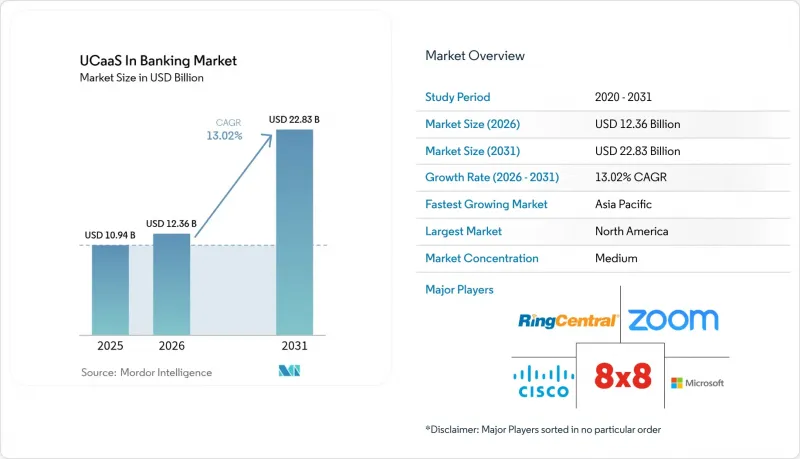
本報告按組件(電話功能、整合通訊、客服中心、協作平台等)、部署模式(公共雲端、混合雲端、私有雲端)、組織規模(中小企業、大型企業)、銀行應用(零售銀行、公司和批發銀行等)以及地區進行分類。
全球銀行業統一通訊即服務 (UCaaS) 市場的趨勢與洞察
自備設備辦公 (BYOD) 與員工流動性
隨著混合辦公模式日益普及,員工擴大使用個人設備,金融機構正在減少對固定電話的依賴。統一通訊即服務 (UCaaS) 工具能夠對流量進行端對端加密,強制執行基於角色的策略,並支援身分聯合,使員工能夠隨時隨地連接,同時確保合規性。瑞穗證券決定將外部通訊遷移到 Zoom,並採用基於活動主機收費模式的方案,這清楚地展示了靈活的授權系統如何在保持可審計性的同時降低閒置許可證的成本。自帶設備辦公室 (BYOD) 策略可以降低硬體支出並提高員工滿意度,但需要複雜的行動裝置管理和地理圍欄功能才能滿足行業預防資料外泄法規的要求。行動性和 UCaaS 安全性的綜效鞏固了銀行的競爭優勢,使其能夠在柔軟性和嚴格監管之間取得平衡。
公司範圍內統一通訊整合的必要性
傳統上,語音、聊天和交易大廳管道各自獨立,阻礙了順暢的協作。現代統一通訊即服務 (UCaaS) 平台整合了這些觸點,並加入了工作流程觸發器,從而實現了分店、客服中心和合規部門之間警報和文件的無縫流動。 NTT Communications 的單一租戶全球統一通訊平台 (UC Fabric) 為 190 多個國家/地區提供支持,幫助跨國銀行標準化撥號方案、報告和策略執行,同時降低維護成本。在併購過程中,整合需求尤其迫切,因為新收購的分店必須快速遷移。如今的尖端解決方案利用人工智慧將諮詢路由到最合適的專家,從而提高首次回應解決率並最佳化人員配置。此外,跨管道的統一交易歷史記錄簡化了對監管機構要求在數小時內完成的電子取證請求的回應。
二、三線銀行對基於雲端的統一通訊系統認知度較低。
區域性金融機構往往缺乏評估統一提案(UCaaS) 方案的專業人員,不得不依賴現有電信業者提供傳統電話服務。美國財政部委託撰寫的一份報告警告稱,有限的雲端運算專業知識使中小型銀行面臨隱性容錯和網路風險,延長了舊有系統的使用期限,並阻礙了現代化進程。因此,教育加速器、藍圖模板和託管服務包在降低准入門檻方面發揮著至關重要的作用。提供遷移獎勵、承包安全解決方案和合規性文件的供應商可以開拓這項服務不足的客戶群。
細分市場分析
至2025年,電話通訊將佔銀行業統一通訊即服務(UCaaS)市場規模的41.88%。這是因為語音通訊對於詐欺預防驗證、交易執行和客戶身份驗證仍然至關重要。同時,隨著視訊、全天候聊天和共用文件工作區整合到單一螢幕上,協作套件預計將在2031年之前以18.04%的複合年成長率成長。這種整合減少了客戶經理的角色切換,並加快了客戶入職和問題解決速度。據Five9稱,自然語言處理(NLP)路由器現在無需人工篩選即可將80%的來電路由到相應的技能組,從而降低了呼叫放棄率。整合通訊功能將電子郵件、簡訊和安全聊天資訊聚合到一個線程化的歷史記錄中,提高了合規審計的可追溯性。視訊銀行自助服務終端將諮詢服務擴展到本地,而通訊平台API允許將用於雙因素認證的語音通話直接整合到行動應用程式中。這種模組化使銀行能夠在不重建其後端核心系統的情況下添加管道,從而提高平台採用率並降低轉換成本。
隨著銀行透過應用內橫幅、RCS 和 OTT 即時通訊工具部署情境感知通知(例如貸款核准提醒、外匯提醒和信用卡使用異常提醒),對嵌入式通訊的需求日益成長。 Webex CPaaS 的銀行模組為 WhatsApp 和 Apple Messages 提供即用型模板,在保持加密和審計日誌記錄功能的同時,加速了部署。這種 API 優先的模式允許開發人員設計客戶體驗,當高價值交易超過指定閾值時,可從聊天機器人升級到安全的視訊通話。 Gartner 預測,到 2030 年,API 驅動的通路將佔金融服務出站流量的一半,這凸顯了電信服務正逐步從獨立產品轉向整合套件中的基礎服務。
公共雲端憑藉其承包的擴充性和付費使用制,預計到2025年將佔據銀行業統一雲端即服務 (uCaaS) 市場佔有率的60.72%。然而,混合雲模式預計到2031年將以18.74%的複合年成長率成長,反映出經營團隊對監管合規性和延遲敏感型工作負載日益成長的關注。第一地平線銀行遷移到Webex客服中心採用了多層架構,將受監管的員工通話錄音保留在本地,同時在思科的多租戶雲上處理經人工智慧分析的匿名資料。這種模式使該銀行能夠在不違反其受託資料處理義務的情況下,透過單一主機管理20,000個終端和750個座席。
對於具有獨特加密和主權要求的全球系統重要性銀行 (G-SIB) 而言,私有雲端仍然是一種選擇,但資本和人員要求阻礙了其廣泛應用。混合策略支持分階段過渡。金融機構可以逐步淘汰各地點的舊式 PBX 系統,並透過會話邊界控制器將流量路由到雲端核心。持續整合管道隨後可在不中斷服務的情況下交付諸如噪音抑制和自動掩蔽等新功能。在日益關注環境、社會和管治(ESG) 的背景下,工作負載彈性還可以降低空閒能耗,幫助銀行實現其碳減排目標。
區域分析
預計到2025年,北美在銀行業統一通訊即服務(UCaaS)市場將維持36.25%的佔有率。這主要得益於成熟的雲端監管體系和充足的企業現代化預算。巴克萊銀行、瑞銀集團和花旗集團等大型企業將協作套件與人工智慧助理結合,以簡化顧問的工作流程,堪稱大規模部署的典範。儘管取得了進展,但只有不到40%的企業完成了遷移,許多區域性銀行仍然依賴價值不斷貶值的PBX系統。因此,兼顧轉型動能和謹慎風險管理的混合部署模式正逐漸成為主流。
亞太地區預計在2031年前以14.54%的複合年成長率實現成長,這主要得益於行動優先的人口結構,促使數位銀行將語音和訊息功能直接整合到其應用程式中。日本電信公司,例如NTT和Softbank Corporation,正在全球範圍內擴展其統一通訊即服務(UCaaS)的部署,而Vonnage與當地系統整合商的合作正在推動東南亞地區呼叫客服中心的數位轉型。這促使對話式人工智慧的應用日益普及,從而提高了問題解決的首次回應率,並實現了全天候多語言支援。
在歐洲,資料主權是關鍵考量因素,銀行越來越重視區域性雲端平台和主權夥伴關係。義大利聯合信貸銀行斥資4億美元收購Vodeno,獲得了一個整合智慧合約引擎的雲端原生平台,在滿足PSD2開放銀行要求的同時,擴展了白牌功能。在中東和非洲,雲端採用跳過了傳統的PBX階段。例如,EcoBank與Google雲端的合作正在35個國家推動一項以數據分析主導的普惠金融計畫。在這些市場,統一通訊即服務(UCaaS)在彌合實體網點稀少地區的服務缺口方面發揮重要作用。
其他好處:
- Excel格式的市場預測(ME)表
- 3個月的分析師支持
目錄
第1章:引言
- 研究假設和市場定義
- 調查範圍
第2章:調查方法
第3章執行摘要
第4章 市場狀況
- 市場概覽
- 市場促進因素
- 自備設備辦公 (BYOD) 和員工行動辦公
- 公司範圍內統一通訊整合的必要性
- 純數位銀行的擴張
- 基於人工智慧的統一通訊即服務 (UCaaS) 用於合規性監控
- 5G專用網路
- CPaaS 已整合到銀行應用程式中
- 市場限制因素
- 二、三線銀行對雲端統一通訊的認知度較低。
- 嚴格的資料安全和資料居住要求
- 與傳統本地PBX系統進行對接
- 供應商 API 鎖定風險
- 重要法規結構的評估
- 價值鏈分析
- 技術展望
- 波特五力模型
- 主要用例和案例研究
- 宏觀經濟因素對市場的影響
- 投資分析
第5章 市場區隔
- 按組件
- 電話通訊
- 整合通訊
- 客服中心
- 協作平台
- 視訊會議
- 通訊平台API
- 按部署模式
- 公共雲端
- 私有雲端
- 混合雲端
- 按組織規模
- 大公司
- 小型企業
- 透過銀行申請
- 零售銀行
- 企業及批發銀行
- 投資銀行
- 支付及金融科技子公司
- 按地區
- 北美洲
- 美國
- 加拿大
- 墨西哥
- 南美洲
- 巴西
- 阿根廷
- 其他南美國家
- 歐洲
- 德國
- 英國
- 法國
- 義大利
- 西班牙
- 俄羅斯
- 其他歐洲國家
- 亞太地區
- 中國
- 日本
- 印度
- 韓國
- 澳洲和紐西蘭
- 其他亞太國家
- 中東和非洲
- 中東
- 沙烏地阿拉伯
- 阿拉伯聯合大公國
- 土耳其
- 其他中東國家
- 非洲
- 南非
- 奈及利亞
- 埃及
- 其他非洲國家
- 中東
- 北美洲
第6章 競爭情勢
- 市場集中度
- 策略趨勢
- 市佔率分析
- 公司簡介
- Microsoft Corporation
- Cisco Systems, Inc.
- RingCentral, Inc.
- 8x8, Inc.
- Zoom Video Communications, Inc.
- Avaya LLC
- Fuze, Inc.
- West Technology Group, LLC(formerly West UC)
- VOSS Solutions
- NetFortris, Inc.
- TetraVX(Netrix, LLC)
- Kurmi Software SAS
- Vonage Holdings Corp.
- Dialpad, Inc.
- Mitel Networks Corporation
- Revation Systems, Inc.
- NICE Ltd.
- Genesys Telecommunications Labs, Inc.
- Google LLC
- Amazon Web Services, Inc.
第7章 市場機會與未來展望
According to Mordor Intelligence, the uCaaS in banking market size was valued at USD 10.94 billion in 2025 and estimated to grow from USD 12.36 billion in 2026 to reach USD 22.83 billion by 2031, at a CAGR of 13.02% during the forecast period (2026-2031).
This report is Segmented by Component (Telephony, Unified Messaging, Contact Center, Collaboration Platform, and More), Deployment Model (Public Cloud, Hybrid Cloud, and Private Cloud), Organization Size (Small and Medium-Sized Enterprises, Large Enterprises), Banking Application (Retail Banking, Corporate and Wholesale Banking, and More), and Geography.
Global UCaaS In Banking Market Trends and Insights
BYOD and Workforce Mobility
Banking institutions are dismantling desk-phone dependencies as hybrid workforces normalize personal device use. UCaaS tools that encrypt traffic end-to-end, enforce role-based policies and federate identity allow staff to connect from any location without jeopardizing compliance. Mizuho Securities' decision to migrate external communications to Zoom under an active-host billing model underscores how flexible licensing reduces dormant seat costs while sustaining auditability. BYOD strategies cut hardware outlays and elevate employee satisfaction, yet they demand advanced mobile-device-management and geo-fencing to meet sectoral data-loss-prevention rules. The interplay between mobility enablement and UCaaS security solidifies competitive advantage for banks able to blend flexibility with rigorous supervision.
Need for Enterprise-wide UC Integration
Historically, siloed voice, chat and trading-floor channels obstructed fluid collaboration. Contemporary UCaaS platforms unify these touchpoints and embed workflow triggers so alerts and documents flow between branches, contact centers and compliance desks. NTT Communications underpins more than 190 countries with a single-tenant global UC fabric, allowing multinational banks to standardize dial plans, reporting and policy enforcement while trimming maintenance overhead. Integration imperatives intensify during mergers, when newly acquired branches must migrate rapidly. Leading solutions now apply AI to route queries to the best-suited specialist, elevating first-call-resolution metrics and optimizing workforce allocation. Unified lineage across channels also simplifies e-discovery requests, which regulators expect within hours.
Low Cloud-UC Awareness in Tier-2/3 Banks
Community institutions often lack specialist staff to evaluate UCaaS proposals, defaulting to incumbent telcos for plain-old telephony. A U.S. Treasury-commissioned assessment warns that limited cloud acumen exposes smaller banks to hidden resiliency and cyber risks, prolonging legacy usage and constraining modernization. Educational accelerators, blueprint templates and managed-service bundles therefore play a pivotal role in lowering entry barriers. Providers that extend migration incentives, turnkey security controls and regulatory documentation can unlock this underserved cohort.
Other drivers and restraints analyzed in the detailed report include:
- Digital-only Banking Expansion
- AI-Enabled UCaaS for Compliance Monitoring
- Stringent Data-Security and Residency Mandates
For complete list of drivers and restraints, kindly check the Table Of Contents.
Segment Analysis
Telephony accounted for 41.88% of the UCaaS in banking market size in 2025 as voice remains indispensable for fraud verification, trade execution and customer identity confirmation. Collaboration suites, however, are projected to drive an 18.04% CAGR through 2031 as video, persistent chat and shared-document workspaces coalesce into a single pane. The convergence reduces swivel-chair actions for relationship managers, speeding onboarding and issue resolution. Five9 reports that natural-language-processing routers now direct 80% of inbound calls to the correct skill group without human triage, trimming abandonment rates. Unified messaging compresses email, SMS and secure chat feeds into threaded histories, boosting compliance auditability. Video-banking kiosks extend advisory services to rural zones, while communication-platform APIs embed two-factor-authentication voice calls directly into mobile apps. This modularity ensures banks add channels without re-architecting back-end cores, reinforcing platform stickiness and raising switching costs.
Demand for embedded communications intensifies as banks deploy contextual notifications-loan-approval pings, FX-rate alerts and card-usage anomalies-through in-app banners, RCS and OTT messengers. Webex CPaaS banking modules deliver out-of-the-box templates for WhatsApp and Apple Messages, accelerating deployment while retaining encryption and audit logging. Such API-first models empower developers to orchestrate journeys where a chatbot escalates to secure video when high-value transactions exceed preset thresholds. Gartner predicts that by 2030, API-driven channels will account for half of financial-services outbound traffic, underscoring telephony's gradual transition from standalone product to foundational service within integrated suites.
Public-cloud captured 60.72% of UCaaS in banking market share in 2025 on the back of turnkey scalability and consumption pricing. Yet hybrid approaches, forecasting a 18.74% CAGR to 2031, reflect heightened boardroom focus on jurisdictional compliance and latency-sensitive workloads. First Horizon Bank's Webex Contact Center migration showcased a layered architecture where recordings of regulated staff remained on-prem while AI analytics processed anonymized data in Cisco's multitenant cloud. This blueprint allowed the bank to maintain 20,000 endpoints and 750 agents under one console without breaching fiduciary data-handling obligations.
Private-cloud remains an option for global systemically important banks with bespoke encryption and sovereignty mandates, although capital and staffing requirements curb its wider appeal. Hybrid strategies support phased migration: institutions can retire aging PBXs site by site, funneling traffic via session-border controllers to a cloud core. Continuous-integration pipelines then deliver feature drops such as noise suppression or auto-redaction without downtime. Given rising environmental, social and governance commitments, workload elasticity also lowers idle energy use, helping banks hit carbon-cut targets.
Complete Report Scope:
- By Component
- Telephony
- Unified Messaging
- Contact Center
- Collaboration Platform
- Video Conferencing
- Communication-Platform APIs
- By Deployment Model
- Public Cloud
- Private Cloud
- Hybrid Cloud
- By Organization Size
- Large Enterprises
- Small and Medium-Sized Enterprises
- By Banking Application
- Retail Banking
- Corporate and Wholesale Banking
- Investment Banking
- Payment and FinTech Subsidiaries
- By Geography
- North America
- United States
- Canada
- Mexico
- South America
- Brazil
- Argentina
- Rest of South America
- Europe
- Germany
- United Kingdom
- France
- Italy
- Spain
- Russia
- Rest of Europe
- Asia-Pacific
- China
- Japan
- India
- South Korea
- Australia and New Zealand
- Rest of Asia-Pacific
- Middle East and Africa
- Middle East
- Saudi Arabia
- United Arab Emirates
- Turkey
- Rest of Middle East
- Africa
- South Africa
- Nigeria
- Egypt
- Rest of Africa
- Middle East
- North America
Geography Analysis
North America retained 36.25% UCaaS in banking market share in 2025, capitalizing on mature cloud regulations and sizeable budgets for enterprise modernization. Barclays, UBS and Citigroup exemplify large-scale deployments that marry collaboration suites with AI copilots to streamline advisor workflows . Despite headway, many regional banks remain tethered to depreciating PBXs, as less than 40% of businesses have completed migration. Hybrid rollouts therefore dominate, balancing transformation momentum with risk-management caution.
Asia-Pacific leads growth at 14.54% CAGR through 2031 as mobile-first demographics spur digital banks to embed voice and messaging directly in apps. Japanese carriers such as NTT and SoftBank export UCaaS footprints globally, while partnerships between Vonage and local integrators digitize contact-center estates throughout Southeast Asia. Conversational-AI adoption rises in concert, lifting first-contact resolution and enabling 24/7 multilingual servicing.
Europe emphasizes data-sovereignty, prompting banks to prefer region-locked clouds or sovereign partnerships. UniCredit's USD 400 million acquisition of Vodeno delivers a cloud-native platform with built-in smart-contract engines, aligning with PSD2 open-banking requisites while expanding white-label capabilities. In the Middle East and Africa, cloud adoption leapfrogs legacy PBX phases; for instance, Ecobank's alliance with Google Cloud powers analytics-driven inclusion programs across 35 nations. These markets underline UCaaS' role in bridging service gaps where physical branches remain sparse.
- Microsoft Corporation
- Cisco Systems, Inc.
- RingCentral, Inc.
- 8x8, Inc.
- Zoom Video Communications, Inc.
- Avaya LLC
- Fuze, Inc.
- West Technology Group, LLC (formerly West UC)
- VOSS Solutions
- NetFortris, Inc.
- TetraVX (Netrix, LLC)
- Kurmi Software SAS
- Vonage Holdings Corp.
- Dialpad, Inc.
- Mitel Networks Corporation
- Revation Systems, Inc.
- NICE Ltd.
- Genesys Telecommunications Labs, Inc.
- Google LLC
- Amazon Web Services, Inc.
Additional Benefits:
- The market estimate (ME) sheet in Excel format
- 3 months of analyst support
TABLE OF CONTENTS
1 INTRODUCTION
- 1.1 Study Assumptions and Market Definition
- 1.2 Scope of the Study
2 RESEARCH METHODOLOGY
3 EXECUTIVE SUMMARY
4 MARKET LANDSCAPE
- 4.1 Market Overview
- 4.2 Market Drivers
- 4.2.1 BYOD and workforce mobility
- 4.2.2 Need for enterprise-wide UC integration
- 4.2.3 Digital-only banking expansion
- 4.2.4 AI-enabled UCaaS for compliance monitoring
- 4.2.5 5G private branch networks
- 4.2.6 Embedded CPaaS in banking apps
- 4.3 Market Restraints
- 4.3.1 Low cloud-UC awareness in tier-2/3 banks
- 4.3.2 Stringent data-security and residency mandates
- 4.3.3 Legacy on-prem PBX lock-ins
- 4.3.4 Vendor API lock-in risk
- 4.4 Evaluation of Critical Regulatory Framework
- 4.5 Value Chain Analysis
- 4.6 Technological Outlook
- 4.7 Porter's Five Forces
- 4.7.1 Bargaining Power of Suppliers
- 4.7.2 Bargaining Power of Buyers
- 4.7.3 Threat of New Entrants
- 4.7.4 Threat of Substitutes
- 4.7.5 Competitive Rivalry
- 4.8 Key Use Cases and Case Studies
- 4.9 Impact on Macroeconomic Factors of the Market
- 4.10 Investment Analysis
5 MARKET SEGMENTATION
- 5.1 By Component
- 5.1.1 Telephony
- 5.1.2 Unified Messaging
- 5.1.3 Contact Center
- 5.1.4 Collaboration Platform
- 5.1.5 Video Conferencing
- 5.1.6 Communication-Platform APIs
- 5.2 By Deployment Model
- 5.2.1 Public Cloud
- 5.2.2 Private Cloud
- 5.2.3 Hybrid Cloud
- 5.3 By Organization Size
- 5.3.1 Large Enterprises
- 5.3.2 Small and Medium-Sized Enterprises
- 5.4 By Banking Application
- 5.4.1 Retail Banking
- 5.4.2 Corporate and Wholesale Banking
- 5.4.3 Investment Banking
- 5.4.4 Payment and FinTech Subsidiaries
- 5.5 By Geography
- 5.5.1 North America
- 5.5.1.1 United States
- 5.5.1.2 Canada
- 5.5.1.3 Mexico
- 5.5.2 South America
- 5.5.2.1 Brazil
- 5.5.2.2 Argentina
- 5.5.2.3 Rest of South America
- 5.5.3 Europe
- 5.5.3.1 Germany
- 5.5.3.2 United Kingdom
- 5.5.3.3 France
- 5.5.3.4 Italy
- 5.5.3.5 Spain
- 5.5.3.6 Russia
- 5.5.3.7 Rest of Europe
- 5.5.4 Asia-Pacific
- 5.5.4.1 China
- 5.5.4.2 Japan
- 5.5.4.3 India
- 5.5.4.4 South Korea
- 5.5.4.5 Australia and New Zealand
- 5.5.4.6 Rest of Asia-Pacific
- 5.5.5 Middle East and Africa
- 5.5.5.1 Middle East
- 5.5.5.1.1 Saudi Arabia
- 5.5.5.1.2 United Arab Emirates
- 5.5.5.1.3 Turkey
- 5.5.5.1.4 Rest of Middle East
- 5.5.5.2 Africa
- 5.5.5.2.1 South Africa
- 5.5.5.2.2 Nigeria
- 5.5.5.2.3 Egypt
- 5.5.5.2.4 Rest of Africa
- 5.5.5.1 Middle East
- 5.5.1 North America
6 COMPETITIVE LANDSCAPE
- 6.1 Market Concentration
- 6.2 Strategic Moves
- 6.3 Market Share Analysis
- 6.4 Company Profiles {(includes Global level Overview, Market level overview, Core Segments, Financials as available, Strategic Information, Market Rank/Share for key companies, Products and Services, and Recent Developments)}
- 6.4.1 Microsoft Corporation
- 6.4.2 Cisco Systems, Inc.
- 6.4.3 RingCentral, Inc.
- 6.4.4 8x8, Inc.
- 6.4.5 Zoom Video Communications, Inc.
- 6.4.6 Avaya LLC
- 6.4.7 Fuze, Inc.
- 6.4.8 West Technology Group, LLC (formerly West UC)
- 6.4.9 VOSS Solutions
- 6.4.10 NetFortris, Inc.
- 6.4.11 TetraVX (Netrix, LLC)
- 6.4.12 Kurmi Software SAS
- 6.4.13 Vonage Holdings Corp.
- 6.4.14 Dialpad, Inc.
- 6.4.15 Mitel Networks Corporation
- 6.4.16 Revation Systems, Inc.
- 6.4.17 NICE Ltd.
- 6.4.18 Genesys Telecommunications Labs, Inc.
- 6.4.19 Google LLC
- 6.4.20 Amazon Web Services, Inc.
7 MARKET OPPORTUNITIES AND FUTURE OUTLOOK
- 7.1 White-space and Unmet-Need Assessment

 歐洲IP電話和UCaaS:市場佔有率分析、行業趨勢和統計數據以及成長預測(2026-2031年)
 整合通訊即服務 (UCaaS) 市場規模、佔有率和趨勢分析報告:按部署類型、產業、地區和細分市場預測 (2026–2033)
 整合通訊即服務 (UCaaS) 市場規模、佔有率、成長率和全球產業分析:按類型、應用和地區分類的洞察,2026-2034 年預測
 2026年全球整合通訊即服務(UCaaS)市場報告整合通訊即服務 (UCaaS) 市場:策略洞察與預測 (2026–2031)
 整合通訊即服務 (UCaaS) 市場分析及至 2035 年預測:按類型、產品類型、服務、技術、組件、應用、部署類型、最終用戶和解決方案分類全球綜合通訊即服務市場規模、佔有率、趨勢和成長分析報告(2026-2034)
 統一通訊即服務 (UCaaS) 市場 - 全球產業規模、佔有率、趨勢、機會及預測(按服務、部署、部署模式、交付模式、最終用戶、地區和競爭格局分類),2021-2031 年全球統一通訊即服務 (UCaaS) 市場:成長機會(2024-2031 年)能源領域統一通訊即服務 (UCaaS) - 市場佔有率分析、產業趨勢、統計數據和成長預測 (2025-2030)