


 |
市場調查報告書
商品編碼
2125283
北美感應電動機:市場佔有率分析、產業趨勢與統計及成長預測(2026-2031 年)North America Induction Motor - Market Share Analysis, Industry Trends & Statistics, Growth Forecasts (2026 - 2031) |
||||||

※ 本網頁內容可能與最新版本有所差異。詳細情況請與我們聯繫。
根據 Mordor Intelligence 預測,北美感應電動機市場規模將從 2025 年的 52 億美元和 2026 年的 54.7 億美元成長到 2031 年的 69.7 億美元,2026 年至 2031 年的複合年成長率為 4.97%。
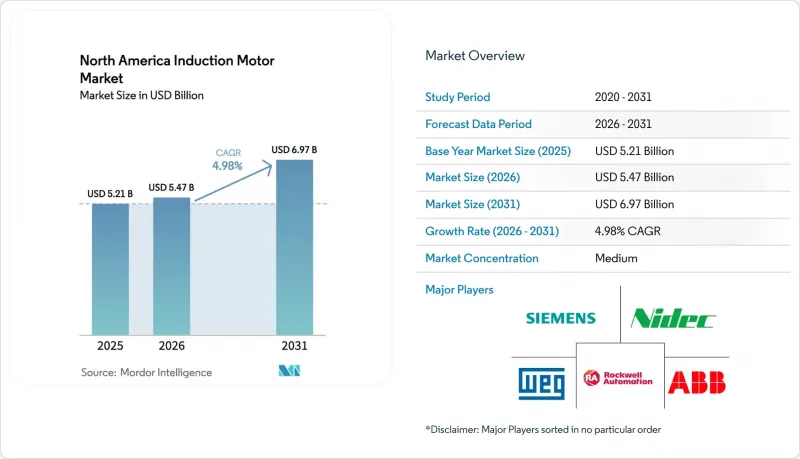
本報告按類型(單相、三相)、額定功率(7.5 kW 及以下、7.5 kW 及以上)、能源效率等級(IE1 及以上)、電壓(低於 1 kV、1 kV 及以上)、應用(泵浦和壓縮機及其他)、最終用戶(石油和天然氣及其他)、銷售管道(新市場和市場銷售)、基地式市場和裝置市場、市場和市場銷售)。市場預測以美元 (USD) 為單位。
北美感應電動機市場趨勢及洞察
美國和加拿大的強制性能源效率標準
2024年實施的法規強制要求功率在0.25至0.75馬力之間的馬達必須達到IE3或更高的能源效率等級,而2027年起,功率超過500馬力的特定機架尺寸的馬達將強制達到IE4能源效率等級。這將迫使原始設備製造商(OEM)重新設計水泵和風扇的封裝,並要求馬達重繞公司提供售後服務後的能源效率認證。加州第24號法規將於2025年進一步收緊,使馬達更換週期縮短約兩年。雖然加拿大已統一了聯邦標準,但安大略省和不列顛哥倫比亞省推出了補貼計劃,為IE4實施成本提供高達20%的補貼。這些協同效應正在北美感應電動機市場造成兩極化:受法規遵從性驅動的新馬達銷量激增,而老舊的IE1和IE2馬達則被報廢而非維修。
向電動車過渡
預計到2025年,微型車產量將達1,580萬輛,其中11.2%為電池式電動車或插電式混合動力汽車。這組裝廠採用公差更小、振動更低的三相驅動裝置。超級工廠的空調系統需要功率高達185千瓦的變頻驅動電機,才能將濕度控制在±1度以內。墨西哥已宣佈到2025年將在電動車領域投資200億美元,這將推動對本地轉子疊片生產線的需求,從而縮短供應鏈。隨著「晶片法」(CHIPS Law)規定的國內採購費率要求供應商在本地採購銅和電工鋼板,生產在地化進程正在進一步加速。
與永磁同步馬達(PMSM)的競爭
永磁同步馬達(PMSM)的效率比感應馬達高出2-5%,預計到2025年,在7.5-37千瓦功率範圍內,PMSM將佔新建暖通空調(HVAC)系統12-15%的佔有率。稀土元素價格的下降縮小了成本差距。然而,高溫設備中退磁的風險以及重繞選擇的限制阻礙了PMSM的廣泛應用。感應電動機製造商正透過採用壓鑄銅轉子來應對這項挑戰,這種轉子在降低材料成本的同時,也彌補了大部分效率差距。
細分市場分析
預計到2025年,三相馬達將佔總銷售量的71.19%,凸顯其在平衡負載工業應用中的主導地位,這些應用需要高啟動轉矩、長壽命和易於維護等特性。這一佔有率在北美感應電動機市場所有類型中佔比最高。隨著《通膨控制法案》下熱泵維修在住宅和小規模商業建築中日益普及,單相馬達的應用正以5.55%的複合年成長率成長。
北美感應電動機市場受益於美國能源部的法規,該法規擴展了IE3標準,將小功率單相馬達納入其中。這導致零件成本上升,但也使得電力公司能夠提供獎勵。由於三相馬達能夠處理瞬時相位不平衡且具有較寬的電壓容差,因此對於功率超過1馬力的水泵和輸送機而言,三相馬達仍然是首選。如今,單相馬達整合了驅動器,無需使用相序轉換器,這使得它們在泳池水泵、農業風機和分散式建築自動化等領域越來越受歡迎。
到2025年,7.6千瓦至37千瓦功率段的感應馬達將佔北美市場總值的38.22%,成為北美感應電動機市場中佔有率最大的細分市場。自動化組裝和資料中心冷卻設備的快速發展推動了7.5千瓦以下功率段馬達的成長,該細分市場的複合年成長率(CAGR)為5.39%。
西門子5.5千瓦IE5馬達預計電價將超過每千瓦時0.12美元,為半導體和製藥業的用戶提供兩年的投資回收期。功率範圍在37至185千瓦之間的更大功率馬達在金屬加工、採礦和汽車壓平機領域保持著穩定的需求,而功率超過185千瓦的馬達在管道和電廠服務領域仍屬於小眾市場。加州和紐約州的法規現已涵蓋小型功率馬達設計,這將加速小型暖通空調和商用冷凍設備的更新換代。
儘管IE3泵仍將佔據主導地位,預計到2025年將佔市場需求的46.74%,但IE4泵的市場佔有率正以5.82%的複合年成長率快速成長。加州、麻薩諸塞州和安大略省的電力公司透過將分時電價與補貼計畫相結合,將許多中負載泵的投資回收期縮短至三年以內。 ABB透露,IE4泵目前已佔其北美出貨量的22%,顯示市場格局正在轉變。
IE2 和 IE1 的淘汰進程仍在穩步推進,除非由於開關設備或框架的尺寸限制而難以升級,否則替代產品僅限於同等型號。 IE4 的效率提升 1.5% 至 2.5%,預計每年可節省 150 至 400 美元(假設年運作時間為 6000 小時,電費為每千瓦時 0.10 美元)。 Regal Rexnord 公司推出的 IE5 產品進一步擴大了其高階產品在半導體和製藥行業無塵室中的用戶群。
其他好處:
- Excel格式的市場預測(ME)表
- 3個月的分析師支持
目錄
第1章:引言
- 研究假設和市場定義
- 調查範圍
第2章:調查方法
第3章執行摘要
第4章 市場狀況
- 市場概覽
- 產業相關人員分析
- 市場促進因素
- 向電動車(EV/HEV)過渡
- 美國和加拿大的強制性能源效率法規
- 智慧工廠對連網電機的需求
- 獎勵促進電網現代化,以提高工業效率
- 電動車和暖通空調產業關鍵供應鏈的本土化
- 電力公司的脫碳目標正在加速馬達維修。
- 市場限制因素
- 永磁同步馬達的競爭
- 銅鋁價格波動
- 電機繞線工作技術純熟勞工短缺
- 工業物聯網馬達中的網路安全問題
- 宏觀經濟因素對市場的影響
- 產業價值鏈分析
- 監理情勢
- 技術展望
- 波特五力分析
- 投資分析
第5章 市場規模與成長預測
- 按類型
- 單相感應電動機
- 三相感應電動機
- 額定功率
- 7.5千瓦或以下
- 7.6~37 kW
- 37.1~185 kW
- 超過185千瓦
- 能源效率等級
- IE1 標準效率
- IE2 高效
- IE3 高階效率
- IE4 超高效
- 透過電壓
- 低電壓(低於1千伏特)
- 中壓(1-6.6千伏特)
- 高壓(6.6千伏或更高)
- 透過使用
- 泵浦和壓縮機
- 暖通空調和製冷
- 物料輸送(輸送帶、起吊裝置)
- 風扇和鼓風機
- 其他用途
- 按最終用戶行業分類
- 石油和天然氣
- 化工/石油化工
- 發電和公共產業
- 水和污水處理
- 金屬和採礦
- 食品/飲料
- 個人生產(汽車、電子產品)
- 其他終端用戶產業
- 按銷售管道
- 新銷售
- 售後市場
- 按安裝類型
- 底座式
- 法蘭安裝方式
- 垂直安裝
- 國家
- 美國
- 加拿大
- 墨西哥
第6章 競爭情勢
- 市場集中度
- 策略趨勢
- 市佔率分析
- 公司簡介
- ABB Ltd.
- Siemens AG
- Nidec Motor Corporation
- Rockwell Automation, Inc.
- WEG SA
- Emerson Electric Co.
- Schneider Electric SE
- Regal Rexnord Corp.
- Baldor Electric Company(ABB)
- Toshiba International Corporation
- TECO-Westinghouse Motor Company
- Franklin Electric Co., Inc.
- Johnson Electric Holdings Ltd.
- Leeson Electric(Regal Rexnord)
- Brook Crompton UK Ltd.
- Cantoni Motor SA
- Lafert North America
- Kollmorgen Corp.
- SEW-Eurodrive GmbH and Co KG
- GE Power Conversion
- Motion Industries, Inc.
- Allied Motion Technologies Inc.
第7章 市場機會與未來展望
According to Mordor Intelligence, the North America induction motor market size is projected to expand from USD 5.20 billion in 2025 and USD 5.47 billion in 2026 to USD 6.97 billion by 2031, registering a CAGR of 4.97% between 2026 to 2031.
This report is Segmented by Type (Single-Phase, Three-Phase), Power Rating (<=7. 5 KW, and More), Efficiency Class (IE1, and More), Voltage (Lower Than 1 KV, and More), Application (Pumps and Compressors, and More), End-User (Oil and Gas, and More), Sales Channel (New, and Aftermarket), Mounting (Foot, Flange, and Vertical), and Geography. Market Forecasts are Provided in Terms of Value (USD).
North America Induction Motor Market Trends and Insights
Mandatory Efficiency Regulations in the United States and Canada
A 2024 rule now enforces IE3 minimums on 0.25-0.75 hp motors and will mandate IE4 for select frames above 500 hp in 2027, obliging OEMs to redesign pump and fan packages and forcing rewind shops to certify post-service efficiency. California's Title 24 tightened further in 2025, accelerating replacement cycles by nearly two years. Canada harmonized its federal code yet layered rebates in Ontario and British Columbia that subsidize up to 20% of IE4 cost. The combined effect bifurcates the North America induction motor market, with compliance-driven new sales surging while older IE1 and IE2 units exit through scrappage rather than rewind.
Shift Toward Electric Vehicles
Light-vehicle output reached 15.8 million units in 2025, 11.2% of which were battery-electric or plug-in hybrids, prompting assembly plants to specify tighter-tolerance, low-vibration three-phase drives. Gigafactory HVAC systems demand variable-frequency-drive-ready motors up to 185 kW to maintain +-1 °C humidity-controlled rooms. Mexico drew USD 20 billion of announced EV investment through 2025, driving local rotor-lamination lines that shorten supply chains. Domestic-content rules under the CHIPS Act compel suppliers to source copper and electrical steel regionally, further localizing production.
Competition From Permanent-Magnet Synchronous Motors
PMSMs deliver 2-5% higher efficiency and reached 12-15% share of new HVAC installs in the 7.5-37 kW band by 2025. Falling rare-earth prices erode the cost gap. However, demagnetization risks in high-temperature plants and limited rewind options curb universal uptake. Induction-motor makers counter with die-cast copper rotors that reclaim most of the efficiency delta at lower material cost.
Other drivers and restraints analyzed in the detailed report include:
- Smart Factories' Demand for Connected Motors
- Grid-Modernization Incentives for Industrial Efficiency
- Volatility in Copper and Aluminium Prices
For complete list of drivers and restraints, kindly check the Table Of Contents.
Segment Analysis
Three-phase machines held 71.19% of 2025 revenue, underscoring their dominance in balanced-load industrial applications where high starting torque, long life, and simple maintenance prevail. This share equates to the largest North America induction motor market share among all types. Single-phase adoption is rising at 5.55% CAGR as heat-pump retrofits under the Inflation Reduction Act permeate residential and light-commercial buildings.
The North America induction motor market benefits from the Department of Energy rule that extended IE3 thresholds to fractional-horsepower single-phase models, raising bill-of-material cost yet unlocking utility incentives. Three-phase units remain favoured for pumps and conveyors above 1 hp because they ride through momentary phase imbalances and broaden voltage tolerance. Single-phase motors now integrate drives that eliminate phase converters, widening their attractiveness in pool pumps, agricultural fans, and distributed building automation.
The 7.6 kW-37 kW segment accounted for 38.22% of 2025 value and therefore represents the largest slice of the North America induction motor market size. Rapid build-out of automated assembly lines and data-center cooling skews growth toward sub-7.5 kW frames, which expand at 5.39% CAGR.
Siemens' 5.5 kW IE5 launch targets electricity prices above USD 0.12 per kWh, offering a two-year payback to semiconductor and pharmaceutical users. Larger 37-185 kW motors remain steady in metals, mining, and automotive presses, while >185 kW machines stay niche in pipeline and power-plant service. California and New York codes now cover fractional-horsepower designs, hastening churn in small HVAC and commercial refrigeration.
IE3 still rules with 46.74% of 2025 demand, yet IE4 advances at 5.82% CAGR. Utilities in California, Massachusetts, and Ontario stack rebates on time-of-use tariffs, slicing the payback gap to under three years for many mid-load pumps. ABB's disclosure that IE4 now forms 22% of North American shipments signals a market pivot.
IE2 and IE1 remain in managed decline, limited to like-for-like replacements where switchgear or frame envelopes prevent upgrades. IE4's 1.5-2.5% efficiency boost yields USD 150-400 annual savings for 6,000-hour duty cycles at USD 0.10 per kWh. Regal Rexnord's IE5 debut extends the frontier for ultra-premium adopters in semiconductor and pharma clean rooms.
Complete Report Scope:
- By Type
- Single-Phase Induction Motors
- Three-Phase Induction Motors
- By Power Rating
- Less than equal to 7.5 kW
- 7.6 - 37 kW
- 37.1 - 185 kW
- More than 185 kW
- By Efficiency Class
- IE1 Standard Efficiency
- IE2 High Efficiency
- IE3 Premium Efficiency
- IE4 Super-Premium Efficiency
- By Voltage
- Low Voltage (Less than 1 kV)
- Medium Voltage (1 - 6.6 kV)
- High Voltage (More than 6.6 kV)
- By Application
- Pumps and Compressors
- HVAC and Refrigeration
- Material Handling (Conveyors, Hoists)
- Fans and Blowers
- Other Applications
- By End-User Industry
- Oil and Gas
- Chemicals and Petrochemicals
- Power Generation and Utilities
- Water and Wastewater
- Metals and Mining
- Food and Beverage
- Discrete Manufacturing (Automotive, Electronics)
- Other End-User Industries
- By Sales Channel
- New Sales
- Aftermarket
- By Mounting Type
- Foot-Mounted
- Flange-Mounted
- Vertical-Mounted
- By Country
- United States
- Canada
- Mexico
List of Companies Covered in this Report:
- ABB Ltd.
- Siemens AG
- Nidec Motor Corporation
- Rockwell Automation, Inc.
- WEG S.A.
- Emerson Electric Co.
- Schneider Electric SE
- Regal Rexnord Corp.
- Baldor Electric Company (ABB)
- Toshiba International Corporation
- TECO-Westinghouse Motor Company
- Franklin Electric Co., Inc.
- Johnson Electric Holdings Ltd.
- Leeson Electric (Regal Rexnord)
- Brook Crompton UK Ltd.
- Cantoni Motor S.A.
- Lafert North America
- Kollmorgen Corp.
- SEW-Eurodrive GmbH and Co KG
- GE Power Conversion
- Motion Industries, Inc.
- Allied Motion Technologies Inc.
Additional Benefits:
- The market estimate (ME) sheet in Excel format
- 3 months of analyst support
TABLE OF CONTENTS
1 INTRODUCTION
- 1.1 Study Assumptions and Market Definition
- 1.2 Scope of the Study
2 RESEARCH METHODOLOGY
3 EXECUTIVE SUMMARY
4 MARKET LANDSCAPE
- 4.1 Market Overview
- 4.2 Industry Stakeholder Analysis
- 4.3 Market Drivers
- 4.3.1 Shift Toward Electric Vehicles (EV / HEV)
- 4.3.2 Mandatory Efficiency Regulations in the United States and Canada
- 4.3.3 Smart Factories' Demand for Connected Motors
- 4.3.4 Grid-Modernization Incentives for Industrial Efficiency
- 4.3.5 On-Shoring of Critical Supply Chains in EV and HVAC Industries
- 4.3.6 Utility Decarbonization Targets Accelerating Motor Retrofits
- 4.4 Market Restraints
- 4.4.1 Competition From Permanent-Magnet Synchronous Motors
- 4.4.2 Volatility in Copper and Aluminum Prices
- 4.4.3 Skilled-Labor Shortages for Motor Rewinding
- 4.4.4 Cyber-Security Concerns in IIoT-Enabled Motors
- 4.5 Impact of Macroeconomic Factors on the Market
- 4.6 Industry Value-Chain Analysis
- 4.7 Regulatory Landscape
- 4.8 Technological Outlook
- 4.9 Porter's Five Forces Analysis
- 4.9.1 Bargaining Power of Suppliers
- 4.9.2 Bargaining Power of Buyers
- 4.9.3 Threat of New Entrants
- 4.9.4 Threat of Substitutes
- 4.9.5 Intensity of Competitive Rivalry
- 4.10 Investment Analysis
5 MARKET SIZE AND GROWTH FORECASTS (VALUE)
- 5.1 By Type
- 5.1.1 Single-Phase Induction Motors
- 5.1.2 Three-Phase Induction Motors
- 5.2 By Power Rating
- 5.2.1 Less than equal to 7.5 kW
- 5.2.2 7.6 - 37 kW
- 5.2.3 37.1 - 185 kW
- 5.2.4 More than 185 kW
- 5.3 By Efficiency Class
- 5.3.1 IE1 Standard Efficiency
- 5.3.2 IE2 High Efficiency
- 5.3.3 IE3 Premium Efficiency
- 5.3.4 IE4 Super-Premium Efficiency
- 5.4 By Voltage
- 5.4.1 Low Voltage (Less than 1 kV)
- 5.4.2 Medium Voltage (1 - 6.6 kV)
- 5.4.3 High Voltage (More than 6.6 kV)
- 5.5 By Application
- 5.5.1 Pumps and Compressors
- 5.5.2 HVAC and Refrigeration
- 5.5.3 Material Handling (Conveyors, Hoists)
- 5.5.4 Fans and Blowers
- 5.5.5 Other Applications
- 5.6 By End-User Industry
- 5.6.1 Oil and Gas
- 5.6.2 Chemicals and Petrochemicals
- 5.6.3 Power Generation and Utilities
- 5.6.4 Water and Wastewater
- 5.6.5 Metals and Mining
- 5.6.6 Food and Beverage
- 5.6.7 Discrete Manufacturing (Automotive, Electronics)
- 5.6.8 Other End-User Industries
- 5.7 By Sales Channel
- 5.7.1 New Sales
- 5.7.2 Aftermarket
- 5.8 By Mounting Type
- 5.8.1 Foot-Mounted
- 5.8.2 Flange-Mounted
- 5.8.3 Vertical-Mounted
- 5.9 By Country
- 5.9.1 United States
- 5.9.2 Canada
- 5.9.3 Mexico
6 COMPETITIVE LANDSCAPE
- 6.1 Market Concentration
- 6.2 Strategic Moves
- 6.3 Market Share Analysis
- 6.4 Company Profiles (includes Global Level Overview, Market Level Overview, Core Segments, Financials as available, Strategic Information, Market Rank / Share, Products and Services, Recent Developments)
- 6.4.1 ABB Ltd.
- 6.4.2 Siemens AG
- 6.4.3 Nidec Motor Corporation
- 6.4.4 Rockwell Automation, Inc.
- 6.4.5 WEG S.A.
- 6.4.6 Emerson Electric Co.
- 6.4.7 Schneider Electric SE
- 6.4.8 Regal Rexnord Corp.
- 6.4.9 Baldor Electric Company (ABB)
- 6.4.10 Toshiba International Corporation
- 6.4.11 TECO-Westinghouse Motor Company
- 6.4.12 Franklin Electric Co., Inc.
- 6.4.13 Johnson Electric Holdings Ltd.
- 6.4.14 Leeson Electric (Regal Rexnord)
- 6.4.15 Brook Crompton UK Ltd.
- 6.4.16 Cantoni Motor S.A.
- 6.4.17 Lafert North America
- 6.4.18 Kollmorgen Corp.
- 6.4.19 SEW-Eurodrive GmbH and Co KG
- 6.4.20 GE Power Conversion
- 6.4.21 Motion Industries, Inc.
- 6.4.22 Allied Motion Technologies Inc.
7 MARKET OPPORTUNITIES AND FUTURE OUTLOOK
- 7.1 White-Space and Unmet-Need Assessment

 亞太地區感應電動機:市場佔有率分析、產業趨勢與統計及成長預測(2026-2031)感應電動機:市場佔有率分析、產業趨勢與統計、成長預測(2026-2031)北美低壓感應電動機:市場佔有率分析、產業趨勢與統計及成長預測(2026-2031 年)
 全球感應電動機市場規模、佔有率、趨勢和成長分析報告(2026-2034)
 感應馬達市場:2026-2032年全球市場預測(按類型、安裝方式、能源效率等級、功率輸出、應用、終端用戶產業和銷售管道)
 2026-2034年感應電動機市場規模、佔有率、趨勢及預測(依產品類型、最終用途產業及地區分類)以相數、機殼、電壓、額定功率、轉速、安裝方式和應用分類的鼠籠式感應電動機市場-2026-2032年全球預測
 感應電動機市場機會、成長要素、產業趨勢分析及預測(2026年至2035年)
 感應馬達市場-全球產業規模、佔有率、趨勢、機會及預測(細分、按類型、按應用、按地區、按競爭,2020-2030 年預測)歐洲感應電動機:市場佔有率分析、產業趨勢與統計、成長預測(2025-2030)