


 |
市場調查報告書
商品編碼
2124105
感應電動機:市場佔有率分析、產業趨勢與統計、成長預測(2026-2031)Induction Motor - Market Share Analysis, Industry Trends & Statistics, Growth Forecasts (2026 - 2031) |
||||||

※ 本網頁內容可能與最新版本有所差異。詳細情況請與我們聯繫。
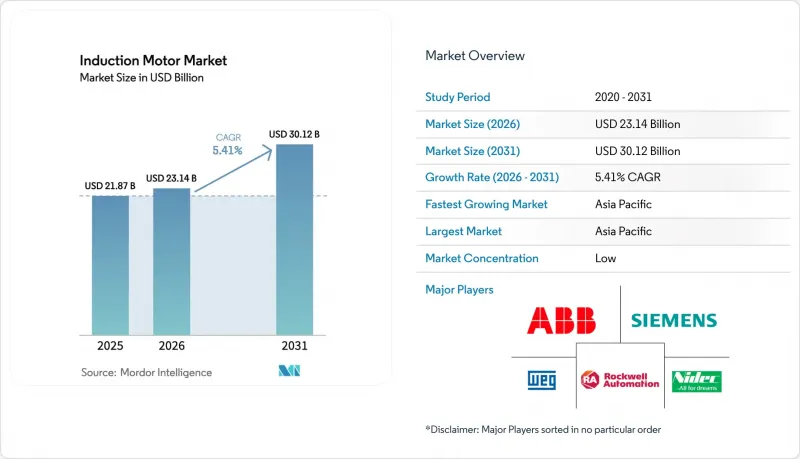
根據 Mordor Intelligence 預測,感應電動機市場規模預計將從 2025 年的 218.7 億美元成長到 2026 年的 231.4 億美元,到 2031 年達到 301.2 億美元,2026 年至 2031 年的複合年成長率為 5.41%。
本報告按轉子類型(例如,鼠籠式感應電動機)、相數(單相感應電動機、三相感應電動機)、能源效率等級(例如,IE1標準能效)、應用領域(例如,泵浦、風機和鼓風機)、終端用戶產業(例如,製造業、石油、天然氣和化學工業)以及地區進行細分。市場預測以美元(USD)計價。
全球感應電動機市場趨勢及洞察
工業系統中高效率馬達標準的廣泛應用
工業馬達系統電力消耗佔比很高,而能源效率政策是推動性能提升和維修的最強勁動力。歐盟的生態設計架構規定,自2023年中期起,75-200千瓦三相馬達的最低能源效率標準為IE4。同時,美國於2024年1月最終確定了風機和鼓風機的標準,旨在促進商用和工業空氣系統中變速和高效能馬達驅動的結合應用。中國的GB 18613-2020標準將0.75-375千瓦馬達的標準提升至IE3,縮小了區域差異,並為高能源效率設計確立了標準。聯合國主導的示範法規將於2025年發布,該法規將指南各國加速實施,並為不同市場(其執法準備程度各不相同)提供分階段過渡路徑。這些法規將採購標準轉向全生命週期性能,從而促進IE3和IE4馬達的升級,並推動變頻器在泵浦和風扇領域的更廣泛應用。 IEC和各國機構制定的統一測試規程將消除技術上的模糊之處,使感應馬達市場能夠透過標準化合規性實現成本節約。
加速工業自動化和流程最佳化項目
隨著工廠的現代化和數位轉型,對能夠在變負載下高效運行的整合式馬達驅動裝置的需求日益成長。變頻驅動器 (VFD) 可降低變轉矩應用中的能耗,並在暖通空調 (HVAC)、供水和物料輸送等現代化改造專案中發揮核心作用。變速功能被納入美國風扇和鼓風機設計標準的要求,這體現在新建和維修專案的馬達選型和控制策略中。原始設備製造商 (OEM) 正在更新驅動平台,以適應更多軸數、更嚴格的安全特性和更簡便的整合,從而降低大規模自動化部署的整體擁有成本。與三相感應電動機配合使用時,驅動器可提高部分負載下的效率,降低機械應力,並延長高佔空比下的使用壽命。隨著工業用戶優先考慮能源效率和提高運作,這些趨勢將繼續推動感應電動機市場的發展。
與永磁馬達和同步磁阻馬達。
永磁馬達在多種運作週期內均具有效率優勢,近期針對風機和鼓風機的相關法規也認可電子整流設計是通風設備的最高標準。同步磁阻馬達無需磁鐵即可達到IE5級能效,並且與合適的驅動裝置配合使用時,可作為低風險、高效率的選擇。這些替代方案可能會對那些優先考慮峰值性能和緊湊外形尺寸的細分市場中對卓越能源效率的需求構成挑戰。然而,這些馬達需要變速控制,且不能直接啟動(DOL),因此感應馬達在恆速運轉和惡劣環境下仍然發揮作用。在永磁馬達設計中,磁鐵供應的不穩定性以及價格波動仍然是需要關注的問題,從總成本和風險的角度來看,無磁性方案仍然具有吸引力。這種平衡體現在原始設備製造商(OEM)的產品藍圖和新產品發布中,他們正在建立涵蓋感應馬達、同步磁阻馬達和永磁馬達產品線的組合,以滿足用戶的多樣化需求。
細分市場分析
預計到2025年,鼠籠式感應電動機將佔據感應電動機市場55%的佔有率,並在2031年之前以7.34%的複合年成長率成長。其主導地位得益於無刷轉子結構、堅固的壓鑄條和端環,以及在嚴苛運作週期下較低的維護成本。隨著各地區對IE3和IE4標準的逐步推進,採用最佳化繞組、軸承和絕緣的變頻驅動感應電動機已成為現代驅動系統的標準配備。採用銅轉子的型號透過降低轉子損耗並在不使用稀土元素磁鐵的情況下提高效率,正在推動高階市場的普及。 IEC測試和效率分類架構提供了正弦波和變頻電源條件下的比較基準,幫助採購團隊評估生命週期成本降低的潛力。在感應電動機市場,堅固耐用的鼠籠式設計仍然是泵浦、風機、輸送機和通用驅動裝置等工業應用的首選。
繞線式轉子設計目前仍局限於一些需要外部轉子電阻以實現精確扭矩曲線的特定應用領域,例如大型起吊裝置和泥漿泵。變頻器驅動的鼠籠式轉子馬達正逐漸取代繞線式轉子電機,其動態控制功能無需電刷和滑環。這種轉變透過減少維護和延長使用壽命,影響營運商的長期成本決策。隨著原始設備製造商 (OEM) 將其銅轉子產品擴展到更大尺寸的機架,安裝基礎將轉向更有效率且面積相近的感應電動機平台。先前豁免的馬達類別(例如煞車馬達和防爆裝置)的 IE3 和 IE4 法規的實施,也推動剩餘安裝基礎向更高效率等級邁進。這些技術和法規趨勢支撐著鼠籠式結構在感應電動機市場中保持穩定的市場佔有率。
到2025年,單相馬達將佔據53%的市場佔有率,主要應用於住宅和低功率應用領域;而三相馬達預計到2031年將以6.76%的複合年成長率成長。由於三相馬達具有更高的扭矩密度、更平穩的運行和更優異的功率因數,它們正逐漸成為工業和商業安裝的標準選擇。變頻驅動器(VFD)能夠精確控制流量和壓力,從而在泵浦和風扇等變扭矩負載中實現節能。歐盟和中國向高能源效率標準的轉變,正在推動商業暖通空調和輕工業領域用三相馬達取代現有馬達。在許多維修項目中,改用配備變頻驅動器的三相馬達可以提高部分負載下的性能並減少機械磨損。隨著自動化和能源效率成為關鍵的設計目標,這些趨勢正在推動感應電動機市場採用三相架構。
工業配電標準建議使用 400V、460V 或 575V 三相電源,簡化了重載馬達的選用。模組化產品線提供多種極數配置和機架尺寸,可實現即插即用,最大限度地減少停機時間。數位銘牌和透過單電纜技術實現的整合回饋,加快了與現代控制系統的試運行。整合到驅動器和閘道器中的預測性維護工具依靠穩定的三相波形進行精確診斷,從而提升可靠性。隨著配備變頻器的三相馬達在商業建築和工廠中日益普及,操作人員可以受益於統一的維護流程。這一趨勢也體現在感應馬達市場,常用尺寸範圍的產品目錄不斷擴展,並提供與變頻器相容的額定值。
區域分析
預計到2025年,亞太地區將佔據62%的市場佔有率,並在2031年之前以6.98%的複合年成長率成長,這主要得益於該地區生產流程的日益精湛與終端用戶需求之間的互補關係。半導體製造、汽車組裝和出口導向製造業構成了未來多年電機和驅動器採購管道的基礎。符合IE3及更高標準的區域政策也推動了大尺寸高效產品的普及。在主要沿海市場,水處理和高效暖通空調系統(HVAC)的需求優先考慮,從而帶動了三相變頻驅動(VFD)最佳化系統的訂單穩定成長。隨著本週期更多晶圓廠專案的規劃,潔淨室暖通空調、泵浦和物料搬運系統仍是強勁的需求來源。這些因素鞏固了感應電動機市場作為亞太地區工業發展重要供應來源的地位。
北美作為成熟市場,持續佔據全球整體18-20%的市場佔有率,該市場重視維修工作的品質和全生命週期服務。美國風機和鼓風機法規的製定正式認可了變速作為合規手段,從而增強了高效率馬達和驅動器的商業價值。近岸外包技術的進步正在提升墨西哥工廠對馬達的需求,這些工廠為汽車和電子供應鏈提供支援。資料中心建設持續推動高效暖通空調馬達和精密系統的訂單,這些系統需要在嚴格的運轉率目標下運作。原始設備製造商(OEM)正在投資美國產能,包括為先進的暖通空調和運動控制產品建造新的組裝和測試生產線。隨著能源標準和基礎設施投資決定支出重點,這些發展正在增強感應馬達市場。
歐洲佔15-17%的市場佔有率,這主要得益於嚴格的生態設計要求以及在危險區域、海上市場和重工業等領域對高階應用的需求。 75-200千瓦功率頻寬內的IE4認證是強制性的,加之IE3認證的廣泛適用性,持續推動用戶轉型為更高能源效率等級。原始設備製造商(OEM)正在擴大在歐洲的防爆馬達產能,以滿足IECEx和ATEX認證的要求。該地區對能源效率的重視使得IE4認證和整合驅動解決方案在泵浦和風扇行業極具吸引力。這些因素支撐著歐盟各行業的感應電動機市場,而一致的合規性和可追溯的性能至關重要。對區域生產和服務基礎設施的投資能夠確保對複雜項目的快速反應。
其他好處:
- Excel格式的市場預測(ME)表
- 3個月的分析師支持
目錄
第1章:引言
- 研究假設和市場定義
- 調查範圍
第2章:調查方法
第3章執行摘要
第4章 市場狀況
- 市場概覽
- 市場促進因素
- 工業系統中高效率馬達標準的廣泛應用
- 加速工業自動化和流程最佳化項目
- 擴建用水和污水基礎設施需要泵送能力
- 加強亞太地區的生產能力並重組供應鏈。
- 無磁鐵設計趨勢源自於高功率驅動裝置中稀土元素供應的風險。
- 鑄銅轉子和逆變器相容設計的改進提高了效率。
- 市場限制因素
- 與永磁馬達和同步磁阻馬達。
- 高效率馬達和變頻器維修初始部署成本。
- 銅和鋁價格的波動給馬達零件的成本帶來了壓力。
- 在暖通空調領域,EC風扇的採用正在取代建築物中傳統的感應電動機。
- 宏觀經濟因素對市場的影響
- 產業價值/價值鏈分析
- 監理情勢
- 技術展望
- 波特五力分析
第5章 市場規模與成長預測
- 按轉子類型
- 鼠籠式感應電動機
- 繞線式感應電動機
- 按階段
- 單相感應電動機
- 三相感應電動機
- 能源效率等級
- IE1標準效率感應電動機
- IE2 高效能感應電動機
- IE3 高效能感應電動機
- IE4 超高效感應電動機
- IE5 超高效感應電動機
- 透過使用
- 泵浦
- 風扇鼓風機
- 壓縮機
- 輸送機和物料輸送
- 電梯和起重機
- 暖通空調設備
- 其他用途
- 按最終用戶行業分類
- 製造業
- 石油、天然氣和化學品
- 發電和公共產業
- 水和污水處理
- 採礦和金屬
- 商業設施和建築物
- 運輸
- 住宅
- 其他終端用戶產業
- 按地區
- 北美洲
- 美國
- 加拿大
- 墨西哥
- 其他北美國家
- 南美洲
- 巴西
- 阿根廷
- 智利
- 其他南美國家
- 歐洲
- 德國
- 英國
- 法國
- 義大利
- 西班牙
- 俄羅斯
- 其他歐洲國家
- 亞太地區
- 中國
- 印度
- 日本
- 韓國
- 澳洲
- 其他亞太國家
- 中東
- 沙烏地阿拉伯
- 阿拉伯聯合大公國
- 土耳其
- 以色列
- 其他中東國家
- 非洲
- 南非
- 埃及
- 奈及利亞
- 其他非洲國家
- 北美洲
第6章 競爭情勢
- 市場集中度
- 策略趨勢
- 市佔率分析
- 公司簡介
- ABB Ltd.
- Siemens AG
- WEG SA
- Nidec Corporation
- Wolong Electric Group Co., Ltd.
- Regal Rexnord Corporation
- TECO Electric and Machinery Co., Ltd.
- Toshiba Corporation
- Toshiba Mitsubishi-Electric Industrial Systems Corporation
- Getriebebau NORD GmbH & Co. KG
- SEW-EURODRIVE GmbH & Co KG
- CG Power and Industrial Solutions Limited
- Kirloskar Electric Company Limited
- Rockwell Automation Inc.
- Hitachi, Ltd.
- Yaskawa Electric Corporation
- Oriental Motor Co., Ltd.
- Bonfiglioli Riduttori SpA
- Sumitomo Heavy Industries, Ltd.
- Brook Crompton UK Limited
- Hyundai Electric and Energy Systems Co., Ltd.
第7章 市場機會與未來展望
According to Mordor Intelligence, the induction motor market size is expected to increase from USD 21.87 billion in 2025 to USD 23.14 billion in 2026 and reach USD 30.12 billion by 2031, growing at a CAGR of 5.41% over 2026-2031.
This report is Segmented by Rotor Type (Squirrel-Cage Induction Motors, and More), Phase (Single-Phase Induction Motors, Three-Phase Induction Motors), Efficiency Class (IE1 Standard Efficiency, and More), Application (Pumps, Fans and Blowers, and More), End-User Industry (Manufacturing, Oil and Gas and Chemicals, and More), and Geography. The Market Forecasts are Provided in Terms of Value (USD).
Global Induction Motor Market Trends and Insights
Rising Adoption of Energy-Efficient Motor Standards in Industrial Systems
Industrial motor systems account for a significant share of electricity use, making energy-efficiency policies the single strongest lever for performance upgrades and retrofit cycles. The European Union's Ecodesign framework set IE4 as the minimum for 75-200 kW three-phase motors from mid-2023. Meanwhile, the United States finalized fan and blower standards in January 2024, which promote variable speed and high-efficiency motor-drive pairings across commercial and industrial air systems. China's GB 18613-2020 has moved the baseline to IE3 for motors with a capacity of 0.75-375 kW, narrowing regional gaps and creating a scale for premium-efficiency designs. UN-led model regulations, published in 2025, provide a template for countries to accelerate adoption, with differentiated pathways for markets at varying levels of enforcement readiness. These rules shift purchase criteria toward lifecycle performance, which supports upgrades to IE3 and IE4 motors and broader deployment of VFDs in pumps and fans. Harmonized test protocols from IEC and national bodies reduce technical ambiguity and help the induction motors market capture savings from standardized compliance.
Acceleration of Industrial Automation and Process Optimization Programs
Factory modernization and digital operations are increasing demand for integrated motor-drive packages that operate efficiently at variable load. Variable frequency drives reduce energy consumption in variable torque applications and are central to modernization programs in HVAC, water pumping, and materials handling. Design standards for fans and blowers in the United States embed variable speed as a pathway to compliance, which filters through to motor selection and control strategies in new and retrofit projects. OEMs have updated drive platforms to support higher axis counts, tighter safety functions, and simpler integration, which lowers total cost of ownership for large-scale automation deployments. When paired with three-phase induction motors, drives improve part-load efficiency and reduce mechanical stress, extending service life in high-duty cycles. These dynamics continue to support the induction motors market as industrial users prioritize energy and uptime gains.
Competition from Permanent-Magnet and Synchronous-Reluctance Motor Alternatives
Permanent-magnet machines hold an efficiency edge in many duty cycles, and recent rules for fans and blowers acknowledge electronically commutated designs as the top-tier benchmark in air-moving equipment. Synchronous reluctance motors achieve IE5-class performance without magnets and are being positioned as lower-risk, high-efficiency options when paired with matched drives. These alternatives can divert premium-efficiency demand in segments that prioritize peak performance and compact form factors. That said, they require variable speed control and cannot operate direct-on-line, which preserves the role of induction motors in fixed-speed and rugged environments. Magnet supply concentration and price swings remain a concern for permanent-magnet designs, which keeps magnet-free approaches attractive on total cost and risk grounds. OEM roadmaps and product launches reflect this balance as companies hedge portfolios across induction, SynRM, and PM lines to meet diverse user needs.
Other drivers and restraints analyzed in the detailed report include:
- Expansion of Water and Wastewater Infrastructure Requiring Pumping Capacity
- Manufacturing Capacity Additions in Asia-Pacific and Supply Chain Reconfiguration
- Magnet-Free Design Preference Amid Rare-Earth Supply Risk in High-Power Drives
- Advances in Cast-Copper Rotor and Inverter-Duty Designs Improving Efficiency
- Volatility in Copper and Aluminum Prices Pressuring Motor BOM Costs
For complete list of drivers and restraints, kindly check the Table Of Contents.
Segment Analysis
Squirrel-cage induction motors held 55% of the induction motors market share in 2025 and are forecast to grow at a 7.34% CAGR through 2031. This leadership rests on brushless rotor construction, robust die-cast bars and end rings, and low maintenance in harsh duty cycles. As compliance moved to IE3 and IE4 across regions, inverter-duty induction motors with optimized windings, bearings, and insulation became a standard pairing with modern drives. Copper-rotor variants have reduced rotor losses, enabling efficiency gains without rare-earth magnets, supporting adoption in premium tiers. IEC test and efficiency classification frameworks provide comparative benchmarks across sinusoidal and VFD-fed conditions, helping procurement teams evaluate lifecycle savings. The induction motors market continues to see specification preferences for rugged squirrel-cage designs in pumps, fans, conveyors, and general-purpose drives in industry.
Wound-rotor designs remain in niche roles that require external rotor resistance for precise torque profiles, including large hoists and slurry pumps. VFD-driven squirrel-cage alternatives have displaced wound-rotor options in many cases by offering dynamic control without brushes or slip rings. This shift reduces maintenance and extends service life, which influences long-term cost decisions for operators. As OEMs extend copper-rotor availability to larger frames, the installed base will shift toward more efficient induction platforms at similar footprint. IE3 and IE4 rules for previously exempt motor categories, such as brake motors and explosion-proof units, are pulling the rest of the base toward premium tiers. These technical and regulatory trends support share stability for squirrel-cage configurations in the induction motors market.
Single-phase motors held 53% share in 2025, centered in residential and fractional-HP uses, while three-phase motors are forecast to expand at a 6.76% CAGR through 2031. Three-phase machines deliver higher torque density, smoother operation, and better power factor, which makes them the default choice in industrial and commercial installations. Variable speed drives allow precise control of flow and pressure, which unlocks energy savings in variable torque loads like pumps and fans. The move toward premium efficiency standards in both the European Union and China incentivizes three-phase upgrades in commercial HVAC and light industrial settings. In many retrofits, swapping to three-phase motors with VFDs improves part-load performance and reduces mechanical wear. These dynamics reinforce adoption of three-phase architectures in the induction motors market as automation and energy efficiency become core design goals.
Industrial distribution standards favor three-phase power at 400 V, 460 V, or 575 V, which simplifies motor selection for larger loads. Modular product families with multiple pole configurations and frame sizes support drop-in replacements that minimize downtime. Digital nameplates and integrated feedback via single-cable technologies make commissioning faster with modern controls. Predictive monitoring tools built into drives and gateways rely on stable three-phase waveforms for accurate diagnostics, which complements reliability goals. As commercial buildings and factories standardize on three-phase motors with VFDs, operators benefit from unified maintenance practices. The induction motors market reflects these preferences with broader catalog coverage and inverter-duty ratings across common size ranges.
Complete Report Scope:
- By Rotor Type
- Squirrel-Cage Induction Motors
- Wound-Rotor Induction Motors
- By Phase
- Single-Phase Induction Motors
- Three-Phase Induction Motors
- By Efficiency Class
- IE1 Standard Efficiency Induction Motors
- IE2 High Efficiency Induction Motors
- IE3 Premium Efficiency Induction Motors
- IE4 Super Premium Efficiency Induction Motors
- IE5 Ultra Premium Efficiency Induction Motors
- By Application
- Pumps
- Fans and Blowers
- Compressors
- Conveyors and Material Handling
- Elevators and Cranes
- HVAC Equipment
- Other Applications
- By End-User Industry
- Manufacturing
- Oil and Gas and Chemicals
- Power Generation and Utilities
- Water and Wastewater
- Mining and Metals
- Commercial and Buildings
- Transportation
- Residential
- Other End-User Industry
- By Geography
- North America
- United States
- Canada
- Mexico
- Rest of North America
- South America
- Brazil
- Argentina
- Chile
- Rest of South America
- Europe
- Germany
- United Kingdom
- France
- Italy
- Spain
- Russia
- Rest of Europe
- Asia-Pacific
- China
- India
- Japan
- South Korea
- Australia
- Rest of Asia-Pacific
- Middle East
- Saudi Arabia
- United Arab Emirates
- Turkey
- Israel
- Rest of Middle East
- Africa
- South Africa
- Egypt
- Nigeria
- Rest of Africa
- North America
Geography Analysis
The Asia-Pacific region held a 62% share in 2025 and is projected to grow at a 6.98% CAGR through 2031, as production depth and end-use demand reinforce each other in the region. Fabs, automotive assembly, and export-oriented manufacturing anchor multi-year procurement pipelines for motors and drives. Regional policy alignment with IE3 and above also supports the adoption of premium efficiency in larger frame sizes. Major coastal markets prioritize water treatment and high-efficiency HVAC, resulting in a steady order flow for three-phase, VFD-optimized systems. With more fab projects scheduled through the current cycle, cleanroom HVAC, pumps, and handling systems remain a reliable pull. These factors support the induction motor market as a critical supplier to APAC industrial development.
North America maintains an 18-20% range of global activity as a mature base that emphasizes retrofit quality and lifecycle services. The United States rulemaking for fans and blowers formalizes variable speed as a compliance pathway and strengthens the business case for high-efficiency motors and drives. Nearshoring has increased demand for motors in Mexican plants serving automotive and electronics supply chains. Data-center construction continues to drive orders for high-efficiency HVAC motors and precision systems that operate within strict uptime targets. OEMs invest in U.S. capacity, including new assembly and testing lines that are aligned with advanced HVAC and motion products. These actions strengthen the induction motors market as energy standards and infrastructure investments guide spending priorities.
Europe's share is 15-17% and is shaped by strict Ecodesign requirements and premium application demand in hazardous areas, offshore, and heavy industry. IE4 mandates in the 75-200 kW range, along with IE3 coverage across broader bands, continue to encourage users to move to higher tiers. OEMs have expanded European capacity for explosion-proof motors that meet IECEx and ATEX certifications. The region's focus on energy efficiency makes IE4 and integrated drive solutions attractive in pumps and fans. These drivers sustain the induction motors market across EU industries that demand consistent compliance and traceable performance. Investments in regional production and service capabilities support fast turnaround for complex projects.
- ABB Ltd.
- Siemens AG
- WEG S.A.
- Nidec Corporation
- Wolong Electric Group Co., Ltd.
- Regal Rexnord Corporation
- TECO Electric and Machinery Co., Ltd.
- Toshiba Corporation
- Toshiba Mitsubishi-Electric Industrial Systems Corporation
- Getriebebau NORD GmbH & Co. KG
- SEW-EURODRIVE GmbH & Co KG
- CG Power and Industrial Solutions Limited
- Kirloskar Electric Company Limited
- Rockwell Automation Inc.
- Hitachi, Ltd.
- Yaskawa Electric Corporation
- Oriental Motor Co., Ltd.
- Bonfiglioli Riduttori S.p.A.
- Sumitomo Heavy Industries, Ltd.
- Brook Crompton UK Limited
- Hyundai Electric and Energy Systems Co., Ltd.
Additional Benefits:
- The market estimate (ME) sheet in Excel format
- 3 months of analyst support
TABLE OF CONTENTS
1 INTRODUCTION
- 1.1 Study Assumptions and Market Definition
- 1.2 Scope of the Study
2 RESEARCH METHODOLOGY
3 EXECUTIVE SUMMARY
4 MARKET LANDSCAPE
- 4.1 Market Overview
- 4.2 Market Drivers
- 4.2.1 Rising Adoption of Energy-Efficient Motor Standards in Industrial Systems
- 4.2.2 Acceleration of Industrial Automation and Process Optimization Programs
- 4.2.3 Expansion of Water and Wastewater Infrastructure Requiring Pumping Capacity
- 4.2.4 Manufacturing Capacity Additions in Asia-Pacific and Supply Chain Reconfiguration
- 4.2.5 Magnet-Free Design Preference Amid Rare-Earth Supply Risk in High-Power Drives
- 4.2.6 Advances in Cast-Copper Rotor and Inverter-Duty Designs Improving Efficiency
- 4.3 Market Restraints
- 4.3.1 Competition from Permanent-Magnet and Synchronous-Reluctance Motor Alternatives
- 4.3.2 Upfront Price Premium of Premium-Efficiency Motors and VFD Retrofits
- 4.3.3 Volatility in Copper and Aluminum Prices Pressuring Motor BOM Costs
- 4.3.4 EC Fan Adoption in HVAC Displacing Traditional Induction Motors in Buildings
- 4.4 Impact of Macroeconomic Factors on the Market
- 4.5 Industry Value / Supply-Chain Analysis
- 4.6 Regulatory Landscape
- 4.7 Technological Outlook
- 4.8 Porter's Five Forces Analysis
- 4.8.1 Threat of New Entrants
- 4.8.2 Bargaining Power of Suppliers
- 4.8.3 Bargaining Power of Buyers
- 4.8.4 Threat of Substitutes
- 4.8.5 Industry Rivalry
5 MARKET SIZE AND GROWTH FORECASTS (Value)
- 5.1 By Rotor Type
- 5.1.1 Squirrel-Cage Induction Motors
- 5.1.2 Wound-Rotor Induction Motors
- 5.2 By Phase
- 5.2.1 Single-Phase Induction Motors
- 5.2.2 Three-Phase Induction Motors
- 5.3 By Efficiency Class
- 5.3.1 IE1 Standard Efficiency Induction Motors
- 5.3.2 IE2 High Efficiency Induction Motors
- 5.3.3 IE3 Premium Efficiency Induction Motors
- 5.3.4 IE4 Super Premium Efficiency Induction Motors
- 5.3.5 IE5 Ultra Premium Efficiency Induction Motors
- 5.4 By Application
- 5.4.1 Pumps
- 5.4.2 Fans and Blowers
- 5.4.3 Compressors
- 5.4.4 Conveyors and Material Handling
- 5.4.5 Elevators and Cranes
- 5.4.6 HVAC Equipment
- 5.4.7 Other Applications
- 5.5 By End-User Industry
- 5.5.1 Manufacturing
- 5.5.2 Oil and Gas and Chemicals
- 5.5.3 Power Generation and Utilities
- 5.5.4 Water and Wastewater
- 5.5.5 Mining and Metals
- 5.5.6 Commercial and Buildings
- 5.5.7 Transportation
- 5.5.8 Residential
- 5.5.9 Other End-User Industry
- 5.6 By Geography
- 5.6.1 North America
- 5.6.1.1 United States
- 5.6.1.2 Canada
- 5.6.1.3 Mexico
- 5.6.1.4 Rest of North America
- 5.6.2 South America
- 5.6.2.1 Brazil
- 5.6.2.2 Argentina
- 5.6.2.3 Chile
- 5.6.2.4 Rest of South America
- 5.6.3 Europe
- 5.6.3.1 Germany
- 5.6.3.2 United Kingdom
- 5.6.3.3 France
- 5.6.3.4 Italy
- 5.6.3.5 Spain
- 5.6.3.6 Russia
- 5.6.3.7 Rest of Europe
- 5.6.4 Asia-Pacific
- 5.6.4.1 China
- 5.6.4.2 India
- 5.6.4.3 Japan
- 5.6.4.4 South Korea
- 5.6.4.5 Australia
- 5.6.4.6 Rest of Asia-Pacific
- 5.6.5 Middle East
- 5.6.5.1 Saudi Arabia
- 5.6.5.2 United Arab Emirates
- 5.6.5.3 Turkey
- 5.6.5.4 Israel
- 5.6.5.5 Rest of Middle East
- 5.6.6 Africa
- 5.6.6.1 South Africa
- 5.6.6.2 Egypt
- 5.6.6.3 Nigeria
- 5.6.6.4 Rest of Africa
- 5.6.1 North America
6 COMPETITIVE LANDSCAPE
- 6.1 Market Concentration
- 6.2 Strategic Moves
- 6.3 Market Share Analysis
- 6.4 Company Profiles {(includes Global level Overview, Market level overview, Core Segments, Financials as available, Strategic Information, Market Rank/Share for key companies, Products and Services, and Recent Developments)}
- 6.4.1 ABB Ltd.
- 6.4.2 Siemens AG
- 6.4.3 WEG S.A.
- 6.4.4 Nidec Corporation
- 6.4.5 Wolong Electric Group Co., Ltd.
- 6.4.6 Regal Rexnord Corporation
- 6.4.7 TECO Electric and Machinery Co., Ltd.
- 6.4.8 Toshiba Corporation
- 6.4.9 Toshiba Mitsubishi-Electric Industrial Systems Corporation
- 6.4.10 Getriebebau NORD GmbH & Co. KG
- 6.4.11 SEW-EURODRIVE GmbH & Co KG
- 6.4.12 CG Power and Industrial Solutions Limited
- 6.4.13 Kirloskar Electric Company Limited
- 6.4.14 Rockwell Automation Inc.
- 6.4.15 Hitachi, Ltd.
- 6.4.16 Yaskawa Electric Corporation
- 6.4.17 Oriental Motor Co., Ltd.
- 6.4.18 Bonfiglioli Riduttori S.p.A.
- 6.4.19 Sumitomo Heavy Industries, Ltd.
- 6.4.20 Brook Crompton UK Limited
- 6.4.21 Hyundai Electric and Energy Systems Co., Ltd.
7 MARKET OPPORTUNITIES AND FUTURE OUTLOOK
- 7.1 White-Space and Unmet-Need Assessment

 亞太地區感應電動機:市場佔有率分析、產業趨勢與統計及成長預測(2026-2031)北美感應電動機:市場佔有率分析、產業趨勢與統計及成長預測(2026-2031 年)北美低壓感應電動機:市場佔有率分析、產業趨勢與統計及成長預測(2026-2031 年)
 全球感應電動機市場規模、佔有率、趨勢和成長分析報告(2026-2034)
 感應馬達市場:2026-2032年全球市場預測(按類型、安裝方式、能源效率等級、功率輸出、應用、終端用戶產業和銷售管道)
 2026-2034年感應電動機市場規模、佔有率、趨勢及預測(依產品類型、最終用途產業及地區分類)以相數、機殼、電壓、額定功率、轉速、安裝方式和應用分類的鼠籠式感應電動機市場-2026-2032年全球預測
 感應電動機市場機會、成長要素、產業趨勢分析及預測(2026年至2035年)
 感應馬達市場-全球產業規模、佔有率、趨勢、機會及預測(細分、按類型、按應用、按地區、按競爭,2020-2030 年預測)歐洲感應電動機:市場佔有率分析、產業趨勢與統計、成長預測(2025-2030)