


 |
市場調查報告書
商品編碼
2124967
安防應用的影像感測器:市場佔有率分析、產業趨勢與統計及成長預測(2026-2031 年)Image Sensor For Security Application - Market Share Analysis, Industry Trends & Statistics, Growth Forecasts (2026 - 2031) |
||||||

※ 本網頁內容可能與最新版本有所差異。詳細情況請與我們聯繫。
據 Mordor Intelligence 稱,2025 年安全影像感測器市值為 34.4 億美元,預計到 2031 年將達到 55.5 億美元,而 2026 年為 37.3 億美元,預測期(2026-2031 年)的複合年成長率為 8.32%。
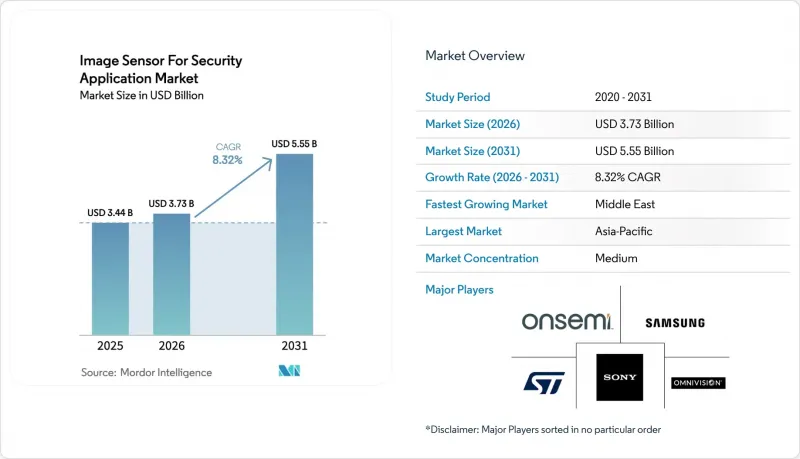
本報告按應用(家用安防攝影機等)、技術(CCD影像感測器等)、頻譜(可見頻譜感測器等)、處理方法(2D影像感測器、3D/飛行時間(ToF)影像感測器等)、最終用戶領域(住宅、關鍵基礎設施等)和地區進行細分。市場預測以價值(美元)表示。
全球影像感測器市場趨勢及安防應用洞察
智慧城市需求增加
利雅德、杜拜、深圳和海得拉巴的智慧城市計畫正在部署密度超過每平方公里1000個節點的鏡頭,由此產生的吞吐量負載只有具備片上推理能力和嵌入式DRAM的感測器才能有效應對。光是沙烏地阿拉伯的NEOM計畫就已簽訂契約,計畫到2024年在26500平方公里的範圍內部署5萬個支援人工智慧的鏡頭,用於即時分析人群流量。這些部署優先採用堆疊式CMOS架構,因為DRAM層無需使用外部記憶體即可緩衝60fps的4K視訊串流,進而將回程傳輸頻寬降低70%。印度的「智慧城市計畫」已累計4,800億印度盧比(約58億美元)用於在2024年實現這一目標,採購指南要求將高達22%的項目支出分配給感測器,這創造了一個巨大的潛在市場。在每個市場,資料主權法規都要求設計人員採用加密的片上存儲,以確保生物識別影像永遠不會跨越國界。
在邊緣整合人工智慧驅動的影像分析
透過將推理處理從雲端轉移到攝影機,偵測延遲可以從 800 毫秒降低到 50 毫秒以內。這在周界安防中至關重要,因為入侵者可以在幾秒鐘內突破關鍵距離。索尼的 IMX500 感測器正是這種模式的體現,它以 12fps 的幀率運行 MobileNet 和 EfficientNet,功耗低於 1W,使電池供電的設備單次充電即可運作18 個月。這種設計轉變正在重塑市場格局。感測器供應商現在正與人工智慧軟體公司合作,提供承包解決方案,而攝影機 OEM 廠商的差異化優勢不再體現在像素數量上,而是體現在模型庫上。諸如歐盟《人工智慧法案》等合規框架強制要求嵌入式推理元資料記錄和安全的無線韌體更新,這進一步鞏固了晶片而非伺服器的價值。
大型晶片影像感測器的製造成本很高
對於尺寸超過 12mm x 12mm 的晶片,300mm 晶圓的良率通常低於 60%,導致單位成本超過 40 美元,使得價格敏感型應用難以普及。堆疊式架構會使封裝成本增加 8-15 美元,只有在邊緣 AI 或超高影格速率至關重要時,投資回報才具有合理性。索尼和 Tower 佔據了堆疊式影像感測器產能的大部分,兩家公司都優先滿足高利潤的行動電話和汽車領域的客戶需求,這迫使安防領域的買家在旺季期間排隊等待 26 週甚至更久。因此,系統整合商正在重新考慮更小的晶片,甚至考慮為特定低光照應用採用 CCD 設計,這表明製造成本如何影響解決方案設計。
細分市場分析
儘管國防和邊境監控領域的訂單量較小,但它們正為安防影像感測器市場帶來溢價。這是因為熱成像和短波紅外線(SWIR)型號的價格是商用CMOS感測器的3到5倍,因此在採購中更受青睞。預計該細分市場將以11.05%的複合年成長率(CAGR)成為所有應用領域中成長最快的,這反映了東歐、南海和中東地區日益緊張的局勢。商業監控領域預計到2025年將佔據安防影像感測器市場45.98%的佔有率,並將繼續在購物中心、物流中心和企業園區等場所保持其主導地位,但隨著北美和歐洲市場接近飽和,該領域正趨於成熟。家庭安防領域在2024年經歷了快速成長,這得益於訂閱模式,該模式可以抵消硬體成本並提供持續的收入來源。它也仍然是新興邊緣人工智慧能力的重要來源。基礎設施和交通監控領域則是成長均衡、較溫和的細分市場。目前新加坡、東京和杜拜的智慧型運輸系統(ITS) 需要 400 萬像素的解析度和寬動態範圍,才能即使在強光或夜間辨識車牌。
國防領域的趨勢也反映了技術的相互作用。非製冷微測輻射熱計陣列和InGaAs焦平面元件正逐步從航太領域滲透到地面應用領域。美國國防部2024年簽訂的一份價值3.4億美元的訂單正在推動對國產感測器的需求,並確保穩定的供應鏈。相較之下,民間買家更傾向於整合神經加速器的影像感測器,這種感測器可將誤報率降低高達80%,並顯著降低監控中心的人事費用。雖然這些架構推高了平均售價,但它們降低了整體擁有成本(TCO)。新的轉變模式清晰可見:先進功能首先出現在國防領域,然後擴展到關鍵基礎設施,最終,隨著成本曲線的下降,它又擴展到住宅設備。
預計到2025年,CMOS將佔據安防影像感測器市場91.62%的主導地位,並且隨著矽晶片小型化不斷降低像素成本,其出貨量持續強勁成長。然而,其優勢之下也暗藏隱患。 InGaAs短波紅外線裝置雖然市場佔有率仍處於個位數,但隨著邊防安全機構對高隱藏性夜視設備的需求,其複合年成長率(CAGR)正以9.28%的速度成長。曾經佔據主導地位的CCD在2024年的出貨量下降了12%,但目前仍未出現完全退出市場的跡象。其卓越的量子效率支撐著科學監測領域對CCD的持續需求,而量子極限檢測在該領域至關重要。在CMOS晶圓上堆疊量子點的技術正在崛起,成為InGaAs的成本競爭對手,儘管靈敏度有所降低,但單位成本可降低40%至60%。
泰萊半導體(Teledyne)收購了Tower Semiconductor的300毫米生產線後,於2024年將其InGaAs產能擴大了30%,這表明該公司對國防領域的需求充滿信心。同時,堆疊式CMOS製程仍然是研發的重點,因為它透過邏輯和像素的分離,實現了高解析度和人工智慧整合。由於晶圓長期短缺,許多中型系統整合商不得不重新採用200毫米工藝,以平衡成本、供貨和性能。隨著代工廠在2026年運作用於CMOS影像感測器的300毫米生產線,這種權衡差距可能會縮小,但在此之前,利基市場的創新仍然具有重要的戰略意義。因此,儘管CMOS仍是主流工藝,但隨著買家將投資分散到專業技術領域,現有製造商面臨的競爭挑戰可能會增加。
區域分析
到2025年,亞太地區將主導安防影像感測器市場,佔據42.05%的市場。這主要得益於中國龐大的社保攝影機網路(超過7億台)以及印度耗資4,800億印度盧比(約58億美元)的「智慧城市計畫」。 GalaxyCore和SmartSens等國內供應商正利用其成本優勢,以600-8美元的價格銷售500萬像素感測器,從現有製造商手中奪取市場佔有率。日本和韓國則致力於引進人工智慧賦能的養老服務,東京2024年競標1.5萬台跌倒偵測鏡頭,為應對超老齡化社會提供了一個典範案例。
中東地區以10.42%的複合年成長率 (CAGR) 保持最高的成長率,這主要得益於沙烏地阿拉伯的「NEOM」和杜拜的「智慧城市」等大型企劃。這兩個項目都要求採用人工智慧分析和片上加密技術,以符合嚴格的資料在地化法規。以色列和土耳其正在擴大用於邊境監控的熱成像和短波紅外線 (SWIR) 套件的國防採購,而波灣合作理事會(GCC) 成員國正在進行競標,將攝影機部署密度與設施風險評估掛鉤。沙塵、高溫和低對比度夜景等氣候條件正在推動堆疊式 CMOS 和 InGaAs 技術的應用,從而提升該地區訂單的價值。北美和歐洲合計將佔 2025 年銷售額的 37.55%,但由於隱私訴訟導致採購週期延長,成長速度正在放緩。儘管美國缺乏聯邦層面的隱私法,但加州的「刪除法案」和伊利諾伊州的「BIPA」使每個站點的合規成本增加了 5 萬至 20 萬美元。為了避免GDPR的處罰,歐洲買家目前傾向採用邊緣部署方案,而集中式臉部辨識系統正在多個城市逐步淘汰。國防和關鍵基礎設施項目仍在積極推進。美國國防安全保障部已撥款4.2億美元用於2024年的邊境管制系統建設,歐盟的NIS2指令也支持機場分析系統的投入。
其他好處
- Excel格式的市場預測(ME)表
- 3個月的分析師支持
目錄
第1章:引言
- 研究假設和市場定義
- 調查範圍
第2章:調查方法
第3章執行摘要
第4章 市場狀況
- 市場概覽
- 市場促進因素
- 智慧城市不斷成長的需求
- 在邊緣整合人工智慧驅動的影像分析
- 物聯網家庭安全攝影機的普及
- 關於公共安全攝影機安裝的監管義務
- 採用事件驅動型神經形態影像感測器進行低功耗監測應用。
- 用於夜間隱蔽監視的短波紅外線和頻譜感測器的發展
- 市場限制因素
- 大型晶片影像感測器的製造成本很高
- 人們日益關注資料隱私和監控法規
- 堆疊式CMOS感測器300mm晶圓產能短缺
- 感測器韌體中的漏洞會導致網路安全風險
- 價值鏈分析
- 監理情勢
- 技術展望
- 宏觀經濟因素對市場的影響
- 波特五力分析
第5章 市場規模與成長預測
- 透過使用
- 家庭安防攝影機
- 商用監視錄影機
- 基礎設施和交通監視錄影機
- 國防和邊境監視器
- 透過技術
- CMOS影像感測器
- CCD影像感測器
- 新技術(例如,InGaAs、SWIR)
- 頻譜
- 可見頻譜感測器
- 紅外線和近紅外線感測器
- 熱感應器
- 頻譜和高光譜遙測感測器
- 透過加工方法
- 2D影像感測器
- 3D/飛行時間(ToF)影像感測器
- 人工智慧晶片影像感測器
- 神經形態事件驅動感測器
- 按最終用途行業分類
- 住宅
- 商業和工業
- 關鍵基礎設施
- 政府和執法機關
- 國防/軍事
- 按地區
- 北美洲
- 美國
- 加拿大
- 墨西哥
- 歐洲
- 英國
- 德國
- 法國
- 義大利
- 其他歐洲國家
- 亞太地區
- 中國
- 日本
- 印度
- 韓國
- 其他亞太國家
- 中東和非洲
- 中東
- 沙烏地阿拉伯
- 阿拉伯聯合大公國
- 其他中東國家
- 非洲
- 南非
- 埃及
- 其他非洲地區
- 中東
- 南美洲
- 巴西
- 阿根廷
- 南美洲其他地區
- 北美洲
第6章 競爭情勢
- 市場集中度
- 策略趨勢
- 市佔率分析
- 公司簡介
- Sony Semiconductor Solutions Corporation
- Samsung Electronics Co., Ltd.
- OmniVision Technologies, Inc.
- ON Semiconductor Corporation
- STMicroelectronics NV
- GalaxyCore Shanghai Limited Corporation
- SmartSens Technology(Shanghai)Co., Ltd.
- SK hynix Inc.
- Canon Inc.
- Panasonic Holdings Corporation
- Toshiba Electronic Devices & Storage Corporation
- PixArt Imaging Inc.
- Hamamatsu Photonics KK
- Teledyne Technologies Incorporated
- ams-OSRAM AG
- Himax Technologies, Inc.
- Teledyne e2v Semiconductors SAS
- Gpixel Inc.
- Tower Semiconductor Ltd.
- Forza Silicon Corporation
第7章 市場機會與未來展望
According to Mordor Intelligence, the image sensor for security application market size was valued at USD 3.44 billion in 2025 and estimated to grow from USD 3.73 billion in 2026 to reach USD 5.55 billion by 2031, at a CAGR of 8.32% during the forecast period (2026-2031).
This report is Segmented by Application (Home Security Cameras, and More), Technology (CCD Image Sensors, and More), Spectrum (Visible Spectrum Sensors, and More), Processing Type (2D Image Sensors, 3D/Time-of-Flight Image Sensors, and More), End-Use Sector (Residential, Critical Infrastructure, and More), and Geography. The Market Forecasts are Provided in Terms of Value (USD).
Global Image Sensor For Security Application Market Trends and Insights
Growing Demand From Smart Cities
Smart-city programs in Riyadh, Dubai, Shenzhen, and Hyderabad each deploy camera densities exceeding 1,000 nodes per square kilometer, creating a throughput burden that only sensors with on-chip inference and embedded DRAM can manage effectively. Saudi Arabia's NEOM project alone awarded contracts in 2024 for 50 000 AI-ready cameras capable of real-time crowd-flow analysis across 26 500 km2. These rollouts prioritize stacked CMOS architectures because DRAM layers buffer 4K streams at 60 fps without off-sensor memory, slashing backhaul bandwidth by 70%. India's Smart Cities Mission has budgeted INR 480 billion (USD 5.8 billion) through 2024, and procurement guidelines earmark up to 22% of project spending for sensors, thereby establishing a vast addressable base. In all markets, data-sovereignty rules drive architects toward encrypted on-die storage, ensuring that biometric footage never crosses borders.
Integration of AI-Powered Video Analytics at the Edge
Moving inference from the cloud to the camera reduces detection latency from 800 ms to under 50 ms, which is vital for perimeters where intruders can cross critical distances in seconds. Sony's IMX500 sensor showcases the model, executing MobileNet and EfficientNet at 12 fps on less than 1 W and enabling battery-powered units to run 18 months on a single charge. The design shift realigns market power: sensor vendors now partner with AI software firms to deliver turnkey stacks, and camera OEMs differentiate on model libraries rather than megapixels. Compliance frameworks such as the European Union AI Act require embedded inference metadata logs and secure over-air firmware, which further cements value in the silicon rather than the server.
High Manufacturing Costs of Large-Chip Image Sensors
Die sizes beyond 12 mm by 12 mm often see yields under 60% on 300 mm wafers, pushing unit costs above USD 40 and making price-sensitive deployments infeasible. Stacked architectures add USD 8 to USD 15 in packaging, so the return on investment becomes defensible only when edge AI or ultra-high frame rates are mandatory. Sony and Tower command most of the stacked capacity, and both prioritize higher-margin handset and automotive customers, leaving security buyers in a queue that stretches past 26 weeks in peak quarters. Integrators, therefore, revisit smaller die options or even CCD designs for niche low-light needs, demonstrating how manufacturing economics ripple through solution design.
Other drivers and restraints analyzed in the detailed report include:
- Proliferation of IoT-Enabled Home Security Cameras
- Regulatory Mandates for Public Safety Camera Installations
- Increasing Concerns Over Data Privacy and Surveillance Regulations
For complete list of drivers and restraints, kindly check the Table Of Contents.
Segment Analysis
Defense and border surveillance orders, while smaller in unit volume, add premium value to the image sensor for security application market because procurement favors thermal and SWIR models with pricing multiples of three to five times commercial CMOS. The segment is forecast to post an 11.05% CAGR, the fastest among all application verticals, reflecting heightened tensions in Eastern Europe, the South China Sea, and the Middle East. Commercial surveillance, which owned 45.98% of the image sensor for security application market share in 2025, continues to dominate shopping malls, logistics hubs, and corporate campuses but is maturing in North America and Europe as saturation nears. Home security grew briskly in 2024, supported by subscription economics that subsidize hardware and add recurring revenue streams, and it remains a vital feeder for new edge-AI features. Infrastructure and traffic monitoring represents a balanced, medium-growth pocket: intelligent transportation systems in Singapore, Tokyo, and Dubai now require 4-MP resolution with wide dynamic range to register plates in glare and at night.
The defense sub-segment's performance also reflects technology cross-pollination: uncooled microbolometer arrays and InGaAs focal-plane devices trickling from aerospace into ground-based applications. Contracts from the U.S. Department of Defense worth USD 340 million in 2024 channel demand toward domestically fabricated sensors, locking in secure supply chains. Commercial buyers, by contrast, lean on image sensors with embedded neural accelerators that lower false alarms by as much as 80%, saving significant labor in monitoring centers. These architectures increase the average selling price but reduce the total cost of ownership. The emerging migration pattern is clear: advanced capabilities debut in defense, cascade into critical infrastructure, and finally arrive in residential devices as cost curves bend.
CMOS captured an overwhelming 91.62% of the image sensor for security application market size in 2025 and still records healthy unit growth because silicon scaling keeps reducing cost per pixel. Yet the same strength hides cracks. InGaAs shortwave infrared devices, though accounting for a single-digit share, are expanding at 9.28% CAGR as border agencies specify covert night-vision options. CCD, once the incumbent, declined 12% in shipments during 2024 but refuses to exit entirely; its superior quantum efficiency underpins persistent demand from scientific surveillance where quantum-limited detection is essential. Quantum-dot overlays on CMOS wafers debut as an economic challenger to InGaAs, offering 40% to 60% lower unit cost albeit at reduced sensitivity.
Teledyne ramped InGaAs capacity by 30% in 2024 after acquiring a Tower Semiconductor 300 mm line, signaling confidence in defense requirements. Meanwhile, stacked CMOS continues to attract R&D efforts because its logic-pixel separation enables both high resolution and integrated AI. The persistent wafer shortage pushes many mid-tier integrators back toward 200 mm flows, balancing cost, availability, and performance. As foundries bring 300 mm lines online for CMOS image sensors in 2026, the trade-off gap may close, but until then niche disruptions hold strategic relevance. The net result is that while CMOS remains dominant, buyer diversification into specialty technologies will raise the competitive stakes for incumbents.
Complete Report Scope:
- By Application
- Home Security Cameras
- Commercial Surveillance Cameras
- Infrastructure and Traffic Cameras
- Defense and Border Surveillance Cameras
- By Technology
- CMOS Image Sensors
- CCD Image Sensors
- Emerging Technologies (e.g., InGaAs, SWIR)
- By Spectrum
- Visible Spectrum Sensors
- Infrared and Near-Infrared Sensors
- Thermal Sensors
- Multispectral and Hyperspectral Sensors
- By Processing Type
- 2D Image Sensors
- 3D/Time-of-Flight Image Sensors
- AI-Enabled On-Chip Image Sensors
- Neuromorphic Event-Based Sensors
- By End-Use Sector
- Residential
- Commercial and Industrial
- Critical Infrastructure
- Government and Law Enforcement
- Defense and Military
- By Geography
- North America
- United States
- Canada
- Mexico
- Europe
- United Kingdom
- Germany
- France
- Italy
- Rest of Europe
- Asia-Pacific
- China
- Japan
- India
- South Korea
- Rest of Asia
- Middle East and Africa
- Middle East
- Saudi Arabia
- United Arab Emirates
- Rest of Middle East
- Africa
- South Africa
- Egypt
- Rest of Africa
- Middle East
- South America
- Brazil
- Argentina
- Rest of South America
- North America
Geography Analysis
Asia Pacific dominated with 42.05% share of the image sensor for security application market in 2025, underpinned by China's vast social-credit camera network that topped 700 million units and India's Safe City Mission funding of INR 480 billion (USD 5.8 billion). Domestic suppliers such as GalaxyCore and SmartSens leverage cost advantages, pricing 5-MP sensors at USD 6 to USD 8 and taking share from incumbents. Japan and South Korea focus on AI-enhanced elder-care deployments: Tokyo's 2024 tender for 15,000 fall-detection cameras sets a template for super-aging societies.
The Middle East clocks the fastest growth at 10.42% CAGR, propelled by mega-projects like Saudi Arabia's NEOM and Dubai's Smart City scheme, both mandating AI analytics and on-die encryption to observe strict data-localization rules. Israel and Turkey expand defense purchases for thermal and SWIR kits aimed at border surveillance, while Gulf Cooperation Council states issue tenders linking camera density to facility risk ratings. The climate, characterized by dust, heat, and low-contrast night scenes, favors stacked CMOS and InGaAs options, adding premium value to regional orders. North America and Europe jointly represented 37.55% of 2025 revenue but show slower gains because privacy litigation lengthens procurement cycles. The U.S. lacks a federal privacy law, yet California's Delete Act and Illinois' BIPA raise compliance costs per site by USD 50,000 to USD 200,000. European buyers now lean toward edge-only deployments to skirt GDPR penalties, suspending centralized facial recognition in multiple cities. That said, defense and critical-infrastructure projects remain vibrant: the U.S. Department of Homeland Security awarded USD 420 million for border systems in 2024, and the EU's NIS2 directive underpins airport analytics spending.
- Sony Semiconductor Solutions Corporation
- Samsung Electronics Co., Ltd.
- OmniVision Technologies, Inc.
- ON Semiconductor Corporation
- STMicroelectronics N.V.
- GalaxyCore Shanghai Limited Corporation
- SmartSens Technology (Shanghai) Co., Ltd.
- SK hynix Inc.
- Canon Inc.
- Panasonic Holdings Corporation
- Toshiba Electronic Devices & Storage Corporation
- PixArt Imaging Inc.
- Hamamatsu Photonics K.K.
- Teledyne Technologies Incorporated
- ams-OSRAM AG
- Himax Technologies, Inc.
- Teledyne e2v Semiconductors SAS
- Gpixel Inc.
- Tower Semiconductor Ltd.
- Forza Silicon Corporation
Additional Benefits:
- The market estimate (ME) sheet in Excel format
- 3 months of analyst support
TABLE OF CONTENTS
1 INTRODUCTION
- 1.1 Study Assumptions and Market Definition
- 1.2 Scope of the Study
2 RESEARCH METHODOLOGY
3 EXECUTIVE SUMMARY
4 MARKET LANDSCAPE
- 4.1 Market Overview
- 4.2 Market Drivers
- 4.2.1 Growing Demand from Smart Cities
- 4.2.2 Integration of AI-Powered Video Analytics at the Edge
- 4.2.3 Proliferation of IoT-Enabled Home Security Cameras
- 4.2.4 Regulatory Mandates for Public Safety Camera Installations
- 4.2.5 Adoption of Event-Based Neuromorphic Image Sensors for Low-Power Surveillance
- 4.2.6 Growth of SWIR and Multispectral Sensors for Covert Night Surveillance
- 4.3 Market Restraints
- 4.3.1 High Manufacturing Costs of Large-Chip Image Sensors
- 4.3.2 Increasing Concerns over Data Privacy and Surveillance Regulations
- 4.3.3 Shortage of 300 mm Wafer Capacity for Stacked CMOS Sensors
- 4.3.4 Vulnerabilities in Sensor Firmware Leading to Cybersecurity Risks
- 4.4 Value-Chain Analysis
- 4.5 Regulatory Landscape
- 4.6 Technological Outlook
- 4.7 Impact of Macroeconomic Factors on the Market
- 4.8 Porter's Five Forces Analysis
- 4.8.1 Bargaining Power of Buyers/Consumers
- 4.8.2 Bargaining Power of Suppliers
- 4.8.3 Threat of New Entrants
- 4.8.4 Threat of Substitute Products
- 4.8.5 Intensity of Competitive Rivalry
5 MARKET SIZE AND GROWTH FORECASTS (VALUE)
- 5.1 By Application
- 5.1.1 Home Security Cameras
- 5.1.2 Commercial Surveillance Cameras
- 5.1.3 Infrastructure and Traffic Cameras
- 5.1.4 Defense and Border Surveillance Cameras
- 5.2 By Technology
- 5.2.1 CMOS Image Sensors
- 5.2.2 CCD Image Sensors
- 5.2.3 Emerging Technologies (e.g., InGaAs, SWIR)
- 5.3 By Spectrum
- 5.3.1 Visible Spectrum Sensors
- 5.3.2 Infrared and Near-Infrared Sensors
- 5.3.3 Thermal Sensors
- 5.3.4 Multispectral and Hyperspectral Sensors
- 5.4 By Processing Type
- 5.4.1 2D Image Sensors
- 5.4.2 3D/Time-of-Flight Image Sensors
- 5.4.3 AI-Enabled On-Chip Image Sensors
- 5.4.4 Neuromorphic Event-Based Sensors
- 5.5 By End-Use Sector
- 5.5.1 Residential
- 5.5.2 Commercial and Industrial
- 5.5.3 Critical Infrastructure
- 5.5.4 Government and Law Enforcement
- 5.5.5 Defense and Military
- 5.6 By Geography
- 5.6.1 North America
- 5.6.1.1 United States
- 5.6.1.2 Canada
- 5.6.1.3 Mexico
- 5.6.2 Europe
- 5.6.2.1 United Kingdom
- 5.6.2.2 Germany
- 5.6.2.3 France
- 5.6.2.4 Italy
- 5.6.2.5 Rest of Europe
- 5.6.3 Asia-Pacific
- 5.6.3.1 China
- 5.6.3.2 Japan
- 5.6.3.3 India
- 5.6.3.4 South Korea
- 5.6.3.5 Rest of Asia
- 5.6.4 Middle East and Africa
- 5.6.4.1 Middle East
- 5.6.4.1.1 Saudi Arabia
- 5.6.4.1.2 United Arab Emirates
- 5.6.4.1.3 Rest of Middle East
- 5.6.4.2 Africa
- 5.6.4.2.1 South Africa
- 5.6.4.2.2 Egypt
- 5.6.4.2.3 Rest of Africa
- 5.6.4.1 Middle East
- 5.6.5 South America
- 5.6.5.1 Brazil
- 5.6.5.2 Argentina
- 5.6.5.3 Rest of South America
- 5.6.1 North America
6 COMPETITIVE LANDSCAPE
- 6.1 Market Concentration
- 6.2 Strategic Moves
- 6.3 Market Share Analysis
- 6.4 Company Profiles (includes Global Level Overview, Market Level Overview, Core Segments, Financials as Available, Strategic Information, Market Rank/Share for Key Companies, Products and Services, and Recent Developments)
- 6.4.1 Sony Semiconductor Solutions Corporation
- 6.4.2 Samsung Electronics Co., Ltd.
- 6.4.3 OmniVision Technologies, Inc.
- 6.4.4 ON Semiconductor Corporation
- 6.4.5 STMicroelectronics N.V.
- 6.4.6 GalaxyCore Shanghai Limited Corporation
- 6.4.7 SmartSens Technology (Shanghai) Co., Ltd.
- 6.4.8 SK hynix Inc.
- 6.4.9 Canon Inc.
- 6.4.10 Panasonic Holdings Corporation
- 6.4.11 Toshiba Electronic Devices & Storage Corporation
- 6.4.12 PixArt Imaging Inc.
- 6.4.13 Hamamatsu Photonics K.K.
- 6.4.14 Teledyne Technologies Incorporated
- 6.4.15 ams-OSRAM AG
- 6.4.16 Himax Technologies, Inc.
- 6.4.17 Teledyne e2v Semiconductors SAS
- 6.4.18 Gpixel Inc.
- 6.4.19 Tower Semiconductor Ltd.
- 6.4.20 Forza Silicon Corporation
7 MARKET OPPORTUNITIES AND FUTURE OUTLOOK
- 7.1 White-Space and Unmet-Need Assessment

 車載監控系統市場預測至2034年-全球分析(依系統類型、組件、駕駛監控功能、乘員監控功能、車輛類型、車輛等級、驅動系統、應用、最終用戶及地區分類)
 歐洲影像感測器:市場佔有率分析、產業趨勢與統計及成長預測(2026-2031)影像感測器:市場佔有率分析、產業趨勢與統計、成長預測(2026-2031)
 影像感測器市場:2026-2032年全球市場預測(按感測器類型、光譜範圍、影像解析度、處理方法、終端用戶產業和分銷管道分類)影像感測器市場預測至2034年-全球技術、頻譜、處理方法、陣列方法、解析度、百葉窗方法、封裝方法、終端應用產業及區域分析
 全球影像感測器市場(至2032年):按類型、處理方法、頻譜、陣列、解析度和應用分類
 InGaAs影像感測器市場-全球產業規模、佔有率、趨勢、機會、預測:按類型、波長、應用、最終用戶、地區和競爭格局分類,2021-2031年
 模組化低光感測器市場報告:趨勢、預測和競爭分析(至2035年)影像感測器市場預測至2034年—頻譜、處理方法、技術、最終用戶和地區分類的全球分析
 車內監控(DMS、OMS)市場(2026 年)