


 |
市場調查報告書
商品編碼
2121920
歐洲影像感測器:市場佔有率分析、產業趨勢與統計及成長預測(2026-2031)Europe Image Sensors - Market Share Analysis, Industry Trends & Statistics, Growth Forecasts (2026 - 2031) |
||||||

※ 本網頁內容可能與最新版本有所差異。詳細情況請與我們聯繫。
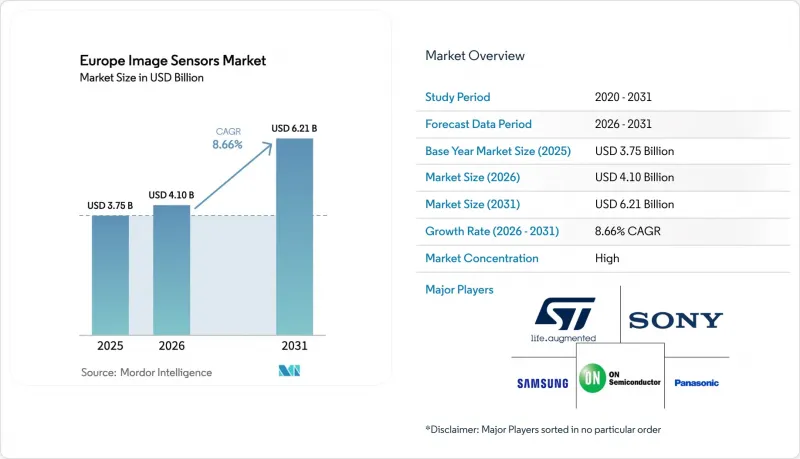
根據 Mordor Intelligence 預測,歐洲影像感測器市場規模預計在 2025 年達到 37.5 億美元,2026 年達到 41 億美元,到 2031 年達到 62.1 億美元,2026 年至 2031 年的複合年成長率為 8.66%。
本報告按類型(CMOS、CCD)、解析度(800萬像素及以下、900萬至2400萬像素、2500萬至6400萬像素、6500萬至2億萬像素及其他)、頻譜(可見光(R GB)、近紅外線(NIR)、短波紅外線(SWIR)及其他)、百葉窗技術(捲簾百葉窗CMOS、全域百葉窗CMOS)、終端用戶產業(消費性電子、醫療保健、工業及其他)和地區進行細分。市場預測以美元(USD)為單位。
歐洲影像感測器市場的趨勢和洞察
Euro NCAP 強制要求配備前置相機(AEB)。
歐洲新車安全評鑑協會 (Euro NCAP) 2025 年和 2026 年的評測協議對駕駛員監控和行人偵測性能最高可授予 25 分,這實際上強制要求所有力爭獲得五星級評級的汽車製造商採用近紅外線前視和車內成像器。系統整合商已將採購計畫提前 18 至 24 個月,以滿足歐盟通用安全法規 (EU General Safety Regulations) 2024 年 7 月的最後期限,進一步推高了歐洲影像感測器市場的供應需求。安森美 (Onsemi) 透露,到 2025 年第三季度,其 4.5 億個車載攝影機將運作,其中 68% 的設計應用與符合歐洲標準的平台相關。此外,乘員分類法規正在收緊安全氣囊展開標準,這推動了監管要求的提高,並促進了飛行時間 (ToF) 模組在駕駛座中的應用。德國博世、大陸集團和採埃孚正在建立一個強大的軟體介面,該介面將強制性的前置相機影像與側視和後視影像整合在一起,從而保護現有感測器供應商的利益。因此,這項強制性要求增加了每輛車的感測器數量,鞏固了現有供應商的地位,並顯著推動了歐洲影像感測器市場的成長。
擁有超過2億像素多鏡頭的智慧型手機之間的競爭
到2025年,索尼和OmniVision都將推出2億像素感測器,旗艦機型的像素間距將小於0.6微米,屆時每個感測器的平均售價將超過30美元。三星正在華城擴大0.5微米製程的量產,以重奪高階市場地位;同時,德國和法國的歐洲模組組裝也在提高產量,因為亞微米像素需要更嚴格的光學公差。晶圓級相機模組透過將鏡頭直接整合到晶片上,將Z軸高度降低了1.2毫米,從而實現了潛望式長焦鏡頭的設計。雖然亞洲晶片製造商主導晶片供應,但歐洲影像感測器市場也間接受益於更高的工廠自動化水平以及對來自歐洲特種玻璃供應商的光電封裝材料日益成長的需求。隨著高階安卓設備出貨量的趨於穩定,營收成長不再只依賴銷售成長,而是依賴更高的附加價值。
歐盟高昂的能源成本和無塵室公用設施成本
歐洲大陸的電費是東亞的兩到三倍,推高了製造成本。同時,歐洲影像感測器市場正從200毫米生產線轉向能耗更高的300毫米生產線。無塵室的暖氣、通風和空調系統佔晶圓廠總能耗的40%,迫使意法半導體(STMicroelectronics)投資1.2億歐元(約1.28億美元)建造現場太陽能發電和熱電汽電共生設施,以對沖價格波動風險。根據畢馬威(KPMG)發布的《2025年半導體產業調查報告》,該地區有66%的受訪者因能源不確定性而延後資本投資,遠高於51%的全球平均水準。歐司朗(ams-OSRAM)在普雷姆施泰滕(Premstetten)投資5.67億歐元(約6.02億美元)的項目專注於汽車和醫療感測器的多品種、小批量生產,平均售價超過5美元,從而避免與售價低於1美元的智慧型手機組件競爭。然而,為了利用離峰時段的電費而引入夜班制度,導致整體運轉率下降了幾個百分點,略微減緩了歐洲影像感測器市場的整體成長。
細分市場分析
預計到2025年,CMOS元件將佔總銷售額的96.19%,這主要得益於堆疊式架構(可將像素讀取頻寬提高三倍)和背照式結構(可將量子效率提高高達40%)。索尼的2455萬像素IMX925全域百葉窗影像感測器採用銅銅混合鍵合技術,可達到每秒394幀的連拍速度。同時,意法半導體的500萬像素BrightSense感測器擁有4000個電子的滿阱容量,並支援高達120分貝的場景。 CCD成像器目前佔據3.81%的市場佔有率,由於其電荷傳輸效率超過99.999%,在天文和光譜分析等領域仍得到應用,但電子倍增CMOS和SPAD陣列正在逐漸蠶食其市場主導地位。隨著節能型行動應用和符合 Euro NCAP 標準的汽車攝影機的逐步普及,CMOS 在歐洲影像感測器市場的佔有率正在不斷擴大。
CMOS預計將以9.21%的複合年成長率成長,遠高於8.66%的整體市場成長率。同時,CCD預計將以較低的個位數速度萎縮。歐洲影像感測器市場規模的成長主要歸功於堆疊式晶片的出現,這些晶片整合了人工智慧加速器和片上資料壓縮功能,從而降低了感測器外部的頻寬需求。這些特性提升了子系統級的性能,並使其溢價合理,足以抵消因穿透矽通孔(TSV)而增加的晶圓成本。儘管科學儀器領域對CCD仍有一定需求,但其銷售額僅佔總銷售額的一小部分。
2500萬至6400萬像素級別的圖像感測器將在2025年佔據42.31%的出貨量佔有率,並廣泛應用於汽車環景顯示融合和印刷基板檢測等領域,因為在這些應用中,影格速率和解析度之間的平衡至關重要。超過2億像素的產品已從最初的少量普及發展到2025年智慧型手機領域達到2億支。這一成長主要得益於無損數位變焦和利用高光譜遙測資料的多幀超高解析度演算法。該細分市場正以9.06%的複合年成長率快速成長,超過所有其他細分市場,並主導歐洲影像感測器市場的整體成長。
低於 800 萬像素的低解析度範圍仍然十分重要,尤其是在後置攝影機和視訊會議模組領域,因為企業級筆記型電腦的網路攝影機正在升級到 1080p。 900 萬至 2,400 萬像素頻寬保持穩定,約佔出貨量的五分之一,涵蓋了從 1,200 萬像素自拍相機到 2,000 萬像素醫用內視鏡等各種產品。預計中端市場將繼續保持成長勢頭。這是因為,雖然在工業和汽車系統中影格速率不容妥協,但高解析度感測器的平均售價 (ASP) 推動了銷售結構向高階傾斜,從而支撐了歐洲圖像感測器市場的高階細分市場。
其他好處:
- Excel格式的市場預測(ME)表
- 3個月的分析師支持
目錄
第1章:引言
- 研究假設和市場定義
- 調查範圍
第2章:調查方法
第3章執行摘要
第4章 市場狀況
- 市場概覽
- 市場促進因素
- 搭載超過2億像素多相機系統的智慧型手機之間的競爭日益激烈
- 歐洲新車安全評鑑協會 (Euro NCAP) 強制要求安裝前置相機(AEB)。
- 向晶圓級光學技術和堆疊式CIS過渡
- 利用人工智慧進行工業機器視覺的津貼
- 一次性尖端對尖端醫用內視鏡
- 用於汽車雷射雷達先導計畫的光子計數SPAD感測器
- 市場限制因素
- 歐盟無塵室的高能源成本和公用事業費用
- 300 毫米 CIS 級產品的產能有限。
- 歐盟嚴格的資料隱私法規限制了臉部辨識技術的普及。
- 先進像素設計工程領域熟練人才短缺。
- 產業價值鏈分析
- 監理情勢
- 技術展望
- 宏觀經濟因素對市場的影響
- 波特五力分析
第5章 市場規模與成長預測
- 按類型
- CMOS
- CCD
- 通過決議
- 800萬像素或更少
- 9~24 MP
- 25~64 MP
- 65~200 MP
- 超過2億
- 頻譜
- 可見光(RGB)
- 近紅外線(NIR)
- 短波紅外線(SWIR)
- 紫外線 (UV)
- 熱紅外線/長波紅外線(LWIR)
- 透過百葉窗技術
- 捲簾百葉窗CMOS
- 全域百葉窗CMOS
- 按最終用戶行業分類
- 消費性電子產品
- 衛生保健
- 產業
- 安全監控
- 汽車和交通運輸
- 航太/國防
- 其他
- 國家
- 英國
- 德國
- 法國
- 義大利
- 其他歐洲國家
第6章 競爭情勢
- 市場集中度
- 策略趨勢
- 市佔率分析
- 公司簡介
- STMicroelectronics NV
- Sony Group Corporation
- Samsung Electronics Co., Ltd.
- ON Semiconductor Corporation.
- OmniVision Technologies Inc.
- BAE Systems plc
- Toshiba Electronic Devices and Storage Corporation
- Nikon Corporation
- Panasonic Holdings Corporation
- SK hynix Inc.
- Canon Inc.
- ams-OSRAM AG
- Teledyne FLIR LLC
- Hamamatsu Photonics KK
- PixArt Imaging Inc.
- Tower Semiconductor Ltd.
- Gpixel NV
- Himax Technologies Inc.
- GalaxyCore Inc.
- Teledyne e2v Ltd.
第7章 市場機會與未來展望
According to Mordor Intelligence, the Europe image sensors market size is projected to be USD 3.75 billion in 2025, USD 4.1 billion in 2026, and reach USD 6.21 billion by 2031, growing at a CAGR of 8.66% from 2026 to 2031.
This report is Segmented by Type (CMOS, and CCD), Resolution (<= 8 MP, 9-24 MP, 25-64 MP, 65-200 MP, and More), Spectrum (Visible RGB, Near-Infrared NIR, Short-Wave Infrared SWIR, and More), Shutter Technology (Rolling-Shutter CMOS, and Global-Shutter CMOS), End-User Industry (Consumer Electronics, Healthcare, Industrial, and More), and Geography. The Market Forecasts are Provided in Terms of Value (USD).
Europe Image Sensors Market Trends and Insights
Euro NCAP Front-Camera Mandate (AEB)
Euro NCAP's 2025 and 2026 protocols award up to 25 points for driver-monitoring and pedestrian-detection performance, effectively forcing every automaker that seeks a five-star rating to adopt near-infrared forward and in-cabin imagers. Integrators compressed sourcing timetables by 18-24 months to meet July 2024 EU General Safety Regulation deadlines, which amplified demand for Europe image sensors market supply. onsemi disclosed that 450 million of its automotive cameras were already on the road by third-quarter 2025, with 68% of design wins linked to Euro-compliant platforms. The regulatory premium is also steering time-of-flight (ToF) modules into cockpits, as occupant-classification rules tighten air-bag deployment criteria. Germany's Bosch, Continental, and ZF are fusing side and rear views with the mandated front-camera feed, generating sticky software interfaces that protect incumbent sensor suppliers. The mandate therefore raises unit count per vehicle and entrenches established vendors, contributing materially to the growth trajectory of the Europe image sensors market.
Multi-Camera Smartphone Race Beyond 200 MP
Pixel pitch in flagship phones fell below 0.6 µm during 2025 as Sony and OmniVision each unveiled 200-megapixel parts, lifting average selling prices above USD 30 per sensor. Samsung is scaling 0.5 µm nodes in Hwaseong to regain premium-tier ground, while European module assemblers in Germany and France gain volume because sub-micron pixels demand tighter optical tolerances. Wafer-level camera modules integrate the lens directly on the die, shaving 1.2 mm from z-height and enabling periscope telephoto designs. Although Asian chipmakers dominate supply, the Europe image sensors market benefits indirectly through higher equipment-automation intensity and through a larger pull for photonics packaging materials sourced from European specialty-glass vendors. With premium Android shipments stabilizing, the value-uplift rather than raw volume expansion supports incremental revenue.
High EU Energy and Clean-Room Utility Costs
Electricity prices in continental Europe remain two to three times higher than those in East Asia, raising fabrication costs just as the Europe image sensors market migrates from 200 mm to energy-hungry 300 mm lines. Clean-room heating, ventilation, and air-conditioning systems consume up to 40 % of total fab energy, obliging STMicroelectronics to invest EUR 120 million (USD 128 million) in on-site solar and cogeneration to hedge price swings. KPMG's 2025 semiconductor survey found that 66 % of regional respondents deferred capital expenditure because of energy uncertainty, well above the 51 % global average. ams-OSRAM's EUR 567 million (USD 602 million) Premstaetten project focuses on high-mix, low-volume automotive and medical sensors with average selling prices above USD 5, avoiding cost competition with sub-USD 1 smartphone parts. Even so, nightshift scheduling to capture off-peak tariffs trims overall utilization by several percentage points, modestly dragging the aggregate growth of the Europe image sensors market.
Other drivers and restraints analyzed in the detailed report include:
- Wafer-Level Optics and Stacked-CIS Migration
- AI-Enabled Industrial Machine-Vision Grants
- Limited 300 mm CIS-Grade Capacity
For complete list of drivers and restraints, kindly check the Table Of Contents.
Segment Analysis
CMOS devices captured 96.19% of 2025 revenue, reflecting stacked architectures that triple pixel-readout bandwidth and backside illumination that lifts quantum efficiency by up to 40%. Sony's 24.55-megapixel IMX925 global-shutter part runs 394 frames per second using copper-to-copper hybrid bonding, while STMicroelectronics' 5-megapixel BrightSense reaches 4 000-electron full-well capacity for 120 decibel scenes. CCD imagers, with 3.81% share, linger in astronomy and spectroscopy because they maintain charge-transfer efficiency above 99.999%, although electron-multiplying CMOS and SPAD arrays are eroding that moat. A gradual shift toward energy-efficient mobile applications and Euro NCAP-compliant automotive cameras is expanding the CMOS slice of the Europe image sensors market.
CMOS is forecast to advance at a 9.21% CAGR, comfortably above the overall 8.66% trajectory, while CCD declines in low single digits. Much of the incremental Europe image sensors market size upside stems from stacked die that embed AI accelerators and on-chip data compression, shrinking off-sensor bandwidth needs. The feature set raises subsystem-level performance, justifying premium pricing that outweighs the higher wafer cost of through-silicon vias. Niche CCD opportunities in scientific instrumentation persist yet remain immaterial to aggregate revenue.
The 25-64-megapixel class held 42.31% of 2025 shipments, preferred for automotive surround-view fusion and printed-circuit inspection where balanced frame rate and resolution matter. Units exceeding 200 megapixels grew from a negligible base to 200 million smartphone sockets in 2025, driven by lossless digital zoom and multi-frame super-resolution algorithms that ride hyperspectral data. That cohort is scaling at a 9.06% CAGR, outpacing all other brackets and contributing a disproportionate chunk of incremental Europe image sensors market size.
Lower bands below 8 megapixels retain relevance in reverse-camera and video-conference modules, especially as enterprise laptops upgrade webcams to 1080p. The 9-24-megapixel slot is steady at roughly one-fifth of shipments, spanning 12-megapixel selfie cameras and 20-megapixel medical endoscopes. Mid-tier momentum will persist because industrial and automotive systems cannot compromise on frame rate, yet high-resolution sensor average selling prices ensure that revenue mix skews upward, supporting the premium layer of the Europe image sensors market.
Complete Report Scope:
- By Type
- CMOS
- CCD
- By Resolution
- Less Than Equal to 8 MP
- 9 - 24 MP
- 25 - 64 MP
- 65 - 200 MP
- More than 200 MP
- By Spectrum
- Visible (RGB)
- Near-Infrared (NIR)
- Short-Wave Infrared (SWIR)
- Ultraviolet (UV)
- Thermal / Long-Wave Infrared (LWIR)
- By Shutter Technology
- Rolling-Shutter CMOS
- Global-Shutter CMOS
- By End-User Industry
- Consumer Electronics
- Healthcare
- Industrial
- Security and Surveillance
- Automotive and Transportation
- Aerospace and Defense
- Other End-User Industries
- By Country
- United Kingdom
- Germany
- France
- Italy
- Rest of Europe
List of Companies Covered in this Report:
- STMicroelectronics N.V.
- Sony Group Corporation
- Samsung Electronics Co., Ltd.
- ON Semiconductor Corporation.
- OmniVision Technologies Inc.
- BAE Systems plc
- Toshiba Electronic Devices and Storage Corporation
- Nikon Corporation
- Panasonic Holdings Corporation
- SK hynix Inc.
- Canon Inc.
- ams-OSRAM AG
- Teledyne FLIR LLC
- Hamamatsu Photonics K.K.
- PixArt Imaging Inc.
- Tower Semiconductor Ltd.
- Gpixel NV
- Himax Technologies Inc.
- GalaxyCore Inc.
- Teledyne e2v Ltd.
Additional Benefits:
- The market estimate (ME) sheet in Excel format
- 3 months of analyst support
TABLE OF CONTENTS
1 INTRODUCTION
- 1.1 Study Assumptions and Market Definition
- 1.2 Scope of the Study
2 RESEARCH METHODOLOGY
3 EXECUTIVE SUMMARY
4 MARKET LANDSCAPE
- 4.1 Market Overview
- 4.2 Market Drivers
- 4.2.1 Multi-Camera Smartphone Race Beyond 200 MP
- 4.2.2 Euro NCAP Front-Camera Mandate (AEB)
- 4.2.3 Wafer-Level Optics and Stacked CIS Migration
- 4.2.4 AI-Enabled Industrial Machine-Vision Grants
- 4.2.5 Disposable Chip-On-Tip Medical Endoscopy
- 4.2.6 Photon-Counting SPAD Sensors for Automotive LiDAR Pilots
- 4.3 Market Restraints
- 4.3.1 High EU Energy and Clean-Room Utility Costs
- 4.3.2 Limited 300 mm CIS-Grade Capacity
- 4.3.3 Strict EU Data-Privacy Rules Limiting Facial-Recognition Roll-Out
- 4.3.4 Talent Shortage in Advanced Pixel-Design Engineering
- 4.4 Industry Value-Chain Analysis
- 4.5 Regulatory Landscape
- 4.6 Technological Outlook
- 4.7 Impact of Macroeconomic Factors on the Market
- 4.8 Porter's Five Forces Analysis
- 4.8.1 Bargaining Power of Suppliers
- 4.8.2 Bargaining Power of Buyers
- 4.8.3 Threat of New Entrants
- 4.8.4 Threat of Substitutes
- 4.8.5 Intensity of Competitive Rivalry
5 MARKET SIZE AND GROWTH FORECASTS (VALUE)
- 5.1 By Type
- 5.1.1 CMOS
- 5.1.2 CCD
- 5.2 By Resolution
- 5.2.1 Less Than Equal to 8 MP
- 5.2.2 9 - 24 MP
- 5.2.3 25 - 64 MP
- 5.2.4 65 - 200 MP
- 5.2.5 More than 200 MP
- 5.3 By Spectrum
- 5.3.1 Visible (RGB)
- 5.3.2 Near-Infrared (NIR)
- 5.3.3 Short-Wave Infrared (SWIR)
- 5.3.4 Ultraviolet (UV)
- 5.3.5 Thermal / Long-Wave Infrared (LWIR)
- 5.4 By Shutter Technology
- 5.4.1 Rolling-Shutter CMOS
- 5.4.2 Global-Shutter CMOS
- 5.5 By End-User Industry
- 5.5.1 Consumer Electronics
- 5.5.2 Healthcare
- 5.5.3 Industrial
- 5.5.4 Security and Surveillance
- 5.5.5 Automotive and Transportation
- 5.5.6 Aerospace and Defense
- 5.5.7 Other End-User Industries
- 5.6 By Country
- 5.6.1 United Kingdom
- 5.6.2 Germany
- 5.6.3 France
- 5.6.4 Italy
- 5.6.5 Rest of Europe
6 COMPETITIVE LANDSCAPE
- 6.1 Market Concentration
- 6.2 Strategic Moves
- 6.3 Market Share Analysis
- 6.4 Company Profiles (includes Global Level Overview, Market Level Overview, Core Segments, Financials as available, Strategic Information, Market Rank/Share, Products and Services, Recent Developments)
- 6.4.1 STMicroelectronics N.V.
- 6.4.2 Sony Group Corporation
- 6.4.3 Samsung Electronics Co., Ltd.
- 6.4.4 ON Semiconductor Corporation.
- 6.4.5 OmniVision Technologies Inc.
- 6.4.6 BAE Systems plc
- 6.4.7 Toshiba Electronic Devices and Storage Corporation
- 6.4.8 Nikon Corporation
- 6.4.9 Panasonic Holdings Corporation
- 6.4.10 SK hynix Inc.
- 6.4.11 Canon Inc.
- 6.4.12 ams-OSRAM AG
- 6.4.13 Teledyne FLIR LLC
- 6.4.14 Hamamatsu Photonics K.K.
- 6.4.15 PixArt Imaging Inc.
- 6.4.16 Tower Semiconductor Ltd.
- 6.4.17 Gpixel NV
- 6.4.18 Himax Technologies Inc.
- 6.4.19 GalaxyCore Inc.
- 6.4.20 Teledyne e2v Ltd.
7 MARKET OPPORTUNITIES AND FUTURE OUTLOOK
- 7.1 White-Space and Unmet-Need Assessment

 車載監控系統市場預測至2034年-全球分析(依系統類型、組件、駕駛監控功能、乘員監控功能、車輛類型、車輛等級、驅動系統、應用、最終用戶及地區分類)
 安防應用的影像感測器:市場佔有率分析、產業趨勢與統計及成長預測(2026-2031 年)影像感測器:市場佔有率分析、產業趨勢與統計、成長預測(2026-2031)
 影像感測器市場:2026-2032年全球市場預測(按感測器類型、光譜範圍、影像解析度、處理方法、終端用戶產業和分銷管道分類)影像感測器市場預測至2034年-全球技術、頻譜、處理方法、陣列方法、解析度、百葉窗方法、封裝方法、終端應用產業及區域分析
 全球影像感測器市場(至2032年):按類型、處理方法、頻譜、陣列、解析度和應用分類
 InGaAs影像感測器市場-全球產業規模、佔有率、趨勢、機會、預測:按類型、波長、應用、最終用戶、地區和競爭格局分類,2021-2031年
 模組化低光感測器市場報告:趨勢、預測和競爭分析(至2035年)影像感測器市場預測至2034年—頻譜、處理方法、技術、最終用戶和地區分類的全球分析
 車內監控(DMS、OMS)市場(2026 年)