


 |
市場調查報告書
商品編碼
2124568
環境生活輔助(AAL):市場佔有率分析、產業趨勢與統計、成長預測(2026-2031)Ambient Assisted Living - Market Share Analysis, Industry Trends & Statistics, Growth Forecasts (2026 - 2031) |
||||||

※ 本網頁內容可能與最新版本有所差異。詳細情況請與我們聯繫。
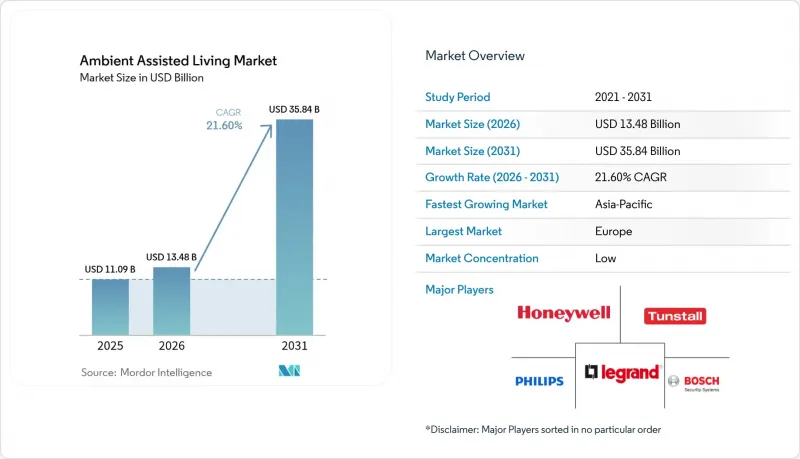
據 Mordor Intelligence 稱,2025 年環境生活輔助(AAL) 市場價值為 110.9 億美元,預計到 2031 年將達到 358.4 億美元,而 2026 年為 134.8 億美元,預測期(2026-2031 年)的複合年成長率為 21.6%。
本報告按組件(硬體、軟體、服務)、技術(智慧家庭和自動化等)、系統功能(安全保障、通訊和連接等)、部署模式(獨立住宅、護理機構等)、年齡層(60-69歲、70-79歲、80歲以上)和地區進行細分。市場預測以美元(USD)計價。
全球環境生活輔助(AAL)市場趨勢與洞察
政策迅速轉向「居家養老」的還款模式
自2024年起,聯邦醫療保險優勢計劃(Medicare Advantage)開始為非醫療居家護理服務提供福利,將以往需要自費的服務轉變為可報銷的福利,直接用於資助環境生活輔助(AAL)解決方案。類似的措施也正在聯邦醫療補助計劃(Medicaid)的居家和社區服務中推行,使支付方能夠用感測器輔助的居家照護取代昂貴的機構床位。預計到2050年,經合組織(OECD)各國的長期照護預算將大幅成長,因此,旨在津貼預防性數位監測的立法努力正在加速推進。這些改革正在將環境生活輔助(AAL)技術從可選項轉變為可報銷的護理服務,擴大了目標市場規模(TAM),並降低了醫療保健系統購買者的採用門檻。
65歲及以上人群家庭中智慧家庭的普及率正在迅速提高。
疫情期間,老年人對智慧型裝置的接受度迅速提升,預計到2024年,多個高所得國家55至65歲族群的智慧型手機使用率將超過80%。語音介面、環境感測器和連接型家電如今可以輕鬆整合到家庭環境中,使服務提供者能夠在一次安裝中提供跌倒偵測、服藥提醒和社交互動工具等功能。歐盟舉措的試驗計畫(例如PHArA-ON)表明,被動式環境感測器比穿戴式裝置更容易被體弱的老年人接受。這為能夠為臨床醫生收集更豐富資料集,同時最大限度減少對老年人生活方式干擾的硬體策略提供了支持。
互通性標準分散,阻礙了統一的看護者儀錶板的創建。
由於各設備製造商對健康資料範本的解讀方式不同,住宅和設施的負責人仍被迫使用多個專有入口網站。儘管美國「互通性核心數據」和歐洲「EEHRxF」等舉措正在取得進展,但普及程度仍參差不齊。整合成本阻礙了大規模應用,尤其是對於IT預算有限的小規模住宅護理服務提供者。缺乏即插即用的語義化特性減緩了跨供應商分析的速度,限制了預測模型的準確性,並迫使採購團隊鎖定在單一品牌生態系統中,從而導致過渡期間的摩擦,並阻礙短期市場加速發展。
細分市場分析
到2025年,硬體將佔銷售額的51.35%。這主要得益於被動被動式紅外線偵測器、門磁感測器和穿戴式裝置的批量出貨,這些裝置構成了大多數安裝的基礎。到2025年,基本型動作感測器的單價將降至10美元以下,從而擴大中等收入家庭的普及率。市場需求正從單一功能設備轉向整合環境數據、生物識別數據和位置數據的多感測器模組。半導體技術的進步使得將人工智慧推理引擎整合到電池供電的標籤中成為可能,從而延長了標籤的運作並降低了維護成本,供應商也因此受益匪淺。
服務業正以更快的速度擴張,服務提供者正透過託管監控、基於人工智慧的警報分類和全天候虛擬客服中心實現盈利,預計到2031年,該行業的複合年成長率將達到23.9%。付費方更傾向於將硬體攤提、軟體授權和專家支援團隊整合到一個固定費率中的訂閱方案。環境生活輔助(AAL)市場服務領域的市場規模預計將在五年內成長三倍以上,使其成為尋求收入來源多元化的電信業者的理想收購目標。軟體層有助於提高客戶留存率,而提供開放API和遠端韌體管理的平台則可減少現場服務次數並提高毛利率。
智慧家庭自動化利用成熟的消費生態系統,例如 Zigbee、Z-Wave 和 Wi-Fi,預計到 2025 年將維持 47.85% 的銷售額。語音助理現在無需特殊佈線即可整合服藥提醒、照明控制和看護者簽到等功能,從而將安裝時間縮短 30%。與主流設備的互通性使供應商能夠將醫療保健服務與娛樂訂閱服務一起提升銷售,從而擴大其在家庭領域的覆蓋範圍。
社交陪伴機器人產業預計將以22.85%的複合年成長率成長,隨著自然語言處理和觸覺回饋使對話越來越像人類,該產業正從實驗性的新奇事物發展成為可擴展的產品線。日本政府已在護理機器人研發項目上投資超過3億美元,推動了承包機器人輔助設備的快速商業化和出口。模組化設計能夠實現經濟高效的客製化,以適應不同的文化背景。案例研究表明,對於獨居老年人而言,孤獨感指標顯著降低。將機器人技術與遠端醫療平台結合的供應商正在實現無縫銜接的護理,降低了轉換門檻,並進一步拓展了環境生活輔助(AAL)市場。
區域分析
預計到2025年,歐洲將佔全球銷售額的33.65%,這得益於歐盟「地平線歐洲」津貼(ec.europa.eu)的資助,該計畫為試點部署津貼,並建立可供採購的案例研究庫。北歐和德語區(德國、奧地利和瑞士)市場強制性的緊急應變法規為可預測的需求奠定了基準,而GDPR合規框架則增強了用戶信心。各國醫療保健系統正在加速將AAL警報整合到電子健康記錄中,從而簡化臨床醫生的工作流程並加強醫療設備分類認證流程。與家庭護理服務提供者合作的供應商正受益於公共資金支持的報銷計劃,這些計劃確保了付款,從而建立了永續的收入來源。
亞太地區各國政府正面臨前所未有的人口老化問題,預計該地區將以23.1%的複合年成長率達到最高成長。日本對機器人技術的補助、中國的「智慧養老」國家計畫以及韓國的5G連結慢性病監測試點項目,都是政策主導市場形成的典型例證。都市區密度提升了部署的經濟效益。當網路能夠覆蓋一棟高層建築中的數百戶公寓時,感測器的分發成本就會降低。然而,農村地區的數位落差依然存在,目前正在進行衛星通訊試點部署,以確保公平存取。區域性企業與電信業者合作,透過將支援環境輔助生活(AAL)的韌體整合到消費性路由器中,加快了部署速度,縮短了產品上市時間,並推動了生活輔助( AAL)市場在全部區域的擴張。
在北美,由於聯邦醫療保險優勢計劃(Medicare Advantage)的報銷機制和私人保險公司的獎勵,人工智慧技術擁有大規模的應用基礎。醫院系統正在實施預測分析,以減少高成本的再入院率,並實現以價值為導向的醫療保健目標。創業融資依然活躍,以人工智慧為中心的新創公司已在多輪資金籌措籌集了超過3000萬美元,用於產品開發和地理擴張。美國也是軟體中間件的主要出口國,向歐洲和亞洲的設備製造商授權資料整合堆疊。在加拿大,單一支付方計畫(Single Payer Scheme)正在省級層級開展採購試點項目,並從中獲得的經驗正被用於製定全國互通性藍圖,以推動到2027年的進一步應用。
其他好處:
- Excel格式的市場預測(ME)表
- 3個月的分析師支持
目錄
第1章:引言
- 研究假設和市場定義
- 調查範圍
第2章:調查方法
第3章執行摘要
第4章 市場狀況
- 市場概覽
- 環境生活輔助(AAL)領域的發展
- 價值鍊和經營模式
- 監管和技術展望
- 市場促進因素
- 經合組織國家的政策正迅速轉向支持「居家養老」的報銷模式。
- 在北美和歐洲,65歲及以上家庭採用智慧家庭的比例正在迅速提高。
- 人工智慧驅動的預測分析降低了緊急應變中的誤報率。
- 5G? /光纖部署將在亞洲各地實現低延遲遠距醫療服務
- 歐盟「地平線歐洲」計畫和「AAL計畫」的津貼正在加速新創公司採用新技術。
- 降低邊緣感測器和穿戴式裝置的成本。
- 市場限制因素
- 互通性標準分散,阻礙了統一的看護者儀錶板的創建。
- 限制跨境監控的隱私和資料主權法規(GDPR、HIPAA)
- 農村地區75歲以上人口的數位素養較低
- 新興市場非臨床輔助生活服務報銷差異
- 波特五力模型
第5章 市場規模與成長預測
- 按組件
- 硬體
- 感應器
- 執行器
- 穿戴式和智慧型裝置
- 智慧家庭設備
- 軟體(人工智慧和分析平台、中間件和設備管理、安全和隱私)
- 服務(實施和整合、託管服務、緊急應變和監控)
- 硬體
- 透過技術
- 智慧家庭和自動化
- 遠端醫療和遠距護理
- 穿戴式裝置
- 社交伴侶機器人
- 系統功能
- 安全保障
- 通訊和連接
- 健康與醫療支持
- 出遊與交通
- 能源與健康
- 按部署模式
- 獨立住宅單元
- 輔助住宅
- 老年護理機構
- 醫院和診所
- 按年齡層
- 60-69歲
- 70-79歲
- 80歲以上
- 按地區
- 北美洲
- 美國
- 加拿大
- 墨西哥
- 南美洲
- 巴西
- 阿根廷
- 其他南美國家
- 亞太地區
- 中國
- 日本
- 印度
- 韓國
- ASEAN
- 澳洲
- 紐西蘭
- 其他亞太國家
- 歐洲
- 德國
- 英國
- 法國
- 義大利
- 西班牙
- 北歐國家(瑞典、丹麥、挪威、芬蘭)
- 其他歐洲國家
- 中東和非洲
- 中東
- 沙烏地阿拉伯
- 阿拉伯聯合大公國
- 卡達
- 科威特
- 巴林
- 其他中東國家
- 非洲
- 南非
- 奈及利亞
- 肯亞
- 其他非洲國家
- 中東
- 北美洲
第6章 競爭情勢
- 市場集中度
- 策略趨勢
- 市佔率分析
- 公司簡介
- Koninklijke Philips NV
- Tunstall Healthcare Group
- Legrand SA
- Honeywell International Inc.
- Bosch Security & Safety Systems GmbH
- Johnson Controls International plc
- CareTech AB
- Doro AB
- Sensara BV
- Alcove Ltd
- 2PCS Solutions GmbH
- Cogvis Software and Consulting GmbH
- Cerner Corporation
- Televic Group NV
- Assisted Living Technologies Inc.
- GrandCare Systems
- Medical Guardian LLC
- GetSafe Home Security
- Huawei Technologies Co. Ltd.
- Panasonic Corporation
- Resideo Technologies Inc.
- LifeStation Inc.
第7章 市場機會與未來展望
According to Mordor Intelligence, the ambient assisted living market size was valued at USD 11.09 billion in 2025 and estimated to grow from USD 13.48 billion in 2026 to reach USD 35.84 billion by 2031, at a CAGR of 21.6% during the forecast period (2026-2031).
This report is Segmented by Component (Hardware, Software, Services), Technology (Smart Home and Automation, and More), System Function (Safety and Security, Communication and Connectivity, and More), Deployment Model (Stand-Alone Residential Units, Assisted Living Facilities, and More), Age Group (60-69 Years, 70-79 Years, 80+ Years), and Geography. The Market Forecasts are Provided in Terms of Value (USD).
Global Ambient Assisted Living Market Trends and Insights
Rapid Policy Shifts Toward Aging-in-Place Reimbursement Models
Medicare Advantage began covering non-medical home supports in 2024, converting formerly out-of-pocket services into reimbursable benefits that directly fund Ambient Assisted Living solutions . Similar parity is emerging in Medicaid Home and Community-Based Services, allowing payers to substitute costly institutional beds with sensor-enhanced home care. Across OECD economies, long-term care budgets are projected to rise sharply by 2050, reinforcing legislative momentum to subsidize proactive digital monitoring. These reforms reposition Ambient Assisted Living technologies from discretionary purchases to reimbursable care, enlarging the total addressable market and lowering adoption friction for health-system buyers.
Surge in Smart-Home Penetration Among 65+ Households
Older adults accelerated smart-device adoption during the pandemic, and by 2024 smartphone usage exceeded 80% among 55- to 65-year-olds in multiple high-income countries. Voice interfaces, ambient sensors, and connected appliances now integrate easily into the domestic environment, allowing providers to bundle fall detection, medication reminders, and social-engagement tools in one installation. Pilot programs funded through EU initiatives such as PHArA-ON demonstrated that passive ambient sensors achieved higher acceptance than wearables among frail seniors, supporting hardware strategies that minimize lifestyle disruption while collecting richer datasets for clinicians.
Fragmented Interoperability Standards Hindering Unified Caregiver Dashboards
Residential and institutional buyers still juggle multiple proprietary portals because device makers interpret health-data templates differently. Despite progress in initiatives such as the United States Core Data for Interoperability and Europe's EEHRxF, implementation remains uneven . Integration costs suppress volume deployments, particularly in small home-care agencies that lack IT budgets. The absence of plug-and-play semantics delays cross-vendor analytics, limits predictive-model accuracy, and forces procurement teams to lock in single-brand ecosystems, creating switching frictions that mute near-term market acceleration.
Other drivers and restraints analyzed in the detailed report include:
- AI-Driven Predictive Analytics Lowering False-Alarm Rates
- 5G / Fibre Roll-outs Enabling Low-Latency Remote Care Services Across Asia
- Privacy and Data-Sovereignty Rules Limiting Cross-Border Monitoring
For complete list of drivers and restraints, kindly check the Table Of Contents.
Segment Analysis
Hardware captured a 51.35% revenue share in 2025, underpinned by volume shipments of passive infrared sensors, door contacts, and wearables that anchor most installations. Unit prices dropped below USD 10 for basic motion sensors in 2025, widening access for mid-income households. Demand is shifting from single-function devices to multi-sensor modules that integrate environmental, biometric, and location data feeds. Vendors benefit from silicon advances that squeeze AI inference engines onto battery-powered tags, prolonging field life and trimming maintenance.
Services are scaling faster, projected at 23.9% CAGR to 2031 as providers monetize managed monitoring, AI-based alert triage, and 24/7 virtual call centers. Payers favor subscription bundles that combine hardware amortization, software licenses, and professional response teams under one capitated fee. The Ambient Assisted Living market size for service offerings is set to more than triple within five years, creating acquisition targets for telecom operators seeking recurring revenue diversification. Software layers add stickiness; platforms offering open APIs and remote firmware management reduce truck rolls and improve gross margins.
Smart-home automation retained 47.85% revenue in 2025 by piggybacking on mature consumer ecosystems such as Zigbee, Z-Wave, and Wi-Fi. Voice assistants now integrate medication reminders, lighting cues, and caregiver check-ins without custom wiring, cutting installation times by 30%. Interoperability with mainstream devices positions vendors to upsell health services alongside entertainment subscriptions, broadening household reach.
Social and companion robotics, forecast to grow 22.85% CAGR, is transitioning from pilot novelty to scalable product line as natural-language processing and haptic feedback humanize interactions. Japan's government injected more than USD 300 million into care-robot RandD programs, enabling rapid commercialization and export of turnkey robotic aides. Modular designs facilitate cost-effective customization for cultural context, and case studies report statistically significant reductions in loneliness metrics among isolated seniors. Vendors integrating robotics with telehealth portals enable seamless continuity of care, raising switching barriers and fueling the next leg of Ambient Assisted Living market expansion.
Complete Report Scope:
- By Component
- Hardware
- Sensors
- Actuators
- Wearable and Smart Devices
- Smart Appliances
- Software (AI and Analytics Platforms, Middleware and Device Management, Security and Privacy)
- Services (Installation and Integration, Managed Services, Emergency Response and Monitoring)
- Hardware
- By Technology
- Smart Home and Automation
- Telehealth and Telecare
- Wearable Devices
- Social and Companion Robotics
- By System Function
- Safety and Security
- Communication and Connectivity
- Health and Medical Assistive
- Mobility and Transport
- Vitality and Wellness
- By Deployment Model
- Stand-alone Residential Units
- Assisted Living Facilities
- Senior Care Homes
- Hospitals and Clinics
- By Age Group
- 60-69 Years
- 70-79 Years
- 80+ Years
- By Geography
- North America
- United States
- Canada
- Mexico
- South America
- Brazil
- Argentina
- Rest of South America
- Asia Pacific
- China
- Japan
- India
- South Korea
- ASEAN
- Australia
- New Zealand
- Rest of Asia Pacific
- Europe
- Germany
- United Kingdom
- France
- Italy
- Spain
- Nordics (Sweden, Denmark, Norway, Finland)
- Rest of Europe
- Middle East and Africa
- Middle East
- Saudi Arabia
- United Arab Emirates
- Qatar
- Kuwait
- Bahrain
- Rest of Middle East
- Africa
- South Africa
- Nigeria
- Kenya
- Rest of Africa
- Middle East
- North America
Geography Analysis
Europe commanded 33.65% revenue in 2025, supported by Horizon Europe grants that subsidize pilot deployments and build a pipeline of procurement-ready case studies ec.europa.eu. Mandatory emergency-response regulations in Nordic and DACH markets created predictable demand baselines, while GDPR compliance frameworks cultivated user trust. National health systems are increasingly integrating AAL alerts into electronic health records, smoothing clinician workflows and bolstering medical-device-class certification pathways. Vendors partnering with home-care agencies benefit from publicly funded reimbursement schemes that guarantee payment, anchoring recurring revenue streams.
Asia-Pacific will generate the fastest 23.1% CAGR as governments confront unprecedented aging curves. Japan's robotics subsidies, China's smart-senior-care national plan, and South Korea's 5G-linked chronic-disease monitoring pilots illustrate policy-led market making. Urban density aids installation economics; sensor distribution costs fall when networks can service hundreds of apartments per vertical tower. However, rural digital divide persists, prompting satellite connectivity trials to ensure equitable access. Regional players collaborating with telecom carriers accelerate rollout by embedding AAL-ready firmware on consumer routers, shrinking time-to-market and fueling Ambient Assisted Living market acceleration across the region.
North America maintains a large installed base, propelled by Medicare Advantage reimbursement and private insurer incentives. Hospital systems adopt predictive analytics to trim costly readmissions and meet value-based care targets. Venture funding remains vigorous, with AI-centric start-ups attracting rounds above USD 30 million that finance productization and geographic scaling. The United States is also a leading exporter of software middleware, licensing data-integration stacks to European and Asian device makers. Canada's single-payer system conducts province-level procurement pilots, and lessons learned are forming national interoperability blueprints that could unlock broader adoption by 2027.
- Koninklijke Philips N.V.
- Tunstall Healthcare Group
- Legrand SA
- Honeywell International Inc.
- Bosch Security & Safety Systems GmbH
- Johnson Controls International plc
- CareTech AB
- Doro AB
- Sensara BV
- Alcove Ltd
- 2PCS Solutions GmbH
- Cogvis Software and Consulting GmbH
- Cerner Corporation
- Televic Group NV
- Assisted Living Technologies Inc.
- GrandCare Systems
- Medical Guardian LLC
- GetSafe Home Security
- Huawei Technologies Co. Ltd.
- Panasonic Corporation
- Resideo Technologies Inc.
- LifeStation Inc.
Additional Benefits:
- The market estimate (ME) sheet in Excel format
- 3 months of analyst support
TABLE OF CONTENTS
1 INTRODUCTION
- 1.1 Study Assumptions and Market Definition
- 1.2 Scope of the Study
2 RESEARCH METHODOLOGY
3 EXECUTIVE SUMMARY
4 MARKET LANDSCAPE
- 4.1 Market Overview
- 4.2 Evolution of the Ambient Assisted Living Sector
- 4.3 Value Chain and Business Models
- 4.4 Regulatory and Technological Outlook
- 4.5 Market Drivers
- 4.5.1 Rapid policy shifts toward ageing-in-place reimbursement models in OECD economies
- 4.5.2 Surge in smart-home penetration among 65+ households in North America and Europe
- 4.5.3 AI-driven predictive analytics lowering false-alarm rates in emergency response
- 4.5.4 5G?/?fibre roll-outs enabling low-latency remote care services across Asia
- 4.5.5 EU Horizon Europe and AAL-Programme grants accelerating start-up adoption
- 4.5.6 Declining costs of edge sensors and wearables
- 4.6 Market Restraints
- 4.6.1 Fragmented interoperability standards hindering unified caregiver dashboards
- 4.6.2 Privacy and data-sovereignty rules (GDPR, HIPAA) limiting cross-border monitoring
- 4.6.3 Low digital literacy among 75+ cohort in rural regions
- 4.6.4 Reimbursement gaps for non-clinical AAL services in emerging markets
- 4.7 Porter's Five Forces
- 4.7.1 Bargaining Power of Suppliers
- 4.7.2 Bargaining Power of Buyers
- 4.7.3 Threat of New Entrants
- 4.7.4 Intensity of Competitive Rivalry
- 4.7.5 Threat of Substitutes
5 MARKET SIZE AND GROWTH FORECASTS (VALUE)
- 5.1 By Component
- 5.1.1 Hardware
- 5.1.1.1 Sensors
- 5.1.1.2 Actuators
- 5.1.1.3 Wearable and Smart Devices
- 5.1.1.4 Smart Appliances
- 5.1.2 Software (AI and Analytics Platforms, Middleware and Device Management, Security and Privacy)
- 5.1.3 Services (Installation and Integration, Managed Services, Emergency Response and Monitoring)
- 5.1.1 Hardware
- 5.2 By Technology
- 5.2.1 Smart Home and Automation
- 5.2.2 Telehealth and Telecare
- 5.2.3 Wearable Devices
- 5.2.4 Social and Companion Robotics
- 5.3 By System Function
- 5.3.1 Safety and Security
- 5.3.2 Communication and Connectivity
- 5.3.3 Health and Medical Assistive
- 5.3.4 Mobility and Transport
- 5.3.5 Vitality and Wellness
- 5.4 By Deployment Model
- 5.4.1 Stand-alone Residential Units
- 5.4.2 Assisted Living Facilities
- 5.4.3 Senior Care Homes
- 5.4.4 Hospitals and Clinics
- 5.5 By Age Group
- 5.5.1 60-69 Years
- 5.5.2 70-79 Years
- 5.5.3 80+ Years
- 5.6 By Geography
- 5.6.1 North America
- 5.6.1.1 United States
- 5.6.1.2 Canada
- 5.6.1.3 Mexico
- 5.6.2 South America
- 5.6.2.1 Brazil
- 5.6.2.2 Argentina
- 5.6.2.3 Rest of South America
- 5.6.3 Asia Pacific
- 5.6.3.1 China
- 5.6.3.2 Japan
- 5.6.3.3 India
- 5.6.3.4 South Korea
- 5.6.3.5 ASEAN
- 5.6.3.6 Australia
- 5.6.3.7 New Zealand
- 5.6.3.8 Rest of Asia Pacific
- 5.6.4 Europe
- 5.6.4.1 Germany
- 5.6.4.2 United Kingdom
- 5.6.4.3 France
- 5.6.4.4 Italy
- 5.6.4.5 Spain
- 5.6.4.6 Nordics (Sweden, Denmark, Norway, Finland)
- 5.6.4.7 Rest of Europe
- 5.6.5 Middle East and Africa
- 5.6.5.1 Middle East
- 5.6.5.1.1 Saudi Arabia
- 5.6.5.1.2 United Arab Emirates
- 5.6.5.1.3 Qatar
- 5.6.5.1.4 Kuwait
- 5.6.5.1.5 Bahrain
- 5.6.5.1.6 Rest of Middle East
- 5.6.5.2 Africa
- 5.6.5.2.1 South Africa
- 5.6.5.2.2 Nigeria
- 5.6.5.2.3 Kenya
- 5.6.5.2.4 Rest of Africa
- 5.6.5.1 Middle East
- 5.6.1 North America
6 COMPETITIVE LANDSCAPE
- 6.1 Market Concentration
- 6.2 Strategic Moves
- 6.3 Market Share Analysis
- 6.4 Company Profiles {(includes Global level Overview, Market level overview, Core Segments, Financials as available, Strategic Information, Market Rank/Share for key companies, Products and Services, and Recent Developments)}
- 6.4.1 Koninklijke Philips N.V.
- 6.4.2 Tunstall Healthcare Group
- 6.4.3 Legrand SA
- 6.4.4 Honeywell International Inc.
- 6.4.5 Bosch Security & Safety Systems GmbH
- 6.4.6 Johnson Controls International plc
- 6.4.7 CareTech AB
- 6.4.8 Doro AB
- 6.4.9 Sensara BV
- 6.4.10 Alcove Ltd
- 6.4.11 2PCS Solutions GmbH
- 6.4.12 Cogvis Software and Consulting GmbH
- 6.4.13 Cerner Corporation
- 6.4.14 Televic Group NV
- 6.4.15 Assisted Living Technologies Inc.
- 6.4.16 GrandCare Systems
- 6.4.17 Medical Guardian LLC
- 6.4.18 GetSafe Home Security
- 6.4.19 Huawei Technologies Co. Ltd.
- 6.4.20 Panasonic Corporation
- 6.4.21 Resideo Technologies Inc.
- 6.4.22 LifeStation Inc.
7 MARKET OPPORTUNITIES AND FUTURE OUTLOOK
- 7.1 White-space and Unmet-Need Assessment

 全球生活協助軟體市場(2026-2030 年)
 中國老年人住宅:市場佔有率分析、產業趨勢與統計及成長預測(2026-2031年)美國老年住宅:市場佔有率分析、行業趨勢和統計數據以及成長預測(2026-2031 年)
 老年人住宅產品:市場規模、佔有率和成長分析(按產品類型、應用、最終用戶、分銷管道、產品類型和地區分類)-2026-2033年產業預測
 養老住家周邊設施市場規模、佔有率和成長分析:按設施類型、服務類型、支付/資金來源和地區分類-2026-2033年產業預測
 2026-2030年全球退休市場
 輔助生活市場規模、佔有率和成長率;全球產業分析;按類型、應用和地區進行分析;以及未來預測(2026-2034 年)。
 老年居住市場:按設施類型、服務提供者、服務類型、性別、年齡層、技能水平、主要支付來源和地區分類。
 環保生活市場:按組件、技術、最終用戶、部署模式、連接類型、應用和分銷管道分類-2026-2032年全球預測
 美國老年住宅市場:市場規模、佔有率和趨勢分析(按設施和地區分類),細分市場預測(2026-2033 年)