


 |
市場調查報告書
商品編碼
2116355
中國老年人住宅:市場佔有率分析、產業趨勢與統計及成長預測(2026-2031年)China Senior Living - Market Share Analysis, Industry Trends & Statistics, Growth Forecasts (2026 - 2031) |
||||||

※ 本網頁內容可能與最新版本有所差異。詳細情況請與我們聯繫。
根據 Mordor Intelligence 估計,2025 年中國住宅市場規模為 368.5 億美元,預計到 2031 年將達到 643.4 億美元,而 2026 年為 404.4 億美元,預測期(2026-2031 年)複合年成長率為 9.73%。
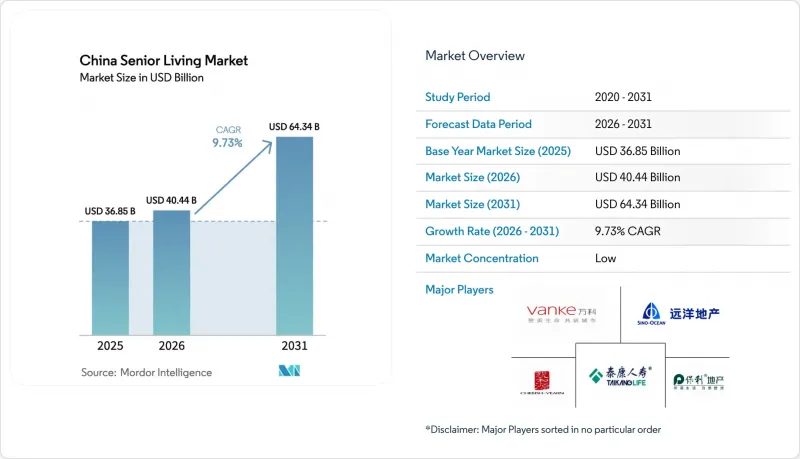
本報告按物業類型(輔助居住、自主型居住、失智症居住)、經營模式(大量銷售、長期租賃、混合模式)、年齡層(55-64歲、65-74歲、75-85歲、85歲及以上)及主要城市(北京、上海、深圳、廣州、成都及中國其他地區)進行分類。市場預測以美元計價。
中國養老市場趨勢與洞察
人口快速老化和老年人口的增加正在重塑護理層級結構。
預計到2031年,中國75歲及以上人口將超過其他所有年齡層,這將推動對輔助住宅、失智症護理和專業護理服務的需求成長。 2024年底,65歲以上人口數將達到2.2023億,佔總人口的15.6%。該族群中糖尿病、心血管疾病和認知障礙的盛行率不斷上升,迫使養老機構將獨立生活單元維修成失智症護理單元,並在其機構內設立老年科門診。參與長期照護保險(LTCI)試點計畫的早期機構已開始對綜合復健服務收費,提高了服務利用率,同時減少了緊急轉運。世界衛生組織自2024年開始試點的「老年人綜合護理架構」正在加速功能能力評估和可互通電子健康記錄的實施。能夠為高護理需求單元配備充足人員的機構,正受益於更長的入住時間和超過通貨膨脹率的定價權。
沿海主要城市的資產形成:培育高階市場
目前,一二線城市居民的家庭儲蓄足以支付每月1100美元至2750美元不等的住家周邊設施費用,這在十年前是難以想像的。退休金收入的成長和房地產資產的增值支撐了人們對以生活方式為導向的專業養老服務的需求。泰康人壽在蘇州於2024年開業的「五園」養老項目,提倡「候鳥式」退休生活方式,利用中國的高鐵實現居民的季節性遷徙。 2025年1月,平安保險以17億美元收購了其數位健康業務部門,進一步顯示了其對遠端醫療系統能夠支撐高額保費的信心。儘管高階市場呈現穩定成長態勢,但內陸城市的中階退休設施運轉率低於60%,凸顯了財富分配的不均。
文化習俗延緩了主要城市以外地區設施的引入。
由於根深蒂固的孝道觀念,家庭照顧仍然備受重視,尤其是在中小城市和農村地區。 2024年成都的一項調查發現,儘管成年子女願意承擔費用,但父母卻不願搬遷,導致許多二線城市養老計畫的入住率低於60%。香港和廣東的退休養老機構計畫雖然成本效益高,但由於老年人更傾向於熟悉的文化和飲食,其使用率仍然有限。儘管營運商正在將這些機構重新定義為“生活社區”,融入藝術工作室和短途旅行等活動,但這種訊息主要吸引的是都市區。因此,中國的居住市場發展不平衡,入住養老機構比例最高的地區往往是文化障礙最低的地區。
細分市場分析
到2025年,輔助住宅將佔據中國住宅市場42.3%的主導佔有率,這反映了其在滿足日常生活支援需求方面的多功能性。雖然自主型住宅仍然吸引著相對年輕的退休人士,但隨著2024年12月全國範圍內的失智症照護法規的實施,業者已開始將重心轉向失智症照護設施。預計從2026年到2031年,失智症照顧設施的複合年成長率將達到10.55%,超過所有其他產品類型。泰康人壽和平安保險透過部署配備感官刺激室和認證人員的安全樓層,在中國住宅市場打造了高利潤且差異化的產品。
增設失智症護理單位會增加資本投入,但會提高每位住戶的平均收入。新框架要求達到最低護理師與住戶比例,並提供家庭支持項目,這設定了進入門檻,使資金雄厚的連鎖業者獲得競爭優勢。獨立生活設施營運商正在維修現有園區,以留住老齡化速度不同的夫妻。同時,長期照護機構正在利用長期照護保險 (LTCI)試驗計畫,對復健療程進行收費,並加強交叉銷售。隨著越來越多的住戶從獨立生活過渡到更高級別的護理,綜合園區提高了入住率的穩定性,並有助於維持長期現金流。
其他好處:
- Excel格式的市場預測(ME)表
- 3個月的分析師支持
目錄
第1章:引言
- 研究假設和市場定義
- 調查範圍
第2章:調查方法
第3章執行摘要
第4章 市場洞察與市場動態
- 市場概覽
- 市場促進因素
- 人口快速老化——75-85歲及以上人口的成長——推動了對自主型、輔助生活和失智症照護的需求不斷成長。
- 一二線城市家庭資產增加,以及對專業照護服務的態度轉變。
- 醫療整合的機會:復健、慢性病管理、為老年人設立的校內診所。
- 政府支持提供老年護理服務,包括試驗計畫、土地利用和公私合營(PPP) 計劃,以及與醫療保險的協調。
- 技術驅動的營運(遠端醫療、遠端監控、跌倒檢測)正在提高治療效果和效率。
- 市場限制因素
- 由於文化上更傾向於家庭式照顧,數位化在主要都市區以外的市場進展緩慢。
- 老年醫學和護理領域的人員短缺,以及服務提供者能力上的差距,阻礙了品質的提升。
- 支付能力差異以及複雜的許可和還款框架威脅著經濟的永續性。
- 價值供應鏈分析
- 政策和法律規範(州指導方針、許可、獎勵)
- 對即將開展和正在進行的項目的見解
- 對數位化和技術促進因素(遠端醫療、智慧設施)的洞察
- 對經營模式和電信業者演變的洞察
- 對投資和資金籌措趨勢的洞察
- 洞察:永續性和設計創新
- 波特五力模型
第5章 市場規模與成長預測
- 按屬性類型
- 輔助生活設施
- 獨立生活
- 記憶護理
- 護理機構
- 按經營模式
- 完全轉移(所有權)
- 長期租賃/出租
- 混合模式(銷售+租賃)
- 按年齡層
- 55至64歲
- 65至74歲
- 75至85歲
- 85歲或以上
- 按主要城市
- 北京
- 上海
- 深圳
- 廣州
- 成都
- 中國等地區
第6章 競爭情勢
- 市場集中度
- 策略趨勢
- 公司簡介
- China Vanke
- Sino-Ocean Group
- Taikang Life
- Poly Developments & Holdings
- Cherish-Yearn
- New China Life
- China Taiping
- Lendlease(Ardor Gardens)
- Aveo China
- Wuxi Langgao Elderly Service
- Country Garden Elderly Care
- Greentown China Senior Living
- Longfor Elderly Care
- China Merchants Shekou Elderly Community
- Bluetown Senior Living
- Ping An Good-Doctor & Ping An Home-Care
- R&F Properties Yuelai Elderly Care
- CIFI Ever Sunshine Elderly Services
- Brookdale & CITIC JV
- Abbeyfield China
- Evergrande Elderly Care
第7章 市場機會與未來展望
According to Mordor Intelligence, the China senior living market size was valued at USD 36.85 billion in 2025 and is estimated to grow from USD 40.44 billion in 2026 to reach USD 64.34 billion by 2031, at a CAGR of 9.73% during the forecast period (2026-2031).
This report is Segmented by Property Type (Assisted Living, Independent Living, Memory Care, Nursing Care), by Business Model (Outright Sale, Long-Lease/Rental, Hybrid), by Age (55-64, 65-74, 75-85, Above 85), and by Major Cities (Beijing, Shanghai, Shenzhen, Guangzhou, Chengdu, Rest of China). The Market Forecasts are Provided in Terms of Value (USD).
China Senior Living Market Trends and Insights
Rapid Aging Cohort Expansion Reshaping Care-Level Mix
China will see its population aged 75 and above outpace all other age brackets by 2031, lifting demand for assisted living, memory care, and skilled nursing. By end-2024, seniors 65 and older totaled 220.23 million, equal to 15.6% of the population. Higher prevalence of diabetes, cardiovascular disease, and cognitive impairment among this group pushes operators to retrofit independent-living wings into dementia-ready units and to embed geriatric clinics on campus. Early adopters tied into LTCI pilots have begun billing bundled rehabilitation services, raising utilization while cutting emergency transfers. The WHO Integrated Care for Older People framework, piloted since 2024, is accelerating the adoption of functional-ability assessments and interoperable electronic records. Operators capable of staffing higher-dependency units are rewarded with longer lengths of stay and pricing power that outstrips inflation.
Wealth Accumulation in Coastal Hubs: Unlocking Premium Segments
Household savings in Tier 1 and Tier 2 cities now support monthly fees ranging from USD 1,100 to USD 2,750 for assisted living, a level unattainable a decade earlier. Rising pension income and property gains underpin a lifestyle-oriented view of professional care. Taikang Life's Wu Garden in Suzhou, opened in 2024, markets "migratory bird" retirement, leveraging China's high-speed rail to shuttle residents seasonally. Ping An's USD 1.7 billion buy-out of its digital-health unit in January 2025 further signals confidence that telehealth ecosystems can justify premium pricing. Despite strength at the top end, mid-market facilities in inland cities still face occupancy below 60%, underscoring uneven wealth dispersion.
Cultural Norms Slowing Institutional Adoption Beyond Tier 1 Cities
Deep-rooted filial piety sustains a family-care bias, especially in smaller cities and rural counties. Surveys in Chengdu during 2024 showed parents resisting relocation despite adult children's willingness to pay, keeping occupancy below 60% in many Tier 2 projects. The Hong Kong-Guangdong RCHE scheme, though cost-efficient, had limited uptake because seniors prefer familiar culture and food. Operators reframe facilities as lifestyle communities with art studios and excursions, but messaging resonates mainly with urban elites. Consequently, the Chinese senior living market grows unevenly, with conversion highest where cultural barriers are weakest.
Other drivers and restraints analyzed in the detailed report include:
- Healthcare Integration Blurring Institutional and Clinical Boundaries
- Government Land and Financing Incentives Accelerating Supply
- Workforce Shortages and Quality Gaps Constraining Service Delivery
For complete list of drivers and restraints, kindly check the Table Of Contents.
Segment Analysis
Assisted living held a commanding 42.3% of China senior living market share in 2025, reflecting its versatility in meeting daily activity assistance needs. Independent living attracts younger retirees, yet operators now pivot to memory care after national dementia-care rules took effect in December 2024. Memory-care units are projected to post a 10.55% CAGR between 2026 and 2031, outpacing every other property type. Taikang Life and Ping An are rolling out secured floors with sensory-stimulation rooms and certified staff, creating high-margin, differentiated products within the Chinese senior living market.
Adding dementia-ready wings raises capital expense but boosts average revenue per occupied bed. Compliance with the new framework requires minimum nurse-to-resident ratios and family-support programs, barriers that tilt competition toward well-funded chains. Independent-living operators retrofit existing campuses to retain couples aging at different paces, while nursing-care facilities leverage LTCI pilots to bill post-acute rehab sessions, strengthening cross-selling. As more residents transition from independent living to higher-acuity care, integrated campuses gain occupancy resilience, supporting long-term cash flow.
Complete Report Scope:
- By Property Type
- Assisted Living
- Independent Living
- Memory Care
- Nursing Care
- By Business Model
- Outright Sale (Freehold)
- Long-Lease / Rental
- Hybrid (Sale + Lease)
- By Age
- 55 to 64 years
- 65 to 74 years
- 75 to 85 years
- Above 85 years
- By Major Cities
- Beijing
- Shanghai
- Shenzhen
- Guangzhou
- Chengdu
- Rest of China
List of Companies Covered in this Report:
- China Vanke
- Sino-Ocean Group
- Taikang Life
- Poly Developments & Holdings
- Cherish-Yearn
- New China Life
- China Taiping
- Lendlease (Ardor Gardens)
- Aveo China
- Wuxi Langgao Elderly Service
- Country Garden Elderly Care
- Greentown China Senior Living
- Longfor Elderly Care
- China Merchants Shekou Elderly Community
- Bluetown Senior Living
- Ping An Good-Doctor & Ping An Home-Care
- R&F Properties Yuelai Elderly Care
- CIFI Ever Sunshine Elderly Services
- Brookdale & CITIC JV
- Abbeyfield China
- Evergrande Elderly Care
Additional Benefits:
- The market estimate (ME) sheet in Excel format
- 3 months of analyst support
TABLE OF CONTENTS
1 Introduction
- 1.1 Study Assumptions & Market Definition
- 1.2 Scope of the Study
2 Research Methodology
3 Executive Summary
4 Market Insight and Dynamics
- 4.1 Market Overview
- 4.2 Market Drivers
- 4.2.1 Rapid aging-growing 75-85+ cohort-expanding demand for independent, assisted, and memory care.
- 4.2.2 Rising household wealth and shifting attitudes toward professional care services in Tier 1-2 cities.
- 4.2.3 Healthcare integration opportunities: rehab, chronic-disease management, and senior-friendly clinics on-campus.
- 4.2.4 Government support for eldercare supply, including pilot programs, land/PPP avenues, and medical insurance linkages.
- 4.2.5 Technology-enabled operations (telehealth, remote monitoring, fall detection) improving outcomes and efficiency.
- 4.3 Market Restraints
- 4.3.1 Cultural preference for family-based care limiting conversion outside top urban markets.
- 4.3.2 Staffing shortages in geriatrics/nursing and uneven operator capability constraining quality scale-up.
- 4.3.3 Affordability gaps and complex licensing/reimbursement frameworks challenging sustainable economics.
- 4.4 Value / Supply-Chain Analysis
- 4.5 Policy & Regulatory Framework (state guidelines, licensing, incentives)
- 4.6 Insight on Upcoming and Ongoing Projects
- 4.7 Insights on Digital & Tech Enablers (telemedicine, smart amenities)
- 4.8 Insights on Business Model & Operator Evolution
- 4.9 Insights on Investment & Financing Trends
- 4.10 Insights Sustainability & Design Innovation
- 4.11 Porter's Five Forces
- 4.11.1 Threat of New Entrants
- 4.11.2 Bargaining Power of Buyers
- 4.11.3 Bargaining Power of Suppliers
- 4.11.4 Threat of Substitutes
- 4.11.5 Intensity of Competitive Rivalry
5 Market Size & Growth Forecasts (Value)
- 5.1 By Property Type
- 5.1.1 Assisted Living
- 5.1.2 Independent Living
- 5.1.3 Memory Care
- 5.1.4 Nursing Care
- 5.2 By Business Model
- 5.2.1 Outright Sale (Freehold)
- 5.2.2 Long-Lease / Rental
- 5.2.3 Hybrid (Sale + Lease)
- 5.3 By Age
- 5.3.1 55 to 64 years
- 5.3.2 65 to 74 years
- 5.3.3 75 to 85 years
- 5.3.4 Above 85 years
- 5.4 By Major Cities
- 5.4.1 Beijing
- 5.4.2 Shanghai
- 5.4.3 Shenzhen
- 5.4.4 Guangzhou
- 5.4.5 Chengdu
- 5.4.6 Rest of China
6 Competitive Landscape
- 6.1 Market Concentration
- 6.2 Strategic Moves
- 6.3 Company Profiles (includes Global level Overview, Market level overview, Core Segments, Financials as available, Strategic Information, Products & Services, and Recent Developments)
- 6.3.1 China Vanke
- 6.3.2 Sino-Ocean Group
- 6.3.3 Taikang Life
- 6.3.4 Poly Developments & Holdings
- 6.3.5 Cherish-Yearn
- 6.3.6 New China Life
- 6.3.7 China Taiping
- 6.3.8 Lendlease (Ardor Gardens)
- 6.3.9 Aveo China
- 6.3.10 Wuxi Langgao Elderly Service
- 6.3.11 Country Garden Elderly Care
- 6.3.12 Greentown China Senior Living
- 6.3.13 Longfor Elderly Care
- 6.3.14 China Merchants Shekou Elderly Community
- 6.3.15 Bluetown Senior Living
- 6.3.16 Ping An Good-Doctor & Ping An Home-Care
- 6.3.17 R&F Properties Yuelai Elderly Care
- 6.3.18 CIFI Ever Sunshine Elderly Services
- 6.3.19 Brookdale & CITIC JV
- 6.3.20 Abbeyfield China
- 6.3.21 Evergrande Elderly Care
7 Market Opportunities & Future Outlook
- 7.1 White-space & Unmet-Need Assessment

 全球生活協助軟體市場(2026-2030 年)
 美國老年住宅:市場佔有率分析、行業趨勢和統計數據以及成長預測(2026-2031 年)環境生活輔助(AAL):市場佔有率分析、產業趨勢與統計、成長預測(2026-2031)
 老年人住宅產品:市場規模、佔有率和成長分析(按產品類型、應用、最終用戶、分銷管道、產品類型和地區分類)-2026-2033年產業預測
 養老住家周邊設施市場規模、佔有率和成長分析:按設施類型、服務類型、支付/資金來源和地區分類-2026-2033年產業預測
 2026-2030年全球退休市場
 輔助生活市場規模、佔有率和成長率;全球產業分析;按類型、應用和地區進行分析;以及未來預測(2026-2034 年)。
 老年居住市場:按設施類型、服務提供者、服務類型、性別、年齡層、技能水平、主要支付來源和地區分類。
 環保生活市場:按組件、技術、最終用戶、部署模式、連接類型、應用和分銷管道分類-2026-2032年全球預測
 美國老年住宅市場:市場規模、佔有率和趨勢分析(按設施和地區分類),細分市場預測(2026-2033 年)