


 |
市場調查報告書
商品編碼
2124555
歐洲、中東和非洲(EMEA)瓦楞紙包裝:市場佔有率分析、行業趨勢與統計數據以及成長預測(2026-2031 年)EMEA Corrugated Board Packaging - Market Share Analysis, Industry Trends & Statistics, Growth Forecasts (2026 - 2031) |
||||||

※ 本網頁內容可能與最新版本有所差異。詳細情況請與我們聯繫。
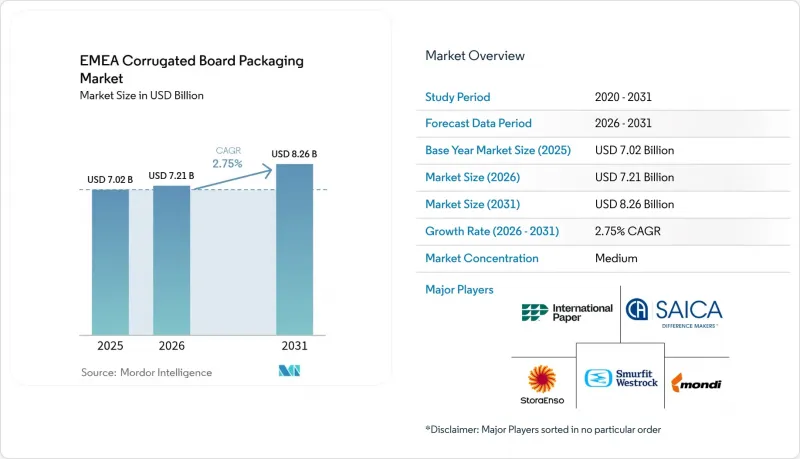
據 Mordor Intelligence 稱,歐洲、中東和非洲 (EMEA) 的瓦楞紙包裝市場預計在 2026 年達到 72.1 億美元,高於 2025 年的 70.2 億美元,預計到 2031 年將達到 82.6 億美元。
預計從 2026 年到 2031 年,其複合年成長率將達到 2.75%。
本報告按最終用戶行業(食品、飲料、電子商務、電氣和電子設備等)、瓦楞類型(A型、B型、C型等)、瓦楞紙板類型(單面、單層等)、印刷技術(柔版印刷、數位印刷等)和地區(歐洲、中東和非洲)進行細分。市場預測以美元計價。
歐洲、中東和非洲(EMEA)瓦楞紙板包裝市場的趨勢和洞察
電子商務小包裹處理量呈爆炸性成長
隨著歐盟內部跨境貿易在2024年成長23%,線上零售為瓦楞紙板創造了新的需求來源。在小包裹形式方面,消費者對具有更強防護性、更大品牌展示空間和精準形狀貼合度的設計需求日益成長,所有這些都推高了單位成本。都市區履約中心越來越傾向於選擇更靈活的紙板加工廠,而非大型郊區工廠,這迫使加工商採用模組化瓦楞紙板生產設備,以實現生產線的快速切換。像Zalando這樣的品牌在2024年改用客製尺寸的水性塗佈紙箱,從而降低了15%的材料成本,並提升了印刷效果。當日訂單的穩定成長進一步推動了歐洲、中東和非洲地區瓦楞紙包裝市場的發展,將小包裹遞送速度轉化為當地工廠的穩定訂單。
歐盟的《包裝廢棄物法規》(PPWR)推動了對可回收包裝的需求。
2024 年的法規要求在 2030 年瓦楞紙板產品的回收率達到 90%,將平均再生纖維含量標準提高到 85%。瓦楞紙板的回收率已達 88%,在合規性領先於塑膠基材。擁有先進脫墨系統的製造商能夠為高白度再生襯紙獲得溢價。這項政策也鼓勵歐洲品牌在中東和非洲的子公司採用纖維材料,以持續履行對永續發展的承諾。因此,歐洲、中東和非洲地區的瓦楞紙板包裝市場是由法規而非補貼驅動的,降低了新投資的風險。
OCC 和 Kraftliner 的價格波動
2024年,瓦楞紙板(OCC)價格波動幅度高達35%,對簽訂年度合約的加工商的毛利率帶來壓力。有限的避險選擇迫使中型瓦楞紙板廠重新談判價格轉嫁條款,否則將面臨帳單危機。牛皮紙襯紙價格也與紙漿和能源成本掛鉤,增加了原料預算的不確定性。這些波動正在加速行業重組,大規模綜合企業透過利用廣泛的纖維原料來源和外匯套期保值來擴大業務,而小規模的獨立企業則選擇退出或專注於特定領域。這些價格波動已使歐洲、中東和非洲地區瓦楞紙板包裝市場的預期複合年成長率(CAGR)下降了0.5個百分點。
細分市場分析
到2025年,食品業將佔據歐洲、中東和非洲地區瓦楞紙包裝市場34.92%的主導佔有率,主要基於農產品出口、保存食品和冷藏調理食品。生產商看重瓦楞紙板在不影響抗壓強度的前提下吸收冷凝水的能力,這使得高解析度影像能夠提升品牌曝光度,同時滿足嚴格的衛生標準。輕質水性塗層包裝箱正逐漸佔領熟食店和烘焙店的貨架,取代PET翻蓋式容器。受直接面對消費者的食品雜貨包裝盒、時尚單品退貨物流和電子產品配送的推動,電子商務通路預計到2031年將以4.12%的複合年成長率成為成長最快的行業。該行業的包裝需求正轉向整合式快速鎖扣、唇形拉環和回扣膠帶,從而降低履約的人事費用。當食品品牌在電商平台上同時銷售多種產品時,他們需要兼具雙重功能的SKU:既能保護生鮮食品,又能讓產品在配送目的地保持吸引力。這產生了協同效應,從而推動了瓦楞紙包裝在歐洲、中東和非洲地區的市佔率擴張。
在飲料類別中,需要使用加固隔板來保護玻璃瓶和鋁製多件包裝,同時庫存正在轉向使用可回收內襯,以履行企業減少碳排放的承諾。在個人護理和化妝品領域,為了提升產品開啟時的視覺吸引力,企業正在選用兼具結構強度和媲美平版印刷印刷品質的微型瓦楞紙盒。在工業零件領域,折疊式模切件正被用作膠合板的替代品,從而減輕重量並簡化清關流程。隨著汽車零件的電氣化,電池模組需要使用防靜電塗層,這在不顯著增加材料消耗的情況下,提供了更高的附加價值。
C型瓦楞紙板憑藉其多功能的緩衝和複合性能,預計到2025年將保持31.95%的市場佔有率,繼續成為成品食品和耐用消費品的首選。然而,微型瓦楞紙板(F型和N型)憑藉其卓越的套準精度和薄壁結構帶來的運輸成本優勢,正以每年3.82%的速度成長。專業加工商正將微型瓦楞紙板與高白度襯紙結合使用,目標市場包括高階巧克力、個人電子產品和POS托盤。 A型瓦楞紙板仍然廣泛用作瓜類和根莖類的堅固農產品包裝容器,這些產品需要在冷藏倉庫中進行垂直堆疊。 B型瓦楞紙板適用於需要精確模切和壓痕的貨架展示。 E型瓦楞紙板涵蓋紙板和瓦楞紙板領域,用於小型電子產品和高階茶葉等需要堅實觸感的產品。瓦楞紙板形狀的多樣化帶來了更廣泛的 SKU 和瓦楞紙板製造機械資本投資的多樣化分佈,這有助於保持 EMEA 瓦楞紙板包裝市場的創新勢頭。
材料科學的進步使得混合瓦楞紙板組合(例如E/B雙層瓦楞結構)成為可能。這種組合兼顧了印刷性能和耐壓性,使加工商能夠建立模組化生產體系,無需更換紙板供應商即可同時處理電商服裝和工業零件的生產。這種方法,尤其是在結合基於產品重量資料庫推薦瓦楞紙板組合的AI模式庫時,能夠顯著提高客戶維繫。
其他好處:
- Excel格式的市場預測(ME)表
- 3個月的分析師支持
目錄
第1章:引言
- 市場分析與定義的前提條件
- 分析範圍
第2章 分析方法
第3章執行摘要
第4章 市場狀況
- 市場概覽
- 市場促進因素
- 電子商務小包裹數量正在爆炸式成長。
- 歐盟對可回收包裝材料的需求,受PPWR的推動。
- 冷鏈中生鮮食品運輸過渡到纖維箱包裝
- 引入人工智慧驅動的包裝以實現合適的尺寸
- 水性阻隔塗層作為塑膠托盤的替代品
- 歐盟CBAM對本地生產的再生襯墊的獎勵
- 市場限制因素
- OCC 和牛皮紙的價格波動
- 使用可重複使用/軟性包裝的替代方案
- 能源價格上漲正在影響紙板製造機器的營運成本(OPEX)。
- 東歐戰爭導致造紙廠關閉
- 產業價值鏈分析
- 監理情勢
- 技術展望
- 宏觀經濟因素對市場的影響
- 波特五力模型
第5章:預測市場規模與成長率
- 按最終用戶行業分類
- 食物
- 加工食品
- 生鮮食品和農產品
- 飲料
- 電子商務
- 電氣和電子設備
- 個人護理和化妝品
- 其他終端用戶產業
- 食物
- 按笛子類型
- 長笛
- 低音長笛
- C調長笛
- 電子長笛
- F/N 微型笛
- 其他類型的笛子
- 按紙板類型
- 一邊
- 單層
- 雙層
- 三層
- 透過印刷技術
- 柔版印刷
- 數位印刷
- 乳化
- 網版印刷
- 其他印刷技術
- 按地區
- 歐洲
- 英國
- 德國
- 法國
- 西班牙
- 義大利
- 其他歐洲國家
- 中東
- 沙烏地阿拉伯
- 阿拉伯聯合大公國
- 土耳其
- 其他中東國家
- 非洲
- 南非
- 埃及
- 奈及利亞
- 其他非洲國家
- 歐洲
第6章 競爭情勢
- 市場集中度
- 策略趨勢
- 市佔率分析
- 公司簡介
- Smurfit WestRock
- Mondi plc
- International Paper Company
- Saica SA
- Stora Enso Oyj
- Svenska Cellulosa Aktiebolaget(SCA)
- Prinzhorn Holding GmbH
- VPK Group NV
- Palm Gruppe GmbH & Co KG
- Dunapack Packaging(Prinzhorn)
- Mayr-Melnhof Karton AG
- Rengo Co. Ltd.
- Nine Dragons Paper(Holdings)Ltd.
- Packaging Corporation of America
- Georgia-Pacific LLC
- Amcor plc
- Pratt Industries, Inc.
- Cascades Inc.
- Arabian Packaging LLC
第7章 市場機會與未來展望
According to Mordor Intelligence, EMEA corrugated board packaging market size in 2026 is estimated at USD 7.21 billion, growing from 2025 value of USD 7.02 billion with 2031 projections showing USD 8.26 billion, growing at 2.75% CAGR over 2026-2031.
This report is Segmented by End-User Industry (Food, Beverages, E-Commerce, Electrical and Electronics, and More), Flute Type (A-Flute, B-Flute, C-Flute, and More), Board Type (Single Face, Single Wall, and More), Printing Technology (Flexography, Digital Printing, and More), and Geography (Europe, Middle East, and Africa). The Market Forecasts are Provided in Terms of Value (USD).
EMEA Corrugated Board Packaging Market Trends and Insights
Exploding e-commerce parcel volumes
Online retail added new corrugated demand streams as cross-border transactions in the EU climbed 23% in 2024. Parcel formats favor protective designs, extra branding space, and fit-to-product geometry, all of which command premium unit prices. Urban fulfillment hubs now prefer agile sheet plants over large suburban complexes, pushing converters to deploy modular corrugators with rapid changeovers. Brands such as Zalando demonstrated 15% material savings and improved print aesthetics after switching to custom-sized water-based coated boxes in 2024. Steady growth in same-day delivery further accelerates the EMEA corrugated board packaging market, translating parcel velocity into reliable order backlogs for local plants.
EU PPWR-driven demand for recyclable packaging
The 2024 regulation mandates 90% recycling rates for corrugated formats by 2030 and elevates average recycled fiber content benchmarks to 85%. Corrugated already delivers 88%, giving it a compliance head-start over plastic substrates. Producers with advanced de-inking systems are locking in price premiums for high-whiteness recycled liner. The policy also nudges Middle Eastern and African subsidiaries of European brands toward fiber adoption to maintain uniform sustainability claims. As a result, the EMEA corrugated board packaging market embeds regulatory pull rather than subsidy push, curbing risk profiles for new investments.
OCC and kraftliner price volatility
OCC prices swung 35% in 2024, compressing gross margins for converters locked into annual contracts. Hedging mechanisms have limited liquidity, forcing mid-tier box plants to renegotiate pass-through clauses or risk solvency. Kraftliner also tracks pulp and energy costs, injecting unpredictability into input budgets. The turbulence intensifies consolidation as scaled integrators leverage broader fiber baskets and currency hedges, while smaller independents exit or specialize. Such swings subtract 0.5 percentage points from the projected CAGR for the EMEA corrugated board packaging market.
Other drivers and restraints analyzed in the detailed report include:
- Fresh produce cold-chain shift to fiber-based crates
- AI-enabled right-size packaging adoption
- Energy-price shock hitting corrugator OPEX
For complete list of drivers and restraints, kindly check the Table Of Contents.
Segment Analysis
The food segment generated a dominant 34.92% share of the EMEA corrugated board packaging market in 2025, anchored in agricultural exports, ambient grocery, and chilled ready-meals. Producers value corrugated's capacity to absorb condensation without losing compressive strength, fulfilling stringent hygiene standards while supporting brand visibility through high-resolution graphics. Lightweight crates with water-based coatings now penetrate deli and bakery aisles, displacing PET clamshells. The e-commerce channel exhibits the fastest 4.12% CAGR to 2031, driven by direct-to-consumer grocery boxes, fashion returns logistics, and electronics deliveries. Packaging needs here skew toward quick-set locks, rip-tabs, and integrated returns tape that shrink fulfillment labor costs. Synergies arise when food brands cross-list on online marketplaces, requiring dual-purpose SKUs that protect perishables and present attractively on the doorstep, thereby reinforcing share gains for the EMEA corrugated board packaging market.
A stable beverage sub-segment demands reinforced section dividers to shield glass and aluminum multipacks, with inventory switching toward post-consumer recycled liner to meet corporate carbon pledges. Personal care and cosmetics lines select microflute boxes that blend structural integrity with near-offset print quality, uplifting unboxing theatrics. Industrial parts now adopt fold-to-fit die-cuts that replace plywood, lowering weight and easing customs clearance. Electrification in automotive components invites antistatic coatings for battery modules, adding premium value layers without heavy material additions.
C-Flute maintained 31.95% share in 2025 for its all-round cushioning and stacking competencies, making it a default choice for case-ready foods and durable goods. However, microflute variants (F and N) are growing 3.82% annually on the strength of superior print registration and slimmer wall thickness that cuts freight costs. Specialty converters pair microflute with high-white liners, targeting luxury chocolates, personal electronics, and point-of-sale trays. A-Flute persists in heavy-duty agriculture bins for melons and root vegetables that face vertical stacking in cold stores. B-Flute wins when precise die-cut scoring is needed for shelf-ready displays. E-Flute straddles cartonboard and corrugated territories, servicing small appliances and specialty teas that crave tactile stiffness. This diversification of flute profiles diversifies SKUs and spreads capex across corrugators, sustaining innovation momentum in the EMEA corrugated board packaging market.
Material science developments allow hybrid flute combinations where an E/B double wall mates print surface with crush resistance, giving converters modular setups to serve both e-commerce apparel and industrial spares without switching board suppliers. The approach elevates customer retention, especially when paired with AI pattern libraries that recommend flute mixes from product weight databases.
Complete Report Scope:
- By End-User Industry
- Food
- Processed Foods
- Fresh Food and Produce
- Beverages
- E-commerce
- Electrical and Electronics
- Personal Care and Cosmetics
- Other End-User Industries
- Food
- By Flute Type
- A-Flute
- B-Flute
- C-Flute
- E-Flute
- F/N Microflute
- Other Flute Types
- By Board Type
- Single Face
- Single Wall
- Double Wall
- Triple Wall
- By Printing Technology
- Flexography
- Digital Printing
- Litho-lamination
- Screen Printing
- Other Printing Technologies
- BY Geography
- Europe
- United Kingdom
- Germany
- France
- Spain
- Italy
- Rest of Europe
- Middle East
- Saudi Arabia
- United Arab Emirates
- Turkey
- Rest of Middle East
- Africa
- South Africa
- Egypt
- Nigeria
- Rest of Africa
- Europe
List of Companies Covered in this Report:
- Smurfit WestRock
- Mondi plc
- International Paper Company
- Saica S.A.
- Stora Enso Oyj
- Svenska Cellulosa Aktiebolaget (SCA)
- Prinzhorn Holding GmbH
- VPK Group NV
- Palm Gruppe GmbH & Co KG
- Dunapack Packaging (Prinzhorn)
- Mayr-Melnhof Karton AG
- Rengo Co. Ltd.
- Nine Dragons Paper (Holdings) Ltd.
- Packaging Corporation of America
- Georgia-Pacific LLC
- Amcor plc
- Pratt Industries, Inc.
- Cascades Inc.
- Arabian Packaging LLC
Additional Benefits:
- The market estimate (ME) sheet in Excel format
- 3 months of analyst support
TABLE OF CONTENTS
1 INTRODUCTION
- 1.1 Study Assumptions and Market Definition
- 1.2 Scope of the Study
2 RESEARCH METHODOLOGY
3 EXECUTIVE SUMMARY
4 MARKET LANDSCAPE
- 4.1 Market Overview
- 4.2 Market Drivers
- 4.2.1 Exploding e-commerce parcel volumes
- 4.2.2 EU PPWR-driven demand for recyclable packaging
- 4.2.3 Fresh produce cold-chain shift to fiber-based crates
- 4.2.4 AI-enabled right-size packaging adoption
- 4.2.5 Water-based barrier coatings replacing plastic trays
- 4.2.6 EU CBAM incentives for local recycled liner
- 4.3 Market Restraints
- 4.3.1 OCC and kraftliner price volatility
- 4.3.2 Substitution by reusable/flexible packaging
- 4.3.3 Energy-price shock hitting corrugator OPEX
- 4.3.4 War-related mill outages in Eastern Europe
- 4.4 Industry Value Chain Analysis
- 4.5 Regulatory Landscape
- 4.6 Technological Outlook
- 4.7 Impact of Macroeconomic Factors on the Market
- 4.8 Porter's Five Forces
- 4.8.1 Threat of New Entrants
- 4.8.2 Bargaining Power of Buyers
- 4.8.3 Bargaining Power of Suppliers
- 4.8.4 Threat of Substitute Products
- 4.8.5 Intensity of Competitive Rivalry
5 MARKET SIZE AND GROWTH FORECASTS (VALUE)
- 5.1 By End-User Industry
- 5.1.1 Food
- 5.1.1.1 Processed Foods
- 5.1.1.2 Fresh Food and Produce
- 5.1.2 Beverages
- 5.1.3 E-commerce
- 5.1.4 Electrical and Electronics
- 5.1.5 Personal Care and Cosmetics
- 5.1.6 Other End-User Industries
- 5.1.1 Food
- 5.2 By Flute Type
- 5.2.1 A-Flute
- 5.2.2 B-Flute
- 5.2.3 C-Flute
- 5.2.4 E-Flute
- 5.2.5 F/N Microflute
- 5.2.6 Other Flute Types
- 5.3 By Board Type
- 5.3.1 Single Face
- 5.3.2 Single Wall
- 5.3.3 Double Wall
- 5.3.4 Triple Wall
- 5.4 By Printing Technology
- 5.4.1 Flexography
- 5.4.2 Digital Printing
- 5.4.3 Litho-lamination
- 5.4.4 Screen Printing
- 5.4.5 Other Printing Technologies
- 5.5 BY Geography
- 5.5.1 Europe
- 5.5.1.1 United Kingdom
- 5.5.1.2 Germany
- 5.5.1.3 France
- 5.5.1.4 Spain
- 5.5.1.5 Italy
- 5.5.1.6 Rest of Europe
- 5.5.2 Middle East
- 5.5.2.1 Saudi Arabia
- 5.5.2.2 United Arab Emirates
- 5.5.2.3 Turkey
- 5.5.2.4 Rest of Middle East
- 5.5.3 Africa
- 5.5.3.1 South Africa
- 5.5.3.2 Egypt
- 5.5.3.3 Nigeria
- 5.5.3.4 Rest of Africa
- 5.5.1 Europe
6 COMPETITIVE LANDSCAPE
- 6.1 Market Concentration
- 6.2 Strategic Moves
- 6.3 Market Share Analysis
- 6.4 Company Profiles (includes Global level Overview, Market level overview, Core Segments, Financials as available, Strategic Information, Market Rank/Share for key companies, Products and Services, and Recent Developments)
- 6.4.1 Smurfit WestRock
- 6.4.2 Mondi plc
- 6.4.3 International Paper Company
- 6.4.4 Saica S.A.
- 6.4.5 Stora Enso Oyj
- 6.4.6 Svenska Cellulosa Aktiebolaget (SCA)
- 6.4.7 Prinzhorn Holding GmbH
- 6.4.8 VPK Group NV
- 6.4.9 Palm Gruppe GmbH & Co KG
- 6.4.10 Dunapack Packaging (Prinzhorn)
- 6.4.11 Mayr-Melnhof Karton AG
- 6.4.12 Rengo Co. Ltd.
- 6.4.13 Nine Dragons Paper (Holdings) Ltd.
- 6.4.14 Packaging Corporation of America
- 6.4.15 Georgia-Pacific LLC
- 6.4.16 Amcor plc
- 6.4.17 Pratt Industries, Inc.
- 6.4.18 Cascades Inc.
- 6.4.19 Arabian Packaging LLC
7 MARKET OPPORTUNITIES AND FUTURE OUTLOOK
- 7.1 White-space and Unmet-need Assessment

 纖維板包裝市場規模、佔有率、成長和行業分析:按纖維板類型、結構、產品類型、箱體形狀、最終用途和地區分類,並預測至2034年
 英國瓦楞紙包裝:市場佔有率分析、產業趨勢與統計及成長預測(2026-2031)瓦楞紙板包裝:市場佔有率分析、行業趨勢和統計數據、成長預測(2026-2031 年)
 2026年全球紙本拉環郵件市場報告
 瓦楞紙板包裝市場機會、成長要素、產業趨勢分析及2026-2035年預測。
 瓦楞紙板包裝市場規模、佔有率、成長及全球產業分析:按類型、應用和地區分類,並預測至2026-2034年
 2032 年瓦楞包裝市場預測:按類型、材料類型、瓦楞類型、包裝類型、應用、最終用戶和地區進行的全球分析瓦楞包裝市場:依類型、最終用戶行業和地區,2026年至2032年