


 |
市場調查報告書
商品編碼
2124209
中東和非洲數位戶外(DOOH):市場佔有率分析、行業趨勢和統計數據以及成長預測 (2026-2031)Middle East And Africa Digital Out Of Home (DOOH) - Market Share Analysis, Industry Trends & Statistics, Growth Forecasts (2026 - 2031) |
||||||

※ 本網頁內容可能與最新版本有所差異。詳細情況請與我們聯繫。
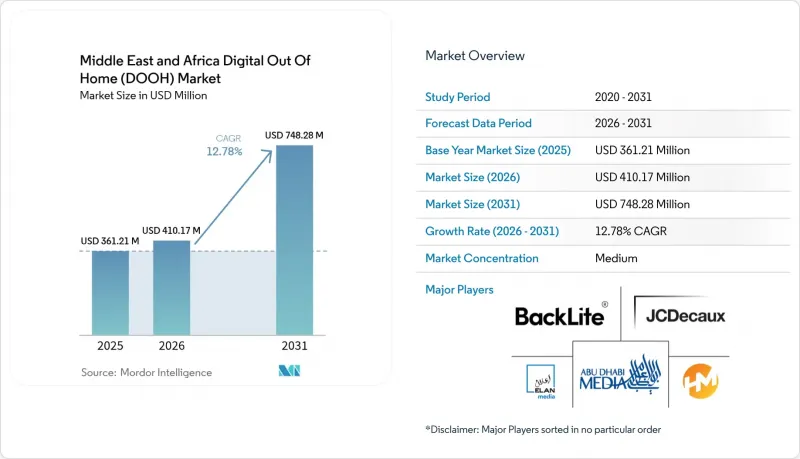
根據 Mordor Intelligence 預測,中東和非洲的數位戶外廣告 (DOOH) 市場規模將從 2025 年的 3.6121 億美元和 2026 年的 4.1017 億美元成長到 2031 年的 7.4828 億美元,2026 年至 2031 年的複合年成長率為 2031 年的年複合成長率(CAGR)為 2031 年。
本報告按服務類型(程序化戶外數位廣告和非程序化戶外數位廣告)、應用領域(廣告看板、公共交通、街道設備及其他)、位置(路邊戶外廣告、機場、購物中心和交通樞紐及其他)、終端用戶行業(汽車、零售、醫療保健、銀行和金融服務 (BFSI)、媒體和娛樂及其他)以及地區進行細分。市場預測以美元 (USD) 為單位。
中東和非洲數位戶外廣告 (DOOH) 市場趨勢與洞察
向數位廣告的持續轉變
廣告預算正從傳統的乙烯基廣告看板轉向聯網螢幕,以實現可衡量的曝光量和快速的創新切換。埃及的戶外數位廣告(DOOH)庫存將在2023年至2024年間加倍,到2025年11月,數位廣告佔有率將達到90.1%,這凸顯了廣告形式的持續替代。在阿拉伯聯合大公國,監管機構已明確規定了逐步淘汰靜態廣告媒體的最後期限,預計到2025年底,超過70%的戶外廣告空間將數位化。對於像ELAN Media這樣將廣告空間與供應端平台(SSP)連接起來的企業而言,預計到2025年,數位廣告收入將佔其總收入的50%以上,與2020年幾乎為零的水平相比,這是一個巨大的轉變。行動重定向進一步推動了這一成長,即螢幕曝光會觸發社交管道上的後續廣告,幫助品牌追蹤消費者的購買過程。這些因素共同推動了中東和非洲戶外數位廣告市場的快速替代方案。
公共交通基礎設施擴建
數十億美元正被投資於預先鋪設線路的地鐵、機場和公車站,用於安裝數位螢幕。利雅德地鐵已在六條線路上整合了2688塊顯示螢幕,並將獨家媒體版權授予沙烏地標誌媒體公司(Saudi Signs Media)。在杜拜,到2025年12月,595個智慧公車站將運作,每個車站都配備乘客Wi-Fi和可觸發程序化廣告的面板。海灣地區的主要機場也採用類似的理念,光是杜拜國際機場就安裝了378塊德高集團(JCDecaux)的面板,可透過Play+平台進行控制。像卡達旺多姆廣場這樣的旗艦購物中心,顧客平均停留時間為100分鐘,這進一步推動了在交通樞紐環境中投放廣告的趨勢。這些場所能夠確保穩定的客流量,從而支撐較高的每千次展示成本(CPM),並為業主帶來長期的投資回報。
海灣合作理事會成員國實施嚴格的廣告監管。
杜拜2020年第6號法令規定,所有廣告創新都必須經過多家機構的審核,這導致前置作業時間週期延長,合規成本增加。此外,杜拜道路交通管理局(RTA)手冊對亮度、動畫時間以及與敏感設施的接近性都做出了限制。在沙烏地阿拉伯,網路安全法將某些戶外數位廣告(DOOH)網路列為關鍵基礎設施,要求營運商接受安全審計並提交事件報告。人工內容審核與即時競價的邏輯相衝突,削弱了程式化廣告的柔軟性,而這正是程式化廣告吸引力的關鍵。因此,法律資源有限的中小型廣告商可能會選擇購買靜態廣告位,甚至完全放棄戶外數位廣告,減緩中東和非洲戶外數位廣告市場向100%數位轉型的步伐。
細分市場分析
儘管程序化廣告目前僅佔收入的一小部分,但其複合年成長率 (CAGR) 已超過傳統合約。到 2025 年,非程序化廣告資源將佔中東和非洲數位戶外廣告 (DOOH) 市場佔有率的 70.88%,這反映出主要廣告主與媒體所有者之間已建立的直接合作關係。獨家特許特許經營協議,例如沙烏地阿拉伯 Signs Media 與利雅德地鐵公司 (Riyadh Metro) 的合作,透過多年期保障確保了穩定的收入來源,這也解釋了為何這種模式仍然如此受歡迎。像 Play+ 這樣的平台允許買家按小時或按天靈活分配預算,對於注重效果的品牌來說,這是一個極具吸引力的選擇。
未來五年,隨著自動化購買維持13.29%的持續年成長率,預計這一差距將進一步縮小。隨著營運商與全球供應方平台(SSP)的合作,整合門檻正在降低,全通路商家只需點擊一下即可進入謝赫扎耶德路、巴林國際機場以及杜哈的高檔購物中心等場所。隨著電信業者部署的5G網路覆蓋海灣合作理事會(GCC)超過90%的都市區,延遲限制不再阻礙即時最佳化。因此,預計中東和非洲數位戶外廣告(DOOH)市場中程序化廣告所佔佔有率將成長數倍,同時,主要交通設施的長期贊助仍有發展空間。
由於高影響力的路邊廣告牌,預計到2025年,它們將貢獻45.79%的收入,但街頭設備和車站顯示器正以14.17%的複合年成長率快速擴張。配備Wi-Fi、QR碼和乘客資訊螢幕的公車站,能將路人短暫的注意力轉化為可衡量的互動。地鐵月台的價值更高。通勤者候車時間最長可達八分鐘,這意味著每位乘客都有多次廣告曝光機會。
未來,公共基礎設施的數位化將重新分配先前用於靜態路邊廣告看板的預算。地方政府更傾向於選擇超薄LED廣告牌,因為與織物廣告牌相比,LED廣告牌造成的視覺干擾更少;而廣告商則看重LED廣告牌能夠根據一天中的不同時段更換創新,而無需承擔重新印刷的成本。這些共同的需求正推動中東和非洲地區數位戶外廣告(DOOH)市場中「其他用途」部分的規模相對於傳統廣告看板這一主要部分實現同步成長。
其他好處
- Excel格式的市場預測(ME)表
- 3個月的分析師支持
目錄
第1章:引言
- 研究假設和市場定義
- 調查範圍
第2章:調查方法
第3章執行摘要
第4章 市場狀況
- 市場概覽
- 市場促進因素
- 向數位廣告的持續轉變
- 公共交通基礎設施擴建
- 加速採用程式化數位戶外廣告
- 沙烏地阿拉伯的龐大計畫正在推動智慧城市相關媒體的發展。
- 利用5G實現即時動態創新觸發
- 利用可再生能源在LED顯示器中推廣ESG
- 市場限制因素
- 海灣合作理事會成員國實施嚴格的廣告監管。
- 在農村地區建立傳統的戶外廣告
- 觀看者測量標準的差異
- 高溫環境下的維護成本
- 宏觀經濟因素的影響
- 監理情勢
- 波特五力分析
第5章 市場規模與成長預測
- 按服務類型
- 程式化數位戶外廣告
- 非程式化數位戶外廣告
- 透過使用
- 廣告看板
- 交通
- 街道設備
- 其他
- 位置和環境
- 戶外路邊
- 飛機場
- 購物中心和交通樞紐
- 商店內部及室內設施
- 其他位置環境
- 按最終用戶行業分類
- 車
- 零售
- 衛生保健
- 銀行與金融服務 (BFSI)
- 媒體與娛樂
- 其他
- 按地區
- 沙烏地阿拉伯
- 阿拉伯聯合大公國
- 科威特
- 卡達
- 摩洛哥
- 埃及
- 其他中東和非洲國家
第6章 競爭情勢
- 市場集中度
- 策略趨勢
- 市佔率分析
- 公司簡介
- JCDecaux SE
- ELAN Media WLL
- BackLite Media LLC
- Hypermedia FZ LLC
- Abu Dhabi Media Company PJSC
- Dooha Media WLL
- EyeMedia Advertising WLL
- Pikasso SARL
- Elevision Media FZ LLC
- Al Arabia Outdoor Advertising CJSC
- Faden Media Company Ltd.
- Hills Advertising LLC
- Arabian Outdoor Advertising LLC
- MBC Media Solutions FZ LLC
- Al Barq Digital Media LLC
- Publicity Qatar WLL
- Sahara Media Advertising Co. LLC
- Ethraa Advertising Company LLC
- Wow Media LLC
- Al Fahad Advertising LLC
- Blue Rhine Media LLC
- Pixcom Technologies LLC
第7章 市場機會與未來展望
According to Mordor Intelligence, the Middle East and Africa DOOH market size size is projected to expand from USD 361.21 million in 2025 and USD 410.17 million in 2026 to USD 748.28 million by 2031, registering a CAGR of 12.78% between 2026 to 2031.
This report is Segmented by Service Type (Programmatic-DOOH, and Non-Programmatic-DOOH), Application (Billboard, Transit, Street Furniture, and More), Location Environment (Roadside Outdoor, Airports, Mall and Transit Hubs, and More), End-User Industry (Automotive, Retail, Healthcare, BFSI, Media and Entertainment, and More), and Geography. The Market Forecasts are Provided in Terms of Value (USD).
Middle East And Africa Digital Out Of Home (DOOH) Market Trends and Insights
Ongoing Shift Toward Digital Advertising
Ad budgets are moving from vinyl billboards to networked screens that deliver measurable impressions and quick creative swaps. Egypt's DOOH inventory doubled between 2023 and 2024 and digital occupancy hit 90.1% in November 2025, underscoring format substitution momentum. The UAE confirmed that more than 70% of its outdoor faces were digital by end-2025 after regulators set firm retirement dates for static units. Operators that connected inventory to supply-side platforms, such as ELAN Media, saw digital contributions pass 50% of revenue in 2025, a dramatic swing from negligible levels in 2020. The growth is reinforced by mobile-retargeting, where a screen exposure triggers a follow-up ad on social channels, helping brands trace the consumer journey. Together, these factors keep the Middle East and Africa DOOH market on a steep replacement curve.
Expansion of Public-Transit Infrastructure
Billions of U.S. dollars are flowing into metros, airports, and bus shelters that are pre-wired for digital screens. Riyadh Metro integrates 2,688 displays across six lines, offering exclusive media rights to Saudi Signs Media. In Dubai, 595 smart bus shelters were in service by December 2025, each featuring passenger Wi-Fi and panels ready for programmatic triggers. Major Gulf airports have adopted a similar blueprint, with Dubai International alone hosting 378 JCDecaux panels addressable through the Play+ platform. Average dwell times of 100 minutes inside flagship malls such as Place Vendome in Qatar further tilt spend toward transit-linked environments. These venues offer predictable footfall that justifies premium CPMs and underpins long-run revenue visibility for asset owners.
Stringent Advertising Regulations in GCC
Dubai's Decree 6-2020 requires every creative to clear multiple agencies, stretching lead times and adding compliance expenses. The RTA manual further caps brightness, animation length, and proximity to sensitive sites. In Saudi Arabia, cybersecurity laws classify certain DOOH networks as critical infrastructure, obliging operators to file security audits and incident reports. Manual content reviews clash with real-time bidding logic, muting some of the flexibility that makes programmatic attractive. Smaller advertisers lacking legal resources may therefore stick to static buys or avoid the medium altogether, tempering the pace at which the Middle East and Africa DOOH market migrates to 100% digital.
Other drivers and restraints analyzed in the detailed report include:
- Accelerating Adoption of Programmatic DOOH
- Saudi Giga-Projects Boosting Smart-City Media
- Persistence of Traditional OOH in Rural Areas
For complete list of drivers and restraints, kindly check the Table Of Contents.
Segment Analysis
Programmatic still represents a minority of sales, yet its CAGR outpaces that of traditional contracts. Non-programmatic inventory accounted for 70.88% of Middle East and Africa DOOH market share in 2025, reflecting entrenched direct media-owner relationships with large advertisers. Exclusive concessions, such as Saudi Signs Media's Riyadh Metro deal, lock in revenue streams through multi-year guarantees, explaining why the model endures. Nevertheless, platforms like Play+ let buyers pulse budgets by hour or day, which is proving persuasive for performance-led brands.
In the next five years, sustained 13.29% growth for automated buying will compress that gap. Integration friction is falling as operators connect to global SSPs, giving omnichannel traders one-click access to Sheikh Zayed Road, Bahrain International Airport, or Doha's luxury malls. With telecom operators rolling out 5G that covers more than 90% of GCC urban centers, latency constraints no longer block real-time optimisation. As a result, the Middle East and Africa DOOH market size attributable to programmatic lines is forecast to multiply while still leaving room for long-duration sponsorships in flagship transit estates.
Billboards retained 45.79% of 2025 revenue thanks to high-impact roadside canvases, yet street furniture and in-station displays are scaling faster at a 14.17% CAGR. Bus shelters fitted with Wi-Fi, QR codes, and passenger information screens convert fleeting passerby attention into measurable engagements. Metro platforms add further value, as commuters spend up to eight minutes awaiting trains, creating multiple impression windows per passenger.
Over time, digital enablement of public furniture will redirect budgets once locked into static roadside walls. Municipalities prefer the low visual clutter of slim LED to fabric vinyl, and advertisers appreciate creative rotation by daypart without re-printing costs. This twin preference supports a proportional rise in the Middle East and Africa DOOH market size generated by "other applications" relative to legacy billboard strongholds.
Complete Report Scope:
- By Service Type
- Programmatic-DOOH
- Non-Programmatic-DOOH
- By Application
- Billboard
- Transit
- Street Furniture
- Other Applications
- By Location Environment
- Roadside Outdoor
- Airports
- Malls and Transit Hubs
- In-Store and Indoor Venues
- Other Location Environments
- By End-User Industry
- Automotive
- Retail
- Healthcare
- Banking and Financial Services (BFSI)
- Media and Entertainment
- Other End-User Industries
- By Geography
- Saudi Arabia
- United Arab Emirates
- Kuwait
- Qatar
- Morocco
- Egypt
- Rest of Middle East and Africa
List of Companies Covered in this Report:
- JCDecaux SE
- ELAN Media W.L.L.
- BackLite Media LLC
- Hypermedia FZ LLC
- Abu Dhabi Media Company PJSC
- Dooha Media W.L.L.
- EyeMedia Advertising W.L.L.
- Pikasso SARL
- Elevision Media FZ LLC
- Al Arabia Outdoor Advertising CJSC
- Faden Media Company Ltd.
- Hills Advertising LLC
- Arabian Outdoor Advertising LLC
- MBC Media Solutions FZ LLC
- Al Barq Digital Media LLC
- Publicity Qatar W.L.L.
- Sahara Media Advertising Co. LLC
- Ethraa Advertising Company LLC
- Wow Media LLC
- Al Fahad Advertising LLC
- Blue Rhine Media LLC
- Pixcom Technologies LLC
Additional Benefits:
- The market estimate (ME) sheet in Excel format
- 3 months of analyst support
TABLE OF CONTENTS
1 INTRODUCTION
- 1.1 Study Assumptions and Market Definition
- 1.2 Scope of the Study
2 RESEARCH METHODOLOGY
3 EXECUTIVE SUMMARY
4 MARKET LANDSCAPE
- 4.1 Market Overview
- 4.2 Market Drivers
- 4.2.1 Ongoing Shift Toward Digital Advertising
- 4.2.2 Expansion of Public-Transit Infrastructure
- 4.2.3 Accelerating Adoption of Programmatic DOOH
- 4.2.4 Saudi Giga-Projects Boosting Smart-City Media
- 4.2.5 5G-Enabled Real-Time Dynamic Creative Triggers
- 4.2.6 ESG Push for Renewable-Powered LED Displays
- 4.3 Market Restraints
- 4.3.1 Stringent Advertising Regulations in GCC
- 4.3.2 Persistence of Traditional OOH in Rural Areas
- 4.3.3 Fragmented Audience-Measurement Standards
- 4.3.4 High Ambient-Temperature Maintenance Costs
- 4.4 Impact of Macroeconomic Factors
- 4.5 Regulatory Landscape
- 4.6 Porter's Five Forces Analysis
- 4.6.1 Bargaining Power of Suppliers
- 4.6.2 Bargaining Power of Buyers
- 4.6.3 Threat of New Entrants
- 4.6.4 Threat of Substitutes
- 4.6.5 Intensity of Competitive Rivalry
5 MARKET SIZE AND GROWTH FORECASTS (VALUE)
- 5.1 By Service Type
- 5.1.1 Programmatic-DOOH
- 5.1.2 Non-Programmatic-DOOH
- 5.2 By Application
- 5.2.1 Billboard
- 5.2.2 Transit
- 5.2.3 Street Furniture
- 5.2.4 Other Applications
- 5.3 By Location Environment
- 5.3.1 Roadside Outdoor
- 5.3.2 Airports
- 5.3.3 Malls and Transit Hubs
- 5.3.4 In-Store and Indoor Venues
- 5.3.5 Other Location Environments
- 5.4 By End-User Industry
- 5.4.1 Automotive
- 5.4.2 Retail
- 5.4.3 Healthcare
- 5.4.4 Banking and Financial Services (BFSI)
- 5.4.5 Media and Entertainment
- 5.4.6 Other End-User Industries
- 5.5 By Geography
- 5.5.1 Saudi Arabia
- 5.5.2 United Arab Emirates
- 5.5.3 Kuwait
- 5.5.4 Qatar
- 5.5.5 Morocco
- 5.5.6 Egypt
- 5.5.7 Rest of Middle East and Africa
6 COMPETITIVE LANDSCAPE
- 6.1 Market Concentration
- 6.2 Strategic Moves
- 6.3 Market Share Analysis
- 6.4 Company Profiles (includes Global Level Overview, Market Level Overview, Core Segments, Financials as available, Strategic Information, Market Rank/Share, Products and Services, Recent Developments)
- 6.4.1 JCDecaux SE
- 6.4.2 ELAN Media W.L.L.
- 6.4.3 BackLite Media LLC
- 6.4.4 Hypermedia FZ LLC
- 6.4.5 Abu Dhabi Media Company PJSC
- 6.4.6 Dooha Media W.L.L.
- 6.4.7 EyeMedia Advertising W.L.L.
- 6.4.8 Pikasso SARL
- 6.4.9 Elevision Media FZ LLC
- 6.4.10 Al Arabia Outdoor Advertising CJSC
- 6.4.11 Faden Media Company Ltd.
- 6.4.12 Hills Advertising LLC
- 6.4.13 Arabian Outdoor Advertising LLC
- 6.4.14 MBC Media Solutions FZ LLC
- 6.4.15 Al Barq Digital Media LLC
- 6.4.16 Publicity Qatar W.L.L.
- 6.4.17 Sahara Media Advertising Co. LLC
- 6.4.18 Ethraa Advertising Company LLC
- 6.4.19 Wow Media LLC
- 6.4.20 Al Fahad Advertising LLC
- 6.4.21 Blue Rhine Media LLC
- 6.4.22 Pixcom Technologies LLC
7 MARKET OPPORTUNITIES AND FUTURE OUTLOOK
- 7.1 White-Space and Unmet-Need Assessment

 法國數位戶外廣告 (DOOH):市場佔有率分析、行業趨勢和統計數據以及成長預測 (2026-2031)亞太地區戶外數位廣告:市場佔有率分析、產業趨勢與統計及成長預測(2026-2031)
 全球數位戶外廣告市場規模、佔有率、趨勢和成長分析報告(2026-2034年)全球數位戶外廣告市場規模、佔有率、趨勢和成長分析報告(2026-2034年)數位戶外廣告:市場佔有率分析、產業趨勢與統計及成長預測(2026-2031 年)
 數位戶外(DOOH) 市場:按平台、媒體類型、螢幕尺寸、網路基礎設施、顯示類型和行業分類 - 全球預測,2026-2032 年英國戶外廣告和數位戶外廣告:市場佔有率分析、行業趨勢和統計數據以及成長預測(2026-2031 年)歐洲戶外廣告投放:市場佔有率分析、產業趨勢與統計及成長預測(2026-2031 年)新加坡戶外廣告 (OOH) 和數位戶外廣告 (DOOH):市場佔有率分析、行業趨勢和統計數據以及成長預測 (2026-2031)
 全球數位戶外廣告 (DOOH) 市場:按格式類型、位置類型、顯示技術、內容格式、採購模式、應用程式和廣告主規模分類 - 市場規模、行業動態、機會分析和預測 (2026–2035)