


 |
市場調查報告書
商品編碼
2073662
英國戶外廣告和數位戶外廣告:市場佔有率分析、行業趨勢和統計數據以及成長預測(2026-2031 年)United Kingdom OOH and DOOH - Market Share Analysis, Industry Trends & Statistics, Growth Forecasts (2026 - 2031) |
||||||

※ 本網頁內容可能與最新版本有所差異。詳細情況請與我們聯繫。
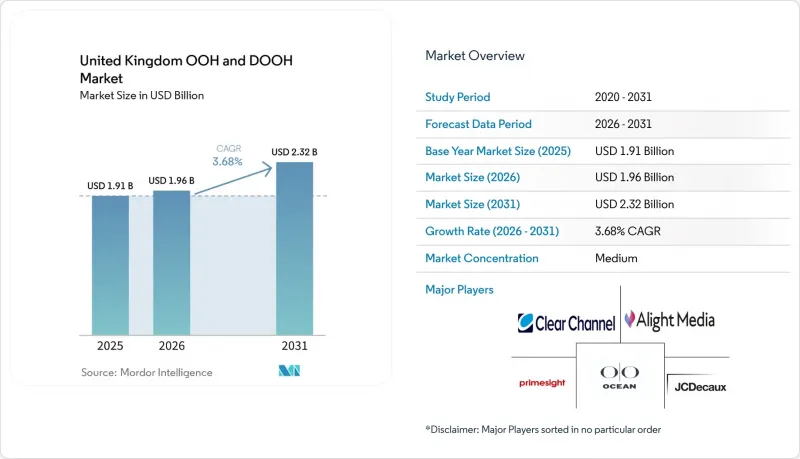
根據 Mordor Intelligence 預測,英國戶外廣告和數位戶外廣告市場規模將從 2025 年的 19.1 億美元成長到 2026 年的 19.6 億美元,到 2031 年將達到 23.2 億美元,2026 年至 2031 年的複合年成長率為 3.68%。
本報告按解決方案類型(傳統戶外廣告和數位戶外廣告)、應用領域(廣告看板、交通廣告、街道設施等)、安裝環境(路邊戶外、機場、店內和室內設施等)、終端用戶行業(汽車、零售、醫療保健、銀行、金融服務和保險、媒體和娛樂等)以及地區進行細分。市場預測以美元計價。
英國戶外與數位戶外市場趨勢與洞察
程序化交易平台正在英國媒體購買者中迅速普及。
VIOOH、Hivestack、Broadsign 和 Place Exchange 已實現路邊、公共交通和零售店內螢幕的競標投放標準化,使得程式化宣傳活動在英國的投放率達到 47%,同比成長 18 個百分點。雖然程序化廣告中仍有擔保交易佔據主導地位,但非擔保交易也在迅速成長,與在線上展示廣告的趨勢類似。戶外廣告專業代理商目前管理近五分之四的程式化廣告預算,反映出廣告投放正向數據驅動型規劃轉變。 91% 的廣告主將受眾置於位置之上,因此,投資不再僅僅增加總支出,而是從其他數位管道重新分配。這種轉變正在重新定義各供應商的差異化優勢,其核心在於第一方資料、動態創新最佳化以及與供應端(SSP) 的合作。
英國主要都會大都會圈智慧城市數位基礎設施的發展
為了確保通訊基礎設施部署的資金,各市議會正在將螢幕整合到公共設施中。在曼徹斯特,一項為期十年、價值7000萬英鎊(約合8900萬美元)的特許經營協議優先考慮大型數位面板的建設;而倫敦的「互聯倫敦」計劃則正在增設數千個小型基地台和光纖回程回程傳輸,以支持即時數位戶外廣告(DOOH)。英國電信的「街頭樞紐」將75吋螢幕與公共Wi-Fi結合;而與哈弗林區政府和德高集團簽訂的七年合約則涉及配備空氣品質感測器的面板。倫敦交通局(TfL)正在強制要求減少60%的電力消耗,並依照其2030年淨零排放目標,逐步改用LED照明。優先部署基礎設施正在加快核准速度,縮短投資回收期,並使數位戶外廣告的發展與當地的永續性議程保持一致。
多個戶外廣告提供者之間測量標準的不一致阻礙了跨網路 ROI 報告。
Route 的受眾貨幣提供覆蓋範圍和頻次,但程序化交易採用基於展示次數的 CPM,這迫使策劃人員協調兩個不相容的框架。這導致廣告主預設選擇與單一供應商簽約,降低了開放交易平台的流動性,並限制了最佳化。產業組織正在試行 OpenDirect 和 OpenRTB 應用於數位戶外廣告 (DOOH),但由於缺乏統一的、符合英國GDPR 標準的歸因系統,導致用於決策的報告產生速度緩慢。因此,儘管有證據表明戶外廣告以兩位數的速度推動智慧型手機用戶行為,但跨網路宣傳活動的預算分配仍然落後。
細分市場分析
預計到2025年,數位戶外廣告將佔據英國戶外廣告和數位戶外廣告市場佔有率的64.83%,並以3.81%的成長率進一步擴大其領先優勢。程序化管道目前已處理47%的宣傳活動,廣告支出正從靜態廣告看板轉向競標廣告位,從而實現創新和定向投放的即時更新。德高集團已將其在倫敦的數位螢幕安裝量加倍,達到2000塊;與此同時,Global集團的鐵路廣告設施正在引入沉浸式曲面LED廣告,進一步擴大了英國戶外廣告和數位戶外廣告市場中高階廣告形式的佔有率。在受業主和城市規劃法規限制數位廣告部署的地區,傳統戶外廣告仍然存在,其低能耗特性使其在長期品牌宣傳活動中保持了價值。諸如使用植物油墨在再生紙上印刷等永續性舉措,正幫助傳統廣告看板在與高能耗LED廣告的競爭中保持市場佔有率。
倫敦交通局 (TfL) 強制要求透過改用 LED 顯示器來降低 60% 的能耗,現有設施的能源效率維修正在加速進行。以 Broadsign 收購 Place Exchange 為例,供應端平台的整合可望建構統一的程序化廣告投放路徑,從而利用尚未開發的中階市場螢幕進行全國範圍的廣告購買。然而,瓶頸仍然在於廣告主的技能。一半的廣告主仍然缺乏管理動態創新的能力,這意味著教育和基礎設施對於決定未來數位廣告市場佔有率的成長至關重要。
到2025年,廣告看板將佔英國戶外廣告和數位戶外廣告市場的39.96%,但隨著與倫敦交通局(TfL)和英國鐵路網公司(Network Rail)的合作,交通廣告的庫存正以每年4.38%的速度快速成長,其中包括在車站安裝超過1000塊新螢幕。光是伊莉莎白線就新增了329個廣告位,而滑鐵盧車站一條160公尺長的多感官電扶梯廣告則清楚地展示了身臨其境型環境所能帶來的高CPM(每千次展示成本)。在通勤者平均25分鐘的停留時間內,這種集中曝光比在路邊匆匆一瞥更有效,能夠提高廣告主的投資回報率,並推動由交通樞紐驅動的英國廣告和數位戶外廣告市場規模的擴大。
街道基礎設施的升級也推動了這一快速成長,4700個公車站正在改造為LED顯示螢幕,倫敦橋上的互動式觸控螢幕提供11種語言的即時路況信息,提高了用戶參與度。監管政策的調整,包括2026年即將生效的關於「高脂肪、高鹽、高糖」食品廣告的轉折點,正在進一步推動交通基礎設施的數位化,要求數位螢幕具備便捷的區域篩选和排期功能。為此,大型廣告看板的所有者正在簽署包含數位使用權的99年租賃協議,這表明,儘管交通廣告的成長速度超過了其他行業,但路邊廣告商也在透過超長期的特許經營協議為未來做好準備。
其他好處:
- Excel格式的市場預測(ME)表
- 3個月的分析師支持
目錄
第1章:引言
- 研究假設和市場定義
- 調查範圍
第2章:調查方法
第3章執行摘要
第4章 市場狀況
- 市場概覽
- 市場促進因素
- 節目交易平台正在英國媒體購買者中迅速普及。
- 英國主要都會大都會圈智慧城市數位基礎設施的擴展
- 利用行動位置分析技術進行數據驅動型受眾定向。
- 零售媒體網路擴大戶外廣告合作,進行全通路宣傳活動。
- 隨著航空業設定2030年實現淨零排放的目標,機場航站大樓的改造與建設也變得越來越活躍。
- 倫敦地鐵的數位化推廣正在提升高階廣告的CPM,並吸引廣告主。
- 市場限制因素
- 多個戶外廣告提供者在衡量標準和標準化方面的差異阻礙了跨網路 ROI 報告。
- 繼 2022 年價格大幅上漲之後,能源成本飆升給 DOOH 的營業利潤率帶來了壓力。
- 地方社區和市政當局為保護文化財產而安裝新型數位螢幕的相關規定。
- 混合工作週期間道路交通量的減少導致城市地區的曝光量下降。
- 宏觀經濟因素對市場的影響
- 產業價值鏈分析
- 波特五力分析
第5章 市場規模與成長預測
- 按解決方案類型
- 傳統戶外廣告
- 數位戶外廣告
- 程式化數位戶外廣告
- 非程式化數位戶外廣告
- 透過使用
- 廣告看板
- 交通
- 街道設備
- 其他用途
- 透過安裝環境
- 路邊戶外廣告
- 飛機場
- 購物中心和交通樞紐
- 商店內部及室內設施
- 其他安裝環境
- 按最終用戶行業分類
- 車
- 零售
- 衛生保健
- 銀行與金融服務 (BFSI)
- 媒體與娛樂
- 其他終端用戶產業
第6章 競爭情勢
- 市場集中度
- 策略趨勢
- 市佔率分析
- 公司簡介
- JCDecaux UK Limited
- Global Media & Entertainment Limited
- Clear Channel UK Limited
- Ocean Outdoor UK Limited
- 75Media Limited
- Smart Outdoor Limited
- Admedia Limited
- Redbus Media Group Limited
- Alight Media Limited
- Elonex Outdoor Media Limited
- Limited Space Media Group Limited
- blowUP media UK Limited
- Signature Outdoor Limited
- Wildstone Group Limited
- Eye Airports Limited
- Maximus Networks Limited
- VIOOH Limited
- Talon Outdoor Limited
- KBH On-Train Media Limited
- London Lites Limited
第7章 市場機會與未來展望
According to Mordor Intelligence, the united kingdom OOH and DOOH market size is expected to grow from USD 1.91 billion in 2025 to USD 1.96 billion in 2026 and is forecast to reach USD 2.32 billion by 2031 at 3.68% CAGR over 2026-2031.
This report is Segmented by Solution Type (Traditional OOH, and Digital OOH), Application (Billboard, Transit, Street Furniture, and More), Location Environment (Roadside Outdoor, Airports, In-Store and Indoor Venues, and More), End-User Industry (Automotive, Retail, Healthcare, BFSI, Media and Entertainment, and More), and Geography. The Market Forecasts are Provided in Terms of Value (USD).
United Kingdom OOH and DOOH Market Trends and Insights
Rapid Expansion of Programmatic Trading Platforms Among UK Media Buyers
Programmatic penetration has lifted to 47% of UK campaigns, up 18 percentage points year-on-year, as VIOOH, Hivestack, Broadsign, and Place Exchange standardize biddable access to roadside, transit, and retail screens. Programmatic-guaranteed deals still dominate, but non-guaranteed volumes are scaling quickly, echoing online display behavior. OOH specialist agencies now manage almost four-fifths of programmatic budgets, reflecting a pivot toward data-driven planning. With 91% of advertisers prioritizing audience over location, investment is being re-routed from other digital channels rather than expanding total spend. This shift is redefining operator differentiation around first-party data, dynamic creative optimization, and supply-side platform partnerships.
Growth of Smart-City Digital Infrastructure in Major UK Metropolitan Areas
City councils are embedding screens into public assets to fund connectivity roll-outs. Manchester's 10-year GBP 70 million (USD 89 million) concession prioritizes large-format digital panels, and London's Connected London program adds thousands of small cells and fiber back-haul to support real-time DOOH. BT Street Hubs blend 75-inch screens with public Wi-Fi, while Havering's 7-year deal with JCDecaux installs panels fitted with air-quality sensors. Transport for London stipulates LED conversions that cut power use 60% and align with its 2030 net-zero goal. Infrastructure-first deployment speeds permit approvals, shortens payback periods and hooks DOOH growth to municipal sustainability agendas.
Measurement-Standardization Gaps Across Multiple OOH Owners Hindering Cross-Network ROI Reporting
Route's audience currency delivers reach and frequency, yet programmatic trades on impression-based CPMs, leaving planners to reconcile two incompatible frameworks. Advertisers, therefore, default to single-operator deals, chilling open-exchange liquidity and limiting optimization. Industry bodies are piloting OpenDirect and OpenRTB for DOOH, but the lack of a unified, UK GDPR-compliant attribution system delays decision-grade reporting. The result is slower budget allocation to cross-network campaigns, despite evidence that OOH drives double-digit uplifts in smartphone actions.
Other drivers and restraints analyzed in the detailed report include:
- Integration of Data-Driven Audience Targeting via Mobile Location Analytics
- Retail Media Networks Extending OOH Partnerships for Omnichannel Campaigns
- High Energy Costs Pressuring DOOH Operating Margins Post-2022 Price Shocks
For complete list of drivers and restraints, kindly check the Table Of Contents.
Segment Analysis
Digital OOH claimed 64.83% of United Kingdom OOH and DOOH market share in 2025 and is projected to widen its lead at a 3.81% trajectory. Programmatic channels already handle 47% of campaigns, diverting spend from static panels toward biddable inventory where creative and targeting can refresh in real time. JCDecaux doubled its London digital footprint to 2,000 screens, while Global's rail estate adds immersive curved LEDs, actions that enlarge the United Kingdom OOH and DOOH market size allocated to premium formats. Traditional OOH persists where landlords or planning rules restrict digital roll-outs, and its lower energy consumption retains value for long-dwell brand campaigns. Sustainability pledges, such as printing on recycled paper with vegetable inks, help classic billboards defend share against energy-intensive LEDs.
Retrofitting efficiency upgrades is accelerating, with Transport for London mandating 60% power cuts through LED conversions. Supply-side platform consolidation, typified by Broadsign's purchase of Place Exchange, promises unified programmatic pipes that could unlock untapped mid-market screens for national buys. Advertiser capability remains the bottleneck: half the buyer community still lacks dynamic creative competencies, suggesting education will be as decisive as infrastructure in determining future share gains for digitized formats.
Billboards represented 39.96% of the United Kingdom OOH and DOOH market in 2025, yet transit inventory is expanding fastest at 4.38% a year as contracts with Transport for London and Network Rail pump more than 1,000 new screens into stations. The Elizabeth line alone adds 329 sites, while 160-meter multi-sensory travelator takeovers at Waterloo illustrate the premium CPMs that immersive environments secure. Commuters' average 25-minute dwell delivers attentive exposures that outperform brief roadside glances, elevating advertiser ROI and boosting the UK OOH and DOOH market size attributed to transit nodes.
Street-furniture upgrades complement this surge, with 4,700 bus shelters under LED conversion, and interactive touchscreens at London Bridge supplying live travel data in 11 languages to heighten engagement. Regulatory shifts, including the 2026 high-fat-salt-sugar advertising watershed, require geo-filters and schedules that digital screens can enact instantaneously, incentivizing further digitization of transit assets. Large-format billboard landlords respond by locking in 99-year leases that embed digital rights, demonstrating that while transit outpaces in growth, roadside owners are future-proofing through very long concessions.
Complete Report Scope:
- By Solution Type
- Traditional OOH
- Digital OOH
- Programmatic-DOOH
- Non-Programmatic-DOOH
- By Application
- Billboard
- Transit
- Street Furniture
- Other Applications
- By Location Environment
- Roadside Outdoor
- Airports
- Malls and Transit Hubs
- In-Store and Indoor Venues
- Other Location Environments
- By End-User Industry
- Automotive
- Retail
- Healthcare
- Banking and Financial Services (BFSI)
- Media and Entertainment
- Other End-User Industries
List of Companies Covered in this Report:
- JCDecaux UK Limited
- Global Media & Entertainment Limited
- Clear Channel UK Limited
- Ocean Outdoor UK Limited
- 75Media Limited
- Smart Outdoor Limited
- Admedia Limited
- Redbus Media Group Limited
- Alight Media Limited
- Elonex Outdoor Media Limited
- Limited Space Media Group Limited
- blowUP media UK Limited
- Signature Outdoor Limited
- Wildstone Group Limited
- Eye Airports Limited
- Maximus Networks Limited
- VIOOH Limited
- Talon Outdoor Limited
- KBH On-Train Media Limited
- London Lites Limited
Additional Benefits:
- The market estimate (ME) sheet in Excel format
- 3 months of analyst support
TABLE OF CONTENTS
1 INTRODUCTION
- 1.1 Study Assumptions and Market Definition
- 1.2 Scope of the Study
2 RESEARCH METHODOLOGY
3 EXECUTIVE SUMMARY
4 MARKET LANDSCAPE
- 4.1 Market Overview
- 4.2 Market Drivers
- 4.2.1 Rapid Expansion of Programmatic Trading Platforms Among UK Media Buyers
- 4.2.2 Growth of Smart-City Digital Infrastructure in Major UK Metropolitan Areas
- 4.2.3 Integration of Data-Driven Audience Targeting via Mobile Location Analytics
- 4.2.4 Retail Media Networks Extending OOH Partnerships for Omnichannel Campaigns
- 4.2.5 Rising Airport-Terminal Redevelopments Ahead of 2030 Net-Zero Aviation Targets
- 4.2.6 London Underground Digital Roll-Out Driving Premium CPMs and Advertiser Adoption
- 4.3 Market Restraints
- 4.3.1 Measurement-Standardization Gaps Across Multiple OOH Owners Hindering Cross-Network ROI Reporting
- 4.3.2 High Energy Costs Pressuring DOOH Operating Margins Post-2022 Price Shocks
- 4.3.3 Community and Council Restrictions on New Digital Screens to Protect Heritage Sites
- 4.3.4 Declining Roadside Traffic During Hybrid Work Weeks Reducing City-Centre Impression Volumes
- 4.4 Impact of Macroeconomic Factors on the Market
- 4.5 Industry Value Chain Analysis
- 4.6 Porter's Five Forces Analysis
- 4.6.1 Bargaining Power of Suppliers
- 4.6.2 Bargaining Power of Buyers
- 4.6.3 Threat of New Entrants
- 4.6.4 Threat of Substitutes
- 4.6.5 Competitive Rivalry
5 MARKET SIZE AND GROWTH FORECASTS (VALUE)
- 5.1 By Solution Type
- 5.1.1 Traditional OOH
- 5.1.2 Digital OOH
- 5.1.2.1 Programmatic-DOOH
- 5.1.2.2 Non-Programmatic-DOOH
- 5.2 By Application
- 5.2.1 Billboard
- 5.2.2 Transit
- 5.2.3 Street Furniture
- 5.2.4 Other Applications
- 5.3 By Location Environment
- 5.3.1 Roadside Outdoor
- 5.3.2 Airports
- 5.3.3 Malls and Transit Hubs
- 5.3.4 In-Store and Indoor Venues
- 5.3.5 Other Location Environments
- 5.4 By End-User Industry
- 5.4.1 Automotive
- 5.4.2 Retail
- 5.4.3 Healthcare
- 5.4.4 Banking and Financial Services (BFSI)
- 5.4.5 Media and Entertainment
- 5.4.6 Other End-User Industries
6 COMPETITIVE LANDSCAPE
- 6.1 Market Concentration
- 6.2 Strategic Moves
- 6.3 Market Share Analysis
- 6.4 Company Profiles (includes Global Level Overview, Market Level Overview, Core Segments, Financials as available, Strategic Information, Market Rank/Share, Products and Services, Recent Developments)
- 6.4.1 JCDecaux UK Limited
- 6.4.2 Global Media & Entertainment Limited
- 6.4.3 Clear Channel UK Limited
- 6.4.4 Ocean Outdoor UK Limited
- 6.4.5 75Media Limited
- 6.4.6 Smart Outdoor Limited
- 6.4.7 Admedia Limited
- 6.4.8 Redbus Media Group Limited
- 6.4.9 Alight Media Limited
- 6.4.10 Elonex Outdoor Media Limited
- 6.4.11 Limited Space Media Group Limited
- 6.4.12 blowUP media UK Limited
- 6.4.13 Signature Outdoor Limited
- 6.4.14 Wildstone Group Limited
- 6.4.15 Eye Airports Limited
- 6.4.16 Maximus Networks Limited
- 6.4.17 VIOOH Limited
- 6.4.18 Talon Outdoor Limited
- 6.4.19 KBH On-Train Media Limited
- 6.4.20 London Lites Limited
7 MARKET OPPORTUNITIES AND FUTURE OUTLOOK
- 7.1 White-Space and Unmet-Need Assessment

 法國數位戶外廣告 (DOOH):市場佔有率分析、行業趨勢和統計數據以及成長預測 (2026-2031)亞太地區戶外數位廣告:市場佔有率分析、產業趨勢與統計及成長預測(2026-2031)中東和非洲數位戶外(DOOH):市場佔有率分析、行業趨勢和統計數據以及成長預測 (2026-2031)
 全球數位戶外廣告市場規模、佔有率、趨勢和成長分析報告(2026-2034年)全球數位戶外廣告市場規模、佔有率、趨勢和成長分析報告(2026-2034年)數位戶外廣告:市場佔有率分析、產業趨勢與統計及成長預測(2026-2031 年)
 數位戶外(DOOH) 市場:按平台、媒體類型、螢幕尺寸、網路基礎設施、顯示類型和行業分類 - 全球預測,2026-2032 年歐洲戶外廣告投放:市場佔有率分析、產業趨勢與統計及成長預測(2026-2031 年)新加坡戶外廣告 (OOH) 和數位戶外廣告 (DOOH):市場佔有率分析、行業趨勢和統計數據以及成長預測 (2026-2031)
 全球數位戶外廣告 (DOOH) 市場:按格式類型、位置類型、顯示技術、內容格式、採購模式、應用程式和廣告主規模分類 - 市場規模、行業動態、機會分析和預測 (2026–2035)