


 |
市場調查報告書
商品編碼
2124152
電子製造服務:市場佔有率分析、產業趨勢與統計、成長預測(2026-2031)Electronics Manufacturing Services - Market Share Analysis, Industry Trends & Statistics, Growth Forecasts (2026 - 2031) |
||||||

※ 本網頁內容可能與最新版本有所差異。詳細情況請與我們聯繫。
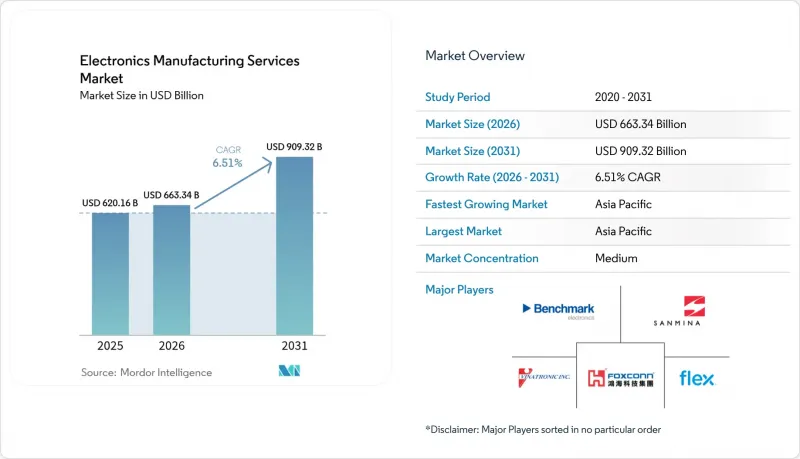
根據 Mordor Intelligence 預測,電子製造服務市場規模預計將在 2025 年達到 6,201.6 億美元,2026 年達到 6,633.4 億美元,2031 年達到 9,093.2 億美元,2026 年至 2031 年的複合年成長率為 6.51%。
本報告按服務類型(電子製造服務[PCB組裝、原型製作等]、測試和開發實施服務等)、經營模式(CM、ODM等)、製造流程(SMT、THT等)、最終用戶(行動裝置、家用電子電器、照明等)和地區進行細分。市場預測以價值(美元)表示。
全球電子製造服務市場趨勢與洞察
為了集中精力提升核心競爭力,OEM廠商正推行外包。
電子公司在專注於半導體藍圖和人工智慧模型訓練的同時,也將機械加工和基板級工作等日益增加的環節外包出去。蘋果將尖端封裝組裝的做法,凸顯了高固定成本工廠的資本密集型特性,也解釋了為何即使是垂直整合的巨頭也看到了電子製造服務市場的價值。智慧型手機和穿戴式裝置的產品生命週期縮短(少於18個月),加速了這一轉變,因為內部製造工廠難以靈活適應快速的產品更新換代。中小型工業和醫療品牌正在將外包範圍從焊接擴展到韌體編程和法規文件編制,從而形成了一個兩極分化的市場:專注於工程技術的供應商可以獲得比通用供應商高出8到12個百分點的利潤率。
加速供應鏈近岸外包和回流
在關稅不確定性和出口限制的背景下,預計到2025年,墨西哥、波蘭和越南的工廠建設項目公告數量將激增23%。墨西哥正被選為電力電子和工業控制設備的主要樞紐,這得益於其勞動成本比中國沿海地區低16%,以及根據美墨加協定(USMCA)享有的免稅地位。東歐已成為醫療設備子組件的生產基地,歐盟關稅協調已將門到門運輸時間縮短至四天以內。越南透過提供10年企業所得稅豁免來吸引智慧型手機和音訊模組的生產線。同時,泰國和馬來西亞正致力於吸引晶片封裝(chiplet-in-package)項目,以發揮其在半導體後端領域的優勢。
半導體和被動元件成本波動加劇
2025年第一季,汽車多層陶瓷電容器的現貨價格波動幅度達35%至50%,導致沒有長期供貨合約的電子製造服務(EMS)參與企業毛利率下降高達120個基點。微控制器前置作業時間從12週大幅延長至26週,迫使代工製造商籌集資金以彌補兩個月的額外庫存,並凍結了原本可用於擴大產能的營運資金。年銷售額超過50億美元的一級供應商擁有議價能力,能夠獲得優先配額,而區域性公司則被迫支付20%至40%的現貨溢價,削弱了它們在消費電子產品競標中的競爭力。工程師們爭相重新設計材料清單(BOM)以避開稀缺的被動元件,導致產品推出延遲4至8週,擾亂了電子製造服務市場的收入確認。
細分市場分析
電子機械組裝和機箱製造預計將以6.83%的複合年成長率成長,超過電子製造服務市場6.51%的整體成長率。汽車和工業領域的買家要求將電纜、機殼和最終測試納入單一採購訂單,從而將專案前置作業時間縮短2-3週。預計到2025年,PCB組裝仍將佔據電子製造服務市場43.32%的佔有率,儘管消費品訂單的毛利率已降至6%以下。由於品牌商需要進行製造符合性設計(DFM)檢驗以及FDA和IEC審核所需的監管文件,因此工程服務每個項目的收入成長了30-50%。
由於醫療和汽車行業的召回成本可能超過1億美元,目前用於測試和開發的預算撥款正在增加。訂單( CTO) 和供應商管理庫存 (VMI) 等物流加值服務能夠幫助企業了解零件供應緊張的情況,從而降低客戶的轉換成本。 48 小時快速原型原型製作使承包商能夠在材料清單(BOM) 最終確定之前完成設計方案的最終定稿。這些增值服務結合,使一級供應商能夠在原本可能同質化的核心服務中保持利潤率。因此,電子製造服務市場正在向那些能夠將先進的機殼組裝技術與工程和供應鏈協調能力相結合的供應商轉變。
到2025年,契約製造佔銷售額的62.46%,但混合模式和承包模式預計到2031年將以每年7.02%的速度成長。缺乏採購能力的新創公司正在採用承包契約,即使價格溢價高達8-12%,以避免採購零件相關的風險。許多汽車和工業品牌選擇混合模式,提供自有專有韌體,同時委託合約製造商設計功率級和通訊板。這種合作模式使他們能夠在保護自身智慧財產權的同時,利用外部規模經濟。
共同開發契約透過分攤模具成本,換取多年產量承諾,進一步深化了這項合作。這種模式迫使客戶提前18至24個月揭露藍圖,從而加強了供應商的鎖定,並穩定了工廠的運轉率。原始設計製造商(ODM)正將此模式擴展到消費電子領域,將連接器、電池和音訊組件捆綁銷售,這導致純粹的合約組裝可獲得的電子製造服務(EMS)市場萎縮。因此,工程深度和資金獲取能力如今比工時費率更為重要。在這種環境下,能夠在合約製造、混合模式和以設計為中心的模式之間靈活切換而不影響盈利能力的供應商具有優勢。
區域分析
預計到2025年,亞太地區將佔全球電子製造服務市場佔有率的56.48%,並在2031年之前以6.63%的複合年成長率成長。中國是最大的收入來源地,日本專注於精密汽車和工業模組,韓國則繼續在顯示器和儲存相關產品的製造領域保持主導地位。印度的「生產連結獎勵計畫計畫(PLI)」對新增銷售額的4-6%進行補貼,吸引了新的智慧型手機和消費性電子產品生產線。同時,越南的十年企業所得稅豁免政策吸引了音訊模組和高階智慧型手機的最終組裝。東南亞國家也升級了封裝設施,以競標連接半導體後端製程和基板組裝的晶片整合專案。
近岸外包改變了北美地區的經濟格局。由於美墨加協定(USMCA)降低的關稅、比中國沿海地區低16%的人事費用,以及從墨西哥到其位於德克薩斯的設計中心只需兩天的卡車運輸,墨西哥獲得了大部分新增產能。美國則保留了航太、國防和醫療設備等高品種、小批量生產線,這些產業的智慧財產權保護抵銷了40%至60%的成本溢價。加拿大的安大略-魁北克走廊專注於汽車遠端資訊處理和強大的工業門戶,利用雙語工程人才和準時制物流來滿足對底特律和中西部地區的交付需求。在歐洲,波蘭、捷克和羅馬尼亞已建立了醫療設備和汽車零件的生產基地,這得益於歐盟關稅體系的協調統一,使得補貨可以在一週內完成。同時,德國、法國和英國保留了生產航空安全和國防電子設備所需關鍵電子產品的國內工廠。
儘管南美、中東和非洲在整體電子製造服務市場中所佔佔有率較小,但它們在特定領域正展現出強勁的成長勢頭。巴西電信業的在地採購法規及其可再生能源逆變器計劃正在支撐區域需求,鼓勵承包商透過與國內分銷商成立合資企業來實現本地化生產。在南非,併網太陽能逆變器和智慧電錶的日益普及催生了利基型的整機組裝訂單,這對擅長在惡劣環境下進行三防膠施工的供應商而言極具優勢。儘管這些市場的絕對規模仍然小規模,但它們為尋求收入多元化和降低地緣政治風險的供應商提供了未來的發展機會。
其他好處:
- Excel格式的市場預測(ME)表
- 3個月的分析師支持
目錄
第1章:引言
- 研究假設和市場定義
- 調查範圍
第2章:調查方法
第3章執行摘要
第4章 市場狀況
- 市場概覽
- 市場促進因素
- 原始設備製造商(OEM)正在將部分業務外包,以便專注於自身的核心競爭優勢。
- 加速供應鏈向墨西哥、東歐和東協的近岸外包和回流。
- 電動車電力電子產品的快速成長,催生了對先進PCB組裝技術的需求。
- 工業物聯網邊緣設備的普及推動了對高密度互連 (HDI) 和先進封裝領域電子製造服務 (EMS) 的需求。
- 印度和越南政府為國內EMS設施提供稅收優惠
- 人工智慧驅動的數位化製造執行系統 (MES) 可提高初始良率並降低重工成本。
- 市場限制因素
- 半導體和被動元件成本波動加劇
- 對智慧財產權保護的擔憂限制了歐盟航太和國防領域的外包。
- 智慧型手機市場中ODM與OEM自有品牌產品之間的競爭
- 由於環境法規(RoHS III、REACH),對過時設備的資本投資增加。
- 產業價值鏈分析
- 監理展望
- 技術展望
- 表面黏著技術藍圖
- 用於高密度佈線和嵌入式組件的印刷基板
- 先進封裝和系統級封裝
- 數位製造執行系統、人工智慧驅動的品質檢測和協作機器人
- 波特五力分析
- 宏觀經濟因素對市場的影響
第5章 市場規模與成長預測
- 按服務
- 電子製造服務
- 印刷基板(PCB) 組裝
- 電子機械組裝/箱體製造
- 原型製作
- 其他電子製造服務
- 工程服務
- 測試和開發執行
- 物流服務
- 其他服務
- 電子製造服務
- 按經營模式
- 契約製造(CM)
- 原始設計製造(ODM)
- 混合/承包/其他經營模式
- 透過製造程序
- 表面黏著技術(SMT)
- 通孔技術(THT)
- 先進封裝/混合工藝
- 最終用戶
- 行動裝置(智慧型手機和平板電腦)
- 家用電子產品
- 電腦(桌上型電腦/筆記型電腦)
- 產業
- 車
- 溝通
- 照明
- 醫療保健
- 其他最終用戶
- 按地區
- 北美洲
- 美國
- 加拿大
- 墨西哥
- 歐洲
- 德國
- 英國
- 其他歐洲國家
- 亞太地區
- 中國
- 日本
- 韓國
- 印度
- 東南亞
- 其他亞太國家
- 南美洲
- 中東和非洲
- 北美洲
第6章 競爭情勢
- 市場集中度
- 策略趨勢
- 市佔率分析
- 公司簡介
- Hon Hai Precision Industry Co., Ltd.(Foxconn)
- Pegatron Corp.
- Flex Ltd.
- Jabil Inc.
- Luxshare Precision Industry Co., Ltd.
- Wistron Corp.
- Sanmina Corp.
- Celestica Inc.
- Benchmark Electronics Inc.
- Plexus Corp.
- Compal Electronics Inc.
- Inventec Corp.
- Universal Scientific Industrial Co., Ltd.(USI)
- BYD Electronics(International)Co., Ltd.
- Shenzhen Kaifa Technology Co., Ltd.
- Asteelflash Group
- Kimball Electronics Inc.
- Sumitronics Corp.
- Nortech Systems Inc.
- Creation Technologies Ltd.
- Integrated Micro-Electronics Inc.
- Zollner Elektronik AG
- New Kinpo Group(Cal-Comp)
- SIIX Corp.
第7章 市場機會與未來展望
According to Mordor Intelligence, the electronics manufacturing services market size is projected to be USD 620.16 billion in 2025, USD 663.34 billion in 2026, and reach USD 909.32 billion by 2031, growing at a CAGR of 6.51% from 2026 to 2031.
This report is Segmented by Service Type (Electronic Manufacturing Services [PCB Assembly, Prototyping, and More], Test and Development Implementation Services, and More), Business Model (CM, ODM, and More), Manufacturing Process (SMT, THT, and More), End-User (Mobile Devices, Consumer Electronics, Lighting, and More), and Geography. The Market Forecasts are Provided in Terms of Value (USD).
Global Electronics Manufacturing Services Market Trends and Insights
OEMs Outsourcing to Focus on Core Competencies
Electronics brands are doubling down on silicon roadmaps and AI model training, shifting an expanding slice of mechanical and board-level work to external contractors. Apple's choice to farm out state-of-the-art package assembly underscores the capital-intensive nature of high-fixed-cost factories and illustrates why even vertically integrated giants see value in the Electronics manufacturing services market. Product lifecycles below 18 months in smartphones and wearables heighten this migration, because internal fabs struggle to flex to rapid model changes. Smaller industrial and medical brands extend outsourcing beyond soldering into firmware flashing and regulatory dossiers, creating a two-tier field where engineering-rich providers capture margins 8-12 points higher than commodity handlers.
Accelerated Near- and Re-Shoring of Supply Chains
Tariff uncertainty and export controls sparked a 23% jump in 2025 plant announcements across Mexico, Poland, and Vietnam. Mexico's 16% labor-cost edge versus coastal China plus USMCA duty-free status make it the preferred hub for power electronics and industrial controls. Eastern Europe secures medical-device subassemblies because EU customs harmonization trims door-to-door transit to under four days. Vietnam locks smartphone and acoustic module lines by offering decade-long corporate-tax holidays, while Thailand and Malaysia co-opt semiconductor back-end prowess to court chiplet in-package programs.
Rising Semiconductor and Passive Component Cost Volatility
Spot prices for automotive-grade multilayer ceramic capacitors swung 35-50% between Q1 2025 and Q4 2025, crushing gross margins by up to 120 basis points for Electronics manufacturing services market participants that lacked long-term allocation deals. Microcontroller lead times ballooned from 12 to 26 weeks, compelling contractors to fund two additional months of inventory and freeze working capital that could have financed capacity upgrades. Tier-1 vendors with USD 5 billion or more in annual revenue wield leverage to secure priority allocation, whereas regional firms pay 20-40% spot premiums, weakening bids on consumer electronics programs. Launch windows slipped four-to-eight weeks as engineers scrambled to redesign bills of material around scarce passives, derailing revenue recognition in the Electronics manufacturing services market.
Other drivers and restraints analyzed in the detailed report include:
- Surge in EV Power-Electronics Requiring Advanced PCB Assembly
- Proliferation of IIoT Edge Devices Driving HDI and Advanced Packaging
- Competition from ODMs and OEM In-House Lines in Smartphones
For complete list of drivers and restraints, kindly check the Table Of Contents.
Segment Analysis
Electromechanical assembly and box build are forecast to expand at a 6.83% CAGR, outpacing the 6.51% headline growth of the Electronics manufacturing services market. Automotive and industrial buyers want one purchase order that covers cables, enclosures, and final test, trimming project lead time by two to three weeks. PCB assembly still held a 43.32% Electronics manufacturing services market share in 2025, but gross margins slipped below 6% on consumer-grade orders. Engineering services generate 30-50% higher revenue per program because brands need design-for-manufacturability checks and regulatory files for FDA and IEC audits.
Testing and development now command a growing budget slice as recalls in medical and automotive segments can climb past USD 100 million. Logistics add-ons such as configure-to-order fulfillment and vendor-managed inventory grant line-of-sight into constrained components, raising switching costs for customers. Prototyping with 48-hour turnarounds helps contractors lock in design wins before BOMs are frozen. Together, these value-added layers let tier-1 vendors defend margins in a core service that might otherwise commoditize. The Electronics manufacturing services market therefore tilts toward suppliers able to blend box build depth with engineering and supply-chain orchestration.
Contract manufacturing captured 62.46% of 2025 revenue, yet hybrid and turnkey models are projected to climb 7.02% each year through 2031. Start-ups without procurement muscle embrace turnkey deals even at 8-12% price premiums because they sidestep component sourcing risk. Automotive and industrial brands choose hybrid structures, supplying proprietary firmware while contractors design power stages and communication boards. This collaboration protects intellectual property and still harnesses external economies of scale.
Joint-development agreements deepen that alignment by sharing tooling costs in return for multi-year volume pledges. The structure forces customers to reveal roadmaps 18-24 months ahead, tightening vendor lock-in and stabilizing factory utilization. Original design manufacturers extend the model in consumer electronics by bundling connectors, batteries, and acoustics, which compresses the Electronics manufacturing services market size available to pure contract assemblers. Consequently, engineering depth and capital access now matter more than hourly labor rates. The landscape favors providers that can pivot among contract, hybrid, and design-rich programs without diluting returns.
Complete Report Scope:
- By Service
- Electronic Manufacturing Services
- PCB Assembly
- Electromechanical Assembly/Box Build
- Prototyping
- Other Electronic Manufacturing Services
- Engineering Services
- Test and Development Implementation
- Logistics Services
- Other Services
- Electronic Manufacturing Services
- By Business Model
- Contract Manufacturing (CM)
- Original Design Manufacturing (ODM)
- Hybrid / Turnkey / Other Business Models
- By Manufacturing Process
- Surface Mount Technology (SMT)
- Through-Hole Technology (THT)
- Advanced Packaging / Hybrid Processes
- By End-user
- Mobile Devices (Smartphones and Tablets)
- Consumer Electronics
- Computer (PCs/Desktop/Laptops)
- Industrial
- Automotive
- Communication
- Lighting
- Medical
- Other End-users
- By Geography
- North America
- United States
- Canada
- Mexico
- Europe
- Germany
- United Kingdom
- Rest of Europe
- Asia-Pacific
- China
- Japan
- South Korea
- India
- South-east Asia
- Rest of Asia-Pacific
- South America
- Middle East and Africa
- North America
Geography Analysis
Asia-Pacific held 56.48% of global Electronics manufacturing services market share in 2025 and is projected to grow at a 6.63% CAGR through 2031. China provided the largest revenue base, Japan specialized in precision automotive and industrial modules, and South Korea remained dominant in display and memory-adjacent builds. India's Production Linked Incentive program, which reimburses 4-6% of incremental sales, attracted fresh smartphone and appliance lines, while Vietnam's ten-year corporate tax holidays drew acoustic modules and final assembly for premium handsets. Southeast Asian nations also upgraded packaging equipment so they can bid for chiplet integration projects that bridge semiconductor back-end and board assembly.
Near-shoring has reshaped North American activity, with Mexico capturing the bulk of new capacity thanks to USMCA tariff relief, a 16% labor-cost edge over coastal China, and two-day truck routes to Texas design centers. The United States kept high-mix, low-volume lines for aerospace, defense, and medical devices where intellectual-property security offsets a 40-60% cost premium. Canada's Ontario-Quebec corridor concentrated on automotive telematics and rugged industrial gateways, leveraging bilingual engineering talent and just-in-time logistics that meet Detroit and Midwest delivery windows. In Europe, Poland, Czech Republic, and Romania landed medical-device and automotive subassemblies because EU customs alignment allows same-week replenishment, while Germany, France, and the United Kingdom preserved flight-critical and defense electronics in domestic plants.
South America and the Middle East and Africa contributed smaller slices of Electronics manufacturing services market size but show targeted momentum. Brazil's telecommunications local-content rules and renewable-energy inverter programs anchor regional demand, encouraging contractors to localize through joint ventures with domestic distributors. South Africa's push for grid-tied solar inverters and smart-meter rollouts nurtures niche box-build orders that reward suppliers skilled in harsh-environment conformal coating. Although absolute numbers remain modest, these pockets diversify revenue streams and provide future landing zones for providers eager to spread geopolitical risk.
- Hon Hai Precision Industry Co., Ltd. (Foxconn)
- Pegatron Corp.
- Flex Ltd.
- Jabil Inc.
- Luxshare Precision Industry Co., Ltd.
- Wistron Corp.
- Sanmina Corp.
- Celestica Inc.
- Benchmark Electronics Inc.
- Plexus Corp.
- Compal Electronics Inc.
- Inventec Corp.
- Universal Scientific Industrial Co., Ltd. (USI)
- BYD Electronics (International) Co., Ltd.
- Shenzhen Kaifa Technology Co., Ltd.
- Asteelflash Group
- Kimball Electronics Inc.
- Sumitronics Corp.
- Nortech Systems Inc.
- Creation Technologies Ltd.
- Integrated Micro-Electronics Inc.
- Zollner Elektronik AG
- New Kinpo Group (Cal-Comp)
- SIIX Corp.
Additional Benefits:
- The market estimate (ME) sheet in Excel format
- 3 months of analyst support
TABLE OF CONTENTS
1 INTRODUCTION
- 1.1 Study Assumptions and Market Definition
- 1.2 Scope of the Study
2 RESEARCH METHODOLOGY
3 EXECUTIVE SUMMARY
4 MARKET LANDSCAPE
- 4.1 Market Overview
- 4.2 Market Drivers
- 4.2.1 OEMs Outsourcing to Focus on Core Competencies
- 4.2.2 Accelerated Near-/Re-shoring of Supply Chains to Mexico, Eastern Europe and ASEAN
- 4.2.3 Surge in EV Power-Electronics Requiring Advanced PCB Assembly Capabilities
- 4.2.4 Proliferation of IIoT Edge Devices Driving HDI and Advanced Packaging EMS Demand
- 4.2.5 Government Tax Incentives for Domestic EMS Facilities in India and Vietnam
- 4.2.6 AI-Driven Digital MES Improving First-Pass Yield and Reducing Rework Costs
- 4.3 Market Restraints
- 4.3.1 Rising Semiconductor and Passive Component Cost Volatility
- 4.3.2 IP Protection Concerns Limiting Outsourcing in EU Aerospace and Defense
- 4.3.3 Competition from ODMs and OEM In-house Lines in Smartphones
- 4.3.4 Environmental Compliance (RoHS III, REACH) Raising Capex for Legacy Facilities
- 4.4 Industry Value Chain Analysis
- 4.5 Regulatory Outlook
- 4.6 Technological Outlook
- 4.6.1 Surface-Mount Technology Roadmap
- 4.6.2 High-Density Interconnect and Embedded Component PCB
- 4.6.3 Advanced Packaging and System-in-Package
- 4.6.4 Digital MES, AI Quality Inspection and Cobotics
- 4.7 Porter's Five Forces Analysis
- 4.7.1 Bargaining Power of Suppliers
- 4.7.2 Bargaining Power of Buyers
- 4.7.3 Threat of New Entrants
- 4.7.4 Threat of Substitutes
- 4.7.5 Intensity of Competitive Rivalry
- 4.8 Impact of Macroeconomic Factors on the Market
5 MARKET SIZE AND GROWTH FORECASTS (VALUE)
- 5.1 By Service
- 5.1.1 Electronic Manufacturing Services
- 5.1.1.1 PCB Assembly
- 5.1.1.2 Electromechanical Assembly/Box Build
- 5.1.1.3 Prototyping
- 5.1.1.4 Other Electronic Manufacturing Services
- 5.1.2 Engineering Services
- 5.1.3 Test and Development Implementation
- 5.1.4 Logistics Services
- 5.1.5 Other Services
- 5.1.1 Electronic Manufacturing Services
- 5.2 By Business Model
- 5.2.1 Contract Manufacturing (CM)
- 5.2.2 Original Design Manufacturing (ODM)
- 5.2.3 Hybrid / Turnkey / Other Business Models
- 5.3 By Manufacturing Process
- 5.3.1 Surface Mount Technology (SMT)
- 5.3.2 Through-Hole Technology (THT)
- 5.3.3 Advanced Packaging / Hybrid Processes
- 5.4 By End-user
- 5.4.1 Mobile Devices (Smartphones and Tablets)
- 5.4.2 Consumer Electronics
- 5.4.3 Computer (PCs/Desktop/Laptops)
- 5.4.4 Industrial
- 5.4.5 Automotive
- 5.4.6 Communication
- 5.4.7 Lighting
- 5.4.8 Medical
- 5.4.9 Other End-users
- 5.5 By Geography
- 5.5.1 North America
- 5.5.1.1 United States
- 5.5.1.2 Canada
- 5.5.1.3 Mexico
- 5.5.2 Europe
- 5.5.2.1 Germany
- 5.5.2.2 United Kingdom
- 5.5.2.3 Rest of Europe
- 5.5.3 Asia-Pacific
- 5.5.3.1 China
- 5.5.3.2 Japan
- 5.5.3.3 South Korea
- 5.5.3.4 India
- 5.5.3.5 South-east Asia
- 5.5.3.6 Rest of Asia-Pacific
- 5.5.4 South America
- 5.5.5 Middle East and Africa
- 5.5.1 North America
6 COMPETITIVE LANDSCAPE
- 6.1 Market Concentration
- 6.2 Strategic Moves
- 6.3 Market Share Analysis
- 6.4 Company Profiles (includes Global Level Overview, Market Level Overview, Core Segments, Financials as available, Strategic Information, Market Rank/Share, Products and Services, Recent Developments)
- 6.4.1 Hon Hai Precision Industry Co., Ltd. (Foxconn)
- 6.4.2 Pegatron Corp.
- 6.4.3 Flex Ltd.
- 6.4.4 Jabil Inc.
- 6.4.5 Luxshare Precision Industry Co., Ltd.
- 6.4.6 Wistron Corp.
- 6.4.7 Sanmina Corp.
- 6.4.8 Celestica Inc.
- 6.4.9 Benchmark Electronics Inc.
- 6.4.10 Plexus Corp.
- 6.4.11 Compal Electronics Inc.
- 6.4.12 Inventec Corp.
- 6.4.13 Universal Scientific Industrial Co., Ltd. (USI)
- 6.4.14 BYD Electronics (International) Co., Ltd.
- 6.4.15 Shenzhen Kaifa Technology Co., Ltd.
- 6.4.16 Asteelflash Group
- 6.4.17 Kimball Electronics Inc.
- 6.4.18 Sumitronics Corp.
- 6.4.19 Nortech Systems Inc.
- 6.4.20 Creation Technologies Ltd.
- 6.4.21 Integrated Micro-Electronics Inc.
- 6.4.22 Zollner Elektronik AG
- 6.4.23 New Kinpo Group (Cal-Comp)
- 6.4.24 SIIX Corp.
7 MARKET OPPORTUNITIES AND FUTURE OUTLOOK
- 7.1 White-Space and Unmet-Need Assessment

 全球電子製造服務市場規模、佔有率、趨勢和成長分析報告(2026-2034)
 北美電子製造服務:市場佔有率分析、產業趨勢與統計、成長預測(2026-2031 年)美國電子製造服務:市場佔有率分析、行業趨勢和統計數據、成長預測(2026-2031 年)
 電子製造服務市場:2026-2032年全球市場預測(依服務類型、技術、組件類型、最終用戶產業及企業規模分類)電子設備電子製造服務:市場佔有率分析、產業趨勢與統計、成長預測(2026-2031)
 專業電子代工服務 (EMS) 市場:按服務、產品類型、經營模式、最終用途、國家和地區分類 - 全球產業分析、市場規模與佔有率及未來預測 (2026-2033)電子製造服務市場:依服務、經營模式、製造流程、最終用戶、國家及地區分類-全球產業分析、市場規模、市場佔有率及2026年至2033年預測
 電子受託製造服務市場預測至2034年-按服務類型、經營模式、製造形式、最終用戶產業和地區分類的全球分析
 全球電訊設備受託製造服務(EMS)市場。
 通訊電子製造服務市場:全球產業規模、佔有率、趨勢、機會和預測(按服務、應用和地區分類)、競爭格局(2021-2031 年)