


 |
市場調查報告書
商品編碼
2125747
北美電子製造服務:市場佔有率分析、產業趨勢與統計、成長預測(2026-2031 年)North America Electronics Manufacturing Services - Market Share Analysis, Industry Trends & Statistics, Growth Forecasts (2026 - 2031) |
||||||

※ 本網頁內容可能與最新版本有所差異。詳細情況請與我們聯繫。
據 Mordor Intelligence 稱,2025 年北美電子製造服務市值為 1972.2 億美元,預計從 2026 年的 2079.8 億美元成長到 2031 年的 2839.1 億美元,預測期(2026-2031 年)的複合成長率預計為 6.42%。
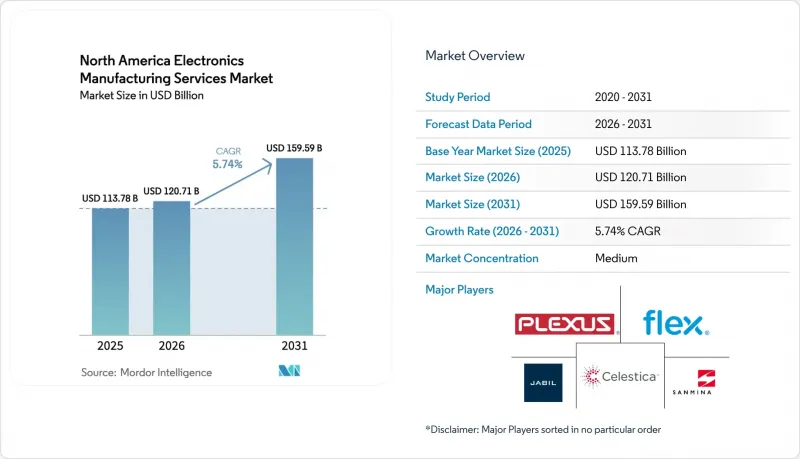
本報告按服務類型(工程服務、物流服務等)、經營模式(契約製造(CM)、原始設計製造 (ODM) 等)、製造流程(表面黏著技術(SMT) 等)、最終用戶(工業、汽車等)和地區進行細分。市場預測以美元計價。
北美電子製造服務市場的趨勢與洞察
《晶片與科學法案》為企業回流提供了強而有力的激勵措施
到2025年底,總計364億美元的津貼將用於40個製造和封裝項目,這引發了一波下游電子組裝投資熱潮。契約製造製造商正在晶圓廠附近建造新的表面黏著技術線,為原始設備製造商(OEM)提供一體化的「晶圓到基板」供應鏈,從而縮短前置作業時間並降低物流風險。捷普公司於2025年中期宣布的位於北卡羅來納州的5億美元專案就是一個典型的例子,該專案將整機組裝能力與先進的封裝節點相結合,以滿足人工智慧和高效能運算的需求。根據「回流計畫」(Reshoring 舉措)的數據,2023年美國宣布新增287,299個製造業職位,其中電氣和電子設備產業位居回流崗位榜首。即使終端市場需求暫時放緩,根據第48D條提供的稅額扣抵也將進一步改善專案的經濟效益,並推動資本投資週期持續到2028年。因此,在政策驅動的產能擴張的主導,北美電子製造服務市場預計將保持優於市場趨勢的成長軌跡。
電動車和ADAS平台對汽車電子產品的需求正在加速成長。
電動車 (EV)動力傳動系統所需的印刷基板(PCB)面積是內燃機汽車的 3 到 5 倍。同時,ADAS 感測器融合模組需要在中小規模生產中快速迭代,這在亞洲地區難以實現成本效益。富士康於 2025 年 6 月發布的「EV.OS」平台表明,即使是亞洲頂尖的專業電子代工服務 (EMS) 供應商也需要北美地區的工廠與當地 OEM 廠商進行合作開發。美國國家公路交通安全管理局 (NHTSA)提案在 2029 年車型時強制所有新型輕型車輛配備自動緊急煞車 (AEB) 系統,這意味著雷達和視覺硬體將被整合到量產車輛中,從而推高墨西哥和美國汽車產業帶的基板需求。諸如電裝 (Denso) 和羅姆 (Rohm) 之間的碳化矽逆變器專案等策略合作增加了設計的複雜性,使得接近性晶片供應商和原型實驗室成為保持競爭力的必要條件。這些因素支持了汽車電子產品銷售額到 2031 年將以 7.54% 的複合年成長率成長的預測。
二級/三級急救醫療服務機構缺乏技術純熟勞工
到2025年,美國製造業工人的平均年齡將達到56.5歲,退休人數超過新人才供給,焊接、檢驗和程式工程等領域將出現就業短缺。一級企業運營經IPC認證的培訓學院,但區域叢集中的小規模工廠無法與汽車組裝的工資水平競爭。北卡羅來納州、德克薩斯州和亞利桑那州社區學院推出的學徒計劃,每個州每年培養的畢業生不足500人,不足以滿足《CHIPS法案》計劃到2028年實施的40個項目。因此,新增產能的擴張速度落後於資本預算預期,導致北美EMS市場實際供應減少,儘管需求強勁,但市場成長卻放緩。
細分市場分析
電子機械組裝和箱體製造的銷售成長最為迅猛,複合年成長率高達 6.72%,這主要得益於國防主承包商和醫療設備製造商 (OEM) 將最終整合外包以節省工程資源。隨著 OEM 將系統級全面測試、法規文件編制和熱設計協同設計等工作委託給值得信賴的合作夥伴,該細分市場在北美 EMS 市場中的佔有率日益成長。印刷基板(PCB)組裝預計到 2025 年將佔市場佔有率的 42.76%,但該市場正步入成熟階段,需求正從通用元件安裝轉向高可靠性的 3 級產品。專注於可製造性設計 (DFM)、失效模式及影響分析 (FMEA) 和元件停產監控的工程服務正在加強供應商關係並增加轉換成本。工業IoT和低地球軌道 (LEO) 衛星硬體中混合訊號元件的日益增多,推動了對自動化測試單元 (ATU) 程式設計的需求成長,從而刺激了原型製作和測試實施業務的發展。捷普收購漢利能源表明,物流和電源供應的專業知識如今已成為領先供應商的差異化優勢。雖然表面黏著技術線仍然普遍存在,但提供三防膠、灌封和環境應力篩檢等服務的系統整合公司在航太和國防領域獲得了更高的價格,這進一步擴大了整機組裝專家的利潤空間。
人工智慧伺服器需求的轉變提升了機殼、冷板和線纜組件等專業技術的重要性,進一步擴大了整機組裝市場佔有率。像Plexus這樣的二線廠商(該公司於2025年11月與Evolv Technology簽訂了合約)表明,快速系統整合正在為大型企業以外的更多企業創造商機。預計2026年至2031年間,北美EMS市場的整機組裝業務規模將達到近400億美元,約佔全部區域市場價值的四分之一。這主要得益於承包訂單訂單了單純的基板級訂單。
預計到2025年,契約製造將維持64.58%的市場佔有率,這反映了工業自動化、通訊和汽車電子領域長期存在的合約關係。然而,隨著原始設備製造商(OEM)要求透過單一發票明確材料採購、設計檢驗和合規文件的責任,混合模式和承包模式預計將以6.81%的複合年成長率成長。在人工智慧伺服器組裝領域,超大規模資料中心業者資料中心營運商會明確效能要求,並將高頻寬記憶體和基板)的採購風險委託給電子製造服務(EMS)合作夥伴,並支付5-8%的溢價以避免意外的分配問題。混合合約在醫療設備的新產品導入(NPI)中也很普遍,OEM與承包商共同擁有模具,而承包商則負責管理FDA審核。原始設計製造(ODM)仍然是北美電子製造服務供應商的利基市場,主要集中在消費性周邊周邊設備和營運商品牌的物聯網節點上,儘管雲端設備供應商擴大採用設計協助服務,以最大限度地減少對其內部硬體團隊的依賴。
捷普位於北卡羅來納州的AI園區就是這個混合模式的典型範例。客戶保留韌體,而捷普則共同投資自動化設備並擁有測試夾具,從而提供代工製造商無法比擬的速度優勢。金寶電子公司揭露,其超過30%的銷售額集中在前三大汽車客戶,顯示傳統的契約製造存在客戶依賴性風險。隨著原始設備製造商(OEM)將供應鏈的穩定性置於邊際成本之上,承包工程合約將在汽車和國防領域變得更加普遍,並在2031年之前重塑收入模式。
其他好處:
- Excel格式的市場預測(ME)表
- 3個月的分析師支持
目錄
第1章:引言
- 研究假設和市場定義
- 調查範圍
第2章:調查方法
第3章執行摘要
第4章 市場狀況
- 市場概覽
- 市場促進因素
- 透過「CHIPS與科學法則」為國內產業回流提供強而有力的激勵
- 電動車和ADAS平台對汽車電子產品的需求不斷成長
- 受監管醫療設備領域對快速新產品導入(NPI)的需求日益成長。
- 擴大人工智慧伺服器和高速運算硬體的生產規模。
- 國防領域強制性的 ITAR 合規要求正在推動國內整車組裝合約的成長。
- 建造需要快速PCB組裝的低地球軌道衛星星系
- 市場限制因素
- 二級和三級急救醫療服務機構缺乏技術純熟勞工
- 亞洲主要契約製造利潤率面臨壓力
- 遵守 PFAS 和 RoHS 法規的成本增加
- 嬰兒潮世代工程師的大規模退休導致各組織流失寶貴的專業技術。
- 宏觀經濟因素對市場的影響
- 產業價值鏈分析
- 監理情勢
- 技術展望
- 波特五力分析
第5章 市場規模與成長預測
- 按服務類型
- 電子製造服務
- 印刷基板(PCB)組裝
- 電子機械組裝/箱體組裝
- 原型製作
- 其他電子製造服務
- 工程服務
- 測試和開發實施服務
- 物流服務
- 其他服務類型
- 電子製造服務
- 按經營模式
- 契約製造(CM)
- 原始設計製造(ODM)
- 混合/承包/其他經營模式
- 透過製造程序
- 表面黏著技術(SMT)
- 通孔技術(THT)
- 先進封裝/混合工藝
- 最終用戶
- 行動裝置(智慧型手機和平板電腦)
- 家用電子產品
- 電腦(桌上型電腦/筆記型電腦)
- 產業
- 車
- 溝通
- 照明
- 醫學領域
- 其他最終用戶
- 按地區
- 北美洲
- 美國
- 加拿大
- 墨西哥
- 北美洲
第6章 競爭情勢
- 市場集中度
- 策略趨勢
- 市佔率分析
- 公司簡介
- Jabil Inc.
- Flex Ltd.
- Celestica Inc.
- Sanmina Corporation
- Plexus Corp.
- Benchmark Electronics, Inc.
- Kimball Electronics, Inc.
- Creation Technologies LP
- SigmaTron International, Inc.
- Nortech Systems Incorporated
- Hon Hai Precision Industry Co., Ltd.
- Pegatron Corporation
- Compal Electronics Inc.
- Quanta Computer Inc.
- Wistron Corporation
- BYD Electronic(International)Company Limited
- Luxshare Precision Industry Co., Ltd.
- Zollner Elektronik AG
- Asteelflash SAS
第7章 市場機會與未來展望
According to Mordor Intelligence, North America electronics manufacturing services market size was valued at USD 197.22 billion in 2025 and is estimated to grow from USD 207.98 billion in 2026 to reach USD 283.91 billion by 2031, at a CAGR of 6.42% during the forecast period (2026-2031).
This report is Segmented by Service Type (Engineering Services, Logistics Services, and More), Business Model (Contract Manufacturing (CM), Original Design Manufacturing (ODM), and More), Manufacturing Process (Surface Mount Technology (SMT), and More), End-User (Industrial, Automotive, and More), and Geography. The Market Forecasts are Provided in Terms of Value (USD).
North America Electronics Manufacturing Services Market Trends and Insights
Robust Reshoring Incentives from the CHIPS and Science Act
Awards totaling USD 36.4 billion across 40 fabrication and packaging projects by late 2025 ignited a downstream wave of electronics assembly investments. Contract manufacturers colocate new surface-mount lines near fabs to offer OEMs integrated wafer-to-board supply chains that shorten lead times and mitigate logistics risk. Jabil's USD 500 million North Carolina project, announced in mid-2025, typifies the strategy of aligning box-build capacity with advanced packaging nodes to capture AI and high-performance computing demand. Reshoring Initiative data showing 287,299 U.S. manufacturing jobs announced in 2023 place electrical equipment and electronics at the top of the repatriation list. Tax credits under Section 48D further improve project economics, driving a sustained capex cycle through 2028 even if end-market demand temporarily softens. Policy-driven capacity additions are therefore expected to keep the North America electronics manufacturing services market on an above-trend growth trajectory.
Accelerating Demand for Automotive Electronics in EV and ADAS Platforms
Electric-vehicle powertrains use three to five times more circuit-board real estate than internal-combustion equivalents, while ADAS sensor-fusion modules require quick-turn iterations at small and mid volumes that Asian sites struggle to support cost-effectively. Foxconn's June 2025 EV.OS platform illustrates that even top Asian electronics manufacturing service providers now need North American hubs for co-development with local OEMs. U.S. National Highway Traffic Safety Administration proposals mandating automatic emergency braking on all new light vehicles by model year 2029 will embed radar and vision hardware into mass-market cars, boosting demand for printed circuit boards across Mexico and the U.S. automotive belts. Strategic collaborations such as DENSO and ROHM's silicon-carbide inverter program intensify design complexity, making proximity to chip suppliers and prototyping labs a competitive necessity. These factors underpin the 7.54% CAGR outlook for automotive electronics revenue through 2031.
Skilled Labor Shortages Across Tier-2/3 EMS Providers
The average U.S. manufacturing worker's age reached 56.5 years in 2025, and retirements outpace incoming talent, making soldering, inspection, and process-engineering roles scarce. Tier-1 firms run their own IPC certification academies, but smaller shops in rural clusters cannot match wage offers from automotive assembly plants. Community-college apprenticeship programs launched in North Carolina, Texas, and Arizona graduate fewer than 500 students per state each year, which is inadequate for the 40 CHIPS Act projects scheduled through 2028. Consequently, new capacity ramps more slowly than capital budgets anticipate, reducing effective supply in the North America EMS market and tempering growth despite healthy demand.
Other drivers and restraints analyzed in the detailed report include:
- Growing Need for Rapid NPI Turn-Around in Regulated Medical Devices
- Expansion of AI-Server and High-Speed Computing Hardware Production
- Margin Pressure from Asian High-Volume Contract Manufacturers
For complete list of drivers and restraints, kindly check the Table Of Contents.
Segment Analysis
Electromechanical assembly and box build generated the fastest revenue growth, rising at a 6.72% CAGR, driven by defense primes and medical-device OEMs outsourcing final integration to save engineering bandwidth. The segment now captures growing portions of the North America EMS market as OEMs delegate full system-level testing, regulatory documentation, and thermal-solution co-design to trusted partners. Printed-circuit-board assembly still accounted for 42.76% of the 2025 value but shows maturity, with demand shifting from commodity placement to high-reliability Class 3 builds. Engineering services focused on design-for-manufacturability, failure-mode-and-effects analysis, and obsolescence monitoring deepen supplier embeddedness and raise switching costs. Prototyping and test implementation businesses flourish as mixed-signal content in industrial IoT and low-earth-orbit (LEO) satellite hardware multiplies the need for automated-test-equipment programming. Jabil's Hanley Energy acquisition illustrates how logistics and power-delivery know-how now differentiate leading providers. Surface-mount lines remain ubiquitous; nonetheless, system-integration shops offering conformal coating, potting, and environmental stress screening capture premium pricing in aerospace and defense, pulling further profit toward box-build specialists.
Demand inflection in AI servers heightens the importance of enclosure, cold-plate, and cable-assembly expertise, further lifting box-build wallet share. Tier-2 players such as Plexus, which won the Evolv Technology contract in November 2025, underscore that quick-turn system integration creates opportunity outside megacaps. Over 2026-2031, the North America EMS market size for box-build work is forecast to approach USD 40 billion, roughly one-quarter of the regional value, as turnkey bookings displace purely board-level awards.
Contract manufacturing maintained a 64.58% share in 2025, reflecting deep legacy agreements in industrial automation, telecom, and automotive electronics. Yet hybrid and turnkey models post a 6.81% CAGR because OEMs want single-invoice accountability for materials procurement, design verification, and compliance paperwork. In AI-server assembly, hyperscalers specify performance envelopes and delegate sourcing risk for high-bandwidth memory and substrates to their electronics manufacturing services partner, paying a 5-8% premium to reduce allocation surprises. Hybrid agreements also dominate new medical-device NPIs, where OEMs co-own tooling but the contractor manages FDA audits. Original design manufacturing remains a niche for North America electronics manufacturing services participants, concentrated in consumer peripherals and carrier-branded IoT nodes, yet cloud appliance vendors increasingly adopt design assistance to minimize reliance on in-house hardware teams.
Jabil's North Carolina AI campus typifies the hybrid model: customers retain firmware, while Jabil co-invests in automation and owns test fixtures, delivering speed advantages that consignment shops cannot match. Kimball Electronics discloses over 30% revenue concentration across its top three auto clients, signaling that traditional contract manufacturing carries customer-dependency risk. As OEMs prioritize supply resilience over marginal cost, turnkey agreements penetrate deeper into automotive and defense, reshaping revenue mix through 2031.
Complete Report Scope:
- By Service Type
- Electronics Manufacturing Services
- PCB Assembly
- Electromechanical Assembly/Box Build
- Prototyping
- Other Electronics Manufacturing Services
- Engineering Services
- Test and Development Implementation Services
- Logistics Services
- Other Service Types
- Electronics Manufacturing Services
- By Business Model
- Contract Manufacturing (CM)
- Original Design Manufacturing (ODM)
- Hybrid / Turnkey / Other Business Models
- By Manufacturing Process
- Surface Mount Technology (SMT)
- Through-Hole Technology (THT)
- Advanced Packaging / Hybrid Processes
- By End-user
- Mobile Devices (Smartphones and Tablets)
- Consumer Electronics
- Computer (PCs/Desktop/Laptops)
- Industrial
- Automotive
- Communication
- Lighting
- Medical
- Other End-users
- By Geography
- North America
- United States
- Canada
- Mexico
- North America
List of Companies Covered in this Report:
- Jabil Inc.
- Flex Ltd.
- Celestica Inc.
- Sanmina Corporation
- Plexus Corp.
- Benchmark Electronics, Inc.
- Kimball Electronics, Inc.
- Creation Technologies LP
- SigmaTron International, Inc.
- Nortech Systems Incorporated
- Hon Hai Precision Industry Co., Ltd.
- Pegatron Corporation
- Compal Electronics Inc.
- Quanta Computer Inc.
- Wistron Corporation
- BYD Electronic (International) Company Limited
- Luxshare Precision Industry Co., Ltd.
- Zollner Elektronik AG
- Asteelflash SAS
Additional Benefits:
- The market estimate (ME) sheet in Excel format
- 3 months of analyst support
TABLE OF CONTENTS
1 INTRODUCTION
- 1.1 Study Assumptions and Market Definition
- 1.2 Scope of the Study
2 RESEARCH METHODOLOGY
3 EXECUTIVE SUMMARY
4 MARKET LANDSCAPE
- 4.1 Market Overview
- 4.2 Market Drivers
- 4.2.1 Robust Reshoring Incentives from the CHIPS and Science Act
- 4.2.2 Accelerating Demand for Automotive Electronics in EV and ADAS Platforms
- 4.2.3 Growing Need for Rapid NPI Turn-Around in Regulated Medical Devices
- 4.2.4 Expansion of AI-Server and High-Speed Computing Hardware Production
- 4.2.5 Defense Mandatory ITAR Compliance Driving On-Shore Box-Build Contracts
- 4.2.6 Low-Earth-Orbit Satellite Constellation Builds Requiring Quick-Turn PCB Assembly
- 4.3 Market Restraints
- 4.3.1 Skilled Labor Shortages Across Tier-2/3 EMS Providers
- 4.3.2 Margin Pressure from Asian High-Volume Contract Manufacturers
- 4.3.3 Accelerating PFAS and RoHS Regulatory Compliance Costs
- 4.3.4 Wave of Baby-Boomer Engineering Retirements Eroding Institutional Know-How
- 4.4 Impact of Macroeconomic Factors on the Market
- 4.5 Industry Value Chain Analysis
- 4.6 Regulatory Landscape
- 4.7 Technological Outlook
- 4.8 Porter's Five Forces Analysis
- 4.8.1 Threat of New Entrants
- 4.8.2 Bargaining Power of Suppliers
- 4.8.3 Bargaining Power of Buyers
- 4.8.4 Threat of Substitutes
- 4.8.5 Intra-Industry Rivalry
5 MARKET SIZE AND GROWTH FORECASTS (VALUE)
- 5.1 By Service Type
- 5.1.1 Electronics Manufacturing Services
- 5.1.1.1 PCB Assembly
- 5.1.1.2 Electromechanical Assembly/Box Build
- 5.1.1.3 Prototyping
- 5.1.1.4 Other Electronics Manufacturing Services
- 5.1.2 Engineering Services
- 5.1.3 Test and Development Implementation Services
- 5.1.4 Logistics Services
- 5.1.5 Other Service Types
- 5.1.1 Electronics Manufacturing Services
- 5.2 By Business Model
- 5.2.1 Contract Manufacturing (CM)
- 5.2.2 Original Design Manufacturing (ODM)
- 5.2.3 Hybrid / Turnkey / Other Business Models
- 5.3 By Manufacturing Process
- 5.3.1 Surface Mount Technology (SMT)
- 5.3.2 Through-Hole Technology (THT)
- 5.3.3 Advanced Packaging / Hybrid Processes
- 5.4 By End-user
- 5.4.1 Mobile Devices (Smartphones and Tablets)
- 5.4.2 Consumer Electronics
- 5.4.3 Computer (PCs/Desktop/Laptops)
- 5.4.4 Industrial
- 5.4.5 Automotive
- 5.4.6 Communication
- 5.4.7 Lighting
- 5.4.8 Medical
- 5.4.9 Other End-users
- 5.5 By Geography
- 5.5.1 North America
- 5.5.1.1 United States
- 5.5.1.2 Canada
- 5.5.1.3 Mexico
- 5.5.1 North America
6 COMPETITIVE LANDSCAPE
- 6.1 Market Concentration
- 6.2 Strategic Moves
- 6.3 Market Share Analysis
- 6.4 Company Profiles (includes Global Level Overview, Market Level Overview, Core Segments, Financials as Available, Strategic Information, Market Rank/Share for Key Companies, Products and Services, and Recent Developments)
- 6.4.1 Jabil Inc.
- 6.4.2 Flex Ltd.
- 6.4.3 Celestica Inc.
- 6.4.4 Sanmina Corporation
- 6.4.5 Plexus Corp.
- 6.4.6 Benchmark Electronics, Inc.
- 6.4.7 Kimball Electronics, Inc.
- 6.4.8 Creation Technologies LP
- 6.4.9 SigmaTron International, Inc.
- 6.4.10 Nortech Systems Incorporated
- 6.4.11 Hon Hai Precision Industry Co., Ltd.
- 6.4.12 Pegatron Corporation
- 6.4.13 Compal Electronics Inc.
- 6.4.14 Quanta Computer Inc.
- 6.4.15 Wistron Corporation
- 6.4.16 BYD Electronic (International) Company Limited
- 6.4.17 Luxshare Precision Industry Co., Ltd.
- 6.4.18 Zollner Elektronik AG
- 6.4.19 Asteelflash SAS
7 MARKET OPPORTUNITIES AND FUTURE OUTLOOK
- 7.1 White-Space and Unmet-Need Assessment

 全球電子製造服務市場規模、佔有率、趨勢和成長分析報告(2026-2034)
 電子製造服務:市場佔有率分析、產業趨勢與統計、成長預測(2026-2031)美國電子製造服務:市場佔有率分析、行業趨勢和統計數據、成長預測(2026-2031 年)
 電子製造服務市場:2026-2032年全球市場預測(依服務類型、技術、組件類型、最終用戶產業及企業規模分類)電子設備電子製造服務:市場佔有率分析、產業趨勢與統計、成長預測(2026-2031)
 專業電子代工服務 (EMS) 市場:按服務、產品類型、經營模式、最終用途、國家和地區分類 - 全球產業分析、市場規模與佔有率及未來預測 (2026-2033)電子製造服務市場:依服務、經營模式、製造流程、最終用戶、國家及地區分類-全球產業分析、市場規模、市場佔有率及2026年至2033年預測
 電子受託製造服務市場預測至2034年-按服務類型、經營模式、製造形式、最終用戶產業和地區分類的全球分析
 全球電訊設備受託製造服務(EMS)市場。
 通訊電子製造服務市場:全球產業規模、佔有率、趨勢、機會和預測(按服務、應用和地區分類)、競爭格局(2021-2031 年)